Category: All About Guns
It usually starts with one of those conversations: If you could only have one gun …
Personally, I really don’t want to live in a world where I’d be restricted to one firearm. However, if you go on an extended trip off the grid in a hunting or survival situation, you probably won’t be able to tote your entire collection of firearms with you.
You can pick out a rifle and handgun for your situation, but you’ll still find gaps between the two. Your rifle may be able to reach out at long ranges and your pistol may be enough to keep you safe from two-legged predators, but will either excel at harvesting game, keeping varmints in check, or providing defense against a four-legged predator?
What if you did have one gun that could do it all, or at least get you close to that goal?
THOMPSON CENTER CONTENDER

Caliber(s)
.223 Remington, .45-70, .410 Shotgun/.45 Colt (other calibers available)
Barrel Length(s)
14 inches (other lengths available)
OAL
17.5 inches (as shown with 14-inch barrels)
Weight (Unloaded)
3.5 pounds (without optics)
Capacity
1
MSRP
Starts at $729
URL
www.tcarms.com
When it first debuted in 1967, the Thompson Center Contender was mostly a curiosity. The barrels were all below 10 inches in length, were octagonal, and represented the lower end of the power spectrum (.22 Jet, .22 LR, .38 Special, etc.). They were accurate, but not particularly useful beyond the firing line at the local outdoor range. By the 1970s, the barrels became round and were offered in rifle calibers such as .223 Remington, .30-30 Winchester, .35 Remington, and .45-70. Magnum. Handgun calibers such as .357 Magnum, .41 Magnum, .44 Magnum, .357 Maximum, and .45 Winchester Magnum followed, and the Contender was reborn as a highly accurate long-distance pistol for metallic silhouette shooting and a suitable hunting arm in either rifle or pistol configuration.

Although they were never intended or marketed as a “bug-out” gun, it’s a role at which they can excel.
Part of the beauty of a Contender is that you can change calibers in a matter of minutes. Remove the forend with a screwdriver, pop out the hinge pin, remove the barrel, install the new one, replace the hinge pin and the forend, and you’re done.
There’s no need to fit, check headspace, or set cylinder gap. Additionally, there’s no need to re-sight the Contender, as the sights or optics are mounted on the barrel. Your zero is always maintained.
Because there’s a 52-year manufacturing period with small changes here and there, some older barrel and frame combinations may require fitting. This has mostly been eliminated with the newest incarnation of the Contender known as the G2 frame, which debuted in 1998. However, even the most accurate barrels and custom frames can still be a bit tight-fitting. The biggest complaint outside of being a single-shot firearm is having to slap the barrel down to get it to break open at times with the older models. The older models do have a better trigger than the G2, however.
Rifle length barrels and a buttstock can be attached to the Contender to give the shooter a single shot rifle. We will not delve into this here, as it doesn’t fit the nature of keeping a battery of several calibers in a small package, but the option is there.

The Thompson Center Contender breaks open like an old-school single-shot shotgun.
My personal favorite combination for the Contender as a bug-out handgun is the following three 14-inch barrels: .45-70 Government, .223 Remington, and .410/.45 Colt.
Each one covers a potential need in most survival scenarios, particularly if you’re looking to hunt your own game. Most importantly, Thompson Center Arms still makes these three barrels for the G2 series.
.45-70 GOVERNMENT
When most people think of the .45-70 round, either single-shot rolling block or falling block rifles come to mind, or possibly a 19th-century lever-action carbine.
The .45-70 barrel represents the upper threshold of power for the Contender in a currently produced factory barrel. It’s capable of taking any animal in North America, from feral hogs and whitetail deer to brown bear, elk, moose, or buffalo.
Because of its power level, many shooters are put off by this caliber in a 14-inch-barreled pistol. When I bought my first Contender barrel in this caliber, the salesman at the counter called me “a f***ing nut” and said he saw someone fire it and break every bone in his hand. Like most gun shop sages, I ignored him and found the recoil somewhere between a .44 Magnum and .454 Casull.
I won’t lie; the pistol has quite a bit of kick to it. The high bore axis and the recoil from the large, heavy slow bullet push the Contender back sharply into your hand. My barrel has the factory muzzle brake installed and is topped with a Leupold extended eye relief 2x scope.
As with most Contender barrels of this length, accuracy is outstanding.

Above: The versatile Contender from top to bottom — 45-70 with 2x Leupold scope; stainless 410/45 Colt with ventilated rib and brass bead; .223 with threaded barrel and rail; wood forend and grip on a blued frame.
.223 REMINGTON
This has always been one of the most popular choices for the Contender pistol. It’s an outstanding varmint round, and if you stick to the 14-inch-barreled version, your velocity, accuracy, and power levels will be on par with what you’d get from an AR rifle with similar-length barrel.
I’ve had my barrel for many years and used it on various frames with no problems. My barrel is threaded ½x28-inch and serves well for silencer testing. If you run suppressors, the Contender makes for one of the quietest hosts out there, because it’s a completely closed action for the entire duration of the firing sequence.
Most often, I mount a red-dot sight on the rail. My barrel started life in a factory blue finish that rapidly deteriorated in service as a field gun for over 20 years. Today, it’s coated in a black Cerakote finish by Nevada Cerakote. My next stage in the world of Contenders is to have all my non-stainless barrels coated the same way.

The Contender tool, used to remove the forend, hinge pin, and barrel.
.45 COLT/.410 SHOTGUN
The .45 Colt/.410 barrel for the Contender is a bit controversial, like most firearms that fire this cartridge combination. This is because a sub-16-inch barrel needs rifling or else it’s considered an NFA item, requiring a $200 tax stamp. That rifling doesn’t help the .410 shot pattern at all. Likewise, the 3-inch chamber for the shotgun shell means the .45 Colt bullet has a significant jump in the chamber before it makes contact with the lands and grooves in the barrel. As a result, the accuracy of the .45 Colt will suffer in the Contender. This is a shame, because you can really bump up the power level of the .45 Colt in this pistol to outshine the .44 Magnum.
Still, with the factory choke and the right ammunition, the .410 shotgun round in a Contender is more than adequate for rabbit, grouse, quail, pheasant, and dove within 50 yards. It’s a good option if you find yourself in a situation where you need to forage for small game and neglected to bring a full-size shotgun.
This barrel is legal in every state except California, where a sub-18-inch barrel on any firearm capable of discharging a shotgun shell makes it a short-barreled shotgun under state law.

Above: A well-used 44 Magnum barrel, synthetic forend, and Pachmayr rubber grip can be practical accessories to have on hand.
OTHER OPTIONS
I have other barrels in various calibers, as a lifetime of shooting and hand-loading has gotten the better of me. All the Magnum handgun calibers work extremely well in a Contender. Another surprisingly good round is the old .30-30 Winchester. In the Contender, you can really tap into the accuracy inherent in this round by loading conical, pointed bullets instead of the old round-nosed ammunition designed for use in lever-action rifles.
Ironically, the .300 Whisper designed by JD Jones was not only intended for use in the AR, but in the Contender as well. This round is known today as the .300 Blackout and some folks might prefer this to the .223 or .30-30 chamberings.
Additionally, you can find sub-caliber chamber inserts that’ll allow you to fire .22 LR or .22 Magnum out of your .223 Remington barrels, for example. These inserts are cheap, and although they don’t provide the accuracy of a dedicated barrel in that caliber, they can be fun to play around with.
The .22 long rifle Contender barrels are among the most accurate you can find this side of a European Free-Pistol. I left them out as part of the bug-out barrel battery because I find a dedicated .22 semiauto or revolver more useful for the same amount of weight as the Contender barrel.

HANDLOADING
While the three barrels I specified were chosen because they fill certain needs, another factor was that there’s an abundance of off-the-shelf ammunition choices for those barrels. The real magic of the Contender platform is that you can tailor your handloads to your individual barrel to increase performance.
If you’re not already reloading ammunition, the Contender will easily get you into it as well as turn you into an accuracy nut!
MORE POWER
Thompson Center Arms offers another option if you find these choices lacking, although all three are available in this platform as well in 15-inch instead of 14-inch barrels. It’s called the Encore and was designed to allow the shooter to fire rounds such as .308 Winchester, .30-06, .460 Smith & Wesson, and in the long-gun configuration, shotgun and muzzle-loading options. Barrels don’t interchange between Contenders and Encores, but a battery of potent hunting guns can be built from a single frame.
SHOOTING THE CONTENDER

My way of shooting the Contender is with a standard two-hand grip that you’d use on any large revolver. I’ve mounted bipods on them, shot them across the hood of my truck, or from a rest built into an ATV. I’ve even laid on my back in the Creedmoor position with the side of the forend braced on the top of my boot for long range with open sights.
Some people cradle the forend in their non-shooting hand, and for a flicker in time there were companies making extremely tall scope mounts to allow the shooter to fire from the mid chest area and the ability to get closer eye relief from a more powerful scope. Those particular mounts are no longer made for good reason.
Ignore the forend — it’s there to look nice and protect the hinge pin. You don’t and probably shouldn’t use it for shooting unless you installed a stud to mount a bipod or are using a rest of some sort.
PRICING
The Contender used to be a more affordable firearm in the $400 price range, and the average price of a barrel would run from $50 to $199 with used ones at the lower end of this spectrum. The current MSRP on a new G2 Contender pistol frame runs from $523 for walnut furniture and blue finish to $548 for stainless and synthetic. New pistol barrels are about $229 each. A complete handgun in one caliber starts at $729 from the factory.
IN SUMMARY
I wouldn’t recommend a Contender as an “only gun,” although some old-school preppers have used one successfully as such. I think they have a place as a hunting and varmint gun, especially when keeping your loadout on the lighter side. The single-barrel lockup and single-action trigger make them accurate and very reliable. Their size and weight make them easily portable, whether you add sling swivels to the grip and forend or keep them in a holster of some type on the hip or across the chest. Other firearms may come and go from my collection, but I’ll always make room for a Contender (or two).




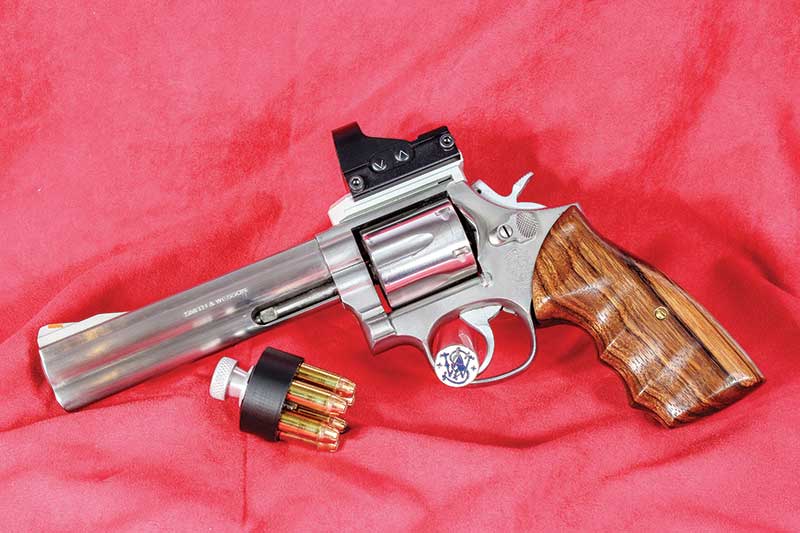
Smith & Wesson’s Model 686 with 6″ barrel is fitted with an UltraDot
L/T optic on Weigand Machine and Design’s mini-mount.
In 1981 a real workhorse galloped out of the Smith and Wesson stable in the form of the company’s model 686 — a stainless version of their model 586. Here we are almost 40 years later and the Model 686 is still going strong.
Based on S&W’s well-engineered L-Frame revolver, the 686 was designed for a steady diet of .357 Magnum ammo. When the 686 first hit the radar screen, it was a bit difficult to get your hands on one as many law enforcement agencies were adopting it as a service revolver. Before the world became emotionally attached to high capacity semi-autos, the 686 quickly procured a strong following. The 4″ 686 was commonly seen resting in the holster of on-duty officers — and the rest of us mere mortals were just trying to find one for sale.
Through the years, the burgeoning 686 became available in these barrel lengths: 2 1/2″, 3″, 4″, 5″, 6″, and 8 3/8″. Other barrel lengths and modifications could be found on exclusive offerings or by special order. Due to the overwhelming popularity of the 686, a multitude of variants occurred including the Classic Hunter, Black Stainless, Target Champion, Model 686 Plus, featuring a 7-shot cylinder. Regardless whether you were in law enforcement, competitive shooting, recreational plinking or a hunter, the 686 was a reliable revolver you could depend on.
Fixing It Up
I took the 686 to the range recently and felt bad it had been neglected. Unfortunately, it didn’t take long to discover my aging eyes and iron sights don’t play well together. When I went to install a mount for optics, I realized the early models were not drilled the same as the newer versions so I sent the gun to Mag-na-port. Ken Kelly worked his magic — along with a nice action job — and now this revolver is a dream come true to shoot. Thanks to Weigand Machine and Design, a neat little compact base was installed for an UltraDot L/T reflex optic.
Just about any company who makes grips will offer one or more options for an L-Frame Smith & Wesson. Preferring finger-grooves, I chose Eagle Grips with their genuine rosewood combat grips. These grips are super comfortable and attractive to boot.
After some modifications, this 686 really shines at the range and I can see the targets better thanks to the UltraDot. Karen, my wife of 40 years, also enjoys shooting this revolver so I started looking for another 686 to add to the stable.
Fortunately, I was able to pick up an 8-3/8″ model. It too was an older gun and had to be sent to Mag-na-port for their alterations to install a Weigand base. This model was a 686 “no dash,” which means it was in the first production run. If a 686 has a number proceeding, it denotes engineering modifications during the production life of the particular model.
The 686-1 implies the redesigned “radius-stud/floating hand” change occurring in 1986 which many people consider less desirable. The 686-2 (1987) S&W changed the hammer nose. The 6″ version I have is a 686-3. This model began regular production in 1988 and signifies a new yoke retention system. The 686-6, manufactured in 2001, has the internal key lock was incorporated. In 1996, S&W introduced a 7-shot cylinder with a round-butt frame and Hogue grips, while deleting the square butt.
After Mag-na-port drilled the top-strap for the Weigand base, I mounted a Leupold 4x scope. Options for grips are almost endless but I finally landed a beautiful set of Claro walnut combat grips from Culina Grips.
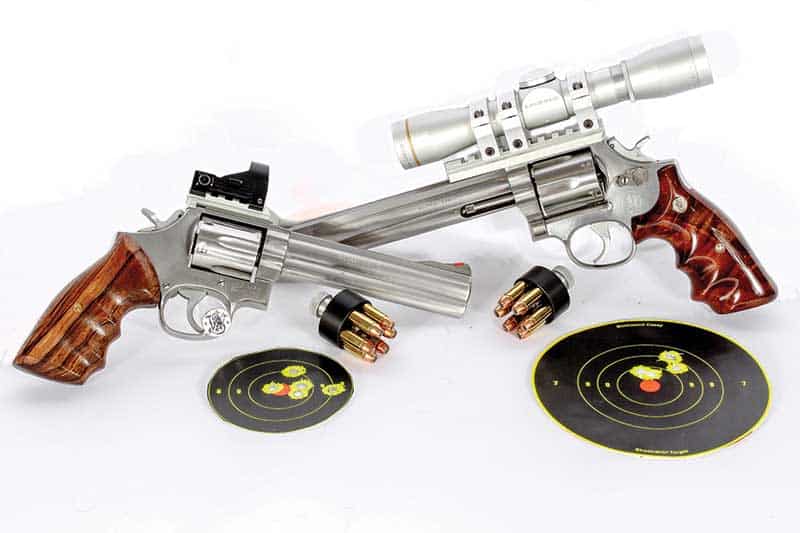
Whether you’re a handgun hunter, target shooter, or like banging steel targets, the 686 is accurate.
Versatility Defined
One of the many attributes of the .357 Magnum is versatility. In my younger years when I was 10-foot-tall and damn near bullet-proof, I shot .44 Magnums for most revolver pursuits. Now, I’ve reached the point in life where I find pleasure in less recoil so Karen and I have been shooting a lot of 38 Specials. Both of these guns are extremely pleasant to shoot. When you want to up your game, there is a plethora of .357 Magnum ammo available.
There are so many options when it comes to bullets for .38 caliber. I’ve been loading Nosler, Hornady, and Sierra 158-gr. bullets for the most part. Cast bullets abound too. Powder choices are also widespread and I generally use Longshot, Unique, 2400, and 231 for plinking loads. H 110 gets the call for magnum rounds. You can tailor your loads for any application from small game hunting, competition shooting, banging steel targets, or handgun hunting.
There are hordes of holsters available for the 686 depending on barrel length and carrying preference. Since I’m packing the longer barrels in the field, I lean toward Simply Rugged, Barranti Leather, Pistol Packaging, or Diamond D Custom Leather rigs.
My next purchase will be a 686 Plus with a 3″ barrel, a seven-shot model. Karen has a slight aversion for semi-autos as she has issues with racking the slide. The shorty 686 will be an ideal home protection piece for either of us.
What The Future Holds
For the moment, I’m having too much enjoyment shooting the two models with 6 and 8-3/8″ barrels — both being very accurate. On our farm, Karen and I have a few deer blinds situated in the woods where shots seldom range beyond 75 yards. This fall I plan on taking one of the revolvers to the woods and hope to fill our freezer with venison.
If a hog hunt happens to hit the radar screen, I won’t hesitate to use Swift ammo and their 180-gr. A-Frame bullet. Many years ago, I watched my good friend JD Jones drop a big hog over 200 lbs. with his 686- and 180-gr. bullets. The shot was well-placed and the big, mean hog dropped quickly. There are better hunting rounds such as the .41 and .44 Magnums but the smaller Magnum will work with proper shot placement and the right bullet.
I won’t be here 50 years from now but I’m willing to bet the Smith & Wesson Model 686 will be. It will go down in the history books as a classic revolver. Long live the 686!
Categories
Rossi M68 review
Categories