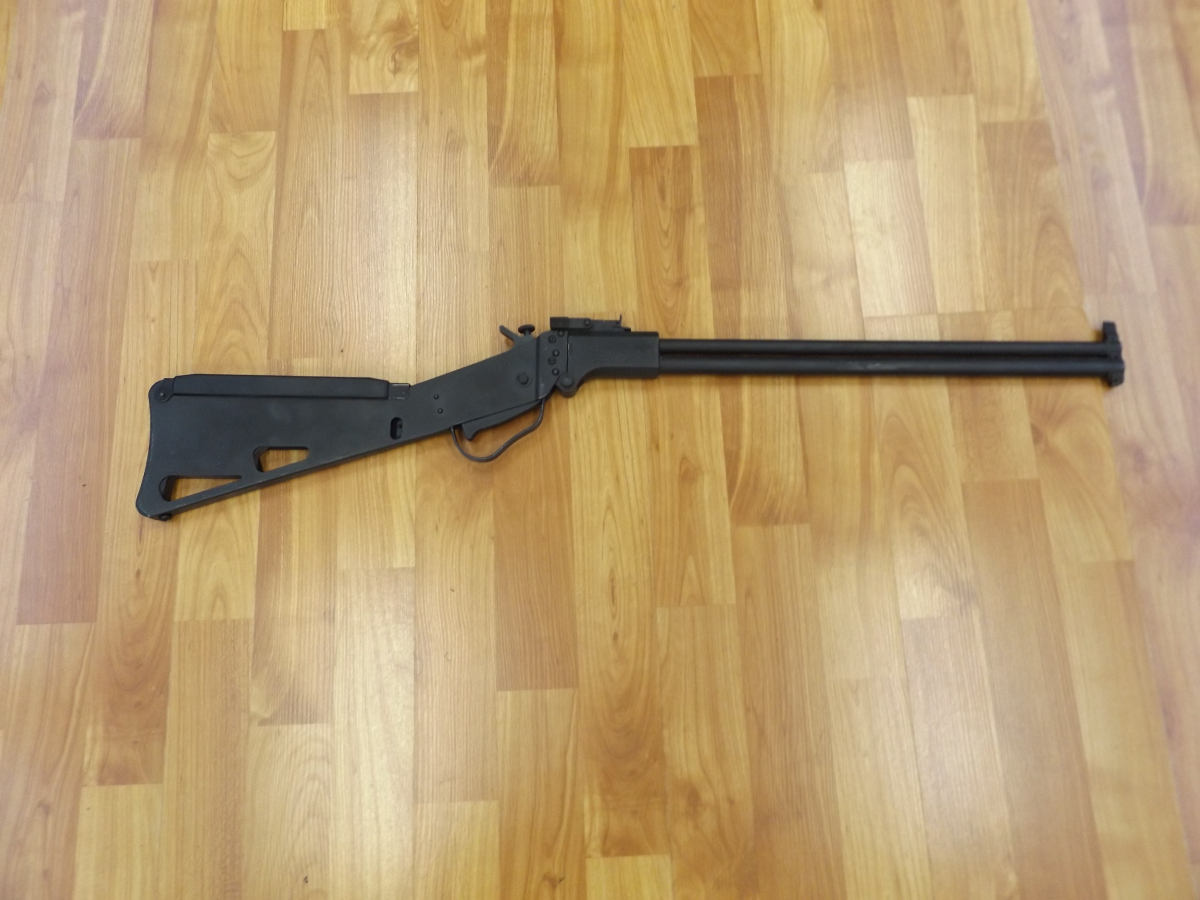
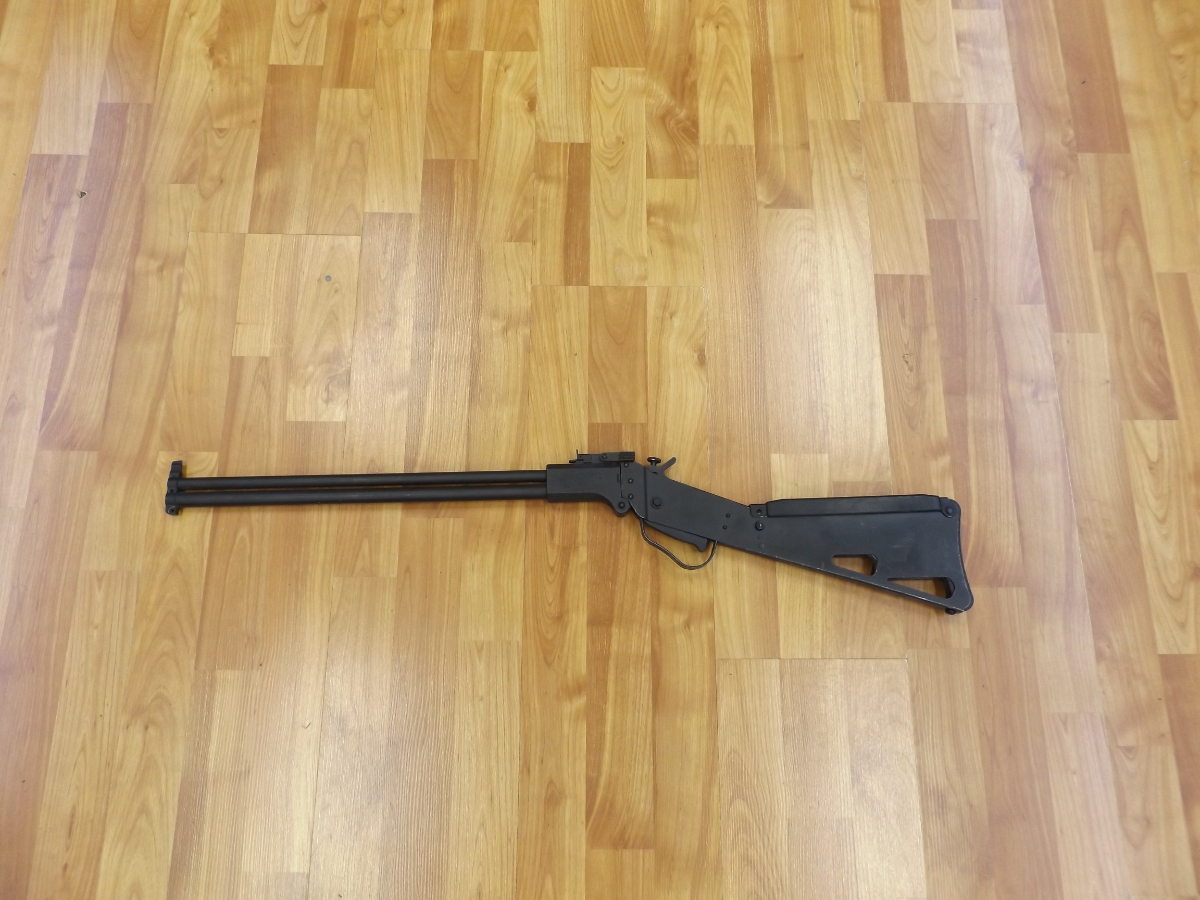

The Ruger Mini 14 is a rifle that we sometimes love to hate. Not especially known for its accuracy or endurance, it’s easy to bash on with all the hindsight afforded by the 21st century. The original design dates back to 1973 and was a scaled-down version of the larger M14 service rifle (hence the name) chambered in 5.56x45mm.
It features a self-cleaning, short-stroke gas system similar to the M1 Garand rifle. A product of its time, it featured wood furniture, no provision for optics, and none of the modularity we’ve come to expect as industry standard on newer rifle designs. But for what we believe it was meant to be — a handy, light-recoiling, ranch-rifle alternative to the AR — it delivers in spades as a no-frills, meat-and-potatoes carbine.
The rifle’s biggest claim to fame came along in the mid 1980s, with the arrival of a now-iconic team of do-gooder guns-for-hire: The A-Team. According to the Internet Movie Firearms Database, the Ruger Mini 14 first appeared in Season 2 but became a favored rifle for the team, with a number of the rifles being purchased specifically for the show and maintained in permanent storage in the show’s prop containers for the duration of its TV lifespan.
This program, more than any other Hollywood venture, made those side-folders famous if only for a moment in pop-culture history. Though Hannibal, Face, Murdock, and B.A. Baracus are meme references now, an entire generation of ’80s kids still recognize the quick rifle with the awkward folding stock that’s vaguely reminiscent of a walking crutch hinged to the back of a baseball bat.
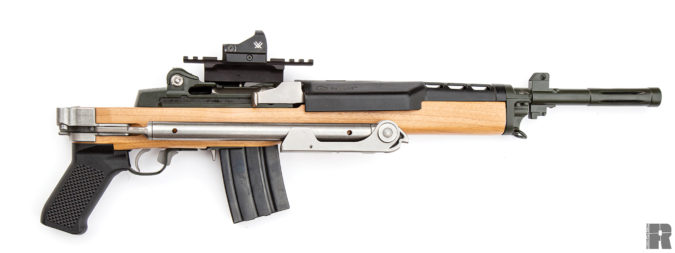
While the current mainstream of gun culture is apt to dismiss the Mini’s Norman Rockwell aesthetics for darker and sleeker alternatives, the firearms aftermarket hasn’t forgotten Ruger’s stalwart little carbine. Not even two years ago, Samson Manufacturing announced the launch of their “A-TM” stock, a side-folder furniture set patterned directly off Ruger’s original design made famous on network television. In real life, that stock was offered on their civilian-legal “tactical” models, as well as on the Ruger Mini 14 “GB” and select-fire AC-556 variants offered to military, law enforcement, and private security agencies.
This led us to the crux of this article: since the 50-year-old design lacks inherent modularity, what can you do with it? As to why this particular question fell into the lap of this particular author … perhaps it was because he happened to have an old Mini in the back of the family safe at home … but sharing Hannibal Smith’s signature hair color and affinity for cigars are uncanny coincidences to say the least.
The base gun for this project was an old, literally rusted-out Ruger Mini 14 GB purchased in the early ’90s. The GB stands for “Government Barrel” and said barrel featured both a bayonet lug and extended flash hider. Originally, these models were only available through Ruger’s Law Enforcement catalog despite being semi-auto only. Regardless, a slew of them did, in fact, make it to the commercial market. Ours sported the standard “semi-pistol” grip sporting stock. We purchased it topped with a scope older than most of our staff, and no other accessories.
But after years of neglect and several cross-country moves, she looked pretty rough. So not only would our effort include some functional upgrades, but we’d also have to undo some of the unkindness of time.
Since there isn’t necessarily anything much you can do with the Ruger Mini 14 trigger or action, and because we had some surface corrosion issues to deal with, we took our rifle to the now-defunct Robar custom shop in Arizona. Known for their [arguably] performance-enhancing finishes and coatings, we wanted something that would at least smooth out the trigger and action, if not improve it mechanically. So we chose a dual-finish approach consisting of self-lubricating NP3 on the action and all internals, and their drab green Poly T2 finish for the barrel and external parts.
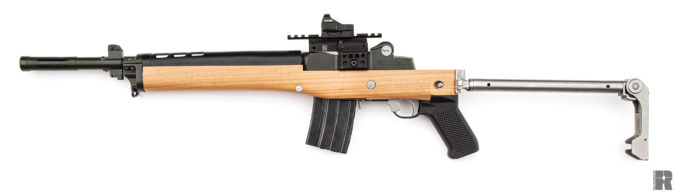
Speaking of the barrel, we previously mentioned this base gun was the somewhat obscure GB model of Ruger Mini 14 with a one-piece bayo lug/flash hider unit at the end of the 16-inch barrel. That unit is 5.5 inches long, so we were able to create what we’ve affectionately come to call the Mini-14K by chopping the barrel down to sit flush with the end of the forearm, about 11 inches, and then pin-and-welding the flash hider.
This kept us over the Form 1 minimum of 16 inches while giving us a much more nimble package, especially when dropped into the aforementioned A-TM stock from Samson Manufacturing. The Samson redux features a walnut forend, stainless steel stock, and folding mechanism in bead-blasted finish with a length-of-pull of 13.5 inches. When extended, the stock tube and folding butt plate both lock up securely with very little wiggle.
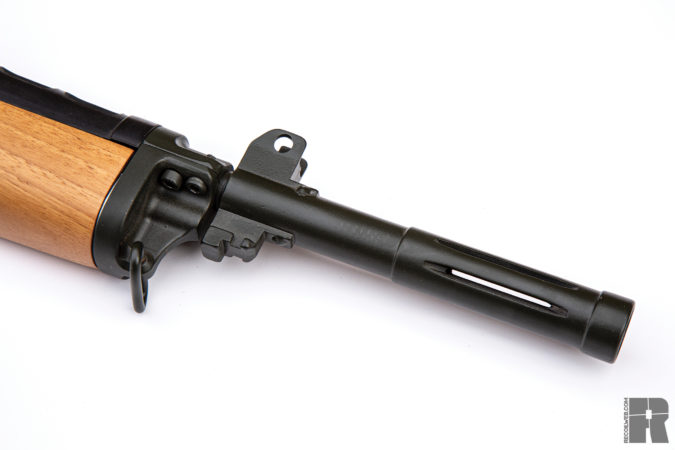
The good news is that the Samson Manufacturing stock is essentially a carbon copy of the 1980s Ruger design: awesome for period purists and A-Team LARPers. The bad news is that the Samson Manufacturing stock is essentially a carbon copy of the 1980s Ruger design, so there are no provisions for modern sling-attachment options. You could overcome this by mounting QD sockets, sling swivels, or short Pic rails directly to the forearm with wood screws.
Frankly, we didn’t have the heart to drill into the walnut without a backup stock unit on hand. But if you were dead set on using this rifle as a legitimate hiking or ranch defense rifle, we suggest taking a deep breath and proceeding with caution. Likewise, if you were to consider creating a light mount in the same fashion.
Alternately, there are a couple of companies still producing bolt-on scout rails, which replace the OEM plastic top-half handguard. These would offer at least enough rail-estate to mount an offset white light, if not a forward sling loop. We simply chose not to go down that rabbit hole on this build. What we did do was mount more suitable optic on board. Since we had no interest in holding onto the antiquated scope, especially after the barrel chop, we attached a short Picatinny rail mount from GG&G and seated the diminutive Vortex Viper on top. Less bulk up top combined with faster, and thus more enjoyable plinking made a small open-window dot like the Viper a natural choice for this fun-gun project.
With our short-but-sweet list of modifications complete, we took our newly minted Mini-14K to the range. We ran a variety of ammo through it ranging from Black Hills 77-grain OTM to some ’90s vintage steel cased import “sport ammo.” The rifle ran all ammo without a hiccup, including the steel-case. Pin-and-welding the elongated flash hider definitely increased maneuverability, with our modified sample gun handling more like an SBR than a full-length rifle.
The NP3’d trigger parts gave us a smooth, crisp bang switch that tripped our trigger gauge at 4 pounds, 2 ounces. Aimed fire produced about 2 to 2.5 MOA accuracy at 50 yards, which is about what you can expect from any Ruger Mini 14 throughout its production history. Of course, any group measurements go out the window when you embrace your inner TV action hero, fold the stock, and hip-fire as much as your ammo budget will allow. Once we finished, our K-conversion with stock folded fit well under the driver’s seat, stuffed between seat and console, and in a duffel bag.
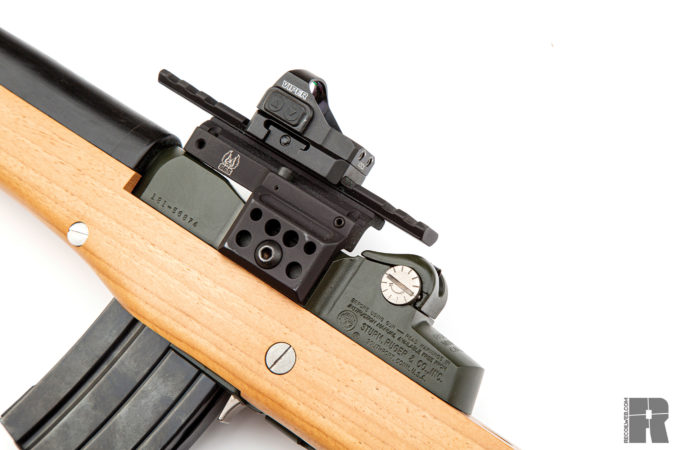
At the risk of being anticlimactic, that was pretty much the end of the road for us on this project. There are aftermarket improvements for the Ruger Mini 14. Just not a lot of them. But we were able to improve the looks, function, concealability, and sighting options. That’s a substantial turnaround for the malnourished rust magnet we found in the back of the safe.
The Ruger Mini 14 has largely been overshadowed even for ranch and truck duty by newer, flashier carbines. To Ruger’s credit, they do have some limited factory offerings with scout rails, polymer furniture, and even a .300 Blackout option — not to mention the Mini-30 in 7.62×39, which has also been around for decades.
While the AR has rightly earned its crown as “America’s Rifle,” the Ruger Mini 14 is still a rock-solid choice for a general-purpose, meat-and-potatoes carbine, and its cult classic pop-culture appeal isn’t to be overlooked. So to those who turn their nose up at this classic American carbine … well … we pity the fools.
[Photography By Nicole Elizabeth.]
Sturm, Ruger & Co. : www.ruger.com
Samson Manufacturing: www.samson-mfg.com
GG&G: www.gggaz.com
Vortex Optics: www.vortexoptics.com