Category: All About Guns

Hallelujah! The legacy media has finally started covering ATF’s unconstitutional war on the country’s gun dealers, which the pro-gun media has been denouncing and warning the public about for more than two years.
The Wall Street Journal published a story Friday morning titled: “Hundreds of Gun Dealers Lose Licenses Under Biden Administration Crackdown.” Nine hours later, FOX News posted their take of the WSJ story titled: “Gun industry cries foul after hundreds of gun dealers lose licenses amid Biden administration crackdown.”
This friends, could be a very good thing.
The more scrutiny the ATF receives, the more difficult it will be for them to continue violating our constitutional rights. But remember that ATF officials are masters of hoodwinking and gaslighting the media and the public. Their responses to the WSJ and FOX show that ATF’s leadership are up to their old tricks. Clearly, they’re trying to downplay the significance of what they’ve already done, and what they continue to do every single day.
Everchanging Rules
In an emailed statement to Fox News, ATF said it is merely following the law:
“Federal Firearms Licensees are often our first line of defense against gun crime and are often a source of critical enforcement information that helps law enforcement identify straw purchasers and disrupt firearms trafficking schemes,” ATF Spokesperson Kristina Mastropasqua said. “FFLs that willfully (emphasis mine) violate the law, however, must be held accountable. ATF conducts inspections to ensure compliance with applicable local, state, and federal laws and regulations and to educate licensees on the specific requirements of those laws and regulations.”
For those familiar with Joe Biden’s weaponized ATF, the word “willfully” should jump off the page.
In a story published in May 2020, one expert warned that the ATF had redefined “willful” to bolster Biden’s zero-tolerance for willful violations policy. Now, because of the new definition, if a dealer makes a simple clerical error, they can lose their license because the new definition of willful states that the dealer knew the law, but willfully chose to violate it anyway – regardless of whether it was a simple oversight, an error by an employee or a minor paperwork mistake.
“They have twisted negligence into willful,” the ATF expert said. “These are not uncommon errors that we’re seeing. Things happen.”
Revoked vs. Surrendered
Both FOX and the WSJ cited ATF revocation data that claimed there were 122 Federal Firearm License revocations during the last fiscal year, which began in October.
First, I need to point out that ATF data – any ATF data – is immediately suspect. I’d rather rely on an 8mm Type 94 Nambu for home defense than any numbers ATF publishes. There is no doubt that far more then 122 FFLs were revoked, but this is not the point.
After a series of embarrassing losses during their own revocation hearings, ATF switched up some of its tactics. Now, in addition to formal revocation proceedings, ATF agents try to scare the hell out of a gun dealer they’ve targeted, hoping they will “voluntarily” surrender their license and avoid hearings and reams of paperwork.
This tactic worked when ATF sent a SWAT team to the home of a gun dealer in rural Oklahoma and handcuffed him in front of his 13-year-old son, but it failed when they threatened a longtime gun dealer in Texas with unspecified federal charges, who instead opted to take them to court.
An FFL is an FFL to the ATF. It doesn’t matter how they get their hands on them, but any truthful data should also include the number of FFLs that were “voluntarily” surrendered.
ATF-Speak
When covering anything ATF, particular attention needs to be paid to their legalese. Often, when ATF claims a gun dealer broke the law, it’s not really a law. It’s actually a rule the ATF came up with themselves. More than a few courts have chastised the agency for trying to be judge, jury and executioner. They’ve violated real laws by creating and enforcing their own rules, which carry the full weight of a federal law, such as fines and lengthy prison terms.
ATF still can’t grasp that Congress creates laws, not the administration or any federal law enforcement agency. They’re headed for a spanking from the Supreme Court that will be legendary in its scope.
Written Statements
When a public official or the agency they represent have nothing to hide, they take questions. They submit to interviews. They give out their cellphone numbers. They make themselves available to the media and the public. After all, they work for us, or at least they’re supposed to.
Nowadays, ATF leadership is hiding deep in a bunker. They don’t respond to emails, phone calls or ever FOIA requests. When pressed hard, they’ll sometimes send a written statement, but only after it’s been approved by teams of lawyers and communications staffers.
This alone speaks volumes about the ATF. It says they don’t believe in accountability to the public, which pays their salaries. It also screams that they have a lot to hide – far more than what’s already been uncovered.
I hope the legacy media’s interest in ATF’s shenanigans continues – the more, the merrier. Besides, ATF has become bloated with lies and is long overdue for a massive investigative enema.
This story is presented by the Second Amendment Foundation’s Investigative Journalism Project and wouldn’t be possible without you. Please click here to make a tax-deductible donation to support more pro-gun stories like this.
About Lee Williams
Lee Williams, who is also known as “The Gun Writer,” is the chief editor of the Second Amendment Foundation’s Investigative Journalism Project. Until recently, he was also an editor for a daily newspaper in Florida. Before becoming an editor, Lee was an investigative reporter at newspapers in three states and a U.S. Territory. Before becoming a journalist, he worked as a police officer. Before becoming a cop, Lee served in the Army. He’s earned more than a dozen national journalism awards as a reporter, and three medals of valor as a cop. Lee is an avid tactical shoote
Categories
WINCHESTER MODEL 1911
Categories
Volcanic Pistols & Carbines
.jpeg)
/cloudfront-us-east-1.images.arcpublishing.com/gray/ELN7I5QUNFGMFFQXDEYTTFZZLQ.png)
A 54-year-old woman living just outside of Tucson, Arizona didn’t really want to have to shoot a neighbor to tried to force entry to her residence, but the man didn’t give her many options. Living by herself, she didn’t have anyone else to help her repel the would-be intruder. She did have a handgun, though, and he availed herself to the great equalizer.
The would-be intruder, a 42-year-old registered sex offender named Jayson Magrum, apparently didn’t care that she’d gotten her gun and told him to stop. Maybe he didn’t think she’d use it. She even fired a warning shot as he tried to crawl in through a window. Even after the shot, Magrum reached in and tried to disarm the woman.
That’s when she shot him. At point-blank range, the pistol proved itself as a great equalizer, ending the attack. The sex offender collapsed after a few more steps and will re-offend no more.
KOLD/Gray News has the story . . .
A convicted sex offender was shot and killed by a woman while trying to break into her Arizona home last week, officials said.
The Pima County Sheriff’s Department said 42-year-old Jayson Magrum died in the Aug. 11 shooting at the home in Three Points, just outside of Tucson.
According to the sheriff’s department, Magrum was trying to break into a woman’s home. She told him to leave, but he did not stop.
Officials said the woman then grabbed a gun and fired a warning shot. Magrum then tried to disarm her, and he was shot and killed.
Fox10 Phoenix had some additional details:
The incident happened just after 2 p.m. on Aug. 11 near Garvey and Pyle Roads. Investigators say 42-year-old Jayson Magrum tried to break into a 54-year-old woman’s home. The woman was home alone and yelled at Magrum to leave, but he allegedly continued to try and break into the home.
“The female armed herself with a handgun and fired a shot out of a window to attempt to scare the male away,” the sheriff’s department said.
Magrum allegedly reached inside the home and tried to take away the gun. The woman then opened fire, shooting Magrum.
Magrum collapsed in the driveway and died at the scene
Once again, a successful defensive gun uses brought to you by the Founders and the right to keep and bear arms. The only thing that stops bad people with evil in their heart is a good guy or good gal with a gun. That is all.
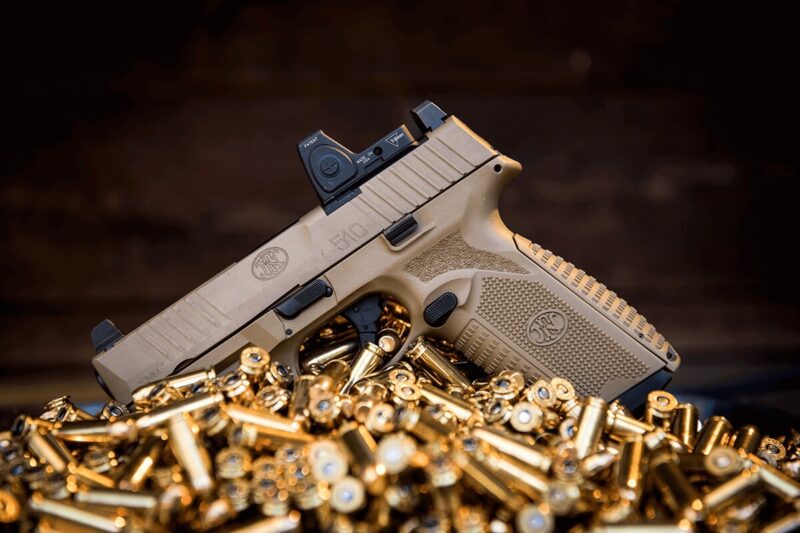
FN America has announced the release of the striker-fired FN 510 MRD and 545 MRD optics-ready big bore pistols.
With dimensions just slightly larger than an FN 509, these two big bore pistols are ideal for users who want to carry with a lot more stopping power.
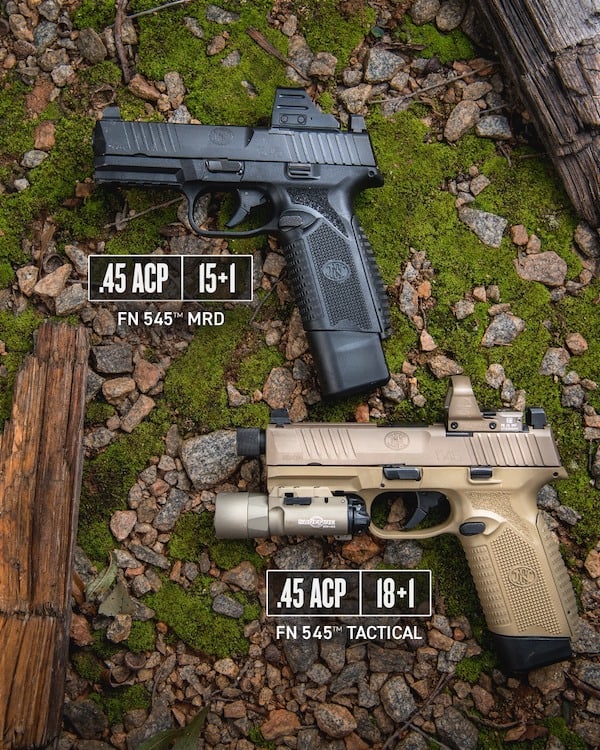
The pistols feature 15+1 rounds of 10mm or .45ACP at the ready, a target-grade 6-pound trigger pull with crisp break, and the company’s patented optics mount that enables enhanced accuracy, making them the perfect tool for personal and home defense.
In response to customer feedback on the FN 510 and 545 Tactical, the FN 510 and 545 MRD feature a flush-fit, 4.1-inch barrel housed within a machined steel slide with front and rear cocking serrations for ease of manipulation. The barrels are cold hammer-forged with a recessed target crown to extend accuracy and a polished feed ramp to ensure reliable feeding of the majority of commercially available loads in both 10mm and .45ACP.
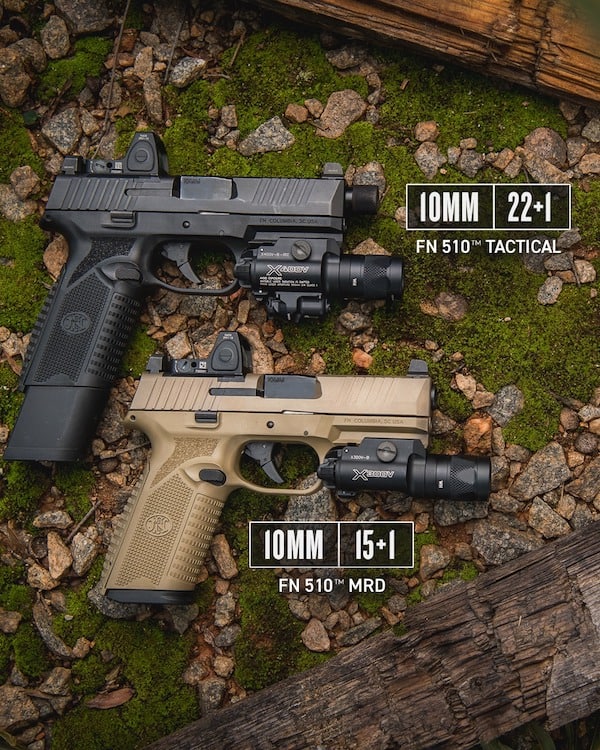
The MRD slide is equipped with FN’s patented Low-Profile Optics-Mounting System that accepts all major optics footprints and enables consumers to direct-mount nearly any optic in minutes with the included hardware while a set of fully adjustable blacked-out iron sights co-witness with most optics and are to provide a clear sight picture, allowing the user the focus on the red dot of the optic.
The ergonomics and contouring of the 15-round grip frame deliver balance to the slide. The included backstraps can be installed to adjust the fit in the user’s hand to deliver a natural point of aim and dampen felt recoil, especially in 10mm. This is coupled with three distinct grip textures that all play a role in anchoring the pistol to the hand.
SPECS
• Chambered in 10mm Auto or .45 ACP
• 4.1-inch flush-fit cold hammer-forged barrel for states that restrict threaded barrels; compatible with FN 510 or 545 Tactical barrels
• 15-round standard capacity with option for 10-round capacity for restricted states; compatible with FN 510 and 545 Tactical extended magazines
• FN Low-Profile Optics-Mounting System with co-witness, blacked-out iron sights
• Target-grade trigger with approximately 6-pound break
• Ambidextrous controls
• MSRP: $919
For full specs on the FN 510 MRD and 545 MRD, visit FNAmerica.com.