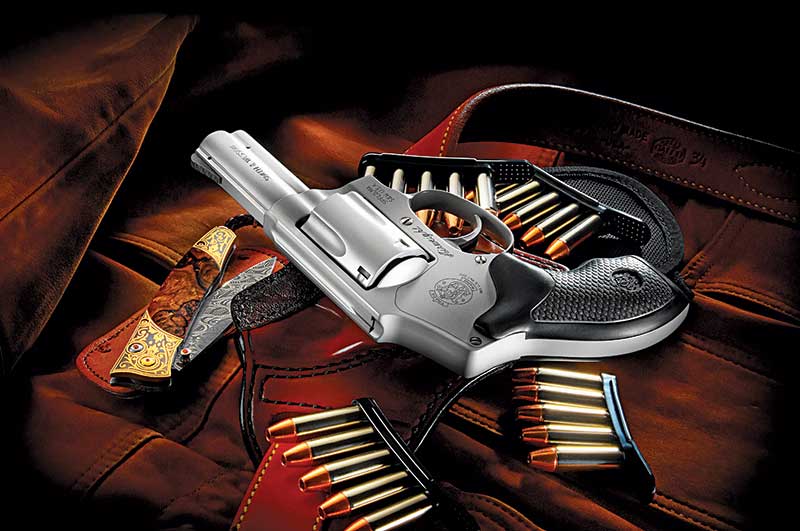
The mighty X-frame revolvers and the gorgeous handguns of their Performance Center notwithstanding, the single most popular handgun Smith & Wesson makes today is the J-frame revolver. Now in its 60th year, it’s probably our most ubiquitous “everyday” handgun. While the classic service revolver has largely been relegated to the police museum, the J-frame outnumbers even baby Glocks in the backup holsters of America’s police.
Many concealed carry instructors find it the most common gun for newbie students to bring to class. When American Handgunner polled its staff writers on their carry guns a couple of years ago, the one most constant factor was one or another permutation of the J-frame in almost everyone’s “carry rotation.”
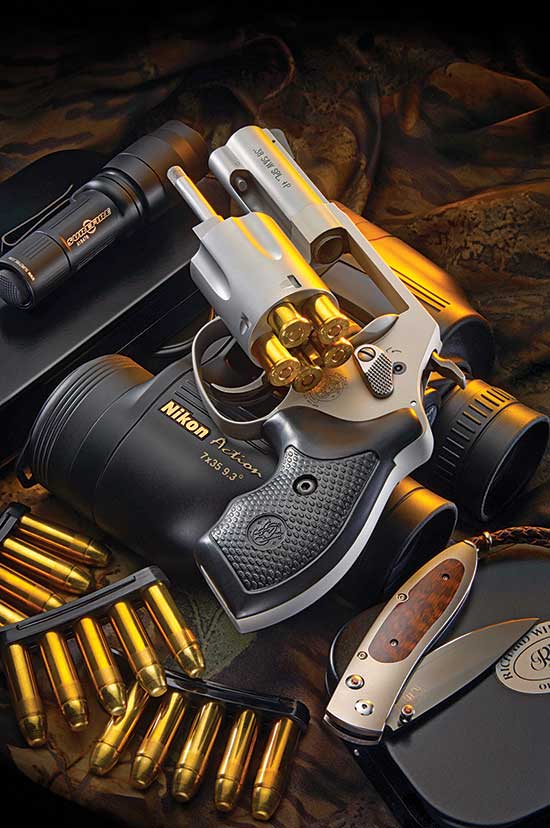
They’re handy, they’re simple, and they’re dead-nuts reliable. Their slim barrels and rounded butts make concealment easier in pocket holsters, ankle holsters, belly bands and even inside the waistband holsters. You can get them as light as 10.5 ounces (the Model 317 Titanium 8-shot .22 LR) and 12 ounces (the Model 340 PD Scandium .357 Magnum 5-shot); and with barrel lengths from 17/8″ (nominally 2″, and still the most popular), to 5″ (the Model 60 .357 variant introduced in 2005). Calibers over the years have included .22 LR, .22 Magnum, .32 Long, .32 H&R Magnum, .327, .38 S&W, .38 Special, .357 Mag, 9mm and even the short-lived .356 TSW. Of them all, though — from the first Chief Special of 60 years ago, to the single best-seller today, the Model 642 — their most enduring and most popular format has been that of a 5-shot, snub-nosed .38 Special.
A Brief History
The year was 1949. Carl Hellstrom had taken over as CEO of S&W, and didn’t like the fact that arch-rival Colt had possessed a monopoly on small frame, short barrel .38 Special revolvers since introducing the Detective Special circa 1927. He ordered his engineers to beef up the small I-frame revolver, hitherto the core of S&W’s .22 Kit Gun and small .32 and .38 S&W pocket revolvers, so it could be manufactured in .38 Special. This required lengthening the frame and the cylinder. The new revolver was introduced at the 1950 national conference of the International Association of Chiefs of Police in Colorado Springs, and was dubbed the Chief Special. (Or “Chiefs Special” according to S&W historian Roy Jinks, or “Chief’s Special” according to the authoritative Standard Catalog of Smith & Wesson by Jim Supica and Richard Nahas). The little revolver was an instant hit, and the die was cast. The new paradigm of the hideout revolver would, forever after, be a 5-shot .38 Special on a stretched .32-size frame.
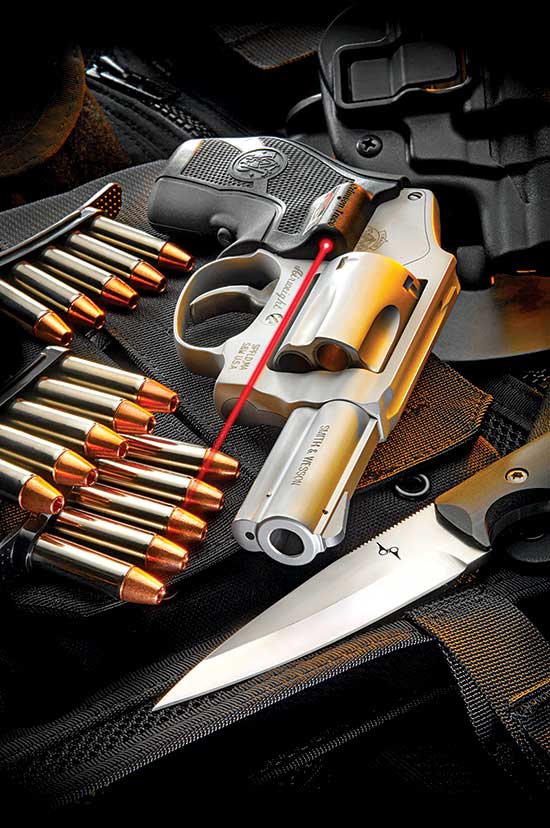
There are three primary configurations of J-frame, and that was set in stone within the first five years of the line’s existence. In 1952, at the request of the already famous Col. Rex Applegate, Hellstrom blended the Chiefs Special platform with the enclosed hammer and grip safety features of the top-break New Departure Safety Hammerless, an 1880s design. Because 1952 marked S&W’s hundredth year in business, they called the new “hammerless” the Centennial. Then, 1955 would see a third option. Reacting to Colt’s introduction of an optional bolt-on hammer shroud for their small frame revolvers circa 1950, S&W designers created a Chief with a built-in hammer shroud and dubbed it the Bodyguard. The tip of its specially-shaped hammer created a “cocking button” that allowed easy-trigger single action firing, but retained the snag-free nature of the Centennial.
The J-frame would be a test bed for S&W innovation. In 1952, the first aluminum-framed Airweight to leave the production line was a Chief’s Special, a variant that would later become known as the Model 37 when S&W went to numerical designations in 1957. So was the first all stainless steel revolver by S&W (or anyone else), the Model 60, introduced in 1965. The first Titanium Smith & Wesson was yet another J-frame, the .22 caliber Model 317 of 1997. When Scandium first made its way into Smith & Wessons at the turn of the 21st Century, those were J-frames, too.
Picking Your Format
Shooting paradigms change, and tastes of shooters change with them. The Chief and the Bodyguard have been in continuous production in one form or another since their introduction. The Chief, of course, is a traditional look double/single action revolver with exposed, spurred hammer, though it has been produced for NYPD and others with the hammer “bobbed.” The Bodyguard looked different enough that some purists thought it ugly, and from the beginning Smith fans nicknamed it “the humpback,” a term you’ll see at the excellent S&W Forum (www.smith-wessonforum.com) to this day.
The Centennial was a different kettle of fish, and quickly found itself on the hind teat of J-frame sales. In the mid-20th Century, many shooters preferred to cock their wheel-guns to single action, and considered double action shooting to be something they would do only in a rare, fast-breaking emergency. The grip-safety put them off, too. The Bodyguard was just as snag-proof coming out of a pocket or shoulder holster, so what the heck was the point of the Centennial? Circa 1974, S&W put the Centennial out of its sales misery and out of the catalog.
Somewhere in the background, one could almost hear the choir singing, “You don’t know what you got, ‘til it’s gone.” By the mid-70s, people were growing savvy to the fact that if you were carrying the gun for those “rare, fast-breaking emergencies,” that’s what you should be practicing for by shooting it that way all the time, so who needed single action? Suddenly, demand for Centennials on the used gun market skyrocketed, and so did their prices.
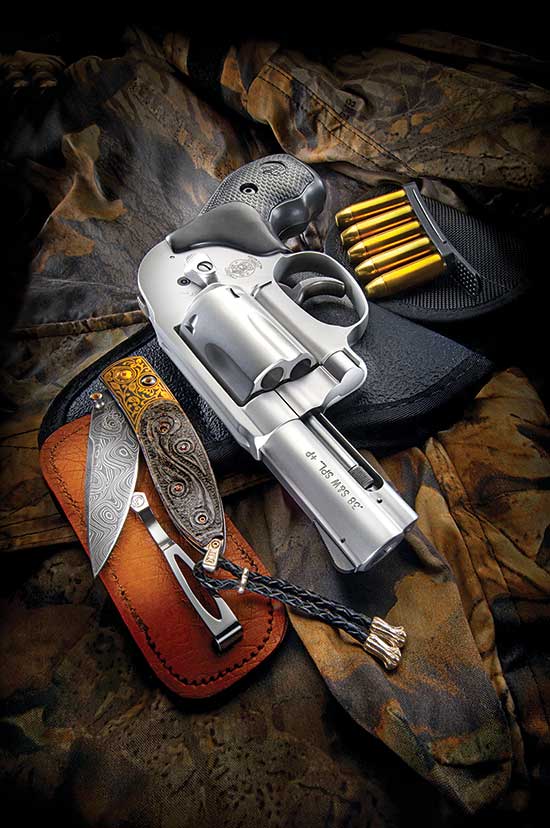
Along about then, folks were figuring out that because the “horn” on the backstrap rose higher on the frame of a Centennial than other J-frames, the shooter could get the firing hand higher on the gun, lowering the bore axis and significantly reducing muzzle rise. A clamor arose for the reintroduction of the Centennial. Circa 1988, I was at a conclave of writers hosted at the S&W factory by then-CEO Steve Melvin. He told us he wanted to reintroduce the Centennial, this time without the superfluous grip safety. We endorsed it heartily, to a man, and the “hammerless” was soon back in the line as the Model 640 — a stainless .38 Special in all steel in its first iteration, with traditional 17/8″ barrel, sans grip safety, and marked +P+ on the frame. It sold like the proverbial hotcakes. Fifteen years after its discontinuance, the Centennial’s time had finally come in the marketplace.
Today, S&W’s head of revolver production, Jim Unger, says the Centennial is the strongest seller in the entire line. The Chief Special with traditional spurred hammer, is second. He tells me the Bodyguard is experiencing something of a resurgence in popularity and biting close at the heels of the Chief for second place honors. The single best-selling handgun in the whole S&W catalog is the Model 642. That’s the classic-look Centennial in .38 Special, with stainless barrel and cylinder and “stainless-look” aluminum Airweight frame. Weight is just under a pound, unloaded. In sales by caliber, according to Jim, the old standby .38 Special remains number one, with .357 Mag second and the .22 rimfires third. In 2009, the company responded to dealer demand and began offering the J-frame chambered as a six-shot .327, which of course will also fire .32 H&R Mag and .32 S&W Long.
The choice between Chief, Bodyguard and Centennial is among the first of many branched paths you take when you enter the vast domain of S&W J-frame options. Each has pros and cons. It goes kinda like this.
Details
Good news: Easy to cock if that’s how you like to shoot, particularly with something like the longer barrel 317 .22 carried as a trail gun. Potential snag of hammer can be overcome by drawing with thumb on hammer, turning your thumb into a “human hammer shroud.” Keeping finger off trigger and thumbing hammer back just enough to drop the bolt and free-up the cylinder allows a cylinder rotation check to make sure there are no high primers that are going to jam the gun in firing. If something does make the cylinder bind, the Chief gives you the most leverage of the three designs to force the hammer back and get a shot off.
Bad news: Too-small, too-smooth, old-style stocks (or too weak a grasp) allow the gun to roll up in the shooter’s hand. In rapid fire, that can quickly allow the spurred hammer to contact the web of the hand, which will block its motion and prevent the gun from firing. The hammer spur, even the reduced profile on the currently produced models, is still “shaped like a fish hook” as NYPD Inspector and firearms authority Paul B. Weston used to say, and can snag on something and stall your draw in an emergency. If fired through a coat pocket, it is possible for a fold of pocket lining to get caught between the face of the hammer and the frame, jamming the gun and preventing firing.
Bodyguard
Good news: That ugly hump of the hammer shroud acts as a “catch point” against the web of the hand to make it much less likely that the gun will roll upward in your grasp upon recoil sufficiently to impair your ability to fire the gun. It is totally snag free. You can thumb the hammer back for an easy single action pull for a “precision shot” if need be. You can safely perform cylinder rotation checks, as with a Chief.
Bad news: Dust collects inside the hammer shroud, and you’ll need to take a pipe cleaner or Q-tip to it regularly, particularly if you carry in the pocket. With just the tiny stub of the cocking button to work with, un-cocking the hammer can become a nightmare, and that problem increases exponentially when you have to do so with hands that are covered with sweat, shaking from adrenaline, and numb from fight-or-flight-induced vasoconstriction, or from winter cold.
Centennial
Good news: It has the best control in a J-frame because you can get your hand so high and the bore axis so low. Even with the super-light .357 Mags, which come back into the hand brutally, you can keep all shots on target fast because the muzzle doesn’t rise as much. You will stop hurting when you stop shooting. This won’t be true for the bad guy on the other side of your gunfire. You have absolute freedom from snag in any kind of draw.
Bad news: There is no safe way to do a cylinder rotation check on the fully loaded Centennial, because the trigger will have to be pulled slightly back for the bolt to release. We’ve tried all sorts of “stick another finger behind the trigger” and all that, and it’s just too awkward. With the Centennial, you have to have your double action trigger pull skills down pat, and you have to know the chambers are clean and won’t keep a fresh cartridge from seating fully, and you have to inspect and know your carry rounds have no high primers.
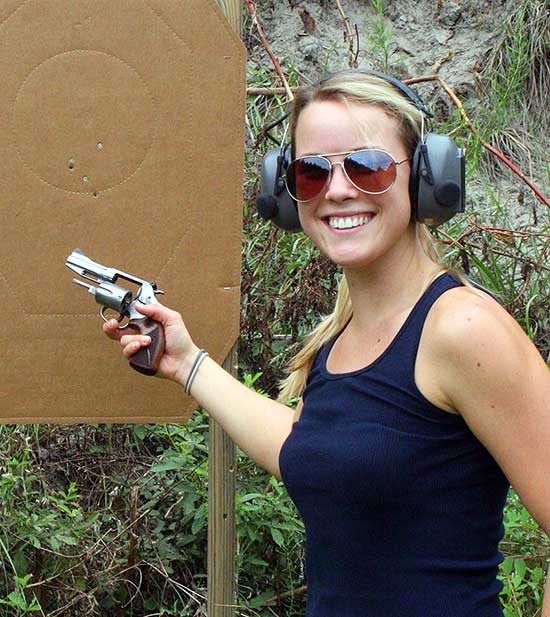
Katherine Rutledge shows the effectiveness of the new Pro Series Model 60.
Group was fired all double action from ten yards.

The 2.5″ barrel affords much longer ejection stroke,
seen here with a Pro-Ported Chief.
Shooting The J-Frame
By the time your J-frame reaches .38 Special caliber, the recoil starts getting mean with serious ammunition. By the time it hits .357 Magnum with full power loads in the 12-ounce variation, it turns into something close to a torture device. It wants to move in your hand, and your hand just wants it to move away. A few tips from an adult lifetime of teaching folks to shoot these things might be in order about now.
Hold the gun hard. Whomever it was that said “hold your gun with 40-percent strength in your dominant hand, and 60-percent strength in your support hand, and above all, just relax” had never fired a light J-frame with +P or, God help us, full-power .357 Magnum. The harder you hold it, the less it will move upon recoil. The harder you hold it, the less it can come back and whack the web of your hand with the upper part of its backstrap, or your middle finger with the back of its trigger guard. And the harder you hold it, the less the ten-ounce gun can move off point of aim as you exert a ten-pound trigger pull upon it, suddenly and swiftly.
Unless you have extra-long stocks, which kinda get in the way of the whole hideout gun concept in the first place, curl your little finger tightly under the butt. This makes the other fingers sympathetically stronger, and also creates a block against the gun rolling backward and muzzle upward/butt downward in your grasp upon recoil.
S&W has equipped these guns with at least four different cylinder latch configurations over the years. The one least likely to slice your thumb firing right-handed, and will still allow you to open the cylinder quickly, is the current production version, which is sort of a checkered semi-oval shape.
From the beginning, these guns were cursed with tiny .10″ wide front sights, with correspondingly tight rear sight notches, which were almost useless under less than perfect conditions. They’ve gotten better. The replacement fixed sights from Bill Laughridge at Cylinder & Slide Shop are so good that S&W put them on their larger framed Night Guard snubbies. Dave Lauck at D&L Sports came out with a great retrofit that I have on my 11-ounce Model 342 Titanium Centennial, and just love. Hamilton Bowen of Bowen Classic Arms also does a sterling job with his sights. At Smith, the humongous Tritium XS 24/7 sight with correspondingly large rear U-notch gives a superb combination of speed and accuracy. It’s found only on the Model 340 M&P .357 at this time, and is the primary reason I bought that gun and carry it most of the time as a backup.
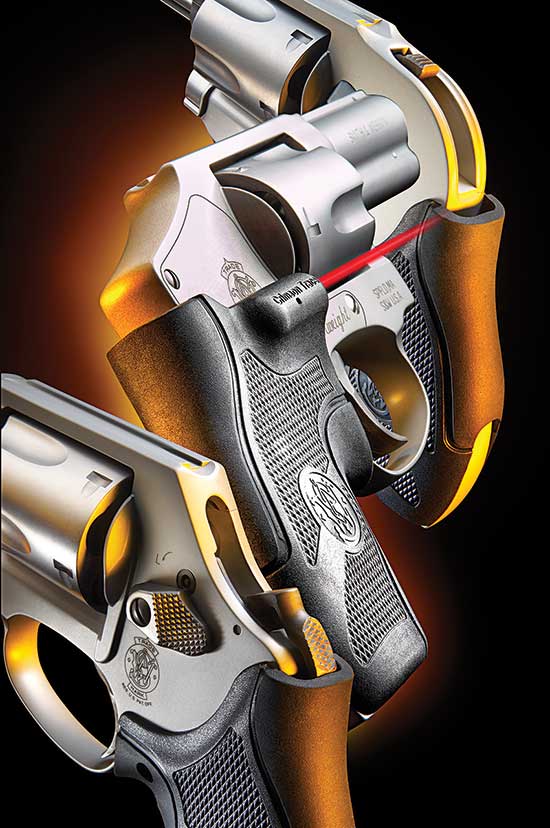
Consider Crimson Trace LaserGrips. I have them on multiple J-frames. Particularly on the older models with less-perfect sights, they make huge sense. They’re now available as S&W factory options on many J-frame models.
Latest Developments
One shortcoming of the J-frame snub has always been incomplete ejection. Between the 17/8″ barrel and the traditional ejector rod lug, the ejector rod became necessarily stubby and just didn’t have enough stroke. That has been changed of late, and you can thank American Handgunner editor Roy Huntington, a long-time J-frame fan.
Roy explains, “After a comprehensive shoot at Gunsite with S&W’s Paul Pluff and about 30 J-frames of all flavors, I came away with the firm conviction a slightly longer barrel and ejector rod would be more efficient. I chatted at length with Jim Unger at S&W, and he was very open to improvement ideas. Some months later during a meeting at a trade show, Jim said, ‘Wait until you see what we have out later. I’m sure you’ll like what you see!’ It turns out the newest offering in the J-frame line-up does indeed have slightly longer barrels and ejector rods. I’m impressed Jim listened to what we learned at the shoot at Gunsite. The guns should offer more reliable ejection and a bit more sight radius to make hitting easier. On a side note, I was not surprised to see many of us regularly hitting 100 yard steel silhouettes, even with the 2″ guns. These guns are indeed accurate in the right hands, solidifying my trust in the J-frame.”
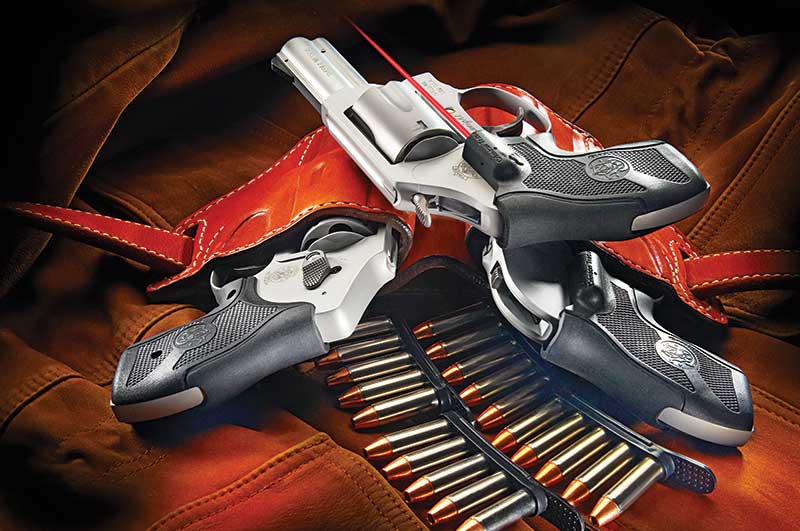
Having shot several of the new 2.5″ J-frames, I can tell you Roy’s predictions have come true. The 5/8″ difference in sight radius becomes significant in a gun as short overall as the J-frame snub, and probably most important, ejection of spent casings is much more positive. Plucking partially ejected brass out of the chambers does not make for a “speed reload,” it makes for a “slow reload.” This longer rod definitely helps. Barrel profile is dramatically changed, of course, but Jim Unger tells me that DeSantis and Galco are already on line with holsters to fit the new-length “J,” with more to come from other makers. The 21/2″ guns are available in Airweight Chief Model 637, Airweight Bodyguard 638 and Airweight Centennial 642 configurations. All weigh 16 ounces with the slight added barrel heft, and all carry a suggested retail of $640 with standard “rubber” grips, and $924 with Crimson Trace LaserGrips.
Also available from the list are J-frames with an integral recoil reduction port ahead of the muzzle. These are in the Pro Series, S&W’s line of upscaled handguns designed and engineered in the Performance Center but built in main-line mass production to reduce cost to the buying public. Upward jets of expanding gases at the instant of the shot do indeed help keep the muzzle down, but they also pose a danger of burning powder debris striking the shooter’s eyes and face if fired from a close-to-the-body retention position. Tailor your choice to your particular defensive manual of arms. My own favorite in the crop is the Pro Series Model 60 .357 with flat-sided 3″ barrel.
And More To Come
By the time you read this, S&W will have introduced their 2010 new products list, in which the J-frame line is richly represented. We will see the return of the all-steel .22 Kit Gun, the stainless Model 63, now in a 3″ barrel/8-shot cylinder format.
And, speaking of .22 Kit Guns, remember the Model 43 Airweight Kit Gun in .22 LR, and the Model 51 Kit Gun in .22 Magnum? Well, 2010 will see the Models 43C and 351C. The “C” stands for Centennial, and we’re talking about eleven-ounce “hammerless” .22s to duplicate the feel of today’s most popular pocket revolver. The 43C will hold eight .22 Long Rifles, and the 351C, seven .22 Magnum rounds. Sights will resemble the excellent high-visibility models seen on the M&P 340 in .357.
The J-frame Smith & Wesson’s 60 year history encompasses both evolution and revolution — and that history is far from over.
.jpg)