Categories
Category: All About Guns
Col. Townsend Whelen
BORN TO A PHILADELPHIA FAMILY OF MEANS IN 1877, TOWNSEND…

Born to a Philadelphia family of means in 1877, Townsend Whelen was a thoughtful man with a talent for expression that has made him one of our most-quoted gun writers. My favorite succinct observation is, “Only accurate rifles are interesting.” A close second might be “The .30-06 is never a mistake.”
Although we agree, this last quote should lie in proper juxtaposition to the fact that he spent many decades diligently working to improve the .30-06 cartridge. Colonel Whelen experimented with the GI .30-06 Springfield while commanding Frankford Arsenal in the early 1920s. Frankford machine shop foreman James Howe, later of Griffin & Howe, assisted Whelen in modifying the .30-06 case to fire bullets of different calibers, as he was particularly interested in creating a cartridge to fire heavier bullets from M1903 rifle actions available from the Civilian Marksmanship Program. Although his experiments with the .25 Whelen ultimately lead to the .25-06 standardized by Remington, probably the best-known and all-around-useful big-game round developed by him is the .35 Whelen.
.35 Whelen
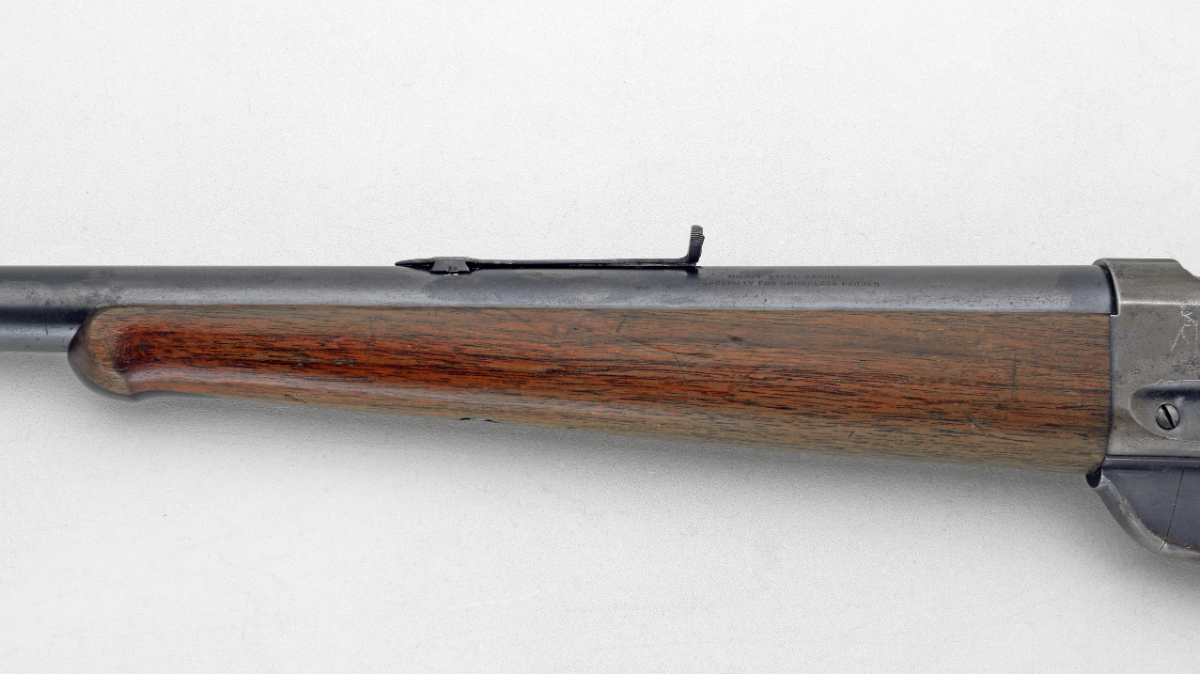
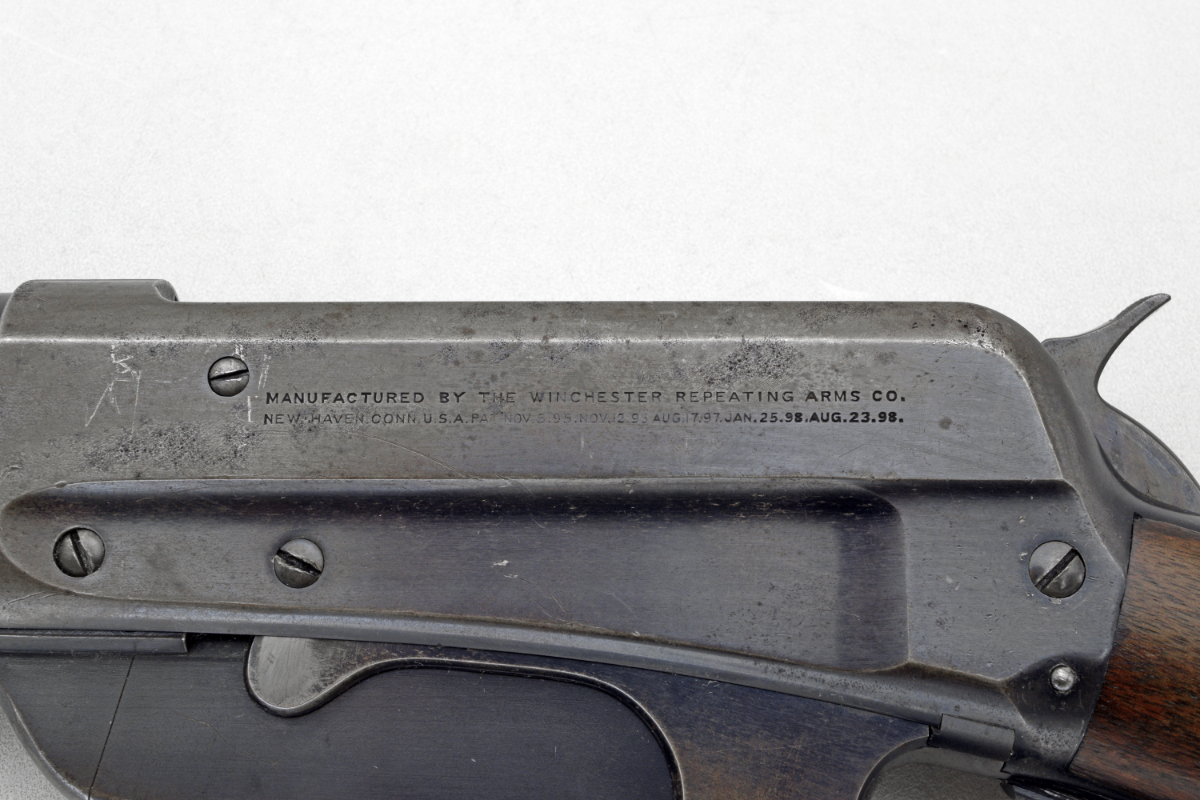
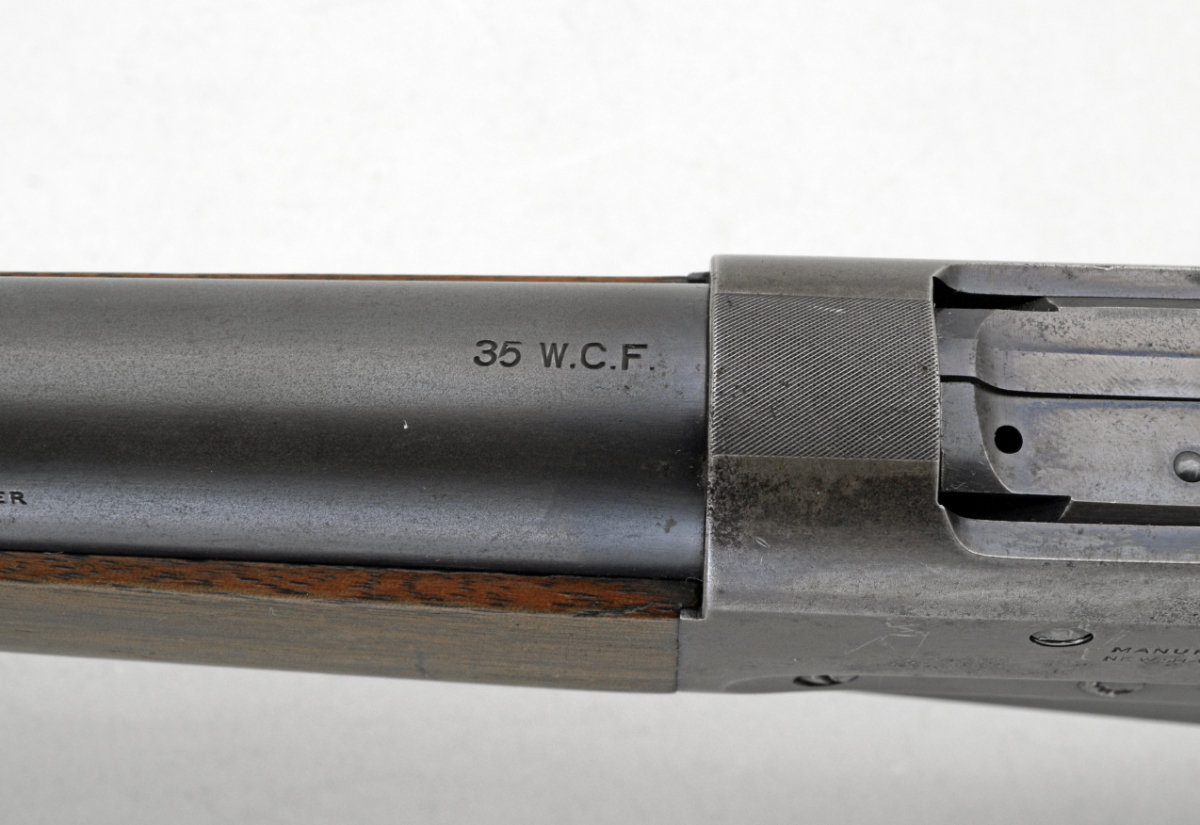
The beauty of the .35 Whelen is that it’s a powerful medium-bore rifle cartridge that does not require a Magnum action or a Magnum bolt face. The parent is the .30-06 Springfield, necked-up for a .358 (9.1mm) bullet, originally developed as a wildcat cartridge in 1922 by Col. Whelen and built by Howe. In a 1923 issue of American Rifleman, Whelen referred to it as “the first cartridge that I designed” and in that same article noted, “Mr. James V. Howe undertook this work of making dies, reamers, chambering tools, and of chambering the rifles, all in accordance with my design.” In 1987, the Remington Arms Company standardized the cartridge as a regular commercial round, first made available in the Remington Model 700 Classic manufactured in 1988.
Suitable .358 bullets range in weight from 150 to 300 grains, and this round can use .38/.357 pistol bullets for cheap practice, low-recoil target shooting and varmint busting. With a 250-grain bullet, the .35 Whelen can deliver 3,500 FPE at the muzzle of a 24-inch barrel.
The .35 Whelen amounts to a ballistic twin of the .350 Remington Magnum, and with the right bullet is suitable for virtually all thin-skinned large and dangerous game. The European designation for this cartridge would be 9x63mm.
Note that the “.375 Whelen” (aka .375-06) was developed in the early 1950s by L.R.
“Bob” Wallack and named in honor of Col. Whelen. It comprises a .30-06 Springfield case necked up to .375. The .375 Whelen Improved was later introduced with a 40-degree shoulder angle, providing more case capacity as well as better headspacing.
.400 Whelen
The .400 Whelen was also developed by Col. Whelen while at Frankford. The cartridge resembles a .30-06 Springfield case necked up to .40 caliber to accept bullets made for the .405 Winchester.
In this instance, James Howe necked down cylindrical brass, available in the arsenal manufacturing process, to form cartridges with a .458-inch-diameter shoulder to fit the chamber of his rifles. Quality Cartridge has also manufactured unformed, cylindrical empty brass cases head-stamped for this cartridge. Griffin & Howe chambered custom-built rifles for this cartridge, and used neck-resizing with cases carefully fire-formed to the chamber in which the loaded cartridges were to be used.
Although requiring skill to reload, this round will throw a 300-grain slug at more than 2,300 FPS, which at the muzzle has 3,522 FPE—a very good harvester of elk, moose and bear at ranges up to 400 yards.
Mr. Rifleman
“A good rifleman plus a good rifle will shoot, see straight, think straight and will run our country straight.”—TW, 1932
Whelen’s interests in ammo were egalitarian and open minded, as this accomplished wilderness hunter and competitive rifle shooter was the real deal, with keen objectivity. In Why Not Load Your Own, he noted, “…in 1901 and 1902 I shot many mule deer, sheep, and goats with my .30-30, and very successfully up to about 150 yards, but I also subsisted largely on grouse, rabbit, ducks, porcupine, and beaver shot with reduced loads. The .30-30 is not to be despised as an all-around rifle.”
Whelen was instrumental in all aspects of redesigning ammunition, developing a practical gilding metal to stop metal fouling, researching the boat-tail bullet, and was instrumental in developing the .22 Hornet.
Fortunately for surviving generations, Col. Whelen was not only a well-expressed writer with something valuable to say, but he was prolific as well, writing full-time after his retirement from the Army in 1936. Whelen served as a contributing editor to American Rifleman, Guns & Ammo, Sports Afield, Field & Stream, Outdoor Life, and other gun and outdoor magazines.
He was the author of many highly-regarded books on small arms, including Small Arms and Ballistics, Why Not Load Your Own, Telescopic Rifle Sights and many others. He began an autobiography, Mr. Rifleman, which was finished by his family and published after his death. If you can only have one of his books, try for a copy of The Best of Colonel Townsend Whelen, edited by Bradford Angier. Whelen’s writings are from experience—strong on hands-on and how-to.
Throughout a life involved with the development of technology, Col. Whelen managed to retain a reverential respect for nature, wilderness, and the wisdom of simple living. Whelen’s stories of, or set in, the great outdoors were often a medium to express nuggets of wisdom, philosophy or practical guidance. Although Mr. Rifleman is primarily remembered for his sound advice on the topics of wilderness living, hunting and rifles, many of his pithy observations would be worthy of Thoreau or Emerson.
Philosophic Ways
Three years before his death in 1961, Col. Whelen wrote, “Scientists remind us that nature intended human beings should spend most of their hours beneath open skies. With appetites sharpened by outdoor living, they should eat plain food. They should live at their natural God-given paces, un-oppressed by the artificial hurry and tension of man-made civilization…Yet the mass of city men, stalking their meat at the crowded market instead of in the green woods or the cool marshes, put up with existences of quiet desperation. Their incessant anxiety and strain is a well-nigh incurable form of disease.”
One of the best shots in the Army, Whelen could hit man-sized targets at 200 yards with an open-sighted M1903 Springfield—six hits in 10 seconds flat—and could do it on command. He was also involved with 1,000-yard shooting—with the 1892 .30-40 Krag. Aside from the innate eloquence of his writings, what comes through is the gentlemanly authority of a writer who has learned by doing, not by studying. He once went to British Columbia, bought a mount and pack horses, pots and pans and headed solo for the farthest regions—not to “survive,” just to live and learn from the fauna and locals, if any. Later in Panama, then uncharted and totally inhospitable, the young lieutenant grabbed a pack, a rifle and set out to make maps and learn the environs. The same point-blank “why not” attitude and quiet enthusiasm that served him from his days as a spindly rich kid served him well throughout an interesting and productive life. And the legacy of his writings, and his cartridges, will serve generations yet to come.
Although we agree, this last quote should lie in proper juxtaposition to the fact that he spent many decades diligently working to improve the .30-06 cartridge. Colonel Whelen experimented with the GI .30-06 Springfield while commanding Frankford Arsenal in the early 1920s. Frankford machine shop foreman James Howe, later of Griffin & Howe, assisted Whelen in modifying the .30-06 case to fire bullets of different calibers, as he was particularly interested in creating a cartridge to fire heavier bullets from M1903 rifle actions available from the Civilian Marksmanship Program. Although his experiments with the .25 Whelen ultimately lead to the .25-06 standardized by Remington, probably the best-known and all-around-useful big-game round developed by him is the .35 Whelen.
.35 Whelen
The beauty of the .35 Whelen is that it’s a powerful medium-bore rifle cartridge that does not require a Magnum action or a Magnum bolt face. The parent is the .30-06 Springfield, necked-up for a .358 (9.1mm) bullet, originally developed as a wildcat cartridge in 1922 by Col. Whelen and built by Howe. In a 1923 issue of American Rifleman, Whelen referred to it as “the first cartridge that I designed” and in that same article noted, “Mr. James V. Howe undertook this work of making dies, reamers, chambering tools, and of chambering the rifles, all in accordance with my design.” In 1987, the Remington Arms Company standardized the cartridge as a regular commercial round, first made available in the Remington Model 700 Classic manufactured in 1988.
Suitable .358 bullets range in weight from 150 to 300 grains, and this round can use .38/.357 pistol bullets for cheap practice, low-recoil target shooting and varmint busting. With a 250-grain bullet, the .35 Whelen can deliver 3,500 FPE at the muzzle of a 24-inch barrel.
The .35 Whelen amounts to a ballistic twin of the .350 Remington Magnum, and with the right bullet is suitable for virtually all thin-skinned large and dangerous game. The European designation for this cartridge would be 9x63mm.
Note that the “.375 Whelen” (aka .375-06) was developed in the early 1950s by L.R.
“Bob” Wallack and named in honor of Col. Whelen. It comprises a .30-06 Springfield case necked up to .375. The .375 Whelen Improved was later introduced with a 40-degree shoulder angle, providing more case capacity as well as better headspacing.
.400 Whelen
The .400 Whelen was also developed by Col. Whelen while at Frankford. The cartridge resembles a .30-06 Springfield case necked up to .40 caliber to accept bullets made for the .405 Winchester.
In this instance, James Howe necked down cylindrical brass, available in the arsenal manufacturing process, to form cartridges with a .458-inch-diameter shoulder to fit the chamber of his rifles. Quality Cartridge has also manufactured unformed, cylindrical empty brass cases head-stamped for this cartridge. Griffin & Howe chambered custom-built rifles for this cartridge, and used neck-resizing with cases carefully fire-formed to the chamber in which the loaded cartridges were to be used.
Although requiring skill to reload, this round will throw a 300-grain slug at more than 2,300 FPS, which at the muzzle has 3,522 FPE—a very good harvester of elk, moose and bear at ranges up to 400 yards.
Mr. Rifleman
“A good rifleman plus a good rifle will shoot, see straight, think straight and will run our country straight.”—TW, 1932
Whelen’s interests in ammo were egalitarian and open minded, as this accomplished wilderness hunter and competitive rifle shooter was the real deal, with keen objectivity. In Why Not Load Your Own, he noted, “…in 1901 and 1902 I shot many mule deer, sheep, and goats with my .30-30, and very successfully up to about 150 yards, but I also subsisted largely on grouse, rabbit, ducks, porcupine, and beaver shot with reduced loads. The .30-30 is not to be despised as an all-around rifle.”
Whelen was instrumental in all aspects of redesigning ammunition, developing a practical gilding metal to stop metal fouling, researching the boat-tail bullet, and was instrumental in developing the .22 Hornet.
Fortunately for surviving generations, Col. Whelen was not only a well-expressed writer with something valuable to say, but he was prolific as well, writing full-time after his retirement from the Army in 1936. Whelen served as a contributing editor to American Rifleman, Guns & Ammo, Sports Afield, Field & Stream, Outdoor Life, and other gun and outdoor magazines.
He was the author of many highly-regarded books on small arms, including Small Arms and Ballistics, Why Not Load Your Own, Telescopic Rifle Sights and many others. He began an autobiography, Mr. Rifleman, which was finished by his family and published after his death. If you can only have one of his books, try for a copy of The Best of Colonel Townsend Whelen, edited by Bradford Angier. Whelen’s writings are from experience—strong on hands-on and how-to.
Throughout a life involved with the development of technology, Col. Whelen managed to retain a reverential respect for nature, wilderness, and the wisdom of simple living. Whelen’s stories of, or set in, the great outdoors were often a medium to express nuggets of wisdom, philosophy or practical guidance. Although Mr. Rifleman is primarily remembered for his sound advice on the topics of wilderness living, hunting and rifles, many of his pithy observations would be worthy of Thoreau or Emerson.
Philosophic Ways
Three years before his death in 1961, Col. Whelen wrote, “Scientists remind us that nature intended human beings should spend most of their hours beneath open skies. With appetites sharpened by outdoor living, they should eat plain food. They should live at their natural God-given paces, un-oppressed by the artificial hurry and tension of man-made civilization…Yet the mass of city men, stalking their meat at the crowded market instead of in the green woods or the cool marshes, put up with existences of quiet desperation. Their incessant anxiety and strain is a well-nigh incurable form of disease.”
One of the best shots in the Army, Whelen could hit man-sized targets at 200 yards with an open-sighted M1903 Springfield—six hits in 10 seconds flat—and could do it on command. He was also involved with 1,000-yard shooting—with the 1892 .30-40 Krag. Aside from the innate eloquence of his writings, what comes through is the gentlemanly authority of a writer who has learned by doing, not by studying. He once went to British Columbia, bought a mount and pack horses, pots and pans and headed solo for the farthest regions—not to “survive,” just to live and learn from the fauna and locals, if any. Later in Panama, then uncharted and totally inhospitable, the young lieutenant grabbed a pack, a rifle and set out to make maps and learn the environs. The same point-blank “why not” attitude and quiet enthusiasm that served him from his days as a spindly rich kid served him well throughout an interesting and productive life. And the legacy of his writings, and his cartridges, will serve generations yet to come.
The amount of irony of this gun must be of huge. As I am sure that Jewish Slave labor must of been used in the making of these rifles during WWII in Europe. For the Nazi War machine, Whose assigned job was to take over the world. Then to kill EVERYONE who basically wasn’t German.
Then just to show you that you can never predict the future with any certainty. The Jewish Survivors wind up in the The Holy Land.
(Despite the best efforts of the British Empire. Who was running the place and kissing the Arabs behind. So that they could continue to make fantastic profits from the oil industry. Which they completely controlled in Iran & Saudi Arabia.)
Where their Zionist Leadership has just bought a whole mess of these rifles that had just made from the Czechs.
Which were to be used to protect their land from invading Arab Armies. Whose sole mission in life at the time. Was to finish Hitlers job of wiping the Jews from the face of the earth.
Anyways, Thanks to some brilliant leadership & some really hard fighting by the Jewish Grunts. They stopped the Arabs cold. Then they were able to push them back & beyond a bit. from their start up point before the UN stopped them
Bottom line – This to me at least proves that the Days of Miracles still exists. That and some Mausers in the right hands, Can still make some serious history. Grumpy

Beginning with the Browning Automatic Rifle (BAR), the squad automatic weapon is a vital platform that continues to evolve as it serves militaries worldwide.
The infantry Soldier’s lot is seldom a happy one. But, it is often full of quiet satisfaction at a hard job well done. Those who command the foot Soldier understand there must be a sensible organization and reliable tools with which to work. In the early 20th century, the organization of the infantry shifted heavily to use of the squad. The squad is a group from nine to as many as 14 men. A junior NCO—corporal or sergeant—commands the infantry squad. There are generally three of them in a platoon, which is commanded by a lieutenant. Since most of our data comes from experience with American infantry, that is what I have described. And while other armies might do things a little differently, there are some parallels in the types of armament employed.
In the early part of that century, the machine gun was all the rage. Various makes and models evolved almost simultaneously from heavy, crew-served guns that initially were used almost as artillery, to lighter guns a single man could carry. A full-automatic gun of that size and weight would have a powerful appeal if included in the infantry squad. In the World War I era and the following decade, virtually every army in the world was set up like this.
As if by mutual agreement, the guns used had similar features. For one thing, they almost always fired the same ammunition as that nation’s service rifle. Further, that ammo was fed into firing position from a sheet-metal box magazine. There were a few models that fed from metal strips. Some models had a semi-automatic trigger system, but all had a full-auto mode. All weighed about 20 pounds empty, while the heaviest ran to 25 pounds. Part of that weight came from a bipod, and all were meant to be fired from a buttstock in the prone position. Tactics involved in deploying the squad auto varied, but everyone prized the stable, full-auto accuracy—enough to give the gunner an ammo bearer. Over time, the squad auto became a specialized form of light machine gun.
Tactics involved in deploying the squad auto varied, but everyone prized the stable, full-auto accuracy—enough to give the gunner an ammo bearer. Over time, the squad auto became a specialized form of light machine gun.
The thousands of French and British soldiers who went to war in 1914 used a variety of automatic rifles with mixed results. When American troops entered the conflict in 1917, the French High Command insisted that the Yanks surrender their early Browning Automatic Rifles (BARs) for the notoriously unreliable French Chauchat machine gun. One of the first problems addressed when the French set about modernizing a post-World War I army was its squad auto. This time, that country’s armories came up with a fine product, and one that lasted for decades.
The gun was the Châtellerault Fusil-mitrailleur (FM) Mmlle 24/29, a 25-pound brute chambered for the French 7.5 mm cartridge. This round was developed in the 1920s, but closely resembles the 7.62 NATO, developed in the 1950s. The FM 24/29 had two triggers, one for semi- and one for full-auto mode. A series of bolt and automatic rifles used the same round. That beefy squad auto—the FM 24/29—served French infantry units through World War II, Korea and two protracted colonial wars in French Indo-china and Algeria. It was a heavy, but reliable gun that solidly anchored the French squad for decades. Some authorities have noted resemblances to the BAR.
British infantry went through a similar series of steps to develop a proper squad auto, and in the end, just bought one. The Bren gun was designed and initially manufactured in Brno, Czechoslovakia. British ordnance looked at everything available and chose this venerable warrior, building their versions at the Enfield arsenal, hence the Bren name (Brno, Enfield).Like the French 24/29, the Bren uses magazines loaded into the top of the receiver, which might seem odd to American eyes, but makes shooting prone easier. Bren gunners learned to load their magazines with great care in order to make the rimmed .303 cartridges feed properly.
And then we have the legendary BAR, a gun first used in the last year of the First World War. Compared to the Bren and FM 24/29, the magazine on the bottom reloads quicker—just
tap the magazine catch in the front of the trigger guard and the magazine falls free. The “B” in BAR stands for Browning and yes, that is legendary John Moses Browning. The gun came from the same brain as several other machine guns, as well as a couple different pistols and even some shotguns you might have heard of.
American infantrymen have long since dropped the BAR and replaced it with the M14, a fine rifle that turned out to be a poor squad auto. When the M16/M4 and the 5.56 mm NATO cartridge were adopted, the situation was again confused. Just recently, the military procured yet another squad weapon from SIG Sauer to replace the venerable M249 SAW.
Once again, we’ve got a new batch of fightin’ iron.
Categories
Army Colt .38 revolver Model 1892
Categories
Shooting a World War One Lugar

All right, we’ll address the most-obvious issue right off the bat here: “budget” and “.50 BMG” are two words that probably don’t belong in the same sentence. Any gun that burns a minimum of $3 with each pull of the trigger definitely isn’t what we’d call a “common man’s” rifle, but as with so many things in life, it’s all relative, isn’t it?
When most people think of .50 BMG behemoths, their mind automatically goes to Barrett, particularly the M107 in current use by the U.S. military. Of course, consumers can buy these semi-automatic monsters for the princely sum of $11,914, and those on a budget can get the poor man’s M107 – the M82 – for a measly $8,846. Sounds reasonable, right? Well, we can’t all drive Ferrari Californias or eat gold-flecked caviar, but at least in the case of the .50 BMG, getting a big-bore fix is more attainable than most American shooters think.
Unlike our previous budget-priced roundups, .50 BMG rifles aren’t exactly stacked side-by-side in the storehouse of every firearm retailer from here to Harare. Indeed, many of the guns are sold directly by the manufacturer, which means there isn’t much room for a middleman, so the prices here reflect the suggested retail price set in place by the maker. Here are five of the lowest-priced .50 BMG rifles on the market today, descending by price:
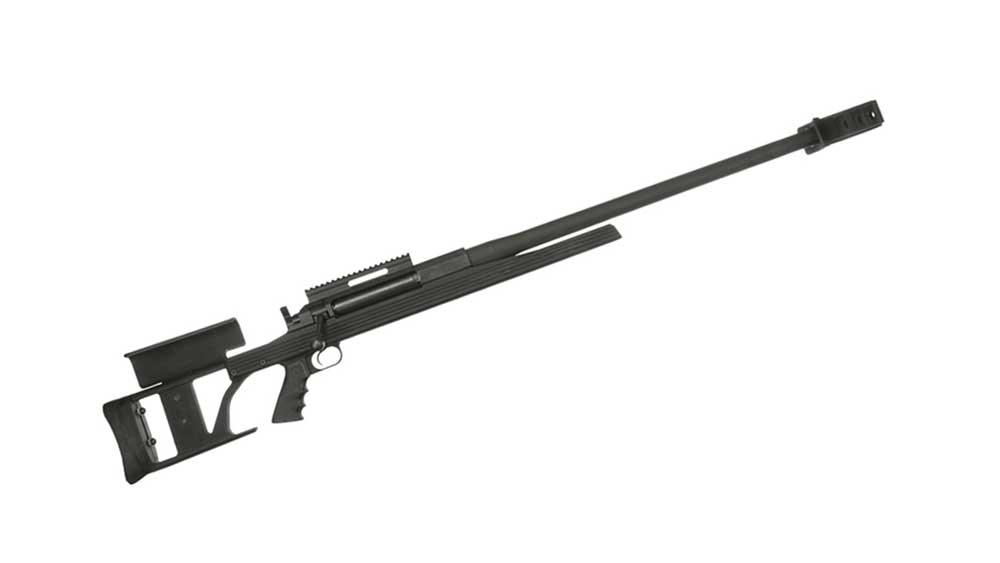
Starting off our list is a company that many probably associate more with the AR-15 than with the .50 BMG. Indeed, the “AR” in AR-15 does stand for “Armalite,” contrary to so many self-ascribed gun experts on the market. However, Armalite didn’t stop at the modern sporting rifle. The company also has a line of bolt-action precision rifles chambered in many of today’s popular long-range calibers, and the AR-50 anchors the top end of the line.
The rifle is a single-shot, bolt-action design equipped with a strong triple front-locking lug complete with a spring-loaded plunger that pops an empty case out of the receiver, readying the gun for the insertion of a fresh round. So, even though it doesn’t feed from a magazine, consumers can still send plenty of rounds at a pace limited only by their wallet. The gun is equipped with a 30-inch chrome-moly heavy barrel, and the whole package weighs in at 34.1 pounds. While the AR-50 is well-built and certainly priced low on the general .50-BMG rifle market, an MSRP of more than $3,000 doesn’t exactly scream “budget-friendly,” so let’s continue on.
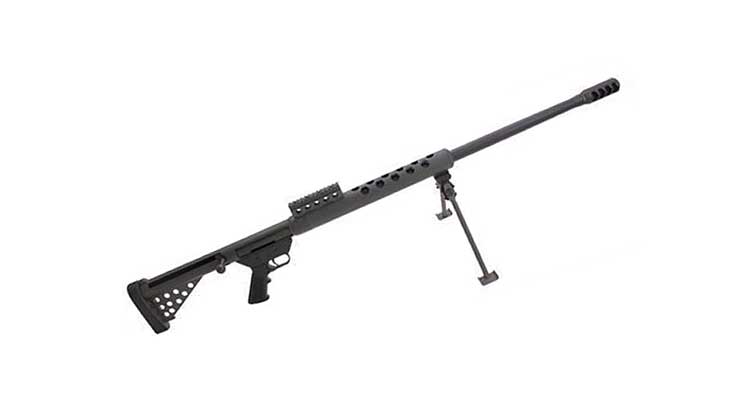
Built since 1999, the Serbu BFG-50 was the first firearm designed by company founder Mark Serbu. Though Serbu has since come out with a host of other unique designs, like its Super Shorty shotgun, the company still cranks out its tried-and-true, first-ever firearm, providing big-bore fans with a fifty they can afford.
Each single-shot Serbu BFG-50 can be had with a number of different barrel lengths, ranging from a 22-inch “Carbine” configuration to a long, heavy, 36-inch-barreled model. The standard rifle ships with a 29.5-inch barrel, though, and each barrel is machined from match-grade alloy steel with a 1:15-inch twist rate. The muzzle end is topped with the company’s Shark Brake, which helps to mitigate the brutal recoil of the .50 BMG, made even more aggressive by the gun’s, relatively speaking, “lightweight” construction, weighing in at 18.75 pounds.
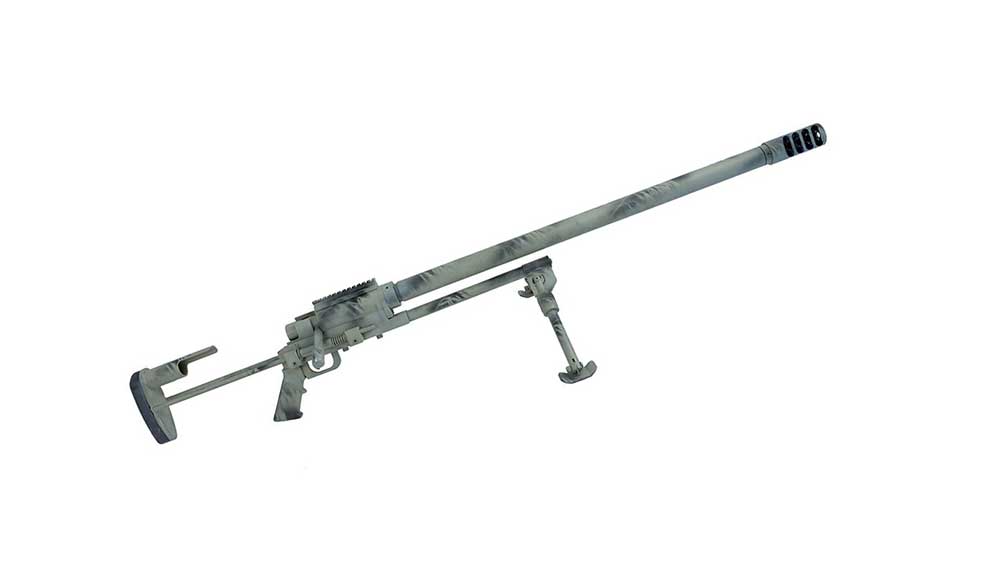
Standing for “Ultra Long Range,” the Noreen Firearms ULR is a simple, basic .50 BMG that has all the features a shooter needs and none they don’t. A single-shot design, the rifle is constructed with a “shell-holder-style” bolt, which requires a shooter to remove the bolt completely from the rifle, slide in a live cartridge, and then return the cartridge-laden bolt to the receiver, locking it into place with a final turn. The rifle doesn’t have any traditional mechanical safeties, so it can’t be carried safely while loaded, certainly a major disappointment for the one person out there who really wants to tote around a loaded .50 BMG rifle. You keep doing you, man.
To enhance accuracy on this precision-oriented long-range rifle, the Noreen team added an adjustable trigger from Timney Triggers, which provides the opportunity for users to fine-tune the pull weight from 2 to 4 pounds, as well as sear engagement and trigger overtravel. To mitigate recoil, the rifle is equipped with a muzzle brake of the company’s own design, as well as a spring-loaded butt stock that absorbs some of the shock of a fired shot. The final recoil-mitigation factor found in the gun is the weight of the rifle itself, clocking in at a weighty 32 pounds.
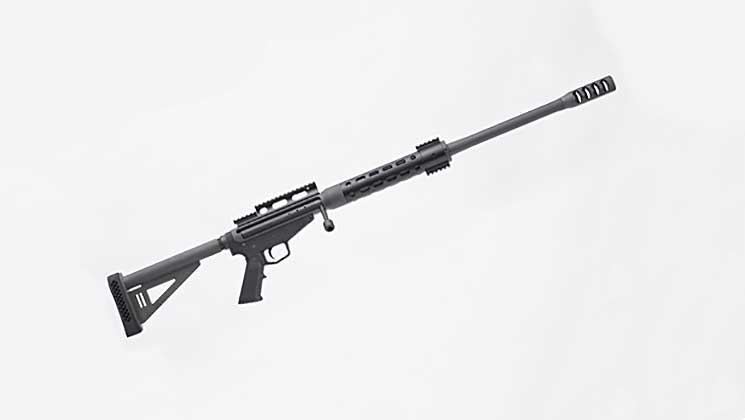
Safety Harbor SHTF-50 Single Shot ($1,850)
Safety Harbor Firearms is probably best-known in the gun world for its AR-compatible .50 BMG upper receiver that pins onto any mil-spec AR-15 lower receiver, but the company also offers complete .50 BMG rifle packages for those in the market for a standalone big-bore rifle. With this package, consumers get the standard SHTF-50 Single Shot upper receiver along with a specially designed lower receiver machined from 4130 chrome-moly steel.
On the upper receiver, consumers will find a 4140 chrome-moly steel barrel available in barrel lengths of 18, 22 and 29 inches long, all with a 1:15-inch twist rate. Mated to the barrel is a two-lug bolt head machined from 4340 chrome-moly steel, along with a bolt body machined from 4130 chrome-moly tubing. The receiver is topped with a Picatinny optics rail, allowing users to pair the high-power rifle with a high-power optic to match. Also, for AR owners with an itch for a mag-fed .50 BMG, the company offers an AR-compatible upper receiver complete with a 5-round detachable magazine for the same price as the complete single-shot rifle.
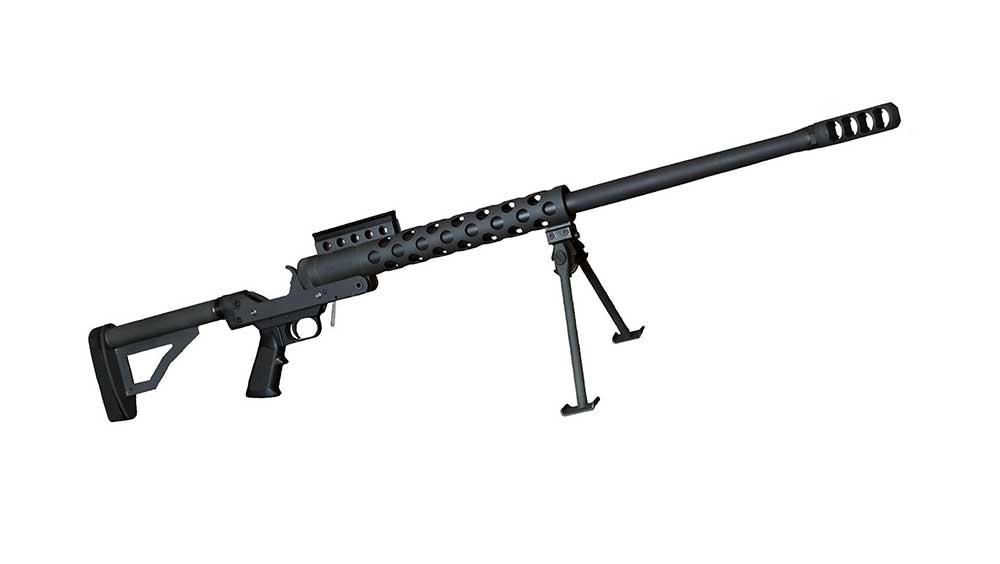
Serbu makes a comeback appearance on our list of budget fifties with one of the company’s latest products released in 2018: the RN-50. Inspired by a social-media campaign, this unique, big-bore rifle offers an extraordinarily accurate .50 BMG precision rifle at prices that most consumers can easily afford.
Unlike many of the other guns on this list, the RN-50 doesn’t use a traditional bolt to lock a round into place on the receiver. Instead, the rifle uses a break-action design paired with a screw-on breech cap. Though this loading method certainly doesn’t provide fast follow-up shots, the simplified design is easy and inexpensive to manufacture and actually provides even greater accuracy than many other .50-caliber guns, because the cap offers symmetrical support to the cartridge.
The standard Serbu RN-50 ships with either a 22-inch or 29.5-inch barrel machined from alloy steel and weighing in at 15 pounds max with the latter barrel attached. For an added cost, consumers can choose either an 18-inch “Shorty” barrel or a 36-inch “Heavy” barrel. At such a low price, the rifle doesn’t ship with a bipod or stock included, but those can be bought for an additional $175 each. Consumers can also add their own, since the receiver plate is compatible with AR-style buffer tubes.
Whatever your choice, it’s clear that the long-range precision game involving .50 BMG is no longer for the fabulously wealthy. There are a number of options for those bit by the big-bore bug that aren’t wildly out of the price range of many of today’s traditional rifles. All that’s needed now is a source of affordable ammo…
Categories