Category: You have to be kidding, right!?!

This is the only known surviving photograph of Henry Ziegland. He is standing on the right alongside his brother Jacob. Public domain.
Henry Ziegland was born in 1861 in Honey Grove, Texas. He came of age on the Ziegland family farm. Young Henry was a man of the earth. However, his formative years were chaotic.
Young Love
Henry inherited the family spread upon his parents’ deaths. In 1878, the young man began dating Miss Sharla Karis. Some historical accounts of this story refer to her as Maisie for some reason. The two young people were smitten.
In what was quite radical for the day, they shacked up together on Henry’s farm without the benefit of marriage. Three years later, they moved into Sharla’s old house, and Henry gifted the family land to his brother Jacob.
Five years after they met, Henry developed cold feet and walked out on Sharla. The poor girl was heartbroken. In a fit of depression, she took her own life. Sharla’s brother James was incensed by this.
His sister had been done wrong, and he was going to make things right. Arming himself, James tracked Henry down and found him tending his horses in the barn on his old family farm.
Prisons are not typically filled with psychopaths. They are populated by people who have poor impulse control. James Karis was not born a monster. He was simply angry. His judgment clouded by rage, James approached Henry and attempted to shoot him through the head.
For any normal person, taking a human life is an anxiety-producing event. James wobbled at the last minute, and his round simply grazed the cheek of his intended victim.
Henry realized what was happening and wisely feigned death. The errant bullet passed out of the barn and embedded itself in a nearby tree. James, believing his diabolical mission complete, then shot himself in the head and died. Henry regained his wits and went on to make a full recovery.

Wheelguns from the early 20th century were oftentimes not terribly powerful. However, they nonetheless yet remained quite dangerous.
What are the Odds?
Two decades later, Henry had moved on from the sordid events of that day in the barn. He still resided on the plot of family land that had figured so prominently in his courtship with poor Sharla Karis.
Eventually, however, the big tree outside the barn had outlived its usefulness. Henry enlisted the assistance of his brother Jacob to remove the offending broadleaf.
It was 1903, the same year the Wright brothers first took flight. It would be another 26 years before Andreas Stihl patented the first man-portable, gasoline-powered chainsaw.
Henry and Jacob chopped down the tree with an axe until they grew weary of it. That’s when the two boys decided to do the manly thing and seek out some dynamite.
Tools versus Toys
I mourn the passing of high explosives in respectable American society. There was a time not so long ago when you could buy explosives with little more than a driver’s license and an excuse.
Blowing stuff up is one of the few marketable skills I retain from the military. I once purchased a whole pile of Kinepak and det cord and used it to clear a dozen beaver dams off of my rural farm.
No kidding, pre-9/11, I bought the stuff out of the trunk of a man’s car in the parking lot of a rural church. Tragically, you can’t do that anymore. When folks complain about testosterone levels dropping precipitously among American males, that’s probably why.
Back in 1903, nobody thought anything about being able to walk out of the local hardware store with a crate of dynamite — cash and carry. You didn’t have to show a driver’s license because, back then, driver’s licenses weren’t a thing.
Nowadays, you have to show ID to buy duct tape at Wal-Mart (no kidding, the chronically exhausted clerk explained that some idiots were taking duct tape, rolling it into little cylinders and smoking it to get high. Holy snap …)

Technical Details
The effectiveness of an explosive is determined by how quickly it burns. Propellants like black powder have a combustion velocity of around 2,000 feet per second. By contrast, C4 high explosive conflagrates at 26,550 fps.
Traditional dynamite of the sort that Henry Ziegland might have used burns closer to 24,000 fps. This characteristic is called brisance. An explosive’s brisance reflects its capacity to shatter stuff.
Henry and Jacob packed the base of the tree with dynamite, primed everything, and lit the fuse. They then stepped back to admire their handiwork.
As anyone who has ever watched those horrifying Tannerite mishap videos on YouTube will attest, it is actually the stepping back a safe distance bit that is the most critical part of the enterprise.
Things Go All Pear-Shaped…
When the explosive charge went off, it duly shattered the thick tree trunk. Incredibly, James Karis’s old bullet, nestled inert within the tree for more than two decades, was energized a second time. The errant projectile flew through the air, struck Henry Ziegland in the left temple, and killed him on the spot.
It seemed that, 20 years after his murderous attack, Sharla’s brother James did indeed complete his mission. He ultimately killed Henry Ziegland, the world’s unluckiest man, from beyond the grave.


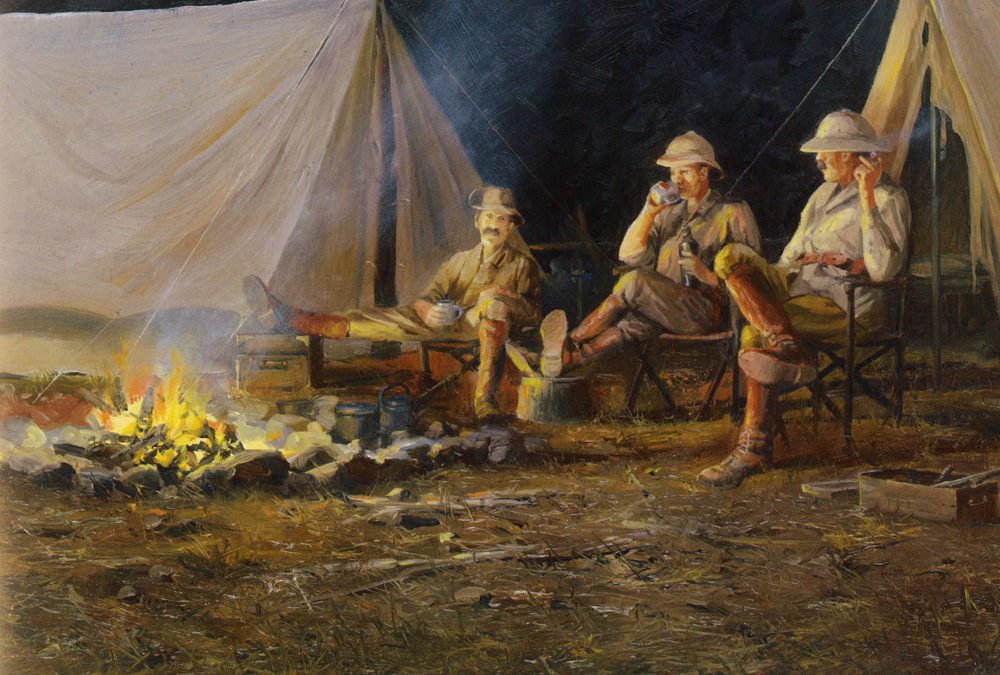
Some of these men returned safely, but many others who sought the “white gold” … would die in the process.
When the ruthless King Leopold II of Belgium died on December 17,1909, so did the severe restrictions on hunting the King’s elephants in the Lado Enclave of the Congo Free State (now southeast Sudan and northwest Uganda).
King Leopold had ruled from an annexed throne and made the Lado Enclave his own personal domain to do with as he wished. After his death, the district became a no-man’s land until the Belgian and British Royals could decide who should control it.
This meant the area was open to hunters who could bag as much ivory as they could carry out. The only obstacle was the large number of loyal Belgian askaris who remained. They were a disorganized bunch of dangerous savages who did not hesitate to shoot on sight.
Soon the “ivory rush” was on and, despite the risks, hunters from all corners of British and German East Africa raced to take advantage of it.
Even Theodore Roosevelt made a point of going to the Enclave that December (1909) before completing his safari. Although the President went there for white rhino, not elephant, it was really to meet the poachers.
TR referred to the men who flocked there as “a hard-bit set,” but affectionately called them “a company of gentleman adventurers.” In reality, they were nothing more than poachers raiding an unadopted territory of its ivory resources before some authority could put a stop to it.
The situation in the Lado Enclave would last only about nine months, until the district became a province of the Anglo-Egyptian Sudan with the southern half being controlled by the British Colony of Uganda.
In the meantime, some of the most prominnt
hunters of the time went to the Enclave in search of the big prize: huge herds of elephants, some containing as many as 500 animals, and bulls carrying ivory up to 200 pounds per side.
Some of these men returned safely, but many others who sought the “white gold,” particularly the lesser known and inexperienced, would die in the process. One such hunter was William Pickering, who literally lost his head doing it.
A well-known poacher and extremely good shot, Pickering was charged and killed by a bull elephant. It seems that he froze with his gun raised as the elephant bore down on him. The huge beast ripped off Pickering’s head and then stomped the man’s lifeless body into the ground.
For most hunters, however, their biggest challenge was outwitting the Belgians and getting themselves and their ivory safely out of the country. The British were sympathetic to the poachers, as it wasn’t “their” ivory, and they benefited from a 25 percent tax on any ivory brought into the British Protectorate from the Belgian side.
One ingenious deception was orchestrated by famed elephant hunter Bill Judd when trying to get across the Nile with a huge haul of ivory. Local natives told him that a Belgian patrol was hidden atop a hill watching the swamp he had to cross to reach the Nile. His only chance was to create a diversion.
He arranged to have some wooden poles whitewashed with the clay used on the inside of native huts and then divided his pagazi into two teams.
He went with the group carrying the white poles, which drew the patrol down the hill while the real ivory went ’round the other side of the hill and made it safely across the Nile. It’s ironic that it was an elephant that would end Judd’s life years later (see “Last Safari”).
Robert Foran hatched another ingenious ruse. This was the same Foran who acted as correspondent for the Associated Press, while unofficially covering the Roosevelt safari a year earlier (see “Codename ‘Rex’”).
The former policeman decided to sneak ivory over to the British side under the cover of a moonless night. He hid his heavily laden canoes along the bank on the British side, then at daybreak he and his men paddled the ivory, as though being chased, back to the Belgian side where they pretended it had been poached in the British territory.
Happy to get one over on the British, Belgian officials agreed to buy the ivory from Foran, who made a handsome profit on the deal, all tax-free.
There is no doubt the activities that took place during the Congo’s transition did much to enhance the frontier atmosphere of early East Africa and the legends it spawned.

Walter Summerford
The Electrified Man
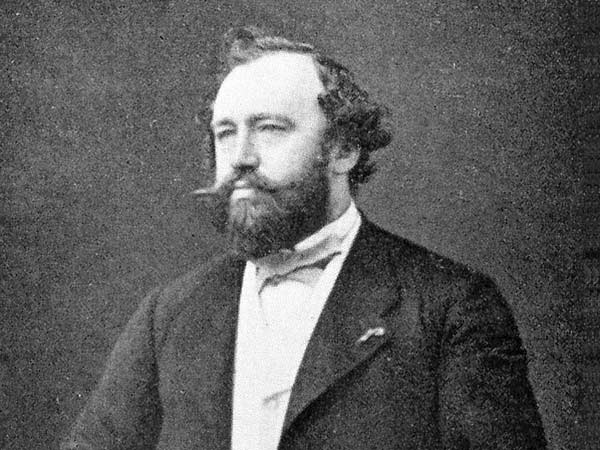
This is Walter Summerford. This poor schmuck got struck by lightning four times, once after he was already dead.
It’s an old wives’ tale that lightning doesn’t strike twice in the same place. Lightning is completely random. In the US alone, there are an average of 40 million lightning strikes per year. The odds of being hit by lightning in America are about one in a million in a given year. However, those numbers are, curiously, not consistent around the globe.
In the UK, there are only around 300,000 lightning strikes per annum. The United Kingdom is markedly smaller than the US, but its weather is way crappier. As a result, the odds of getting struck over there are closer to 1-in-15,300.
Lightning is some seriously nasty stuff. It’s basically just a big honking spark. Electrostatic energy builds up in the atmosphere and can discharge either from cloud to cloud or from a cloud into the ground. A typical lightning bolt runs about 50,000 degrees F, or five times the temperature of the surface of the sun. They pack millions of joules of energy. That stuff is undeniably pretty to look upon. However, you really don’t want to get any of it on you.
Around the globe, there are roughly 6,000 lightning strikes each and every minute. Nearly a quarter million people are struck by lightning every year. Roughly ten percent of those are killed.
On a certain level, those seem like pretty decent odds. If only one in every million Americans gets struck by lightning every year and, of those, nine out of ten live to tell the tale, that doesn’t sound so bad.
Those are indeed reassuring numbers, unless you happen to be Walter Summerford. Walter Summerford has been described as the unluckiest man in the universe. He was struck by lightning four times. One of those strikes was actually after he was already dead.
Background
Walter Summerford served as a British officer in World War I. In 1918, Major Summerford was riding a horse through a Belgian field when he caught a bolt of lightning.
This massive electrical shock rendered the poor man paralyzed from the waist down. However, he gradually recovered. With the war over and his recovery nearly complete, Summerford was demobilized and sent to Vancouver for further rehabilitation.
Six years later, in 1924, Summerford was enjoying a little quiet time out fishing by a river. A storm came up, so the man took refuge underneath a nearby tree. A bolt of lightning struck the tree and tracked down his body and into the ground. The strike left Summerford almost completely paralyzed on his right side.
After two long years, Summerford finally regained the use of his legs. The man was an inveterate outdoorsman and loved wandering about the wilderness hiking, hunting, and fishing.
However, in 1930, whilst taking a stroll in a public park, he was struck by lightning a third time. This bolt rendered him completely paralyzed. It was also markedly worse than the previous two. Summerford was destined to spend the rest of his natural life in a hospital bed.
Summerford’s physicians were amazed the man had survived this third blow. He fought valiantly for another two years before finally succumbing to the cumulative effects of these three lightning strikes in 1932.
As to whether he enjoyed some kind of unique body chemistry or had somehow offended his Maker, no one will ever know. Regardless, it was undoubtedly the cumulative effect of these three lightning strikes that ultimately did Walter Summerford in.
Four years after he was buried in a public cemetery in Vancouver, Canada, Walther Summerford’s gravestone was itself struck by lightning and split into pieces.
I’m not much into conspiracy theories myself. However, it is tough not to believe that there was something supernatural and spooky going on with that unfortunate guy.
The truly curious bit was that Walther Summerford was struck every six years starting in 1918, just like clockwork. Even after he died, when his six years were up, that’s when lightning struck his tombstone. The cyclical nature of the thing strains credulity, but his tale is well-documented.
The brother of one of the soldiers with whom I served was actually struck three times. Once the poor guy was in the shower. I can only imagine what that might do to somebody’s emotional well-being, not to mention your perspective on general hygiene.
My colleague was from rural Texas. He said that every time it got a little bit stormy out, his brother would retreat to the living room away from the television and read a book. Who can blame him?
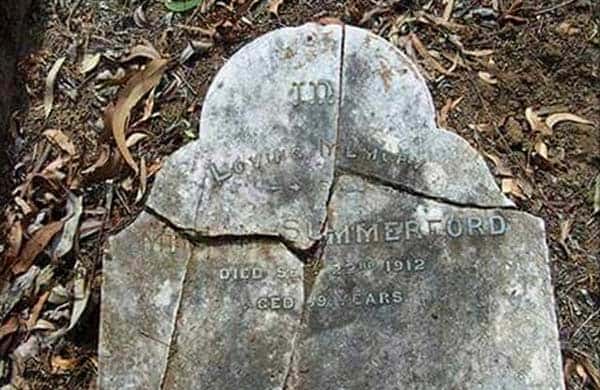
Walter Summerford got struck by lightning once after he was already dead. This is his shattered tombstone. Image: Public domain.
Ruminations
As kind of an amateur science guy myself, I always gravitated toward basic physics. I can get my head around the way things move. However, chemistry and electricity always kind of made me itch. I struggled to visualize these disciplines, so they held little fascination for me.
However, I have long appreciated that electricity is best appreciated at a distance. If Walter Summerford has taught me anything, it is that I’d really sooner not get struck by lightning.