Category: You have to be kidding, right!?!


“A California appeals court [Fourth Appellate District, Division One Court of Appeal of California] ruled Friday that the state may continue sharing the personal information of gun owners with ‘gun violence’ researchers,” The Western Journal reports. “California’s Department of Justice had been permitted to share ‘identifying information of more than 4 million gun owners’ collected by the state during the background check process for firearms purchases with ‘qualified research institutions,’ ostensibly to aid in the study of gun-related accidents, suicides and violence.”
The “personal information” includes “names, addresses, phone numbers, and any criminal records, among other things.” What “other things”?
Per the bill that “authorized” this massive privacy intrusion against citizens for claiming their rights (Assembly Bill No. 173), those include “a database of gun violence restraining orders, and a database of firearm precursor parts purchases.” In other words, that will include people who have never been charged with or tried for a crime, let alone convicted, and will identify people who bought parts that may later be declared verboten.
And more, but you have to go to the court opinion to see how much:
“The DROS [Dealer Record of Sale] system and the associated AFS [Automated Firearms System] and APRF [Ammunition Purchase Records File] databases create a unique data set regarding gun and ammunition ownership not available anywhere else. Researchers in California have used this data to conduct empirical research regarding firearm-related violence for some time.”
“The court’s decision is a victory in our ongoing efforts to prevent gun violence,” Attorney General Rob Bonta Bonta crowed in a media release. “AB 173’s information-sharing serves the important goal of enabling research that supports informed policymaking aimed at reducing and preventing firearm violence. Research and data are vital in our efforts to prevent gun violence in California and provide a clear path to help us save lives.”
Left unsaid is how Bonta’s DOJ incompetently keeping databases on gun owners has already demonstrably exposed and endangered them.
“California’s Department of Justice mistakenly posted the names, addresses and birthdays of nearly 200,000 gun owners on the internet because officials didn’t follow policies or understand how to operate their website,” the Associated Press reported last December. California Rifle and Pistol Association President Chuck Michel “noted the leaked data likely included information from people in sensitive positions — including judges, law enforcement personnel and domestic violence victims — who had sought gun permits.”
As for who the “researcher” is privy to the data, per AB 173:
“This bill would name the center for research into firearm-related violence the California Firearm Violence Research Center at UC Davis. The bill would generally require that the information above be made available to the center and researchers affiliated with the center, and, at the department’s discretion, to any other nonprofit bona fide research institution accredited by the United States Department of Education or the Council for Higher Education Accreditation, as specified, for the study of the prevention of violence.”
That pretty much guarantees whose yard they’ll be playing in, and that suits someone who is no stranger to this correspondent just fine.
ADVERTISEMENT
SCROLL DOWN TO CONTINUE READING
“The court’s decision is an important victory for science,” University of California’s Davis California Firearm Violence Research Center Chair Garen Wintemute declared. It’s more like an “important victory” for “agenda science”…
Back in 2007, I warned gun show attendees that Wintemute was surreptitiously eavesdropping on and recording gun show transactions to report them to authorities and justify banning private sales. I saw this as a violation of gun show rules and recommended notifying security if anyone saw it happen. He told Slate it was a “Wanted poster” and tied that in with threats against his life and that “federal law enforcement agents recommended that I wear a ballistic vest.” There was also the false accusation that I had “outed” him. The end result was the science journal Nature felt compelled to publish a (incomplete) retraction.
Call the guy a “researcher” and a scientist” if you like. I prefer “prohibitionist” and “apparatchik.” And drama queen.
Reason warned against AB 173 back when Gov. Gavin Newsom first signed it into “law.”
While acknowledging that “the law also insists that ‘Material identifying individuals shall only be provided for research or statistical activities and shall not be transferred, revealed, or used for purposes other than research or statistical activities, and reports or publications derived therefrom shall not identify specific individuals,’” they made another important observation:
“[A] gun owner might understandably not be thrilled that people in the business of coming up with reasons why no one should be allowed to own guns (largely true of people in the ‘gun violence research’ field) can easily know their name, address, and all the weapons, parts, and ammo they bought legally. What’s more, nothing in the law as written applies any stern level of oversight or punishment over misuse of the information.”
That “misuse” can be deliberate by activists gone wild or due to lax/incompetent security protocols. And it’s not like sensitive and supposedly secure government systems at the highest levels can’t be breached and hacked by anyone, from cyber criminals to foreign enemies. It’s not like names, addresses, and lists don’t have real-world street value, and it would be just like the prohibitionists to have their efforts actually increase violence and its incentives.
It also looks like it might be a good way for someone with list access and an agenda to call in an anonymous tip and give police “probable cause” for sending out militarized confiscation teams. It’s not like law enforcement won’t do so with information targeting owners of previously registered but now prohibited items.
A truism about “gun control” laws is that criminals don’t obey them, and they end up infringing on those who have. A case in point is 1968’s Haynes v. U.S., in which the Supreme Court (correctly, if you think about it) decided that forcing a convicted felon to register an NFA weapons he was prohibited by law from possessing violated his Fifth Amendment-recognized right against self-incrimination. So, oath-breaker Bonta’s vaunted database, relied on by the Davis gun show mole and his gaggle of anti-gun eggheads, by design, does not include the very reprobates initiating the lion’s share of the “gun violence” they’re purporting to “study”—California’s armed-to-the-teeth criminals who get their guns the old-fashioned way, by breaking the law.
It’s all Kabuki theater designed to divvy up the tax plunder and subject a population they hold in contempt (and, truth be known, fear) – gun owners – to more demoralizing in-your-face harassment.
There’s another break afforded exclusively to criminal suspects, the reading of their “Miranda rights.” Noting another well-documented prohibitionist tactic, declaring what was once legal to now be banned, gun owners buying what could be prohibited later should be advised that whatever they admit to on a required registration form can and will be used against them in a court of law if the Democrats get their way.
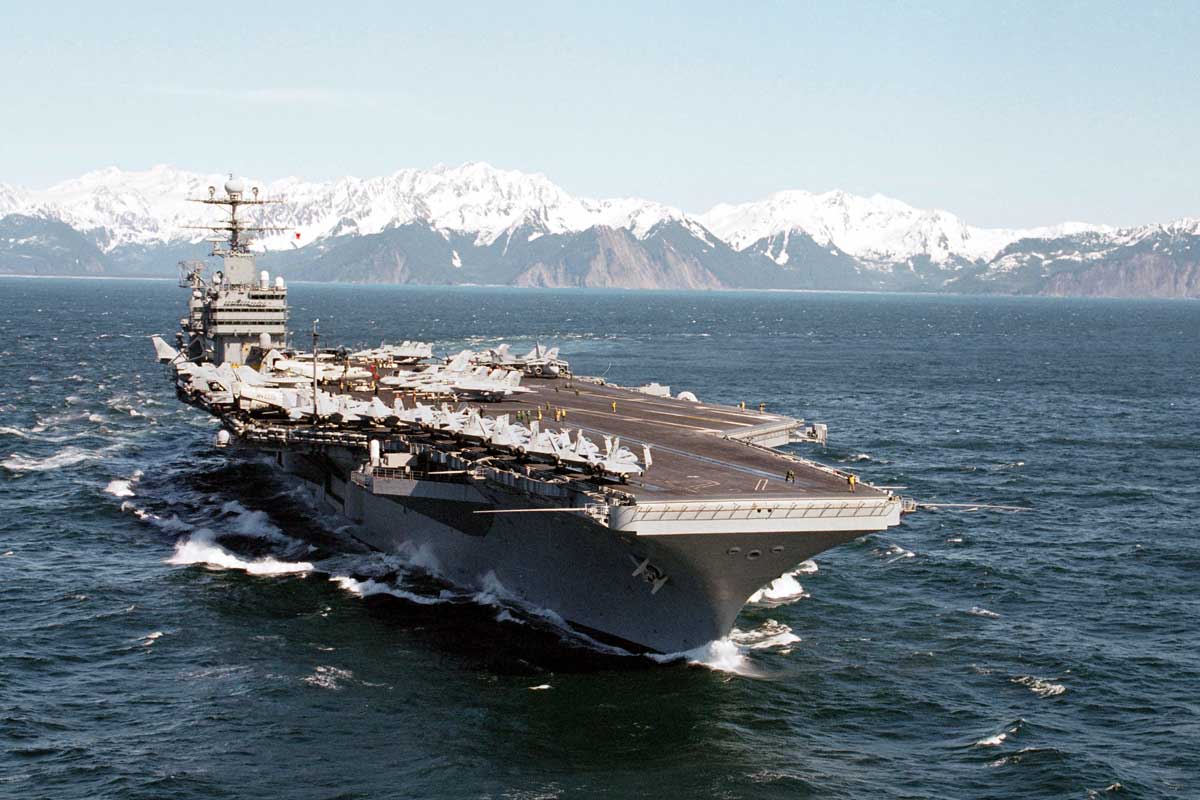
I snagged this from the 3rd party email, yeah I’m an Army guy that happens to know a bit about Navy stuff, especially Carriers. I still think they need to go back to naming them for battles, and not politicians. I am glad to see the Enterprise coming back though.
The U.S. Navy’s Nimitz-class carriers are about to turn 50. But given the demand for the carrier air wing and delays to the Nimitz-class replacement—the Ford-class—the USS Nimitz (CVN 68) itself is unlikely to retire as soon as expected.
The Navy’s fiscal 2023 budget has already called to extend the first-in-class CVN 68, commissioned in 1975, for another deployment cycle instead of decommissioning it in 2025 as previously planned. Service officials say the upcoming budget request could include a final decision on extending the next in the class, the USS Dwight D. Eisenhower, beyond its 2027 projected end-of-service date—though extending just that ship likely will not be enough.
“Extending Nimitz, extending Ike, it’s going to happen for every Nimitz-class carrier. At least one extension,” Vice Adm. Kenneth Whitesell, then-commander of Naval Air Forces, said during an Aug. 25 discussion at the Tailhook Symposium shortly before retiring from the service.
- USS Nimitz extended, Eisenhower likely to follow
- The service seeks Ford-class advanced procurement change
- Repeated extensions could worsen strike fighter deficit
The future of the Nimitz class and oversight of ongoing issues facing production of the second Ford-class carrier, the USS John F. Kennedy, was a focal point of the discussion at the symposium. The Navy’s current plan for the Nimitz calls for $200 million for extension work as part of a 5.5-month maintenance schedule, according to a March 2023 report to Congress.
“Carriers are the linchpin of everything we do in naval aviation,” Director of Air Warfare Division N98 Rear Adm. Michael Donnelly said. “Our requirements are designed and aligned within our air wings to provide the capability out to the [combatant commands] for our ability to conduct the mission. Our ability to get the carriers out on time, whether it is new procurement or maintenance, is essential.”
The first-in-class USS Gerald R. Ford (CVN 78) is now deployed to the Mediterranean, about two years after it achieved initial operational capability. The Ford was extensively delayed and over budget, commissioning five years before the deployment and 15 years after its naming. Originally projected to cost $10.5 billion, the ship ended up costing $13.3 billion. Though it has advanced capabilities such as the new electromagnetic catapult system and improved weapons elevators, it is not yet able to bring on Lockheed Martin F-35Cs.
- See also: USS George Washington Tests New Systems Following Extended Overhaul
- U.S. Navy’s Venerable ‘COD’ Prepares To Fly Off Into The Sunset
The Kennedy (CVN 79) was christened in December 2019 and is scheduled to be delivered in 2025, one year later than its prior expected delivery. The next in the class, the USS Enterprise (CVN 80), has also been affected by labor and supply chain issues, with its delivery date at least a year late as well, now scheduled for 2028.
The Navy has also faced issues with midlife servicing of its ships. The USS George Washington (CVN 73) came out of its Refueling and Complex Overhaul process in May, about two years later than expected. “We are dependent on Newport News, Virginia,” Whitesell said of issues in the Huntington Ingalls Industries Newport News Shipbuilding yard.
To address the Refueling and Complex Overhaul issues, the Navy is executing a performance-based contract for the process on the USS John C. Stennis (CVN 74). For new builds, the service is also looking at extended advance procurement contracts to have more of a lead time in the supply chain, switching to a three-year period from the current two years, Donnelly said.
“We have to look at our procurement strategies so that we are designing the budgeting and programming [and] buying those on the right centers [to] keep the momentum going in the industrial process,” he says.
Demand for carriers will not likely abate soon, as evidenced by the Ford and Eisenhower operating together in the Mediterranean. The Navy has been stressed in fulfilling its post-Cold War plan for a permanent 1.0 carrier presence on station in three hubs—the Western Pacific, the wider Middle East and Europe. To keep up this presence, the service needs 15 carriers—a 3:1 ratio because of maintenance and deployment process requirements. This plan was outlined in the 1993 Bottom-Up Review under then-Defense Secretary Les Aspin, but the service has been unable to meet it since, says Steven Wills, a navalist with the Center for Maritime Strategy at the Navy League.
Navy policy has shifted to the Fleet Response Plan, which focuses on being able to surge aircraft carriers forward when needed, as with the six carriers deployed for Operation Desert Storm and the five for Operation Iraqi Freedom. The current fleet size of 11 stresses this model, and with reactor time left on the ships, multiple extensions are possible, Wills says. “We beat our ships up. We’ve only got X amount of carriers, and constantly keeping one-third deployed, that’s rough,” he says.
In some ways, keeping the carriers active may be easier than decommissioning them, says Bryan Clark, a senior fellow and director of the Hudson Institute’s Center for Defense Concepts and Technology. Taking apart a massive, nuclear-powered aircraft carrier is a long, expensive and difficult job of which few companies are capable. Just three responded to a request for proposals to decommission the USS Enterprise. This process requires dismantling the nuclear reactor before shipping it to a nuclear waste storage facility, all while the ship takes up space in a dry dock.
As the Navy is planning its future carrier fleet size, it also faces math problems with its air wings. The service customarily had one more carrier air wing than its total number of carriers before deciding it did not need to keep that many aircraft. The Navy currently has nine air wings to serve on 11 carriers. “That means each air wing is getting worked at max availability,” Clark says.
Not all air wings are populated with enough strike fighters, he notes, and the Navy is not looking to buy more. Current F-35C production is capped by Lockheed Martin’s capacity and issues facing development of new capabilities, such as the Block 4 package. Early Super Hornets are reaching service-life caps, as Boeing’s Block III upgrade process has proven more time-consuming than originally expected, while the Navy wants to end new production.
For now, this means the service has been shuffling aircraft around its squadrons to populate those underway. It is a workable approach for now, but it is not necessarily sustainable, he says.
The Navy plans to address the potential aircraft shortages by leaning heavily into uncrewed aviation. The 2022 Navigation Plan authored by then-Chief of Naval Operations Adm. Mike Gilday, who has now retired, called for carrier air wings to be 60% uncrewed and 40% crewed. This plan hinges for now on the Boeing MQ-25 Stingray, slated to be the trailblazer for uncrewed carrier-based operations ahead of new programs such as Collaborative Combat Aircraft on which the Navy is working with the Air Force. Those uncrewed “loyal wingman”-type aircraft, which are to fly alongside F-35s and Next-Generation Air Dominance platforms, are expected to begin to be fielded by the end of the decade.