Categories
A Victory!

The Invincible Manurhin MR73 Revolver is Back in the USA Patty Miller

Manurhin MR73 revolver

Have you ever wonder what the strongest revolver being manufactured is? According to the gent over at Sootch00, it’s the Manurhin MR73.

Never heard of it? That’s not really surprising considering there aren’t very many of them in the United States. The revolvers are made in France at the same factory that used to make Walther PPs and PPKs. That’s thanks to the fact that Walther was not able to produce them in Germany after the war, so the company contracted with Manurhin for the manufacturing.

Because the Manurhin MR73s aren’t super well known here in the States, they are pretty hard to come by. Sootch00 says that since 1973, these are the best revolvers in production. So good, in fact, that the French Special police forces helped design them to fit their standards. They are so well made that the MR73s are designed to take a full 150 fully loaded 357 magnums a day. He went on to say that some revolvers are documented to have run at least 175,000 rounds through them.

The MR73s that are in the country are being imported, but most are police surplus. He says the prices can range from $500 for used ones on surplus sites to $6,000 for a new model. The ones reviewed by Sootch00 are the police/combat models that come in 357 Magnum as well as 38 Special. Manurhin did have a 9mm cylinder to swap into the frames, but in the 1980s French law changed to make the 9mm illegal, so the company had to stop production.

Manurhin MR73
Notice the beavertail on the rubber grips? Sootch00, and other revolver shooters, say that helps keep accuracy for the second and third shots.

The models have 3”-10” barrel options, with the longer barrels having bipods and scopes mounted to help with precision. The grips that are found most often are the military rubber ones, as it’s nearly impossible (or cost-prohibitive, perhaps) to find the walnut grips. He also
likes the beavertail on the grip to hold for 2nd and 3rd shots (or more) of the 6-round cylinder.

Each MR73 spends about twelve hours in the factory getting all the parts hand-fitted. They have hammer forged barrels along with the forged cylinders and receivers out of what they refer to as ordinance steel alloy. They are roughly the size of a K-frame with a straight back single- or double-action hammer.

Manurhin MR73 internal parts
Look at this beauty. The parts are all milled and hand-fitted, taking about 12 hours per revolver to assemble.

MR73 accuracy is solid and known to be accurate even after many rounds. Supposedly the revolver’s accuracy has to be at most a .8” grouping at 25 yards in order to leave the factory. Not only that but the revolvers are tested with loaded ammo that has pressures about 30 percent stronger than commercially available loading.

Manurhin MR73 shot groups on targets.
Showing the MR73 accuracy as done by Sootch00. Not too bad, all things considered.

He said that since they are surplus, that they’ll need to be taken apart to clean them up. With a two-piece grip and replacement parts being hard to come by, you’ll want to take it slow and easy and make sure you’re using gunsmithing tools to minimize any potential damage.

So, there you go, the Manurhin MR73 revolver — the strongest revolver out there.


French Badassery: The .357 Magnum GIGN Revolver Sniper

Bucky Lawson (June 14, 2021)

GIGN revolver

“The coolest combat revolver ever made.” That’s how Forgotten Weapons firearms guru Ian McCollum describes the Manurhin MR73 “Sniper Revolver.” A bold statement, but I have to agree that it would be tough to top a hand-fitted double-action .357 Magnum with an eight-inch
barrel designed to fire “multiple hundreds of thousands of rounds” over its lifetime that’s also equipped with a scope and bipod.

Ian McCallum with Manurhin M73 Sniper Pistol
Ian McCollum used his Top Secret Contacts in the French Interior Ministry to get his hands on a Manurhin M73 Sniper pistol.

The MR73 was the standard service pistol of the elite French counterterror unit known as the Groupe D’Intervention de la Gendarmerie Nationale (National Gendarmerie Intervention Group) or GIGN. Think of them as the rough equivalent of the American FBI Hostage Rescue Team or the German GSG 9. The GIGN revolver first entered service in 1973 and has not been officially retired, though it last saw widespread operational use around 2000.

GIGN Shooters on the Line with the MR73.
GIGN shooters on the line with the MR73.

I wasn’t personally aware of the MR73 and its official role until quite recently, and I thought to myself, “Why in the name of Sam Colt would a high-speed outfit like the GIGN choose a revolver as its primary sidearm?” Well, they had some pretty good reasons, as I learned. Ian does a great job explaining them in his video, keeping in mind the context of the early 1970s when all this went down:

• The only autoloaders available to the GIGN at the time were the Colt 1911, Browning Hi-Power, and French Mac 50, all single action only pistols.

• At the time, it was standard to not carry “cocked and locked,” meaning that any SA autoloader would require some kind of manipulation upon being drawn.

• The available autoloaders only met reliability standards with FMJ ball ammo, but since GIGN envisioned much of their mission to be hostage rescue, possibly in confined quarters such as airliners, they needed to use JHP to prevent over-penetration. A revolver gave them that capability with the reliability they needed.

• GIGN philosophy focused on fewer high precision shots as opposed to volume of fire, again reflecting their mission parameters. Because of this, capacity wasn’t a major concern, especially considering the available autoloaders only had standard capacities of eight or nine rounds anyway. GIGN was thinking in terms of two to three well-aimed shots.

Mechanical Stuff

So, the Manurhin Firearms Division designed the MR73 to the exacting standards laid down by the GIGN. Chambered in .357 Magnum, it features, essentially, what Ian describes as “improved Smith & Wesson lockwork” beefed up to handle the demanding training schedule of the GIGN. They had to be able to maintain a pace of around 150 rounds per day, every day, over the lifespan of the gun. As mentioned earlier, “multiple hundreds of thousands of rounds” without major wear and tear or malfunctions. And that is with .357 Magnum combat loads. No .38 Special plinking for this hot rod.

The MR73 was available with 3, 4, and 5 ¼ inch barrels, and every GIGN revolver was extensively hand fitted. As Ian notes, “the quality is there.” The trigger is equipped with roller bearings for a smooth pull and is adjustable in both SA and DA. Ian describes a “heavier cocking stroke” (snicker) for the hammer, but a lighter and smoother DA pull designed for a high level of precision. And high precision they are. The factory accuracy standard was no more than a 20-millimeter (0.8 inches) group at 25 meters. Ian says the MR73s are “supremely accurate revolvers.” Now put a scope on that.

Manurhin GIGN revolver
The Manurhin System is Described as an “Improved Smith & Wesson Lockwork.”

The scope was a 2.5x Bushnell Magnum Phantom (again, consider the context of the time) with a simple crosshair reticle. The bipod was a Harris 1A2 Ultralight with a proprietary mount designed by GIGN and manufactured by Manurhin.

MR73 sniper revolver with Bushnell 2.5x scope and Harris bipod
The MR73 sniper revolver features a Bushnell 2.5x scope and a Harris bipod.
Manurhin MR73 Scoped revolver sniper
The hammer is fairly heavy, but the double-action pull is smooth and light.
Manurhin GIGN revolver bipod mount
The proprietary Manurhin bipod mount was designed by GIGN.
Harris Bipod, extended
The Harris bipod could be extended, giving the weapon a lot of flexibility in tight spaces.

Mission

The sniper version came about in 1981 when the GIGN took over Presidential security from the police. According to Ian, the Presidential Mansion has certain windows that make great spots for snipers as part of the security setup but are so cramped that a rifle would have had to stick way out past the sill. So, the “supremely accurate” MR73 GIGN revolver, with an eight-inch barrel, scope, and bipod was slotted in. The shots in that role were expected to be no more than 100 yards, well within the capabilities of the scoped revolver, especially with a highly trained GIGN shooter on it.

GIGN scoped revolver sniper MR73
The MR73 sniper scoped revolver was designed for the GIGN Presidential Security Detail.
Manurhin MR73 GIGN revolver sniper
The scoped revolver looks pretty deadly to me.

As mentioned earlier, the MR73 hasn’t seen widespread operational service since about 2000, but it hasn’t been officially retired. It serves as the standard GIGN sidearm in ceremonial duties and it is believed that certain GIGN operators still carry it, as they have a lot of freedom regarding their personal weapons and gear. Ian says that GIGN “Likes the idea that they are high-speed operators using .357 Magnum revolvers,” so that may well be the case. There are a “handful” of sniper versions still in the armory, but none are known to have been used in that role for fifteen years or so.

Manurhin

Ian gives a brief, but interesting, history of the Manurhin company, including their involvement with Walther after World War II. I personally own a Manurhin P1 version of the venerable Walther P38. The company has been bought up by at least a couple of conglomerates over the last few decades, its current parent company being the French hunting firearms manufacturer Chapui Armes. Beretta USA has partnered with Chapui Armes to import a new civilian MR73 to the US, with the same standards and quality (and price). Damn fine-looking firearms.

MR73 sniper scoped with bipod, anterior view
The MR73 Sniper scoped revolver had a high-quality, innovative design.

Ian doesn’t hold back on his final evaluation of the weapon: “Every bit as good as the Colt Python, arguably better, given the longevity they can stand up to… The MR73 is, I think, without a doubt, the finest revolver they (Manurhin) ever made and, arguably, one of the best revolvers ever made, period.”

 

Categories
A Victory! Well I thought it was funny!

My Role Model for when I get about 4 more years older!

Categories
A Victory! One Hell of a Good Fight Our Great Kids This great Nation & Its People

The Great War: Most Decorated The Doughboys (WWI Documentary)

https://youtu.be/d7PlIx_tqGc
I guess that I was EXTREMELY lucky enough to talk to some of these great men. Like my Dad’s Father & my Grandfather Morris, who even in their old age were a riot to be around. As they were always up and trying out new things & ideas even when they were in their 70’s and up in years.
All I can say is this. That I almost felt sorry for the Folks that they went and kicked the shit out of .  Nah they needed it! Grumpy

Categories
A Victory!

The Jews who REFUSED to go Quietly – Jewish Resistance in World War 2

Categories
A Victory! All About Guns The Green Machine This great Nation & Its People

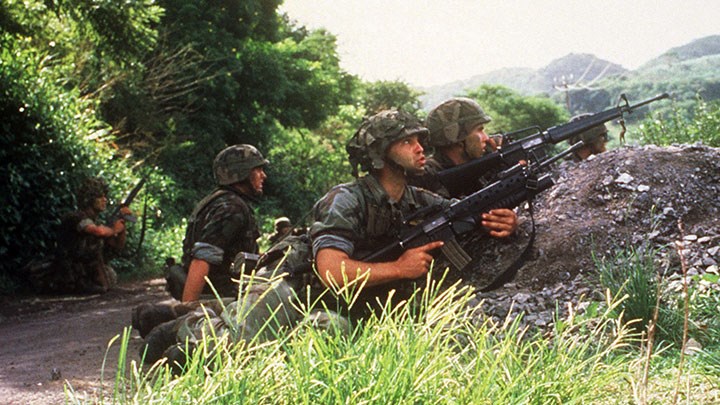
38 years ago we conquered The Island of Grenada – Which helped in The Final Defeat of the Soviet Union as 6 years later the Berlin Wall fell

I snagged this off American Rifleman.

The invasion of Grenada had just begun, and the U.S. assault troops were in trouble. American transport aircraft dropped a company of U.S. 75th Rangers onto the runway at Port Salines Airport, and the American troops were quickly engaged by 23 mm anti-aircraft guns. With the men scattered along the length of the runway and struggling to shed their parachutes, two Soviet-made BTR-60 armored personnel carriers appeared at the end of the runway and began to close on the Americans. The BTRs’ heavy machine guns began to chatter, and soon, 14.5 mm rounds were splattering off the tarmac among the American troops.

Urgent Fury was a multi-national operation. Men of the Eastern Caribbean Defense Force help secure the island. The soldier in the foreground carries the FN FAL rifle (7.62 NATO) while the man to left holds a Sterling submachine gun (9 mm).

Urgent Fury was a multi-national operation. Men of the Eastern Caribbean Defense Force help secure the island. The soldier in the foreground carries the FN FAL rifle (7.62 NATO) while the man to left holds a Sterling submachine gun (9 mm).
A particularly large amount of communist small arms were found on Grenada. The crate is filled with M44 carbines (7.62x54 mm R). The rifle in the middle is the relatively rare Czech vz.52/57 rifle (7.62x39 mm). On the left is the ubiquitous AK-47.

A particularly large amount of communist small arms were found on Grenada. The crate is filled with M44 carbines (7.62×54 mm R). The rifle in the middle is the relatively rare Czech vz.52/57 rifle (7.62×39 mm). On the left is the ubiquitous AK-47.
The vz.52/57 was a surprise find for U.S. troops on Grenada. These rifles had been phased out of Czech service in 1957, and many found their way to Cuba, who then passed them on to nations like Angola and Grenada. The vz.52/57 has an integral blade bayonet in a recess cut into the right side of the stock.

The vz.52/57 was a surprise find for U.S. troops on Grenada. These rifles had been phased out of Czech service in 1957, and many found their way to Cuba, who then passed them on to nations like Angola and Grenada. The vz.52/57 has an integral blade bayonet in a recess cut into the right side of the stock.

Maj. David T. Rivard noted the difficult initial moments of the Grenada operation in his report “An Analysis of Operation Urgent Fury” to the Air Command and Staff College:

“The anti-aircraft guns had been positioned on hills near the airport and could not depress their guns low enough to effectively fire on the C-130s. As the 700 Rangers drifted toward the airstrip in their chutes, the Cubans met them with AK-47 fire. Armored personnel carriers appeared within 400 yds. of the landing zone and started to engage the Rangers. The troops took cover, and the AC-130 gunship overhead provided effective covering fire. The enemy forces had been waiting for the attack.”

Czech Samopal Sa 25 (vz. 48b) submachine guns (9 mm) captured in Grenada. The wooden-stocked Sa 23 is seen at the right.

Czech Samopal Sa 25 (vz. 48b) submachine guns (9 mm) captured in Grenada. The wooden-stocked Sa 23 is seen at the right.
An UZI captured among the communist AK-47s.

An UZI captured among the communist AK-47s.
Soviet-made PKM (7.62x54 mm R) general-purpose machine guns captured on Grenada.  These gas-operated MGs fire from an open bolt with a cyclic rate of 650 rounds-per-minute.

Soviet-made PKM (7.62×54 mm R) general-purpose machine guns captured on Grenada. These gas-operated MGs fire from an open bolt with a cyclic rate of 650 rounds-per-minute.

As the BTR-60s quickly closed the range, it appeared that the Rangers’ drop zone would be overrun.  When the vehicles reached the mid-point of the runway, both BTRs were suddenly struck with hollow-charge antitank rounds. The fast-acting Rangers had set up 90 mm recoilless rifles and immediately scored hits. This was just in time, as the sky above was filled with the descending parachutes of the next wave of Rangers. The second group of Rangers quickly assaulted the 23 mm AA guns positions atop a nearby hill.  Within 10 minutes, the AA guns were silent, too.

At War in America’s Backyard

The invasion of Grenada began on the morning of Oct. 25, 1983.  Operation “Urgent Fury” quickly became fast and furious, as America’s Rapid Deployment Force, including elements of the 82nd Airborne Division, Marine Corps, U.S. Army Delta Force, and Navy SEALs, moved to secure the island from Grenadian and Cuban communist forces.

A PKM machine gun posed alongside a broad range of long arms captured on Grenada, including an SMLE Mk III, a Martini-Henry rifle, a commercial shotgun and a Czech vz. 52/57.

A PKM machine gun posed alongside a broad range of long arms captured on Grenada, including an SMLE Mk III, a Martini-Henry rifle, a commercial shotgun and a Czech vz. 52/57.
Many more eastern-bloc small arms were captured on Grenada than there were men to use them—leading U.S. intel experts to believe that the Cubans and Soviets were planning a strong push to extend their influence into Latin America.

Many more eastern-bloc small arms were captured on Grenada than there were men to use them—leading U.S. intel experts to believe that the Cubans and Soviets were planning a strong push to extend their influence into Latin America.
A PKM machine gun captured, along with a M1 carbine.

A PKM machine gun captured, along with a M1 carbine.

President Reagan directed U.S. forces to Grenada specifically to guarantee the safety of 600 American medical students on the island. The action in Grenada came just two days after the deadly terrorist attack on the USMC barracks in Beirut, Lebanon, where a suicide truck bomb killed 220 U.S. Marines. The Cold War turned hot in the sunny Caribbean, only 1,500 miles southwest of Miami, Fla.

Communist Defenses

Communist forces on Grenada were well-equipped with anti-aircraft guns, particularly the Czech-made M53 quadruple 12.7 mm gun. These guns were particularly dangerous to the helicopters that supported the landing force. While Operation Urgent Fury may not rival the Marine landings of previous wars, there was no shortage of leatherneck heroism on Grenada.  The USMC profile “U.S. Marines in Grenada 1983” describes the dangers presented by enemy AA on the island and traditional Marine courage in response:

“Marine Capt. Jeb F. Seagle dragged Captain Timothy D. Howard away from their burning AH-1 Cobra, shot down by Grenadian 12.7 mm antiaircraft fire near Fort Frederick. Capt. Seagle was killed while looking for help for Howard, who had been severely wounded. Howard was ultimately rescued by a CH-46, piloted by Maj. DeMars and 1st Lt. Lawrence M. King, Jr.

A U.S. Ranger poses with a haul of AK-47s and a Czech vz. 52/57 light machine gun (7.62x39 mm).  The vz. 52/57 used either metallic link belts or 25-round box magazines interchangeably.  Its cyclic rate was 1,100 rounds-per-minute.

A U.S. Ranger poses with a haul of AK-47s and a Czech vz. 52/57 light machine gun (7.62×39 mm). The vz. 52/57 used either metallic link belts or 25-round box magazines interchangeably. Its cyclic rate was 1,100 rounds-per-minute.
A haul of carbines: M44 types, vz 52/57, and the U.S. M1 carbine.

A haul of carbines: M44 types, vz 52/57, and the U.S. M1 carbine.
A mixed crate of vz. 52/57 rifles and M44 carbines.

A mixed crate of vz. 52/57 rifles and M44 carbines.

While another Marine Cobra attacked the antiaircraft site with 20 mm cannon and rockets, Maj. DeMars landed his CH-46 in the field near Howard. The landing chopper attracted small-arms fire to the field. A few rounds hit the CH-46, slightly damaging the stabilizing equipment. The squadron maintenance chief, Gunnery Sgt. Kelly M. Neidigh (a Vietnam veteran) riding along as a gunner, quickly disconnected himself from his intercom equipment and jumped from the aircraft.

Armed with an M-16 rifle, he sprinted the 40-yd. distance to Capt. Howard. Ignoring the fire directed at him, Neidigh half-dragged, half-carried Howard back to the aircraft and hoisted him on board with the aid of the crew chief. Cpl. Simon D. Gore, Jr. Still under fire, DeMars continued to wait in hopes of finding Capt. Seagle, not knowing that hostile fire had already killed him.

A soldier of the Eastern Caribbean Defense Force poses with a captured RPG-2 rocket launcher and a Bren L4 light machine gun (7.62 NATO).

A soldier of the Eastern Caribbean Defense Force poses with a captured RPG-2 rocket launcher and a Bren L4 light machine gun (7.62 NATO).
Bren L4 light machine guns captured on Grenada.

Bren L4 light machine guns captured on Grenada.
Cold War trophies: U.S. Rangers enjoy their haul of AK-47 assault rifles. Note the Czech vz. 52/57 LMG to the far right.

Cold War trophies: U.S. Rangers enjoy their haul of AK-47 assault rifles. Note the Czech vz. 52/57 LMG to the far right.

Finally, with no sign of the second Cobra pilot, and with Howard’s condition rapidly worsening, DeMars decided to take off. The second Marine Cobra was hit by AA fire and crashed into the harbor with the loss of the pilot and copilot. The CH-46 flew Captain Howard to the USS Guam, where he received medical treatment that saved his life but could not save his right forearm.”

An Island Base for Communist Expansion

The island of Grenada was filled with arms caches, with the communists storing far more firearms than there were Cubans or Grenadians available to use them.  The Marine history of Urgent Fury describes the efforts made to secure the stockpiles:

“Local citizens immediately began to point out members of the militia and the People’s Revolutionary Army to the Marines, leading them to houses and other sites of concealed arms caches. Grenadians even loaned their vehicles to the Marines for use in gathering the considerable quantities of arms and ammunition that were being uncovered. Patrols, accompanied by local guides, moved into the countryside to search out caches; Marines established roadblocks to stop and identify members of the Grenadian army and militia who were trying to escape detection by changing into civilian clothing.”

Multiple styles of AK-47 rifles captured on Grenada. An extra barrel for a Czech vz. 52/57 LMG is seen on top of the pile.

Multiple styles of AK-47 rifles captured on Grenada. An extra barrel for a Czech vz. 52/57 LMG is seen on top of the pile.
AA defense: several examples of the Czech-made M53 (12.7 mm) AA gun were captured on Grenada. This gun was used in the defense of Point Salines airport.

AA defense: several examples of the Czech-made M53 (12.7 mm) AA gun were captured on Grenada. This gun was used in the defense of Point Salines airport.
Liberated: American students at St. Georges University on Grenada pose with a trooper of the 82nd Airborne Division. He carries an M16A1 rifle equipped with an M7 bayonet.

Liberated: American students at St. Georges University on Grenada pose with a trooper of the 82nd Airborne Division. He carries an M16A1 rifle equipped with an M7 bayonet.

Later, as the Marines took the Grenadian fort at St. Georges:

“Large quantities of weapons, including light machine guns, AK-47 assault rifles, heavy machine guns and great stacks of ammunition were left behind in Fort Frederick. Nearby, Marines discovered a truck with three new 82 mm mortars and two trucks heavily loaded with anti-aircraft ammunition. In underground tunnels below the fort, which had housed a headquarters of some type, Dobson’s men found quantities of significant documents, including an arms agreement recently signed by Nicaragua, Cuba, Grenada and the Soviet Union.”

Covering the evacuation of American students, a US soldier cradles a M60 general-purpose machine gun.

Covering the evacuation of American students, a US soldier cradles a M60 general-purpose machine gun.
The barefoot grenadier: an M16/M203-armed soldier enjoys the weather on Grenada.

The barefoot grenadier: an M16/M203-armed soldier enjoys the weather on Grenada.
A Marine radio operator on Grenada armed with a M16A1.

A Marine radio operator on Grenada armed with a M16A1.

Clearly, communist forces in the Caribbean were preparing to expand their influence out from Grenada, turn the 135 square-mile island nation into a fortress or both. The “Island of Spice” was filled up with a lot more than nutmeg. Major Rivard’s report details the firearms discovered by U.S. forces:

“There were about 10,000 rifles, including assault rifles, sniper rifles and carbines; more than 4,500 machine guns, 294 portable rocket launchers with 16,000 rockets. In addition to this, there were 60 anti-aircraft guns of various sizes including almost 600,000 rounds of ammunition and 30 57 mm ZIS-2 anti-tank guns with about 10,000 rounds of ammunition. Finally, 60 armored personnel carriers, 30 76 mm ZIS-2 field guns and 20,000 uniforms were also found. Large amounts of this equipment were captured still in shipping crates stored in warehouses.”

Classic Small Arms of the Cold War

The fighting on Grenada was a microcosm of the Cold War and a technological snapshot of a conventional engagement between western and communist forces. Most of the small arms used during Urgent Fury are well-known players, the U.S. M16A2 and the M60 machine gun versus the Soviet AK-47 and PKM GPMG. The island’s location gave some of the Grenadian small arms a certain uniqueness.

Every Marine a rifleman: a USMC M16A1 in action on Grenada.

Every Marine a rifleman: a USMC M16A1 in action on Grenada.
A ride home: a trooper of the 82nd Airborne behind the wheel of an M151 1/4-ton utility vehicle (the “Mutt”), featuring an M60 on the pedestal mount.

A ride home: a trooper of the 82nd Airborne behind the wheel of an M151 1/4-ton utility vehicle (the “Mutt”), featuring an M60 on the pedestal mount.
The paratroopers come a-knocking. Men of the 82nd Airborne clear houses on their sweep through Grenada. Both carry M16A1 rifles and M72 LAW (66 mm) anti-tank weapons.

The paratroopers come a-knocking. Men of the 82nd Airborne clear houses on their sweep through Grenada. Both carry M16A1 rifles and M72 LAW (66 mm) anti-tank weapons.

M1 carbines were a part of the mix. Soviet M44 bolt-action carbines were also there. So were a few British Bren guns chambered in 7.62×51 mm NATO. The Cubans sent a few older Czech-made firearms to Grenada, including the vz. 52/57 semi-automatic rifle and the rare vz. 52/57 light machine gun (both in 7.62x39mm).

Kind of a Big Deal

I have a couple of friends who were part of Operation Urgent Fury, and for years, they have described the invasion to me as “not a big deal.” For years, I have let them get away with under-selling it. Looking back and realizing the large (and growing) firearms stockpile on Grenada at that time, the operation was rather important. America simply could not let more communist dominoes fall in the Caribbean or in South America. Urgent Fury helped keep the Cold War from reaching a boiling point while also keeping communism contained. Just six years later, the Berlin Wall would come down, and the Soviet Union fell with it. Of the opposing players, only Cuba remains today.

Evacuees board a UH-60 Black Hawk helicopter mounting a stripped-down M60D machine gun, featuring spade grips and a canvas bag to catch ejected spent casings.

Evacuees board a UH-60 Black Hawk helicopter mounting a stripped-down M60D machine gun, featuring spade grips and a canvas bag to catch ejected spent casings.
M151 “Mutt” sporting a pair of M60 machine guns, as well as a wire-cutting bar attached to the front grill.

M151 “Mutt” sporting a pair of M60 machine guns, as well as a wire-cutting bar attached to the front grill.
Officers and men of the 82nd Airborne test out a captured PKM machine gun (with a 100-round ammunition belt container).

Officers and men of the 82nd Airborne test out a captured PKM machine gun (with a 100-round ammunition belt container).

Ultimately, 19 American troops were killed in Operation Urgent Fury, and nearly 120 were wounded. Communist forces lost 45 dead and nearly 350 wounded.  This was the price to halt Soviet and Cuban communist expansion in the Caribbean. The American students on the island were returned safely to the U.S. Democracy was restored in Grenada, a free nation where they now call Oct. 25 “Thanksgiving Day”.

Categories
A Victory! All About Guns Allies Art Dear Grumpy Advice on Teaching in Today's Classroom Good News for a change!

Wherein a sweptback bolt becomes an insomniac’s grand pursuit. [by Rusty Ward]

JUDGING BY THE NUMBER OF COMMERCIALS promoting sleep aids (my favorite features a piano-size moth guiding a perfectly coiffed woman to an immaculately turned-out bed), insomnia is a thing to be fought. I can’t understand why, because history is awash with famous insomniacs who benefitted from their sleeplessness. At the head of this list stands Marcel Proust, whose insomnia enabled him to enshrine such childhood trivialities as a goodnight kiss from his mother and a bit of petite madeleine dipped in tea in a literary masterpiece spanning thousands of pages.

Remembrance of Things Past, or as currently translated, In Search of Lost Time, is not for the faint-hearted. I began reading it as a young man and greedily sucked in the first 500 pages, began to lose traction in the next 500, and spun out completely in the second 1,000. I still return to it occasionally, knowing in the same way that I know I’ll never see all of the Rocky Mountains that I’ll never finish Proust’s 1.3-million-word masterpiece. What I gained in my time with Proust was a conviction that my own nocturnal adventures were gifts that revived past pleasures and sometimes illuminated future ones. Case in point: Lying awake one night in softly filtered moonlight beneath the ceiling fan’s gentle whir, I glanced at the bedside clock to see how much of the night remained to be enjoyed. Glowing numerals said 2:43, and off I went.

ONCE UPON A TIME, in the closing years of the 1960s, the decade one writer defined as when our country suffered a nervous breakdown, there was a kid undistracted by flower children, assassinations, moon walks, and unpopular wars. That kid, obsessed by forest and field, lake and stream, couldn’t concentrate on anything else for longer than two seconds. Today he’d be labeled ADD and introduced to the local pharmacist. But luckily he had a sympathetic father and an indulgent mother who allowed him to self-medicate with heavy doses of open air and wild places. While his peers were obsessing on cars, rock-and-roll, and girls, our protagonist, indifferent to the first two and unready for the last, extended his obsession for woods and fields to include rifles—a tough act in the Deep South, which in those days was a shotguns-only world. There was no Internet, no TV hunting channels, no virtual anything to feed his rifle obsession, so the kid absorbed hunting magazines like a sponge, coming to know the writers better than the adults in his own neighborhood. Firearms catalogs littered his room, and he rushed through homework to pore over ballistics tables and study the comparative anatomy of the Model 70 vis-à-vis the Model 700.

The years passed, and one autumn day in the early 1970s the kid wedged himself into the fork of a solitary oak in a South Alabama bean field. The Ruger Model 77 on his shoulder was only a couple of years out of the womb, but like most kids, he wanted to try new things. Winchester and Remington had been around almost since the days of stone axes, and founders Oliver and Eliphalet looked like Dickens characters. Bill Ruger, on the other hand, was dapper and hip and no older than the kid’s parents, and he built things like inexpensive .22 autoloading pistols (one of which the kid had already worn free of bluing), cowboy-style revolvers long after Colt had dumped the design, and an unlikely single-shot rifle, all of which the shooting public took to like free ice cream.

Later, Ruger would be written up in Forbes, design his own car and yacht, acquire a world-class art collection, and be compared to John Browning as a firearms designing genius. Before those things, though, Ruger announced his Model 77 bolt-action rifle about the time the kid’s obsession was peaking. For the kid, it was the right thing at the right time. His gun writer gurus called it an instant classic, though the kid struggled to see the similarity between the Model 77 and the ancient civilizations his teachers used the same word to describe. Beyond its innovative design features and uncluttered lines, reviewers were amazed that Ruger offered the 77 only in what the ad-men called “short stroke” calibers—language that would have killed it instantly in the sexually obsessed decades that followed.

The kid liked everything about the new rifle, from its clean lines down to its flattened, oddly angled bolt handle, and he meant to have one. That you couldn’t get it in the all-American .30/06 or O’Connor’s pet .270 merely added a dash of spice to its appeal. The .243 Winchester was the wunderkind cartridge of the day, claimed by some writers to drop deer like Thor’s hammer, inexplicably quicker than more powerful rounds and without their backlash. The concept being hammered out in the kid’s mind was that a Ruger 77 in .243 topped with one of the new generation of variable scopes (it would be a Weaver V7 from the old El Paso firm) was about as cutting edge as you could get. And the kid made it happen.

AS DARKNESS SETTLED OVER THE BEAN FIELD, a buck stepped out of the shadows. The kid gulped, steadied the crosshairs, and got a shot off before the shakes could introduce him to the darker side of gravitational acceleration. The buck dropped without a quiver, just as advertised. The kid never forgot the way he felt when his dad’s ridiculously finned ’59 Chevy hove into view, and he knew his dad could see him standing over his buck in the headlights.

Other deer fell to his magic .243 before the kid had a run of bad luck; accepting poor judgment and bad shooting as the real culprits lay miles of maturity into his future. In the meantime, companies were turning out new wonder cartridges, and the kid was relieved to read that his failures may have been equipment related. He dropped the .243 as quickly as it had downed that first bean-field deer, and a new obsession took flight.

If there was an “it” cartridge in the early 1980s, it was the .280 Remington. Introduced in throttled-back form to accommodate its namesake company’s semiautos and pumps, then jacked up to .270 speeds and renamed 7mm Express in an effort to bolster lagging sales, then back to the .280 when consumers found the dual names confusing, it seemed a cartridge in search of an identity. But the rifle cognoscenti took to it like ants after honey, and the articles poured forth like free wine. Mystical ballistic qualities were once again hinted at, and our kid, still clay to the printed word and hungry for the cutting edge, jumped in with both feet. He still liked 77s and scoured the land until he found one in .280.

Categories
A Victory!

Score one for the USMC!

Categories
A Victory! Allies Anti Civil Rights ideas & "Friends"

The View Doesn’t Appreciate a Right The NRA (Ahh See the tears, see the tears! Grumpy)

The View Doesn’t Appreciate a Right


Women, and especially black women, are increasingly buying firearms for self-defense. This reality did not sit well with the hosts of a somehow still-running daytime talk show.

Readers are likely aware of, if not familiar with “The View.” Sherri Shepherd is an actress and former co-host of “The View” who recently returned for a guest spot. Self-professed “big gun control person” Joy Behar set up a segment on the rise in gun ownership among black women, queuing up Shepherd to reveal that she is among the large number of black female new gun owners.

Shepherd shared with the audience that she, like millions of other Americans, recently became a first-time gun buyer. Shepherd said:

“During the quarantine, I felt really helpless, Joy, and we’re talking about depression, I felt [my son] Jeffrey would look at me like he was so scared. I get these little alerts in my neighborhood app about there’s going to be a march through the neighborhood and I started feeling like, ‘how am I supposed to protect my son if something happens?’”

Shepherd took steps to lawfully acquire, be trained, and familiarize herself with her firearm. She practices regularly. She did – and presumably does – everything as prescribed.

That wasn’t enough for former federal prosecutor Sunny Hostin.

Hostin admitted that she knew many black women who had acquired firearms recently but quickly pivoted to the supposed inherent risks of firearm ownership. She claimed having a firearm in the home increases the risk of homicide and suicide but offered no references. The research that supports such claims is based on a flawed methodology to support a predetermined outcome. We’ve covered some examples here and here.

Hostin claimed she knows “the statistics” and referenced going to crime scenes as a federal prosecutor. Vaguely referencing advocacy masked as research does not afford anyone special insight into firearm ownership, nor does witnessing the aftermath of criminal actions.

After all, we know with certainty that criminals do not lawfully acquire the firearms they use in crimes. Hostin was a former federal prosecutor who won an award for prosecution of child sexual predators and child sex abuse. Her experience at crime scenes is very unlikely to be relevant to the lawful gun ownership exemplified by Sherri Shepherd – or a hundred million other law-abiding American gun owners.

Hostin concluded her soap box sermon with “”I still believe that in this country our readiness to sort of allow arms to be purchased at will and fired at will has led to violence and hatred becoming a really popular pastime.”

A former federal prosecutor should really know the difference between criminal and lawful actions. A former federal prosecutor should also know that federal law requires retailers to conduct a background check before all firearms purchases, and that the background check requirement as well as the prohibiting factors were codified in the 1968 Gun Control Act.

But that’s the game, right? Try to drum up some in-group credibility by claiming you or your friends own guns, and then blur the lines between lawful gun ownership and criminal behavior. Just like the drivel presented as “statistics,” this is a worn-out trope.

Shepherd tried to explain to her fellow panelists on “The View” and the audience that she found arming herself to be empowering. It seems that all Shepherd wants is a chance to keep her son and herself safe. “If something happens, I can protect my child.”

That’s what the 2nd Amendment provides: a chance.

Sherri Shepherd is just one of hundreds of thousands of black women who became first-time gun owners. The year 2020 may be over, but interest in firearms has not passed. The National Shooting Sports Foundation estimates that 3.2 million people purchased a firearm for the first time in the first half of 2021. More than 90% of licensed firearms retailers reported an increase in black female customers in this time frame – along with sizeable increases in every other demographic group.

That’s in addition to the estimated 8.4 million new gun owners that joined our community last year. Approximately 11.6 million new gun owners in 18 months.

That’s a lot of people who, just like Sherri Shepherd, just want a chance to protect their loved ones.

There is nothing irresponsible or unlawful about that.

Categories
A Victory!

31 years ago, The Cold War ended. Let us give Thanks that it never really went Hot! Grumpy

Fall of the Berlin Wall - Wikipedia

Categories
A Victory! All About Guns

And I think its about time that the US Gunmakers face some REAL Competition!

Why U.S. Gunmakers Could Soon Face New Competition

Samuel Colt’s venerable company is getting a new lease on life under European ownership.

Key Points

  • Firearms demand is coming down from record levels but still experiencing significant growth.
  • Czech gunmaker CZG’s acquisition of Colt gives it a major foothold in the U.S. firearms industry.
  • CZG’s ownership of Colt and production of firearms at Colt factories will allow it to compete for U.S. military contracts under the Buy American Act.
Major names in the U.S. firearms industry, including Smith & Wesson Brands (NASDAQ:SWBI) and Sturm, Ruger & Company (NYSE:RGR) could soon have significant new competition. Czech gun manufacturer Česká zbrojovka Group (OTC:CZGZ.F), or CZG, is gearing up for a strong push into the U.S. after acquiring Colt.

CZG is now much better positioned to compete for law enforcement and military firearms contracts in the U.S., along with expanded civilian firearm sales. Aiming to double its revenue to $1 billion or more, it looks like competition will be ramping up for this industry.

A gun store employee reaches into a glass display case full of firearms.

IMAGE SOURCE: GETTY IMAGES.

The current firearms market

Firearms purchases seem to be slowing after 2020’s frenzy with sales growth for Smith & Wesson dipping to low double-digits in the fiscal 2022 first quarter after several periods of triple-digit growth. Earlier this month, firearms companies saw their stock prices rise after the Biden administration’s pick for ATF chief, David Chipman, failed to secure the support needed to cement his nomination. However, those small gains weren’t nearly enough to offset the steady decline shares have seen since June as investors respond to the news of an industry slowdown.

But sales are still growing despite the slowdown. Ammunition manufacturer Ammo reported solid second-quarter results in late August too. Both firearm and ammunition prices remain somewhat elevated due to continued strong demand intersecting with supply bottlenecks, though the price inflation has eased since 2020 and even early 2021.

CZG and Colt

While it has sold Czech-made firearms in the U.S. for years, including hunting rifles, semi-automatic pistols, and sporting rifles such as its civilian semi-auto version of the CZ Bren 2, CZG bought out Colt’s Manufacturing Company in early 2021. Colt, founded in the mid-19th century by the famous Samuel Colt, has had a long, checkered history, including many changes of ownership and multiple bankruptcies. It does, however, make several iconic firearms and has supplied the U.S. Army with multiple generations of the M-16 select-fire rifle platform, including the current M4 carbine. CZG launched its IPO last October, using the proceeds to buy out Colt in a deal that totaled $220 million in cash, plus approximately one million shares of CZG stock.

In an interview with firearms website TFB (TheFirearmsBlog), CZG’s president Lubomír Kovařík noted how the Colt acquisition provides a major expansion to the Czech company’s factory capacity. “CZG will gain an additional production capacity and expand its customer network in North America and other countries,” he said. He also pointed out how “[t]hrough Colt, CZG will become a supplier to Mil/LE customers and armed forces in the United States, including [the] U.S. Army.” He views the companies as synergistic with Colt having superior manufacturing and supply chain assets, while CZG brings top-notch research and development to the combined business.

Under U.S. law, only companies manufacturing guns in the U.S. can compete for American military contracts. Owning Colt will allow CZG to enter its firearms in the U.S. military procurement competitions. Colt lost a major contract with the American military in 2015, but half of its 2020 revenue still came from military and law enforcement sales, according to Reuters.

Czech analysts at Fio Banka predict CZG’s police and military sales in the U.S. will jump from 10% of U.S. sales to 50% thanks to the possibility of Colt contracts with the U.S. Army and other branches of the armed forces. CZG says the combined annual revenue of CZG and Colt total about $570 million, but it aims to expand this figure to more than $1 billion by 2025.

And the company is generating strong growth. Fiscal 2021 first-quarter revenue jumped 64% year over year, while EBITDA increased 117%. Net profits for the quarter beat analysts’ predictions by about 12% as well. To top it all off, CZG pays an annual dividend yielding about 1.6%, while its payout ratio sits at a very manageable 26%.

CZG’s plans to reach more than $1 billion in sales in just four years will still be a challenge for the company. Czech analyst Pavel Ryska from J&T Banka told Reuters he believes the target could be achieved if “the U.S. civilian demand remains robust and keeps rising, and second, CZG adds further production capacity either through its own [capital expenditures] or through additional acquisitions that are well executed.”

What this all means for American gumakers’ stocks

Neither Smith & Wesson nor Ruger have large-scale contracts with the U.S. Army or any other service branch. CZG’s takeover of Colt’s military supply role won’t affect either company’s business in this regard. Increased manufacturing capacity, however, plus the easier potential introduction of new CZG firearms made in the U.S. could win it additional law enforcement and civilian sales.

While CZG’s growth projections are dramatic, police and civilian sales are unlikely to significantly move the needle in opposition to Smith & Wesson or Ruger’s success, either. CZG is already competing with the two companies in these markets, meaning its effect on the competitive landscape is already priced in. Even with Colt’s catalog added to its own, nothing in CZG’s lineup is likely to revolutionize its civilian or police sales position.

Thus, the impact of CZG’s expansion on American firearms companies should be minimal. However, for those investing in the firearms sector of consumer durables stocks, CZG itself might be worth watching as a bullish choice if it ever applies for and attains listing on the NYSE or Nasdaq.


10 stocks we like better than Sturm, Ruger & Company, Inc.

When our award-winning analyst team has a stock tip, it can pay to listen. After all, the newsletter they have run for over a decade, Motley Fool Stock Advisor, has tripled the market.*

They just revealed what they believe are the ten best stocks for investors to buy right now… and Sturm, Ruger & Company, Inc. wasn’t one of them! That’s right — they think these 10 stocks are even better buys.