BALNEÁRIO CAMBORIÚ, Brazil — Take away the açaí smoothies and the skewers of barbecued Brazilian meat and the four-day Texas ExpoTiro here could be a gun show anywhere in the United States.

Gun ownership went up. Killings went down. Brazil debates why.© Photo by Arthur Manson/Photo by Arthur Manson
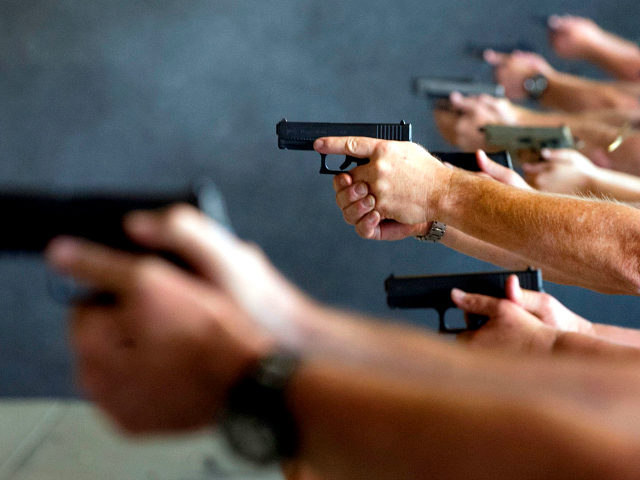
Firearms dealers from all over the world have rented booths to market Glock pistols and AR-15s, and gun rights advocates are offering lectures on how to confront violent urban crime.
“This is a triumph of liberty!” said retired military police chief Marcelo Venera, the executive director of the two-year-old expo, the largest gun show in the country and the first open to civilians. “We are here to show that we are good people and there is nothing wrong with loving guns!”

Retired military police chief Marcelo Venera is executive director of the Texas ExpoTiro. He says it was named after the United States’ “most gun-loving state.”© Elizabeth Dwoskin/TWP
The gun owners of Brazil are proclaiming victory these days. Private gun ownership, once tightly restricted in Latin America’s largest country, has grown at least sixfold in the four years since President Jair Bolsonaro began relaxing the rules.
What’s more, gun enthusiasts say, it’s working: The homicide rate in Brazil — one of the world’s most violent countries — has fallen more than 27 percent since 2017.
“Everyone said there would be more homicides when Bolsonaro loosened the restrictions,” said Paulo da Silva, 25, attending the gun show with friends. “But it turned out to be the opposite!”

Attendees study weapons at the gun show.© Photo by Arthur Manson/Photo by Arthur Manson
Private gun ownership still remains tightly restricted in Brazil, as compared with the United States, and the majority of the population says civilians should not be allowed to own firearms. But the changes here have fueled a new debate over the benefits and harms of allowing more access.
Research consistently shows that when private gun ownership goes up, killings follow. Analysts say it’s too early to draw conclusions from what they’re calling a global test case for what happens when strict gun rules are suddenly lifted. But many say the drop here has more to do with organized-crime trends, investment in policing and demographics.
Much violent crime in Brazil, and homicides in particular, stems from turf battles between the well-armed drug cartels that control favelas, or slums, throughout the country. The victims are predominantly poor young men of color. In 2017, a major war between the country’s two biggest cartels drove gun-related homicides to record levels.
But since then, conflict between First Capital Command and Red Command has calmed considerably, said Roberto Uchôa, a former federal police officer and member of the Brazilian Public Security Forum. First Capital Command now dominates São Paulo, Brazil’s most populous state. In Rio de Janeiro, Red Command now clashes mostly with militias run by police, not rival gangs. As a result, the country’s northeast, ground zero for the groups’ 2017 war for new territory, has quieted.
Bolsonaro has also reaped the benefits of a decade of investment in policing, said Isabel Figueiredo, also a member of the Brazilian Public Security Forum, a nonprofit research group that has advocated for tougher gun laws. Presidents Dilma Rousseff and Luiz Inácio Lula da Silva professionalized local police forces and improved data collection and training, leading to a steady drop in homicides in several states. Lula, who was president from 2003 to 2010, defeated Bolsonaro in October to win a third term; he takes office in January.
Brazil’s aging population is also a factor, analysts said. Roughly half of homicide victims here are between 12 and 29 years old. A decade ago, that age group represented 31 percent of the population. Today it represents roughly 27 percent. There’s no comprehensive data on the age of perpetrators, but criminologists say victims and perpetrators tend to be the same age. Demographically, older Brazilians are aging out of crime faster than younger ones are aging in.

A police truck carrying a corpse passes residents of Rio’s Complexo do Alemão favela during a police raid on July 21.© Mauro Pimentel/AFP/Getty Images
In the United States, decades of research has found a strong correlation between gun ownership and homicide rates, suicides, accidental shootings and shootings by law enforcement. Every 1 percent increase in firearm ownership is associated with a 0.6 percent increase in overall homicide rates and a 0.9 percent increase in firearm homicide rates, according to Daniel W. Webster, a professor at the Johns Hopkins Bloomberg School of Public Health and co-director of its Center for Gun Violence Solutions.
Gun ownership in Brazil is far more limited than in the United States, where there’s more than one gun per person. In Brazil, there are more than 48 people per gun.
Still fewer Brazilians are allowed to carry guns outside the home. Violence is linked more closely to carrying than to ownership.
Webster called the belief that arming more civilians makes society safer “a fantasy that is put forward by the gun lobby” — and is not grounded in any data.
The Brazilian Public Security Forum found that 6,000 deaths could have been prevented if Bolsonaro had not made guns more accessible.
The Instituto Sou da Paz, a Sao Paulo-based nongovernmental organization that advocates for gun control, notes that school shootings, still rare here, have become more frequent since 2019. Of the 12 school shootings here since 2002, five have occurred in the past four years.
Suicides are up 29 percent since 2017, according to public data; Figueiredo and other analysts here believe this is related to the spike in gun ownership. Brazil does not compile data on accidental shootings or shootings by law enforcement.
“This drop in homicides is really, really big,” Figueiredo said. “But it has nothing to do with Bolsonaro’s policies. If anything, his policies have cost thousands of lives.”
At Texas ExpoTiro — Venera says he and his wife named the gun show for America’s “most gun-loving state” — the firearm fans see it differently. The conservative southern state of Santa Catarina is Bolsonaro country; it delivered the third-highest percentage of votes for the incumbent in the October election.
In another echo of the United States, many here claim that the election was “stolen” and that Lula is a criminal who won’t actually assume the presidency on Jan. 1.

A campaign sticker for President Jair Bolsonaro lies near weapons for sale at a shooting club in São Paulo on Oct. 25, five days before the second round of the presidential election, which he lost.© Matias Delacroix/AP
And in a country where police cannot always be trusted to respond effectively, Santa Catarina is also a place where people say they believe they should be able to take personal safety into their own hands. Gun rights advocates, including Bolsonaro himself, say reducing controls on guns has turned Brazil into a far safer place for its 215 million citizens. Bolsonaro’s son Eduardo made the argument this year in a speech at a gun show in California, evidence of growing ties between right-wing movements in the two countries.
“What’s happened with firearms is the same as what happened with the microwave oven,” said Juliana Lopes, a military police major and shooting instructor. “It entered people’s homes … and has become a survival tool.”
Since Bolsonaro took office, the number of shooting clubs here has doubled to more than 2,000. A new lobbying group modeled on the National Rifle Association just got its president elected to Congress. Online, an emerging generation of gun rights influencers has garnered hundreds of thousands of followers. The stock price of Taurus, Brazil’s largest gun manufacturer, went up 200 percent.
Lula’s advisers have said he plans to reverse many of Bolsonaro’s decrees. But they have also acknowledged that once you recognize rights, it is difficult to take them away.
Paulo Bonoso attended the gun show with his wife, Erika, and friends. Seven or eight years ago, the 43-year-old oceanographer said, he was opposed to civilians owning guns. He said Brazilians had been “brainwashed” into hating guns — even sales of realistic-looking toy guns, he noted, are banned.
Then he started to “open” his mind, he said, reading the writings of conservative Brazilian philosopher and self-defense advocate Olavo de Carvalho and questioning conventional wisdom. He became interested in getting a firearm. But before Bolsonaro, he said, it was “too much of a hassle” to buy one.

Gun enthusiasts Paulo and Erika Bonoso at Comanche, their soon-to-open shooting club in Santa Catarina.© Courtesy of the Bonosos/Courtesy of the Bonosos
Bolsonaro’s changes, delivered in nearly three dozen presidential decrees, included reducing taxes on imported weapons, allowing civilians to purchase assault rifles and increasing the number of firearms registered sport shooters could own from 16 to 60.
He also dropped a rule requiring would-be purchasers to justify their need for a firearm to their local police department. Previously, a civilian who wanted to buy a gun needed to submit an application that substantiated their personal level of risk — describing in detail whether they lived in a condominium complex with a doorman or a secure gate, for example. Police had wide discretion on whether to grant or deny the license.
“You could go through this exhausting and expensive process, only to hear a ‘no’ at the end of it,” Bonoso said. “Because some sheriff decided your home was too safe.”
In 2020, Paulo, Erika and their two school-age sons moved from Rio Janeiro, where they say Erika was robbed 16 times, to a family beach house in Santa Catarina. They began to buy guns — a Taurus revolver, pistol and shotgun and a Glock G17 semiautomatic for him; a Taurus G2C pistol and a couple of revolvers for her. They were planning to buy an AR-15, T4 or other type of semiautomatic when the Brazilian government blocked sales of semiautomatic weapons in September, citing heightened risk during the election period.
Several expo attendees said they needed a gun because they live in a rural area where the police presence is minimal. Others said they just like them. In a region populated by many people of German descent, they said, guns have long been part of the local culture. Lula, they said, suppressed the will of the people when he tried to prohibit civilians from owning guns entirely in 2005. He didn’t get the full ban, but lawmakers ended up passing some of the most stringent gun regulations in the world.
Many said they admire the gun culture of the United States — the expo even included a talk on guns in Texas delivered by a member of the Houston-based Brazil-Texas Chamber of Commerce.
Still, a dozen people interviewed at the gun show by The Washington Post said they appreciated that Brazil continues to place far more restrictions on would-be buyers than the United States does. Brazilians must show proof of income and a residence where the firearms must be located. They must undergo a basic psychological evaluation and register with the police and a shooting club.
Brazilians still have more restrictions on carrying guns outside the home. Gun owners are allowed to carry a gun only if they are on their way to a shooting club. Webster said gun homicides and accidental deaths in the United States are tied more closely to carrying than to possession.
Another key difference: Guns are roughly three times as expensive in Brazil as in the United States, which makes private ownership primarily an enthusiasm of people with higher incomes.
U.S. citizens owned more than 393 million firearms in 2018, or 1.2 per person, according to the Small Arms Survey, a Geneva-based research organization. Brazilians owned 4.4 million in 2021, or 0.02 per person, according to the Security Forum.

An employee prepares for a customer’s practice session at a shooting club in São Paulo.© Matias Delacroix/AP
The United States has a much more “developed” gun culture than Brazil, Venera said. Brazilians aren’t ready to drop the restrictions altogether, he said, but he hopes they will be soon: “You just can’t give a car to someone who can’t drive.”
Venera is not concerned that legal gun sales will help arm the cartels. Criminals have always had guns, he said, and they prefer automatic weapons. “Only civilians couldn’t defend themselves,” he said.
The Instituto Sou da Paz reported this year that most of the 33,000 firearms used in crimes in São Paulo state between 2011 and 2020 were purchased legally. Uchôa says that drug traffickers do generally prefer fully automatic weapons, which remain illegal here, but that street criminals tend to use revolvers and handguns because they are easier to conceal.
The flowering of gun culture here has prompted the Bonosos to open a shooting club in their small beach town of Imbituba. Inspired by the American West, they are calling the club Comanche, after the Native American tribe of the southern Great Plains. The club is set to open next month, at the same time as Lula’s inauguration.
But now, after 18 months preparing for the launch, they worry that the new president will clamp down again.
“We could lose our rights and be sent back to zero,” he said.