Categories
A Victory! All About Guns Good News for a change! Our Great Kids Stand & Deliver Well I thought it was neat!

Mississippi Arms, Liam Little & His 2A Escape From Canada

Oxford, Mississippi, is a quaint, storybook-sort of place. The University of Mississippi and the sprawling Winchester ammunition plant keep the community young, busy, and well-funded. A genteel southern population ensures the town is clean, safe, and cool. It’s like 1950’s America without the social baggage. Lots of people want to come here. However, it was not always so pleasant.

Liam Little & Mississippi Arms

A delightful little burg of 26,430 people nestled in north central Mississippi, Oxford has a colorful past. General Grant burned the courthouse square back in August of 1864. Two cop-killing losers were publicly executed here in 1903. James Meredith boldly broke some serious racial barriers as the first African-American student at Ole Miss back in 1962. Despite all that chaos, nowadays the Oxford Square looks like something out of Disneyworld.

As you face east, you will see Neilson’s clothing store. They’ve been in business in the same location since 1839. Neilson’s sits alongside Square Books Junior and City Hall. Now direct your gaze to the right and down the hill past the Tallahatchie Gourmet restaurant and you will find a small, nondescript store front with a neon “Open” sign in the shape of an AK-47. The sign reads, “Mississippi Arms.” Mississippi Arms is the coolest gun shop I have ever seen.
Origin Story: Mississippi Arms

Mississippi Arms began life several years ago as Mississippi Auto Arms. At the height of the Obama gun-buying frenzy, MAA sold 1,000 black rifles per year. MAA enjoyed a robust online presence selling guns, ammunition, gun parts, and accessories. They specialized in the cool, edgy stuff that keeps Chuck Schumer and Nancy Pelosi awake at night. When the owner retired, he sold the business and they changed the name.

Nowadays Mississippi Arms is Candyland for gun nerds like us. They have most everything on their website. The business is licensed as both a dealer and manufacturer of Title 2 firearms. They build their own machine guns as well as a dedicated line of sound suppressors. This store is where dreams are made. Mississippi Arms is not your typical Fudd gun shop.

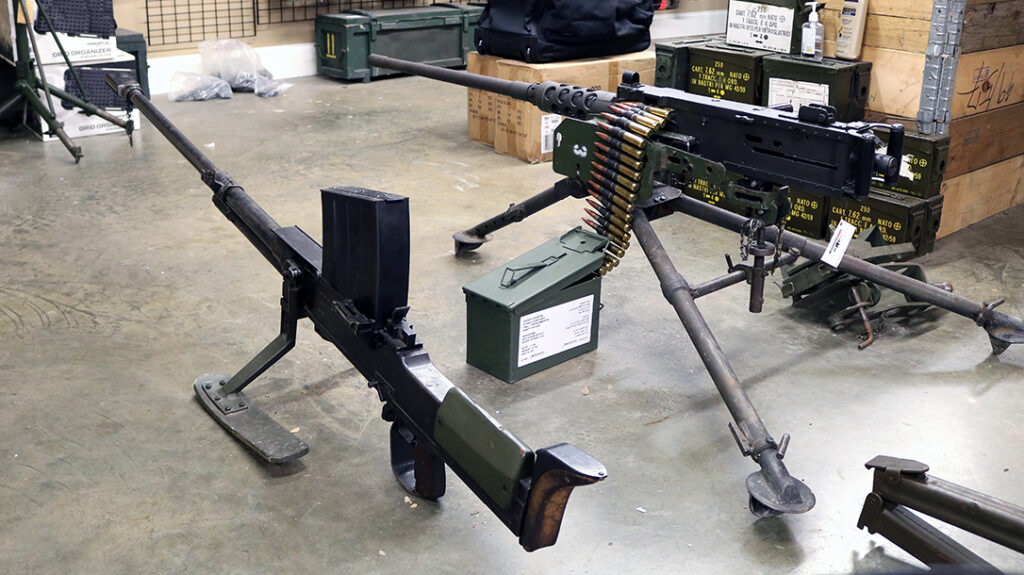
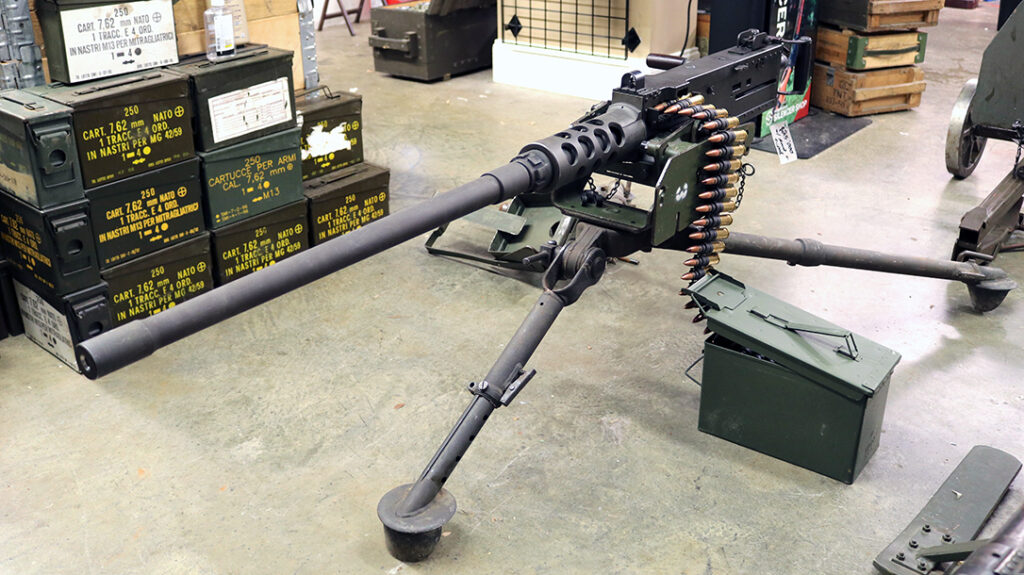
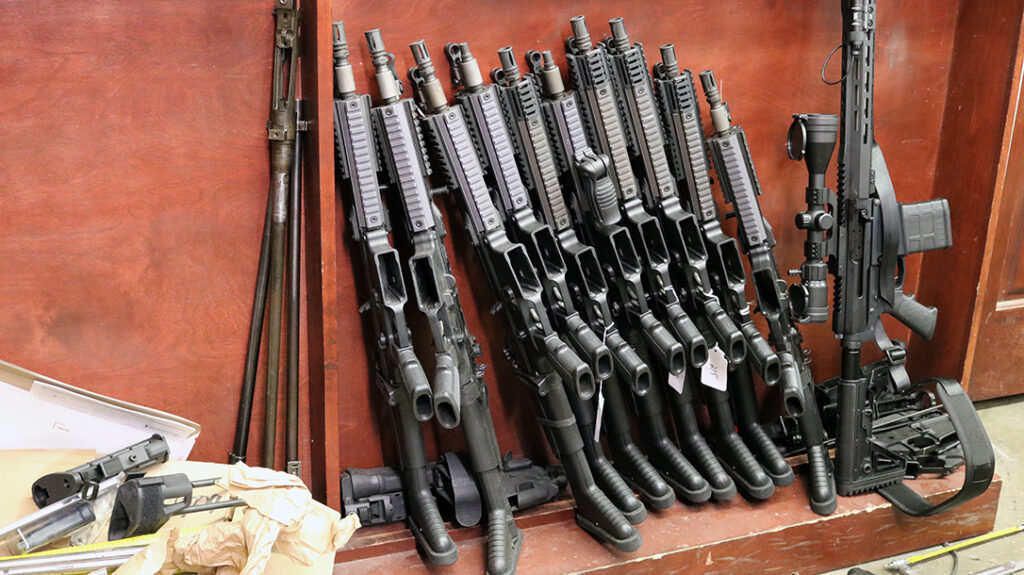
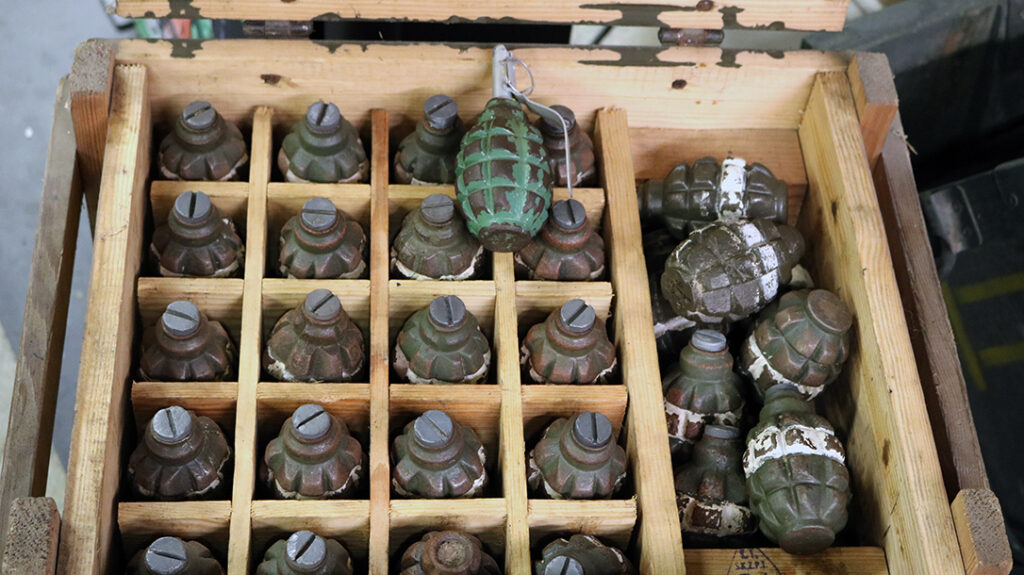
The first thing you notice is the Lahti 20mm anti-tank rifle sitting on the floor alongside a Ma Deuce .50-caliber machine gun on a tripod. Hanging on the wall is a live RPG-7, a PKM belt-fed machine gun, an M-60 with a sound suppressor, and a German MG34. A row of selective-fire, short-barreled FN SCAR carbines sits along one wall waiting to be cut up into parts kits. A bewildering array of black rifles blankets the walls. At any given time, a handful of local gun geeks congregates in the place griping about gun laws and generally solving the problems of the world. Throughout it all, sitting behind the counter is an amiable young guy with an ever-so-slight foreign accent. That’s 26-year-old Liam Little, owner and chief bottle washer at Mississippi Arms. Turns out Liam is a political refugee from Canada. His is a simply fascinating tale.
The Guy: Liam Little

Have you noticed that illegal immigration seems to be in the news a lot these days? With 320,000 migrant encounters on the southern border in December of 2023 alone and an estimated 16 million undocumented aliens already in the country, immigration will undoubtedly be the seminal issue of the upcoming Presidential election. It seems half the planet is flowing across our porous borders claiming asylum from something or other. Amid a veritable sea of unwashed humanity streaming into America illegally, Liam Little actually did it right.

Liam is a die-hard gun nerd with the poor grace to have been born in Montreal, Canada. If you are a gun guy, living in Canada these days is not philosophically unlike growing up in North Korea. The Canadian government just doesn’t trust its citizens with firearms anymore. When faced with a lifetime of unarmed servitude, Liam immigrated south.

Talking to Liam is a bit like chatting with Elon Musk. The guy just has an energy. He sees problems and engineers solutions. He is a natural businessman.

Liam is technically in the United States for law school on a student visa. When I was last there, he was complaining that they wouldn’t let him CLEP out of law school a year early. He runs his thriving gun business while simultaneously attending class at the University of Mississippi law school right down the road. The storefront is closed Sunday, Monday, and Tuesday so Liam can get his coursework done. He’s a pretty busy guy.

Draconian Politics

So, how does a kid from Canada in the country on a student visa for law school legally own a machine gun business? For starters, you have to be really smart and know the law really well. Then you just have to have the drive. Liam’s motivation is a pure and holy quest for freedom.

At a time when disdain for America seems to be the engine that propels the radical Left to ever more-rarefied attacks on individual liberty, Liam has tasted the pure elixir of freedom and just can’t get enough. As a burgeoning lawyer, he knows the rules and goes to meticulous lengths to work within them. He obtained the requisite licenses to run his thriving gun business all with Uncle Sam’s blessings. I’ll spare you the details except to say that his approach was undeniably elegant.

Like most people I have known who came to America seeking political freedom, Liam has little use for those who denigrate the United States. Most folks who gripe about America have simply never lived anyplace else. Liam cannot stand Justin Trudeau and his mob of meddlesome Left-wing socialists up north. He knows from personal experience what it is like to live in a place where gun ownership is prohibited and cherishes the unique liberties we enjoy in America. His life goal is to fully assimilate into our culture and make his way in the gun business.
Details

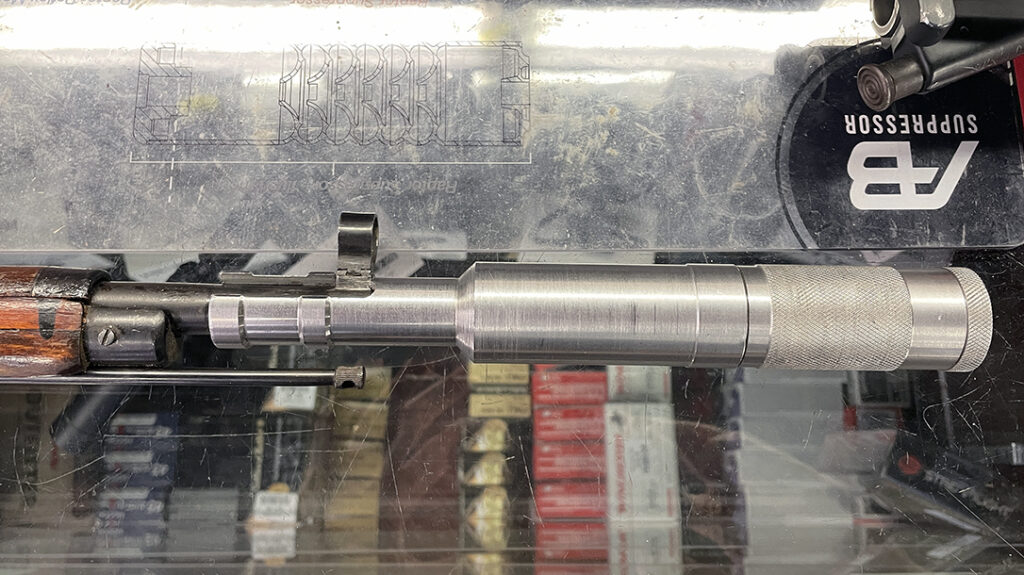
It’s worth a surf over to Liam’s website. His home-grown .22 rimfire cans will run $235 apiece. When I was there he showed me prototypes for a replica WW2-vintage Soviet Bramit suppressor. The Bramit can slips over the muzzle of a Mosin-Nagant bolt-action rifle and locks in place with a twist. Like the originals, there is ballistic data engraved on the side to accommodate reduced-charge subsonic loads.
Russian grunts in WW2 were trained to pull the bullets from standard 7.62x54mm ball rounds and dump part of the powder charge before reseating the bullets manually. In so doing they converted their standard bolt-action infantry rifles into short-range covert subsonic sniper tools. They also made similar cans for the M1895 Nagant revolver. Liam is planning on manufacturing those as well. He really does have some extraordinary projects in the works. I ordered myself one of his .22 cans on my first visit to the store.

Ruminations

We gripe about American gun laws all the time, and rightly so. Without constant vigilance the freedom-averse hoplophobes in Washington will invariably strip our rights away just as their counterparts did up north. However, for the time being at least, we still enjoy unrivaled access to firearms for both personal protection and recreation.

Liam Little is the real deal. Raised in a socialist paradise, Liam came to America seeking the purist expression of personal freedom on planet Earth. Liam personifies the American dream in the Information Age. Unlike so many other immigrants, however, he is doing so legally through personal force of will, detailed knowledge of the law, and raw, unfiltered heart.

The next time you need some gun widget, surf on over to MississippiArms.com and see if Liam has it in stock. If ever you are passing through Oxford, Mississippi, on a Wednesday through Saturday, do yourself a favor and drop by the store for a chat. Mississippi Arms is a cool place, and Liam Little is a cool guy. Mississippi Arms is where freedom thrives.

Categories
California You have to be kidding, right!?!

The Los Angeles Nazi Bunker

Categories
A Victory! All About Guns War

The Unknown “Ace Killer” of North Africa in World War II

Categories
War You have to be kidding, right!?!

U.S Green Berets and Russian Spetsnaz Joint Fire Fight

Categories
A Victory!

ATF Post Chevron

Categories
A Victory!

What SUPCO’s Chevron Deference decision means for gun owners and the ATF by Lee Williams

Much of the coverage of the U.S. Supreme Court’s recent decision to overturn the Chevron Deference doctrine suffers from one of two problems: Either it’s written by lawyers for lawyers and is therefore unintelligible for anyone without a juris doctor, or it’s written by the corporate media and is chock-full of errors, omissions and untruths.

Bill Sack, director of legal operations for the Second Amendment Foundation, agreed to help clarify this landmark Supreme Court decision, which it turns out is good for gun owners and bad for the ATF.

Q: What is the Chevron Deference doctrine?

A: “By a vote of 6-3, the justices overruled their landmark 1984 decision in Chevron U.S.A., Inc. v. Natural Resources Defense Council, Inc., which gave rise to the doctrine known as  Chevron Deference. Under that doctrine, if Congress has not directly addressed the question at the center of a dispute, a court was required to uphold the agency’s interpretation of the statute as long as it was reasonable.

What the Chevron Deference doctrine did was when administrative agencies write regulations, they often will have their own administrative courts that interpret the regulations the agency has drawn up.

For example, if the EPA makes a regulation that says a factory can only put out so much pollution, and there is a question as to whether a specific factory violated the regulation, the first place the factory has to go is the EPA’s administrative court, where an EPA administrative judge will interpret the EPA’s regulations.

If the factory is unsatisfied with the EPA judge’s decision, they can appeal to federal court. What Chevron Deference did was this: If the administrative court’s decision was appealed, the federal court was then supposed to be heavily deferential to the findings of that administrative court.

Basically, the doctrine put a thumb on the scale in favor of the administrative agency.

The federal court was supposed to give a lot of deference to what the administrative agency found. From a liberty perspective, this is a separation of powers problem. The administrative agency, as an executive agency, is supposed to enforce the law.

It’s not supposed to write the law. It’s not supposed to interpret the law. These alphabet agencies were writing regulations, which is a legislative function. They were enforcing the regulations, an executive function, and then they were interpreting the regulations, which is a judicial function.

The ATF and the alphabet agencies were doing the jobs of all three branches of government and if challenged, the federal courts were supposed to defer to what their administrative courts found. Even if the federal court thought the agency’s administrative court got it wrong, they didn’t always overrule the decision.

They believed that these agencies were the experts, who were best at administering and interpreting the own regulations. For example, the courts acted like since the EPA found that the EPA did nothing wrong, we’ll defer to them since they’re the experts.”

Q: What specifically did the U.S. Supreme Court decide?

A: “Chevron was overturned formally based on the Administrative Procedures Act, which sets out the procedures that federal agencies must follow as well as instructions for the courts to review actions by those agencies. The Supreme Court decided that this deference was unlawful. The Supreme Court said federal courts should start from scratch, rather than showing deference to the alphabet agencies. The High Court removed their thumb from the scale.”

Q: How will this decision affect the ATF?

A: “Hopefully, it tones down all of the administrative agencies because it returns power to the judiciary. It should tone down the ATF just like the rest. They can no longer adjudicate their own rules and say, ‘we’re right because we said we’re right.’

The writing has been on the wall for some time that Chevron would get knocked down. In a few of the (Administrative Procedure Act) challenges, the ATF has said they are not relying on Chevron to make their point. I suspect they didn’t want to hang their hat on Chevron. During the pistol brace and bump-stock cases, the ATF specifically said they were not relying on Chevron Deference.

If Chevron Deference were still alive, the ATF could write a rule like pistol braces. If someone was prosecuted for it and believed they shouldn’t have been found guilty in an ATF court, the ATF could rely on Chevron Deference during the appeal.

It was a big tool that every administrative agency had in their quiver.”

Q: How will the Supreme Court’s decision affect cases already in litigation, such as bump-stocks, pistol braces, frame and receiver and who needs an FFL?

A: “I don’t believe it will affect any of the current cases against ATF because the ATF has already disclaimed using Chevron.”

Q: Will this decision have any impact on the hundreds of gun dealers who have had their Federal Firearm Licenses revoked by the ATF for minor clerical reasons? (This question was posed to Adam Kraut, the Second Amendment Foundation’s executive director.)

A: “No. Revocation is entirely within the administrative process. The ATF only has to show a single willful violation. It’s not ambiguous where it would be difficult to ascertain what Congress meant. The courts have defined what willful is – they did something the law said they can’t do. Whether it was intentional, or they transposed some numbers, it’s still willful. There’s no deference in that regard. They don’t have to defer to the ATF to interpret anything,” Kraut said.

Q: Do gun owners still need to go through the ATF’s administrative process or can they now go straight to federal court?

A: “They still have administrative courts. They will still adjudicate violations of their own regulations, but if you want to appeal, the federal court has much greater leeway to overturn the administrative agencies with Chevron gone. The courts should be much better equipped to keep the administrative state in check,” Sack said.

Q: How will the Supreme Court’s decision affect gun owners?

A: “Big picture – for ATF and all of the other administrative agencies – it will hold their feet to the fire to interpret their own regulations fairly.”

Categories
A Victory! Ammo You have to be kidding, right!?!

Oklahoma, Alabama Now Have AI-Powered Vending Machines That Sell Bullets By Lucas Ropek

In a questionable new trend, supermarkets in the South now seem to be selling bullets right out of a dispenser.

It’s no secret that Americans love guns. Not only do nearly half of Americans say they live in a household with guns, but the U.S. beats out every other nation on Earth when it comes to gun density (the 2nd most gun-dense country is Yemen, and it’s not even close). The U.S. is actually the only country that has more guns than people. Given all that, it’s not much of a surprise that, in some states, you can now walk into a grocery store and buy bullets from a vending machine as if you were ordering a candy bar or a soda.

Well, sorta. Not quite. The vending machine company behind this new trend, American Rounds, says it uses artificial intelligence and facial recognition technologies to verify that buyers are of legal age to buy bullets. So it’s a slightly more rigorous process than buying a Twix.

There are shockingly few regulations around ammunition purchases in the U.S., but some of the few that exist are age-based. Federal law says you have to be at least 18 years old to buy ammunition for long guns, like rifles and shotguns, and if you want to buy bullets for handguns, you have to be at least 21. As such, American Rounds has created an identity verification mechanism for its bullet vending machines that can supposedly verify how old the person buying the ammunition is.

“Our smart retail automated ammo dispensers have built-in AI technology, card scanning capability and facial recognition software,” the company’s website states. “Each piece of software works together to verify the person using the machine matches the identification scanned.”

Cleveland.com originally reported on the proliferation of American Rounds’ machines, writing that they were currently available at six locations in Oklahoma and Alabama. On Friday, a local news outlet in Alabama reported that a store in Tuscaloosa had removed one of the machines after “the legality of the machine was questioned” at a city council meeting. The city’s legal department admitted the machines were legal if they met proper zoning requirements. The store has said that it “removed the machine on July 3rd because of a lack of sales,” the outlet reported.

Gizmodo reached out to American Rounds for more information about their business and will update this story if it responds.

Categories
A Victory! All About Guns Anti Civil Rights ideas & "Friends" Gun Fearing Wussies

Supreme Court Smacks Down NY’s CCW Law

New York Gov. Kathy Hochul at a recent gun violence prevention convention. (Photo: Hochul/Ny.gov)

Today, the Supreme Court gave New York’s “Concealed Carry Improvement Act” the boot, thanks to a challenge led by Gun Owners of America (GOA) and Gun Owners Foundation (GOF).

GOA and GOF weren’t messing around when they filed their petition back in February.

They argued that the Second Circuit ignored the Supreme Court’s precedent from the New York State Rifle & Pistol Association v. Bruen case.

The petition took aim at parts of the law they deemed unconstitutional, like the “good moral character” requirement for concealed carry permits.

After the Bruen decision in 2022, Gov. Kathy Hochul and the Albany crew rushed to pass this new law, but it turned out to be even more restrictive than the last one that got shot down.

GOA quickly stepped up to challenge it.

Even though GOA managed to get a preliminary injunction to block some parts of the law, the Second Circuit mostly reversed it.

The controversial law demanded that applicants for a concealed carry license prove their “good moral character,” undergo in-person interviews with law enforcement, provide four character references, and complete 18 hours of training—way more than the previous 4-hour requirement.

Erich Pratt, GOA’s Senior Vice President, didn’t hold back his excitement:

“New York’s anti-gun politicians were quick to double down after the Bruen decision, but today they’ve been smacked down again,” he said in a press release.

“With the High Court making clear the Second Circuit got it wrong and by remanding the case back to the lower court, the High Court is forcing New York’s politicians to eat a huge plate of humble pie,” he continued. “We look forward to continuing the fight for New Yorkers’ right to carry – without government pre-requisites.”

This Supreme Court decision marks a big win in the ongoing battle for gun rights in New York.

Categories
This great Nation & Its People Well I thought it was funny! You have to be kidding, right!?!

Well thats awkward & something they did not mention in High School!

Categories
A Victory!

What the 4th is really about