When considering the origins of legendary cocktails, it’s doubtful that Egypt is the first place to spring into anyone’s mind. Like many culinary innovations made during World War II, “The Suffering Bastard” is a concoction birthed from a world of limited supplies in which everyone had to make do with whatever they could get their hands on – and it shows.
The Suffering Bastard is a legendary beverage, created by a legendary barman, in time and place where new legends were born every day. The unlikely mixture is said to have turned the tides of the war against Erwin Rommel’s Afrika Corps in Egypt. True or not, it succeeded in its original mission: curing the hangovers of British troops so they could push Rommel back to Tunisia.
In 1941, World War II was not going well for the British Empire. Even though the previous year saw British and Imperial troops capture more than 100,000 Italian Axis troops in North Africa, Hitler soon sent in his vaunted Afrika Corps to bolster Axis forces in the region.
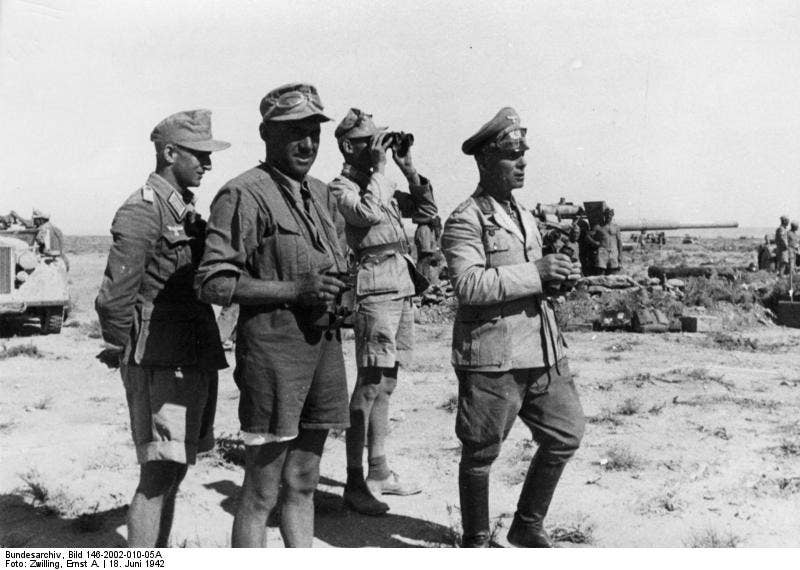
Field Marshal Erwin Rommel with staff in North Africa, 1942. (Bundeswehr Archives)
Up against crack German troops led by capable tank strategist and Field Marshal, Erwin Rommel, the British experienced a number of defeats in the early months of 1941. They were pushed out of Libya and the lines were within 150 miles of the Egyptian capital of Cairo. His goal was to capture the Suez Canal and cut the British Empire in two.
During the Battle of El-Alamein, Rommel was quoted as saying “I’ll be drinking champagne in the master suite at Shepheard’s soon,” referring to the world-famous Shepheard’s Hotel in Cairo. Inside the hotel was the well-known Long Bar and behind that bar was bartender, Joe Scialom, whose stories could rival anyone’s, from Ernest Hemingway to Ian Fleming.
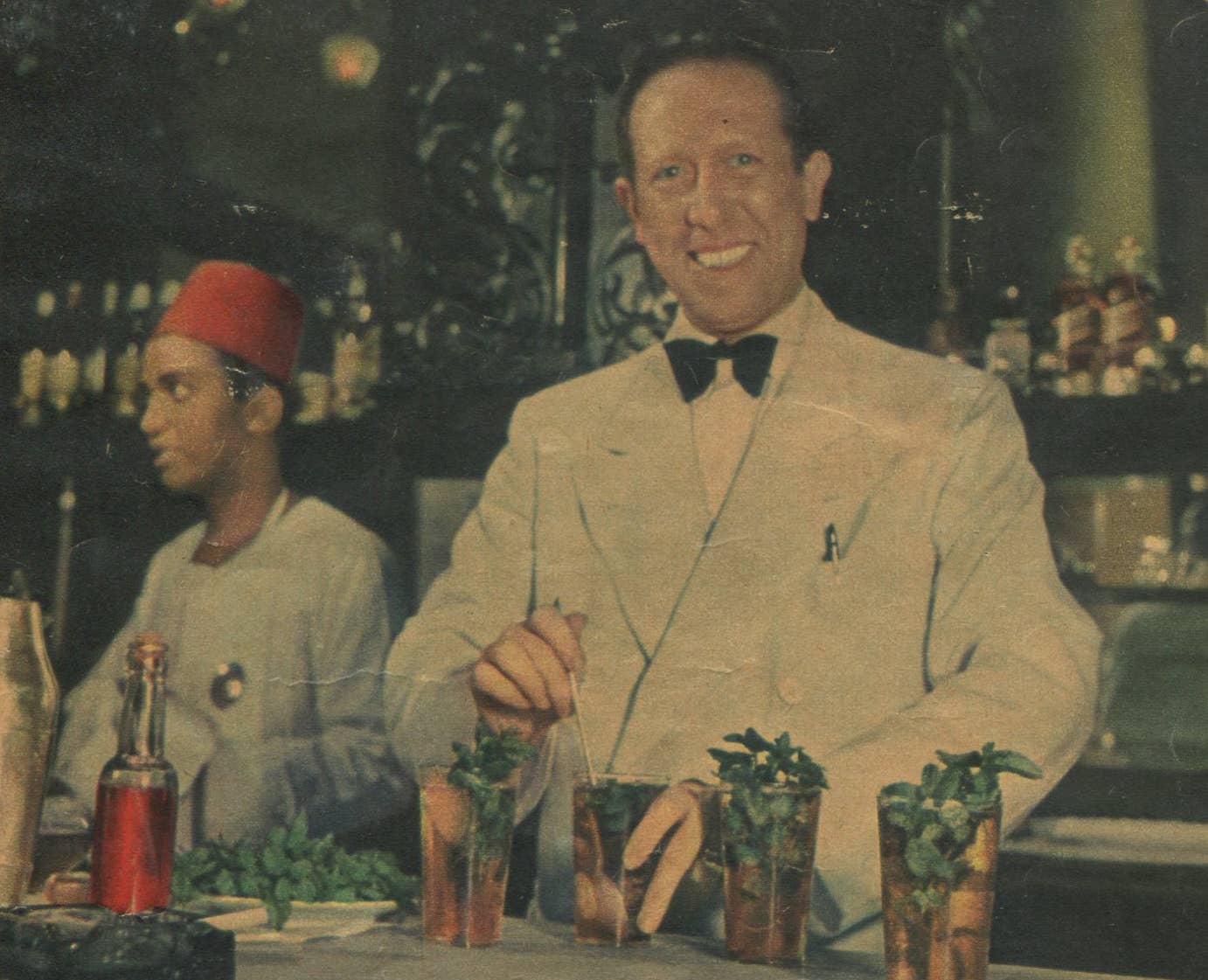
Scialom behind the Long Bar in Cairo’s Shepheard’s Hotel.
Scialom was a Jewish Egyptian with Italian roots. Born in Egypt, he was a trained chemist who worked in Sudan in his formative years but soon found he enjoyed applying the principles of chemistry to making drinks. The chemist-turned-barman who spoke eight languages would eventually travel the world over, to Cairo, Havana, London, Paris, Rome, Istanbul, and Manhattan, drinking alongside folks like Winston Churchill and Conrad Hilton. Much of that would come later, however. In 1941, he was the barkeep at the Long Bar and he was faced with a unique problem.
The war made it very difficult to get good liquor in Egypt. British officers resorted to drinking liquor that wasn’t made of such high quality and soon began complaining about terrible hangovers. In an effort to do his part for the British, Scialom set out to make a drink that would give them the effect they wanted while curing their inevitable hangovers. He used an unlikely combination of bourbon and gin along with added lime, ginger ale, and bitters to create a drink that did the job perfectly.
Many variations on the original recipe exist, to include ingredients like pineapple syrup and rum, but the original Suffering Bastard used bourbon and gin as its base.
The first Battle of El Alamein in 1942 resulted in a stalemate. The Axis supply lines from Libya were stretched out to their breaking point and Rommel could not press on to Alexandria. Before the second Battle of El Alamein, the ranking British general, Claude Auchinleck, was replaced. His spot eventually taken by one General Bernard Montgomery. The next time the two sides met at El Alamein, Montgomery was in command and British hangovers were a thing of the past. Monty and the British Empire troops turned Rommel away and pushed him westward toward an eventual defeat.
We have never been closer to nuclear war than we are right now. If the conflict in Ukraine sparks a large scale nuclear war between the United States and Russia, billions of people could die.
This is why so many of us desperately want leaders from both sides to sit down at the negotiating table and try to work out their differences peacefully. Perhaps a peaceful solution is not possible, but for the good of humanity they should at least make an attempt. Because as things stand right now, all it is going to take is one mistake for the world to be plunged into an unthinkable nuclear cataclysm.
According to author Annie Jacobsen, the U.S. has a network of satellites that is constantly watching for an ICBM launch from one of our enemies…
“The US Defense Department has a early warning system. And the system in space is called SBIRS, a constellation of satellites that is keeping an eye on all of America’s enemies.”
“So the moment an ICBM launches, they see the hot rocket exhaust on the ICBM a fraction of a second after it launches. And so there begins this horrifying policy called launch on warning, and that’s the US counterattack.
“The reason that the United States is so ferociously watching for a nuclear launch somewhere around the globe is so that the nuclear command and control system in the US can move into action to immediately make a counterstrike.
“That policy, launch on warning, is exactly like it says, it means the United States will not wait to absorb a nuclear attack. It will launch nuclear weapons in response before the bomb actually hits.”
In the event of a surprise first strike, there would only be a handful of minutes to get the president out of bed and decide what to do.
Needless to say, the president would not want to launch a counterstrike if it is a false alarm.
Because once the missiles are in the air, there is no calling them back.
Microseconds into the explosion of a nuclear weapon, energy released in the form of X-rays heats the surrounding environment, forming a fireball of superheated air. Inside the fireball, the temperature and pressure are so extreme that all matter is rendered into a hot plasma of bare nuclei and subatomic particles, as is the case in the Sun’s multi-million-degree core.
The fireball following the airburst explosion of a 300-kiloton nuclear weapon—like the W87 thermonuclear warhead deployed on the Minuteman III missiles currently in service in the US nuclear arsenal—can grow to more than 600 meters (2,000 feet) in diameter and stays blindingly luminous for several seconds, before its surface cools.
The light radiated by the fireball’s heat—accounting for more than one-third of the thermonuclear weapon’s explosive energy—will be so intense that it ignites fires and causes severe burns at great distances. The thermal flash from a 300-kiloton nuclear weapon could cause first-degree burns as far as 13 kilometers (8 miles) from ground zero.
If you are at ground zero, you will have zero chance of surviving.
According to a study that was conducted several years ago, approximately 34 million people would die during the first few hours of a large scale nuclear war between the United States and Russia.
Using archived weather data over 48-hour periods across a number of dates in 2021 to simulate the expected radioactive plume, the scientists found that the West Coast states were the lowest risk due to a prevailing easterly wind.
However, depending on the exact wind direction, the worst fallout could fall over any part of the U.S. and Canada east of Idaho. Based on weather patterns on December 2, 2021, Chicago, Illinois and D.C., among other population centers, would be in the direct path of a fatal dose of radiation.
In a worst-case scenario, almost all of Montana and North Dakota, as well as parts of Nebraska, Colorado, Wyoming, South Dakota and Kansas would receive a dose more than 10 times what is considered lethal, resulting in deaths in a matter of days. Most of the Midwest would receive a lethal dose, while elsewhere would see deaths occur in weeks.
Radioactive fallout would kill far more people than the initial explosions would.
But the “good news” is that radiation levels would dissipate fairly rapidly.
So if you are far enough away from a ground zero and you are able to survive the initial tsunami of radioactive fallout, it will eventually be safe to go outside again.
As horrific as those statistics are, the tens to hundreds of millions of people dead and injured within the first few days of a nuclear conflict would only be the beginnings of a catastrophe that eventually will encompass the whole world.
Global climatic changes, widespread radioactive contamination, and societal collapse virtually everywhere could be the reality that survivors of a nuclear war would contend with for many decades.
Two years after any nuclear war—small or large—famine alone could be more than 10 times as deadly as the hundreds of bomb blasts involved in the war itself.
Ultimately, nuclear winter will kill more people than anything else.
For those of us that live in the northern hemisphere, it will be exceedingly difficult to grow much of anything once temperatures drop far below normal…
This makes Earth freezing cold even during the summer, with farmland in Kansas cooling by about 20 degrees centigrade (about 40 degrees Fahrenheit), and other regions cooling almost twice as much. A recent scientific paper estimates that over 5 billion people could starve to death, including around 99% of those in the US, Europe, Russia, and China – because most black carbon smoke stays in the Northern hemisphere where it’s produced, and because temperature drops harm agriculture more at high latitudes.
Can you imagine what our world would look like if such a war actually happened?
Unfortunately, relations between the United States and Russia are the worst that they have ever been, and we are getting closer to a nuclear war with each passing day.
Politicians in the western world assume that the Russians would never risk a nuclear war because the consequences would be so apocalyptic for everyone.
But Russian politicians have warned us over and over again that if we push Russia too far there will be a nuclear war.
And as I detailed in my new book entitled “Chaos”, the Russians have been feverishly preparing to fight a nuclear war for many years.
They know that there are no “winners” in a nuclear war.
But they also know that whoever strikes first will have the best chance of surviving one.
Right now, Russian forces are advancing and Ukrainian leaders are becoming increasingly desperate…
“Western leaders are bracing for the Ukrainian army’s collapse as it has only been able to slow the advance of Russian forces amid weapons and ammunition shortages, the Times writes.
In its editorial, titled ‘It’s time we talked about the fall of Kiev’, the paper points out that ‘contrary to the predominant view that this is a perpetual frozen conflict, with neither side able to win a decisive advantage, the front line is bitterly contested and there is a real risk of Ukrainian forces being pushed back’.
‘This is the nightmare scenario now being contemplated by western policymakers’, the Times notes.
Russia’s advance ‘would obviously be disastrous for the Ukrainians’. ‘It would also confront the West with all manner of tough challenges’, the newspaper says. ‘The consequences of a partial or complete defeat would be calamitous in ways western populations have barely begun to understand.
But we have a lazy habit in the comfortable West – away from Europe’s front line in east and south Ukraine – of wishful thinking and being unprepared for bad surprises’, the Times emphasizes.”
Ukrainian officials realize that the only way they can win the war is for NATO forces to intervene, and some western leaders such as French President Emmanuel Macron are very open to the idea.
But Vladimir Putin has warned that this will put us one step away from nuclear war, and he has decided to conscript another 150,000 men into the Russian military…
Vladimir Putin has called up another 150,000 men for Russian army conscription, the highest figure for eight years.
This comes as Orthodox priests have been ordered to say prayers in church for the dictator’s victory in the war.
The recruits are aged 18 to 30 and will be conscripted between 1 April and 15 July amid his war against Ukraine.
The Russians are convinced that western leaders want to bring down the Russian government and divide Russia up into a bunch of smaller pieces.
On the other side, politicians in the western world are determined to do “whatever it takes” to keep the Russians from winning in Ukraine.
Both sides are being unreasonable and paranoid, and that is a recipe for disaster.
All it is going to take is one mistake to unleash a nuclear cataclysm, and billions of lives hang in the balance.
You really wouldn’t think there should be a sign on these
things reading, “Do Not Eat,” but you just never know.
I don’t know where you stand on the subject of demonic possession, but I made an acquaintance at a big inner-city hospital who offered some unique insights on the subject.
Modern medicine excels at quantifying things. If more than two people suddenly start having similar symptoms, some research physician someplace is going to hang an eponym on it and celebrate having discovered a new disease.
As an example, the Fregoli Delusion is a delusional misidentification syndrome wherein the sufferer is convinced that different individuals are, in fact, a single person capable of changing their appearance at will. It was named after 19th-century Italian actor Leopoldo Fregoli. Fregoli was notorious for his ability to alter his appearance during a stage production. As you might imagine, not a lot of folks suffer from this disease.
One of the more common forms of psychosis, however, is paranoid schizophrenia. This unfortunate malady typically results in delusions and hallucinations, usually auditory, that blur the lines between what is real and what isn’t. While there are some great medications that can help treat this problem, if left to its own devices, paranoid schizophrenia can make it all but impossible to lead a normal life. And then there was Robert, who took everything to the next level.
I met Robert on a Monday morning. While on my inpatient psych rotation as a medical resident, I got weekends off. That meant that if someone showed up acting strangely in the ER over the weekend, the ER guys would just tuck them away on the psych floor. As a result, you just never knew what would be waiting for you when you showed up for work on Monday morning.
Robert was a simply incredible physical specimen. He looked like an African-American Arnold Schwarzenegger circa 1984. The guy was just huge. He was also articulate, engaging and friendly. He began acting weird over the weekend, so his family took him to the ER. Once there, he swallowed a drywall screw and the hypodermic needle off of a syringe he retrieved from the sharps container. That earned him a ticket to the psych floor.
Robert, whose name has been changed to protect privacy, shot a total stranger with a .38 revolver for the most unsettling of reasons.
Robert had worked in a sketchy part of town, so he began carrying a .38 revolver for protection. One day, he passed several Hispanic gentlemen on the side of the road. One of the voices in his head told him that a particular member of the group was going to hurt somebody. He further explained that this individual, if left to his own devices, might actually hurt Robert.
Therefore, he drew his weapon and shot a total stranger five times in the belly because the voices in his head told him to do so. This got the attention of local law enforcement. Robert subsequently spent the next five years in prison. As near as I could tell, the only thing he did for those five years was lift weights.
Robert had only been out of prison for about 30 days when we met. He stopped taking his medications, something the voices in his head directed him to do whenever they needed him to be “thinking clearly,” and, predictably, began acting weird. We got his meds regulated, packaged him up, and sent him home.
Roughly one-fifth of Americans suffer from some sort of diagnosable mental illness. Fortunately, very few are as severe as Robert. While his chart proclaimed that he suffered from paranoid schizophrenia, Robert was convinced that it was something altogether more.
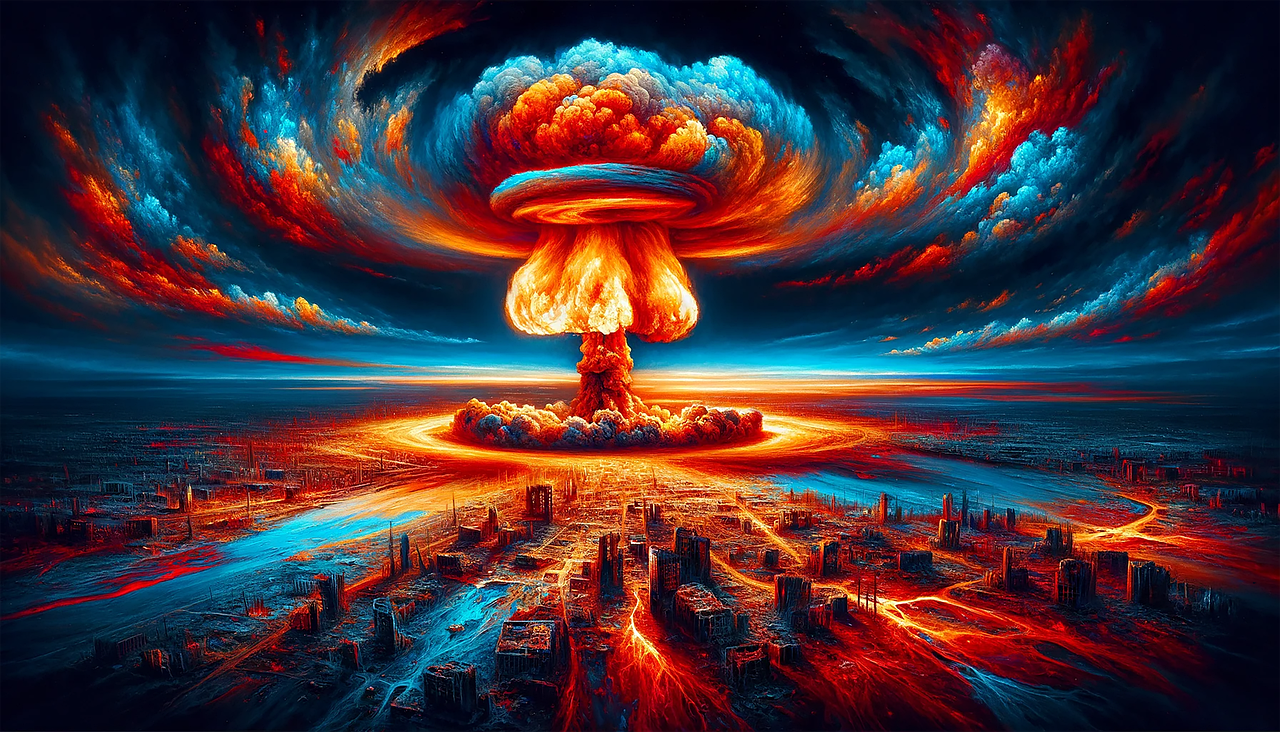 We have never been closer to nuclear war than we are right now. If the conflict in Ukraine sparks a large scale nuclear war between the United States and Russia, billions of people could die.