
Author: Grumpy
The Man is just amazing and the next time I am in the UK. I am going to buy a bottle and see how good it is! Grumpy
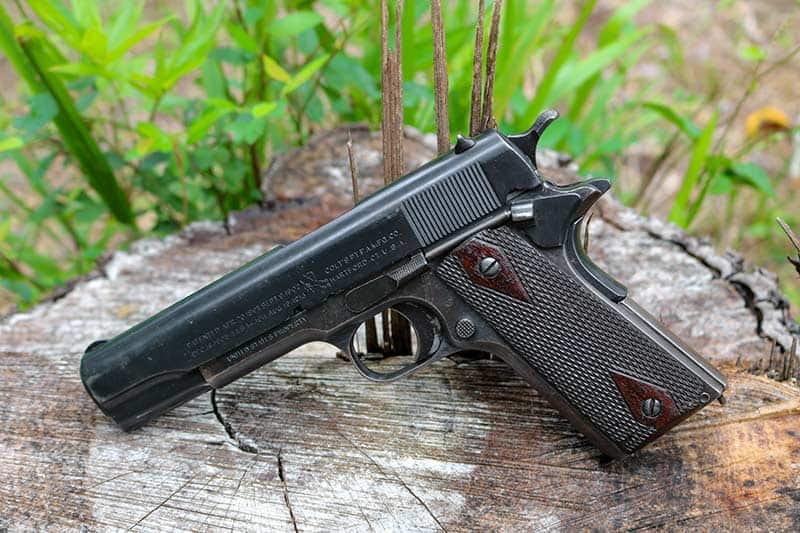
The Colt M1911 automatic pistol remains a competitive defensive tool even today. Back in 1934, it was a paradigm-shifting design.

Baby Face Nelson’s handgun of choice was the Colt M1911. Some were.38 Super, while others were .45 ACP. He used both the stock version as well as full-auto conversions made by famed mob gunsmith Hyman Lebman.
Some folks just come from the factory broken. How much of it is nature versus nurture has occupied psychologists for ages. Oftentimes, those broken people live out their lives until they do something sufficiently egregious as to earn incarceration and anonymity. Others can be a bit flashier.
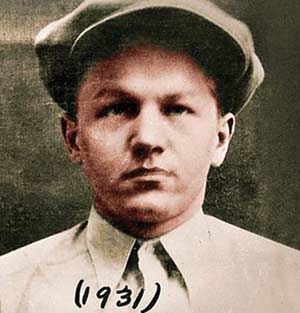
Lester Joseph Gillis, aka Baby Face Nelson, was tragically born without a conscience. Photo: Public Domain
The Origins of the Monster
Lester Joseph Gillis was born in December 1908 in Chicago. He shot his first man at age 12. Gillis happened upon a handgun and popped a buddy in the jaw over some perceived slight or other. He spent the next year in reform school but stole his first car immediately upon his release. This earned him another year and a half behind bars.
Such aberrant behavior has a name these days. Had Lester Gillis been born in the Information Age, he would have been diagnosed with antisocial personality disorderand put on all sorts of psychoactive medications. He then still would have pursued a life of crime and spent most of his adult life in prison.
As it was, Lester Gillis represented an odd convergence in the human species. A loving father, an affectionate husband and a born leader, Gillis was also a psychopath who came of age amidst the Great Depression. All that stuff synergistically combined to make him a legend.
Gillis learned his craft as part of a gang of “strippers.” Their MO involved stripping the tires off people’s cars and selling them on the black market. In his early 20s, he graduated to armed robbery.
His gang secured their victims with tape before ransacking their homes. They became known as the Tape Bandits in the press.
In a single hit on a magazine executive named Charles Richter in January of 1930, the Tape Bandits made off with $205,000 in jewelry. That would be about $3.6 million today. Once Gillis got a taste of the good life, he couldn’t stop.
One of his armed robbery victims later said of Gillis, “He had a baby face. He was good looking, hardly more than a boy, had dark hair and was wearing a grey topcoat and a brown felt hat, turned down brim.”
Gillis’ mates called him Jimmy. However, newspapermen coined the nom de guerre “Baby Face” Nelson. He carried that name with him to his grave. Thanks to his sordid profession, that didn’t take long.
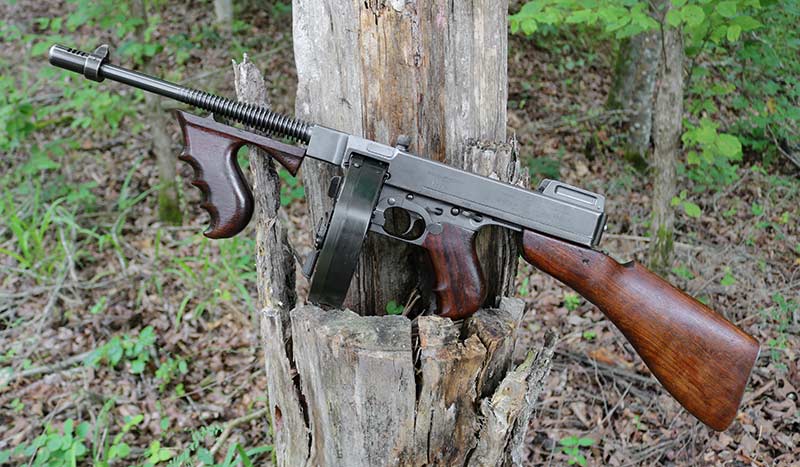
The M1921 Colt Thompson got all the press, but Depression-era gangsters used a wide variety of weapons. Many of them came from Hyman Lebman’s San Antonio gun shop.
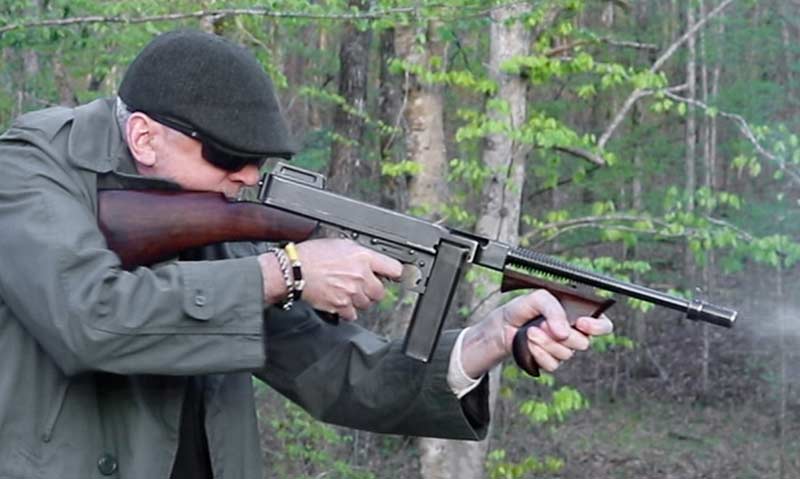
The M1921 Colt Thompson submachine gun was the ideal tool for the professional bank robber who was not overly concerned with collateral damage. When equipped with a 50-round drum, the Thompson was a devastating close-range weapon.
The Monster Comes of Age
What really set Nelson apart from his peers was his willingness to just blow people away as the need arose. He killed his first man, a robbery victim named Edwin Thompson when he was 22.
In 1933, during a getaway from a bank robbery in Brainerd, MN, Nelson sprayed a crowd of bystanders with his Thompson submachine gun. The following year he got cut off in traffic by a paint salesman in Chicago and shot the man to death.
Normally such a fulminant temper and congenital lack of conscience would be a bad thing. However, once Nelson met John Dillinger, he weaponized his psychopathy into something altogether marketable.
In April of 1934, Nelson, Dillinger, Dillinger’s best mate Homer Van Meter, John “Red” Hamilton, Tommy Carroll, Pat Reilly, Nelson’s wife Helen, and three bits of female arm candy descended upon the Little Bohemia Lodge in Manitowish Waters, WI, for some down time.
Emil Wanatka owned Little Bohemia. While playing cards with Dillinger, he noticed his holstered handgun and informed his wife. She had a friend call the feds. Legendary G-Man Melvin Purvis gathered a few FBI guys and hit the place. The end result was a bloodbath.
Eugene Boisneau, John Hoffman and John Morris were just three normal guys who had dropped by for the famed Little Bohemia $1 Sunday night special.
They were climbing into their 1933 Chevrolet Coupe just as the FBI agents arrived. It was dark, and somebody squeezed a trigger. Boisneau was killed outright. His two pals were shot to pieces but survived. Tragically, the gunfire also activated Dillinger and company.
Everyone but Nelson fled into the woods. Nelson just snatched up his Thompson and charged out the front door, exchanging fire with Purvis himself. His audacious assault bought him enough time to escape.
Nelson subsequently hijacked several cars and took a total of seven hostages. He winnowed the crop down to three and was climbing into yet another stolen vehicle when FBI agents Jay Newman and W. Carter Baum, along with local constable Carl Christensen, arrived. Nelson embraced the fog of war, confidently approaching their car and asking the men to identify themselves. The G-Men did so, and Nelson hosed them down with a full-auto M1911 pistol.
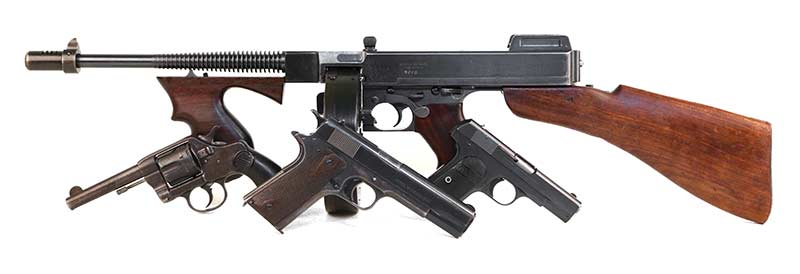
The Colt Thompson and the Colt M1911 pistol (below, center) made for a smart match for many a Depression-era criminal.

Gunsmith to the Stars
Hyman Lebman was a San Antonio gunsmith who serviced an eclectic clientele. He sold hunting weapons, cowboy boots and saddles upstairs in his shop at 111 South Flores Street.
However, he kept the really good stuff in the basement. Back before the 1934 National Firearms Act, there were literally no rules governing firearms. Machine guns were available over the counter, cash and carry. You didn’t have to show a driver’s license because nobody had a driver’s license. Lebman thrived in this space. More than a few Chicago gangsters vacationed in San Antonio as a result.
Lebman sold Thompson submachine guns as the opportunities arose. He was also known for two custom weapons in particular. He converted the Winchester M1907 rifle to full-auto and added a Cutts compensator, extended magazine and the vertical foregrip from a Tommy gun.
Homer van Meter used a Lebman M1907 to kill patrolman Howard Wagner during a bank robbery in South Bend, IN, in 1934. His masterwork, however, was what he called his baby machine gun. Hyman Lebman’s full-auto 1911 pistols raised the bar on concealable firepower.
Lebman offered these converted 1911 machine pistols in both .45 ACP and .38 Super. Some were selective fire, while others were full-auto-only. At one point, Lebman was testing an early prototype in his basement and shot a row of holes through the floor above, narrowly missing his son Marvin.
The guns could be had with a modified Cutts compensator, the foregrip from a Thompson submachine gun and an extended magazine packing either 18 or 22 rounds, depending upon the caliber. These Lebman mini machine guns cycled at more than 1,000 rpm.
In 1933, Nelson, his wife, Helen and their son, Ronald, along with infamous gangster Homer Van Meter, had Thanksgiving dinner with the Lebmans in their home. Nelson subsequently left with five full-auto babies in .38 Super, four standard Colt 1911 pistols in .45 ACP and a pair of Thompsons. Nelson gave $300 apiece for the Thompsons — 50% above retail.
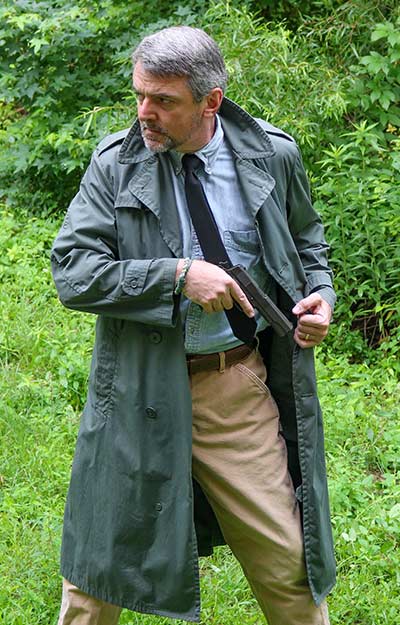
The Colt M1911 pistol was concealable, reliable, powerful and accurate. It was a common weapon for the motorized bandits of the 1930s.
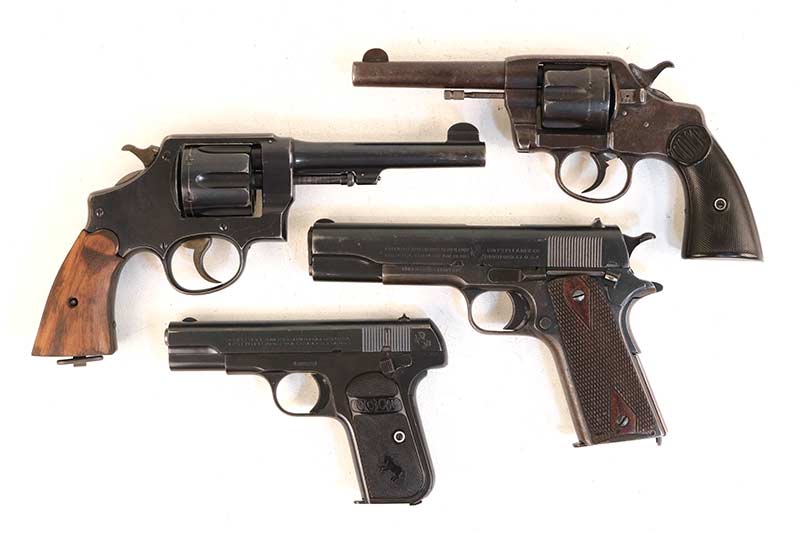
1930s-era criminals preferred handguns like these for their concealability and firepower.

This is the bulletproof vest Baby Face Nelson wore
during his bank robberies. Photo: FBI
The Death of the Monster
Following the demise of Dillinger and Van Meter at the hands of police, Nelson became the FBI’s Public Enemy Number 1.
On November 27, 1934, Gillis and John Paul Chase engaged in a shootout with federal agents Samuel Crowley and Herman Hollis at a turnout in Barrington, IL. Nelson killed the two G-Men with a Colt Monitor BAR but caught eight buckshot in his legs and a single .45 ACP bullet to the belly for his trouble.
The .45 ACP round punched through his liver and pancreas. Baby Face Nelson bled out and died later that evening in his wife Helen’s arms. He was 25 years old. It seems a fitting end for the serendipitous psychopath.
Hyman Lebman, for his part, had to stop his machine gun business after the passage of the 1934 NFA. However, he worked as a gunsmith in San Antonio into the 1970s. His son Marvin later described the visiting gangsters as “men in nice suits and hats.” Hyman Lebman, the unofficial armorer to the mob, eventually succumbed to Alzheimer’s disease in 1990.

There was a time, and it really wasn’t that long ago, when kids could vanish for an entire Saturday, come home covered in dirt, bruises, cactus needles, and questionable decisions, and nobody thought the world was ending.
You didn’t need a GPS tracker, a parental panic app, or a neighborhood alert system. You had streetlights. When they came on, you went home. That was the contract. Helmets were optional, scraped knees were expected, and if a kid got hurt, parents didn’t blame “society.” They blamed the kid, handed them a Band-Aid, and reminded them not to bleed on the carpet they’d worked overtime to afford. Parenting used to be honest like that.
Back then, “gun culture” wasn’t a culture; it was simply part of everyday life. Practically every household had a .22, a shotgun, or a revolver tucked somewhere between the tools and the fishing gear.
Nobody acted like they were living inside a political thriller. A firearm was just another tool, sitting comfortably next to the tackle box, the socket set, and the wooden spoon that doubled as a household disciplinary device with impressive range and velocity.
And here’s the part that would give modern activists heart palpitations: kids grew up around all of this and survived. Not because they were supernatural, but because the adults around them taught responsibility, consequences, and the revolutionary idea of not touching things that weren’t yours.
Somewhere between the mid-1990s and today, the country quietly shifted from raising resilient kids to manufacturing full-time catastrophists.
Fear became fashionable, outrage became profitable, and suddenly the same society that once trusted people to keep a .22 in the closet without imploding began treating lawful gun ownership like a moral disorder. The world didn’t get more dangerous — the communication did. Fear got Wi-Fi, outrage got an audience, and misinformation got a business plan.
Growing Up in the Last Era of Real Freedom
Kids of that era lived like part-time stunt performers without any union protections. Wide-open spaces were our playgrounds, and you could ride dirt bikes, go-karts, and ATCs (those unstable, glorious three-wheeled death traps) until the sun dipped behind the rooftops.

Every cactus needle, every bruised shin, and every busted knuckle came with a lesson attached. Neighborhoods were self-policing: every adult within a five-house radius had full authority to correct your behavior, and nobody called it “interference.” It was just called raising kids.
Firearms weren’t identity statements, political props, or moral tests. They were household fixtures. Pickup trucks with rifle racks weren’t symbols; they were just trucks.
Parents rolled through school pickup lines with a rifle behind the seat, and nobody fainted, panicked, or demanded a lockdown. People understood context back then. A gun in a truck meant hunting trip, ranch work, or routine life, not imminent doom.

Kids owned pocketknives, BB guns, and pellet rifles. Some had brass knuckles or Chinese throwing stars bought at swap meets during their “training to become backyard ninjas” phase.
They threw stars at old wood fences, cardboard boxes, and that one tree trunk that had seen better days. These weren’t signs of delinquency; they were signs of being a kid in an era where imagination, risk, and responsibility weren’t treated as threats.
And even when tempers flared, especially at those questionable weekend gatherings — fistfights settled more disputes with the guys who postured, provoked, and convinced themselves they were tough than anything else. Nobody reached for their parents’ firearms. It was unthinkable. There was an unspoken line between “having power” and “abusing power,” and everyone understood it instinctively.
That lesson didn’t require a campaign, a PSA, or a nonprofit with a multimillion-dollar CEO salary. It was just common sense.
The Age of Optics — From Fear to Virtue Signaling
By the time the 2000s rolled around, perception had officially replaced reality. The conversation around firearms wasn’t about responsibility or training anymore — it was about appearances, hashtags, and headlines.
Owning a gun had become a social statement, not just a personal choice. You were either seen as part of the “problem” or part of the “solution,” depending on which news network or social feed people followed. The same people who once respected their neighbors for doing and owning whatever the hell they wanted without raising an eyebrow were now side-eyeing them for simply exercising a right.
That shift didn’t happen overnight; it was carefully manufactured. Television networks learned that outrage paid the bills, and social media platforms learned it could be automated. Every viral story, every emotional clip, every grainy surveillance video of violence became instant ammunition for those pushing the idea that disarmament equals safety.
What used to be an honest debate about personal responsibility turned into a stage performance of virtue. Politicians began “doing something” for the cameras, not for the country. Celebrities who had armed bodyguards preached about “gun reform.” Corporate marketing departments started virtue signaling for clicks, boycotting firearm companies one month and selling violent movies or video games the next.
And the worst part? It worked. Fear became fashionable.
The new social currency wasn’t knowledge; it was outrage. People didn’t need to know how a firearm worked or what the Second Amendment actually meant. They just needed to repeat the right slogans: “No one needs an AR-15.” “Common sense gun laws.” “Weapons of war.” Those phrases became social passwords, proof that someone belonged to the “right” side of the conversation, whether they understood what they were saying or not.
Meanwhile, the people who actually lived with firearms, hunters, veterans, sport shooters, and everyday gun owners, were cast as relics from another era, dismissed as extremists for simply carrying on what their parents taught them.
It was cultural gas lighting on a national scale: take something ordinary, twist the language around it, and make it sound dangerous. That’s how the anti-gun movement grew, not through facts or function, but through framing. And that framing was no accident.
What Really Changed
When you step back and look at it, the contrast isn’t subtle; it’s obvious. The guns didn’t change, the people did. The same firearms that sat safely in the corner of someone’s bedroom decades ago are still the ones sitting in gun safes today, although the options now are far more numerous, and the coolness factor has definitely grown.
What’s different is the culture around them: the constant noise, the headlines that never stop, the algorithms that thrive on outrage, and the people who mistake feeling informed for actually being informed.
We used to be a country that trusted people to make their own decisions. If you wanted to hunt, you hunted. If you wanted a pistol in the glove box, nobody batted an eye. Freedom wasn’t micromanaged; it was expected. It came with risk, but it also came with pride and responsibility.
Now, that same freedom is treated like a liability. Somewhere along the way, being a responsible gun owner stopped being normal and started being political. Every purchase, every post, every opinion gets filtered through a lens of suspicion, as if believing in the Second Amendment makes someone dangerous.
But the truth is more straightforward than all the noise: the gun was never the problem.
The real problem is what happens when a society trades courage for comfort — when it stops trusting its citizens and starts worshiping control.
And the news media and social media have created a spread of information so instantaneous and on such a massive scale that the human brain becomes overwhelmed — conditioned to believe whatever problem a politician wants to project.
It’s a diversion from reality, a distraction from what actually affects each and every individual in this country.
We don’t need more fear. We need more responsibility. We need to get back to raising adults who understand that laws or algorithms don’t guarantee safety; it’s earned through respect, education, and discipline.
The same values that kept a generation of kids safe while shooting BB guns, throwing Chinese stars at the old sap-ridden tree that would never die but continued to flourish, riding their dirt bikes and ATCs (now called ATVs) in the open spaces just a few miles from home, and dodging the farmers in the orange groves who shot salt pellets at kids cutting through on their way to the open fields, are the same ones that can keep this country grounded today.
If there’s one thing worth remembering, it’s this: freedom will always come with risk — and that’s what makes it worth defending.
AUTHOR’S NOTE
Thanks for reading, and if this reminded you of an era when kids survived childhood with BB guns, dirt bikes, hose water, and a healthy fear of disappointing their parents, feel free to share it. Today’s profitable anti-gun movement is loud, emotional, and honestly a little embarrassing; a cocktail of misinformation, disinformation, and performative panic. But it doesn’t have to stay that way.

