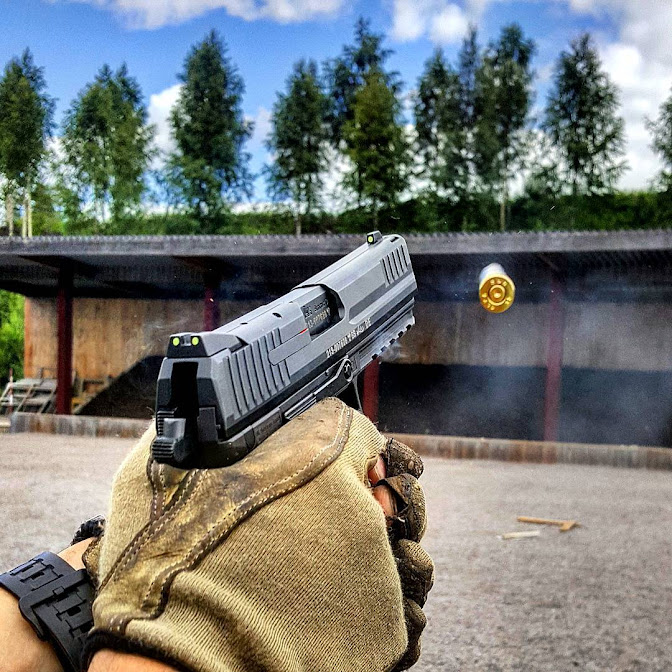
What a charming phrase – To fix their minds so that they could go back. Grumpy
Author: Grumpy

The 6.8 SPC cartridge was developed due to troubling reports about failures of the 5.56 NATO cartridge to incapacitate enemy soldiers. During a development project led by a soldier of the 5th Special Forces Group and a member of the Army Marksmanship Unit, the goal was to create an enhanced rifle cartridge that was compatible with the M4 carbine—AR15—with minimal changes to the weapon.
This started with the 6 mm PPC, which ironically is essentially the same cartridge as the recently released 6 mm ARC, but the project engineers necked it up to 6.5 mm. For some more irony, this is what is known today as the 6.5 Grendel. Due to the poor magazine capacity of this fatter case, it was discarded, and they went to work with the smaller diameter .30 Remington case. Ultimately what would emerge was the 6.8 (.277-caliber) SPC (Special Purpose Cartridge) which was submitted to SAAMI by Remington shortly after the turn of the century.
Since its introduction there has been an ongoing argument as to whether the 6.8 SPC is a better combat or fighting cartridge than the 5.56 NATO/.223 Remington. It would appear the verdict is still out. Though used to some limited extent by military units, the 6.8 SPC never achieved widespread adoption by the U.S. military; the 5.56 NATO is still the primary chambering for individual military weapons. Given the press and publicity of the 6.8 SPC, civilians looking for a home/self-defense carbine now question which cartridge they should trust their life to.
This started with the 6 mm PPC, which ironically is essentially the same cartridge as the recently released 6 mm ARC, but the project engineers necked it up to 6.5 mm. For some more irony, this is what is known today as the 6.5 Grendel. Due to the poor magazine capacity of this fatter case, it was discarded, and they went to work with the smaller diameter .30 Remington case. Ultimately what would emerge was the 6.8 (.277-caliber) SPC (Special Purpose Cartridge) which was submitted to SAAMI by Remington shortly after the turn of the century.
Since its introduction there has been an ongoing argument as to whether the 6.8 SPC is a better combat or fighting cartridge than the 5.56 NATO/.223 Remington. It would appear the verdict is still out. Though used to some limited extent by military units, the 6.8 SPC never achieved widespread adoption by the U.S. military; the 5.56 NATO is still the primary chambering for individual military weapons. Given the press and publicity of the 6.8 SPC, civilians looking for a home/self-defense carbine now question which cartridge they should trust their life to.
Given the application of home/self-defense, the answer is very likely—from a practical standpoint—unimportant; either cartridge should do a fine job of sorting out any problems you could reasonably expect to face in a home or self-defense situation. The answer of which cartridge is “best” for the job is really irrelevant. A more important question would be, what ammunition should be used for either in a home or self-defense setting.
The considerations here are practically endless with regard to the 5.56 NATO, which can also safely and effectively fire .223 Remington ammunition; MidwayUSA lists more than 150 loadings that will work in an MSR chambered for the 5.56 NATO. As for the 6.8 SPC, they only list 14. Not only does ammunition selection matter, availability is also something to think about. As far as centerfire rifle cartridges go, .223 Remington is one of the best-selling cartridges. Every day the world is making a lot more .223 Remington ammunition than they are 6.8 SPC.
Another advantage of the 5.56 NATO is capacity. There are 10-, 20-, 30-, and even 40-round AR-15 magazines for the .223 Remington available. Because of the larger diameter cartridge case, with the 6.8 SPC magazine capacity is about 16 percent less. Is this a big deal? Probably not, but there is nothing as bad as running out of ammunition when you really need it. If you’re considering some sort of survival situation where you have to operate on foot, 1 pound of 5.56 NATO ammo equates to 38 rounds; 1 pound of 6.8 SPC ammo equals 28 rounds. That’s a substantial difference.
Keep in mind that the military was considering the terminal effects of FMJ ammunition. Modern defensive loads for the 5.56 NATO/.223 Remington like the 55-, 62-, and 75-grain Speer Gold Dot perform substantially better. Of course, non-FMJ 6.8 SPC ammunition, like the Fusion 90- or 115-grain bonded spitzer, perform very well too.
Given similar modern projectiles, for close quarters terminal performance as it relates to self-defense, the 6.8 SPC is probably the better option. Though arguably, with proper bullet placement, the 5.56 NATO/.223 Remington should work just as well. Where the 5.56 NATO/.223 Remington bests the 6.8 SPC is when other things are considered. Other things like cost of range ammo, versatility of specialized loads, and shooting at extreme distance, specifically with a rifle that has a fast twist barrel.
If all you want is a rifle to help save your life in a situation that could reasonably be expected to happen to an average civilian, then get a 6.8 SPC and buy several cases of practice and defensive ammo. If on the other hand you want a rifle you can use to defend yourself, use to have fun on the range, use to take a carbine training class, use to shoot at long distances, and use to hunt varmints and even deer, (Yes, the .223 Remington is legal for deer hunting in more states than it is not) opt for the 5.56/.223 Remington. It is the most versatile cartridge compatible with the AR-15.
Of course, it should go without stating that given the modularity of the AR-15, you always have the option of having a different upper for each cartridge…just in case you cannot make up your mind.

The century may have been new, but the established sidearm of the time was the Single Action Colt, which had 30 years of history in the Indian Wars. The Colt came in many variations of finish, caliber and barrel length. The variation that somehow managed to capture my interest was the gun that collectors called the “Sheriff’s” or “Storekeeper’s” Model. Colt called it the ejectorless model.


In those long-ago times, Colt was willing to customize its revolvers, and several batches of SAAs materialized with no ejector rod and housing on the lower-right edge of the barrel. Most of these guns had shorter-than-usual barrels. For some reason, this simpler, cleaner mechanism appealed to more than a few shooters, although it required another tool to poke out the empties.
This interest carried over to the post-World War II re-introduction of the SAA Colt. I was one such budding handgunner in the 1970s while working as a southern California peace officer. I found Serial No. 207264 (hereinafter referred to as No. 64) in King’s, a famous southland gun emporium. Yeah. I bought the old brute.
No. 64 may have started as an entirely normal 4.75” .45 Colt with the fit, finish and case-hardening to die for, but that was in 1901. By 1979, it was a ruin—re-blued at least twice. It may have passed through many hands in 78 years, but none of the unknown number of owners would seem to have had sufficient monies to defray the cost of a bore brush and rod. After a couple of lengthy and diligent cleaning sessions, I had to accept that No. 64 was a lost cause.
Some previous owner had apparently reached the same conclusion and decided to sacrifice the gun to experimentation. He removed and discarded the ejector rod and housing, then cut the barrel back to 3 inches. Worse than that, he cut and welded the front of the frame to do away with the loop that accepts the rear edge of the ejector rod housing. The gun could not be returned to original SAA configuration. Oh well, I bought it as a Sheriff’s Model anyway—I just wanted a shooter.
Dressed in a light coat of grease and zipped into a proper gun rig, No. 64 rested easily in a big Browning safe for many years. Other SAA Colts would come and a few would go, but this one just lingered on. Then one day several years ago (and decades wiser in the custom gun field), I was looking for something else and ran across No. 64. Although the major shooting parts—barrel and cylinder—were a total loss, the frame, lockwork, butt and grips were not too bad. After all, it was an original Colt SAA with matching numbers where they were supposed to be—frame, butt and trigger guard.
Always, I had been drawn to the clean good looks of a Sheriff’s model, and that may have been part of the reason that No. 64 had not been summarily dismissed from my armory. A restoration just might be in order. I’ll admit that I was puzzled with what the frontiersman armed with one of these things used to punch out the empties. Not likely to have a pencil in his pocket, nor a section of hardwood dowel. Certainly not a BIC pen.
I needed to resolve this dilemma before attempting a resurrection of No. 64. Several European revolvers, both SA and DA/SA, have a sort of folding ejector rod that went into the central axis of the cylinder. That would seem to be the only available space on the gun. Old No. 64 lived on my desk for several months while I did make-a-living work and fooled with the gun on breaks. Then one day—with no fanfare whatsoever—an idea came to me.
A Colt Frontier Model has what is called a base pin. It is literally the axle on which the cylinder turns. Early SAAs used an angled screw to hold it into the frame, but later (and current) guns have a spring-loaded latch that holds the base pin in place. When you take the cylinder out to clean one of these legendary revolvers, you pull the base pin forward out of the frame.
In doing this, I noticed that the pin itself—a steel rod about three inches long and a quarter inch in diameter—would make a great tool for punching out brass. If you pulled it out of the frame, however, the cylinder would be loose and would fall out of the gun. It occurred to me that a machinist with lathe skills might be able to make a special base pin. I carefully worked out my idea and made what I thought was a workable drawing of the modification that would get it done.
I took the gun and the drawing to my friend and ace pistolsmith Terry Tussey of Tussey Custom, who gets the credit for making a reality of the Trython and other custom handguns. I admit that his response to my design and idea was, to say the least, deflating. He looked at the drawing for about, oh maybe 10 seconds. Then he grunted something about “won’t work—we’ll do it this way.” The next time I came by his shop, he handed me a working version of the idea.
On the finished gun, the shooter moves the hammer to the “half-cock” position and opens the loading gate. Then he presses the base pin latch on the front of the frame and pulls the base pin forward and out of the gun. The cylinder remains in place and capable of turning as normal. Our pistolero now uses the base pin as a punch to reach in the chambers and push empties out of the gun in sequence. When he needs to load up for a stroll down Allen street, he pushes the pin back in place in the gun. It works.
I will admit that the first time, we worked with a much used replica single action that I picked up at a local gun show. Terry gave this project to Steve Duell, one of the well-qualified pistolsmiths working in his shop. It came out perfectly on the recent production SAA, so we went ahead and made the modification to old No. 64.
When they did that one, I was so pleased with the result that I had to do it up right. Terry was backed up with other work and couldn’t complete a total renovation of my Sheriff’s model, so I appealed to Hamilton Bowen of Bowen Classic Arms. Bowen is well-known in the world of wheelguns and has done special projects for me on other occasions.
Bowen got No. 64 with the base pin modification we have just examined, but no other work performed. Both barrel and cylinder were in terrible shape with deep pitting. Bowen offers a special dovetailed-in front sight that replicates the ones used by Sedgely and other pre-World War II ‘smiths. He fitted one to a special barrel on No. 64.
To get a little heavier-than-normal barrel, he made a new barrel from stock. The cylinder was also new, but not the original caliber. At my request, the new cylinder was chambered for the .45 ACP cartridge. I am uncommonly fond of.45 ACP revolvers—as opposed to .45 Colt—simply because of the cost of ammunition. I can almost always find cheaper .45 ACP ammo.
Bowen’s accomplishments thus far described made the gun a great new shooter, but what he did for the cosmetics made it no small triumph of the gunmaker’s art. Hamilton Bowen has developed a technique of preparing steel parts that results in a subdued luster to the final blue job. He did not case-harden the frame, but rather just blued it.
He also had to pretty well rebuild the action in order to finish it up properly. I sent the gun to Joe Perkins at Classic Single Action in Tucson for one-piece style grips. Joe selected a piece of walnut where the natural grain mirrored the classic butt curve. It is an uncommonly handsome little custom revolver.
Categories
Smith & Wesson Model 18-2 Made 1962

Categories
Some 1911 & Luger Porn


Categories
Nice!