Categories
Author: Grumpy

World War I era firearms have enjoyed a kind of collectors’ renaissance in recent years. This rising popularity has been partially fueled by movies and video games that encompasses many of the iconic firearms of the period. Classics, like the Mauser C96 and Springfield M1903, continue to be extremely popular among collectors and appear frequently in popular media. With the sheer number of firearms used in and around the time of World War I, it can be easy for new collectors to overlook some truly excellent guns that don’t get the same attention as their more well-known counterparts. Sometimes, the lesser-known firearms have the most to offer us as collectors and shooters. No gun illustrates this point more clearly than the Steyr M1912 pistol.
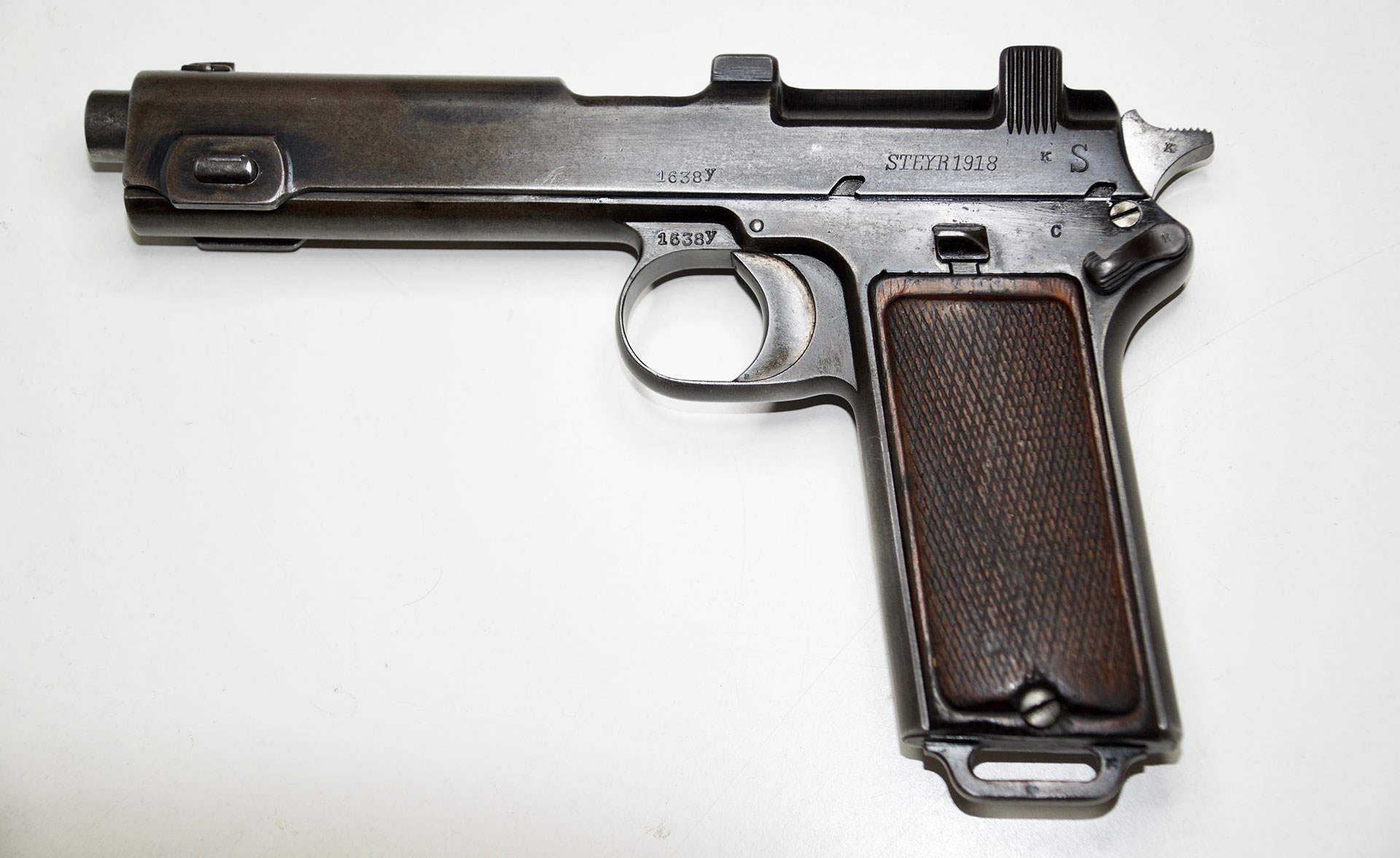
The Steyr Model of 1912 is a semi-automatic, short-recoil operated handgun chambered in 9×23 mm Steyr. Also frequently referred to as the “Steyr Hahn” (Hahn being a German word for hammer), the M1912 was first produced in 1911 by the legendary Austrian arms manufacturer ŒWG Steyr. Though it would not be immediately adopted by Austro-Hungarian troops, the gun proved popular in the export market. Both Chile and Romania would order variants of the M1912 pistol from Steyr. With the outbreak of World War I, exports to Entente-aligned Romania were no longer an option. The Austro-Hungarian government would order large quantities of Steyr M1912 pistols to supplement their supply of Roth Krnka M7 pistols. The consensus is that the M1912 had a good reputation, and was a very solid military service pistol for the time.
From a collectability standpoint, there is much to be said for the M1912. Like most other pistols of the era, the value of the Steyr Hahn is climbing steadily. That being said, it hasn’t suffered the same level of inflation that certain other surplus and historical firearms have. This means that collectors may still find a decent price on an M1912, if they know where to look and have patience. While it’s certainly not the least expensive World War I surplus firearm, the M1912 gives you a lot of bang for your buck. Most handguns similar in size and cartridge potency from this era are far more expensive to collect.
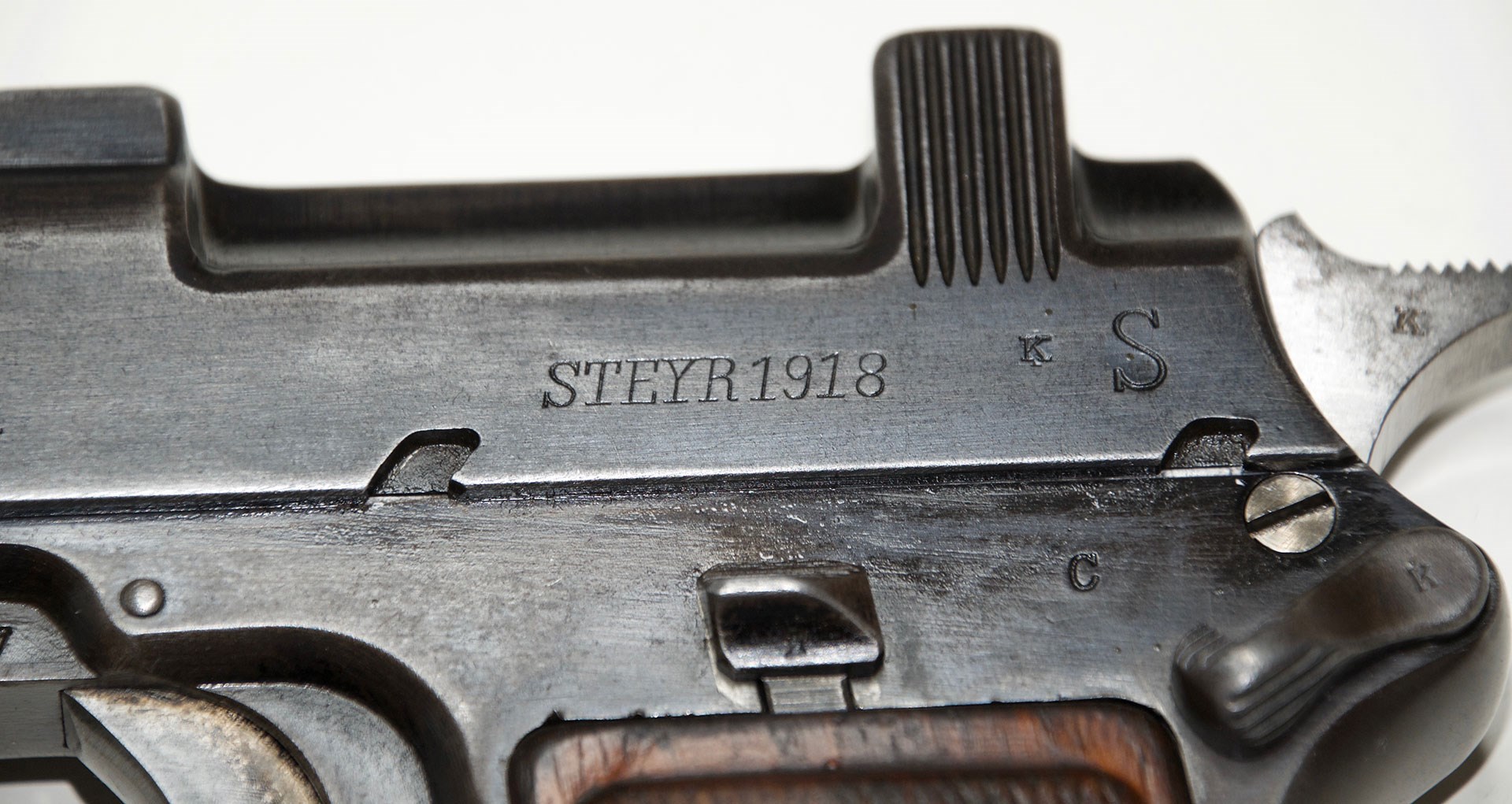
Another factor that makes the M1912 great to collect is its reliable nature and sturdy construction. I have owned and handled quite a few antique and military surplus firearms, and one thing I have come to realize is that many of these old guns are prone to parts breakages and odd malfunctions. Most of the time this is simply due to the age of the firearm, but sometimes design choices can create issues as well. For example, I have a Mauser C96, a pistol that is notoriously complicated compared to some of its peers. It has had quite a bit of work put into it, yet it still doesn’t work well. In my experience with M1912s, if you’re not missing parts, the odds are the gun will function and function well. Taking care of the pistol is not difficult, as field-stripping down to major components is simple. Many of these pistols can also be found in good condition because they were popular among officers and personnel serving off of the frontlines.
Where the Steyr Hahn really shines is at the range. For the collector who enjoys shooting their arms, getting their hands on an M1912 should be on the list of priorities. Ergonomically, it shares similarities with some of the other cutting-edge guns of the day. That is to say, the M1912 shares the more modern grip style of early 1900s Colt automatic pistols and is significantly more comfortable to hang onto than a Roth Krnka M7 or Mauser C96. The full-size grip houses an internal eight-round magazine that loads via stripper clips.
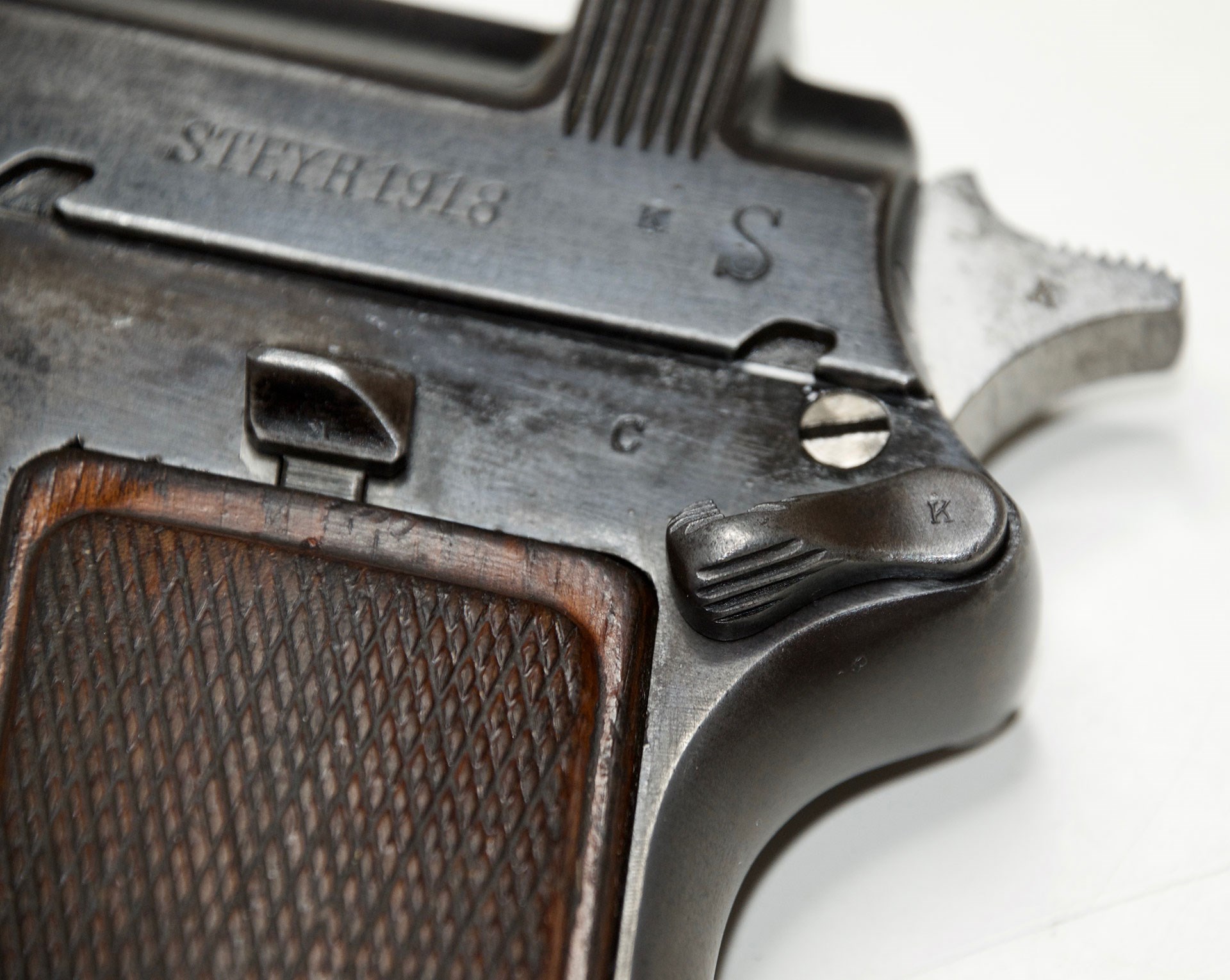
The beavertail is substantial enough that slide bite is not an issue. Controls on the M1912 are positioned in pretty natural areas for right-handed shooters. As a left-handed shooter, I’ve found that they aren’t that difficult to operate with some practice. There is also plenty of room to manipulate the slide when compared to a lot of the other service pistols of the era, without awkward two-finger pinching maneuvers to pull the slide rearward. The safety features a hook that latches into a notch in the slide, and also acts as a slide lock. A release lever is positioned further forward on the frame, allowing the remaining cartridges in the magazine to be dumped without having to cycle the slide or fire the pistol. It should be noted that pushing down on this lever will send every cartridge in the magazine flying out of the top of the pistol at once, like a geyser!
Firing the M1912 is an absolute pleasure. The 9×23 mm Steyr chambering provides decent power with a very mild recoil impulse. The 9×23 mm cartridge may lack the energy of more modern pistol rounds, but it has no problem whatsoever knocking down heavy steel targets on the range. Factory loaded 9×23 mm Steyr generally makes use of a 115-grain bullet, regardless of which manufacturer you buy from. This means that the recoil impulse of the M1912 will be relatively similar across various brands of ammo. 9×23 mm ammunition can be found on the surplus market and has been produced by brands like Fiocchi and Hornady, though availability has decreased over the last few years.
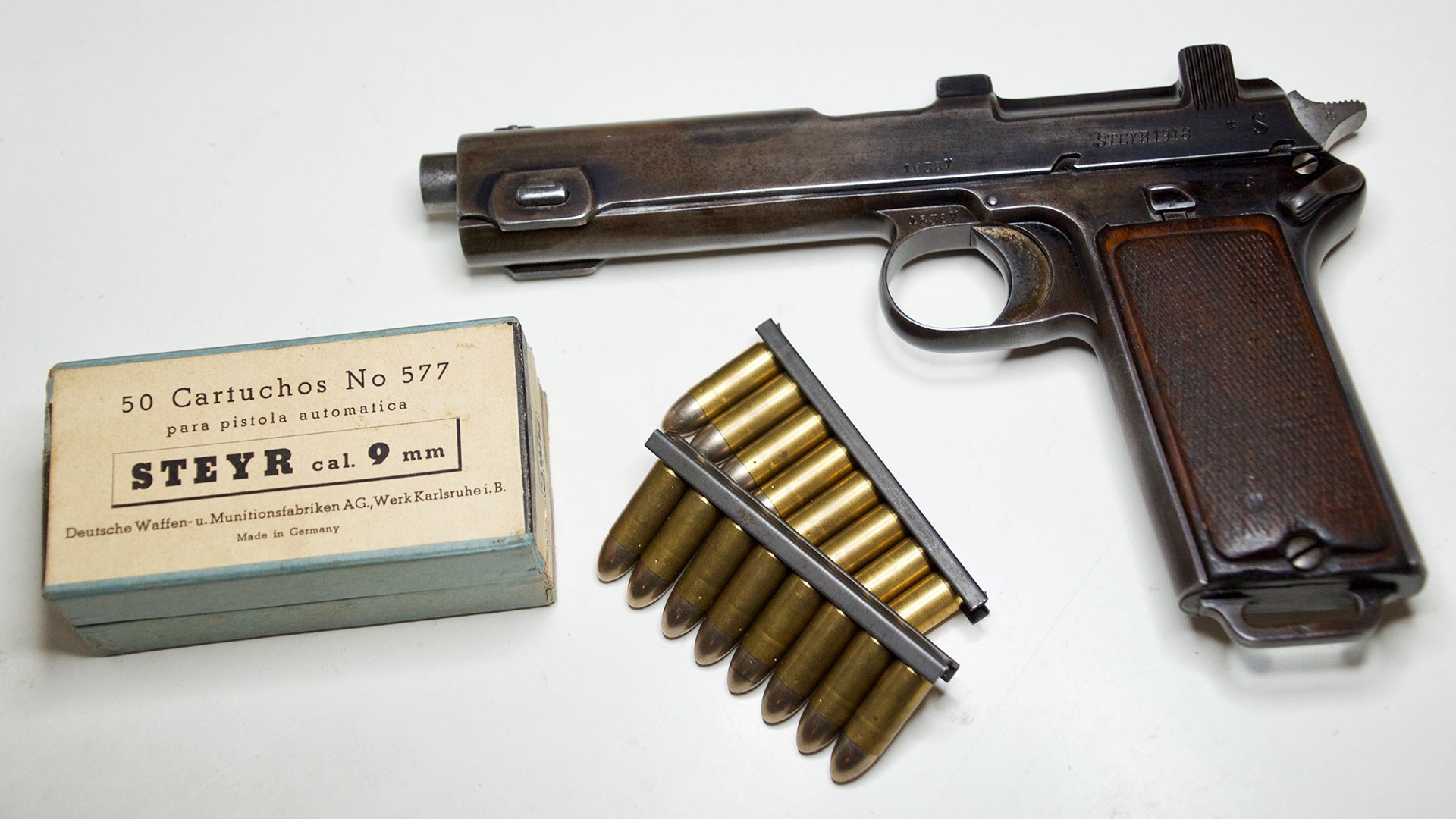
At this point, most of the 9×23 mm to be found on the internet costs in excess of a dollar per shot. Looking around at my local gun stores, I was able to buy several boxes of factory loads for around 60 cents per round. Surplus 9×23 mm Steyr tends to be less expensive, but in many cases is corrosive and will eat away at your bore if you don’t clean it promptly. As a side note, if the proprietary ammo steers you away from the M1912, there is a variant of the pistol that was re-chambered for 9 mm Luger during World War II. While this would certainly be more practical, there is something more enthralling about firing the gun in its original format.
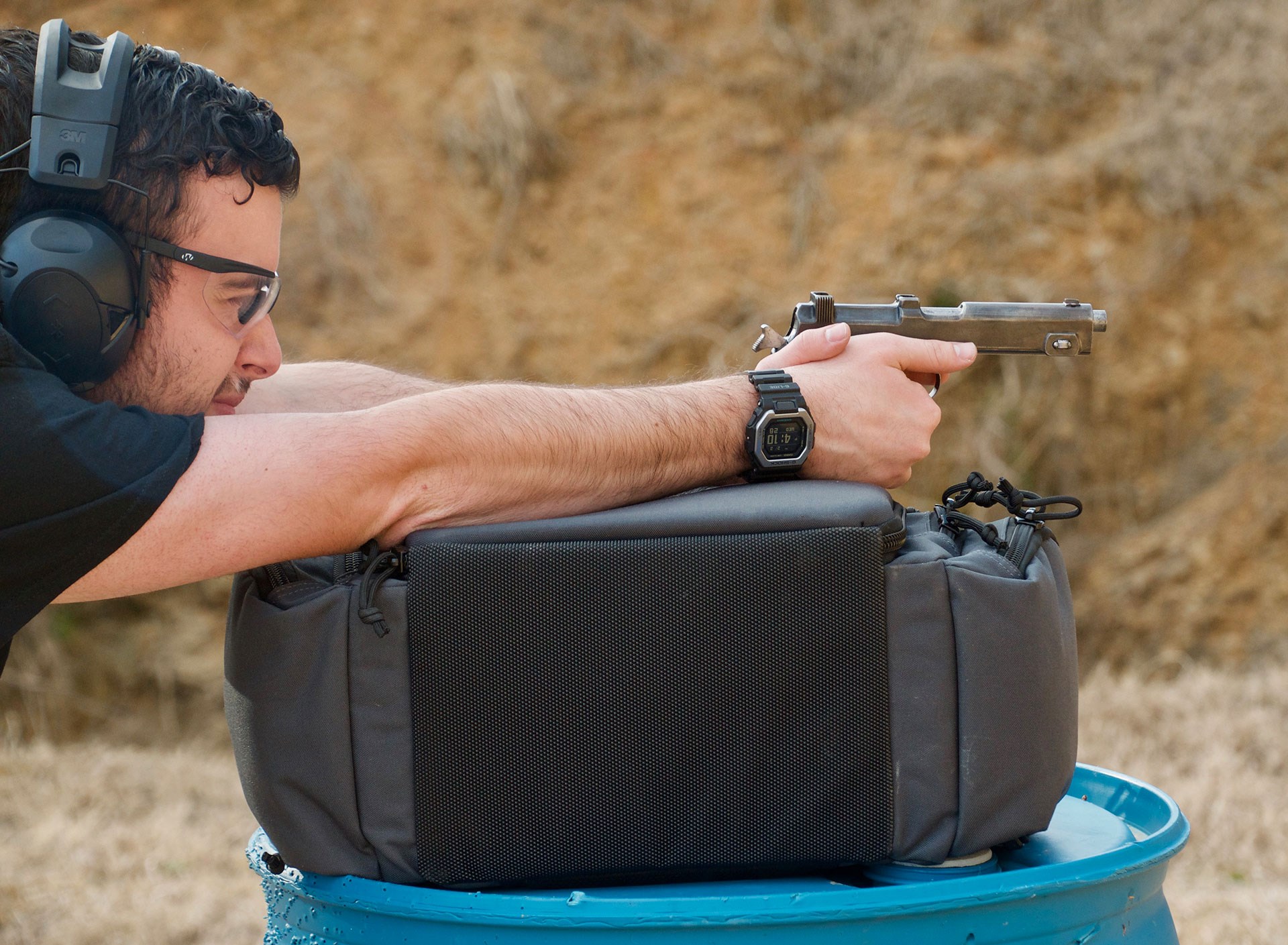
The pistol itself feels very smooth to operate. The lugs on the rotating barrel glide easily in their notches, with the use of a bit of gun grease. The trigger pull is crisp, despite having a bit of travel. Yet the reset is nice and tactile. The sights are pretty basic, but substantial enough that they don’t hinder accuracy noticeably. The M1912 is among the most accurate military surplus pistols I have ever had the opportunity to fire. When firing with one and two hands, I was able to produce groups similar to those of modern defensive handguns. I’m not sure if this has more to do with the overall easy-to-use design of the M1912 or the quality of the barrel itself.
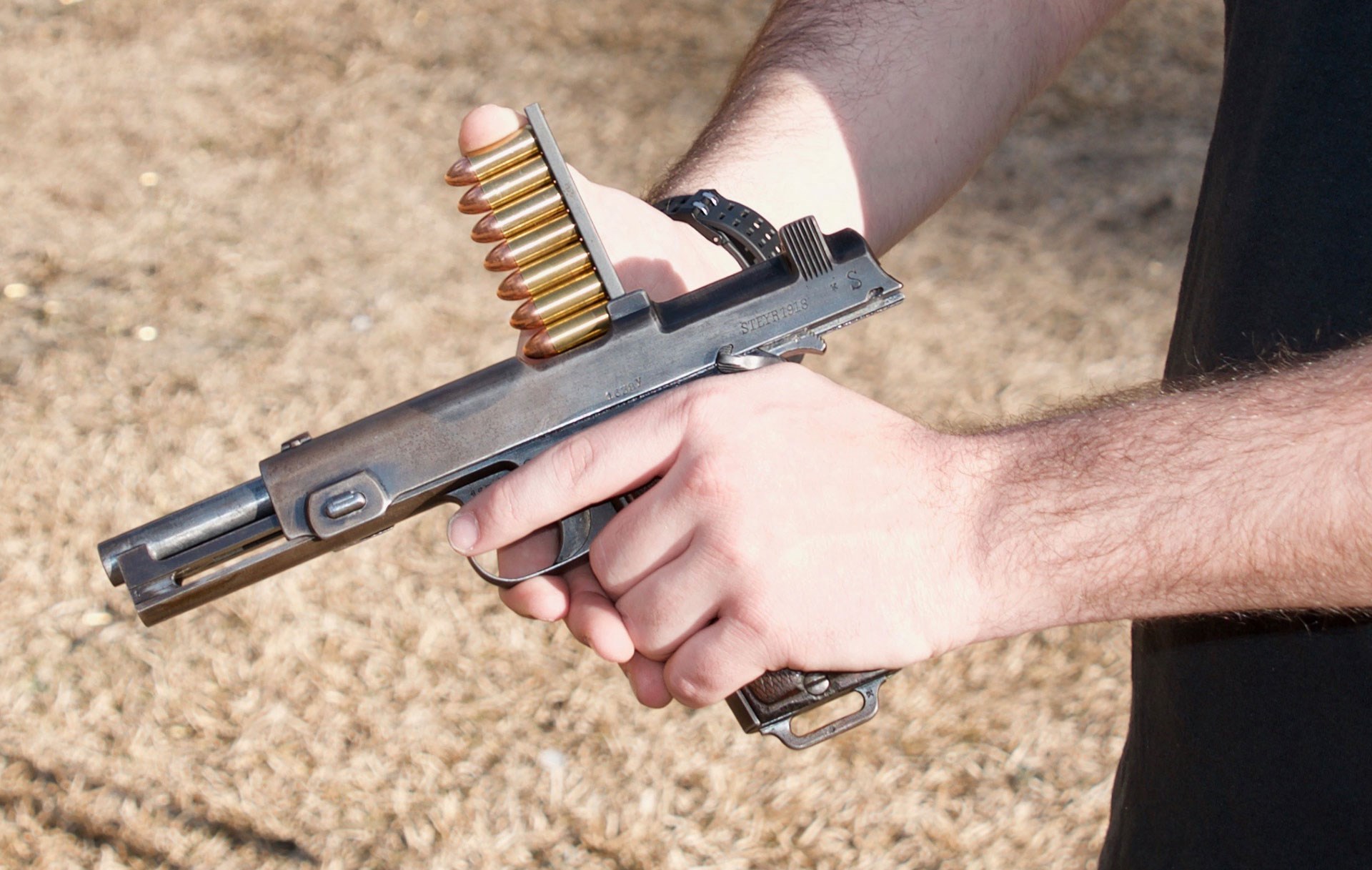
The Steyr Hahn handles rapid fire like a champ, though the trigger will take some getting used to in order to run it with speed. The 9×23 mm Steyr is flat shooting enough that follow up shots can be strung together without a great deal of effort. I would love to run the M1912 through a match one day, as it feels suited to that style of shooting. Although a detachable magazine will almost always be faster to reload, the stripper clips for the M1912 are surprisingly quick to use due to the very pronounced clip guide notch on the slide. The handling characteristics of the M1912 are a big part of what makes it such an excellent choice for collectors that shoot. When doing more dynamic shooting with the M1912, it doesn’t feel sluggish or unresponsive. This pistol is extremely capable despite its age.
The Steyr M1912 is truly a blast to own and shoot. There is so much interesting history tied to this pistol, and it’s a shame it is not more popular. It can still be found at a price point that is within reach for many new collectors. There is a lot of value in the Steyr Hahn. Not only do you get a piece of history that served in World War I and World War II, but you get a pistol that is fun to shoot. Whether you’re an avid collector or have never owned a vintage military surplus firearm, I highly recommend you look into the stellar Steyr M1912.
Categories
Mauser C96 Broomhandle
Categories
The History of Glock


New York – -(AmmoLand.com)-
“It is time for us to think outside the box and form two countries. Instead of civil war I propose civil separation. We are two countries, so ideologically opposed that each feels victimized and dominated by the other. Political leaders need to step up and brainstorm next steps. Clearly lay out the two ideologies and give each state a vote as to where they belong.” ~“Opinion Letter” from reader of The New York Times posted on June 5, 2022, responding to May 27, 2022 “America May Be Broken Beyond Repair,” by the Political Progressive Columnist for the Times, Michelle Goldberg. The letter writer, Dawn Menken, a Psychologist, from Portland, Oregon, is the author of “Facilitating a More Perfect Union: A Guide for Politicians and Leaders,” published in 2021*
If the American public didn’t know the truth before, it knows it now: the battle for the very Soul of the Country is on the line, and Ground Zero of that battle isn’t Uvalde, Texas. It’s New York City, New York, with the Bruen case shortly coming down the pike.
The Nation is indeed “two Countries,”—no less so now than at the time of the American Civil War: friend against friend, brother against brother, uncle against cousin, father against son. But what is different today is that ideologies cut across and into the very notion of what it means to be an American. There are those who hold to the meaning and purport of our Nation as set forth in our Constitution and especially in the Nation’s Bill of Rights. And there are those who wish to jettison all of it in the erroneous belief that our Nation is at its core, immoral, even evil. They wish to destroy the very fabric of a free Constitutional Republic.
But the salient difference between these two Countries rests on this:
Those Americans who embrace and cherish their fundamental right to keep and bear arms, and others who do not.
Those who embrace and cherish their fundamental right to keep and bear arms also recognize and embrace their sovereignty over Government. They understand that government exists to serve the interests of the people. They recognize that Government is the servant and the American people are the sole master.
Unfortunately, many Americans are of a different mindset. Such Americans have bought into the psychological conditioning programmed into them that guns are awful and gun owners are to be despised. Such Americans care not that Government is their servant, not their master. They recognize not and care not that by ceding their God-Given right to keep and bear arms, they have laid the foundation for their own demise: loss of Selfhood, loss of Dignity, loss of Self-Reliance, loss of mastery over their own destiny.
But what does the Government Tyrant do about the population of gun owners? That places the Tyrant in a quandary. The Tyrant cannot gain control over those who have the will and means to effectively resist the insinuation of tyranny over them. And, while two-thirds of the population has apparently capitulated, that still leaves a goodly third of Americans who have not and will not capitulate. One hundred million people is a lot of people by any reckoning.
What, then, does a Tyrannical Government do?
How does the Tyrant go about separating an estimated 400 million firearms (according to American Gun Facts) in the hands of roughly one-third of the population?
According to a November 2020 Gallop Poll, thirty-two percent of Americans possess firearms. See also a report of the Rand Corporation, a 2017 report of the Pew Research Center, titled, “the Demographics of gun ownership,” and an SSRN 2021 “National Firearms Survey.”
The American public is routinely bombarded with viral memes. Injected with and subjected to verbal and visual memes on a daily basis, many Americans develop a phobic reaction toward guns and toward those who possess them: word phrases such as “Gun Violence,” “Gun Culture,” “Mass Shootings,” “Assault Weapons,” “AR-15 Rifles,” “Weapons of War,” “Large Capacity Magazines,” and other such nomenclature, when coupled with images of violence, operate as visual and auditory cues, that induce a neurotic reaction in the target population. This is to be expected; in fact, this is intended. The goal is to create in the mind of the target audience a feeling of physical revulsion and repulsion toward guns.
But is it really a concern over the safety of innocent people that motivates a vigorous response against firearms and firearms ownership, misguided though that be, or is there something more sinister at play? If it were the former, one would expect a harsh response toward the massive wave of everyday criminal violence infecting and infesting our Country, especially in the major urban areas. But we see no such response.
Those State and municipal Government officials and legislators, who rabidly attack guns in the hands of average, rational, responsible, individuals, handle rampant violent and vicious crime infecting their locales with diffidence and an air of casual indifference.
So, it cannot be violent crime generally or violent gun crime committed by drug-crazed lunatics, psychopathic and psychotic gangbangers, and garden-variety criminals, particularly, that motivate these officials.
What might it be, then? Why would Globalist Government officials, along with their compatriots in the Press, go off half-cocked whenever a rare occurrence, invariably avoidable, of “mass violence” arises, occasioned by the actions of a solitary lunatic?
Why would Government officials and legislators shriek for more nonsensical gun laws, targeting tens of millions of average Americans, predicating the need for all of it on the lowest common denominator among us: the lone wolf psychotic.
The answer is plain. The actions of that lone wolf psychotic merely provide a convenient pretext. It isn’t the criminal actions of the lone wolf killer that Government is concerned about. For he doesn’t pose a viable threat to Government. Rather, it is the armed citizenry that poses a threat to a Tyrannical Government and poses a threat by virtue of the mere fact of being armed.
But why should Government fear its own armed citizenry? It shouldn’t and wouldn’t unless Government seeks to usurp the sovereignty of the citizenry, as it clearly aims to do here.
A perspicacious Tyrant would know it is a Tyrant. But this Federal Government doesn’t know it.
The Federal Government has amassed power and authority that doesn’t belong to it; power and authority that never did belong to it, believing, wrongly, that the power it has usurped from the people is rightfully its own. And the Government has become jealous in guarding this power, hoarding it.
The Federal Government has come to perceive the armed citizenry as a potential rival that must be crushed, and not as a master to whom it must serve. And we, gun owners, for our part, would do well to view this present Government as a rival to our rightful claim of sovereignty over the Federal Government.
Our claim of sole sovereignty over Government is grounded on the Constitution, and on fundamental, unalienable, immutable, eternal God-given natural law Rights. And, what, then, does the Federal Government presume to claim its sovereignty over us on? What can it presume to claim sovereignty over the American people on? Nothing but a set of limited, contingent, demarcated powers and authority handed through us to it, conditioned on the fact that Government exists to serve our interests, not its own.
Whose claim of sovereignty is superior? And, if one falls back on the aphorism, “might makes right,” well, then, the Government is not alone as the bearer of arms.
*Menken’s book purports to be a guide for political leaders on how to bring the Country together to resolve the Nation’s differences. Yet, one year after the publication of her book, it is clear from her NYTimes letter Times, that Menken has had a change of heart; surrendered to the truth that reconciliation is impossible. That should have been obvious to her all along. It wasn’t.
There are two antithetical ideologies at play. One ideology is grounded on the principles, precepts, and tenets laid down in our Nation’s sacred documents. The other intends to cast it out. One ideology was forged in the Nation’s struggle for independence from tyranny. The proponents of that ideology seek to preserve the Natural Law Rights and Liberties of the people. They intend to maintain and preserve the success of the American Revolution.
The other ideology, grounded on the principles, tenets, and precepts of Collectivism, much in evidence today, seeks to upend the hard-fought battle for Independence from tyranny. For Collectivism is predicated on Tyranny. It is inextricably tied to it. On our website, we discussed all of this in several articles some time ago. See, e.g., our article posted four years ago, in 2018, titled: “The Modern American Civil War: A Clash of Ideologies.”
About The Arbalest Quarrel:
Arbalest Group created `The Arbalest Quarrel’ website for a special purpose. That purpose is to educate the American public about recent Federal and State firearms control legislation. No other website, to our knowledge, provides as deep an analysis or as thorough an analysis. Arbalest Group offers this information free.
For more information, visit: www.arbalestquarrel.com.
Three weeks ago, I wrote an article covering my analysis of the Uvalde school shooting. Since then, we’ve learned some more facts about what happened that day. If anything, these facts indicate that the police response was even more dismal than I originally reported. Here are some updated news links and my thoughts about what happened.
The first issue that has been clarified is exactly what happened after the killer crashed his truck and before he made entry into the school. There was confusion about whether or not officers were on scene and if or how they confronted the killer.
It turns out that cops were on scene. They chose not to engage stating they feared missing and hitting children in the area.
Uvalde cop wielding AR-15 failed to take shot to kill gunman
Imagine being given the opportunity to instantly stop an active killer event at an elementary school before anyone got hurt. Then imagine failing to take that opportunity because you don’t trust your own marksmanship abilities.
I wonder if these officers wished they had practiced more or taken a carbine class on their own dime to build their skill set? Probably not, because in police work, failing to act is always preferable to acting and experiencing an unfavorable outcome.
These officers will never be punished for failing to take the shot, but they would be fired, sued and maybe jailed if they shot and accidentally hit a kid.
Which option would you choose given this scenario? I would argue that sometimes you have to take the shot regardless of the backstop. If these officers would have missed, they may have hit a couple kids on the playground. That would be absolutely horrible, but would be a far better result than the massacre that occurred.
But again, these officers will not be disciplined for allowing a murderer to get into an elementary school. They would be fired and sued if they had missed and shot kids on a playground. These are the rules society has set for officers. There’s no expectation that they do anything. They get punished if they screw up. They aren’t given the training to be truly competent with their weapons. It’s easy to see why they made the choices they did.
People have been clamoring for kinder, gentler, less militarized cops for the last 15 years. This is the result. As my friend Darryl Bolke says: “You get the police department you deserve.” When you reward and promote inept cowards, yes-men, and suck-ups because they never used force or screwed up in the field, you get police chiefs like Pete Arredondo.

Absolutely unfit for command and many of your police chiefs are just like him.
Remember, these are the folks you are calling to help you in your worst moments. As I’ve said before, you are on your own. No one is coming to save you.
You’d think that failing to shoot a murderer entering an elementary school would be the worst that one could imagine. But no. The hits keep coming. It turns out that almost everything this police chief said has been a lie.
Uvalde cops ‘didn’t even try to open door of massacre classroom’
The classroom doors couldn’t be locked from the inside. That’s a massive school safety issue. If we want to minimize casualties against an attacker already inside the school, speed is of the essence. All classroom doors should be able to be locked from the inside without a key.
The article above states that killer didn’t have a key. Although it’s possible that the shooter got a key from the teacher and locked it from the outside, the event timeline doesn’t give him much time (less than two minutes) to do that.
That means the door was most likely unlocked.
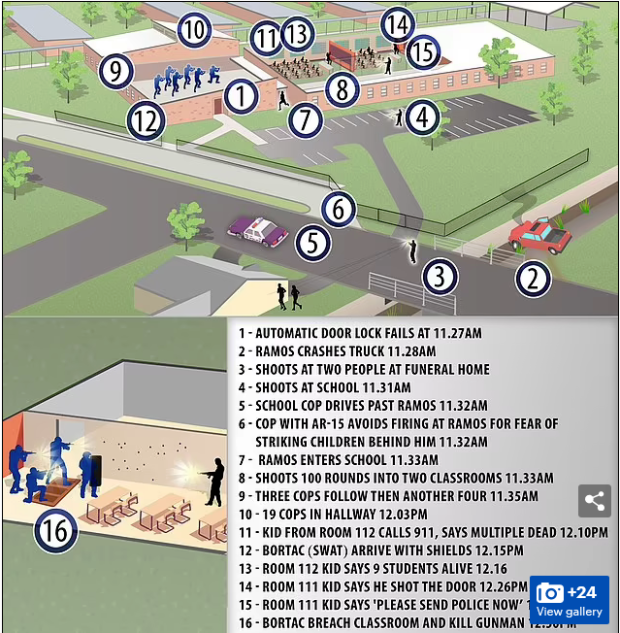
Timeline from link above
Video shows the police massed in the hallway made ZERO attempts to unlock the door during their 77 minute wait. Unconscionable. If the officers would have checked, they would have indeed found the door unlocked.
Uvalde classroom door unlocked during shooting as officers waited for keys: ‘Abject failure’
“Three minutes after the suspect entered the west building, there was a sufficient number of armed officers wearing body armor to isolate, distract, and neutralize the subject,” he said. “The only thing stopping a hallway of dedicated officers from entering Room 111, and 112, was the on-scene commander, who decided to place the lives of officers before the lives of children.”
Law enforcement apologists claim that the police officers inside were waiting for breaching tools, shields, and rifles. Completely untrue. Read the absolutely damning article below.
Officers in Uvalde were ready with guns, shields and tools – but not clear orders
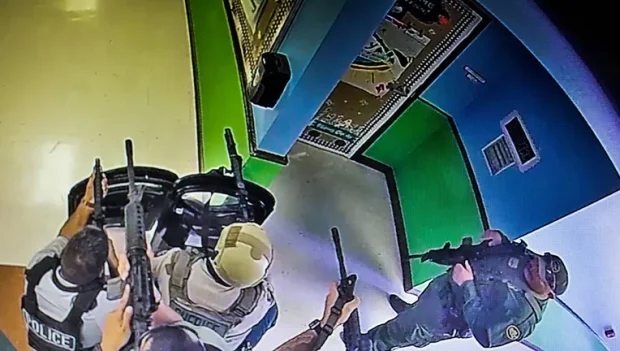
The photo (linked in article above) above was from 12:04. The breach occurred at 12:50. I see five rifles and two shields. According to the article, they had breaching gear as well.
“A Halligan bar — an ax-like forcible-entry tool used by firefighters to get through locked doors — was available. Ballistic shields were arriving on the scene. So was plenty of firepower, including at least two rifles. Some officers were itching to move.”
This is a Halligan tool. It (usually along with a short sledge hammer) is the primary tool used for breaching outward opening doors.
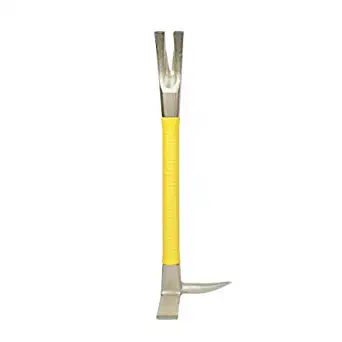
More horrific details are revealed in the link below.
“If there’s kids in there, we need to go in”
“No security footage from inside the school showed police officers attempting to open the doors to classrooms 111 and 112, which were connected by an adjoining door. Arredondo told the Tribune that he tried to open one door and another group of officers tried to open another, but that the door was reinforced and impenetrable. Those attempts were not caught in the footage reviewed by the Tribune. Some law enforcement officials are skeptical that the doors were ever locked.
Within the first minutes of the law enforcement response, an officer said the Halligan (a firefighting tool that is also sometimes spelled hooligan) was on site. It wasn’t brought into the school until an hour after the first officers entered the building. Authorities didn’t use it and instead waited for keys.
Officers had access to four ballistic shields inside the school during the standoff with the gunman, according to a law enforcement transcript. The first arrived 58 minutes before officers stormed the classrooms. The last arrived 30 minutes before.
Multiple Department of Public Safety officers — up to eight, at one point — entered the building at various times while the shooter was holed up. Many quickly left to pursue other duties, including evacuating children, after seeing the number of officers already there. At least one of the officers expressed confusion and frustration about why the officers weren’t breaching the classroom, but was told that no order to do so had been given.
At least some officers on the scene seemed to believe that Arredondo was in charge inside the school, and at times Arredondo seemed to be issuing orders such as directing officers to evacuate students from other classrooms. That contradicts Arredondo’s assertion that he did not believe he was running the law enforcement response. Arredondo’s lawyer, George E. Hyde, said the chief will not elaborate on his interview with the Tribune, given the ongoing investigation.”
The Texas director of public safety stated in the recent hearings:
“We set our profession back a decade,”
I would argue that we set the profession back more than a quarter of a century and this singular event will be the turning point where the general public loses all faith in law enforcement officers across the country. I predict that the profession will never recover and that society will see some very big changes (none of them for the good) in the next few years.
:max_bytes(150000):strip_icc():format(webp)/funny-tombstones-25-5bd9bf6ec9e77c0051933de5.jpg)
:max_bytes(150000):strip_icc():format(webp)/funny-tombstones-26-5bd9bfca46e0fb00514f86a3.jpg)
:max_bytes(150000):strip_icc():format(webp)/funny-tombstones-24-5bd9bf3046e0fb002611c7ee.jpg)
“She always said her feet were killing her but nobody believed her.”
:max_bytes(150000):strip_icc():format(webp)/funny-tombstones-22-5bd9be29c9e77c0051dff6d7.jpg)
:max_bytes(150000):strip_icc():format(webp)/funny-tombstones-20-5bd9bb3f4cedfd00266d6bc5.jpg)
:max_bytes(150000):strip_icc():format(webp)/funny-tombstones-18-5bd9baa3c9e77c0051926e0c.jpg)
:max_bytes(150000):strip_icc():format(webp)/funny-tombstones-16-5bd9b6c7c9e77c00268aafad.jpg)
:max_bytes(150000):strip_icc():format(webp)/funny-Tombstones-14-5bd87607c9e77c00265b71c8.jpg)
:max_bytes(150000):strip_icc():format(webp)/funny-Tombstones-13-5bd8737d46e0fb0026dc5032.jpg)
:max_bytes(150000):strip_icc():format(webp)/funny-Tombstones-10-5bd8718946e0fb0026dbfefe.jpg)
:max_bytes(150000):strip_icc():format(webp)/funny-Tombstones-4-5bd86e8646e0fb0051197ec8.jpg)
:max_bytes(150000):strip_icc():format(webp)/funny-Tombstones-3-5bd86e13c9e77c0051141297.jpg)
:max_bytes(150000):strip_icc():format(webp)/funny-Tombstones-2-5bd86dd646e0fb00516285cf.jpg)
:max_bytes(150000):strip_icc():format(webp)/funny-Tombstones-1-5bd86c264cedfd002637aeee.jpg)
And finally what I want on my Headstone
:max_bytes(150000):strip_icc():format(webp)/i-was-hoping-for-a-pyramid-on-tombstone-280388-5bda087d46e0fb0051a5ed0b.jpg)

Peter Hathaway Capstick was born in January 1940 in New Jersey. A 19th-century man dropped incongruously into a 20th-century world, Capstick abandoned a successful Wall Street career in his twenties seeking adventure. Like Theodore Roosevelt and Ernest Hemingway before him, Capstick found that for which he quested.

Capstick started out in Latin America, earning his hunting chops while striving to master the Spanish language. With a few years of jungle experience, he returned to New York and started a business arranging guided hunting excursions for well-heeled clients. This led to a stint working for Winchester Adventures and, in 1968, his first trip to Africa.

With that trip, Capstick found his true calling. For years afterward, he worked in Zambia, Botswana, and Rhodesia as both a game ranger and a safari guide. As a professional hunter Capstick mastered the nuances of stalking deadly game and, along the way, had some truly epic adventures. In 1977 he published his first book, Death in the Long Grass, and ignited the imaginations of countless youngsters comparably yearning for adventure. I was one of them.
Setting the Stage

In 1975 Capstick was working in Rhodesia, the recent civil war in Zambia having run him out of that volatile country. He set up his headquarters in an abandoned adobe house some fifty miles south of Victoria Falls. The locals knew this area as Vlakfontein.

Capstick had his loyal band of porters, gun bearers, and indigenous Zulu comrades, all of whom were integral parts of his hunting and guiding excursions. As they settled into their new digs they began having problems with the neighbors. Such social friction is an unfortunate aspect of the human condition. However, the neighbors, in this case, were a nearby 100+-strong troop of yellow baboons.
Almost Human

The yellow baboon is a ubiquitous finding in south-central Africa. A large Old World monkey, these primates are complex social creatures and remarkably intelligent. They can live for up to thirty years.

A big male yellow baboon weighs some ninety pounds and sports outsized canines. They are immensely strong and terrifyingly fast. Baboons are omnivorous, eating almost anything they can catch. Their very intelligence is what makes them at times deadly.

Like most of us primates, these have a natural cruel streak and will at times kill just for the thrill of it. Their predation on livestock and incursions into human settlements can make them nuisance animals. Under the wrong circumstances, it can be much, much worse.
The Crime

The woman was weeding her garden with her four-month-old child swaddled to her back in the African fashion. She was unarmed and in a place where the sundry threats endemic to the African continent seemed distant and unimportant. Sensing in that weird way that she was being watched the young woman turned around to find four large male baboons stalking her as a group.

One of the big animals held her attention, while the other three circled around to gain an advantage. She shouted and flailed at the creatures, yet still they came closer. While the lead animal distracted her one of the other beasts ran in and snatched the child off her back with his jaws. She fought mightily as only a mother will, suffering grievous wounds in the process, but was unable to save the child.

Two of Capstick’s assistants were nearby and heard the woman’s cries. They killed one of the animals with a spear and dispersed the other three, but they were too late. After numerous close calls and uncomfortable encounters, the baboons had taken human life.
Stalking a Band of Killers

Capstick found the troop easily enough. They called a thick grove of Prince of Wales feather trees home, and the stench of their excreta was detectable for a great distance. In daylight, the animals would forage in search of food and mischief. At night they returned to their roost for protection and company. With the troop out and about Capstick and his men went to work.

They gouged a shallow trench all the way around the grove and sloshed it with some one hundred gallons of kerosene, gasoline, and old motor oil leaving a narrow opening at one end. As the sun faded Capstick and his spearmen posted themselves at this opening. In addition to small flashbang pyrotechnic noisemakers and a few parachute flares, Capstick also carried a remarkably specialized military weapon.
Guns in a Land with No Rules

Africa is a land awash in bountiful natural resources not altogether conceptually dissimilar to our own continent. Africa has space, minerals, oil, farmland, and manpower. However, the indigenous peoples cannot seem to stop killing each other long enough to get properly organized. If the continent could set aside its differences, join forces, and start projecting power we’d all be paying taxes to them.

One of the odd attributes of living in a perennial war zone is the ready availability of state of the art military hardware. In 1975 this was the tidy little MAC-10 submachine gun. How the weapon got to the continent in the first place has been lost to history. However, Capstick bought the diminutive bullet hose with gold sovereigns from a local farmer who decided to move someplace safer. The gun came with a sound suppressor, 1,800 rounds of 9mm ball ammo, and thirty box magazines. Capstick kept the gun in a custom buffalo hide holster in the event of incursions by two-legged predators.
The Weapon

The Military Armament Corporation M-10 was a simple pressed steel submachine gun developed by Gordon Ingram in 1964. The gun was designed from the outset to accommodate a screw-on sound suppressor, a radical appendage for its day, and was available in either 9mm or .45ACP. The guns sold for $120 apiece retail. While we all refer to this compact stuttergun as the MAC-10, the company never promoted this term.

The MAC-10 saw limited employment by Special Forces in the latter part of the Vietnam War and was used operationally by the Navy SEALs, the Israeli Sayeret Matkal, and the British SAS. The gun’s small size and blistering rate of fire made it a formidable close-quarters combat tool. However, these same attributes also made it a poor general-purpose weapon.

The MAC-10 weighed more than six pounds empty. This made the gun almost as massive as an M16A1 rifle. Additionally, the collapsible stock wobbled, and the stubby barrel invited the errant defingering. The 9mm gun’s greatest detriment, however, was its 1,250-rpm rate of fire.

The MAC-10 burns ammo at a profligate rate and is difficult to control. The MAC Company tried desperately to cajole the US Army into replacing their venerable 1911A1 pistols with MAC subguns. One can only imagine the number of perforated Privates that might have resulted had the Big Green Machine bought a couple hundred thousand of these rascals.
The Op

A flare conflagrated the combustibles, and the baboons went, as it were, ape. Spurred on by flashbangs fired from slingshots the beasts charged insensate for the exit only to meet the sputtering muzzle of Capstick’s MAC-10. He left the sound suppressor off so as to enhance the chaos. With a gun bearer providing fresh magazines the professional hunter cut the unhinged primates down by the drove. Those that successfully raced past were addressed by Capstick’s spearmen.

When the dust settled, Capstick had exterminated about a third of the troop. He wrote that he was filled with a mighty pathos later that evening by the uncanny humanity and intelligence of these animals. However, the troop was harassing the locals and had killed a child. Capstick’s crew and the local citizenry were thrilled at developments.

The remains of the baboon troop retired to a more remote location. Years later Capstick came back through the area and noted that the population of birds and smaller creatures that had been pressed to extinction by the troop had made a robust comeback. The baboons had settled some twenty miles away and were no longer a bother.
Denouement

Such pitiless primal carnage seems unimaginable to our sensitive constitutions today. I will admit that it surprised me to revisit this tale of my youth and appreciate that it happened well into the modern era. However, Africa is not Mississippi, and, unlike my particular corner of paradise, the animals thereabouts can legitimately kill you. Regardless, this was a simply riveting anecdote.

Capstick masterfully authored some thirteen books. I‘ve consumed most of them. Those that I have read were truly superb. I’d start with Death in the Long Grass, but don’t blame me if you can’t put it down.

Peter Hathaway Capstick was a hard-drinking chain smoker and a throwback to a different time. However, such a lifestyle comes at a cost. Capstick died of heart disease in 1996 in Pretoria, South Africa, at age 56. He was an archetype, a traditional man of action at a time when the world was ridding itself of such. We just don’t grow them like Capstick anymore.


The MAC-10 is a fun range toy, but I wouldn’t want to go to war with it.

I once read that a machinegun shoot without a MAC-10 is like a day without sunshine.
