


There is something unique and romantic about the concept of a single-shot rifle. It somehow changes the mindset of the shooter to perhaps focus just a bit more on the shot. Having just one in the gun is almost a ‘gentlemanly’ statement—it speaks to a level of discipline as a marksman. Now, that’s not to say that anyone who uses a repeater is less conscientious, but I will confess to thinking a bit differently when I’m using a semi-automatic or quick-handling pump gun.
The classic Farquharson staking style rifle was very popular in Europe and African hunting at the turn of the 20th century; it had an action designed to handle an exorbitant amount of pressure, and the svelte lines made for a visually appealing package. While the advent of reliable bolt-action and lever-action rifles certainly didn’t help the popularity of the single-shots, there has always been a small, yet dedicated following of hunters and shooters who prefer this type of firearm.
The late William B. Ruger was an innovator in the firearms industry, developing a line of firearms that were either totally new designs, or a unique twist on an existing, proven style. When he released the Ruger No. 1, in 1967, the bolt-action rifles were all the rage, and there were those who questioned the logic of putting a falling-block single-shot into production. However, Bill had it right, and the No. 1—which wore its Farquahrson roots on its sleeve—was a huge success. Being a falling block design, there were no limits to the type of cartridge that the rifle could handle; due to the lack of a magazine rimmed, rimless and belted cartridges could be used without limitation. An under lever was used to release the breech block, and the thick piece of steel could handle even the highest pressure cartridges. So, from the speedy varmint cartridge to a stout medium-caliber magnum, up to and including the huge elephant cartridges, you could find a Ruger No. 1 chambered in a cartridge to fit your shooting or hunting needs.
While there are those who would question the sanity of a hunter who would take a Ruger No. 1—or any single-shot rifle—on a dangerous game hunt, it has been done for well over a century, with surprising success. While I feel that there are better choices for that job, I do know that the No. 1 will comfortably handle all other types of hunting, and I’ve been very surprised at how fast a hunter who is well versed in the ways of a No. 1 can reload their rifle.
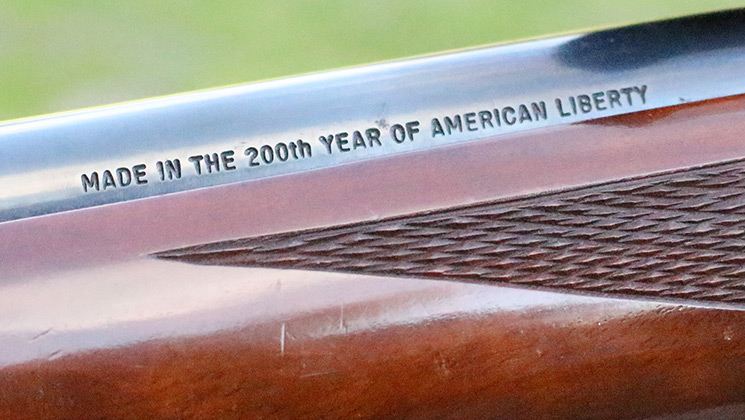
Reading R.L. Wilson’s book Ruger & His Guns, you will find some insight to the production of the now-classic falling-block rifle. Mr. Ruger certainly appreciated the compact package that a single-shot rifle made—lacking a receiver, the overall length of the firearm is reduced by roughly 2-1/2 to 3”—and paid homage to the Alexander Henry and Farquharson predecessors of the Victorian era. However, Bill Ruger’s hammerless design simplified things by taking one step out of the firing process, and the over-designed extractor/ejector makes sure the shooter isn’t scrambling to remove a cartridge, and allows for that quick reload I’ve mentioned.
Are there any issues with a No. 1? To be honest and fair, I have seen some issues on certain models, where the forend of the stock impinges on the freedom of the barrel, and causes accuracy issues once the barrel gets hot. There is a fix for this, a certain type of rubber-gasket thingy that gives some space between the stock and barrel, and many users have seen a dramatic tightening of group size once this is sorted out. Some No. 1s will show a level of accuracy that isn’t up to par with some of our good bolt guns (a two-piece stock can and will have a part to play in this), but I’ve never seen one that wouldn’t give decent hunting accuracy.
I like the No. 1’s trigger; most have been clean and crisp and allow for good shooting technique. That compact package makes for a fantastic rifle to carry in the field, both in length and weight. The rifle is truly ambidextrous, in that the safety is tang-mounted, located directly under the thumb irrespective of which side you shoot from, and the loading process is as friendly to righties as it is to lefties. The quarter rib, with integral recesses for scope mounting is compact, yet allows the larger model scopes to be mounted easily, and the shorter ring spacing doesn’t handicap a shooter who enjoys the shorter optics.
There are several variants of the No. 1, like the 1A, which is an iron-sighted affair, with the grooved Alexander Henry forend and a 22” barrel, or the 1B, which features a rounded forend and longer 26” barrel, but lacks the iron sights. The 1S medium sporter features the longer 26” barrel for many calibers, and the Henry forend as well as iron sights. The 1H Tropical rifle is chambered for the big game calibers—like .375 H&H Magnum, .416 Rigby, .450/400 3” Nitro Express and .458 Winchester Magnum, among others—with a good, heavy barrel and iron sights to complete the package. The Varmint model—the No. 1V—uses a clean, bull barrel and is chambered in some varmint favorites like .223 Remington, .22/250 Remington, .220 Swift and 6mm Remington, though there were some offered in 7mm Remington Magnum and .300 Winchester Magnum (the latter being a favorite choice of my pal Donald Thorne, Jr.) for a heavy-caliber varminting experience.
Most Ruger No. 1s feature a checkered walnut stock, though I have seen a cool laminate wood/stainless steel model which would make a lot of sense for those who enjoy inclement weather. The Ruger RSI variant uses a full-length Mannlicher stock, mated to a shorter barrel, for those who enjoy that style of rifle.
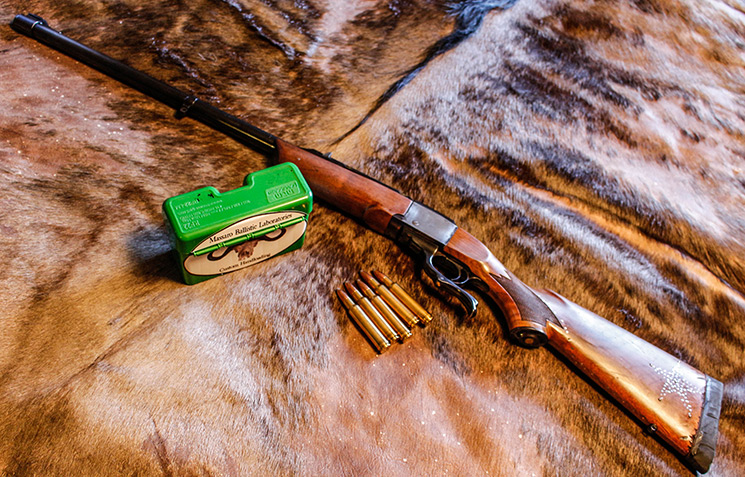
My own No. 1 is a well-worn, or better yet ‘battered’ No. 1H Tropical, that started its life as a .375 H&H Magnum, but was rechambered to .378 Weatherby Magnum. It was the personal rifle of my friend, the late PH Jay T. Carlson, and after his untimely passing it came into my possession. It does have a certain level of recoil—some have described it as ‘soul-crushing’, but it’s an accurate rifle, and for Jay’s sake I’ll leave it as is. It is a rifle that comes with a story, and I prefer them that way. Oddly enough, Jay Carlson and Bill Ruger were friends, both hailing from Connecticut.
Bill Ruger was indeed an innovator; he seemed to have his finger on the pulse of what shooters—who appreciated form and function over bells and whistles—truly wanted. Thank you Mr. Ruger, for keeping the single-shot rifle alive; I hope you’re traversing the Happy Hunting Grounds with an accurate No. 1 in hand.

This random photo depicts the last run of Ladder 118 as it crosses the Brooklyn Bridge. None of the firefighters would survive the tower’s collapse.
.gif)
.gif)
.gif)
.gif)
Produced in extremely limited numbers, the “Tough ‘Ombres” Walther PPs are some of the most sought-after German guns carried home by America’s GIs during WW2, and Rock Island Auction Company is offering one of the rarest of the rare this May – a Walther pistol that truly stands in a league of its own.

As a near-identical twin to General George S. Patton’s presentation Walther and one serial number below the legendary general’s gun, the Walther PP of Lieutenant Colonel Thomas M. Andrews, Chief of Staff for Major General Herbert L. Earnest of the 90th Infantry Division, is a one gun wish-list gun for WW2 enthusiasts, Walther collectors, and firearms fans as a whole.

Andrews’ Walther is also one of only three known examples of this type of engraved Walther PP presentation pistol with a late blank slide. The late war Walther PP blank slide was found on Walther PPs made towards the end of WW2, when German gun manufacturers started cutting corners in manufacturing to speed up gun production as the war turned poorly for the Axis powers. The only known engraved Walther PP presentation pistols of the type with a late blank slide are General Patton’s’, Colonel John C. Whitcomb’s (serial number 378447P), and the Walther engraved to Lieutenant Colonel Thomas M. Andrews.
Bearing serial number 381790P, this engraved presentation Walther was almost certainly produced directly before General George S. Patton’s nearly identical pistol (serial number 381791P), which currently resides at The General George Patton Museum in Fort Knox.

Much of the surface of Lieutenant Colonel Andrew’s Walther PP is covered in deep-cut oak leaf motifs with checkerboard accents, zig-zag and dot borders, and geometric accents on the trigger guard. Often left blank on late war military PPs, the left side of the slide has received a hand-cut “Walther” banner – all features identical to General Patton’s pistol.
The old adage “if a gun could talk” certainly applies to the truly fascinating and phenomenal Walther PP pistols engraved for members of the 90th Infantry Division. When General Patton’s 3rd Army captured the Walther factory in April of 1945, a number of pistols were assembled from the remaining engraved part sets, which had been produced by the Walther factory prior to and during the war, then set aside for future presentation to German officers.

Thomas Andrews’ family states that he personally commissioned the Walther pistols that would be presented to General Patton and other top brass. The serial number and matching design of Lieutenant Colonel Andrews’ Walther PP seems to support that story, as does Andrews’ position as the G4 logistics officer during the occupation of Zella-Mehlis.

Though many senior members of the 90th Infantry Division and certain favored NCOs were presented with Walther PPs with the symbol of the Tough ‘Ombres engraved on either side, the stunning pistol Andrews was able to secure for himself stands out from the rest. With the same accents, motifs, borders, grip, and a comparatively rare hand-cut “Walther” banner on the left of the slide, it’s visually a near twin to General Patton’s presentation Walther, but the pistol’s late blank slide, found on only two other engraved Walthers in this style, truly places Lieutenant Colonel Andrews’ pistol in the same rare category as the famous general’s.
Thomas M. Andrews was a 1934 graduate of the University of Chicago and a family man prior to being called to service in 1942. Major Andrews trained as a field artillery officer and joined the U.S. Army’s 90th Infantry Division as a motor officer with the Service Battery of the 345th Field Artillery Battalion.

One of the heavy hitters of Patton’s 3rd Army, the 90th Infantry Division was at the forefront as the Allies pressed across France and into Germany in early 1945. Andrews was promoted to Lieutenant Colonel in October of 1944 and became Chief of Staff for General Herbert L. Earnest. A few months later, General Earnest led the 90th Infantry Division on a 47-day push into the heart of Germany and seized a cache of more than 100 tons in German gold bullion and millions in foreign currencies, as well as a healthy supply of cognac, champagne, priceless antiques, and countless other treasures from the crumbling Third Reich.
In early April, as the Western Allies drove deeper into Germany, the 90th Infantry Division was one of the first to reach Zella-Mehlis, home of the Walther Arms weapons factory. Fritz Walther and the mayor of Zella-Mehlis defied Hitler’s orders to fight to the last man and instead formally surrendered the town to American forces.

Securing the Walther plant was a fruitful effort for the U.S. Army and their joint mission with the British to retrieve any and all German weapon research before it could be destroyed by retreating Nazi forces or fall into Soviet hands. While Fritz Walther and his brothers were placed under house arrest, the 90th Infantry Division thoroughly explored the fabled weapons factory.

Accounts concerning the occupation of Zella-Mehlis vary, though all agree that the 90th took the sprawling Walther Arms facility without a fight. Soldiers who were souvenir hunting also had widely different experiences. Many were ordered not to take war trophies, while other officers were more lenient or chose to look the other way as the grounds were searched and inventory was conducted. These factory-captured Walthers are sometimes called cigarette pistols, as soldiers would offer packs of cigarettes to the factory workers still on-site in exchange for having a Walther pistol assembled from the remaining parts.
“At Zella Mehlis, we found the Walther pistol factory, much to our delight. Later, much to our disappointment, our “captured” pistols were ordered returned to the factory.”
– Clifford H. Peek, Five Years, Five Countries, Five Campaigns: An Account Of The One-Hundred-Forty-First Infantry In World War II.
The men of the 90th were able to get a number of half-finished presentation-grade Walther pistols fitted out to their specification. Though some similarities are apparent in many of Zella-Mehlis factory captured pistols, like the Eagle/N stamp proofs and the black checkered plastic grips with Walther banners, a number of interesting variations exist due to the mixed inventory on hand in Walther’s engraving room and factory production line.

Another common element to factory captured Walthers is the “ac” code on the left side of the slide. During WW2, the Germans assigned letter codes to munitions manufacturers to keep the Allies guessing as to their place of origin, such as designating Mauser “byf” and Spreewerk “cyq.” The German “ac” designation is found on most late war era military contract P.38s, PP, and PPK pistols.
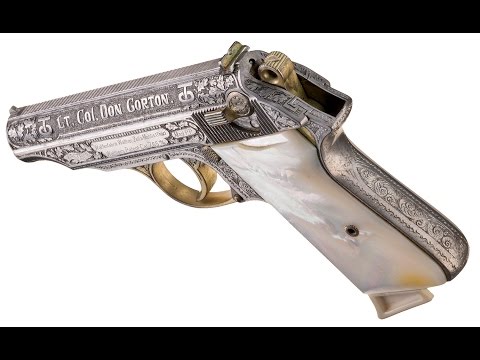
The pistol Andrews acquired was one of many presentation-to-be PPs on hand, and would have been more or less ready to receive the name and insignia. As a staff officer and logistics specialist with the 90th Infantry Division, Lieutenant Colonel Andrews would have been ideally placed to receive one of these elite Walther pistols.
In July of 1945, Andrews was released back to the States on points. After a few years working on Santa Catalina Island for the Wrigley Family, Andrews returned to Illinois and settled down as the owner of Algonquin Hardware Store. He retired from the Army Reserves as a colonel.

Thomas Andrews carried his commitment to service into civilian life, serving his community as president of the Algonquin Lions Club, president of the Algonquin Business Association, and commander of American Legion Post 670 (now part of Post 1231 in Lake in the Hills, Illinois). Andrews passed away on December 6th, 1996, one day before the 55th anniversary of Pearl Harbor, the event that roused the Greatest Generation to answer their nation’s call.
Factory captured Walthers are exceptional guns, and even more so were the exceptional men of the 90th Infantry Division who carried these pistols in the final months of WW2. For some, the captured Walthers served as mementos. For others, they were a small reward for what they’d endured in the fight to liberate Europe, when the world asked ordinary men to do extraordinary things.

The Walther PP pistol engraved to Thomas M. Andrews that’s featured in Rock Island Auction Company’s May 13-15 Premier Firearms Auction is a phenomenal standout as a near twin to General George S. Patton’s Walther, only one serial number down from his, and one of only three known engraved Walther PP presentation pistol of this type with a late WW2 blank slide. In an auction filled with the finest firearms, this little pistol stands out as one of May’s hidden treasures.