Author: Grumpy
Categories
.277 SIG Fury Demystified by LEVI SIM

Earlier this week, SIG introduced their new Cross rifle to much acclaim. They mentioned that it’s chambered for .308 Winchester, 6.5 Creedmoor, and .277 SIG Fury.
Well, the speculation about this mysterious .277 SIG Fury has practically broken the internet. GunsAmerica spoke directly with an authoritative representative from SIG to get the scoop and figure out exactly what’s going on with this cartridge.

NOTE: Our Editor, True Pearce, took the Cross rifle and the new Fury ammo on an elk hunt this Fall and we used some of his leftover ammo for these photos. Please note that these are pre-production cases and they don’t even bear a headstamp.
Is the .277 SIG Fury a Magnum?
The short answer is no. It fits into a short action rifle and has the same head diameter as a .308.
Why .277 or 6.8?
As many of you know, traditionally the best bullets are not found in .277 caliber. While a few good ones exist, most of the favorite bullets on the market are .260 caliber (6.5), .284 caliber (7mm) or .308 caliber. So why did SIG choose .277 (6.8mm)?
The answer is they didn’t. The U.S. military wants a new belt-fed machine gun and put out a contract for one. SIG entered a belt-fed machine gun hoping to win the contract. The military specified the caliber of 6.8 or .277. Of course, the military wants the cartridge lighter and more powerful so SIG began developing the .277 Fury for that contract. SIG has been selected as one of the three finalists for the contract and will be going into full production with the .277 SIG Fury for the military. The commercial market gets to reap the benefits of over two years of R&D with the cartridge for the military.
The other two finalists for the belt-fed contract are General Dynamics and Textron.
To summarize the .277 SIG Fury was designed for the military. Specifically for SIG’s belt-fed machine gun entry.
140 Grains, 3,000 FPS, 16″ Barrel
There have been all kinds of numbers circulating, but the facts are that a 140-grain bullet will attain a velocity of more than 3,000 FPS from a 16″ barrel. Exact chronographed velocity won’t be finalized until it’s checked in SIG Cross production rifles but at least 3,000 FPS is certain. Obviously, longer barrels are going to mean even faster speeds.

This is significant because this kind of speed is usually only possible from longer barrels and magnum rifles. While some claim handloaded speeds with 6.5 Creedmoors of over 2900 fps with 140 grain bullets, the truth is that they are shooting 28-30 inch barrels or are not following actual published load data and are far exceeding safe pressures (We might know some guys).

SIG’s launch of the Cross rifle is targeted squarely at hunters and long-range shooters. They even offer it from the factory with FirstLite’s popular Cipher pattern. That gun with a 16″ barrel and chambered for .277 SIG Fury weighs just 6.2 lbs, and that’s very attractive when you consider that velocity.
What’s Different About This Case?
The .277 SIG Fury is a three-piece cartridge. The brass part of the case encompasses the body, shoulder, and neck. The base or head of the case is stainless steel and is where most of the pressure happens. The third piece mechanically bonds the stainless base and brass body together inside the case. SIG says, “We see this as the technology of the future.”
Putting a steel head on a brass case is not a new idea, but it has never been mass-produced. “We’ve been targeting a better way to manufacture it,” SIG’s representative says.

Steel is much stronger than brass so this case can withstand higher pressures without being as thick as brass would require. It’s much lighter, making this case weigh significantly less than brass casings of similar loads. Soldiers who pack this stuff around by the ammo can-full will appreciate that.

The case head is the same diameter as .308 and 6.5mm Creedmoor cases. The case has a similar OAL to a .308.


All these comparison photos should give you a good idea about the case. Once the SAAMI registration is published we’ll have exact dimensions.
80,000 PSI
A standard cartridge, like a .308, is producing (on the high side) around 60,000 PSI. A magnum cartridge, like .300 Remington Ultra Magnum, can produce as much as 66,000 PSI.
SIG’s Fury is working at more than 80,000 PSI. They have created and tested proprietary blends of faster burning powder that help safely push those pressures and velocities while maintaining good accuracy.

80,000 PSI is the key to getting high speeds from a short barrel. It’s not using standard powders, either. These are new proprietary powder blends SIG has developed while developing this ammo for the military.
Sweet, I’ll Have Ol’ Reliable Rechambered in .277 Fury…
Can you have your gunsmith rechamber your favorite rifle in SIG Fury? Technically, yes. SIG has even tested several actions from other manufacturers. A Remington 700 can certainly handle it, but SIG doesn’t recommend it, and for good reason.
That much pressure can be handled by existing actions, but they are not designed for it and it’s going to wear on them. “We Built the Cross rifle like a tank,” SIG says. Everything about this new action is engineered for longevity under the high pressure produced by this cartridge.

.277 Only?
SIG will have the .277 ammo available commercially in 2020. This is SIG’s first proprietary rifle cartridge. But they already have other calibers in the works. They confirmed that a 6.5mm case is on the way and that we may see long action calibers follow.

SIG emphasized that any forthcoming products won’t be existing chamberings. “Future cases using this technology will be a SIG Fury caliber. All of those cartridges will be proprietary SIG.” There won’t be a 6.5mm Creedmoor with this casing because they want to ensure that nobody loads this high-pressure ammo in actions that aren’t designed for it.

It does feed perfectly from existing AICS magazines.
SAAMI Registration
The .277 SIG Fury was filed with SAAMI in summer 2019 and the registration is expected to be completed early in the first quarter of 2020. Since it’s not finalized with SAAMI, we don’t have the exact specs and tolerances, yet.

SAAMI, the Sporting Arms and Ammunition Manufacturing Institute, is “tasked with creating and publishing industry standards for safety, interchangeability, reliability and quality, coordinating technical data and promoting safe and responsible firearms use.” All cartridges you buy commercially meet SAAMI specs and you can reference their specs for your own reloading.
What Does SIG Proprietary Mean?
This is a SIG designed cartridge that doesn’t fit any other chambering. Some speculation was that this would fit in a regular 6.8. It won’t. Sig has registered this cartridge with SAAMI and fully expects other manufacturers to produce ammunition and rifles chambered in their proprietary chambering. No royalties will be required. Everyone will benefit from the commercialization of this cartridge.
Barrel Life
With high pressures and special powders, the barrels have got to be wearing out like crazy, right?
Testing is still being conducted on barrel life, and most of the focus has been on the full-auto belt-fed machine gun barrels SIG is pitching to the military. They have done lots of testing on the bolt guns, too, but SIG isn’t ready to release numbers quite yet.

They told us the preliminary numbers, though, and we had to ask again to clarify because it didn’t sound possible. We can say that with specific barrel coatings the barrel life with the .277 SIG Fury is better than the speculation in the forums and better than you’re imagining.
Way better than you’re imagining. Can’t wait for SIG to finish testing and release the final numbers.
Reloading
SIG will have reloading supplies for Fury ammo in the future. Their priority right now is in winning the government contract and launching the ammo commercially.


What Happens to the SIG Fury if SIG Doesn’t Win the Military Contract?
SIG assured us that they are “all in” on this cartridge and concept and that regardless of what the military does that they will be producing and creating other calibers.
Their first goal is to finalize a manufacturing process that allows them to build cases in huge quantities and for as low of a price as possible.

As part of their audition with the military, SIG has to produce millions of rounds of ammunition this year for testing. Their priority is supplying the military, of course, but they are making it available commercially no matter the military’s choice.
“We’ve already invested in this, in the machinery,” SIG told GunsAmerica. “We are going forward with this no matter what happens with the military.”

What’s It Going to Cost?
SIG doesn’t know yet but they know that to succeed commercially that it can’t be way more expensive than other hunting ammunition on the market. Currently, they’re machining the case heads but have several other technologies that they’re investing in that could make the cases much less expensive.
And if the military adopts it, then it should become relatively inexpensive due to the quantities that will be manufactured.

What Ammo Will Be Available?
We do know that there is going to be 135-grain match ammo and 140-grain ammo right off the bat. These photos are all the 140-grain hunting round. SIG expects a plethora of bullet options to follow as well as other ammo manufacture’s to load for the round.
How Does It Shoot?
Preliminary tests are excellent. Our Editor, True Pearce who has hunted with and shot the rifle and ammo says that “it exceeded his expectations in a hunting rifle.” Currently all of the Cross rifles chambered in .277 SIG Fury are prototypes but you can expect GunsAmerica to do some accuracy testing and report on it as soon as production guns are available. It doesn’t do anyone any good to report on a non-production prototype rifle’s accuracy that will be different than the finished product.
The Cross Rifle
The Cross rifle — which is a crossover between tactical and hunting — is currently the only rifle available for the .277 SIG Fury ammo. It is the only rifle that can shoot it, and SIG developed the rifle from the ground up for this revolutionary cartridge.

Development started four or five years ago on the rifle and it has been extensive. Everything in the rifle was designed and manufactured by SIG. The action and trigger (parts you can’t see from the pictures) are different from a design perspective than anything else available on the market. Obviously there are similarities between any rifle. They all have a stock, a bolt and a barrel but the way it works is unlike anything else out there.
Unfortunately, rumor has it that the production version won’t have the dust cover.

MSRP for the Cross rifle is $1,779, but you’ll find it at stores for the minimum advertised price of $1,599.
Categories
A really old sweat

Categories
Walther PPK/S
Categories
Minute of Mae: Ottoman Mauser 1893
Categories
Here is to help make Friday Better! NSFW


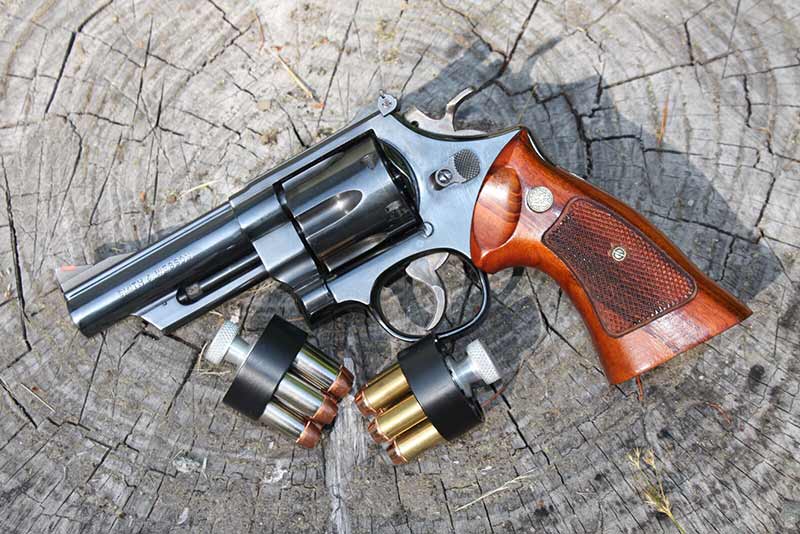
Workman’s 4-inch Model 57 with factory grips.
As I get older, I’ve discovered the increasing importance of size, shape and diameter when it comes to shooting big bore sixguns.
It’s widely known I prefer the .41 Magnum over the .44 Magnum for the slightly flatter trajectory and slightly lower felt recoil, but when it comes to the latter, part of the equation is the grip.
Years ago, when I first acquired a Model 57 Smith & Wesson with a 6-inch barrel, I took a pretty quick dislike to the factory grips. They just didn’t have the right feel, and when I touched it off with full-house loads, there was no mistaking a revolver had gone ‘BANG!’ in my hand.
At the time, I was on a tight young family budget so I bought a superb Pachmayr rubber Presentation one-piece grip and it made a world of difference. The rubber covering the backstrap reduced felt recoil, and I also slapped a Pachmayr on my Ruger Blackhawk with the same result. This ignited what has become something of a lifetime study of grips.
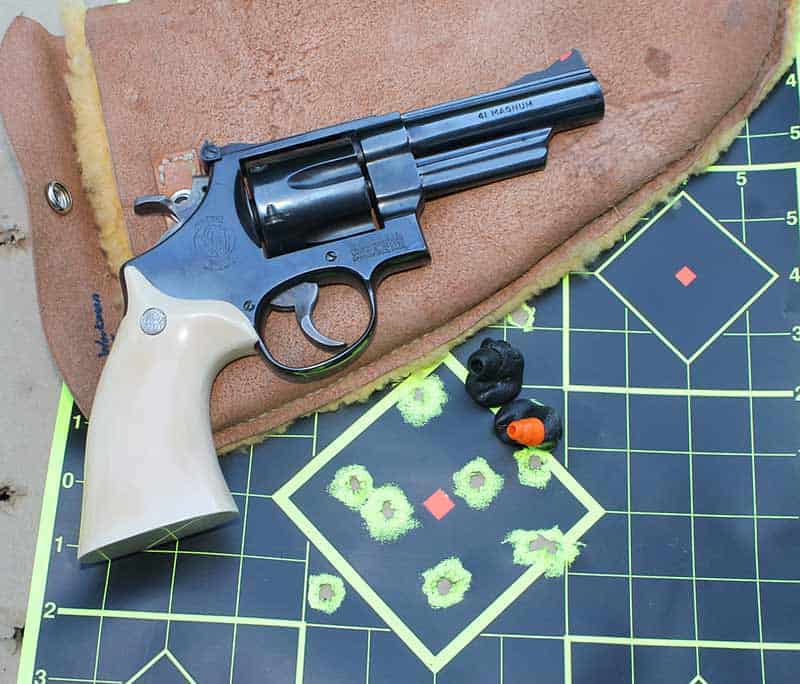
As these things go, I wanted to fancy my revolver up a bit and found a set of synthetic grips at a gun show. The salesman said they were “bonded ivory” — a mix of synthetic and ivory dust that would age with time (they did) — and not only did that attract my attention, but more so did the shape. This set of grips had a palm swell so I plunked down a modest bit of cash (far less expensive than real ivory, which was still legal at the time) and I discovered having a wider profile along the backstrap and the palm swell really did make a difference.
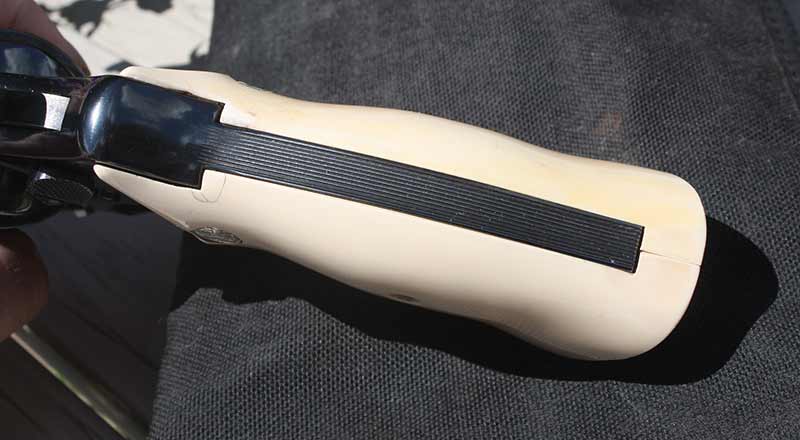
Which is the best for you, wide or slightly thinner? I like a palm swell, you might not.

The width of the grip spreads recoil over a slightly wider area of the hand, rather than pound a narrow space between my thumb and the pocket of my hand. These grips—I have no idea who the maker was—truly did the trick.
I’m Guilty!
I am guilty of searching for perfection, which years of experience has taught me really doesn’t exist. Translation: I have more than one set of grips for the N-Frame S&Ws now in my gun safe.
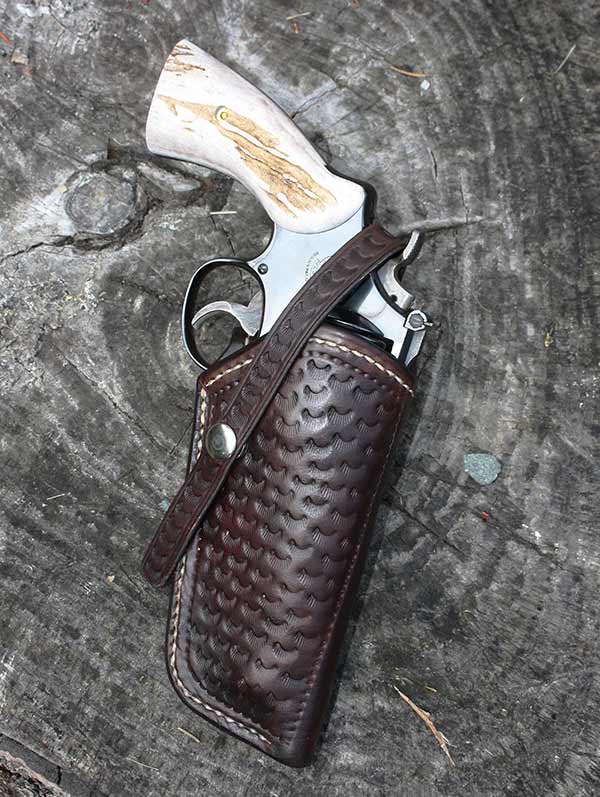
Eagle Grips produced this set of eye-catching elk antler grips.
Raj Singh at Eagle Grips built a set of beautiful elk antler “magna” style grips that I consider my “barbecue” set for getting really fancy. When he introduced me to some stuff called Kirinite, I suggested that if he made target-style grips for double-action revolvers out of the stuff to the same dimensions as Eagle’s popular Heritage grips, he’d probably sell a bunch of them. I got one of the first sets, and I’ve had very good luck with them.
Eagle produced this set of tough Kirinite grips to imitate ivory.
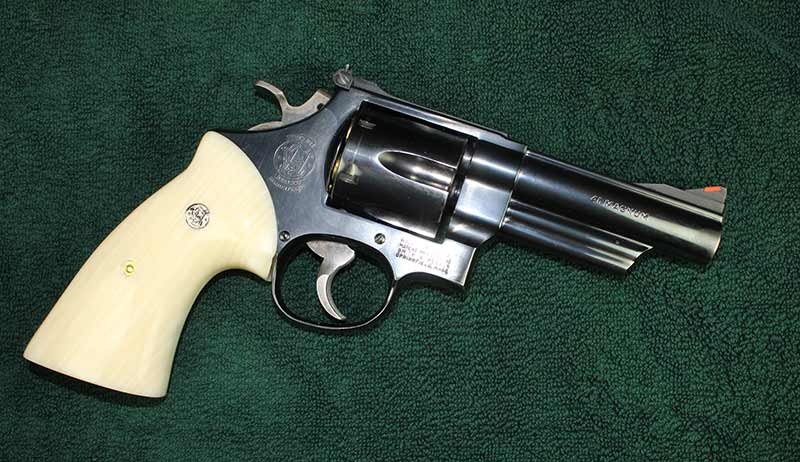
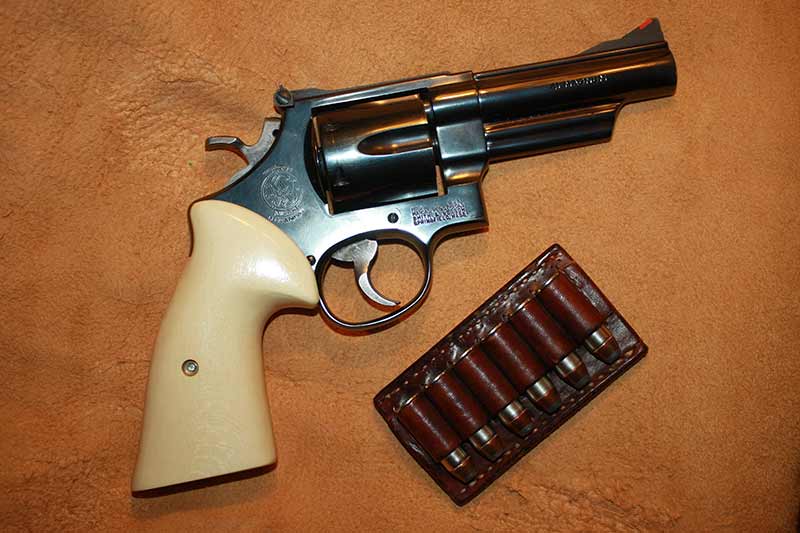
A few years ago, I bought a set of imitation ivory grips from Altamont. They were on my 4-inch M57 when I had to dispatch a wounded mule deer buck a few years ago in an Eastern Washington canyon. These grips look superb with the S&W medallions, and in my opinion, they’re far preferable to the factory grips that were on this revolver when I bought it. Depending upon the size of one’s hand, they just might be what you’re looking for.
Once, while attending a long-range handgun shoot, I met a guy who had mounted a set of American holly grips on his revolver. The stuff looked like real ivory from a distance because it had yellowed slightly, so we had quite a chat. Some months later, I talked to longtime pal Rod Herrett at Herrett’s, and had a set of holly grips made in the Roper design. Once again, a great fit and feel, but the one thing I noticed immediately was how lightweight holly is. Compared to the antler and synthetic materials, this wood is almost weightless.
This set of Roper grips made from American Holly by Herrett’s is as functional as they are attractive.
The Roper style also has a slight palm swell, which spreads the recoil comfortably. The butt end on my set is a bit narrower than I prefer, but they hide well under a vest or jacket.
https://www.lymanproducts.com/brands/pachmayr
The Importance of ‘OUCH!’
Some folks think gun writers are immune from recoil discomfort because of all the shooting we do. Let’s put that one to rest immediately; recoil hurts regardless of who you are.

I shot a buck with this revolver while it was wearing this handsome set of Altamont grips.
I once had the displeasure of shooting a big bore revolver manufactured with awful narrow synthetic grips. For serious handgunners, especially those involved in silhouette shooting or hunting where precision is paramount, firing a painful handgun can contribute to developing a flinch.
Don’t ignore the “ouch” factor. It’s as hard on the hand as running a chainsaw all day, typing with carpal tunnel or hammering nails or busting firewood for hours using a maul. Later in life, that’s going to come back and haunt you. At my age, that’s not conjecture, it’s experience.
A sidearm needs to fit the hand comfortably. This can only be determined by trying out a few with different grips, before making a purchase. I swap out my grips occasionally, same as using different holsters, but none of them produce discomfort upon discharge. I learned my lesson years ago.
Has Turnaround Started?
Earlier this month, the Washington State Department of Licensing provided me with data showing a year-long decline in the number of active concealed pistol licenses has turned around, and the number is on the way back up.
May saw almost 5,000 additional CPLs in circulation, and I am anxiously awaiting the June data to see if the positive pattern continues.
Washington, like all other states, saw a spike in gun sales over the past 12 months due to a variety of factors. Numbers declined due to COVID-19 shutdowns of basic services such as accepting new license applications by law enforcement agencies.
Gotta Love the Judge
Someday, they’ll be talking affectionately about U.S. District Court Judge Roger T. Benitez for his no-nonsense rulings on gun control and the Second Amendment.
Twice this jurist has smacked California gun control laws, most recently a couple of weeks ago when he declared the Golden State’s ban on so-called “assault weapons” to be unconstitutional. Anger from the gun control crowd, including Gov. Gavin Newsom, was predictable.
In his 94-page ruling, Judge Benitez dropped this gem at the top of Page 60: “How well has the California ban on assault weapons worked? Before AWCA (Assault Weapons Control Act), twice in a decade, an assault weapon was used in a mass shooting. On average, since AWCA, twice a decade, an assault weapon was used in a mass shooting. The assault weapon ban has had no effect. California’s experiment is a failure.” (Emphasis in original.)