

Capt. Emanuel Victor Voska, U.S. Army
There seems to be a rule somewhere that any time a nation’s founding fathers are depicted in a group photograph or painting, they’re required to adopt a certain gravitas in their expression to help convey not only the momentousness of their deed, but also their own stature as serious men, such as future generations might look up to.
Such seriousness is very much in evidence in an old photograph of the first Czechoslovak National Council, taken presumably at the time of independence in 1918. Nine men, three in uniform, the rest wearing the formal dress of the day; stiff-necked, high collars, pince-nez spectacles, mustaches, some florid, some pointy, stare in the general direction of the camera, but not into it, and none of them smiling.
Except for one.
Today, almost no one remembers him either here in his adopted country or in the two republics that came from the one he played such a heroic role in helping found.
He stands in the very center of the group, behind two seated officers whose uniforms are much fancier than his, which is darker and seemingly without any identifying insignia. He stares directly into the camera, an almost imperceptible smile on his lips, like he knows we’re there, looking at him across a gap of ninety-plus years. He smiles like it’s a secret he’s sharing with us, like he’s someone who knows all about keeping and sharing secrets.
Then you see the narrow, leather strip of a Sam Browne belt coming diagonally down from his right shoulder, and then you notice that on the other there are two gold bars. That’s when you realize that this man is a captain in the U.S. Army.

In this group photo, Voska stands at center, in U.S. Army uniform, just behind the right shoulder of Czechoslovakia’s first defense minister, Vaclav Klofac, with hat off. Wikimedia commons
His name was Emanuel Victor Voska, and besides being a U.S. Army officer and a founding father of Czechoslovakia, he was also one of the greatest spymasters of the 20th century. Today, almost no one remembers him either here in his adopted country or in the two republics that came from the one he played such a heroic role in helping found.
At the time of Voska’s birth in 1875, the Austro-Hungarian Empire was on its last legs. Emperor Franz Josef had already been on the throne twenty-five years and still had another forty left to go. The Czechs, Slovaks, Serbs, Croats, Bosnians and other subject nations were growing increasingly restive under his imperial rule and the emperor relied more and more on his vast networks of secret police informers to quash any dissent.
Using his own funds, Voska traveled tirelessly all over the world, connecting himself with thousands of Czechs and Slovaks living overseas, who, though outwardly loyal to the Empire, shared his dream of a Czechoslovak nation.
Trained as a stone sculptor, Voska would have, under normal circumstances, spent his life in his native Bohemia, except that something he said got picked up by an informer and passed on to the police, who paid the young man a visit. Voska decided it was time to leave and seek his fortune in America.
Though he arrived with only a few dollars in his pocket, within a few years he had become a wealthy, powerful businessman. Using his own funds, Voska traveled tirelessly all over the world, connecting himself with thousands of Czechs and Slovaks living overseas, who, though outwardly loyal to the Empire, shared his dream of a Czechoslovak nation. From them he began building vast spy networks that stretched not just all over the globe, but even into Austrian diplomatic service.
Back in the land of his birth, Voska settled down to a quiet life in a farming town. But then fascism started rearing its ugly head in Germany a few miles away, and before long, he was running Czech anti-fascist activities in Spain, working with anyone, including Czech communists, who’d join the cause.
When World War I broke out in 1914, Voska, having already received the blessing of President Woodrow Wilson, put his networks to work for the British, where they scored a number of important coups. With Voska’s help, they smashed German efforts to supply weapons to Irish nationalist groups, both in Ireland and the United States, and a similar operation to start an anti-British revolt in India. Voska also uncovered spy activities by the German Ambassador in Washington and caught an American journalist doubling as a German agent.

Capt. E.V. Voska, seated, in Prague, 1919.
When the United States entered the war in 1917, Voska was promptly given a commission as a captain and sent to Russia. His real mission was to make contact with the more than 60,000 Czech and Slovak soldiers who had switched sides after being captured by the Russians. Though some were fighting for the Czar, most were on the sidelines, self-organized into an army whose loyalty was to a nation that didn’t yet exist. Now with Russia teetering toward revolution, Americans needed to know how the Czech Legions might play into the equation. Voska smuggled into Russia Thomas Masaryk, the Czech leader and President Wilson’s personal friend, who urged the legionnaires to stay out of the upcoming turmoil. Nevertheless, events overtook them and the Czechoslovak Legions found themselves embroiled in a war against the Bolsheviks. By the time they’d fought their way home via Siberia and San Francisco, Czechoslovakia had become a nation and Voska was already in Prague helping set up the new government.
Voska spent the next ten years in prison. Some satisfaction did come during show trials, when a number of the same communist leaders who had persecuted Voska were themselves tried and executed for treason.
Back in the land of his birth, Voska settled down to a quiet life in a farming town. But then fascism started rearing its ugly head in Germany a few miles away, and before long, he was running Czech anti-fascist activities in Spain, working with anyone, including Czech communists, who’d join the cause. When the Germans invaded Czechoslovakia in 1939, Voska was one of the first Czechs that the Nazis arrested. Somehow he managed to escape to America.
Soon he was back in uniform, this time as a colonel. Voska spent the war in Turkey, overseeing American intelligence operations there and in the Balkans. When the war ended, Voska returned to Czechoslovakia and again tried to live the remainder of his days in peace. Again, it was not to be.
In 1948, the Communists staged a coup and took over Czechoslovakia. For two years, they didn’t bother Voska, because he was someone many of them knew personally and admired. But then Voska was arrested and put on trial for treason. Even though he was now an old man of 75, he fought hard against the charges, arguing that being then an American citizen, nothing he might have done could have been considered treasonous. Voska spent the next ten years in prison. Some satisfaction did come during show trials, when a number of the same communist leaders who had persecuted Voska were themselves tried and executed for treason. What clinched their guilt were old letters found in Voska’s files showing that they had met with him to discuss anti-Franco operations in Spain.
In 1960, the communists finally released the 85-year-old Voska, but he died, a free man, a few days later.

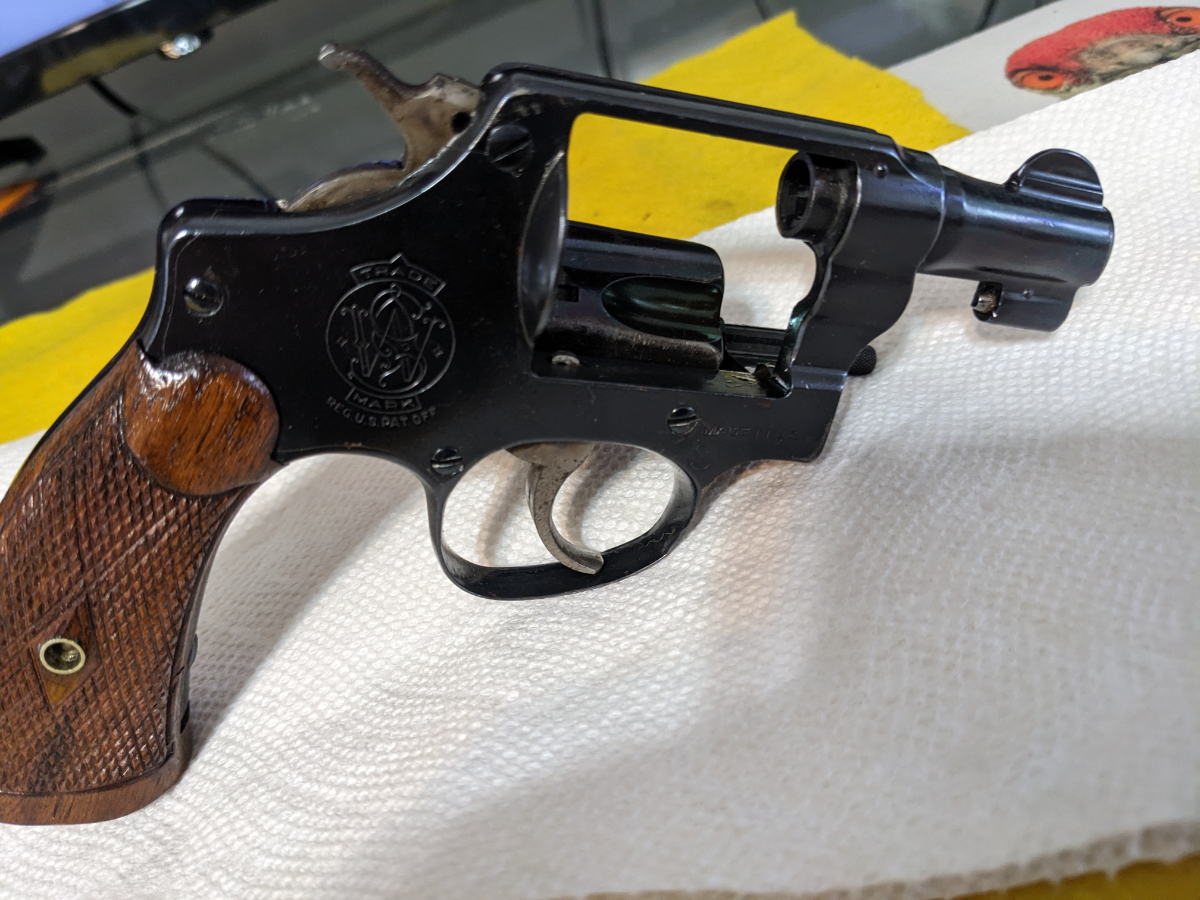
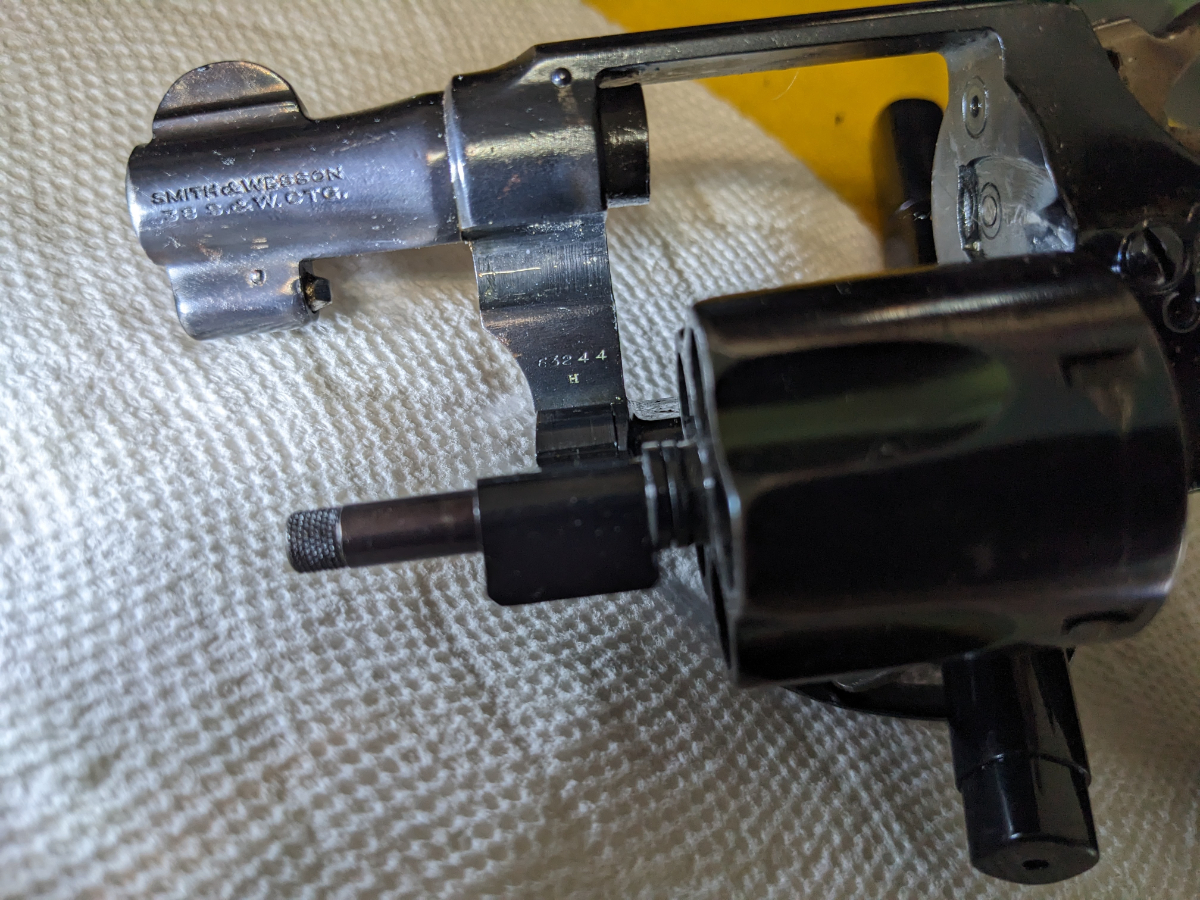
Pistols used in the National Matches started out in a pretty straightforward manner. Until 1911—actually until supplies of M1911 pistols became available—competitors in the National Individual Pistol Match used either of the two revolvers prescribed for U.S. Military service. Those were the several variations of Colt “New Army” and “New Navy” revolvers of 1892 (including the follow-on models of 1894, 1895, 1896, 1901, and 1903) and Smith & Wesson’s .38 Hand Ejector, Model of 1899—known from the outset of production as the “Military & Police” (M&P).
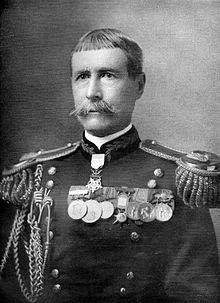
The only controversy came about in 1905, when Army Brig. Gen. William P. Hall declared that, “No Pistol with a barrel over six-inches in length will be allowed to used in the National Pistol Match …” Hall was the Military Secretary of the United States Army and the officer detailed to take charge of the 1905 Matches.
Hall’s decision was reported in the appropriate journals—among them Shooting and Fishing magazine. Editor John Taylor Humphreys, who happened to have been the only civilian to compete in the 1904 National Pistol Match, pointed out that Gen. Halls decision did not take into account that 6 1/2-inch barrel revolvers had been permitted in 1904.
The early promulgation of Gen. Hall’s decision probably did not prevent misunderstanding, but it did not prevent the wails of potential competitors who wanted whatever advantage and extra one-half inch of barrel offered (presumably the familiarity with a particular revolver). In the August 10 edition of Shooting and Fishing there appeared the text of three sets of correspondence—two between Gen. Hall and procurers of military equipment and a letter to Humphreys.
Brig. Gen. William Crozier, Army Chief of Ordnance, responded to Hall’s query to the effect that barrels of revolvers issued to troops were of six-inch length. N.E. Mason of the Navy’s Bureau of Ordnance informed Hall that the Navy had purchased S&W revolvers, then in storage at the New York Navy Yard, and that those revolvers had six-inch barrels.
Perhaps to pour oil on troubled waters, NRA Secretary Albert Jones ruled that in matches sponsored by the NRA and the New Jersey Rifle Association, revolvers with 6 1/2-inch barrels would be allowed. Smith & Wesson helped too, with a long run solution to the problem. The S&W Second Model, First Change became, in rather short order, the .38 Hand Ejector, Military & Police Model 1905, First Change, and the 6-inch barrel length was returned to the product line.
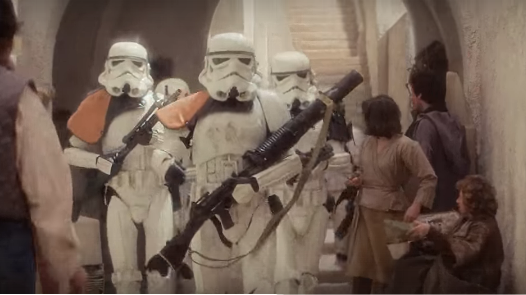
stories about weapons. The machine gun, which will be discussed today, was designed by Colonel of the American Army Isaac Newton Lewis in 1911, while he used the developments of Samuel McLean. But here, between General William Crozier, the head of the US artillery department, and Isaac Lewis, as they say, “a black cat ran”, and the American army did not receive a machine gun then. Lewis himself was offended and left the army.
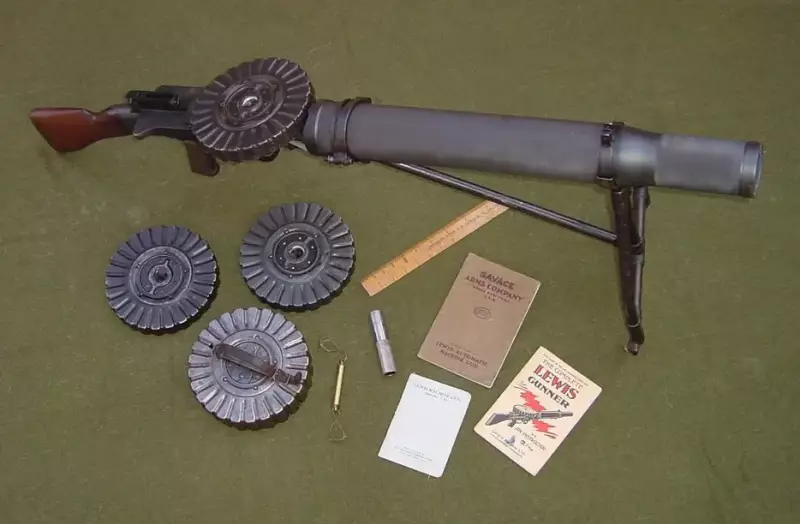
In 1913, he moved to Belgium, and already there, in the city of gunsmiths Liege, he created his own company Armes Automatique Lewis. He began promoting his machine gun in Europe back in 1910. Then he sold the rights to it to the American company Automatic Arms Company of Buffalo in New York and the Belgian Factory National. The Belgians in 1913 produced a small number of his machine guns under the British .303 cartridge, and in 1914 he managed to sell a license for his machine gun to the British company Birmingham Small Arms (BSA). So for him, inventive activity ended in the best way: Lewis was paid a lot of money, and he became a very rich man. And then, together with his factory, he completely moved to England and ended up there just in time – literally on the eve of the German invasion.
With the outbreak of the First World War, the production of Lewis machine guns under the designation Model 1914 was deployed by the BSA company in Birmingham and the Savage Arms Company in the USA. It was officially adopted by the British Army on October 15, 1915.
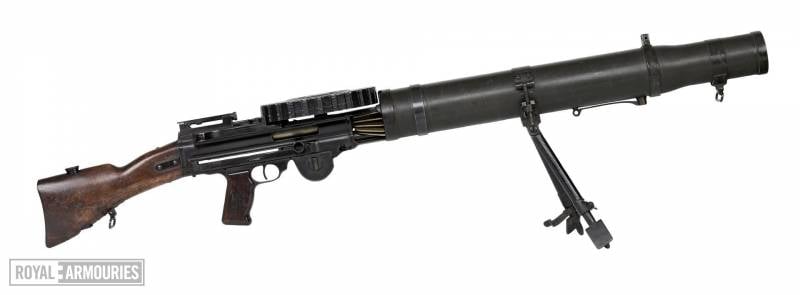
The main difference between these two designs was that the BSA weapons were designed for .303 British cartridges, while the Savage produced machine guns for .30-06 cartridges, which required certain alterations to the magazine, feed mechanism, bolt, barrel, extractor and gas operating system. But Savage also produced machine guns chambered in .303 British: M1916 and M1917, which were exported to Canada and the UK. A lot of machine guns fell into the US Army (although officially she didn’t take it into service!) And went to the naval the fleet. And later they were delivered to the UK under Lend-Lease during the Second World War.
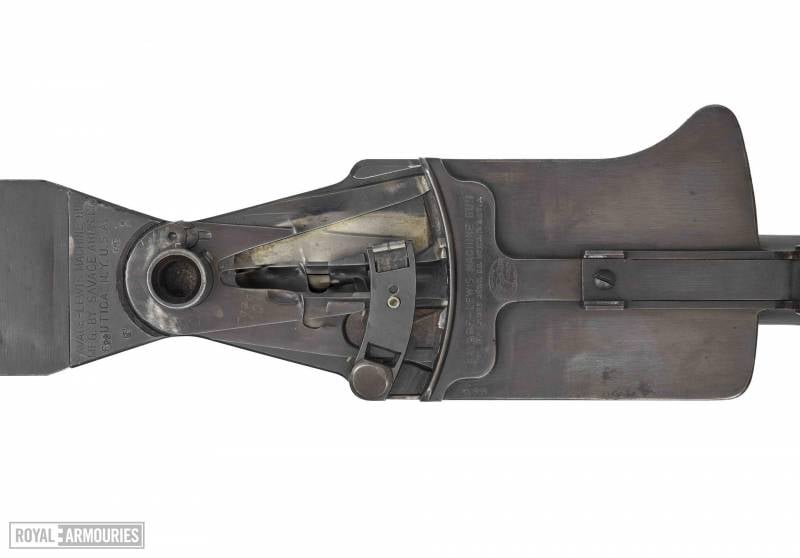
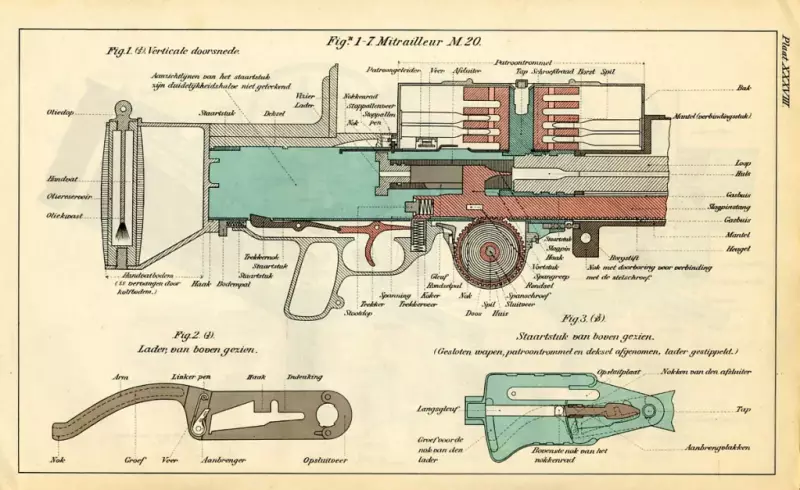
Note that the creators of the machine gun fully took into account the love of the military for simple and technically advanced systems and made a truly simple and technically perfect weapon. Automatic machine gun had a gas drive. Part of the powder gases expanding after the shot was removed from the barrel and pushed the piston under the barrel back. The piston rod, which was included in the receiver, had a serrated thread, just like the Saint-Etienne machine gun. But it was located on its outer surface and rotated the gear wheel not inside it, but outside, located in front of the trigger guard in a characteristic tide. Interestingly, the return spring was located just inside this wheel, which made it possible to significantly reduce the size of the receiver. It should be noted that the return spring in the Lewis machine gun also had an adjusting device for changing the recoil resistance depending on changes in temperature and wear. As unusual as this decision may seem, the Lewis design turned out to be quite reliable and was then even copied by the Japanese and widely used by them during World War II.
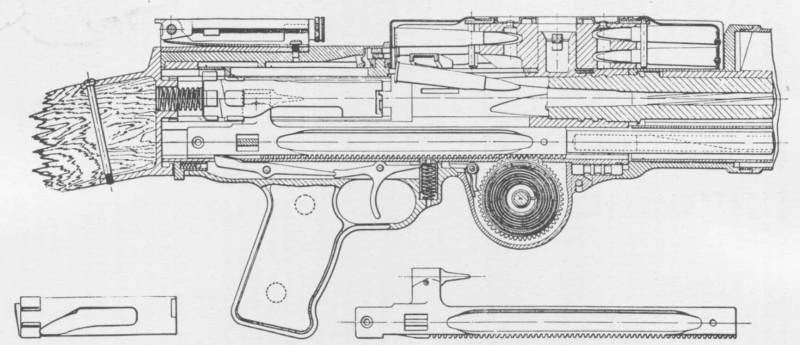
At the rear of the piston there was a vertical rack with a striker, on which a bolt was put on, hollow inside. When the force of the return spring returned the piston after firing and retreating to the rearmost position, the rack moved along the helical cam track in the bolt and rotated it at the end of its stroke, when it was at the breech. This allowed the three lugs at the rear of the bolt to fit into the slots in the receiver to secure the bore. And the fixed drummer at that time still continued to move forward and through the hole in the shutter mirror struck the primer.
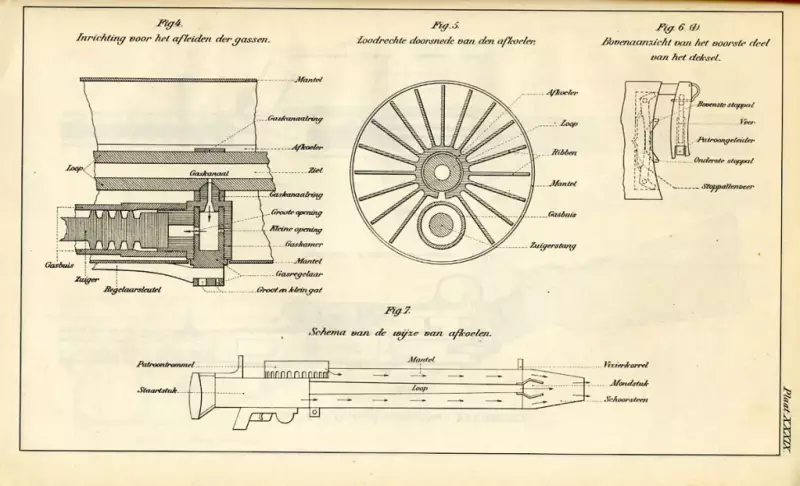
But perhaps the most unusual part of this machine gun was the aluminum barrel casing, which forced the muzzle stream of powder gases to draw air out of it and thereby cool the barrel, on which an aluminum radiator with radial fins was put on from the muzzle to the breech inside the barrel. There was a discussion about whether the casing was really necessary, since during the Second World War many old aviation machine guns that did not have a casing-radiator were transferred to anti-aircraft units of the British militia on British airfields, and they all functioned perfectly without it.
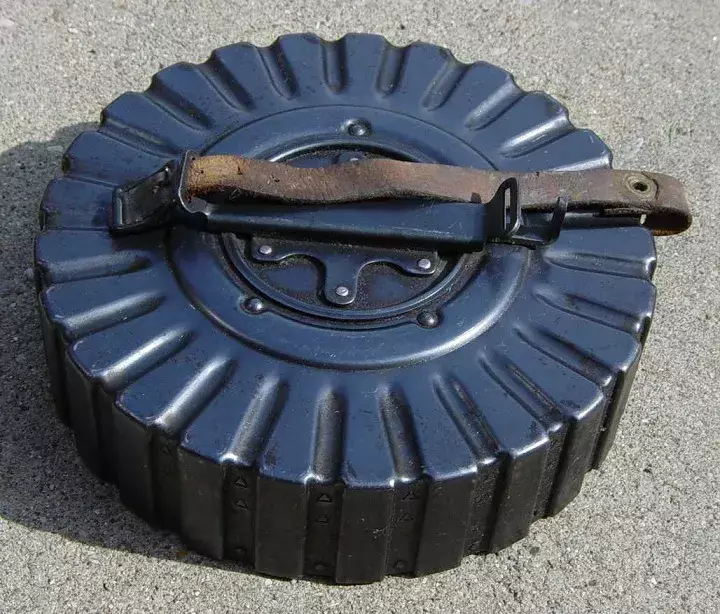
The Lewis machine gun used unusual open bottom disc magazines for 47 or 97 rounds. In such stores, the cartridges are held by the central disk by the nose, and they themselves are located inside in the form of a radial fan. There is no spring in such a store, and the supply occurs due to the fact that the cartridges simply fall into the machine gun as a result of mechanical action. So, the store at Lewis was driven by a cam at the top of the bolt, which, through a special curved lever, ensured the operation of the cartridge feed mechanism and at the same time turned the store itself.
The machine gun showed a rate of fire of about 500-600 rounds per minute, and an aircraft machine gun of 1918 with a recoil amplifier fired up to 800 rounds per minute. The version for ground use had a weight of 12,7 kg, that is, half as much as the Vickers machine gun, and was convenient in that only one soldier could shoot from it.
Already in the first days of the war, the machine gun was used during the defense of Namur, and it began to be issued to British infantry battalions in early 1916. At the same time, the heavier and less mobile Vickers machine guns were withdrawn from the infantry for use by a specialized machine gun corps. In early 1917, the US Navy and Marine Corps adopted the M1917 Lewis machine gun chambered in .30-06 caliber.
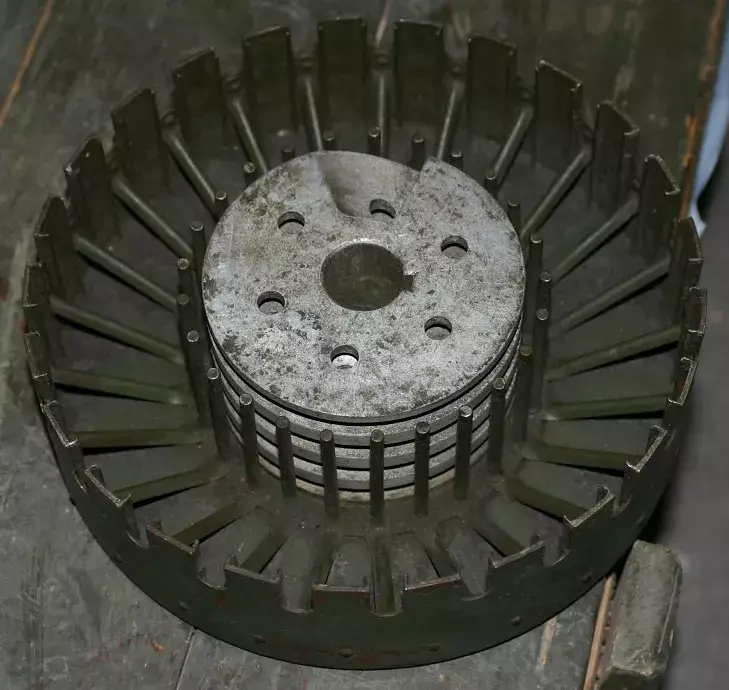
The machine gunners on the Western Front noted the “invulnerability” of the machine gun (it did not have a casing with water, which was easily penetrated by bullets and shrapnel, after which the machine gun failed), but were not too happy with the fact that they were continuously firing from it, shooting 12 stores in a row, impossible. Machine gunners were required not only to be able to shoot accurately, but also to maintain their weapons. So, it was necessary to completely disassemble it, and then, blindfolded, reassemble it correctly in just one minute, and this despite the fact that the machine gun consisted of 104 parts!
The machine-gun team consisted of seven people: two shooters No. 1 and No. 2 and five ammunition carriers. Accordingly, the tactics of the British infantry also changed. If earlier she went on the attack with chains, now a squad or a platoon, under the cover of a Lewis machine gun, fled to the nearest shelter, from where they covered the machine gunners running towards him with fire, after which everything was repeated. The Germans appreciated this tactic (as well as the machine gun!) And immediately adopted both. At the same time, they nicknamed him “] i] Belgian rattlesnake [/ i]”, which, perhaps, best of all characterizes his high fighting qualities.
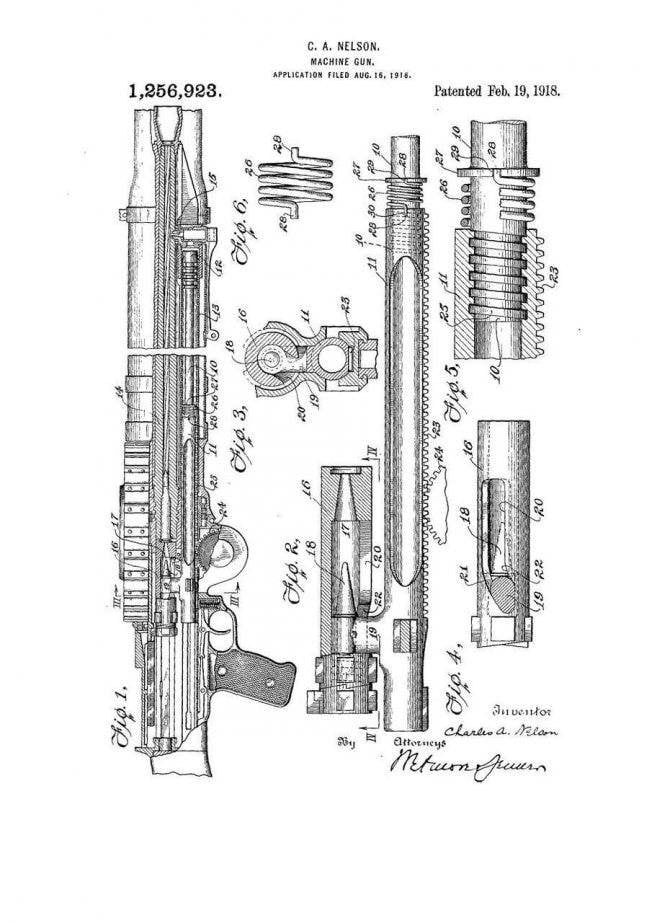
In 1917, the Russian Empire purchased 10 Lewis machine guns from the British government and ordered another 000 guns from the United States. The US government was unwilling to supply Tsarist Russia with these machine guns, and there is some doubt as to whether they were actually sent, although records exist that show that 10 Savage machine guns were delivered to Russia by March 000, 31. In any case, machine guns of this type during the years of the civil war in Russia were used by both whites and reds, as well as all kinds of nationalist formations.
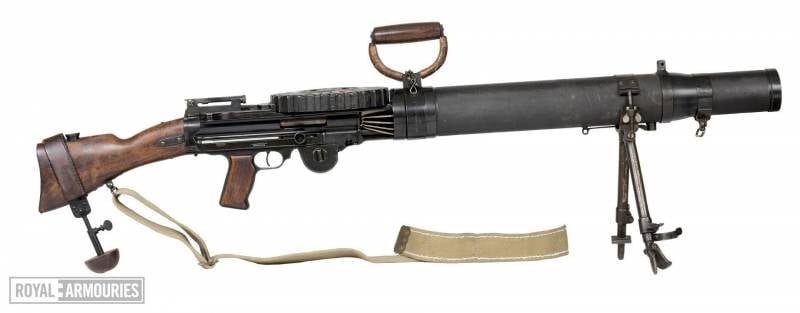
to British Tanks Mark IVs were also supplied with these machine guns, as the military appreciated the compactness of their magazines. However, they did not take into account one circumstance! It turned out that the tank’s ventilation system leads to a reverse flow of air through the cooling jacket of the machine gun, as a result of which powder gases are blown directly into the shooter’s face during firing. Therefore, as soon as an improved machine-gun belt was developed for the Hotchkiss machine gun, the Lewis was immediately replaced by them on all later models of tanks.
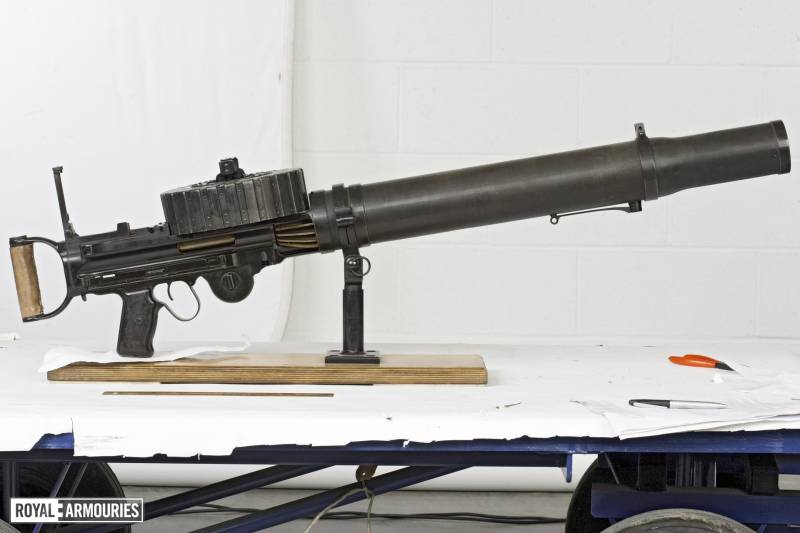
The only serious drawback compared to the Vickers machine gun was the high price of the Lewis. It cost £165 in 1915 and £175 in 1918, while the price of a Vickers was only about £100. But the assembly of the Lewis was about 80% faster than the Vickers, not to mention the fact that it was much more portable. As a result, by the end of the First World War, the number of Lewis machine guns exceeded the number of Vickers machine guns in a ratio of about 3: 1.
To be continued …