Categories
All About Guns Allies You have to be kidding, right!?!

Here we look into the Prestigious firm of James Woodward & Sons by Ben Laidlaw

James Woodward & Sons are considered by many as building the best guns of all time.

James Woodward started out in the trade apprenticed to Charles Moore around 1827. James Woodward worked his way through the ranks to become the head finisher at Charles Moore. They later became partners c.1844 and the firm moved to new premises at 64 St James’s St, Pall Mall, trading as Moore & Woodward.

Arcaded fences and T safty.

“Woodward’s had build an excellent reputation for best guns mostly being sold to the aristocracy.


At some stage Moore dropped out of the business c1851 and James Woodward later became James Woodward & Sons c1872 when James took his two sons James and Charles into partnership at the same address. James the son of the founder ran the business until his death on the 7th July 1900, his brother Charles had already died some five years earlier. The firm was then taken over by the nephew of James, Charles L Woodward. Records show that the firm later moved address in 1937 to 29 Bury St, but then suffered bomb damage in the Second World War and were temporarily accommodated by Grant & Lang at no 7 Bury St, untill no 29 was put back in order..

Woodwards had build an excellent reputation for best guns mostly being sold to the aristocracy, you needed to have deep pockets to be on the order books. Now if you can find a good clean example a side by side will fetch just under £10.000 but the over and under is around the £20.000 mark. These guns are not common and you will have a job to find a good one. There was one story being told by the leading London berrel-filer c1930 that Woodwards would reject any barrels that he had regulated for them unless he was able to get as few as two or three extra pellets into the standard pattern ! Perhaps this is why Woodwards with  their original choke boring throw perfect patterns.


It has been said that guns made by James Woodward & Sons have been consistently the best guns ever seen. Better than Purdey, H&H and Boss, but this I guess is down to one’s own taste. The Company concentrated on Shotguns and especially their legendary sidelock side by side game gun with its arcaded fences and signature T Safty. 29 inch barrels were a standard for Woodward as this was seen to be most efficient but other sizes could be ordered. The Prince of Wales stock was also a favourite of Woodward. We also encounter from time to time single triggers and sidelever’s but these were not the standard unless ordered otherwise. Although Woodward had their own single trigger design.

The firm was most well know for its development and production of its over and under design in 1913 by    Charles L Woodward. This and the Boss over and under were and still are without doubt the two best designs ever produced, and again its personal preference to which is considered better. In 1948 Charles L Woodward wanted to retire and offered the business to Tom Purdey who acquired it as a going concern.

Once Purdey had acquired James Woodward & Sons they immediately adopted the Woodward over and under design in favour of their own and it is still being made today.


The firm of James Woodward & Sons certainly deserves merit for their contribution to the over & under gun of today. And for those lucky enough to own one of their Classic game guns or the famous over and under, you have a rare treasure indeed !
Categories
All About Guns Ammo

Why do people carry this gun? Taurus Judge performance.

Categories
All About Guns

CHARTER ARMS TARGET BULLDOG .44 SPECIAL BY JOHN TAFFIN

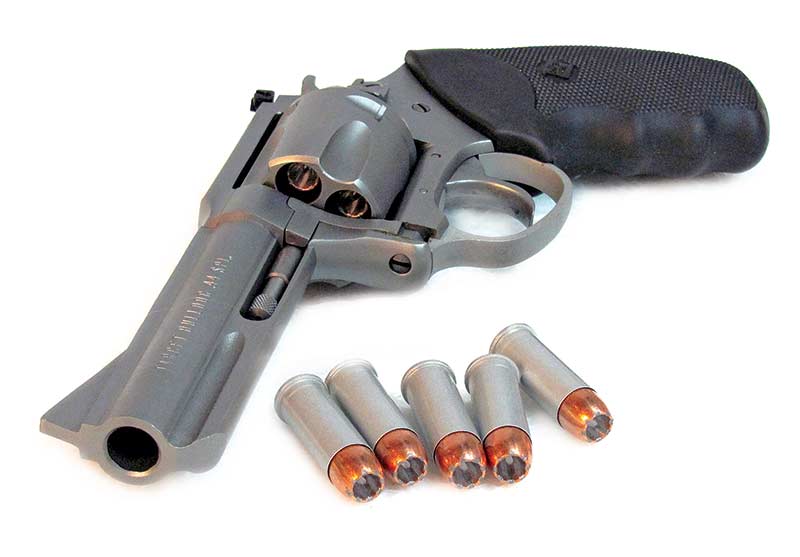
Loads shown are Blazer 200-grain JHPs, proven performers.

During my high school years as I started reading the likes of Elmer Keith and then a little later Bob Hagel and John Lachuk I also acquired a deep interest and then even deeper affection for the .44 Special. In the mid-1960s Charter Arms brought out the first .44 Special Bulldog. It could not have come at a better time.

The .44 Magnum arrived in very late 1955 and started showing up in gun shops in 1956. There were many who foolishly felt the .44 Special was dead. Elmer Keith retired his, Skeeter Skelton traded his 4″ 1950 Target .44 Special in on a Smith & Wesson .44 Magnum with the same barrel length, and by the mid-1960s, both Colt and Smith & Wesson had dropped the .44 Special from their catalogs. The only way one could have a .44 Special was to find a used one, convert something like a .44-40 Colt Single Action to a .44 Special by fitting a new cylinder, or buy a Charter Arms Bulldog.

Charter Arms managed to keep the meagerly flickering flame of the Special alive, at least until Skeeter realized his mistake and admitted the 4″ .44 Magnum was too much of a good thing and traded it off, replacing it with another 4″ Smith & Wesson .44 Special. During the ensuing years, S&W’s attention to the .44 Special was sporadic at best. It wasn’t until our own Mike Venturino, Clint Smith and Editor Roy twisted arms at S&W (with the cooperation of Tony Miele there) a few years ago, a fixed-sight, N-Frame .44 Special became a catalog item for S&W once again.

All during this time, except for a brief closed doors session, Charter Arms continued to offer .44 Specials. As this is written .44 Special sixguns are available from Colt, Freedom Arms, Ruger, Smith & Wesson and Taurus. However, Charter Arms is currently the only manufacturer offering a small-frame, 5-shot, double-action .44 Special, with adjustable sights.

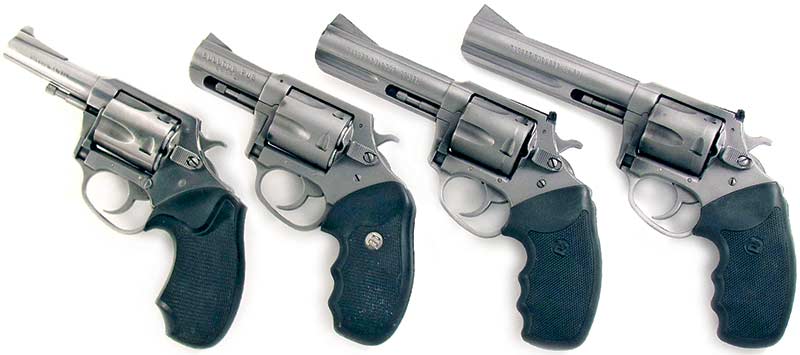
Left to right: Original stainless steel Bulldog .44 Special, Bulldog Pug, 4″ and 5″ Target Bulldogs.

That First One

The original Charter Arms .44 Special in the 1960s was a blued, 5-shooter with a 3″ barrel. At the time it was one of my most-carried sixguns and logged many miles in the top of my boot. One year, now more than 30 years ago, we rented a motorhome and took a rare vacation with the kids, who were all in high school at the time — and the .44 Bulldog was stashed in the camper and it came in handy. Twice in my life a gun protected my young family, and in both cases the gun I had with me was the .44 Bulldog.

Sometime after introducing the original blued .44 Special Bulldog, Charter Arms came out with what they called a Target Model. It was an excellent idea, poorly executed. Somehow, someone thought they could come up with an adjustable-sighted .44 Special Bulldog by putting a shroud over a relatively thin barrel. Perhaps it could happen, however there has to be some way to anchor the shroud just as Dan Wesson did with the locking nut on the end of their barrels. Instead Charter Arms tried to hold the shroud on with one screw at the bottom of the shroud in front of the frame. It did not work well.

Targets shot with 5″ Bulldog showed it was a real shooter.

Modern Models

Today’s Target Bulldogs bear little resemblance to the original idea. The barrel is not shrouded but rather is a full under-lugged barrel properly screwed into the frame. Both 4″ and 5″ versions are available, complete with an adjustable rear sight and a ramp front sight. For my eyes, loads and hand, the front sight on both .44 Special Bulldogs was too tall, requiring the rear sight to be adjusted up too high to the point I feared I would lose the adjusting screw. The simple solution for me was to take metal off the top of the front sight.

The 5″ .44 Special Target Bulldog we tested worked perfectly and smoothly from the beginning, both double and single action. However the 4″ version had a little hitch in the trigger when fired double action and Tom, my gunsmith at Buckhorn, smoothed this out for me and reshaped the front sight.

Let’s take a closer look at the Target Bulldogs, which are basically identical except one has a 1″ longer barrel. Weights are approximately 20 and 22 ounces for the 4″ and 5″ Bulldogs, and that extra 2 ounces and 1″ longer barrel makes quite a difference in feel or balance or whatever we choose to call it. The shorter barrel seeming to nestle back in the hand while the longer barrel seems more muzzle heavy. These are both all stainless steel, except for the black adjustable rear sight assembly, 5-shot, double-action, very easy packing, weather-beating, go along anywhere revolvers.

Barrels are full under-lugged, rounded off at the bottom front for easy holstering, having an attractive scalloped cut-out running the length of the underlug in front of the cylinder ejector rod. It’s quite attractive and also removes a very slight amount of weight. The trigger is smooth while the hammer is serrated for easy single-action cocking. Both are also quite easy to operate double action.

The top of the frame is flattened with the rear sight assembly very nicely fitting inside the rear sight channel with no part of the assembly protruding above the frame. Grips are full wraparound, finger-grooved, checkered rubber which will not win any prizes as far as looks are concerned, however function-wise they are just about perfect for these little .44s.

With their 5-shot cylinders allowing the bolt cut to be placed between rather than directly under the chamber, Charter Arms .44 Special Bulldogs have always been stronger than any loads I would normally wish to use in them. They are certainly not .44 Magnums, but will handle .44 Specials and.44 Russian and .44 Colt rounds.

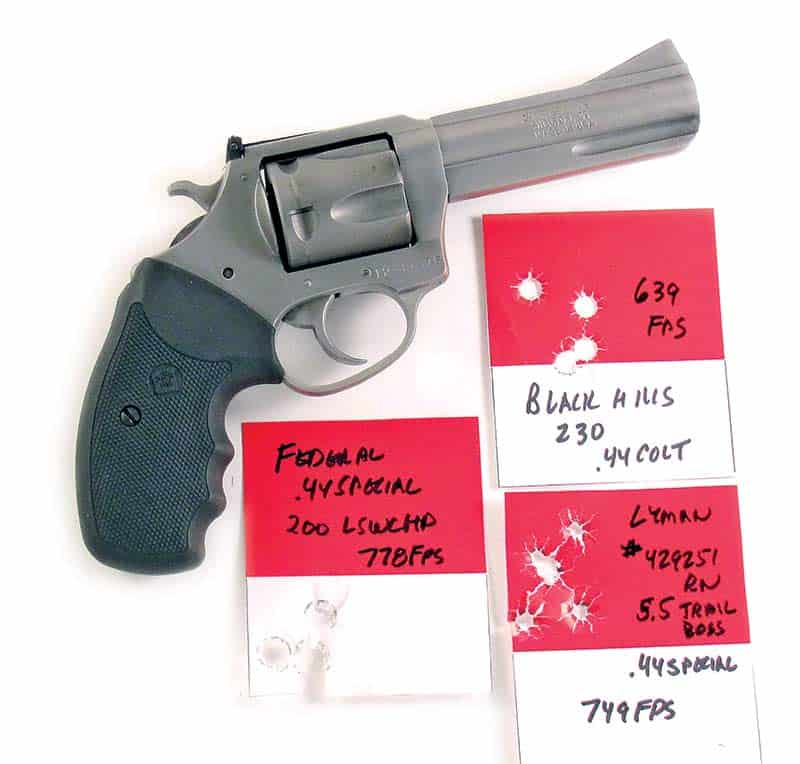
The latter two, designed for Cowboy Action Shooters, are quite pleasant to shoot and actually could be quite effective with their 200–230-grain bullets at nearly 700 fps from the longer barreled Bulldog, and 650 fps from the 4″ .44 Special.

The 5″ Bulldog was test-fired at 20 yards with the .44 Russian loads from both Black Hills and UltraMax grouping in 11/8″. With the shorter barrel I shot at a more realistic self-defense distance of seven yards, with the Black Hills 230-grain .44 Colt load grouping in 3/4″. So these loads not only shoot easily they are more than adequately accurate.

There’s a wide variety of good factory .44 Special loads available
today so don’t shy away from the .44 Special if you don’t reload.

The 4″ was more compact, but still performed.

Defensive Loads

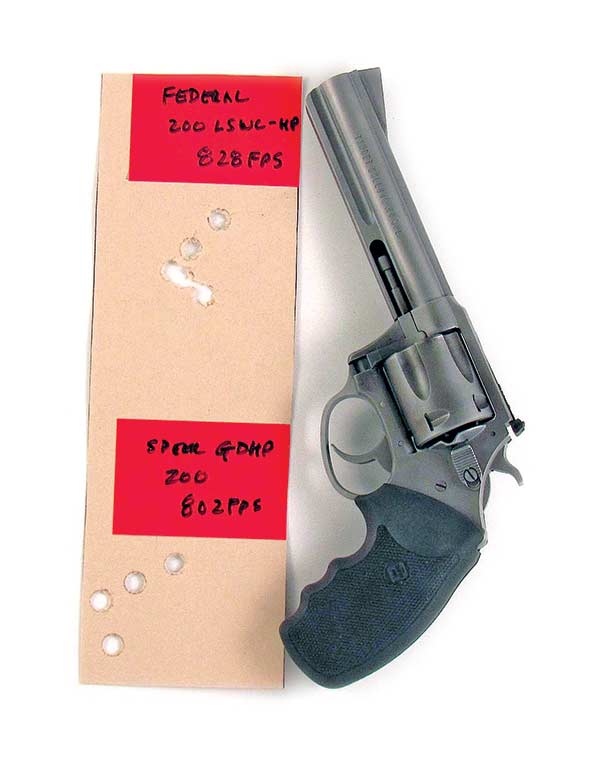
Switching to more serious .44 Special hollowpoint loads saw the Federal 200-grain lead SWC-HP clock out at 825 fps, with a 20-yard group of 7/8″ from the longer Bulldog and 775 fps and 3/4″ at seven yards from its smaller brother. Winchester’s 200-grain Silvertip JHPs do 766 fps and 11/4″ from the 5″ Special. For those wanting a heavier bullet, the Winchester 240-grain lead flatpoint does well over 700 fps.

My most-used .44 Special load consisting of the RCBS #44-250 Keith bullet over 7.5 grains of Unique clocks out at over 1,000 fps in the 5″ Bulldog which is quite a bit of energy coming from the barrel of such a small sixgun. The original .44 Special load from over 100 years ago can be duplicated with the Lyman round-nosed #429251 bullet over 5.5 grains of Trail Boss. This load does 750 fps and delivers 1″ groups from the 4″ Bulldog.

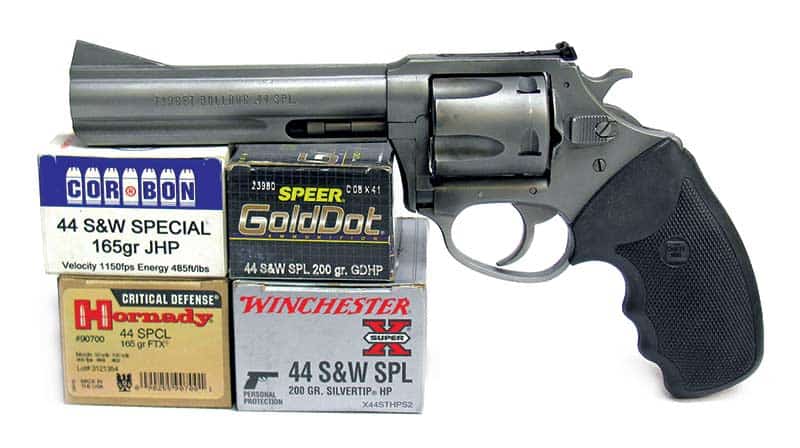
Both Speer and Hornady offer self-defense loads for the .44 Special, with the latter Critical Defense version a 165-grain JHP with a muzzle velocity over 1,000 fps, while the Speer 200 Gold Dot is at 800 fps and designed to expand at .44 Special velocities. Either one should be a good choice.

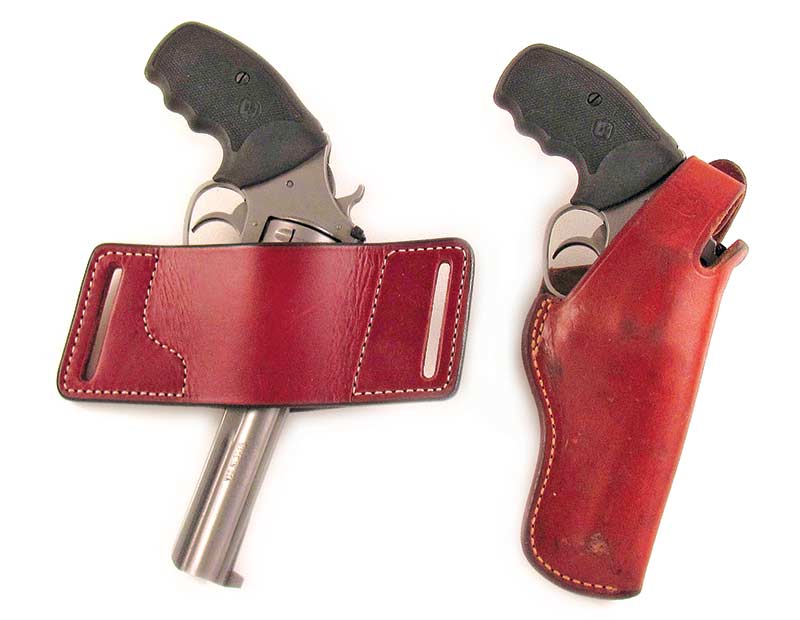
They carried easily in this universal belt slide from
Gary Reeder and a Bianchi Thumb-break.

Keepers

I definitely like both of these stainless steel Bulldogs and they will not be going back. These little Charter Arms revolvers will find duty outdoors or in vehicle carry. Bulldogs definitely have a serious application, however sometimes we just need plain and simple fun shooting.

With these Bulldogs I can see this means .44 Russian and .44 Colt loads used for big-bore plinking along with the duplicated original .44 Special roundnosed load. There was a time in my life I felt everything had to be loaded full bore. Thankfully those days are passed and I can also shoot for enjoyment. Getting smarter is one of the few benefits of getting older.

Categories
All About Guns

My new 1874 Sharps rifle. Quigley down under edition

Categories
All About Guns War

HMS Hood vs Bismarck | Why did the Royal Navy Lose?

https://youtu.be/iWKqotLGTvE

Categories
All About Guns

Tallassee Carbine: The Confederacy’s Last-Ditch Effort

Categories
All About Guns

M1 Carbine Standard Products 25th Anniversary

Categories
All About Guns

Marlin 1894 Cowboy Limited 44 Magnum 24 inch

Categories
All About Guns

A CZ 550 Safari Magnum Mag Bolt-Action Rifle with a 25″ barrel in the mighty & hard hitting caliber of 458 Winchester, made in 2006

The CZ 550 Safari Magnum is a bolt-action rifle designed and manufactured by the Czech firearms company Ceska Zbrojovka (CZ). The rifle is part of CZ’s Safari line of rifles, which are designed for hunting and shooting in Africa and other big game hunting locations.


Categories
All About Guns

Mossberg 500 vs Remington 870