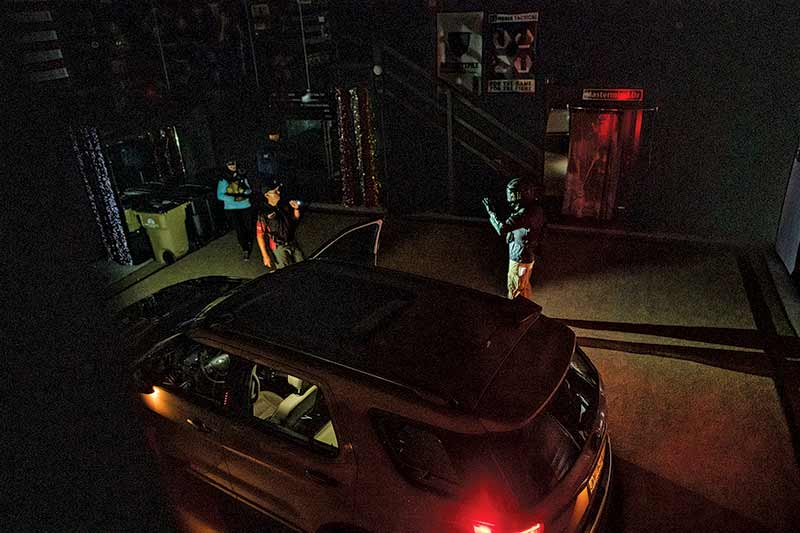
In this parking garage, you may pass a drunk or beggar and get to your car without
incident, or you may be attacked by muggers with shock knives or UTM guns.
Over the past three days I’ve been shot, stabbed, beaten, wrestled, molested by drunks, thugs and muggers, stabbed some more and killed about a dozen times. Ahhh … it’s been a truly glorious few days.
On the plus side, I did manage to ward off a few dozen seriously violent bad guys using escalating combinations of voice commands, lights and UTM sim firearms. Creative problem solving was the name of the game. One determined student pummeled his attacker with an outdoor trash can when his gun went out of action.
After perforating role-playing thugs with hundreds of “bullets,” something occurred to me. I used precisely one traditional range skill.
Thanks to the professionalism of the self-defense trainers at W.O.F.T. Self Defense outside of Orlando, Fla., I’m still alive and well, albeit with welts, bruises and various aches and pains. Sometimes that’s the price of valuable life lessons and I was more than happy to pay it.
Over the past decade or so, I’ve been to a couple of dozen firearms and defensive shooting courses. I can say without reservation I learned more practical self-defense skills over the past three days than all the others combined.
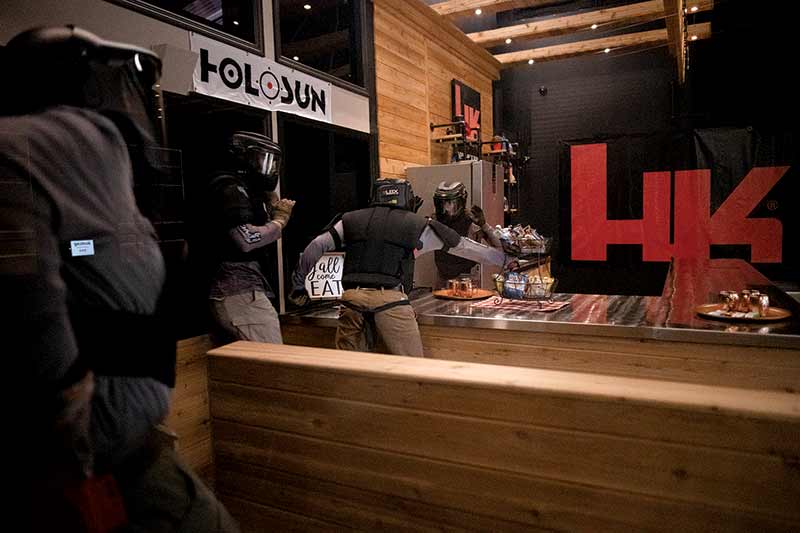
Did all those others teach me how to shoot? Absolutely. However, I’ve not yet seen anyone doing deep and immersive training with real defensive scenarios most likely to be encountered in everyday life. How many shooting schools have you sitting in a coffee shop, minding your own business, when two of six role-playing instructors break out into a full-on domestic fight? Maybe a weapon comes into play. Maybe it doesn’t. Or the “drunk” appearing to be sick next to your car suddenly pops up with a knife or gun? Ever thought about what you might do?
In this coffee shop you might witness a disgruntled employee squabble or need to react to an armed attack.
Learnings
The make-believe notion of being the cowboy in a white hat, casually standing back and shooting to save the day, was quickly destroyed. If only criminals would cooperate and accept the easy fate.
Situational awareness, or paying attention, is great. I’m all for a switched-on lifestyle. But if you think you’re so good at master-level awareness, you’ll be able to spot and solve any problem with a gun, you’re deluding yourself. We each face dozens of moments every single day when other people, or objects and structures capable of hiding an attacker, are close enough to allow one to be in our face long before we can react and bring a gun into the fight. Other defensive tools, both physical and mental, are a must.
A light is a powerful tool, and I need a simpler one. We ran dozens of scenarios in a dark parking garage ranging from a drunk harassing us to a planned two- or three-on-one mugging. Whether there was criminal intent, the light was a useful tool to help separate the annoying from the truly dangerous. When things got ugly, the light was a valuable tool not only to identify targets, but to distract, buy precious fractions of seconds, and sometimes escape. My current model has different intensities and modes. Forget that. I want one power level — high — and one button.
Leaving doesn’t feel very macho, but is often the right solution. Remember, as much as you may want to see yourself as society’s designated protector, you have a bigger obligation to come home to your family. That’s hard to do if you’re dead or spending the next few decades in jail as a result of getting mixed up in someone else’s altercation. Think long and hard before getting involved. The real story is far too often different from what first appearances indicate.
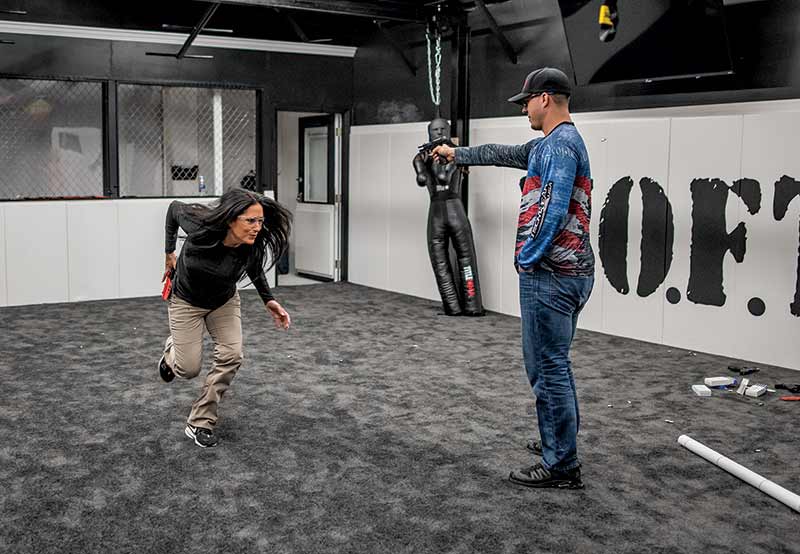
Explosive and committed action is a powerful strategy. By acting with vigor, you have a 0.25 to 0.50-second action/reaction advantage over your adversary. This can save your life.
Don’t settle for grabbing the “little gun” and stuffing it in a pocket before you run to Walmart or out to grab some milk. Those are likely your most statistically dangerous errands. If you’re going to carry, do it right.
Angela from event host H&K commits to explosive action in hopes
of turning the tables on an attacker.
That Range Skill?
Oh, and the one range skill I did use throughout the force-on-force shooting incidents? Malfunction clearing. While UTM-equipped firearms are more likely to jam, most malfunctions were a result of close quarters combat. Shooting while yanking your gun back to a retention position because Joe McThuggNoggins is lunging for it tends to cause a misfeed. Pulling the trigger with your muzzle jammed into an attacker pounding you into the pavement is another winning cause of a stuck gun. The list goes on — with a common denominator. Fighting with a gun at contact distance doesn’t allow for a proper Weaver or Isosceles stance and grip, and the risk of jams skyrockets, so be darn sure you learn how to instinctively clear your gun.
I’ve always figured malfunctions were unlikely in a self-defense encounter because quality modern ammo and guns almost always go bang. But the best gear may not work right in the middle of a close-quarters fight. At one point I ended up pistol whipping an instructor (wearing protective gear) in the head with a jammed pistol. Clearing a malfunction would have been a great option, but my support hand was holding his knife at bay. Yet another scenario I didn’t fully appreciate until it happened to me.
If you carry a gun for self-defense, by all means, learn how to shoot. “Range” skills will help when you’re shooting at high speed from awkward positions, even if you’re not planted in your official gunfighter stance at standoff distance. But be sure to consider some real scenario training to learn tools and strategies for problem solving, with or without that gun. The past three days changed my life, and it was only a taste of what I still need to learn.
We don’t try our cases in the press” has to change. Here’s why.
There’s a Latin saying: Silentium est consensus. It translates to “silence equals consent.” When a wrongfully accused person does not answer the charge, most people read it as an admission of guilt. It’s a legal principle of our law that this is not so, but unfortunately, only attorneys and cops seem to realize that.
Those same lawyers and cops have all been told in law school and the police academy, “We don’t discuss our cases in the press; it will all come out in court.” Unfortunately, in recent years, things have changed. Greed-motivated plaintiffs’ lawyers and politically motivated prosecutors have taken to trying their cases in the press, and when the accused do not respond in the same venue, well … silentium est consensus becomes the uncontested verdict in the Court of Public Opinion.
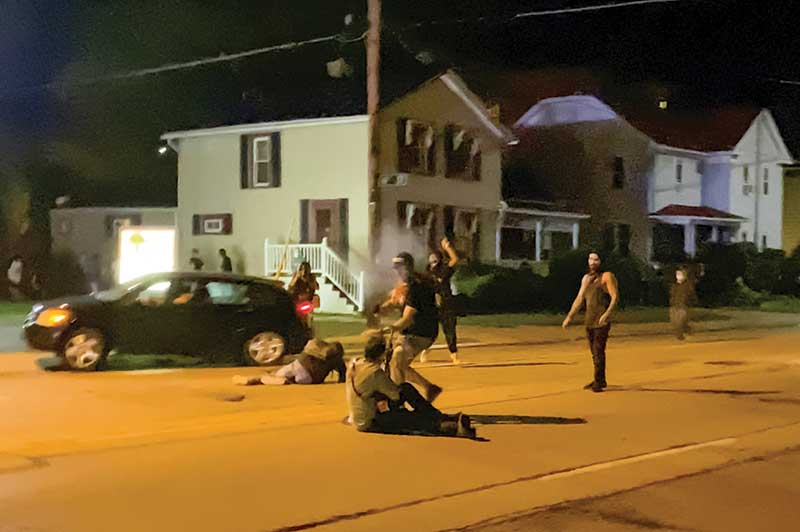
Kenosha: Kyle Rittenhouse fires the shot that “vaporizes” Gaige Grosskreutz’s
gun arm, which is holding a GLOCK 27 aimed at his head.
Riots
Los Angeles, 1992. A hulking suspect became violent during a traffic stop. An early version of the TASER had no effect, and when four LAPD cops “swarmed” him each grabbing an arm or a leg, he threw them aside like a terrier flinging rats. A citizen named George Holliday turned on his new camcorder in time to catch the man, Rodney King, trying to jerk Officer Lawrence Powell’s Beretta from its holster. The batons came out, and a bit over a minute and 50-some PR-24 swings later, the man was in handcuffs. The video found its way quickly to the media.
The suspect was black, the officers white, and the “Rodney King beating” became a national outrage. The public saw, again and again, the ugliest 10 seconds of the video, though King’s gun snatch attempt was never shown until the trial and then seen by only a small percentage of the public. When the cops were acquitted, riots followed, taking more than 60 lives, injuring thousands, and wreaking economic devastation in what was already one of the most poverty-stricken parts of the city.
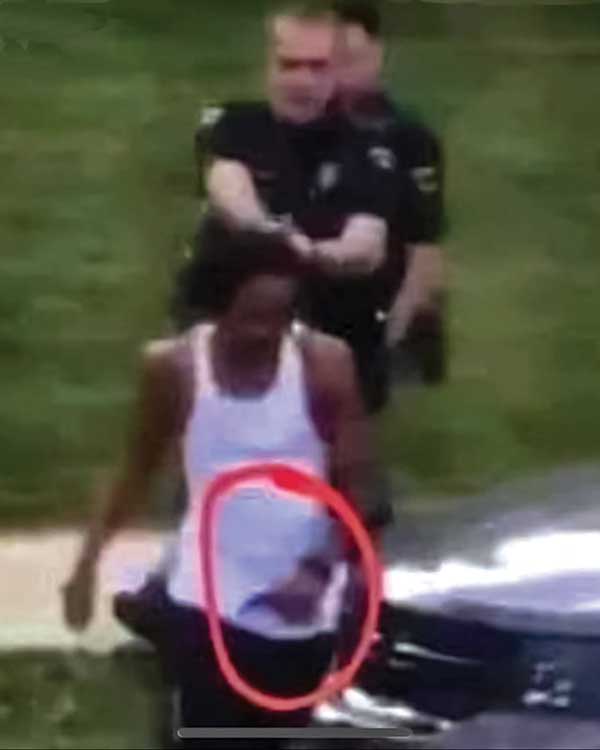
Kenosha, 2020. Almost three decades later, another video surfaced in a city of 100,000 in Wisconsin. It showed police officers with drawn guns following a black man, Jacob Blake, from the right rear of an automobile containing two little kids, around the front to the driver’s door, where one officer finally shot him seven times behind lateral midline. It became an instant cause célèbre: “Unarmed Black Man Shot Seven Times in Back.” The police department said not a word in defense of the officer’s action. The city burned and incurred tens of millions of dollars in damages, and three men were shot on video in demonstrable self-defense, two fatally, by a young man subsequently tried for murder.
From the beginning, a knife had been visible in Blake’s hand, and the officer fired only after he perceived the man turning on him with it within arm’s reach. In truth, the story should have been “Cops Save Black Children from Knife-Wielding Kidnapper.” Yet the “unarmed” narrative continued even after Blake himself confessed he was armed and the state Attorney General’s Office at last released the truth — weeks after the riot and the killings.
Circle shows Jacob Blake’s knife in his left hand, as cops follow him with drawn
guns shouting commands to drop it, moments before he is shot.
By Con
Years after the King conflagration, when Charlie Beck became chief of LAPD, he created a policy whereby after any potentially controversial OIS (Officer Involved Shooting) a press conference would be held. It would include the original 911 call, dashcam and bodycam video, scene photos and a narrative of what actually happened. It would be widely disseminated to the public, with the promise the investigation would continue, and the public kept apprised.
Las Vegas Metropolitan Police Department followed, setting a high standard for thoroughness. So did a number of other police departments.
LAPD to LVMPD and beyond, except for disturbances caused nationwide by the death of George Floyd in Minneapolis, every department following this policy has escaped major rioting. The reason is, they have “gotten ahead of the story” and kept false narratives from gaining traction.
We have seen the same principle in armed citizen self-defense shootings. A few years ago in Austin, Texas, John Daub had to shoot and kill a home invader who broke through the front door of his home while his wife and children were present.
He was a member of the Armed Citizens Legal Defense Network (armedcitizensnetwork.org), which had attorney Gene Anthes on the scene before the blood on the floor dried — telling reporters what had really happened. The result: a justifiable homicide ruling and public support and sympathy for John and his family.
A rule of human conflict is when one’s opponents change their attack strategy, one has to alter defense strategy accordingly. With today’s twisting of the truth by journalists and lawyers with less than honorable motives, we need police departments and attorneys who will not leave those who righteously pull the trigger undefended in the unforgiving Court of Public Opinion.
In the 18th century, a new nation was recovering from its War of Independence. The economy was in shambles. And, subsequently, so were the drinking habits of citizens across the fledgling United States of America.
During the colonial era, American whiskey was considered a low-brow tipple, one relegated to mountain folk of the frontier beyond population centers along the East Coast. But following the Revolutionary War, whiskey was thrust into the forefront of the American experiment—causing an early confrontation whose reverberations continue to be felt today.
In this article, we’ll see how these factors led to the event known as the Whiskey Rebellion. And we’ll see how the spirit at the heart of this conflict—Monongahela Rye—was an early predecessor of today’s Bourbon and American Rye whiskeys and how innovative craft whiskey makers are bringing back this historical spirit and leading a renaissance in an emerging whiskey sub-category.
Background & History
Following the end of the American War for Independence, the newly established Treasury Department—led by Alexander Hamilton—was broke. During the war, the national government—an alliance of states loosely bound by the Articles of Confederation—was unable to levy taxes. As a result, it racked up $75 million in debt.
Simultaneously, America’s relationship with drinks was being altered by divergent forces.
First, the production of Rum was disrupted by the war. The import of finished drinks like European wine and French cognac ceased, as did trade with the British islands that supplied the molasses the Atlantic coast distilleries used to make Rum were wiped out by British embargoes. Import duties caused prices to soar. Suddenly, the favorite tipples of those living in the wealthy and influential population centers along the Atlantic Coast were wiped out.
Settlers loading whiskey and other goods for transport tocities back east, including Philadelphia. Photo by Aaron Kendeall for Gentlemen Ranters. Courtesy Whiskey Rebellion History Center.
So, the young nation turned to the whiskey that was already wildly popular in the Allegheny highlands to fill its demand. The Founding Fathers were quite philosophical about this endeavor.
A domestic drinks industry was needed to fill the gap and liberate Americans from the tariffs of foreign wines and spirits. Whiskey could be made from plentiful crops harvested domestically without any foreign inputs. And federal officials could tax production to help lower the national debt.
George Washington’s stance was so enthusiastic that he began distilling whiskey at his property at Mount Vernon – becoming the largest whiskey distiller in the United States by his death in 1799.
What Was the Root Cause of the Whiskey Rebellion?
A group was considerably less enthused about the idea of an excise tax on distilled spirits production – the western farmers along the frontier of the new nation. Those centered around the hamlets that dotted the Monongahela River valley as it meandered along the banks of Washington County and Allegheny County while flowing north towards Pittsburgh to meet the Allegheny River and form the Ohio River were especially adamant. Surrounding areas, including Fayette County, Westmoreland County and Bedford County, were also involved.
When congress authorized the newly-established federal authority of the treasury department to enact an Excise Whiskey Tax in 1791—the first such tax levied by the new national government—on whiskey production, farmers in these western counties protested the tax. The ensuing conflict became known as the ‘Whiskey Rebellion.’
Who Were the Whiskey Rebels? And Who Were They Rebelling Against?
Let’s stage the stage.
Like a Shakespeare play, the drama about to unfold is best told with an introduction to our cast of characters.
We should emphasize this was a civil dispute—a conflagration that unfolded as a battle between the new federal government, militia forces and mountain distillers who sought to protect their most important source of revenue. And like most civil disputes, it pitted neighbors and family members against each other. Both sides were ranked with a significant number of Revolutionary War veterans.
As we will learn, the lines drawn between these dynamic forces were quite blurred. But we can draw distinctions where applicable.
John Neville – Brigadier General and veteran of the Revolutionary War. He was appointed Inspector of Revenue by President George Washington for the district that included Western Pennsylvania.
John Adams – Vice President of the United States during the Whiskey Rebellion.
George Washington – First President of the United States. He was in office during the Whiskey Rebellion. George Washington’s Mount Vernon estate later featured the country’s largest distillery.
James Madison – Founding Father and later President of the United States. A shrewd Anti-Federalist politician, he argued for the right of the rebels to plead their case in the court of public opinion.
James McFarlane – Earned the rank of Major during the Revolutionary War. He was a leader of Whiskey Rebellion forces and was killed in the exchange of gunfire at Neville’s property.
‘Light Horse Harry’ Henry Lee III – Revolutionary War Hero, Lee was a cavalry commander during the Revolutionary War. He was summoned by the president to lead roughly 13,000 federal troops to put down the rebellion. Ironically, his son—Robert E. Lee—would later lead the Army of Northern Virginia against federal troops during the American Civil War.
James Ross – Pennsylvania politician and member of Pennsylvania’s Constitutional Convention. Ross was chosen by President Washington to negotiate with the rebels and diffuse the situation.
William Findley – An Anti-Federalist, Findley nonetheless helped to calm the situation and acted as an arbiter between the rebels and the government.
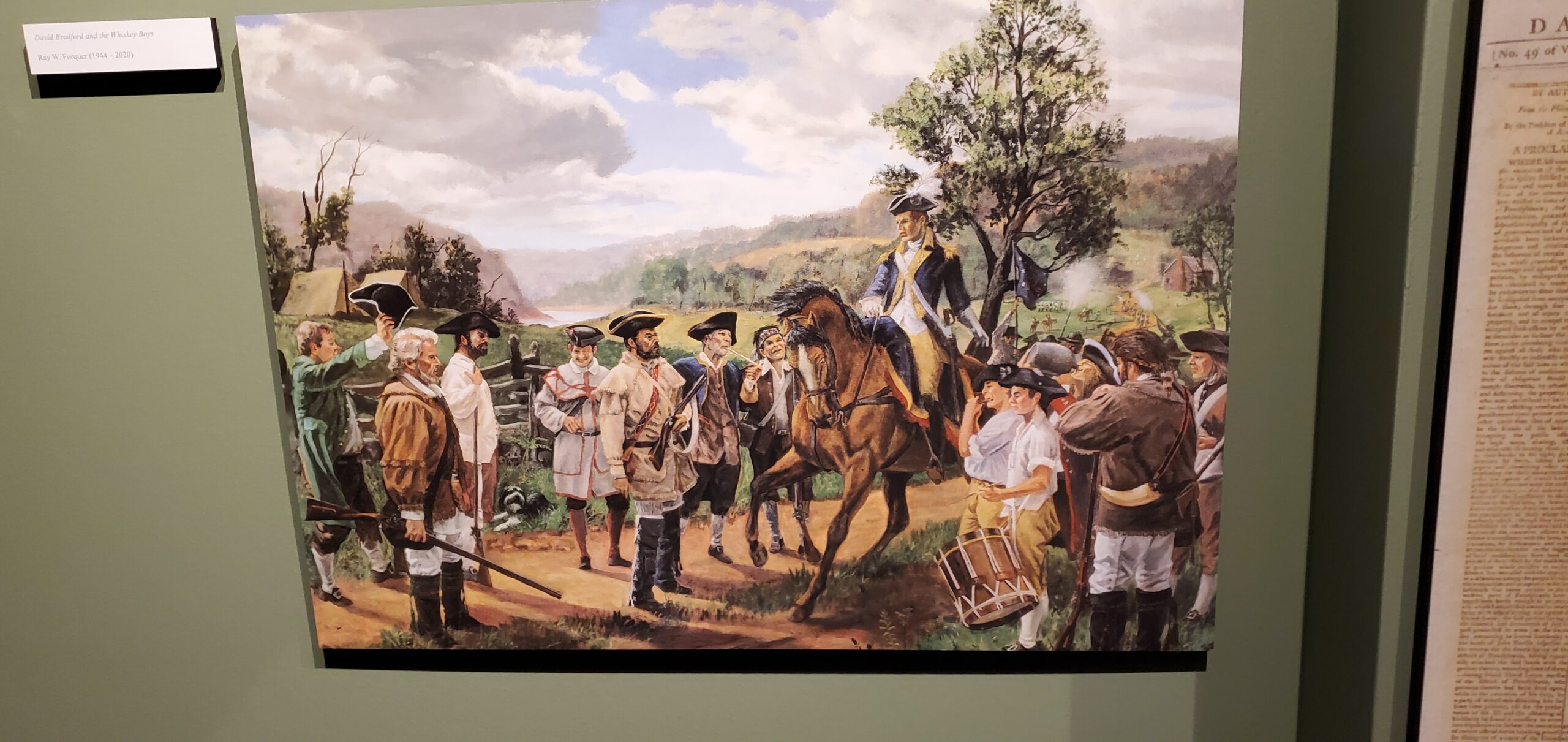
David Bradford – Whiskey Rebel and distiller, attorney and shipping magnate. A Revolutionary War veteran, he was among the wealthiest men on the Western frontier.
Hugh Henry Brackenridge – A Pennsylvania lawyer and moderate, he tried to position both sides to calm, earning the dislike of all.
Whiskey Boys – This group vehemently opposed taxation and harassed federal revenue officers and any distillers they saw as bowing to law enforcement.
Alexander Hamilton – Secretary of the Treasury, he directed federal officials to collect taxes from distillers and personally led the forces to put down the rebellion.
Thomas Jefferson – Founding Father and third President of the U.S., he politician whose stance on personal liberty helped motivate the rebels.
Albert Gallatin – A calm-headed statesman and member of the Friends of Order, he opposed the tax. But Albert Gallatin’s level-headed pragmatism was credited with avoiding additional bloodshed.
Tom the Tinker – Whiskey Boys organizer and agitator who signed anonymous threatening letters to distillers who cooperated with the law. Often, stills that ignored these pleas might’ve found their equipment ruined.
As the two camps of distillers broke into factions, the Friends of Liberty were the rebels, and the Friends of Order sided with maintaining order. And the Federalist wing of government sought to execute their power to repay America’s war debt, eventually mustering armed forces to put down the rebellion.
Why Was Monongahela Rye Whiskey Crucial to the Economy?
The Monongahela River Valley played an essential role in forming what is now recognized as American whiskey.
Before Bourbon was a county—or Kentucky a state—farmers in the western counties that formed the new nation’s frontier used excess grain from their harvests to produce whiskey. Throughout the Allegheny Mountains—a natural boundary preventing westward expansion—distillers turned this grain into whiskey, a shelf-stable product that would not spoil and could even improve with age.
In a time before refrigeration, we cannot emphasize the importance of a product that could preserve surplus grain yields. In fact, throughout these frontier counties, folks utilized whiskey as a currency where paper notes and coins were scarce.
The whiskey produced on the Pennsylvania frontier was colloquially known as ‘Monongahela Rye.’
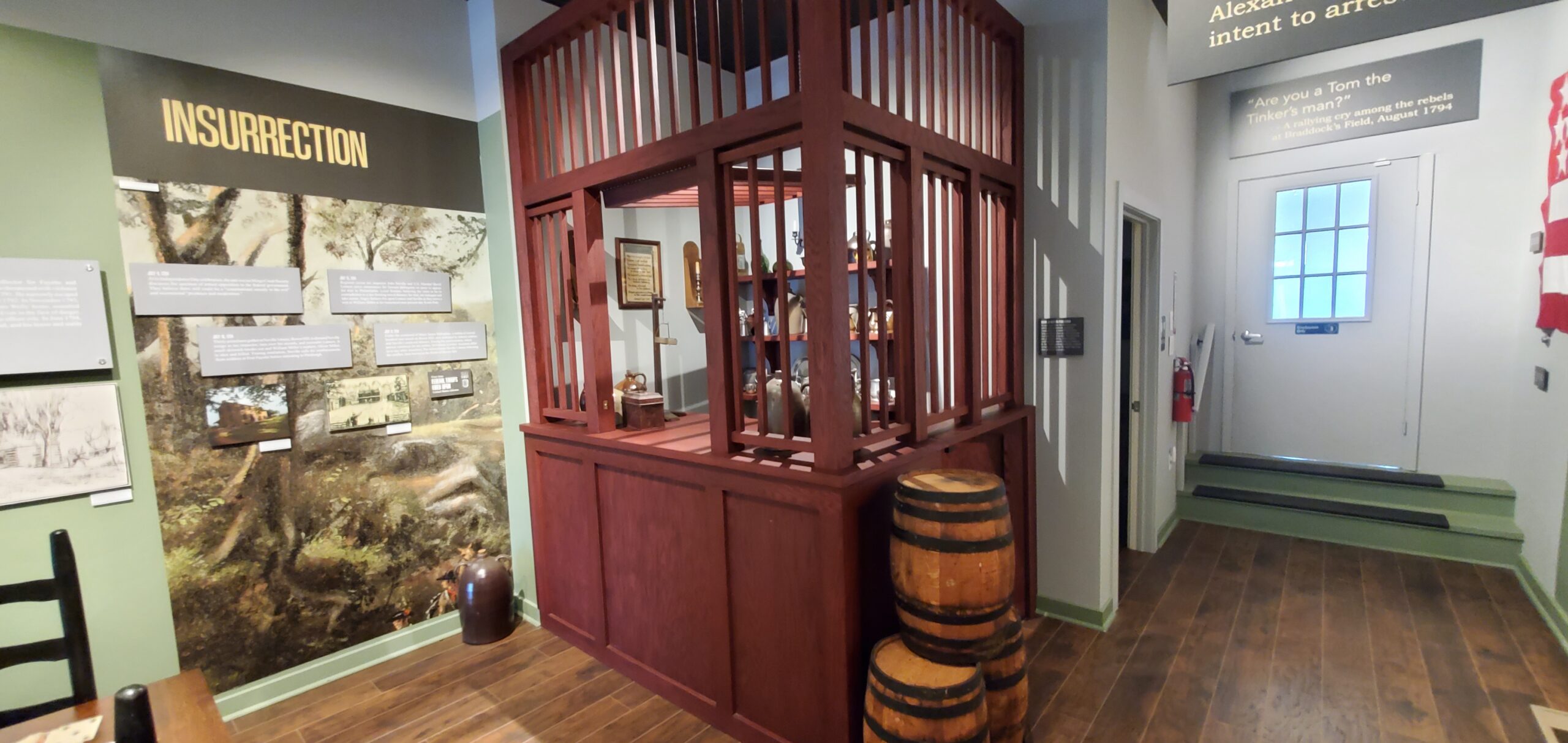
To learn more about this aspect of the story, we traveled to the Bradford House and Whiskey Rebellion History museums in Washington, Pennsylvania. There, Bradford House Head Docent Dave Budinger helped explain the importance of whiskey production in the local economy.
The Bradford House Museum in Washington, PA. Photo by Aaron Kendeall for Gentlemen Ranters.
Dave is a fantastic storyteller—we really recommend visiting the museum if you ever find yourself in the Pittsburgh area and want to explore the growing Monongahela Whiskey trail. We will let him pick up this part of the story and explain how David Bradford fits into the big picture.
“[David Bradford] had a distillery, he had a grist mill, and he had a sawmill,” Dave said. “And he owned great tracts of land in the area. There, he distilled his whiskey and probably a lot of other people’s whiskey.
“These farmers had individual stills, and maybe one still would serve about five or six individual families here. People would send their grain to the nearest gristmill, which would grind it and prepare it. Some of the ground grains would become flour, which would be shipped—apparently, wheat doesn’t grow quite well in New Orleans.
“So, flour was a very important product,” Dave said. Goods would travel down the Monongahela River to the Ohio River and then the Mississippi River, eventually making its way to the port of New Orleans.
On the frontier, whiskey wasn’t just an essential part of the economy—in many ways, it was the economy. Because of the distance from banking institutions, access to currency was often nonexistent.
“That’s why it was so important out here,” Dave said. “This was their cash. And for this new upstart federal government to tax their only way to make any cash out here really upset the hell out of them—enough to pick up a musket and do something about it.”
An essential piece of Bradford’s role in the whiskey economy dealt with his shipping interests. He organized the pack trains of horses that served as the main avenue of the trade from the western frontier east to Philadelphia and the Atlantic Coast.
“This is before there were any decent roads over the mountains, so they had to ship things by horseback for the most part,” Dave said. “Farmers would get together and build these long trains of horses, ship their goods over and cross their fingers they didn’t lose too much. And Monongahela Rye was very sought after on the other side of the mountains. We had some very good distillers here.”
Whiskey was the most critical commodity being transported east from Western Pennsylvania.
“They couldn’t make money shipping their grain across the mountains because it’s too bulky,” Dave said. “You could have a horse carry four bushels of grain, but if you distill that grain into whiskey, a horse could carry the equivalent of 24 bushels of grain over the mountains,” Dave said. And whiskey was much more valuable than grain, earning more profits per pound of cargo.
At this point in history, most whiskey would be consumed as a white, unaged spirit—days or weeks after coming off the still. But, as we mentioned in our previous What is Bourbon? post, transportation of whiskey down the Ohio and Mississippi rivers to New Orleans led to important discoveries in the art of maturation. The earliest of these shipments would’ve been Monongahela Rye.
But similar magic happened in the barrel on the road east to Philadelphia. Thanks to the jostling of the liquid over the rugged mountain paths, agitation might have created intriguing flavor characteristics. So, in addition to today’s mandated American oak barrels, used charred and uncharred oak barrels would’ve been used, along with wood like chestnut, maple and hickory—barrels that might be considered exotic wood by today’s distillers.
Monongahela Whiskey was perfectly placed for distribution.
In addition to river route to market—the Monongahela meets with the Allegheny River in Pittsburgh to form the Ohio River—an overland route was available east to Philadelphia, which at the time was the capital of the United States and one of the largest markets in the country. The wooden barrels that served as shipping vessels also imparted flavors on the overland route, and the jostling of the horse-drawn wagons over rugged mountain trails might’ve helped distillers understand the improvements offered by wood maturation.
What Was the Whiskey Rebellion? And How Did It Play Out?
The Excise Tax on distilled spirits disrupted production not only in the frontier settlements in Western Pennsylvania, but across the newly formed United States.
Many Revolutionary War veterans—including some Scots with a generational view of avoiding any tax on whiskey from the King’s exchequer—abhorred the the idea of federal officials coming after their primary means of income.
Poor farmers who distilled to monetize their excess harvest across the country fomented opposition to the tax. In North Carolina, a sizeable population of distillers opposed the tax and began illicit distillations. In Kentucky, Maryland, South Carolina and what is now West Virginia and Ohio and throughout the Appalachian Mountains chain, distillers raised opposition and fought tax collectors.
But we will focus on a group along the Monongahela River Valley in Pennsylvania near the town named Washington to honor the first president of the newly formed nation.
The Whiskey Excise Act, known as the ‘Whiskey Tax,’ was the country’s first excise tax. It was enacted in March 1791.
After petitioning unsuccessfully against the tax, farmers grew increasingly frustrated. In September of that year, a tax inspector was tarred and feathered. Tensions continued to mount as the government looked to enforce its tax, and local distillers were split into camps based on whether they fought the tax. Finally, a whiskey tax collector was attacked at Pigeon Creek. The idea of violent resistance and declaring independence from the United States grew.
In July 1794, the Battle of Bower Hill occurred in which about 600 whiskey rebels led by Major James McFarlane surrounded the house of revenue collector General John Neville. During the struggle, McFarlane received a fatal gunshot, and several other participants were injured and killed before Neville’s house was burned to the ground.
Enraged by the death of McFarlane, the rebels met at Braddock’s Field near Pittsburgh. About 7,000 people marched through the streets of Pittsburgh, terrorizing residents until the situation was diffused.
What Was the Whiskey Rebellion Flag?
A short discussion of vexillology…
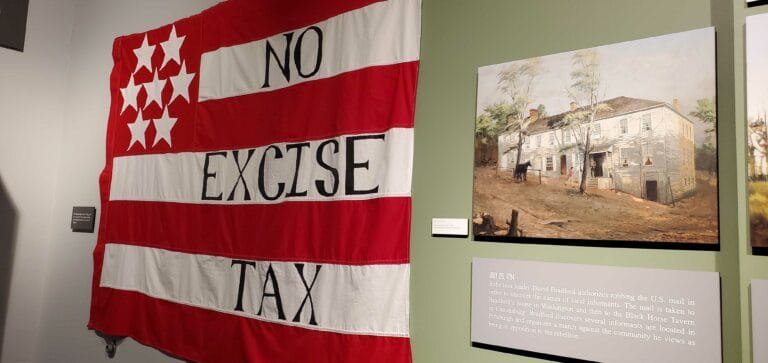
The flags the rebels carried varied, but often had seven stripes—four red and three white—one for each of the counties represented at Braddock’s Field— Allegheny, Fayette, Washington, Bedford, Westmoreland and Ohio and Monongalia counties, which are in modern-day West Virginia. Simple flags were often hung from liberty poles to show solidarity with those fighting for independence. Often, they carried an inscription with the words ‘no excise.’
Examples of the federal standard, left, and the striped insurrection flags, both from the Whiskey Rebellion museum. Photo by Aaron Kendeall.
A second flag has caused some disagreement.
The flag depicts an eagle on a field of blue and 13 white stars—representing the original 13 colonies. It is often described as a Whiskey Rebel flag, but recently historians have suggested it may have been flown by the troops mustered by the federal government because of its similarity to federal standards of the day.
Monongahela Rye Production Techniques
In future posts, we will dive more in depth into the production techniques of historical distillers, as well as how today’s producers are paying homage to that legacy when producing today’s top brands. But for now, check out this video of the historical diorama that is on display at the Whiskey Rebellion History Center in Washington, Pennsylvania.
Video by Aaron Kendeall for Gentlemen Ranters.
Monongahela Rye in Today’s Marketplace
We must make a distinction between the Straight Rye whiskey customers are familiar with in today’s marketplace. Today, American Rye whiskey must be made from a mash bill of at least 51% rye grain. But as we noted in previous posts about the history of Canadian Whisky, the Scottish distillers who were more accustomed to using malted barley as the primary grain of their wort started utilizing the hearty rye grain that thrived in colder climates along the frontier and used the term to describe varying amounts of the grain in their distillates. So the rye content in Monongahela Rye historically would’ve varied from still to still and from batch to batch depending on each year’s yield and what remained from the harvest after being sold on the commodities market.
Popular Monongahela Rye and Pennsylvania Whiskey Brands
While only the tip of the iceberg, here are three brands that will help you start your journey to learn more about the Monongahela Rye category.
Wigle Whiskey – Named after Philip Vigol, an anglicized spelling of the German Wigle, this brand is produced in Pittsburgh and makes Rye whiskey along with a panoply of distilled spirits, liqueurs and ready-to-drink beverages. Note: The author worked as a distiller and brand ambassador for Wigle before its acquisition by Highland Ventures.
Liberty Pole – Located a few blocks away from the historic Bradford House, Liberty Pole was founded by the passionate Hough family. They utilize local grains to make authentic Monongahela Rye style whiskey—along with bourbon, bourbon cream liqueur, corn whiskey and other distilled spirits.
Stoll & Wolf – Old meets new in an innovative whiskey brand that honors the past. The distillery is on the site of the old Bomberger’s Distillery in Schaefferstown, Pennsylvania, which was founded in 1753 and boasts the distinction as the oldest distillery in the United States. It was the original production site of the Michter’’’s brand and when it shut down in 1989, Dick Stoll had been one of the last old-school producers to make Pennsylvania Rye. Along with partner Eric Wolfe and his wife Avianna, they resurrected the historic brand and were among the first to distil using historic methods at the reconstructed distillery at George Washington’s Mt. Vernon home.
Ponfeigh Distillery – Once up and running later this year, the continuous column still at Ponfeigh will have the capacity of 3,000 barrels per year. Focusing on Monongahela Rye, this project is another indication that volume distilling is returning to Western Pennsylvania.
Photos by Aaron Kendeall for Gentlemen Ranters.
Bibliography & Additional Resources
Below are some great titles that will help you dive deeper into this important historical episode in which the American Government first met armed resistance to its Constitutional powers.
“The Whiskey Rebellion” by William Hogeland. Simon & Schuster, 2006.
“The Whiskey Rebellion: Frontier Epilogue to the American Revolution” by Thomas P. Slaughter. Oxford University Press, 1986.
Brackenridge, Hugh Henry (1795). Incidents of the Insurrection in Western Pennsylvania in the Year 1794. Philadelphia: Printed and sold by John M’Culloch.
“The Alcoholic Republic: An American Tradition” by W.J. Rorabaugh. Oxford University Press, 1979.
Thanks to Dave Budinger, Tracie Liberatore and Denise Cummins at the Bradford House Museum for their help in writing this article.
We were deployed to the arctic reaches of Alaska. Winter was the primary training time for the Army in the frozen north, and we were immersed in a full-bore combat exercise. The TOC (Tactical Operations Center) was a bustling hive of frenetic activity. Under such circumstances, the radios are all slaved to speakers. That way, the free flow of information proceeds unimpeded and combat leaders have instant access to the big picture. The scene this day was one of unfettered chaos.
These were the days before cell phones, so being deployed meant being truly cut off from your families. Such isolation was one of the toughest parts of military service for me. However, in the event of a true emergency, there was one way to get a critical message to a soldier operating in the field. If it was truly epically important, a family member could contact the post headquarters and have a landline phone call tapped into the military radio net. I have no idea how they did that. It occurred only very seldomly.
The TOC was crowded with husky armed men, steely eyed killers all. We were neck-deep in war and all had our game faces on. Threat forces were active in our area, and we were running half a dozen different tactical operations simultaneously. Cutting through the chaos, the net control guy came over and said he had an emergency message for my friend Dave from his wife Lisa.
Our collective blood ran cold. A combat unit is a family, and a tight one at that. There is an implicit intimacy that really has no parallel in the civilian world. When one hurts, we all hurt. If you got a civilian on the tactical net, it invariably meant somebody had died back in the World.
Dave and Lisa were in their mid-30s and had no children. They had recently transferred up from Fort Hood in Texas and grafted onto our merry mob. They were both likable, committed and cool.
The TOC fell silent as the net control guy worked his magic. In a few moments, Lisa’s voice came over the net. It was clear she had been crying. Dave addressed his wife in this most regrettably public of circumstances and asked what was the matter. She sobbed in reply, “Dave, we got a baby!”
The Adoption Option
As a physician, I have been privileged to touch any number of profoundly moving adoption stories. Children who are outcast or unwanted are grafted into a home to create a family, arguably the most powerful of God’s many extraordinary creations. However, ask anyone who has endured the process; adoption is an intentionally grueling thing. Parenthood is the loftiest of human responsibilities, and the system ensures one does not simply wander into adoption without sober preparation.
In the military, adoption is doubly difficult. When my wife and I hit our 10th anniversary, we were at our 10th address. As adoption is typically managed by the state, it can be extremely difficult for a service family to complete the process successfully before being shipped off some place else. Such a nomadic life is just yet another daunting aspect of the military experience.
In Dave and Lisa’s case, they had initiated the process in Texas only to be transferred to Alaska before it was complete. They had essentially given up, presuming this to be yet another dry hole. Lisa’s call from the adoption agency had been wholly unexpected.
Back At The War …
You could have heard a pin drop. Dave stammered and asked his wife to clarify. She explained she had gotten a call from the agency and they had an infant ready to be picked up back in Texas. She was going to make the arrangements so they could leave as soon as we redeployed back to home station.
The entire TOC erupted in cheers. There was a lot of back slapping and congratulations, enough to smother poor Dave in his lamentably sordid state. There were also not a lot of dry eyes among all those hard-core professional warriors. It was honestly one of the most powerful moments I have ever experienced.
Dave and Lisa went from zero to 60 in an instant. They hadn’t planned on becoming parents, so they had literally none of the gear they needed to embark up this most arduous of missions. As soon as we redeployed, Dave jumped on a plane with his wife headed for Texas. Those of us left behind, then made a few phone calls.
When this new family returned, all the car seats, highchairs, changing tables, diaper genies and nitnoid baby crap they needed was waiting for them. A combat unit is a family. We did what families do.
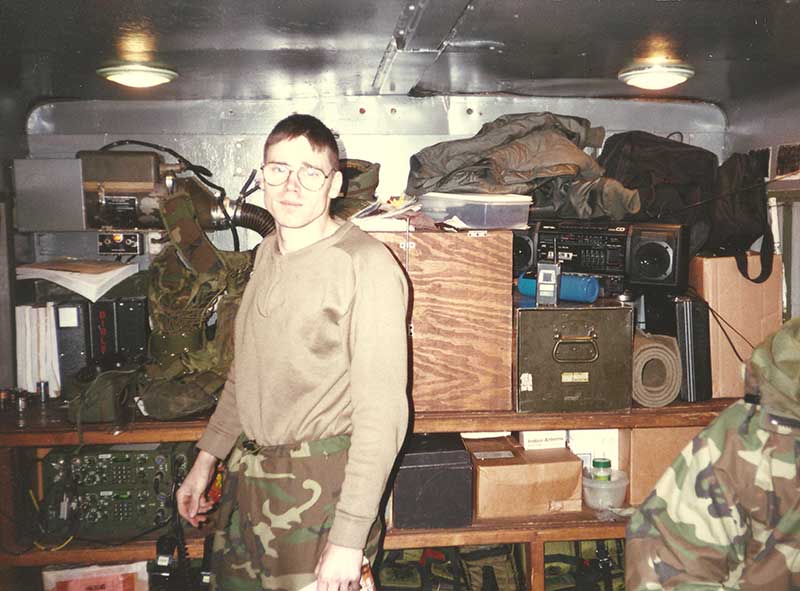
Military operations in the arctic present their own unique challenges. Maintaining hydration
is one of them. This is indeed an Army buddy from back in the day but is neither SSG Munoz
or SPC Smith. I doubt they want their faces associated with this tale.
It is frequently easier to get dehydrated in the arctic than it is in the desert. I’ve spent a lot of time in both, and each has its own unique miseries. Drinking water is invariably cold in the frozen wastes. It takes a bit of personal discipline to force yourself to drink ice water when it is forty below zero out.
In this case our NBC (Nuclear Biological and Chemical) team had used the Humvee assigned to my ops section to do their NBC survey of our proposed area of operations in Alaska. They had been in the vehicle several hours during the convoy to the field site. These four swine deployed in our truck, did their mission and then headed off to wreak mayhem elsewhere, dropping off the vehicle as they departed. In the process they failed to clean their dunnage out of our Humvee. That meant several paper sacks filled with empty candy wrappers, discarded Gatorade bottles, MRE scraps and the like. As I said, swine.
My Ops NCO, SSG Munoz, was now using this same truck to lay commo wire along with his assistant, SPC Smith. This thankless backbreaking toil can frequently take hours dependent upon the distance to higher headquarters and intervening inhospitable terrain. These two guys had been out working long enough to drink up all of their water. They were thirsty.
Munoz called a brief halt so they could catch their breath. Desperate for something to drink, SPC Smith began poking around the detritus left over from the NBC team. Amidst the discarded packaging and empty bottles he found one that had apparently gone overlooked.
This bottle of Snapple was indeed fresh and unopened. Amidst the arid snowscape this was ambrosia, a gift from the gods. As SPC Smith gleefully announced his find, SSG Munoz snatched it out of his hand with a terse, “Rank has its privileges. Gimme that.”
SSG Munoz’ assistant was disappointed, but the guy had a point. It was his call to make.
Munoz opened the lid and it gave a satisfying “pop” as the seal was broken. Without hesitation he upended the bottle and took a long deep draught. According to the story as related to me by SPC Smith later that evening, SSG Munoz then got an odd look on his face. He handed the bottle back to his buddy with a curious, “What do you think of this?”
Smith studied the bottle intently for a moment. The liquid was indeed golden like Snapple, but it had an odd aroma. The surface of the elixir also sported a little characteristic foam. That’s when the light came on.
“That’s not Snapple!” he exclaimed. “That’s pee!”
It seems the NBC team, cooped up as they were in the back of the cold truck for the long deployment, had actually recycled the Snapple bottle. After they drank everything up they had used this receptacle as an ad hoc urinal. As the warm liquid cooled it had resealed the container. SSG Munoz had just taken a mighty gulp of chilled NBC guy urine.
SSG Munoz was, to say the least, unsettled by this revelation. Smith related later that Munoz shoved a finger down his throat and retched mightily. Desperate for something with which to cleanse his palate, you recall a lack of drinking water is what got them into this predicament in the first place, he broke open an MRE and started chewing dry cocoa beverage powder. This desiccated stuff indeed took the edge off, but it didn’t do much to slake the poor guy’s underlying thirst.
Dazed by the whole sordid ordeal, SSG Munoz ultimately pulled himself together and, with Smith giggling in the background, eventually successfully completed the mission. They made their way back to the company area and Munoz got some proper hydration. On the way back, SSG Munoz swore Smith to secrecy over the episode on pain of death. Smith kept Munoz’ secret right up until they got to the company TOC (Tactical Operations Center). Then he told anybody who would listen.
There are several lessons to be learned here. A good leader gives his guys the first fruits of everything. A proper commander is last in line to the chow hall and first to do the hard things. Everything good is because of your guys. Everything bad is because of you. Apply those sacred dicta religiously and you’ll likely never inadvertently drink NBC guy pee.
 I am told by reliable sources that they have some shall we say bothersome triggers? Grumpy