Author: Grumpy
Categories
Why hello there!


In early November 2000 I had the opportunity to spend about 2½ hours talking with one of the top accuracy gunsmiths in Virginia. I’d taken a rifle I was having trouble with to him to see if he could diagnose the problem. I had a chance to view the inside of my expensive custom barrel through a bore scope. Though I’d only fired about 250 rounds of .270 Winchester handloads through this barrel the throat bore the characteristic look of alligator skin that comes with shooting a barrel when it’s hot.
I was shocked. I thought I’d been quite careful to let the barrel cool between shots, generally allowing at least 8 to 10 minutes between shots. I do recall that on a couple of occasions I did fire as many as five rounds into a group without allowing very much cooling time between shots, but I hardly considered that abusing the barrel.
Generally speaking, I’d tried to follow the old advice to never shoot a barrel if it feels hot to the touch. The gunsmith’s opinion was that by the time you feel heat on the outside, it’s way too hot on the inside.
This revelation started me wondering how many other things I didn’t know about properly caring for rifle barrels. I decided to do some serious research regarding barrel life and the things that affect it. As I researched, I found an enormous amount of material.
Since I’ve mentioned heat I suppose it’s appropriate that I discuss that first. I’m told that the powder charge in high-pressure cartridges burns at a maximum temperature range of roughly 4,900°F to 6,000°F. Barrel steels melt and flow at temperatures of about 2,500°F. The only thing that gives a rifle barrel any appreciable life is the extremely short duration of exposure to such temperatures during each shot, and the opportunity to cool between shots.
 In the first few shots from a new barrel, the powder gas probably actually blasts away very thin layers of the surface. Peak temperature of the gas is much higher than the melting temperatures of either chrome-moly or #416 stainless steel. As those first shots are fired, under intense heat and pressure of the powder gases, nitrogen combines chemically with the interior surface layer of the bore to form iron nitrides in the throat and first few inches of the bore. This process is called Nitridation. Under a microscope, this nitrided surface shows up as a white layer. The nitride surface coating in a barrel performs a valuable service in protecting it from the very hot powder gas, but it also is responsible for the eventual loss of dimensions in the throat that we often refer to as erosion.
The white nitride is very strong and hard, but it is brittle. The combination of such a stiff coating on the more flexible underlying barrel steel presents problems. Firing one shot hardly makes the barrel feel warm to touch on the outside. However, the innermost molecular layer of the bore probably approaches the temperature of the powder gases for a minute fraction of a second, as each shot is fired. At .0001” into the bore surface, temperature may reach 2800°F. At .001” into the bore surface, the temperature may reach 1000 to 1500°F. Steels which may have a tensile strength of 110,000 to 120,000 p.s.i. at room temperature, show tensile strengths of only 30,000 to 40,000 p.s.i, at 1100°F. The hotter we allow our barrels to get, the more ductile the steel becomes.
As the underlying steel flexes under the pressures produced by firing, the brittle nitrided surface layer becomes cracked. These cracks tend to form “islands” in the nitrided layer. When viewed through a bore scope the cracking presents an appearance often referred to as “alligator skin”, because that’s what it looks like. Over time, thermal and mechanical effects cause chipping of the layer, leaving more sharp edges, cracks and pits, whose edges are then more susceptible to further nitriding. Pits, cavities, and cracks overlap and the result is destruction of the surface, changes in form, and an overall enlargement of the chamber throat.
Now that I’ve given you the bad news, what can you do to minimize heat (and pressure) damage to your rifle’s barrel? The most obvious answer is to allow adequate cooling time between shots. Essentially you want to allow the insideof the barrel to return to ambient temperature before firing the next round. Since damage is directly related to heat and pressure, shooting loads using less powder and producing less pressure should help to some degree. Cast bullet loads using small amounts of fast burning powders at relatively low pressures should allow you to practice a lot with your rifle without causing noticeable damage. If properly done, chrome plating (as currently standard in service rifle bores) can extend accurate barrel life.
What if you always want to shoot full power loads and your bore isn’t chrome plated? Well, actually you’re still in pretty good shape. Jim Carmichel of Outdoor Life magazine set out to see just how long a barrel would last under hard usage. He had a custom rifle chambered in .220 Swift (a notorious barrel burner). He reported that this rifle was initially capable of placing five-shot groups into as little as 3/10ths of an inch at 100 yards. Mr. Carmichel reports using the rifle for prairie dog shooting where he would sometimes fire 40 or 50 rounds as fast as he could aim. He reports occasionally firing 600 to 800 rounds a day if the shooting was really good.
After firing 3000 rounds, Mr. Carmichel carefully examined the barrel with a bore scope and tested accuracy. Though he reports that the area ahead of the chamber showed serious erosion, the rifle still proved capable of ½ inch groups. After 5000 rounds, he reports that the first 2 inches of rifling were literally gone, yet the rifle was still capable of ¾ inch groups. At this point, he reports making one more trip to the prairie dog fields and firing all of his ammunition. Upon his return he tested the rifle for accuracy. The five-shot group exceeded the “magic” 1-inch standard he’d chosen by only 44/1000ths of an inch. Total shots fired through the barrel; 5,920 rounds. Guys, that’s a lot of shooting for most of us. I’d dare say that many of us still wouldn’t be unhappy with five-shot groups that went just over an inch. We might continue shooting that rifle for quite some time.
Other experimenters have reported results with other calibers and rates of fire. I’m told that Highpower competitors using the .308 Winchester cartridge expect to fire approximately 3,000 to 4,000 rounds before replacing their barrels. You’ll note that Highpower competition involves quite a bit of “rapid-fire”. Under “slow-fire” conditions, results can be quite different. The American Rifleman (March, 1956, p. 22) tells of Finnish experiments with a 7.62 mm rifle in which acceptable accuracy for the difficult 300 m target lasted for about 14,000 rounds. The article “Barrel Life” by Q. Kernaghan and B.R. Lewis (The American Rifleman, Feb. 1960, p. 38) cited experiments which showed that grouping ability of .30-06 rifles with Arsenal match ammunition, using the 172-gr. boattail bullet, suffered no decline of accuracy in 8,000-10,000 rounds.
It should be noted that the Finnish ammunition developed a maximum pressure of 39,000 p.s.i., while the 1950’s era U.S. match ammunition produced average pressures of approximately 45,000 p.s.i. These lower pressures no doubt contributed to the extended accurate life of the barrels.
Another factor leading to the relatively long accurate life of the barrels in the above-mentioned tests may have been the bullets used. It has been suggested that one reason accuracy falls off as throat erosion worsens is that bullets are deformed in passing through the eroded area. Some bullets are less subject to deformation and may continue to shoot accurately in spite of serious erosion. Some people have been able to extend the useful life of a barrel by utilizing bullets made with stiffer jackets and core material. Some have also reported improving accuracy in an eroded barrel by using slightly oversize bullets (for example, using bullets of .309 diameter rather than standard .308).
Now that you are aware of the effects of heat on rifle barrel life, you can deal with this factor as you see fit. Even if you literally shoot the rifling out of the barrel, chances are the action and stock are still in good condition. A gunsmith can replace your barrel and you’re good to go again.
As implied (but not stated) thus far, few (if any) rifle barrels wear out from the effects of bullet friction on the rifling. One is then led to ask, “what else shortens barrel life?” According to my research, rusting or corrosion from lack of cleaning is the most common cause of shortened barrel life. Damage from improper cleaning ranks next. (Kind of sounds like the old saw; “You’re D—– if you do and you’re D—– if you don’t.” doesn’t it?) Let’s look a little deeper and see exactly what we’re dealing with.
Corrosion is the disintegration of metal by direct chemical attack or by electrochemical reaction. Atmospheric corrosion is an example of direct chemical attack. Oxygen, carbon dioxide, and water vapor are present everywhere in the air around us. Also present are various corrosive compounds, the more common ones being those containing sulfur and chlorine. Electrochemical reactions occur when metals such as steel and copper having different potentials, are in contact in the presence of a solution which conducts electricity (such as water).
Rusting of rifle barrels does not usually occur unless relative humidity is above 50%. In urban and industrial atmospheres, where large amounts of sulfur dioxide, nitric oxide, or chlorides are present, rusting may occur at as low as 40% relative humidity. In a clean desert atmosphere it may not occur below 70% humidity. However, even with relatively low relative humidity it is possible for condensation to form with diurnal changes in temperatures or, in colder climates, when bringing firearms from the cold into a warm, more humid atmosphere such as a house. With air conditioning in common usage during the hot summer months one must also consider the possibility of condensation when a rifle is taken from the relatively cool indoor environment into the hot, humid outdoors.
High power rifle barrels fired with jacketed bullets and left uncleaned and unoiled, in an average urban atmosphere should be considered prone to electrochemical reaction. This reaction is usually concentrated in cells and patches of rust, instead of a uniform overall rusting.
Rust occupies much more space than the steel from which it is formed. Thus buildups tend to rise above the normal surface of the bore. Rust is quite hard and the buildups will deform and tear loose particles from the bullet jacket, rather than being pushed out or broken up by the bullet. Rusted areas are also prime locations for adsorbed moisture to gather. Even if rust is cleaned away, the metal is usually left pitted; with rough edges, which pick up jacket fouling and ever larger quantities of adsorbed moisture. Once started, rust in a rifle barrel is difficult to clean out and it is very difficult to stop, as it tends to proceed at an accelerating rate.
Rust inside a rifle barrel destroys accuracy. It raises pressures and makes them more erratic. It damages the bullet and upsets its balance. If bullet deformation resulting from a rough and rusted barrel is added to the normal deformation produced by hot, high-pressure powder gases driving the bullet into the lands and down the barrel, accuracy is certain to suffer.
Prevention is simple; thorough cleaning following each day’s shooting, and then application of a light protective coating to the bore. Most common gun cleaning solvents, at best, remove jacket fouling rather slowly. Most high power rifle barrels will show streaks and patches of jacket fouling when examined with a borescope, even when cleaned regularly. If a rifle bore has good interior finish and is of uniform size, a thin gilding metal wash has little effect on grouping. Regular cleaning removes loose powder fouling and partially burned powder particles, thus removing lodging places for moisture. Without moisture, corrosion is unlikely to occur.
Preservative oils which displace water are sometimes referred to as “polarized.” Such oils usually neutralize fingerprints and tend to neutralize airborne corrosive chemicals. They form a water repellant film, sealing over small crevices, cracks, and tool marks to prevent water molecules from coming in contact with the steel. Top shooters and gunsmiths also believe that it’s not good to fire a rifle when the barrel is totally dry. Thus a thin film of gun oil left in the bore between trips to the range serves two purposes. Of course, you’ll want to run a couple of dry patches down the bore to wipe out excess oil before firing as too much oil in a bore can cause serious problems when firing.
A light gun oil is probably not going to suffice to prevent corrosion if you plan to store the rifle away for more than a couple of months. In this case, you’ll want to thoroughly clean the rifle and then apply a grease (such as RIG) or other preservative intended for the purpose.
The forum has previously published an article which I wrote which dealt with what I consider to be proper rifle cleaning techniques. Rather than attempt to rewrite that article here, let me simply state that the most common accidental damage from improper cleaning is probably the uneven “lapping” of various parts of the bore due to using cleaning rods capable of holding grit and using them improperly. You should use a one-piece hardened steel rod (coated or uncoated rods are both OK so long as the coating is non-embedding). Such a rod is unlikely to hold grit, and is resistant to being bent out of shape. Use a rod guide to help direct the rod straight down the center of the bore.
This concludes my thoughts on factors affecting rifle barrel life. I learned a number of interesting things while researching it. I hope you’ve enjoyed the article and perhaps learned something new along the way. It seems that no matter how many years I’ve spent shooting I’m always learning something new. I guess that helps to keep it interesting.
Categories
WWII HANDGUNS
WHAT’S YOUR FAVORITE?

Duke’s array of WWII handguns, encompassing everything from the
Soviet TT33 7.62x25mm to the U.S. Colt Model 1911A1.
In my lifelong study of World War II history, much of the focus has been on handguns used in the immense fracas. Handguns carried by all sides were relatively unimportant compared to the vast array of other weapons utilized. Because of this, often their details are not mentioned in print or in oral history. Most WWII handguns were officially issued but at least in American forces, many were privately owned.
However, once in a while tidbits pop up that get my attention. Recently, in a memoir of a U.S. Marine on Iwo Jima, the writer tells of a patrol consisting of himself and four others searching caves. In one he lifted a mat under which he found six pristine S&W Model #3 top break .44 Russian revolvers. As finder he kept two and gave one each to the other patrol members. Decades earlier S&W did sell the Japanese Imperial Navy a quantity of .44 Russian revolvers so evidently this is how six of them ended up on the tiny island.
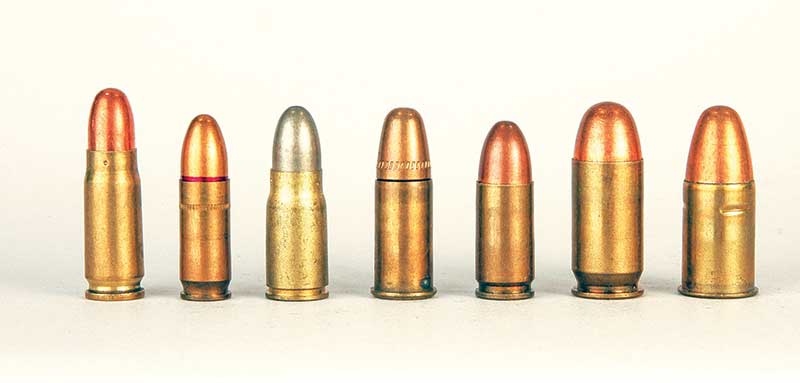
Cartridges of World War II handguns. From left — the Soviet 7.62x25mm,
French 7.65 Long, Japanese 8mm Nambu, British 38-200, 9mm Parabellum,
U.S. .45 Auto and British .455 Webley.
Details, Please?
Another handgun incident on Iwo Jima took a different turn. Some Marine officers were observing the battlefield when a Japanese soldier emerged screaming from a hidden cave with a bayoneted rifle. One of the officer’s runners calmly drew his “nickel-plated .38 revolver” and downed the soldier with two shots. This is an example of lack of detail. Avid handgunners would love to know what sort of nickel-plated .38 he used. We will never know but in my imagination I favor a Colt SAA .38-40 with 4-3/4″ barrel.
As far as officially-issued handguns go, they ranged from .30 caliber semi-autos shooting 85-grain bullets at an amazing 1,500 fps to .455 caliber revolvers firing 265-grain bullets at the incredibly low speed of 650 fps. The first example was the Soviet Union’s TT33 chambering 7.65×25 cartridges. The latter was Great Britain’s Mk VI .455 Webley revolver.
WWII official-issue handguns ranged greatly as to time of development. The top-break British Mk VI.455 Webley was the same basic design as their Webley Mk I that appeared circa 1890. Its ammunition was loaded with black powder then. The most modern designed World War II handgun was Walther’s double-action P38 9mm Parabellum, which came about just a year before the war’s advent in 1939.
Germany probably issued more different handguns than any other nation because arms factories in conquered nations were ordered to continue production with the weapons going to the German war effort. Their three most basic versions were P08 “Luger,” the aforementioned P38 and FN “Hi-Powers,” which the Wehrmacht designated P640 (b). All were 9mm. Added to those were such guns as Poland’s Radom vz35 and French MAS Model 1935A. The latter was chambered for France’s odd little 7.65 Long but Radoms were 9mm. It should be mentioned Germany issued a passel of small semi-autos in .380 Auto, .32 Auto and .25 Auto calibers. Mostly those went to officers and air crew who were not expected to actually fight with their handguns. Germany even issued some Model 1911 .45 Autos captured when they occupied Norway.

The United States’ military primarily relied on the .45 Auto cartridge
but chambered it in both semi-autos and revolvers. From left —
the U.S. Colt Model 1911, S&W Model 1917 and Colt Model 1917.
U.S.A.
America’s ground troops were predominately issued .45 Auto handguns — mostly Models 1911/1911A1 although thousands of .45 Smith & Wesson and Colt revolvers also saw combat. U.S. Navy and Marine Corps aviators usually were issued .38 Special Smith & Wesson revolvers. An acquaintance once told me he was a rear turret gunner in a Navy TBF bomber and carried a .38 Special S&W in a shoulder holster. I asked if he managed to bring it home but he said, “No, it’s at the bottom of the Pacific Ocean. I lost it when our plane had to ditch in the sea from battle damage.”
I have handloaded for and shot all the WWII handguns shown in the accompanying photo. As an American I’m supposed to say my pick of the litter would be our Model 1911/1911A1 .45 Auto. With no combat experience and being only a recreational shooter, I’m fond of my .45 Autos. However, I see why the FN (Browning) Hi-Power 9mm with 14-round capacity was popular. A copy made in Canada by the John Inglis Company was issued to some British troops, especially paratroopers. Likely any handgun accompanying WWII soldiers in foxholes, were a great comfort on dark nights.