IBM and six unlikely manufacturers produced 90% of wartime BARs — not Colt, Winchester, or Marlin.
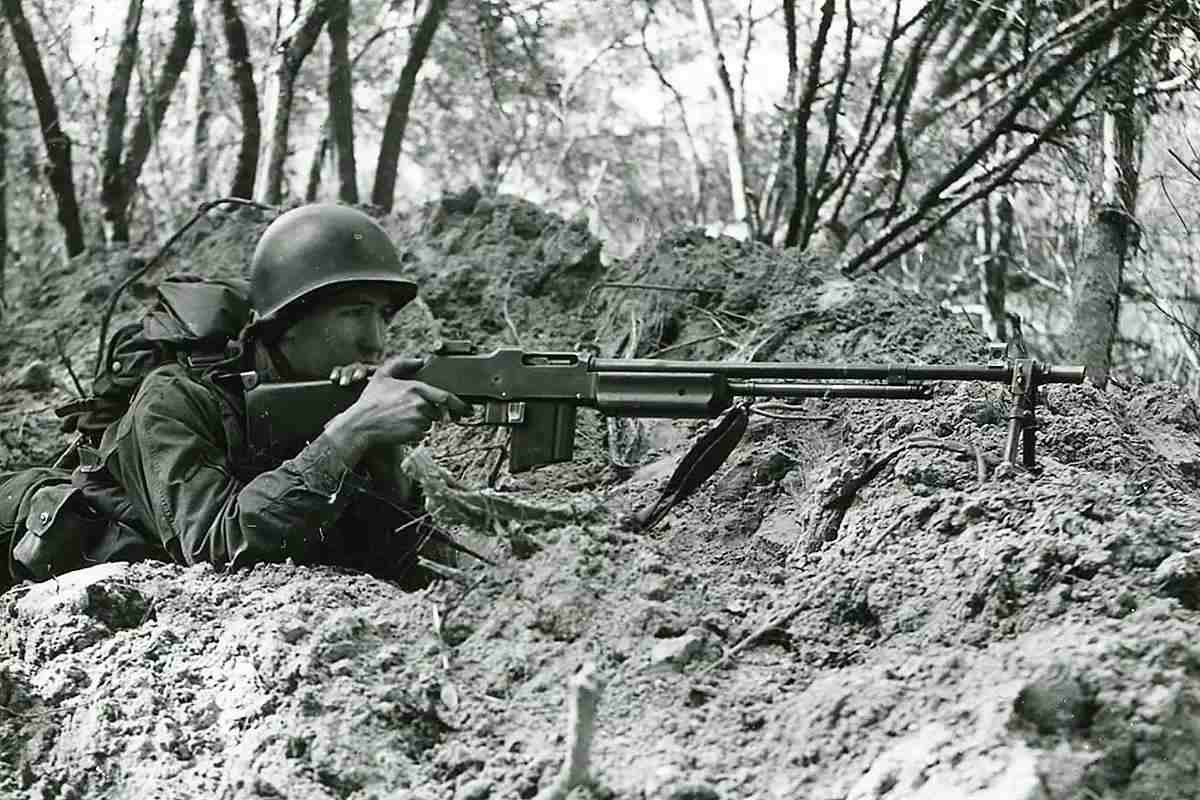
By the time American troops came ashore in Normandy, fought through the hedgerows of France, battled across the Philippines, and clawed their way up the volcanic slopes of Iwo Jima, the Browning Automatic Rifle had become one of the most respected infantry weapons in the U.S. arsenal.
The .30-’06 BAR gave American squads a level of mobile firepower unmatched by many opponents and earned a reputation for reliability in the Pacific’s heat, mud, and jungle — conditions that defeated plenty of other weapons. Yet one of the most interesting aspects of the BAR’s wartime story has little to do with combat and everything to do with the companies that built it.
Not Manufactured by Who You Would Think
Most shooters assume that a firearm as important as the BAR would have been produced by one of America’s major gun manufacturers. It seems like a reasonable assumption. After all, the original M1918 BAR had been produced during World War I by Colt, Winchester, and Marlin-Rockwell. When America entered the Second World War, however, the company that would ultimately manufacture the vast majority of new BARs was not a traditional firearms manufacturer at all.
Instead, most of America’s wartime BARs were built by an unlikely collection of companies whose prewar experience included silverware, sporting goods, office machinery, and bookbinding equipment.
Before Pearl Harbor
To understand how this happened, it is necessary to understand the situation facing the United States before Pearl Harbor.
Although the BAR had served the Army since 1918, production had effectively ceased after World War I. During the lean interwar years, the Army relied on existing stocks while funding for new weapons remained limited. Large numbers of BARs remained in storage, and many military planners believed those inventories would be sufficient for any future conflict.
The rapid expansion of the U.S. military beginning in 1940 invalidated that assumption. As America prepared for the possibility of war, demand for automatic weapons increased dramatically. Existing inventories could not equip the rapidly growing Army, Marine Corps, and National Guard. The Ordnance Department needed a way to restart BAR production, but doing so would not be simple.
An Unconventional Solution
One major obstacle involved manufacturing capacity. Traditional firearms companies were already heavily committed to other military contracts. Tooling dating back to World War I still existed, but much of it had been stored for decades and required significant refurbishment. At the same time, the Army needed production measured in hundreds of thousands of rifles, not merely thousands.
The solution was unconventional. Rather than relying on a single firearms manufacturer, the government encouraged the formation of a consortium known as the New England Small Arms Corporation, commonly referred to as NESA. Organized in 1941, the consortium brought together several companies that had little or no prior experience manufacturing military firearms.
Among the firms involved were International Silver Company, known for producing silverware and household goods; A.G. Spalding & Brothers, famous for sporting equipment; National Blank Book Company; Blake Manufacturing Company; Elliott Addressing Machine Company; and Boston Wire Stitcher Company, better known today as Bostitch.
On paper, none of them looked like the maker of one of America’s most important infantry weapons.
What they did possess, however, was manufacturing experience, machine tools, factory space, and skilled workers.
The Ordnance Department understood that modern industrial production depended upon precision machining rather than a company’s historical association with firearms. If a factory could produce complex industrial components to exact tolerances, it could potentially manufacture firearm parts as well.
Production Spread Across Multiple Facilities
Under the NESA arrangement, production was spread across multiple facilities. Individual companies manufactured specific components, which were then assembled into complete rifles. This distributed approach allowed the government to leverage existing industrial capacity without disrupting other critical wartime production programs.
The transition was not seamless. Much of the old BAR tooling required extensive repairs and modification before it could be used effectively. Engineers discovered that equipment stored since the First World War often failed to meet the demands of modern mass production, and some of the stored tooling had to be updated to match the current M1918A2 configuration.
Workers had to learn unfamiliar manufacturing processes, while inspectors established quality-control procedures to ensure parts produced by different companies would fit together properly.
Manufacturing Gradually Accelerated
Despite these challenges, production gradually accelerated. By early 1943, NESA was delivering new M1918A2 BARs to the military — the modernized version of the rifle, stripped of its semi-automatic fire mode, fitted with a slower-rate buffer and a bipod, and optimized for sustained automatic fire as a squad support weapon.
Once manufacturing stabilized, output increased substantially. The consortium ultimately became the dominant producer of the weapon, manufacturing approximately 168,000 rifles during the war.
Then there was IBM. Today, International Business Machines is associated with computers and information technology, but during World War II the company participated extensively in military production. Concerned that additional manufacturing capacity might be needed, the government awarded IBM a BAR contract as well.
IBM quickly adapted to firearm production and began delivering rifles in 1943. Ultimately, the company produced approximately 20,000 BARs before its contract was terminated as military priorities shifted. The government then reassigned IBM’s manufacturing resources to other wartime projects, including M1 Carbine production.
Nearly 190,000 BARs produced for the War Effort
Combined, NESA and IBM produced nearly 190,000 new BARs during World War II. Of those rifles, roughly ninety percent came from the New England Small Arms consortium. This means that the overwhelming majority of newly manufactured BARs carried by American soldiers and Marines during the war rolled out of factories that had never built a firearm before.
The BAR’s combat reputation has often overshadowed the remarkable industrial story behind it. Historians rightly celebrate the rifle’s service on battlefields from Normandy to Okinawa, but the companies responsible for placing those rifles in the hands of American fighting men are little remembered.
Their story illustrates one of the greatest strengths of the American wartime economy: the ability to rapidly transform civilian industry into military production. Factories that had never built a firearm before the war learned to manufacture one of the Army’s most important weapons. Workers who had previously produced consumer goods found themselves contributing directly to the defeat of Nazi Germany and Imperial Japan.
Without the New England Small Arms Corporation and its network of unlikely manufacturers, the Army’s ability to field large numbers of BAR-equipped squads would have been severely constrained.
Collectors today prize Colt, Winchester, or IBM markings, yet the rifles that armed most American squads came from a wartime industrial partnership that demonstrated how American manufacturing could adapt, innovate, and deliver under extraordinary pressure. In many ways, that achievement was every bit as important to victory as the weapon itself.