 Sixteen million Americans served in uniform during World War 2; 418,500 perished. One in every 38 American servicemen gave their lives for their country.
Our flight crews had it the worst: 44.4% of all RAF bomber crewmen died in the rarefied skies above Europe. However, that pales in comparison to the German U-boats.
In the opening salvoes of the Battle of the Atlantic, U-boat wolf packs wreaked unmitigated havoc on Allied transport ships. Over time, however, improvements in countermeasures as well as the breaking of the Enigma code fundamentally changed that calculus. By war’s end, three out of every four German submariners had been killed in combat.
Occurring as it did in the middle of vast oceans, WW2 naval combat was pitiless. The winners might go home to fight another day. The losers almost invariably slipped beneath the waves to either drown or be mercilessly crushed by the weight of the sea. Such stakes ensured that all involved fought like Norse berserkers.
The Players
The night May 5, 1943 was clear with a bright moon. U-66, a Type IXC German U-boat under the command of Oberleutnant Gehard Seehausen, was cruising along the surface recharging its batteries off of the Cape Verde Islands. U-66 was Hitler’s seventh-most successful German submarine now on her ninth war cruise. Her tally included some 33 Allied ships. U-66 had been at sea for four months and was desperately low on fuel.
As luck would have it, a U.S. Navy TBM Avenger launched from the American escort carrier U.S.S. Block Island picked up U-66 on radar some 20 miles from the U.S.S. Buckley, a compact American destroyer escort that was just itching for a fight. The Buckley’s skipper was Lt. Cmdr. Brent Able. In the dim light, the captain of U-66 mistook the Buckley for a German resupply submarine.
The Fight
By the time Seehausen realized his mistake, the two warships were only 4,000 yards apart. The German skipper ordered a snap torpedo shot that passed harmlessly off the Buckley’s starboard side. Lieutenant Cmdr. Able opened fire with everything that would shoot.
The Buckley ravaged the trapped U-boat for the next two minutes with her 3-inch deck guns, 40mm Bofors, 20mm Oerlikons, and sundry .50-caliber machine guns. High-explosive rounds ripped into the submarine’s conning tower and superstructure. Seehausen fired another ineffectual torpedo. Then Lt. Cmdr. Able then gave his ship hard right rudder and drove the nimble vessel up onto the deck of the U-boat.
In desperation, the Seehausen ordered his men topside. Some attempted to surrender. Others fought like Dervishes.
The crew of the Buckley had emptied their small arms lockers. First Officer Klaus Herbig led a German boarding party onto the forecastle of the destroyer escort. American sailors with Thompsons and .50-caliber machine guns tore them to pieces.
To say this was a desperate fight just doesn’t do it justice. Two of the attacking Kriegsmariners were struck in the head with coffee mugs. Gun crews unable to depress their weapons sufficiently began throwing empty ammunition cases down on the advancing Germans. Several enemy sailors still managed to board the American vessel.
The boatswain’s mate pulled his 1911 pistol and shot the first man dead. The Chief Fire Controlman swept the deck of the German boat with his Thompson. Lt. Cmdr. Able later said he enjoyed, “Excellent results.”
One enemy sailor managed to make it into the wardroom where a ship’s cook doused him in hot coffee before pummeling him into submission with the coffee pot. Five Germans were captured alive onboard the Buckley and escorted below by a sailor armed with a hammer. Meanwhile, the German deck gun crew literally disintegrated when struck by a burst of four 40mm high-explosive rounds.
As the U-boat scraped along the Buckley’s starboard side, an American torpedoman tossed a hand grenade through the open hatch to the U-boat’s conning tower. The dying U-boat then veered into the Buckley near the stern, tearing a hole in the engine room and shearing off the starboard screw. However, U-66 was done. The entire fight had spanned a mere 16 minutes.
The Aftermath
The crew of the Buckley expended 300 rounds of .45 ACP, 60 rounds of .30-06, 30 rounds of 12-gauge buckshot, and a pair of fragmentation grenades along with the aforementioned dinnerware and coffeepot. Roughly half of the U-boat’s crew survived. Oberleutnant Seehausen went down with his boat. He was 26.
The Buckley returned to Boston under her own power. Lieutenant Cmdr. Brent Able was awarded the Navy Cross, the Navy’s second-highest award for valor. His crew was authorized to wear a combat star on their European-African Theater ribbons.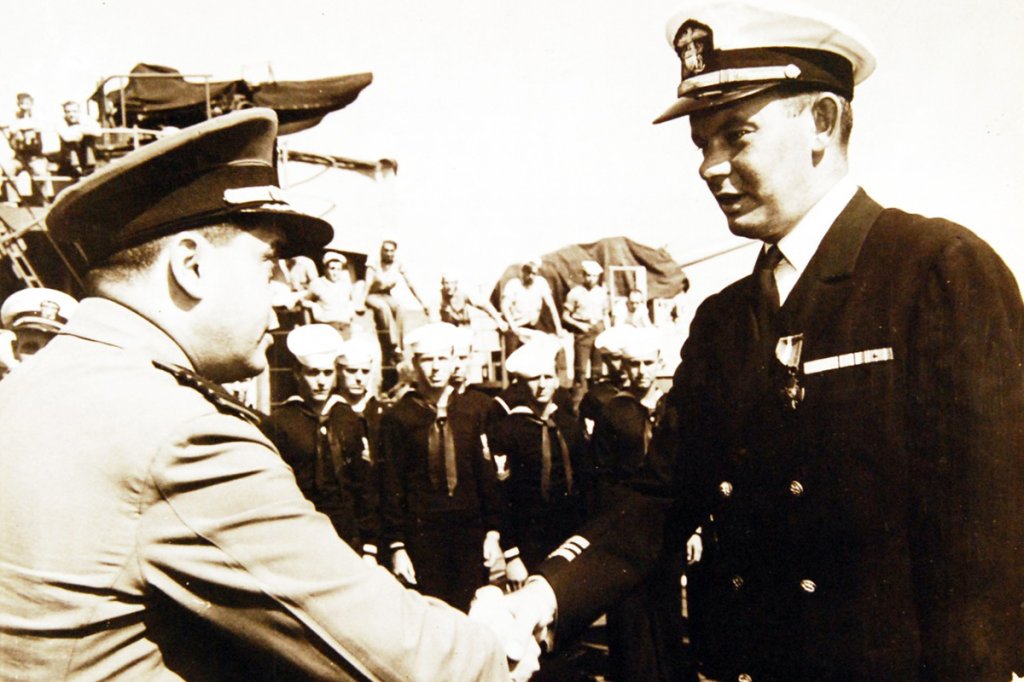
The sinking of U-66 was the last close quarters ship-to-ship combat in U.S. Naval history. What a bunch of freaking studs.