
Categories
Do You Have Too Many Guns?


Editor’s Note: Every shooter has played some version of this game. If you could step back in time and build the perfect battery of firearms for a specific era, what would you choose? Not what was common. Not what was affordable. What was the very best, or perhaps most interesting available?
This article explores that question through the lens of 1920, a fascinating period when the world was emerging from the First World War but had not yet entered the technological age that would define the second. Military surplus arms, bespoke British sporting rifles, Browning‘s latest pistols, and the first practical submachine guns all existed side by side. It was a time when a wealthy traveler could board an ocean liner in Europe, hunt dangerous game in Africa, cross Asia by rail and motorcar, and encounter vastly different challenges along the way.
To explore the idea, author Dr. Will Dabbs created the fictional Archibald Leach, a globe-trotting adventurer with deep pockets, questionable judgment, and access to the finest firearms money could buy. The result is not a list of the most famous guns of 1920, but rather one man’s vision of the ideal firearms battery for surviving—and thriving—in a rapidly changing world. Follow along on this journey and decide for yourself. Would you have chosen the same firearms, or built a very different battery for a life of adventure in 1920?
Quick Look
- A fictional wealthy adventurer provides the setting for assembling the ultimate firearms collection of 1920
- Colt’s Model 1908 Vest Pocket and Pocket Hammerless provide discreet concealed-carry options
- The legendary Colt M1911 and German MP18,I offer substantially greater firepower when trouble escalates
- A bespoke .275 Rigby and massive .600 Nitro Express Purdey cover everything from ordinary hunting to dangerous African game
- The M1918 Browning Automatic Rifle provides the collection’s ultimate answer when serious firepower is required
- Together, these classic firearms illustrate some of the finest and most advanced gun designs available just after World War I
The year was 1920, and Archibald Leach was chronically bored. Born into proper money and cursed with an incurable wanderlust, Archie had never worked a day in his life. He occupied himself by traveling the world, wooing women who were comparably rich, gorgeous, and distracted, and shooting things. It didn’t hurt that he was also not unduly encumbered with scruples or, for that matter, much of a conscience.
Like most folk of his station, Archie liked to gamble. Despite having more money than he could ever spend, swindling cash out of other wealthy, bored, powerful people made for a simply splendid pastime. This also earned the good Mr. Leach some formidable enemies.
Archie had run the baccarat tables at Casino de Monte-Carlo, sold a nonexistent bridge to a Russian warlord in the aftermath of the Revolution, fleeced an opium smuggler in the Guangxi Corridor in China, and harvested everything from crocodile to white rhino across the broad arid plains of Africa.
Tools of the Trade
We are so lamentably domesticated today. In 1920, people of means crossed the world’s great oceans on massive liners like the Olympic, Aquitania, and Imperator. They traveled with huge steamer trunks filled with the trappings to support their lives of opulence and excess. Porters and coolies packed the gear, and there were no customs searches. There weren’t a great many rules, for that matter. Money made the wheels turn, and the sky was the limit if you had enough of it.
As a diverting intellectual exercise, my friend and editor Dave Fortier and I figured it might be fun to cook up a hypothetical playboy like Archie Leach and then arm him with the tools he would need to hunt, thrive, and survive in the world of 1920.
Humanity would be dragging itself out of the hemoclysm that was its first war on a truly industrial scale, and the planet would still be covered in a thin patina of firearms. Archie would have the cash to raid the world’s seediest arms bazaars and the support staff to help him carry everything.
As our hypothetical playboy roared across Europe, Africa, and Asia in his 7.0-liter V12 Packard, he would need the full spectrum of firepower to secure his person in the face of such threats as Bengal tigers, Cape buffalo, affronted potentates, and husbands done wrong.
If money were no object and a state-of-the-art arsenal the objective, here’s how I would have done it back in 1920. Your mileage may vary, but this is what would work for me.
Starting Small
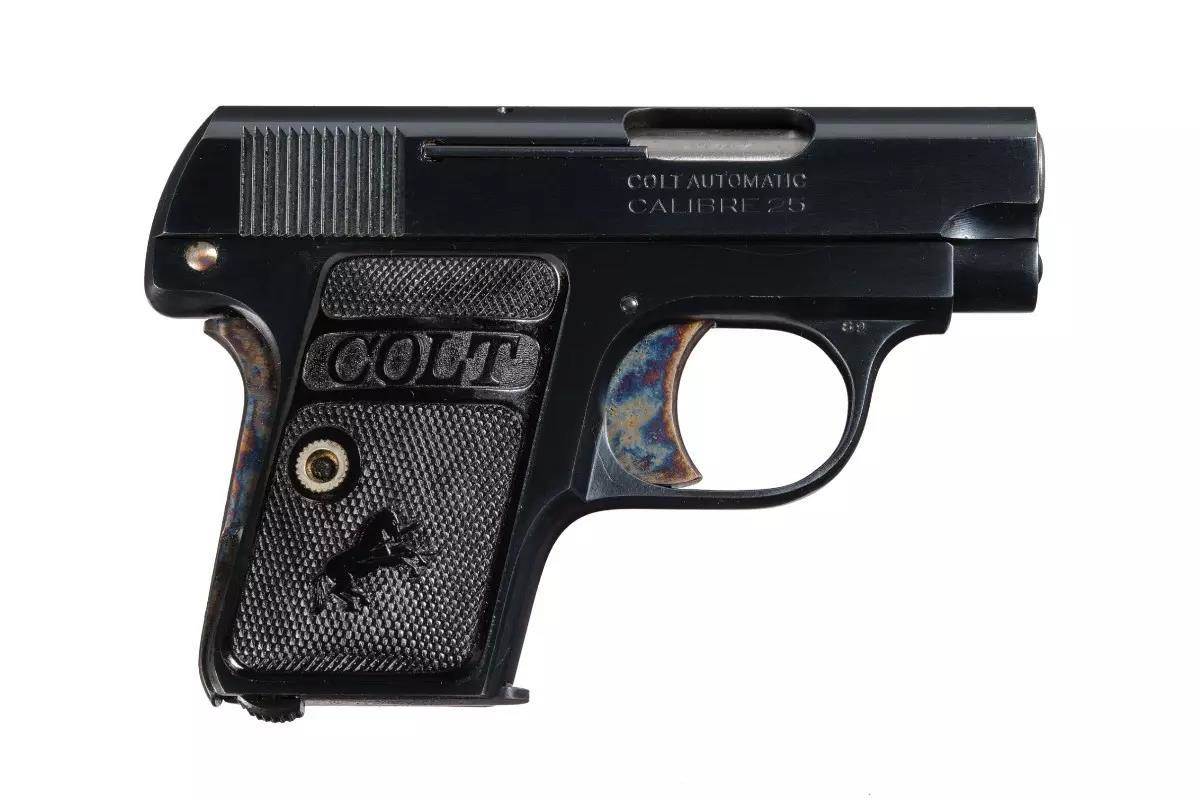
To thrive in the sorts of sordid spaces where Archie Leach operates, he would need to be armed whenever he wasn’t asleep or in the shower. In 1920, my favorite last-ditch deep-cover handgun would be the Colt Model 1908 Vest Pocket. At 4.5 inches long and weighing a mere 13 ounces, the Vest Pocket would ride comfortably in even the most minimalist clothing.
Colt knew the Vest Pocket internally as the “N” model. A basic unlocked blowback design, the Model 1908 fired John Browning’s diminutive .25 ACP cartridges out of a 6-round detachable box magazine. The sights were tiny, fixed, and worthless, and the gun incorporated a built-in grip safety to help keep the operator from inadvertently castrating himself in the heat of the moment. The Vest Pocket wasn’t much of a gun, but it was the pistol you could always have handy.
The Walking Around Gun
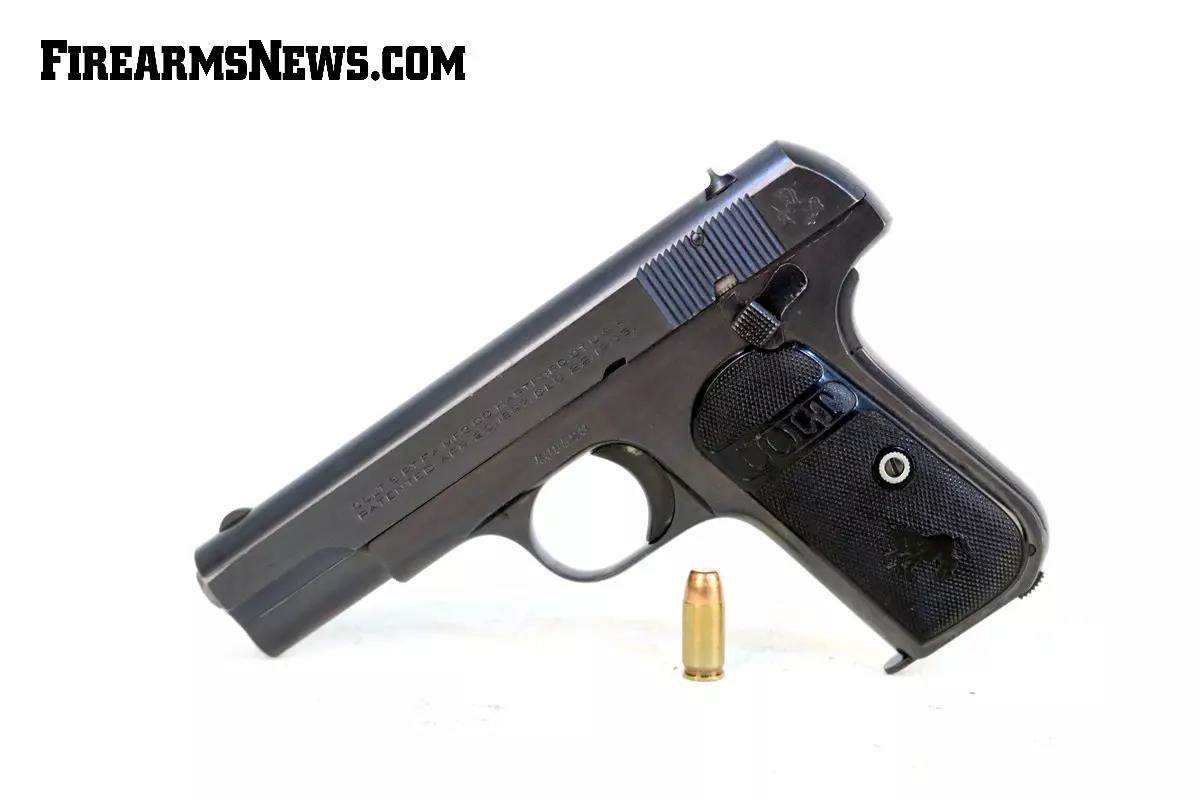
Our concealed carry pistol also spawned from the fertile mind of the inimitable John Moses Browning back in 1908. The Colt Model 1908 Pocket Hammerless actually wasn’t. The 1908 was a hammer-fired design; it was simply that the hammer was concealed underneath the slide where it couldn’t snag on anything.
Recommended
In 1920, high-performance hollow-point bullets were not a thing. Handgun cartridges pushed full metal jacket ball rounds or nothing at all. The original Colt Model 1903 was a trim deep-cover defensive pistol chambered in .32 ACP. Archie’s M1908 was the same gun firing the larger .380 ACP round.
More than half a million Colt Pocket Hammerless guns were produced in both chamberings. The gun was the standard General Officer pistol for American flag officers during World War II. The notorious gangster John Dillinger—Public Enemy Number 1—was clutching an M1908 when Melvin Purvis’ boys gunned him down outside the Biograph Theater in Chicago in 1934.
The Colt Pocket Hammerless was shockingly easy to carry. The trim dimensions made it fairly spunky on the range, particularly in its .380 ACP guise. The sights were too small to be of much use, but it carried 7+1 and shot reliably when you needed it. This was the gun that Archie packed when out gambling or on a particularly hot date.
Proper Iron
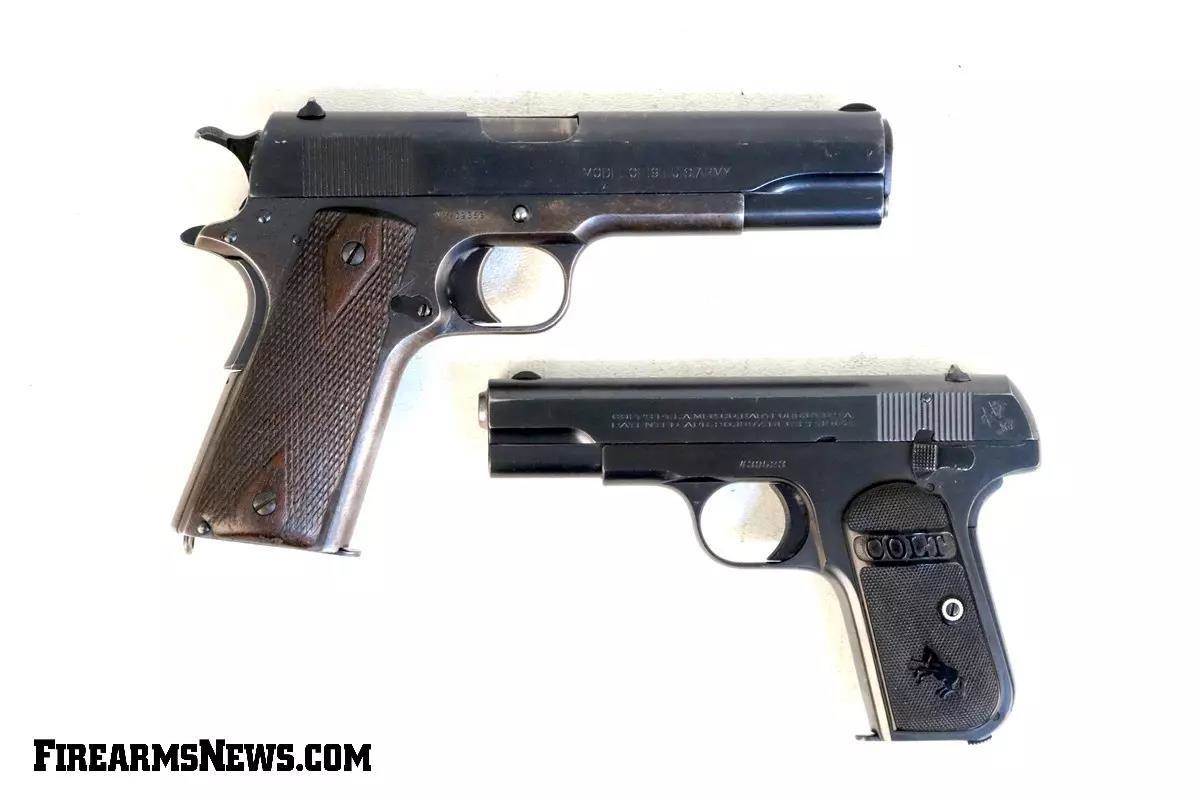
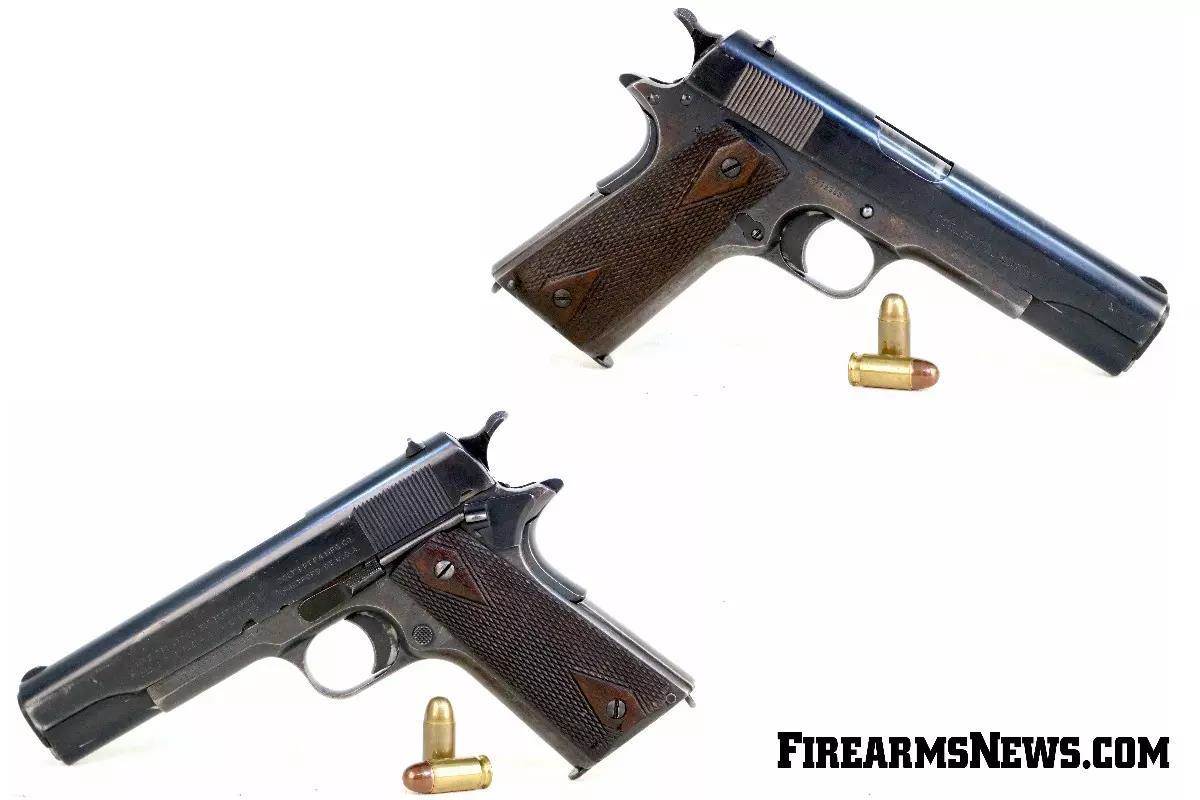
If Archie set out to do a deal with a rum runner or some unsavory pirate, he would need a little more concealable firepower. In 1920, there was really only one serious option. That would be the inimitable Colt M1911 in .45 ACP.
The 9mm P.08 Parabellum Luger was an undeniably sexy beast, and there were certainly some manly wheelguns in circulation. However, John Browning’s .45-caliber hand cannon sported a magnificent single-action trigger and threw a slug fully twice as massive as its Teutonic competition.
The 1911 was admittedly heavy at 39 ounces empty, but it carried 7+1 onboard and would ride fairly comfortably underneath a dinner jacket in a custom-made shoulder rig. There wasn’t much concealing that from the probing fingers of some amorous heiress, but that gaping half-inch muzzle reliably projected authority in the sketchiest of spaces.
The Colt of this time period was the original M1911 model with the hard to see sights, but it was fast into action, hit hard, held more rounds than an N-frame big-bore Smith and was quick to reload. With a couple of spare magazines tucked into a jacket pocket, you were ready for a night out.
The Tool for Those Times When Life Gets Extra Complicated
You might think me biased thus far in favor of John Browning. You’d be correct in that assumption. The great man held 128 patents at the time of his death. If there was such a thing as a John Moses Browning fan club, I’d proudly serve as local chapter secretary. However, in this case, our pistol-caliber submachine gun comes from the other side of the pond.

The Maschinenpistole 18,I (MP18,I) was not the world’s first pistol-caliber submachine gun, but it was the first one that really worked. Initially committed to action in the middle of 1918, the MP18,I was a preview of coming attractions.
The gun operated via simple unlocked blowback and fired from the open bolt. Earliest versions fed from the same 32-round trommelmagazin snail drum utilized by the Artillery Luger pistol. The trommelmagazin was as complicated as the human female, but it nonetheless ran fairly well.
The MP18,I was 33 inches long and weighed 9.2 pounds. It was chambered in six different calibers, but the 9mm Parabellum version was the one Archie would use. The gun cycled at around 450-500 rounds per minute and could clear a room of bloodthirsty brigands in nothing flat.
The MP18,I also carried a certain exotic mystique in 1920. The Great War had ended only recently, and the gun remained closely associated with the elite German Sturmtruppen (Storm troops) who had shocked Allied trenches with their aggressive infiltration tactics. While machine guns had previously been cumbersome crew-served affairs, the MP18,I gave a single determined man the firepower of an entire rifle squad at conversational distances.
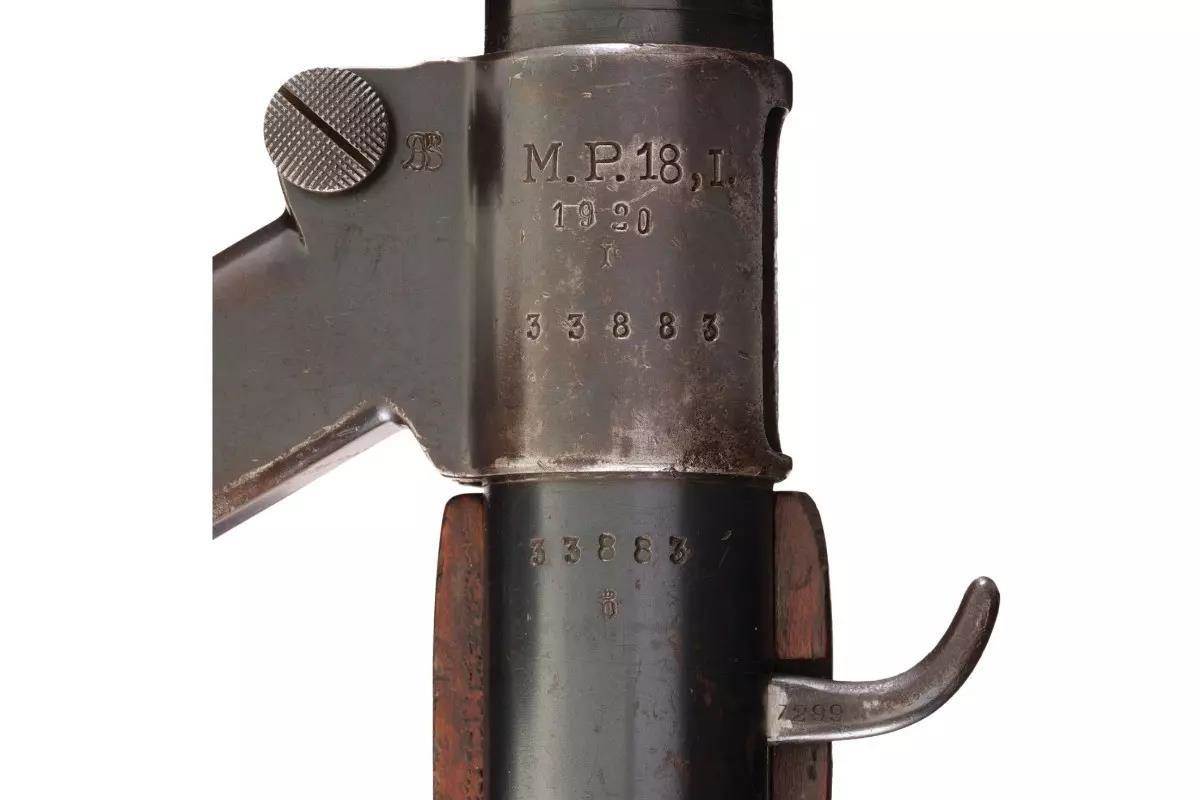
Ammunition was plentiful throughout Europe in the aftermath of the war, and examples of the gun found their way into armories, police arsenals, and less reputable collections alike. For a gentleman adventurer expecting trouble in narrow alleyways, crowded train stations, or riverfront warehouses populated by unsavory characters, few tools offered so much authority in so compact a package.
Big Game Hunting Rifle
Archie’s general-purpose utility hunting rifle was a bespoke bolt-action .275 from John Rigby & Co. The controlled-feed Mauser design offered unflinching reliability in the sorts of spaces where whatever it was you were hunting could also quite readily kill you. Sporting five in the magazine, one up the pipe, and double set triggers, these custom .275 Rigby rifles were designed to harvest serious game. Plus, in a pinch it could be rapidly reloaded using Mauser’s famous five-round stripper clips.
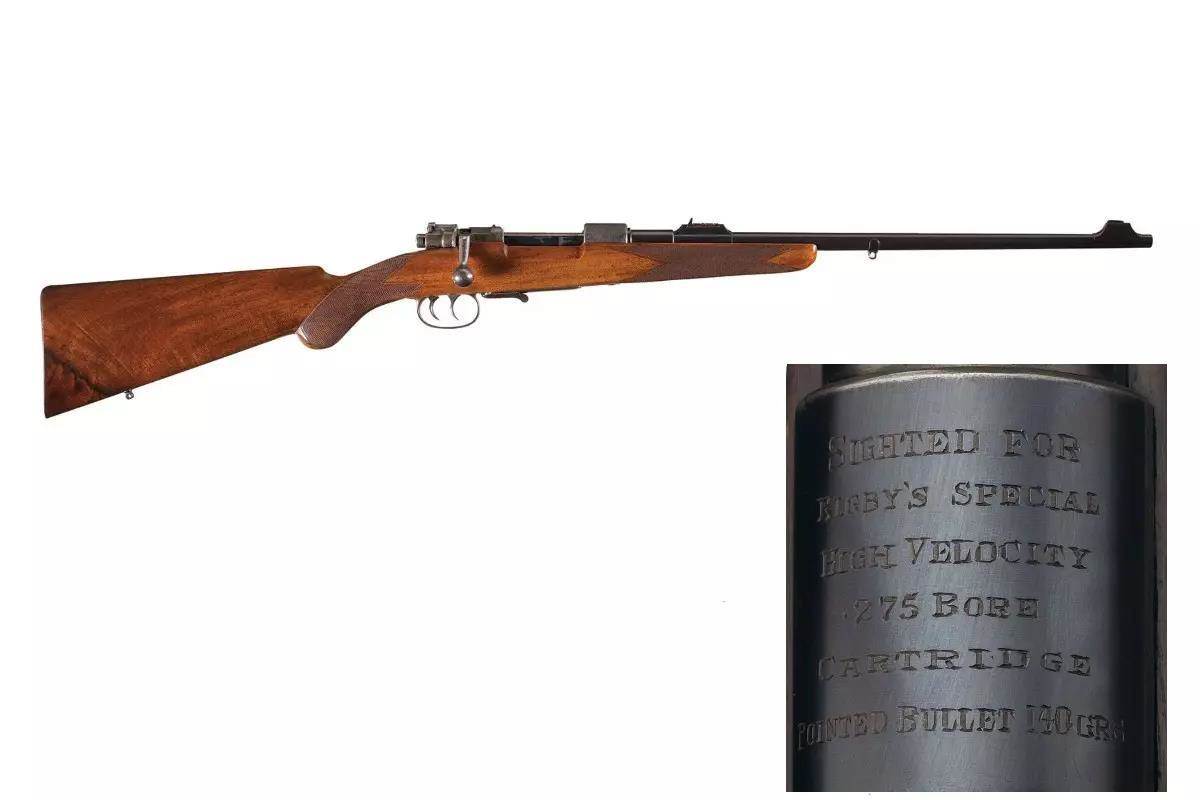
Archie’s Rigby would feature finely checkered walnut stocks, a custom barrel contour, and express sights with one fixed and two folding leaves. The stocks would be stained with sweat and worn smooth with hard use in arid places. Out to a couple hundred yards, such a 7mm-bore Rigby would keep the camp pot stocked and take any serious game such as lion, zebra, and sundry African hoof stock. Its 173-grain bullets were capable of surprising penetration.
The choice of the .275 Rigby was hardly accidental. Though known in continental Europe as the 7x57mm Mauser, the cartridge had already earned a legendary reputation in the hands of professional hunters and explorers.
Most famous among them was Walter Dalrymple Maitland Bell, better known as “Karamojo” Bell, who accounted for hundreds of elephants using the cartridge and carefully placed shots.
Bell’s success demonstrated that marksmanship and penetration often mattered more than brute power. The cartridge shot flat by the standards of the day, generated modest recoil, and offered excellent sectional density which facilitated it performing better than paper figures would lead you to believe.
For a traveler who might be hunting antelope one day, and defending himself against something considerably less friendly the next, the .275 Rigby represented one of the most versatile sporting cartridges available anywhere on Earth.
Really Big Game Hunting Rifle
In 1920, playboys like Archie Leach still harvested such exotic beasts as elephant and rhino in unsettling quantities. The world back then was unimaginably vast and its resources thought to be nigh infinite. To put down the truly big boys, Archie would pack a James Purdey & Sons self-opening sidelock in .600 Nitro Express.
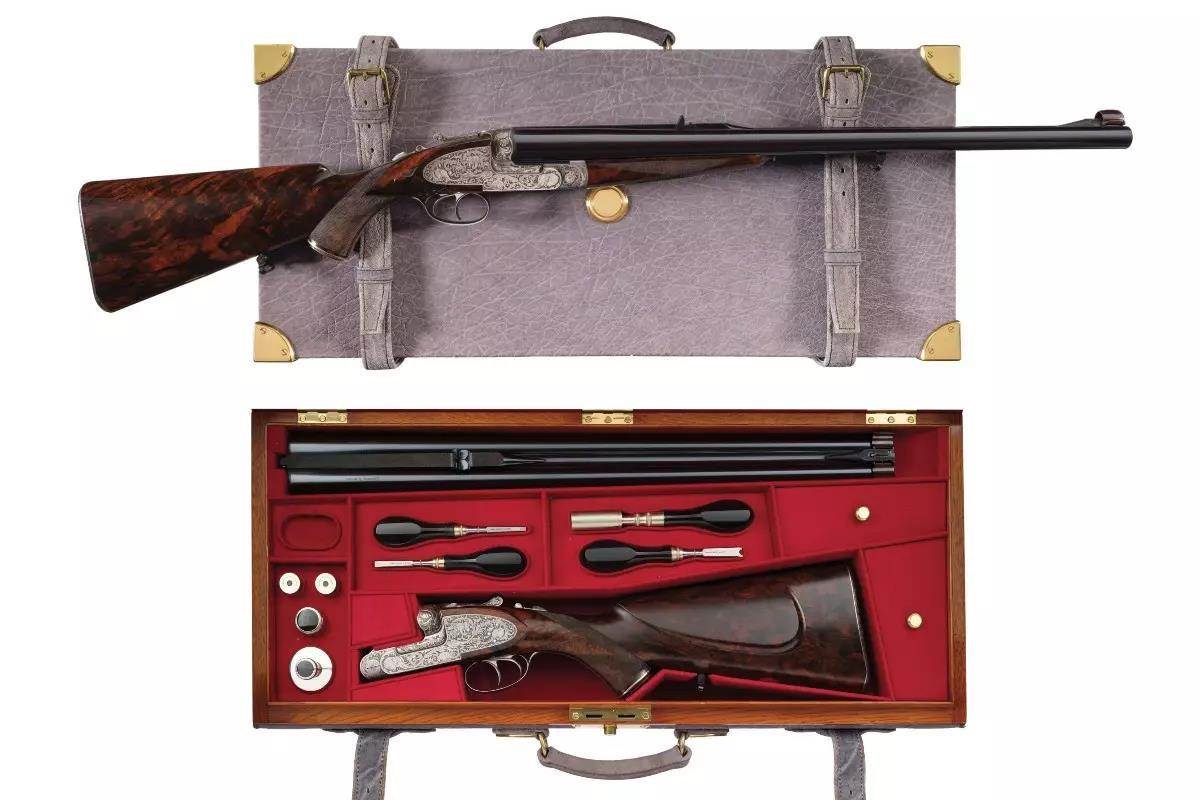
Sporting 24-inch barrels and tipping the scales at a whopping 15 pounds, these magnificent Purdey elephant guns were exceedingly rare. Production of the .600 Nitro Express versions likely never topped more than 20 copies. Featuring 24-inch solid-rib chopper-lump barrels, these vintage Purdeys produced an amazing 8,000 ft-lbs of muzzle energy and would drop any terrestrial game animal on Planet Earth.
Of course, nobody carried a .600 Nitro Express because it was practical. The rifle was a statement as much as it was a tool. Recoil from the massive cartridge was fierce enough to separate the dedicated sportsman from the merely curious, and ammunition was ruinously expensive even by the standards of the day.
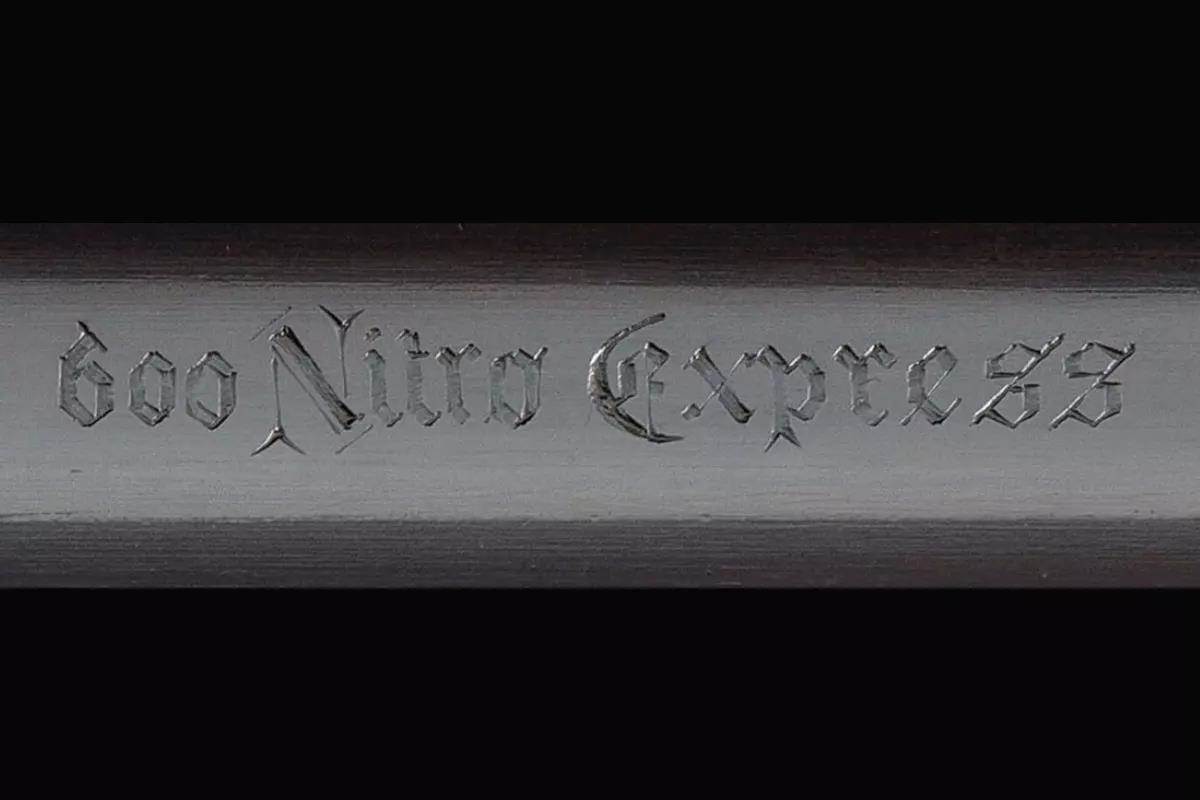
Yet among the wealthy hunting fraternity of the British Empire, the great Nitro Express doubles occupied a place similar to that of a fine yacht or bespoke motorcar. They represented the pinnacle of craftsmanship and prestige.
When facing an elephant at bad-breath distance in thick cover, where a wounded animal could close the gap in seconds, the instantaneous second shot offered by a double rifle provided a measure of reassurance that no repeating arm could quite duplicate.
For Archie Leach, practicality was only part of the equation. Style mattered too, and nothing announced one’s arrival at safari camp quite like a cased Purdey chambered for the mighty .600 Nitro Express.
The “Break Glass in Case of War” Gun
If the threat was pursuing him in the heavy automobiles of the day or cowering behind trees, Archie would need some serious firepower. The anchor of his man-portable firearm collection was the Browning Automatic Rifle. The M1918 BAR weighed 16 pounds and was 47 inches long. It fired .30-‘06 rounds from a 20-round box magazine. This select-fire machine rifle cycled at around 600 rounds per minute.

Clyde Barrow famously revered his stolen copies, even going so far as to cut at least one down at the end of the gas cylinder to create something stubbier and more compact. The BAR would reach out as far as you might reasonably see and kill most anything it touched. Little says, “You’d best calm down, mate!” like the massive BAR.
The Browning Automatic Rifle was not elegant in the way a London best gun was elegant, nor was it particularly convenient to carry.
However, if trouble arrived in quantity, there was simply nothing else in 1920 that offered such a combination of range, power, reliability, and sustained fire. Stowed in a leather case across the back seat of his Packard, the BAR represented the sort of practical insurance that wealthy men purchased when they expected life to become unpredictable.
The BAR also occupied a peculiar place in history at the time. The Great War had ended barely two years earlier, and the gun still carried the aura of a battlefield legend. Designed to allow American infantrymen to advance while delivering automatic fire, the Browning Automatic Rifle had proven a much better design than the French Chauchat it replaced. It was the very cutting edge of military technology.
Ruminations
While our friend Archie might not technically be a real guy, it was certainly a fun exercise kitting him out. More than that, however, it offers an interesting snapshot of a world that no longer exists.
In 1920, much of the globe remained vast, mysterious, and only loosely connected. Wealthy adventurers crossed continents by steamship and rail, hunted in places now protected as national parks, and moved through empires that have long since vanished. Their firearms reflected that environment. Reliability mattered more than gadgetry, power trumped convenience, and every gun had a clearly defined purpose.
Of course, every reader will have a different opinion on the ideal battery. Some might trade the MP18, I for a Winchester Model 1897 trench gun. Others would prefer a Webley revolver over the Colt Pocket Hammerless or a Holland & Holland double rifle in place of the Purdey. That is part of the fun. The world of 1920 offered an extraordinary blend of old and new technology, and there was no single correct answer.
Thusly equipped, Archie Leach would be ready for quite literally anything. Whether it was rescuing a captured Indian princess from the dacoit Sultana Daku’s bloodthirsty mob, crossing Africa in pursuit of dangerous game, or simply surviving the consequences of his own questionable decisions, Archie could wield these weapons in both civilized urban spaces and much more austere realms.
Hopefully our exercise offered an entertaining glimpse into one of the most fascinating periods in firearms history and makes you think, “What would I pick if I were Archie Leach?”

Bucky Lawson shares his experience using the Henry Homesteader 9mm carbine as a home-defense tool over the course of three years with range testing and more.
I’ve had my Henry Homesteader Carbine for just over three years now. I initially handled and fired it at its introduction at SHOT Show 2023 and decided I needed one for my own. Good decision. The Homesteader hasn’t disappointed me. I use it mostly for maintaining my basic rifle skills, otherwise known as plinking, and it also serves as a home defense rifle. I’ll address why I assigned it that role later. It’s a lot of fun and I think the Homesteader is among my most useful long guns.
If you’re unfamiliar with the Homesteader, it represents Henry’s first original foray into the world of semi-automatic firearms. It’s a clear departure from the lever action rifles that built the company’s reputation. Despite my very good first impression, I wondered how the Homesteader would hold up under extended use, considering Henry’s lack of history with such firearms. Time and many, many rounds have long put those concerns to bed. I can’t even tell you how many rounds my Homesteader has fired. A couple thousand anyway.
The gun’s 9mm Luger chambering has a lot to do with that. It’s a rifle I can actually afford to shoot a lot. Love my other long guns, but the only rifles I shoot as much as, or more than, my Homesteader are my .22s and AR-15s, and the latter are more expensive to shoot than the Henry. The 9mm Homesteader also fits into a kind of sweet spot between .22 and AR. It’s nice and it’s fun.
So, let’s get into the Henry Homesteader Carbine, what it is, why I like it so much, and a couple of small upgrades I made.
Henry Homesteader Carbine Features
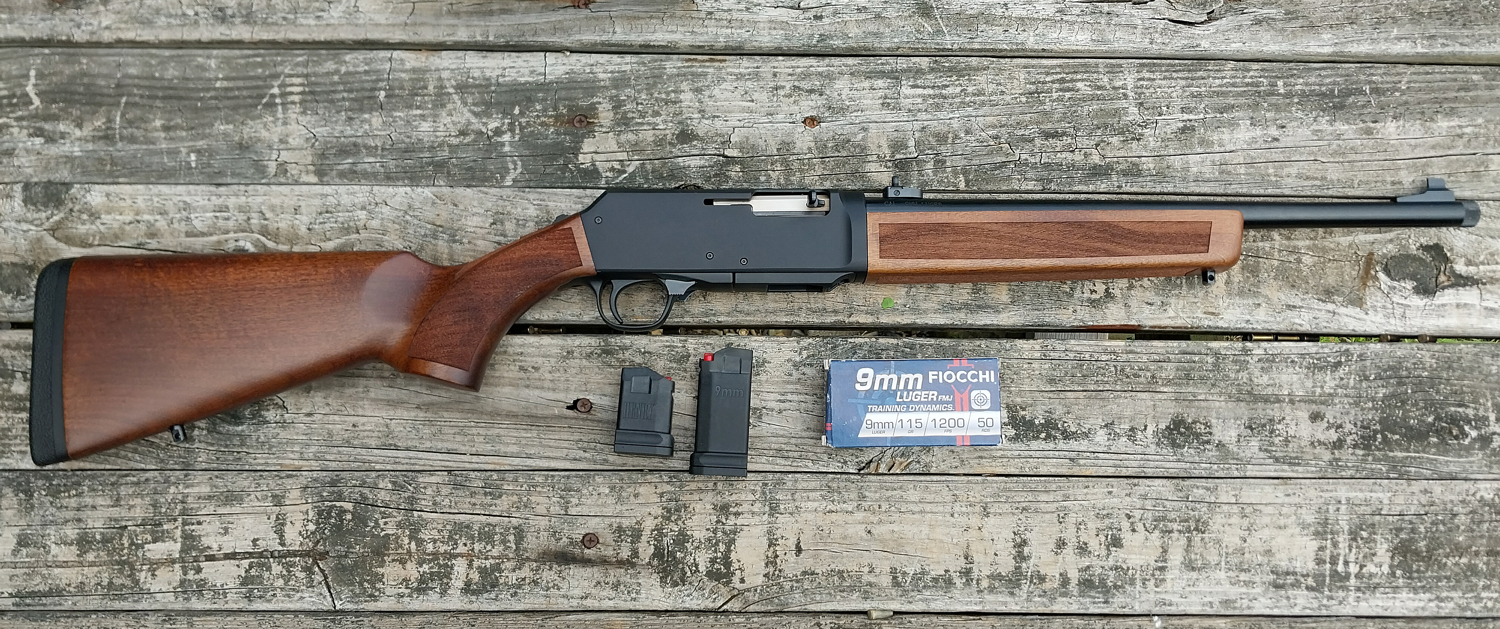
Operationally, the Homesteader reminds me of the M-1 Carbine and the Ruger 10/22, while it kind of looks like a Browning BAR (the hunting rifle, not the World War II squad weapon). The side charging handle is familiar, except the Homesteader’s is reversible, unlike those on the other rifles. The reversal process is simple, requiring only a minute or two. That ambidexterity extends to the tang-mounted thumb safety, the 10/22-like mag release, and the bolt catch located just forward of the trigger guard.
Stock & Forend
The American walnut stock is solid and it looks nice, but the gun is still pretty light at 6.6 pounds. The walnut forend conceals a recoil mitigating device that Henry calls a “reciprocating mass.” Basically, it’s a weight that times the blowback action, facilitating proper ejection of the spent casing. The extra weight also helps with muzzle rise, though the recoil is almost negligible,
Barrel
The 16-inch barrel features a threaded muzzle for a suppressor or other device. I’ve run it with a suppressor and a brake. The suppressor stays on when it’s staged for home defense. I shoot it both ways on the range, or with no device at all.
Sights
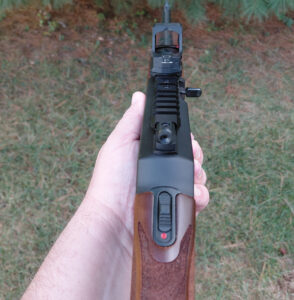
The factory sights consist of a blacked-out front blade and a ghost ring set just forward of the receiver. They work fine, but there was more air than I like in the ghost ring. So, I replaced it with a Picatinny rail section and a Skinner Sights peep sight. That’s attached to the top of the receiver, is which drilled and tapped for the Weaver 63B footprint. The peep sight gave me a better aperture and moved the rear sight to the receiver’s rear, extending the sight radius as God intended. The rail also allows an optic. I currently run a red dot.
Compatible Magazines
The Homesteader ships with one 5-round and one 10-round proprietary Henry magazine. I was a little skeptical at first since new mags can be weak spots, and Henry lacked some experience. But, again, my concerns were quickly dispelled. The Henry mags work very well indeed, and I’ve never had so much as a hiccup from them.
But Henry also provides other options. For an extra 30 bucks or so, you can purchase an adapter kit that allows your Homesteader to use Glock 19 and 17, Sig Sauer P320, or Smith & Wesson M&P 9mm mags. That obviously opens up some possibilities for expanded capacity and easy acquisition of extra magazines. It also provides opportunities for you to use the same mags in your carry gun and your truck gun. That’s a very attractive proposition and shows that Henry thinks about what their customers might want.
I got the Glock attachment even though I don’t own a Glock (don’t start). It made sense to me since Glock mags are everywhere and they aren’t all that expensive. I haven’t installed it because the Henry mags work so well. But I recently got a Stribog SPA3G that uses Glock mags, so it’s probably time.
Running the Henry Homesteader

From the beginning, I’ve viewed the Homesteader as a workmanlike firearm, despite its admittedly attractive profile. The 9mm cartridge makes it ideal for varmints or self-defense. A handy, carbine-length gun in an easy-to-shoot caliber is a nice gun to have in the truck too.
But a gun that has an actual job, or jobs, has to run reliably. Every time. And brother, my Homesteader does just that. As I noted, I have at least a couple thousand rounds through this gun. I have not experienced a single malfunction that I can remember, and I’m pretty sure I would remember, given my job. I mainly run 115 and 124-grain FMJ on the range, though I occasionally shoot some +P defensive rounds since that’s what I load in the home defense magazines.
Range Testing
I recently ran the Homesteader through a deliberately-hard range session using ammo from my friends at Ammo-to-Go. Using all my Henry mags, with my co-tester reloading them as I used them up, I put 270 rounds through the gun as fast as I could shoot them. The Homesteader got hot and it got filthy. The mags were covered in residue and took a while to clean out. But the gun ran like a champ. Steel rang through that little valley like bells when the British were coming. I was really proud of my Homesteader. Not so happy when I had to clean everything, but this was for science and all. It’s not, however, something I’ll likely repeat.
I used the following loads in the test:
- 115-grain Blazer Brass FMJ (50 rounds)
- 115-grain Federal American Eagle FMJ (50 rounds)
- 124-grain PMC Bronze FMJ (100 rounds)
- 124-grain Sellier & Bellot FMJ (50 rounds)
- 124-grain Remington Golden Saber +P BJHP defensive rounds (20 rounds)
My Homesteader as a Home Defense Carbine
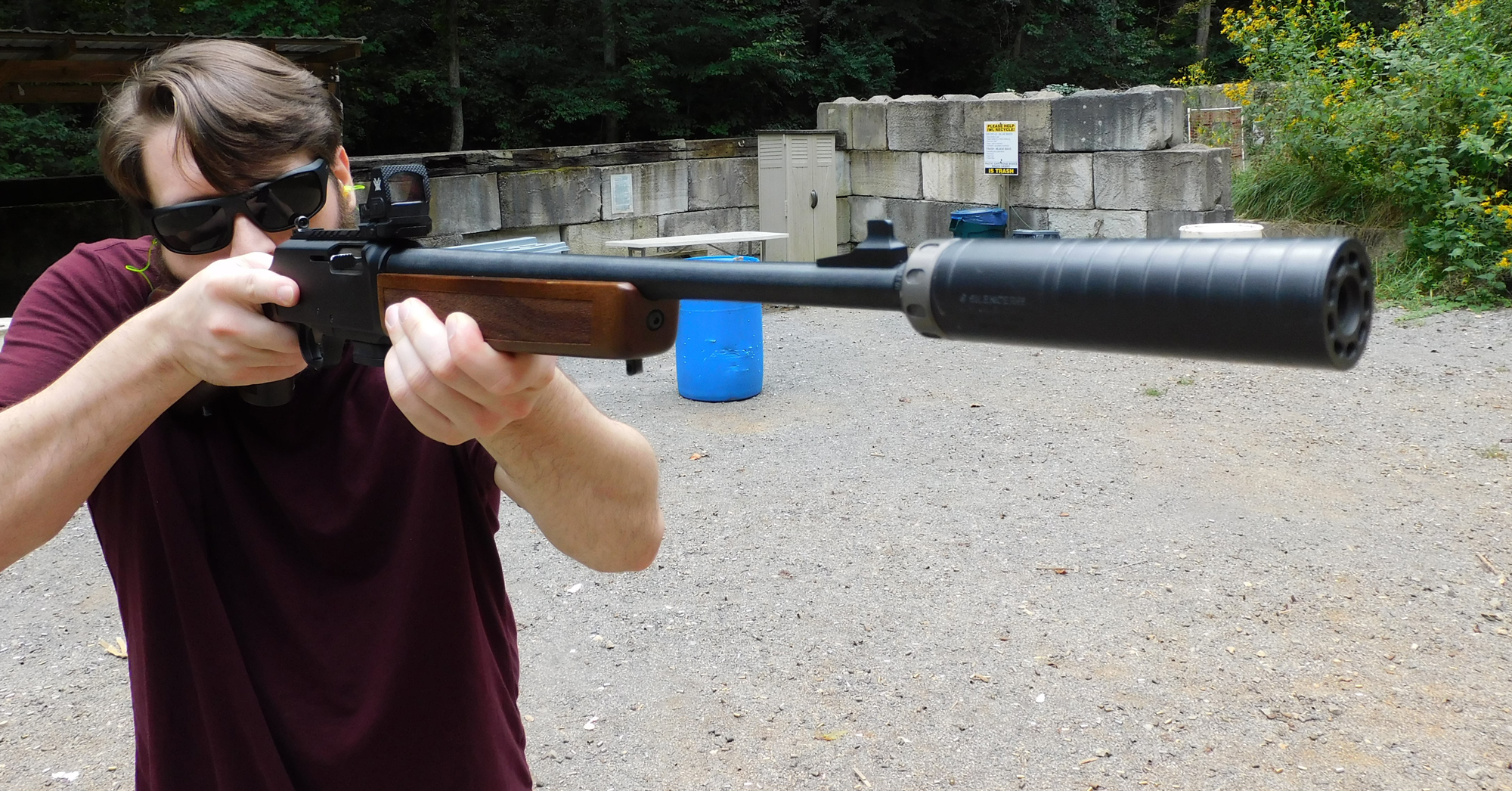
I mentioned that I use my Homesteader in the home defense role. Here’s why. First, the gun has proven itself reliable and capable. Second, the 9mm cartridge is less likely to penetrate walls than a 5.56 NATO round. Third, I can suppress it so I’m less likely to blow out my eardrums. Fourth, the 16-inch barrel makes it handy enough for indoor work. Fifth, I love it with an unmagnified red dot.
And finally, the traditional wood and steel look means an overzealous prosecutor is somewhat less likely to try to make an example of me if things go sideways. That’s not a joke, as you know if you read the right firearm publications.
The only thing it lacks in the home defense role is the ability to easily attach a weapon light. Henry offers a newer Homesteader with an M-Lok-compatible forend, but they don’t seem to sell the forend separately. I’m looking for options to attach a light.
The Homesteader isn’t my only home defense gun, but it’s an important part of my system.
Henry Homesteader vs Ruger PC Carbine
If you’re shopping carbine options, odds are good you’re considering the Henry or Ruger’s popular PC Carbine. Both are excellent options and could have a place in your safe at home.
On looks alone, the Henry is the classic choice while Ruger’s PC Carbine is the more tactical “black rifle” looking option.
Ruger’s PC Carbine features faster takedown, with a quick release barrel assembly. (You’ll need to release pins to takedown the Homesteader.) Many shooters also find the Ruger’s accessories and customization options appealing. Henry doesn’t have the same breadth of available trigger-swaps, etc.
In terms of performance, the rifles are similar. The Henry name may command a slightly higher price and its stock walnut stock adds some class to the package. That said, there are options for Walnut Ruger PC Carbine furniture out there too.
Parting Shots
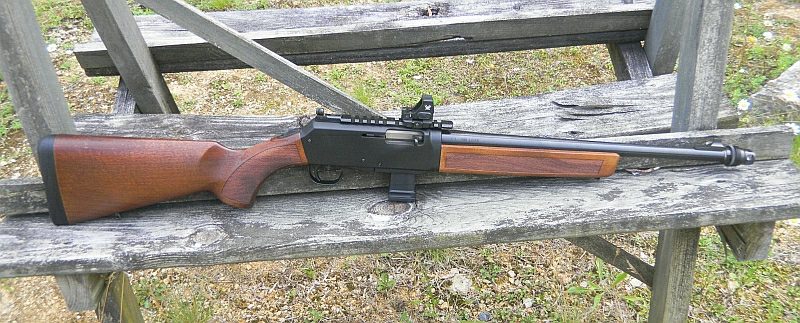
I make no bones about liking my Homesteader. But the gun has earned that regard. It’s reliable, accurate, and a lot of fun. The recoil is negligible, and it works great with a suppressor. I’ve found that I particularly like it with an unmagnified red dot optic, and I’m currently running a Vortex Defender-ST on it. I zeroed the optic at 85 yards, and I regularly shoot it out to 125.
But it’s only fair that I express my one complaint, other than the factory ghost ring sight. I don’t care for the mag release. Don’t get me wrong, it works exactly like it’s supposed to. But it doesn’t feel natural to me and I have the same complaint about my Ruger 10/22s since they have the same kind of catch. Both complaints are subjective, personal opinions, but I’ve gone on so much about how great the gun is that I felt I should mention what I don’t like. So, there it is.
The Homesteader is a handy, fun little carbine. If you’re looking for something like that, check out the Homesteader. It made a splash back in 2023, and with good reason. Three years in, I haven’t regretted mine for even one second.
Henry Homesteader Specifications
- Caliber: 9mm Luger (+P and +P+ rated)
- Capacity: Various, depending on magazine setup. Ships with one 5 and one 10-round Henry magazine.
- Semi-automatic
- Barrel length: 16.37 inches
- Overall Length: 35.75 inches
- Length of Pull: 14 inches
- Weight: 6.6 lbs.
- Threaded Muzzle (Unthreaded variant available to comply with state laws)
- American Walnut Stock and Forend
- Tang-Mounted Thumb Safety
- Ambidextrous Controls with a Reversible Charging Handle
- Available Glock, Sig Sauer, and Smith & Wesson M&P Magazine Adapter Kits


