Month: December 2024

Categories
The Remington Rolling Block Rifle
I shivered a bit strolling past the obligatory “Gun-Free Zone” sign posted outside the local elementary school. The proposed hijinks this day had been cleared at the highest levels, however, it is still mighty unnatural to walk into a school packing a bazooka.
It’s quite an ordeal to gain entrance to a typical school these days. You have to scan an ID and have your picture taken. The picture is printed on a little piece of adhesive paper you stick onto your shirt. I intentionally affixed mine upside down. When (conservatively) 10,000 kids later helpfully pointed out my sticker was upside down, I simply glanced at the thing and responded, “Not to me.”
My buddy Jason and I share a Biblical-grade, David-and-Jonathan-sort of friendship. In the past 1/2-century we’ve partaken of some of the most delightful mischief together. Our mission this day was to introduce Jason’s son William and his 3rd-grade Insights class to the physics behind potato cannons.
I can only imagine the visionary man who first strolled into his local hardware emporium and imagined he (you know it was a guy) might subsequently contrive a mechanism with which to launch a vegetable into low earth orbit.
While this was destined to be the most exciting thing these kids had ever done in school, the humble spud gun remains nonetheless legitimately educational. Such a contrivance indeed embodies the principles of combustion, pressure, velocity, and kinetic energy along with a smattering of materials science and electricity.

You simply haven’t lived until you have built yourself a potato cannon. Cheap, fun, and breathtakingly powerful, a proper spud gun is just crazy cool. Just don’t blow yerself up!
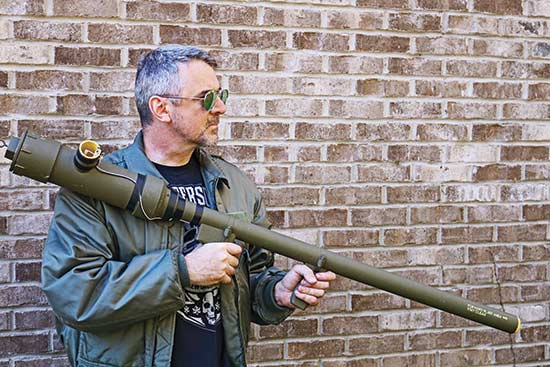
Potato canons are cheap and easy to make. Hang time for the potato when
fired near vertical is simply hilarious.
The Device
The basic concept consists of a combustion chamber sporting a PVC washout on one end and a reducer fitting on the other. The angry end necks down to a smaller-diameter barrel into which you insert the vegetable. You grind or sand the muzzle to an edge circumferentially to cut a plug like a cookie cutter. Use a broomstick to press the tater down the bore. (Sink a trio of screws through the reducer fitting so your spud doesn’t fall into the combustion chamber.)
Most spud guns use hairspray for power. That’s sticky and gross. Jason and I have always used propane. We adapted some surgical tubing to a box store propane torch and use a 60cc syringe to draw off fixed volumes of propane. Our optimal charge is 90cc, but the volume of your combustion chamber drives that number. The trial and error is half the fun.
We set the electrodes from a standard grill igniter in the side of the combustion chamber and ran the wires to our pistol grip. With the igniter button affixed within the grip and both grips attached via pipe clamps the whole shebang looks like a 57mm recoilless rifle in dim light. As my buddy Jason is an artist, he naturally sprayed his olive drab and stenciled cool GI lingo all over it. Sink small screws through all your joints to bolster the PVC cement.
The Physics
A spud gun is simply awash in science. We started out with a discussion of pressure, energy, and work. Conservation of energy states: “Energy is neither created nor destroyed but rather changes forms.” Nuclear power is an exception to that axiom, but we didn’t want to get too deep into the weeds.
We blew up a balloon and let the air out very slowly. The noise sounded like a fart, so you can imagine what a crowd-pleaser that was. Then we filled a balloon and released it to jet about the classroom. Finally we blew up a balloon and burst it with a pin. In each case the balloon held roughly the same amount of energy, it was just released in different ways.
We then discussed the three elements necessary for combustion—fuel, oxygen, and heat. Air the gun out well, stuff a spud down the bore, then seal it up and charge it with propane and you have two of the three elements, hit the grill igniter to add the magic spark and…
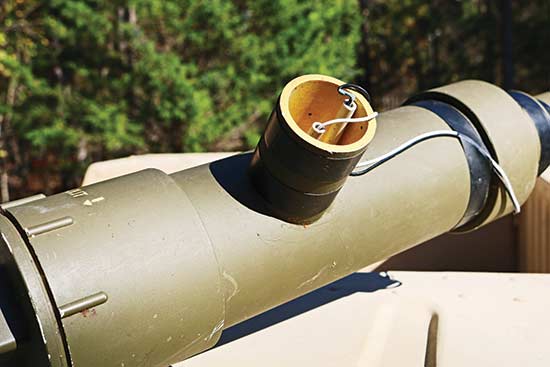
The electrodes from a standard grill igniter are mounted in the wall of the combustion chamber.
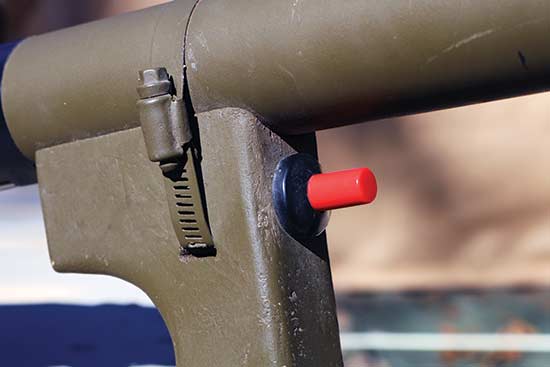
Arrange the pushbutton from the grill igniter in the pistol grip so it looks like a trigger.
Trigger Time
If you’ve never fired one before, a nicely tuned spud gun is immensely powerful. It really would take your head off if employed recklessly. As a result, we naturally observed the obligatory safety rules. The kids stayed well clear, we triple checked everything downrange, and everybody sported eye protection.
The gun actually produces some healthy recoil and will throw a spud literally out of sight. At 45 degrees the potato disappears. Against terrestrial targets like the playground equipment, the tater explodes like a bomb. When fired near vertical the hang time is simply hilarious.
We expended our basic load of potatoes (10 pounds) with the kids still clamoring for more. The teachers took turns behind the gun, and all involved had a literal blast. Additionally, as I bumped into the kids at the clinic later in the week, they could all parrot back the three basic components of combustion.
Learn By Doing
There are those less durable members of society, some of whom will undoubtedly read this column and who will take profound umbrage my friend and I were allowed to teach Physics to a group of 3rd graders using a weapon (sort of) as a training aid. These kids are impressionable, after all. How might this warp their little minds?
I did stuff like this when I was in 3rd grade and turned out just fine, thank you. My two sons could clear rooms, run black guns, and nail targets at great distances better than their old man before they reached their teens, and they are tax-paying productive adult Americans today. (They were also the reason I never had to worry about a school shooting at the Dabbs Homeschool.)
School shootings are the very pinnacle of Satan’s many manifest diabolical contrivances. After orchestrating the Holocaust and inventing crack cocaine I guess the old serpent just felt he needed an encore. At the end of the day, however, there is nonetheless great value to be had when reasonable educators and administrators apply the rules reasonably. I guarantee this particular group of 3rd graders will not soon forget those three elements of combustion.
Thank You Notes
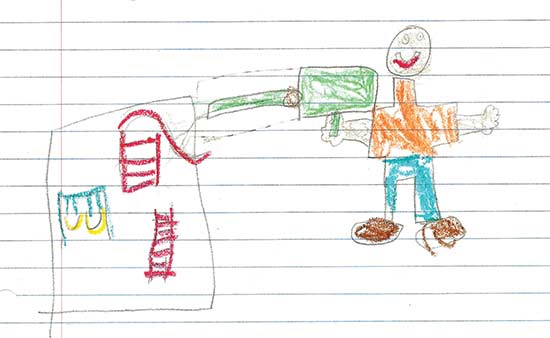
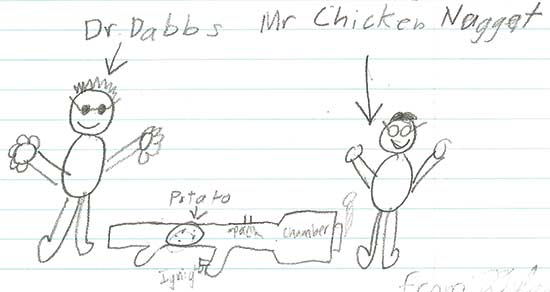
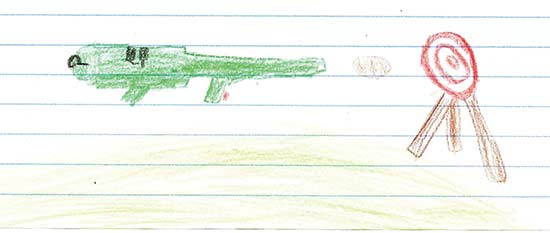
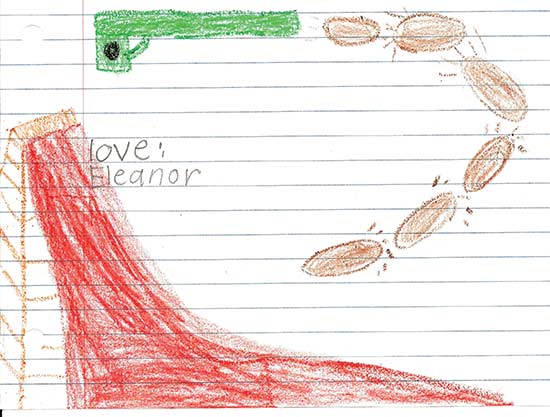
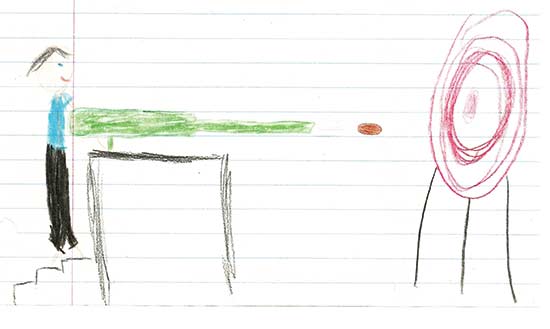
The following week I got a huge stack of thank you notes, all in that formative hand typical of the youthful authors and most liberally festooned with colorful art. Here are a few unretouched excerpts:
“We loved your viset becuase yall are the most awesome people I have ever met.”
“My favorete part of the potato gun was the ignitor.”
“You were so funny when you blasted the slide. I wish I could of seen more.”
“I love the way you came so happy and with a good heart!” (This obviously came from a girl.)
“I leanred lots of things. You need the following to operate a potato cannon; fuel, heat, a potato (obviously), and many other things.”
“I liked the way you told us how a potato gun works and drew a picture of it on the white board.”
“You in spirerd me to build a potato gun and shot it.”
“The hole thing was amazing.”
“I got some potato scraps at recess and to be honest it was really stinky so I threw them away.”
“I’m sure the playground equipment was taught a lesson.”
“Thank you for showing us how to make fire! Now I will take over the world. Ha ha ha. Just kidding.”

I bet that you REALLY had to be on the ball there, all the time or lose a body part REAL Quick!! Grumpy
PS My Dad saw what a T.O.T. of such shells like this could do in Korea. He said that an entire hill was just lifted up and dropped. needless to say we took that hill fairly easily.
Categories
THE .32 WCF
DUKE RE-THINKS HIS PLINKING GUNS

Duke’s .32-20 Colt SAA and Cimarron Arms Short Rifle. Duke pronounced them great fun to shoot!
Of all the popular Old West cartridges the .32 WCF/.32-20 has lacked popularity with me. I don’t know why exactly. Perhaps it was because I never had a raging miniature poodle that needed shooting. Or maybe it was because the concept of mating such a tiny cartridge to such heavy guns as Colt SAA revolvers or Winchester lever guns seemed illogical.
Whatever the reason, while I’ve owned dozens of big bore Colt SAAs and likewise with Winchester (and replica) lever guns, I’ve owned precisely four .32-20s. One was a Colt SAA with 4-3/4″ barrel, one was an Italian SAA replica with 7-1/2″ barrel, one was an original Winchester Model 1873 on which someone had shortened the barrel and magazine tube to 20″, and one was a Japanese made Browning replica of Winchester’s Model 53 with 22″ barrel.
All were decent guns. None stuck around very long. Now in 2021 matters have changed. First, in 2020 I found a 3rd Generation Colt SAA with 7-1/2″ barrel made about 10 years ago. As with all Colt SAAs I’ve seen in recent years it’s a beautifully crafted revolver. Because its previous owner decided to “erase” its color case hardening due to some surface rust it was priced very attractively. Its blued surfaces were untouched. I’m going to have it re-color case hardened but that will be a future column.
That Colt has been a fine shooter and just plain fun for popping empty soda cans and chunks of firewood. I shoot on my own property so the cans are policed and the splintered firewood left to make its way back to nature. Over the winter and spring of 2021 I’ve loaded hundreds of .32-20s, all with cast bullets either of my own making or commercially cast. Luckily when I launched on my full auto kick a dozen years back I laid in thousands of suitable primers for each purchase. Therefore current shortages have not plagued me.
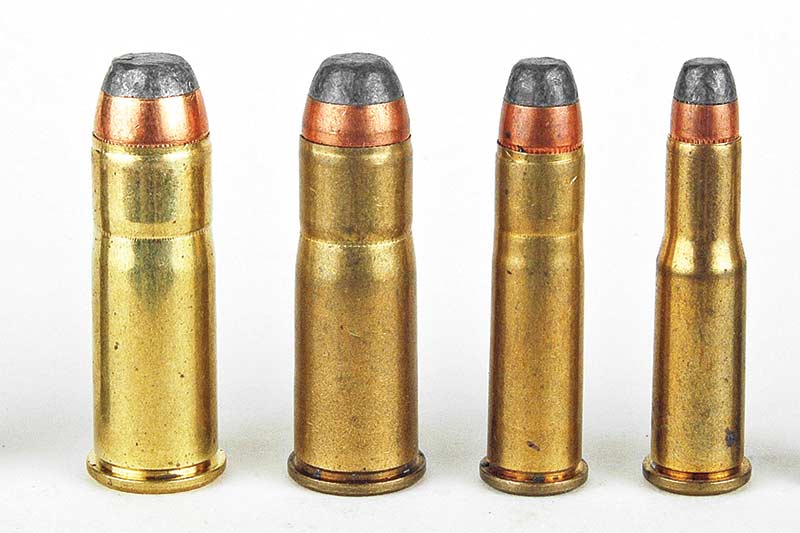
This lineup of cartridges contains the Winchester Centerfire pistol size cartridges
that were chambered in Models 1873 and 1992 lever guns in the late 1800s.
From left: .44-40, .38-40, .32-20 and .25-20. The latter one was only in Model 1892s.
Plinkers
Mostly .22 rimfires have been the ultimate plinking guns, but this shortage has raised ammo prices significantly. The .32-20 might actually be cheaper now. A powder charge of 3.0 grains of Bullseye will net 2,333 loads from a 1-lb. can! Another fine load is 3.5 grains of Titegroup. That makes for 2,000 loads per pound. Most .32-20 bullets run from 100 to 120 grains. That’s 70 to 58 bullets per pound of lead alloy.
There was one problem when I returned to .32-20 reloading. My RCBS and Lyman .32-20 molds had disappeared since last used in the 1990s. Have you tried to buy RCBS or Lyman molds during this time of shortages? None available! However, I did find an outfit called MP Molds that had in stock a brass four-cavity “convertible” mold capable of making 115-grain hollow point or 120-grain solid bullets by changing a few parts. Of all places it was in Slovenia! I prepared for a long wait but it arrived in one week. Talk about service! Closer to home in Utah I found a company named Arsenal Molds. They offered a clone of RCBS’s 98-grain SWC so I ordered a brass four-cavity mold there too. It also arrived in a week. I was set to go.
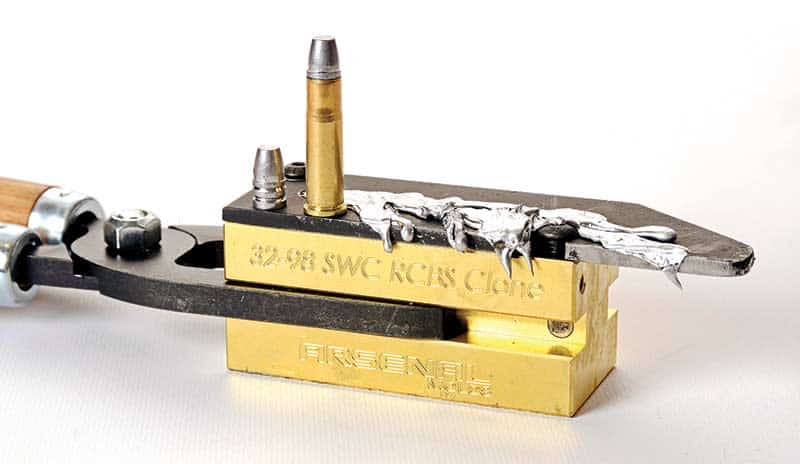
Duke got this four-cavity .32 caliber bullet mold from Arsenal Molds in Utah.
The Bug Strikes — Again
With enthusiasm building for .32-20s I just had to start looking at lever guns. I didn’t want original Winchester or Marlins unless I could examine their bores for condition, and unfortunately Montana’s gun shows have been curtailed severely by COVID-19 problems. So I turned to the Internet searching for Italian Winchester replicas. What I desired was a ’73 carbine because it would be lighter. Even on the Internet they weren’t all that plentiful.
One afternoon while Yvonne was in a store and I was sitting outside with my iPad, I located a few Cimarron .32-20 carbines and short rifles. Before my wife returned I had bought and paid for one. Only when it arrived did it dawn on me I had bought a short rifle instead of a saddle ring carbine. Short rifles are configured as normal length rifles but only have 20″ barrels. When I told Yvonne of my mistake she said, “Duke, sometimes I think you need constant adult supervision.”
Anyway, the Cimarron .32-20 also shoots fine. With the mentioned powder charges and bullets my 7-1/2″ Colt SAA gives about 850 fps and the 20″-barreled lever gun breaks 1,200 fps. I’m having great fun with both.
PS: I haven’t told Yvonne yet but I just ordered a Cimarron .32-20 saddle ring carbine. Shhh …
And this is why.
One of the earliest American nine-millimeter pistols was adopted for wartime service to take out enemy sentries… and barking dogs.
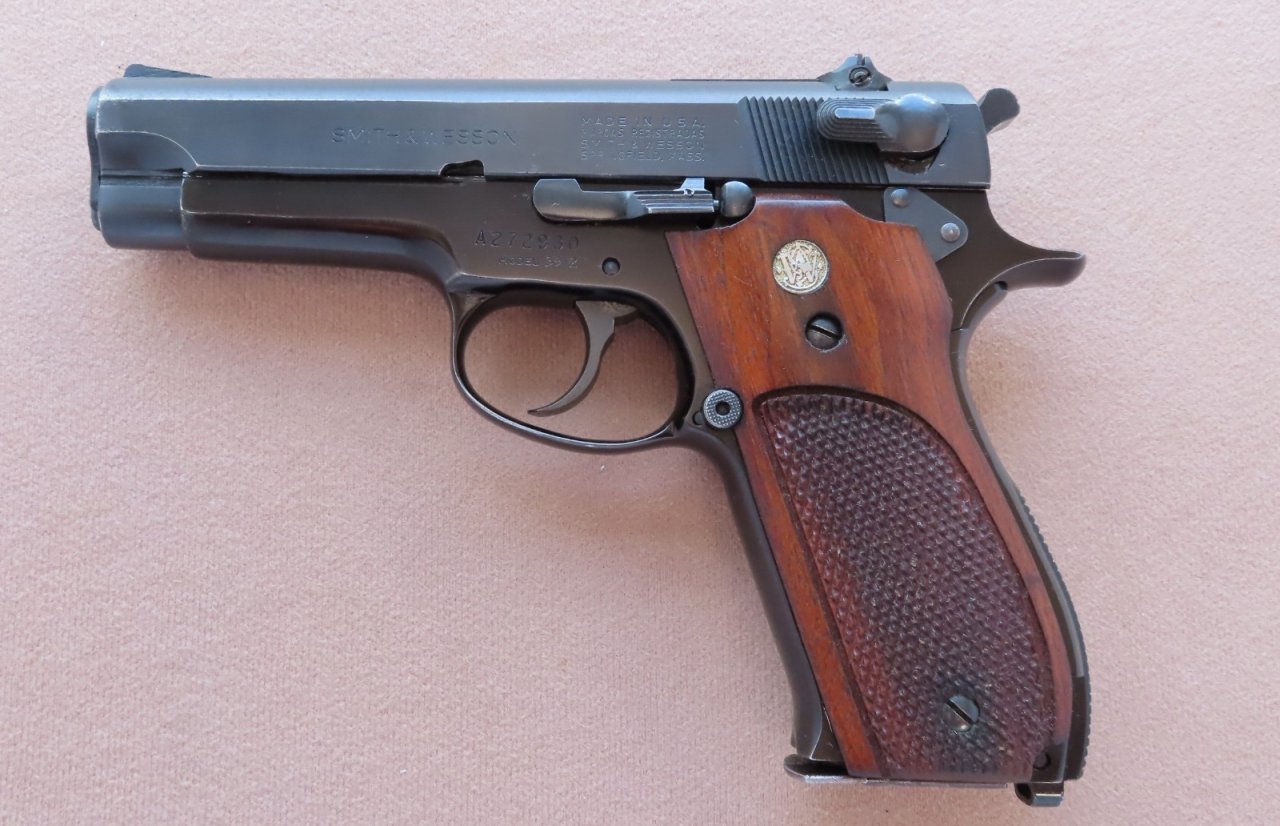
The Smith & Wesson Model 39 semi-automatic handgun served U.S. Navy SEALs during the Vietnam War and then went on to become one of the American nine-millimeter high capacity pistols, the Model 59.
The Smith & Wesson Model 39 had its roots in postwar America. U.S. troops, encountering the Walther P-38 on the battlefield, had a favorable impression of the German pistol. U.S. gunmaker Smith & Wesson decided to make an Americanized version of the P-38 for the domestic market, and borrowed heavily from Walther’s design. Internally, the Model 39 was very similar, to the point where magazines could almost be swapped between guns. Externally there were key differences, including a 1911-type full barrel slide removed with a twist of a barrel bushing. The Model 39 went on commercial sale in 1955.
The Model 39 was a double action pistol. It was 7.44 inches long and weighed just 26.5 ounces empty with a four-inch barrel. It was a recoil-operated handgun using a modified version of the Colt/Browning locking system used on handguns such as the 1911. Like the Walther P-38 the slim metal, single stack magazine held eight rounds of 9-millimeter Parabellum.
During the 1960s the CIA had experimented on a suppressor for the Walther P-38, a pistol which in the Agency’s opinion combined reliability, firepower, and a distinctive non-American lineage. The suppressor greatly reduced the Walther’s report, particularly when combined with a slide lock that prevented the slide to fly backward. The use of a slide lock turned the pistol into a single-shot weapon and caused dramatic wear and tear on the handgun’s components, but the result was a very quiet pistol.
As the Vietnam War ramped up U.S. Navy SEALS requested a new suppressed pistol. The Naval Ordnance Laboratory picked the Smith & Wesson Model 39 and proceeded to adapt the CIA’s P-38 suppressor to it, including slide lock. The pistol used a heavy, full metal jacket 158 grain round developed with the assistance of Remington Arms. The extra weight slowed the normally supersonic 9mm round to below the speed of sound, eliminating the sharp crack of a bullet exceeding Mach 1.
The pistol’s imminent issue to SEAL units required it to be able to work after being transported through water. Plastic seals and muzzle plugs could seal off the suppressor from water and prevent water from entering the pistol barrel. The waterproofing was sufficient to protect the gun up to 200 feet underwater, both with the suppressor installed and without. The gun could be fired without removing the muzzle protection, which was blown off as the bullet exited the barrel.
The resulting weapon was given the Navy designation 9mm Pistol Mark 22 Mod 0. The weapon could be used by SEALs to covertly take out sentries guarding an enemy-held village or enemy stronghold, or even dogs that threatened to bark and reveal a SEAL unit’s presence. The Mark 22 Mod 0 received the nickname “Hush Puppy” for this reason.
The Model 39/Mark 22 was used by SEAL units throughout the Vietnam War. As the war wound Smith & Wesson turned its attention to updating the Model 39. The company’s designers went back to the drawing board and widened the grip, adding one of the first double-stack magazines ever on an American handgun. This nearly doubled magazine capacity to 14 rounds.
While that may sound perfectly normal today, at the time six-round revolvers dominated the firearms scene and other semi-automatics carried a similar amount of rounds to the Model 39. The increased magazine size added only eight ounces to the weight of the pistol empty, in part due to the use of aluminum. The new pistol, called the Model 59, hit the U.S. domestic market in 1971.
The Odyssey of the Smith & Wesson Model 39/59, from its Germanic origins to the gun shops of America and the jungles of Vietnam, was unique and very much a product of the Cold War. Although out of production and no longer common, Smith & Wesson’s nine-millimeter handgun has earned a noteworthy place in American firearms history.
Kyle Mizokami is a writer based in San Francisco who has appeared in The Diplomat, Foreign Policy, War is Boring and The Daily Beast. In 2009 he co-founded the defense and security blog Japan Security Watch. You can follow him on Twitter: @KyleMizokami.