Story by Timothy Bella • 4h ago
Month: May 2023
Categories
P53 Enfield Turkey Shoot
Categories
“AT HOME WITH GUNS”
Categories
CALIFORNIA DREAMING By Aristophanes
“Best way to live in California is to be from somewhere else.”
— Cormac McCarthy, No Country for Old Men
The beacon of hope that used to be California is now a fading memory. Once the state symbolized the American Dream and prosperity, with classic cars cruising along Muscle Beach and Hollywood glamour drawing talent and beauty from everywhere: today it is a shadow of its former self, drowning in struggle and decline. As a native Californian, it breaks my heart to see my home state in such disrepair. In Texas I feel like a refugee from a country destroyed by some unimaginable disaster. The pain that I feel when I think about California’s current condition runs deep.
I grew up in the 90s in a small farming town in California’s central valley, with an economy built on peach orchards and a state university. Like many rural inland areas, our town was heavily white and conservative and struggled to cope with high taxes designed to support a large welfare class within the big cities. Those taxes enabled service industry workers to survive on low wages that couldn’t keep up with the high cost of living, but also fostered dependency.
In recent years, more people have been leaving California than arriving, a new trend for the Golden State, California has even lost a seat in the House of Representatives due to population decline, while Texas gained one. For my part, one reason I left the state almost a decade ago was because of the sense Californians were resigned to their fate. There was no fight left in the California Republican Party. Conservatives lacked either the influence or the will to wrest back control from the parasitic political consultant class who had captured the party and ran such unappealing candidates as Carly Fiorina and Meg Whitman. The party that had launched the political careers of popular candidates like Richard Nixon, Ronald Reagan, and Pete Wilson suddenly ran out of charismatic candidates. Attempts at governing through popular democracy were also stymied, with Prop 187 and Prop 8 both passing by strong margins only to be struck down later by federal judges. The last GOP majority in the state assembly was in 1994. I was just a kid back then, with no idea the golden age had come and gone.
Despite California’s decline, glimpses of its former glory can still be found. Streets, schools, and buildings in the Bay Area and Sacramento bear the names of war heroes like Dan Daly, and statues of some of the greatest Americans we’ve ever produced are tucked away in parks and streets of small-town California. Take what was once McClellan Air Force Base in Sacramento, now a business park. The Barracks have transformed into the Lions Gate Hotel, with the former Officer’s club serving as a bar, its walls adorned with pictures of the base’s history. The Squadron buildings are now cheap, asbestos-filled office space, occupied by homelessness NGOs that seem unable to do more than help the mentally ill and addicted subsist until they perish.
But just a few miles away, slumbering California can still be found. Away from the main urban arteries, American flags hang from homes, and carefully preserved classic cars are a common sight.
When I go back to California to visit the family I still have there, I’m moved by the memories of the best parts of my childhood. I’m lucky enough to remember the idyllic “old California.” Violent crimes were so rare that they were the talk of the town when they did happen. I remember 4th of July block parties, where we could still legally use our own fireworks. We would watch the massive fireworks show put on by the university and then produce one of our own. The whole street would assemble in front of a neighbor’s house, and everyone would take turns lighting off fountains and mortars for hours. Halloween enjoyed almost universal participation, and no one was afraid that it would be unsafe for kids to take to the streets in search of candy on their own. I walked to my elementary school, starting in first grade, with no fear of getting snatched up.
But in 2001, the old world came to an end for me, a little sooner than it did for most. My parents had been fighting and considering a trial separation for a few years, and my dad had fallen into a deep depression. He was prescribed the antidepressant Paxil, but 9/11 was the final nail in the coffin for him. The spark of optimism he still had preserved flickered out, and a month later he took his own life. Paxil would later face class action lawsuits over its role in driving depressed men like my dad to rock bottom. The California Dream ended for me that day, and ignited the rage I feel.
***
“They paved paradise and put up a parking lot.”
— Joni Mitchell, Big Yellow Taxi
No stretch of California evokes memories more vividly for me than the stretch of Highway 65 and Highway 70 from the northern edge of Sacramento to the mountain town of Paradise. In the summer the vast fields of haygrass resemble yarn spun from gold. Elkins Frosty, with its proud banner proclaiming the best (and only) burgers and shakes in town since 1976 recalls simpler times. Then, after the Oroville Dam, you reach the ill-fated town of Paradise.
Like many logging towns in the Northern California mountains, Paradise was devastated by the Sierra Club’s campaign to destroy the State’s logging industry in the name of conservation. With its primary industry gone, these towns sunk into economic decline. Most of the young people moved out, while drug use and petty crime increased. Eventually the economy consisted largely of retirees and the government, a situation now common to small towns across America following deindustrialization. Then, in 2018, the devastating “Camp Fire” wildfire burned Paradise to the ground, leaving only ashes and devastation in its wake.
My aunt and cousin, who had spent most of their lives in Paradise, lost their homes. Scores upon scores of homes were reduced to nothing more than concrete pads. But my great-grandmother survived. Her home was spared, and she returned as soon as she was allowed before recently passing away at the age of 92. It was her funeral that brought me back to Paradise and gave me a chance to see how the town was doing with its rebuilding efforts.
Despite the scars left by the Camp Fire, still visible on the trees that survived, Paradise has a feeling of new life to it. Slogans of solidarity and pride are scattered throughout the town: “Paradise: Rebuilding The Ridge,” “Paradise Strong,” and “Faith & Hope In Paradise.” Many of the buildings that were destroyed have been replaced with structures made of steel. There are new businesses everywhere, funded by fire insurance money and new investments. A charred metal Burger King sign without a building to go with it is all that remains of the many big corporate franchises that have yet to return. With the overgrowth swept away by the fire, enriching the soil, Paradise is an example of the cycle of destruction and rebirth that nature destines for all its creations.
***
“And home isn’t here and home isn’t there.”
— Deborah Landau, The Last Usable Hour
It is difficult to suppress the notion that the apathy towards the issues plaguing rural communities in California may be attributed to the disconnect between the political and financial power centers of the state and these areas. Over the past decade, the population of California saw a ten percent increase, with the majority of growth concentrated in urban areas. This influx has resulted in a class of urban parasites who have displaced native residents due to the growth of housing demand and have also imposed their own values and priorities upon these areas. The stereotype of the progressive middle-class “Californian” nobody wants to move into their red state was more than likely born in Pennsylvania or Ohio.
This new class has overrun the state, treating the residents as collateral damage in their search for upward mobility and acceptance within their adopted lifestyles. They have abandoned their roots, and in doing so, have turned a blind eye to the struggles of the folk that resembles their heartland kin. These problems, which closely mirror the struggles of their own families and hometowns, are now distant and insignificant to the political power that stems from the cities. As a result, there are no repercussions for neglecting to address them.
California today is at a crossroads. Will it be able to reclaim its former glory, or will it continue to decline? Time will tell. The once great state is now ravaged by poverty and corruption. The glamour of Hollywood and the prosperity of the gold rush and railroad seem like distant memories, preserved only in film. The pension obligations of its bureaucracy are in danger of going unfunded, while unions wield their power to prevent necessary changes. The Golden State is setting itself up for a catastrophic reckoning, but perhaps that is the only way it can be revived. Like an overgrown forest, California needs a firestorm to raze it, so that seeds of the future can be sown once again.
William Mason, chief engineer at Colt, came up with one of the grandest sixguns of all time, the 1873 Single Action Army. I’ve often maintained the SAA is so good Mason must’ve fallen asleep at the drawing board and some supernatural force drew up the plans in front of him as he slept.
Colt’s new sixgun was chambered in a new cartridge—the .45 Colt with a 255-grain bullet over 40 grains of black powder. Barrel length was 7-1/2″, it had a top strap and the grip frame was borrowed from the 1851 Navy. This was a very powerful pistol, and when I have duplicated the load with modern components in old-style brass, muzzle velocity is right at 900 fps.
The US Army did not only adopt this new revolver, but it also became a favorite among civilians. Colt would produce more than 350,000 Single Action Army revolvers from 1873 to 1940. Beginning in 1878 it was also chambered in the cartridges used by the Winchester 1873 levergun—first, the .44 Winchester Centerfire, then the .38 WCF, and the .32 WCF. During the course of production of what is now known as the 1st Generation Colts, these four cartridges were the most popular and in the order mentioned. More than 30 other chamberings were also offered.
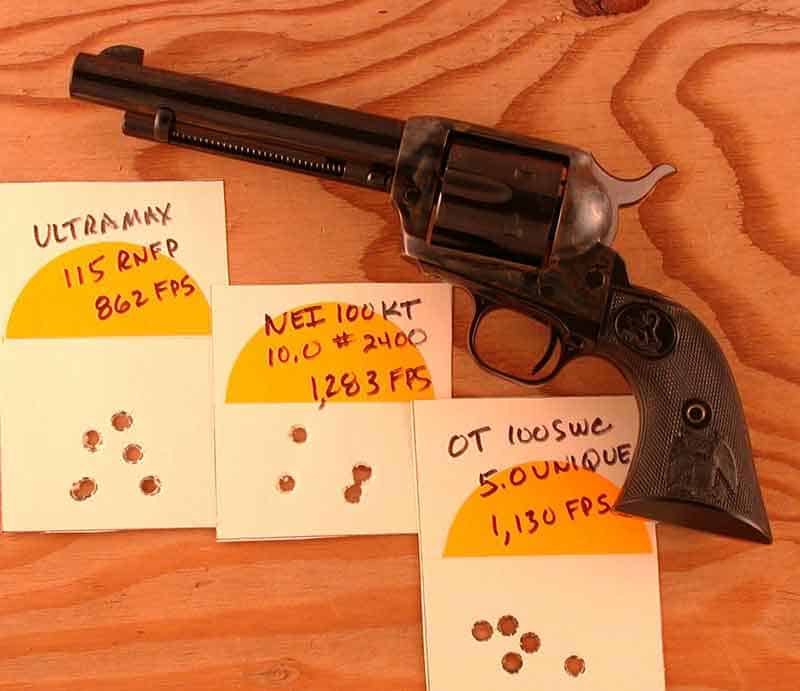
Light recoil makes for accurate, fun and easy shooting with the 5-1/2″ Colt SAA .32-20.
By 1940 demand for the Colt Peacemaker had dropped and the machinery was worn out, so Colt removed it from production. Thanks to the demand produced by old Westerns on the new medium of television in the early 1950s such a demand rose the first of the 2nd Generation Colts arrived in December 1955. This time production would last a much shorter period ending in 1974 when machinery was once again worn out.
This time the shutdown period was much shorter and the 3rd Generation Colts arrived in 1976. Since then, the Colt Single Action Army has followed a somewhat strange path sometimes offered as a production gun and other times from the custom shop. The bad news is quality has also been spotty, however, the great news is current Colt Single Action Army sixguns are of excellent quality with close attention paid to fit and finish. Colt has added new machinery and adopted the attitude of wanting to produce the finest Single Action possible. I’d say they’ve succeeded.
I received three test sample SAAs in the three standard barrel lengths of 4-3/4″, 5-1/2″, and 7-1/2″ in three different chamberings. Colt is currently offering the Single Action Army in .45 Colt, .357 Magnum, .38 Special and the three WCF chamberings. The latter three are now better known as .44-40, .38-40 and .32-20. It is my understanding these latter designations came about in the 1880s when Marlin wanted to chamber their rifles in these cartridges without using the name Winchester on their barrels.
Before we look at each of the three SAAs separately, a few general remarks are appropriate. All three are excellently finished with a beautiful deep blue and the breathtaking case hardened colors Colt has long been known for. Metal to metal fit is excellent with no overhanging edges such as where the triggerguard meets the bottom of the mainframe. The grips are the standard checkered rubber black eagles, and are also fitted exceptionally well with no sharp edges hanging over, and the ears of the top of the backstrap and the curve of the back of the hammer are also fitted very well.
I was especially impressed with the lockup of the cylinder. The bolt is fitted to the notches in the cylinder, the cylinder is fitted to the base pin, and the base pin is fitted to the frame so there is very little side-to-side or front to back movement of the cylinder. All three sixguns are very well timed. An old test to check for timing is to place light thumb pressure on the cylinder producing resistance as the hammer is cocked. If the timing is off the cylinder will not lock completely into battery. All three cylinders passed the test. These guns are put together right!

The .44-40
Let’s look at them individually starting with the shortest barrel length. The 4-3/4″, known as the Civilian Model in the 1800s, is in .44-40. Trigger pull on this one was set at 4-1/8 pounds, barrel/cylinder gap is .006″, and the cylinder throats are all a uniform .429″. There is a lot of variation found in Single Actions, both domestic and replicas chambered in .44-40. I have found some as tight as .426″ and my 2nd Generation Peacemaker Centennial Commemorative and early 3rd Generation are set at .427″ and .429″, respectively. As a bullet caster, I tailor bullets to fit particular sixguns and always keep loads on hand with bullets in both diameters.
Shooters, especially those not familiar with the traditional fixed sights found on Single Actions often ask, “Why can’t they sight in these guns for me at the factory?” They are asking the impossible, as there are so many variables. We all see and hold differently, point of impact will vary according to the load used, and even the lighting conditions will affect where the bullet strikes the target. Because of the latter, I never try to sight in a sixgun under indoor lighting. I have also noticed if you spend a lot of time shooting during the day, the point of impact will change slightly as the angle of the sun changes. If you’re really lucky a Single Action will shoot right to point of aim with the selected load right out of the box. Anyone this lucky should be buying lottery tickets.
Having said all this, the .44-40, in my hands using my eyes and my loads, shoots approximately 1″ to the right and 3/4″ low at 20 yards. Both of these are an easy fix thanks to my friend Denis Fletcher, a retired engineer, who is now a pretty good machinist. He made a barrel vise for me, which fits the trailer hitch on my Silverado. We have become experts at twisting barrels and it won’t take much to bring this one right into line and, once the load is selected, file just enough off the top of the front sight to bring point of aim in perfect alignment with point of impact.
I have pretty much standardized on 200- to 225-grain bullets for the .44-40 using 8.0 grains of either Unique or Universal or 8.5 grains of Power Pistol. In the relatively short-barreled .44-40 these loads are in the 850 to 900 fps category, making them adequately powerful while still very pleasant shooting.

The 21st Century Colt Single Actions include these models (above) representing the most common
barrel lengths of 7-1/2″ (.38-40), 5-1/2″ (.32-20), and 4-3/4″ (.44-40). The handiest barrel length
for the Colt Single Action is the 4-3/4″ (below), here in the very popular .44-40.

The .32-20
Next up is the 5-1/2″ .32-20. Trigger pull on this one is 4-3/4 pounds, barrel/cylinder gap is .005″, while the chamber throats are a uniform .313″. This one is dead on for windage and shoots about 1-1/2″ low so a few file strokes will bring it right to point of aim.
Two standard loadings for the .32-20 for decades has been 5.0 grains of Unique or 10.0 grains 2400. These loads put the .32-20 into the Magnum class and should not be approached lightly. (They are only for large-framed revolvers and never should be used in either the S&W M&P or the Colt Police Positive.) Both of these loads shot well with 100-grain cast bullets. Recoil in the relatively heavy Colt is extremely mild. This .32-20 would make an excellent varmint pistol, and no can or rock at a reasonable distance would stand a chance.
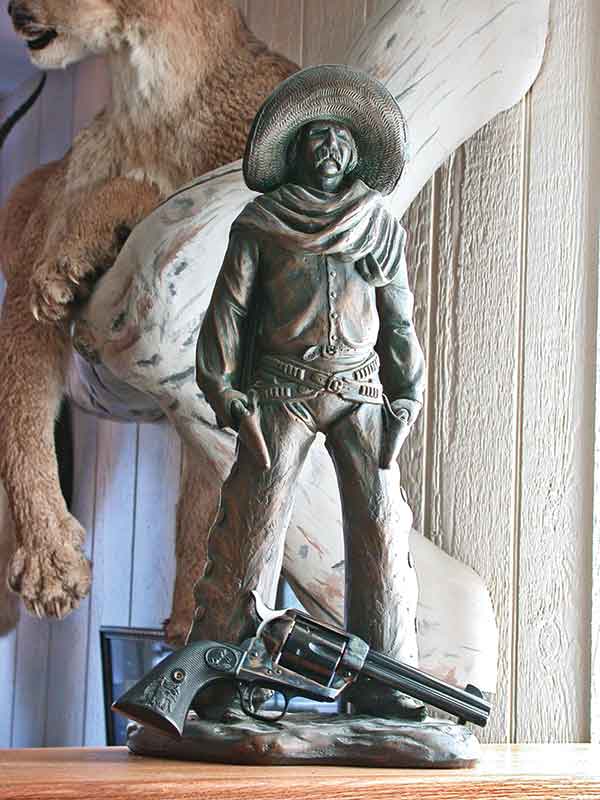
Colt first chambered the Single Action Army for .44 Winchester Centerfire in 1878.
More than 130 years later it is still around.
The .38-40
Finally we come to the 7-1/2″ .38-40. My first Colt, my first centerfire sixgun, was a .38-40 and it has been a favorite cartridge ever since. (OK, so I have many favorite cartridges.) This SAA has a trigger pull of 4-1/2 pounds, barrel/cylinder gap of .007″, and cylinder chamber throats are a uniform .399″. This one will definitely need a barrel tweaking as it shoots 2″ to the right for me and 3/4″ low.
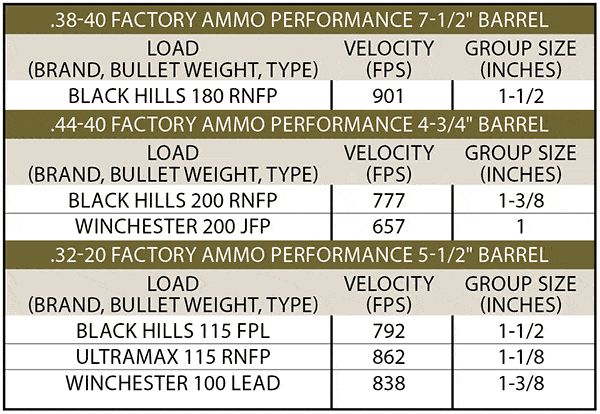
In a properly set up sixgun, the .38-40 is a very accurate cartridge. It got a bad rap in the early days simply because chamber throats and barrel diameters did not always match up very well. This is no longer the case. My standard load for the .38-40 is 8.0 grains of Universal or Unique under a 180-grain cast bullet. Muzzle velocities are in the 1,000 to 1,100 fps, again, resulting in a powerful but pleasant shooting load. All test results are in the accompanying chart and reveal what an excellent performer this Colt Single Action really is.
All three of these are test guns on loan, however, all three of them are not going back. I will definitely purchase one of them (there is no way the .38-40 will ever leave my hands), possibly two, and if finances are in line, all three. I can’t give them any finer recommendation than that.
Single Action Army
Maker: Colt Mfg. Co.
545 New Park Ave.
West Hartford, CT 06110
(860) 236-6311, www.coltsmfg.com
Action Type: Single Action
Caliber: .32-20, .38-40, .44-40 (tested) .45 Colt, .357 Magnum, .38 Special
Capacity: 6*
Barrel Length: 4-3/4″, 5-1/2″, 7-1/2″
Overall Length: 10-1/4″, 11″, 13″
Weight: 39 ounces (varies)
Finish: Blue/Case Hardened Frame, full nickel
Sights: Fixed
Grips: Checkered black eagle
Price: $1,290, $1,490 (nickel)
*For safety, this revolver must be carried with the hammer down on an empty chamber, reducing capacity to five.
Black Hills Ammunition
P.O. Box 3090, Rapid City, SD 57709
(605) 348-5150, www.black-hills.com
Walt Ostin of Custom Gun Leather
39-1260 Fisher Rd. RR 2
Cobble Hill, BC, VOR ILO Canada
(250) 743-9015
Conservatives hail Daniel Penny as ‘hero’ after killing man on subway


Conservatives hail Daniel Penny as ‘hero’ after killing man on subway© David Dee Delgado/Reuters
In the nearly two weeks since Daniel Penny was recorded killing Jordan Neely on a New York City subway with a minutes-long chokehold, the 24-year-old Marine Corps veteran has faced calls to be arrested, been denounced as a vigilante by activists and been labeled a “murderer” by Rep. Alexandria Ocasio-Cortez (D-N.Y.).
But in the lead-up to the Manhattan district attorney’s office charging him with second-degree manslaughter, Penny has found a groundswell of financial and online support from high-profile Republicans such as Florida Gov. Ron DeSantis, Fox News personalities and conservatives on Elon Musk’s Twitter. Many of them have rallied around Penny and hailed the veteran as a “hero” and “good Samaritan.”
“We stand with Good Samaritans like Daniel Penny,” DeSantis tweeted Friday night. “Let’s show this Marine … America’s got his back.”
“The Marine who stepped in to protect others is a hero,” tweeted Rep. Marjorie Taylor Greene (R-Ga.).
A legal-defense fund set up by Penny’s attorneys on a crowdfunding site that has hosted fundraisers for defendants in the Jan. 6, 2021, insurrection and Kyle Rittenhouse had raised more than $1 million as of Saturday afternoon. Most of the money has come from anonymous donors thanking him for what he did and agreeing with his lawyers’ statement that Penny never intended to harm Neely, 30.
The right-wing response to the case suggests that Republican lawmakers and pundits could make Penny into the latest conservative talking point.
In the process, conservatives and right-leaning media outlets have described Neely — a Black homeless man who authorities say was described by witnesses as acting in a “hostile and erratic manner” — as “unhinged” and with “a long history of violent crime.” The political right has seized on police statements that Neely had 44 previous arrests for offenses such as assault, disorderly conduct and fare evasion. (Authorities have not confirmed Neely’s record for The Washington Post.) Fox News host Greg Gutfeld said the manslaughter charge against Penny was “pro-criminal” and “anti-hero.”
Greene went one step further.
“Jordan Neely was a violent criminal who should have been behind bars,” she wrote on Twitter on May 6. Her tweet was liked by Musk, who also liked a Twitter poll from another user asking, “Did Jordan Neely deserve what happened to him?” (More than two-thirds of those who voted in the poll said, “Yes, he had it coming.”)
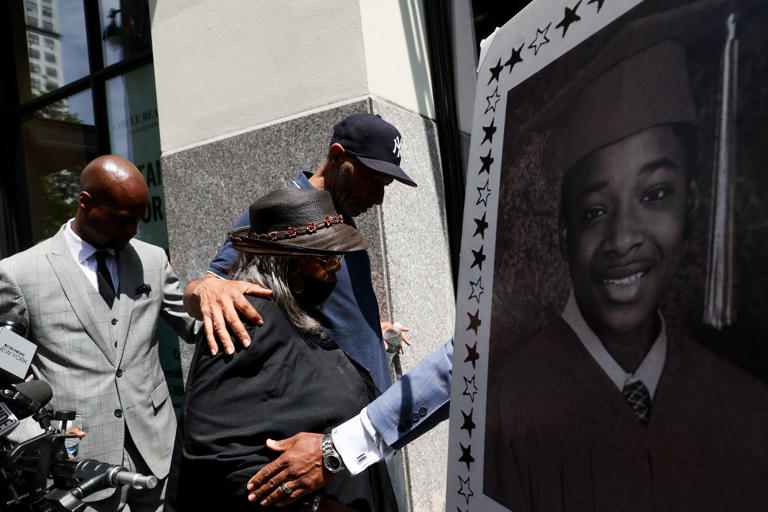
Andre Zachery and Mildred Mahazu, father and aunt of Jordan Neely, a man whose death has been ruled a homicide by the city’s medical examiner after being placed in a chokehold on a subway train by Daniel Penny, walk on the day of a news conference in New York City on Friday. (REUTERS/Brendan McDermid)© Brendan Mcdermid/Reuters
The political right’s embrace of Penny — whose New York voter registration in 2016 listed his party affiliation as “Conservative” — is an attempt to take the legal case against him out of the courtroom and onto television, social media and the fundraising circuit, experts told The Washington Post.
“Penny’s case has been injected into the bloodstream of partisan politics,” said Matt Dallek, a professor of political management at George Washington University. “A lot of conservatives can point to vigilantes like him and say, ‘They’re standing between us and the mob.’ It fits into a political narrative, and people like Penny are appropriated, whether they want to be or not.”
Steven M. Raiser, one of Penny’s attorneys, did not immediately respond to a request for comment Saturday regarding the right-wing support his client has received.
Daniel Penny charged with manslaughter in Jordan Neely’s subway chokehold death
Penny, of Long Island, was arraigned Friday on a charge of second-degree manslaughter and was released on a $100,000 cash bond. His next court appearance is scheduled for July 17. If convicted, Penny could face five to 15 years in prison.
“Jordan Neely should still be alive today, and my thoughts continue to be with his family and loved ones as they mourn his loss during this extremely painful time,” Manhattan District Attorney Alvin Bragg (D) said in a statement.
The Neely family’s attorneys said they are seeking a grand jury indictment, telling reporters that Penny “didn’t care about Jordan” when he placed him in the fatal chokehold. Penny’s attorneys have argued that their client acted in self-defense and “could not have foreseen [Neely’s] untimely death.”
The conservative response to Penny’s actions has drawn comparisons to Rittenhouse, who was acquitted on all charges after killing two people and wounding a third during unrest related to a police shooting in Kenosha, Wis., in 2020, said Jon Marshall, an associate professor at Northwestern University’s Medill School of Journalism who has studied the relationship between presidents and the press. Rittenhouse has been championed by conservatives, with Turning Point USA founder Charlie Kirk and others calling him a “hero.”
“What we’re seeing now for Daniel Penny after he killed Jordan Neely is that he fits within a long, ugly history of some media and politicians glorifying vigilante violence,” Marshall said. “There’s a history of the ‘us vs. them’ narrative, and the ‘us’ is besieged and under great threat, and that’s what justifies these acts of great violence.”
Experts say it’s a narrative among conservatives that has helped fuel the online fundraiser for Penny’s legal-defense fund. Penny’s attorneys set up the fundraiser on GiveSendGo, a Christian crowdfunding site created after the site GoFundMe removed far-right campaigns that went against its terms of service. GiveSendGo has hosted campaigns for Rittenhouse, Capitol riot defendants and the “Freedom Convoy” — a group of truckers in Ottawa in 2022 that protested a rule requiring cross-border drivers to be vaccinated.
When Penny was charged with manslaughter on Friday, the campaign raised about $600,000 on that day alone, Jacob Wells, the CEO and co-founder of GiveSendGo, told The Post. Donors are giving an average of about $700 per minute to the fundraiser, he added. Rittenhouse’s campaign raised about $630,000 between August and November 2020, Wells said, and the convoy campaign’s record campaign raised nearly $10 million.
Penny’s $1 million crowdfunding campaign is already among the highest totals in the history of GiveSendGo.
“Daniel Penny and his legal team came to GiveSendGo first because they know, as a platform, we stand for people’s right to a fair and due trial,” Wells said. “I think it’s appropriate in this moment in time when social media is amplifying people’s voices significantly, it’s all the more reason why defendants need access to a rigorous defense and funds to afford that rigorous defense.”
At least 20 donors had given $1,000 or more to Penny’s GiveSendGo campaign as of Saturday afternoon.
“Thank you for protecting the citizens that day,” wrote an anonymous donor who gave $10,000, the largest single donation.
Another anonymous high-dollar donor wrote that Penny “had the bravery to stand up and do the right thing,” adding of Neely’s death: “No tears for the [man] who died.”
The financial support Penny’s legal team has received is due, in part, to the coverage of right-leaning media outlets and Republican politicians using his case to score points on the latest front of the culture war, experts say.
The beginning of the conservative media response to Neely’s death and Penny, whose name was not immediately known to the public, came when the New York Post described Neely as “unhinged” in its first story on the May 1 killing. It continued during Fox host Sean Hannity’s show on May 4, when the Fox News host described Neely as “a mentally ill homeless guy with a long history of violent crime.” After saying the Marine Corps veteran had “subdued” Neely, a member of Hannity’s audience exclaimed, “Woo!”
When police said Penny, who is White, was initially taken in for questioning and released without charges, protesters filled the subway system and demanded that the man who killed Neely be arrested. Kayleigh McEnany, a White House press secretary in the Trump administration who is now a Fox News host, scoffed at the protesters’ chants for justice, saying on May 5, “Well, at least they have rhythm.” Her co-hosts laughed off-screen.
Other conservative outlets such as One America News have had segments asking whether Penny “should be prosecuted or honored.” The Wall Street Journal’s conservative-leaning editorial board made the case against charging Penny, describing him in a Friday headline as “the Subway Samaritan.” Rep. Matt Gaetz (R-Fla.) gave Penny a similar nickname — “Subway Superman” — on former president Donald Trump’s Truth Social platform.
Marshall, the Northwestern professor, noted that Penny’s case pointed to a history in which U.S. politicians have used crime and fear of crime to their own advantage, capitalizing on moments of division to strike a chord with their bases. Experts cited Trump as a recent example. They also emphasized how DeSantis, who is expected to seek the 2024 Republican nomination for president, exemplified this practice when he tweeted his support of Penny, saying the country must “take back the streets for law-abiding citizens.”
“Politicians speak about them and promote them long before the cases go to trial,” Marshall said. “In a prior generation, it would have taken weeks to build up to this point. Now, it can build up to this point in a matter of minutes, and people can jump to conclusions quickly and can make assumptions before the facts are known.”
On Twitter, Musk’s paid verification program has boosted the reach of conservative and far-right voices, which have called for Penny to be given a medal and said the manslaughter charge amounted to “a travesty.” Musk has called protests of Neely’s killing “disingenuous,” and he liked a tweet calling Neely “worthless.”
Experts agree that the emotionally charged atmosphere surrounding Penny’s case will persist into the summer.
“It’s a drumbeat that has begun,” Dallek said. “The dynamic that suggests that Penny is a victim of some sort of injustice and being unfairly persecuted, those cries will only grow in volume.”
___________________________________________________ But then its from the The Washington Post. So what can I tell you?Grumpy
Categories
MATURE MAN’S RIFLE
Categories
SWITZERLAND WILL NEVER BE CONQUERED IN WAR
SWITZERLAND WILL NEVER BE CONQUERED IN WAR
 OTTO THEUDORICUS

Switzerland is in a unique position in Europe. It is landlocked and borders three potential big players in an all-out war. Besides its neutrality, which would by no means guarantee protection from an invasion (e.g., Netherlands in WW2), there are many practical reasons why this small country can offer shelter and safety from an armed conflict even if the country were to be invaded.

It has a small but highly trained military
The Swiss army is made up of 21,000 active personnel and another 150,000 in reserve. National service is mandatory for every able-bodied male citizen, making just about every man in the country having a basic level of combat training and the ability to use a firearm. At age 35 you become part of the reserve and the government issued assault rifle is given to you. The idea behind your assault rifle being so readily accessible is for the scenario where in the event of war each civilian becomes a soldier almost immediately, making mobilisation very fast and efficient.

The Stgw 57. Although no longer in production or used by the army this assault rifle is widely owned privately.
An armed population
Gun ownership is extremely high. Unlike most other countries in Europe, the Swiss government encourages an armed populous and requires active personnel to store their assault rifle at home and, up until 2008, even store live ammunition. Over 600,000 citizens belong to shooting clubs, including children.
The population of Switzerland stands at around 8.2 million, of this 2.7 million are male aged between 15 and 64. With 3.4 million guns this makes for an impressive force for an invading army to face.
However, with globalism and the cancer that it is spreading to all corners of the planet, gun rights are being eroded and limitations are slowly being implemented. In just 20 years, the militia has shrunk from 600,000 to less than 200,000. Every time there is a shooting, the subject resurfaces and there is a knee-jerk reaction of some who want a total gun ban. With guns so deep rooted into Swiss culture, every referendum so far has failed, but small changes have been made. This being said, crime is very low and the high number of guns does not correlate with the number of homicides, as the left loves to claim.

Natural borders
Geography
The entire southern border is made up of the Alpine mountain range, with most of the highest peaks concentrated in this region and forming the natural divide between Switzerland and Italy. An invading army would simply not be able to enter through this formidable obstacle with heavily armed defenders on every cliff edge.
Yes, Napoleon marched his Grand armee up and through the St Bernard pass but there was no opposition to hamper his progress.
The Northwestern border is also protected by mountains, much smaller but still a logistical headache for an invader. Along the North and East, you have the Rhine river and lake Constance, so this leaves very few flat entry points. The only realistic routes are in and around Geneva and Basal, but even these are quite narrow and would bottleneck the invaders. Monumental efforts would be needed to either navigate through mountain passes or cross large rivers and lakes.

Disguised bunkers like this are dotted all across the mountains
Eventually, a well-equipped and determined army would probably breach the border in combination of full frontal attacks in the urban areas mentioned above and amphibious assaults across the Rhine. This would only be the start however as Swiss militia and regulars retreat into their natural defenses, trying to flush them out will be nearly impossible short of dropping nuclear weapons.
This would eventually descend into guerrilla warfare which could last for years. It is unlikely that the occupiers could be pushed out and defeated without some kind of foreign intervention depending on the belligerents involved. For example, Italy and Austria would not stand a chance of even invading in the first place due to the Alps. France and Germany would also have a hard time but would probably be able to invade and hold at least part of the country.
Individual nations invading is very unlikely, though the EU could turn tyrannical and mount an invasion. Russia would be a distant second and I don’t see any other foreign powers capable of reaching Switzerland to invade.
A well-built fallout infrastructure
There are enough nuclear fallout bunkers to shelter the entire population. Regulations since 1963 made it compulsory for every new building to have such shelters
If Switzerland is left alone and the war takes place just outside its borders but involves nuclear weapons, the large mountains will offer good protection from such strikes. Large cities are the primary targets of nuclear attacks, so if we look at which cities are the closest to Switzerland, this can help to work out where the safest place would be.
If we assume the worst case scenario and a 50 megaton warhead is dropped, Paris, Berlin, and London are all far enough away to escape the blast and even the thermal radiation. Therefore the safest places are the towns and villages directly behind mountains deep within the Alpine regions away from the borders, mainly the South and Central parts.

Conclusion
Entering Switzerland now is very easy since it is a part of Schengen and one can literally walk across the border with seldom checks at crossing points that are actually manned. For those who think all-out war is just not going to happen, don’t be surprised when it does, especially with the polarisation we’re currently seeing. At best there will be armed insurrections across Europe, which will be mostly isolated but numerous and could easily escalate. Worst case is of nuclear bombs leveling the entire continent. Either way I predict most survivors will find themselves in Switzerland.
Read Next: 10 Reasons Why Switzerland May Be The Best Country In The World
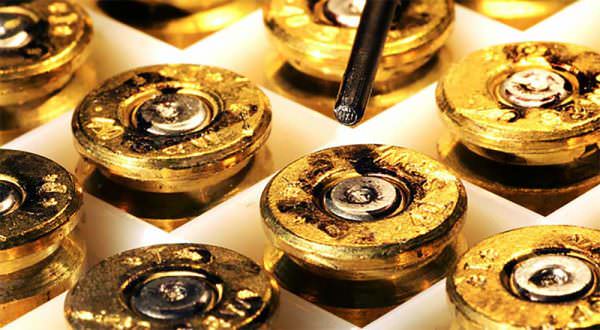
Proposed Pennsylvania House Bill 586, introduced on March 20, 2023, proposes significant changes to ammunition regulations that would impact law-abiding gun owners in the state. The bill, which was introduced by 12 state Democrats, including prime sponsor Representative Stephen Kinsey, seeks to give the Commissioner of Pennsylvania State Police and the Secretary of Revenue the power to enforce the new rules and collect a tax on ammunition to fund the changes.
Encoded Ammo Database, Pennsylvania House Bill 586
The bill would create an “encoded ammunition database,” which would contain comprehensive records of all ammunition sold or purchased, including details from the manufacturer, seller, and purchaser. The National Shooting Sports Foundation (NSSF), the trade organization for the shooting sports industry, has raised concerns about exactly this type of database in a recent Bullet Serialization Fact Sheet [embeded below], noting that it could have negative implications for public safety and law enforcement.
The bill has several provisions, including a requirement that all ammunition sold in Pennsylvania must be encoded with multiple serial numbers. This means that a manufacturer must add individual serial numbers to all ammunition provided for retail sale in a manner yet to be established by the Pennsylvania State Police commissioner. Each bullet would have a unique serial number located at its base, inside the cartridge casing, and outside the box of ammunition.
In a related article that alerted us to this crazy bill, Riley Bowman, Vice President of ConcealedCarry.com pointed out that this could pose significant challenges for producers and negatively impact ammunition produced for law enforcement, even though they are exempt from this bill. He noted that ammo producers are already struggling to keep up with demand, and the time required to produce a single round of ammunition could increase from seconds to minutes.
The bill also requires anyone who possesses non-encoded ammunition to dispose of it by January 1, 2024. Is what they are proposing that millions and millions of rounds of ammunition be shot in less than a year by Pennsylvania gun owners?
Reloading Ammo Would Be Dead
It fails to mention how this would impact hand-loaded ammunition. How would hobby reloaders even accomplish the serialization and eventual reporting of that data to the state? The bill ignores other issues, such as recycled brass or collected casings.
Manufacturing & Purchasing Headaches
Additionally, all ammunition manufacturers would be required to provide their name and address, the serial numbers found on every bullet, casing, and box, and any other information that the commissioner deems necessary. The purchaser would be required to provide detailed personal information to the seller, including the date of purchase, the purchaser’s name, date of birth, driver’s license number, or other number issued by the federal government or state of Pennsylvania, and the serial numbers of all ammunition bought by the purchaser. The retailer would then be required to provide this information to the commissioner for the encoded ammunition database and maintain a copy of all records submitted for at least three years.
5 Cents Per Round Tax!?
The Firearms Policy Coalition called it Ammunition Registration. FPC noted that: “… the bill requires that a “tax of five cents per round of ammunition …imposed on the sale at retail or use of encoded ammunition in this Commonwealth.” What’s the tax for, you ask? Believe it or not, that money would go towards funding a police-run ammunition database. FPC sees this for what it is.”
The bill outlines punishments for potential violators, including a misdemeanor charge for sellers who do not provide the required information and a misdemeanor charge for individuals who intentionally destroy or render unreadable the encoded information on ammunition. Manufacturers who violate the bill’s provisions would be subject to a civil fine imposed by the commissioner.
While the bill’s proponents claim that it would help law enforcement, opponents argue that it would hurt their ability to obtain ammunition for defensive use and training. It could also negatively affect law enforcement officer performance and safety.
The bill poses a significant threat to the right to keep and bear arms in Pennsylvania. The cost of producing serialized ammunition using unproven technology is guaranteed to raise the price of ammunition far above what most people can afford. This could fundamentally strip away the right to self-defense from everyone except for the most wealthy among us.
Nationally, ammunition serialization has received a lot of attention in the past, with versions of the “Ammunition Accountability Act” appearing in 18 state legislatures in 2008. However, none of these bills passed.
Pennsylvania House Bill 586 proposes significant changes to ammunition regulations that will negatively impact law-abiding gun owners in the state. The bill’s provisions, including the requirement for serialized ammunition, the creation of an encoded ammunition database, and increased responsibilities and punishments for manufacturers, sellers, and purchasers, will lead to increased costs, decreased availability of ammunition, and potential legal consequences for innocent individuals.
The bill’s supporters and sponsors argue that it would make it easier to track down criminals and prevent them from obtaining ammunition. Still, gun owners know the real purpose behind this legislative nightmare is to add additional burdens on lawful gun owners while failing to address actual ways of reducing crime rates. As the bill moves through the legislative process, it is likely to face significant debate and scrutiny from both sides of the political spectrum. Ultimately, it will be up to you to let your Pennsylvania lawmakers know how you feel about ammunition registration, so act now.
Bullet Serialization Fact Sheet ~ National Shooting Sports Foundation