Month: April 2023
Categories
The Round That Won The West
Categories
Long Branch Colt
Categories
Well I thought they were funny!






Categories
Grease Guns anyone?

I was very lucky to shoot one of these at NTC back before my Unit had to do a final turn it. Frankly I was mighty reluctant to hand it back after shooting a magazine of 45 ACP. In that it had a fairly slow rate of fire but that made it a lot more accurate for me at least.
Frankly I liked it a lot better than my M-16 and the Thompson that I shot later at Vegas. I can now see why my Dad liked his when he was in Korea. Grumpy
 Mayor Karen Bass said she wants to boost hiring at the Los Angeles Police Department, which has lost hundreds of officers in the past three years. (Carolyn Cole / Los Angeles Times)
Ten years ago, the Los Angeles Police Department celebrated a historic hiring milestone, announcing the city had reached a target sought by at least two mayors and multiple police chiefs: 10,000 officers.
That achievement was the culmination of an expensive seven-year campaign waged by then-Mayor Antonio Villaraigosa, much of it during a global recession that ravaged the city’s finances.
Now, within a three-year span, those gains have been erased. The LAPD is hemorrhaging officers, with more leaving the force than are joining it. Police Chief Michel Moore reported last week that sworn staffing had fallen to 9,103, down nearly 1,000 from 2019, the year that preceded the outbreak of COVID-19.
Mayor Karen Bass is looking to confront the issue head on by ramping up hiring and lifting barriers to recruitment. Her proposed budget, which will be released Tuesday, will call for the city to restore the department to 9,500 officers — an extremely tall order, given the ongoing staff exodus.
“I know that that is ambitious, but I think it needs to happen.” she said.
Bass will release her proposed budget, her first since taking office in December, amid a growing number of departures from the LAPD, not just by those nearing retirement age but also some of the department’s much newer officers.
In an interview, Bass said she fears the accidental release of photographs of LAPD officers, recently provided by the department in response to a public records request, could accelerate the outflow. If the city fails to fix its recruitment and retention problems, the LAPD could easily fall below 9,000 officers in the coming months, Bass said.
The call to rebuild the LAPD will almost certainly generate pushback from groups such as La Defensa, which advocates for alternatives to prisons and policing. Ivette Alé-Ferlito, the group’s executive director, said the city should take advantage of the drop in police staffing, by expanding the number of unarmed specialists who respond to residents experiencing mental health crises or other emergencies — and ensuring those workers are compensated at levels typically reserved for police.
“This is an opportunity to be able to start investments into alternatives to law enforcement responses,” Alé-Ferlito said.
A spokesperson for the Los Angeles Police Protective League, which represents rank-and-file officers, said his group welcomes the mayor’s efforts to “rebuild the LAPD after years of neglect.”
“This staffing decline didn’t start with Mayor Bass,” union spokesperson Tom Saggau said. “But we hope it ends with Mayor Bass.”

On paper, Bass is proposing what looks like a minor adjustment to the LAPD’s authorized staffing. For nearly a year, the department has been budgeted for 9,460 officers, the amount approved by the City Council. Bass’ hiring target represents an increase of 40.
On another level, however, getting to 9,500 would be an incredibly tall order. The department is expected to lose about 600 officers in the coming year due to retirements and resignations. To reach Bass’ target, the LAPD would need to hire 1,000 officers over the next fiscal year, at a time when Police Academy classes are frequently half or two-thirds full.
Bass acknowledged the difficulty, saying she’s “not super confident” the LAPD will reach her goal.
“But I think it’s very important to set that as a marker — very important,” she said. “There’s no way I would say, ‘I want to get to 9,200.’ Again, because I’m really worried about further attrition.”
Bass will send her budget proposal to a council that is ideologically further left, and more skeptical of police, than it was when she launched her campaign in 2021. Two of the council’s newest members, Hugo Soto-Martinez and Eunisses Hernandez, argued against police hiring during their campaigns.
A third, Councilmember Nithya Raman, ran in 2020 on a platform that called for transforming the LAPD into a “much smaller, specialized armed force.”
Hernandez said Friday she wants police staffing to continue on its downward trajectory. She and Soto-Martinez said they want money that goes unspent on LAPD staffing to be shifted into social services.
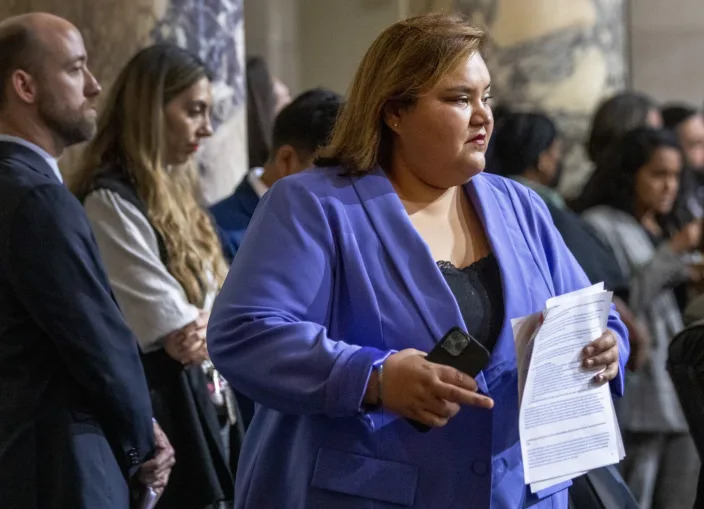
“Our priority is to invest that money in programs that address some of the most common 911 calls, like homelessness, mental health and drug treatment, so we can alleviate the burden on police officers and improve public safety for the community,” Soto-Martinez said.
With the LAPD struggling to recruit, Raman is also making the case for expanded social services, such as after-school programs. “These programs are often easier to hire for, and are proven to make communities safer,” she said Sunday on Twitter.
The LAPD is not the only big-city law enforcement agency facing a shrinking workforce. According to FBI data, police department ranks in New York City and Philadelphia have decreased 8% and 9%, respectively, since 2019, while Chicago experienced an 11% drop.
That phenomenon can be traced, in part, to a shrinking labor pool and growing public scrutiny after a spate of high-profile police killings, said Niles R. Wilson, senior director of law enforcement initiatives for the Center for Policing Equity, which studies ways to reduce racism in policing. Many big-city agencies are losing officers to smaller, suburban departments that offer better pay and fewer risks, he said.
Wilson said younger people are less likely to go into a profession with longer hours and a high risk of injury. At the same time, he said, cities have begun sending mental health teams or other unarmed responders to calls once fielded by police.
“I think you’re going to start seeing [police] staffing levels are going to adjust, as jurisdictions start to adopt more alternative response models,” Wilson said.
In Los Angeles, Bass has begun moving in that direction, opening an office of community safety that does not involve police. Meanwhile, the LAPD has responded to the decrease in staffing by scaling back key operations.
The department has closed front desks at the vast majority of its police stations during nighttime hours and reduced the size of specialized units, such as those that pursue fugitives and investigate human trafficking, Moore said. The LAPD’s cold-case teams, which investigate unsolved murders, are staffed by reserve officers, he said.
“We’ve protected the uniformed patrol officers” who head out into neighborhoods, Moore said. “But we’ve downsized narcotics units in every area. We’ve downsized vice units in every area.”
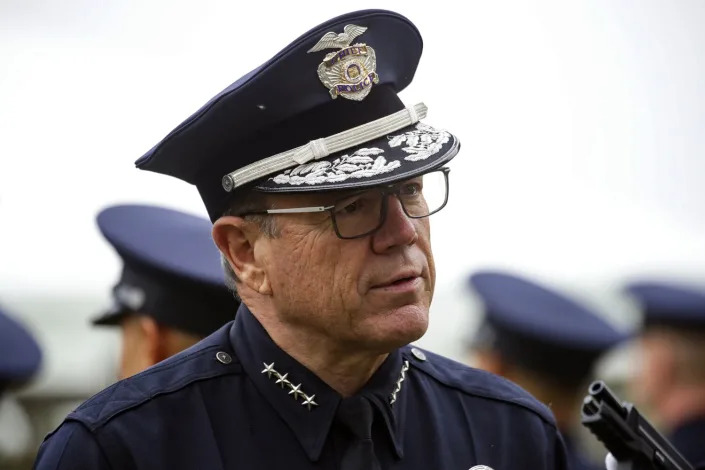
The debate over police spending has been further complicated by a recent drop in crime. Homicides in L.A. were down 26% through April 1, compared with the same period last year. Robberies have declined 19% over the same time frame, while violent crime is down nearly 12%, according to department figures.
Raman recently highlighted the downward trend on social media. Moore, asked about those numbers, countered by saying crime has increased in many categories compared with 2019, the last pre-pandemic year.
Compared with four years ago, homicides are up 8% this year, while the number of shooting victims has climbed 30% and the number of vehicle thefts by 47%, LAPD figures show.
The Police Protective League, which is in contract talks with Bass and other city leaders, has argued in recent weeks that the city is not doing enough to persuade officers to stay. Union leaders said officers are experiencing low morale caused by rising anti-police sentiment, insufficient pay and difficult working conditions created by staffing shortages.
Saggau, the union spokesperson, said officers assigned to 10- or 12-hour days are regularly being ordered to work two to four additional overtime hours to meet minimum patrol levels, leaving them exhausted. Officers who specialize in gangs, narcotics or other subject areas are being pulled away from those duties to ensure that minimum patrol levels are maintained, Saggau said.
Moore said he attributes the rising number of departures to the “turmoil” of the last three years — COVID-19 and growing anti-police sentiment following the murder of George Floyd in Minneapolis. Some foes of policing have threatened officers on social media, he said.
Officers “are looking around the country and saying, ‘Wow, I could go someplace else and get a hiring bonus of 10, 20, 30, 40, 50 thousand dollars,'” Moore said.
Desperate to hire officers, city officials are looking to provide signing bonuses of $15,000 to $20,000 to new hires — a proposal heading to the City Council. The department has stepped up recruiting at historically Black colleges and East Coast universities. LAPD brass are looking at resurrecting the “bounce program,” which allows the chief to bring retired officers back for up to a year, in hopes of luring back as many as 200 retired cops.
The drop in LAPD staffing can be traced to 2020, the year City Hall was buffeted by a major budget crisis — one triggered by COVID-19 shutdowns — and massive street protests over Floyd’s murder. Demonstrators were demanding that city funds be shifted away from police and into social services.
Mayor Eric Garcetti and the council agreed to cut LAPD staffing to about 9,750, freeing up about $26 million. In the period that followed, the department kept shrinking, with officers leaving in larger-than-expected numbers.
Near the end of his term, Garcetti argued for a force of more than 9,700. Council members adopted what they said was a more achievable goal: 9,460 officers by June 30, the end of this fiscal year.
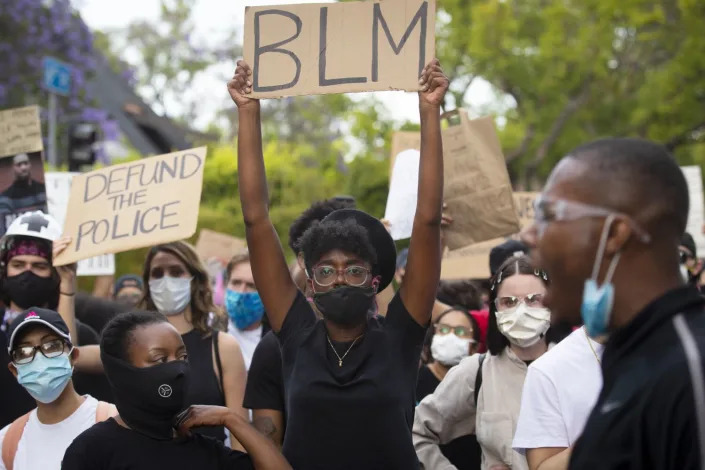
Those numbers also turned out to be unrealistic, with the department now more than 350 officers below the council’s goal.
While running for mayor, Bass promised to take the department back up to 9,700. She said she picked that number because it was the amount already authorized in the city budget.
Bass said she plans to spend the coming year determining the number of officers needed at the LAPD. Moore, for his part, said he would be satisfied with a return to 10,000.
“If we could have the workforce we had pre-pandemic, I think that we’d have a safer city,” he said
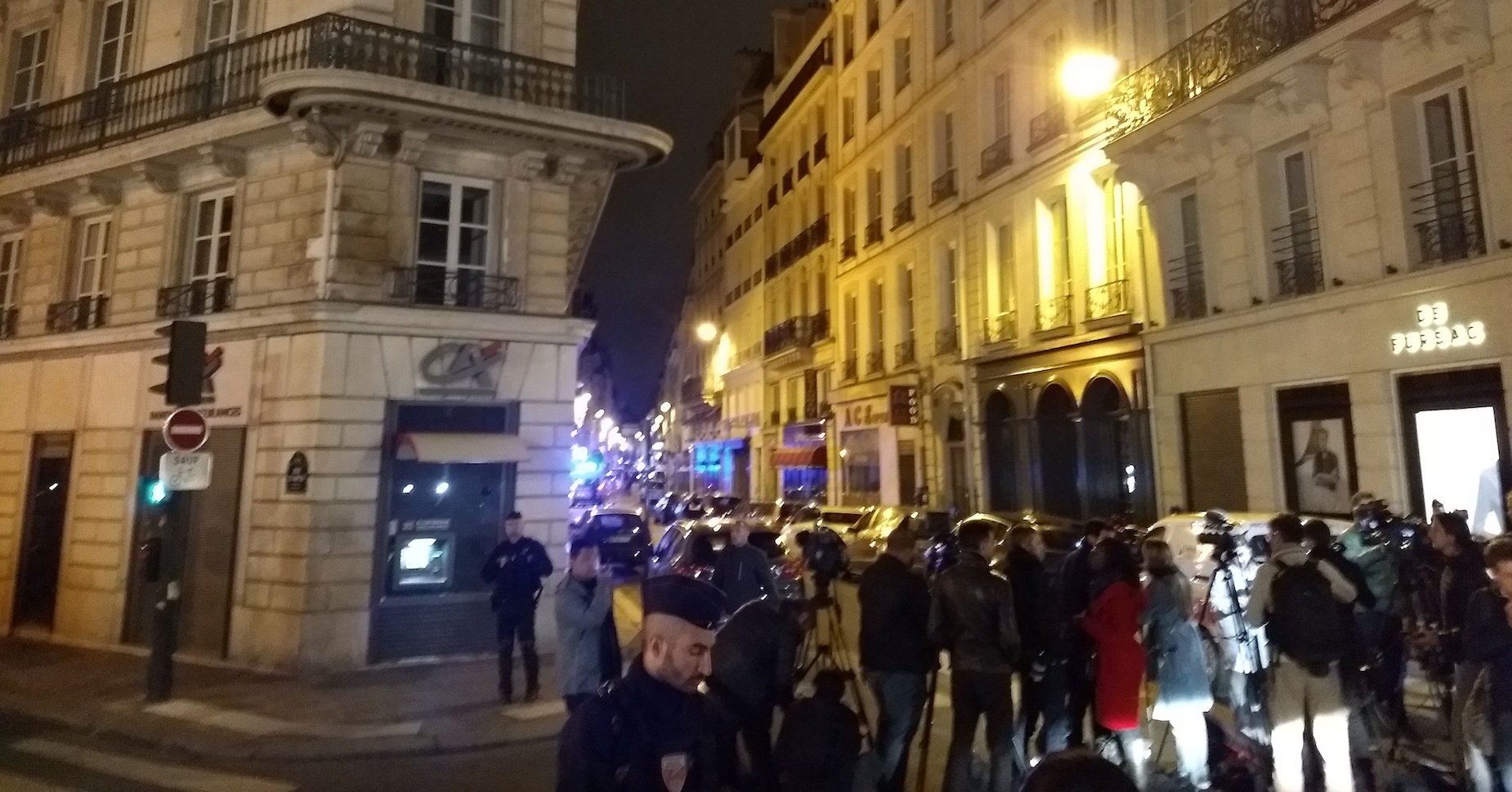
The scene after a terrorist knife attack in Paris, France on May 12, 2018
We all hear statistics regarding active shooter incidents. I would be surprised if the phrase ‘active shooter’ is not already in the urban dictionary. Well, that’s certainly not the complete picture. How many single- or multi-casualty incidents do not involve firearms? What about vehicles used as battering rams? Perhaps our terminology would be more accurately “Active Assailant.”
Although I must admit that I have not seen any current assessments of objective data collected regarding the use of edged weapons in such attacks, I believe that the use of edged weapons as primary weapons is on the rise.
Certainly, the ability of virtually anyone to acquire an edged weapon legally or casually is without restriction, save for those incarcerated – although that does not deter creative and motivated minds from making a shiv out of basically anything.
We carry edged weapons on and off duty (what is your agency’s edged weapons policy?), at home, and everywhere else. We train on handgun retention, but what about retaining that large handled push knife on your duty belt?
We have all heard the “21-Foot Rule.” It is more of an illustration of action vs. reaction and how quickly things can go wrong. Unfortunately, this was distorted into an absolute.
Nearly every agency has a box of knives confiscated during subject contacts. Having no evidentiary value, they end up in the ‘knife box.’ Some of those things are testaments to what you can create with duct tape and something sharp.
Several videos have recently shown officers utilizing Tasers or other less lethal force against subjects with edged weapons. Many of those suspects were much closer than 21 feet.
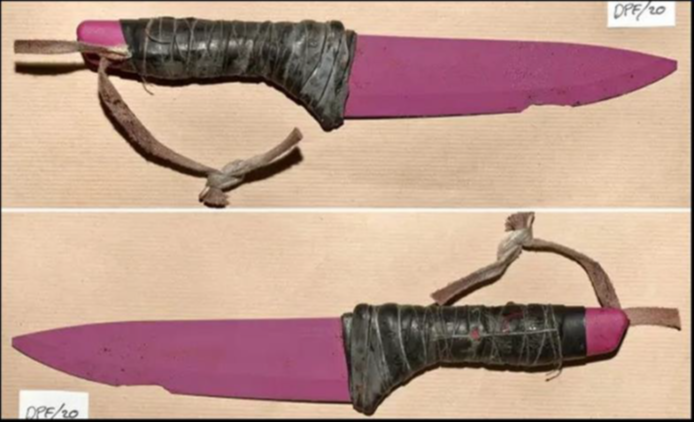
The ceramic knives used in the Paris attacks
I have several concerns, not the least of which is a growing trend for officers hesitating to appropriately use deadly force, fearing their agency will not fully back them, or just not wanting to be the next media target.

The meat cleaver used in the terrorist attack on the Carlie Hebdo magazine office.
Terrorists and the Use of Edged Weapons
Propaganda from several terrorist organizations has encouraged the use of readily available edged weapons, as they can often have fewer visible indicators, along with a reduced time of detection and disruption.
The October 2020 publication of the pro-ISIS ‘The Voice of Hind’ by the Jund al-Khilafah urges using edged weapons against accused blasphemers.

A pro-ISIS view on using edged weapons against non-believers.
This document highlighted the October 2020 knife attack in France on a teacher. The teacher was targeted after discussing freedom of expression and the Charlie Hebdo Muhammad cartoons.
A few days later, another individual killed three people and injured several others with a knife inside a Nice, France church. At the French consulate in Jeddah, Saudi Arabia, both a guard and another individual were also stabbed.
Responding officers may observe indications that an edged weapon attack is a terrorism-related incident. An attacker’s actions or statements during an incident may provide insight into potential motivations and possible follow-on tactics, techniques, and procedures used by the attackers.
Consider that an incident may be part of a larger complex and coordinated attack, which may entail others targeting first responders.
A suspect motivated by violent ideology, especially martyrdom, may not comply with commands to stop the attack and disarm.
You may see the following indicators:
Pre-arrival – Information from 911 operators, such as reported behaviors or statements indicating allegiance to terrorist groups or a need for revenge.
During Response – In addition to sizing up the scene and performing life-saving actions, try looking for visible or audible signs indicating violent extremist ideology, such as stickers, graffiti, and flags.
Post-incident – Investigators can exploit social media, pocket litter, journals, interviews, financial transactions, and travel records for the investigation.
Responders should be highly aware of their surroundings, which warn of an attempt to lure first responders into an ambush or follow-on attack.
If someone approaches you, watch their hands for palmed items or suspicious movements, such as reaching for pockets, the waistband, or anywhere a weapon could be concealed.
Attackers have modified innocuous items, such as lawnmower blades or wrenches, to conceal their appearance as edged weapons.
Use of appropriate safety gear is recommended, such as ballistic vests. They may not be designed to protect against edged weapons but might provide extra protection.
Training – Responders are encouraged to continue training for an edged weapon attack. Studies have established parity of force between holstered firearms and impact or edged weapons of 21 feet, based on reaction time and marksmanship changes challenges, with firearms gaining an advantage at increased distances.
- Update use of force policies and training to include edged and impact weapon attacks.
- Teach self-aid for edged weapon injuries. Make sure officers have quick clotting bandages and tourniquets.
- Develop and validate emergency response plans to improve mitigation tactics, increase rapid life-saving treatment, and assist with the transition to the investigation phase. Then train on them.
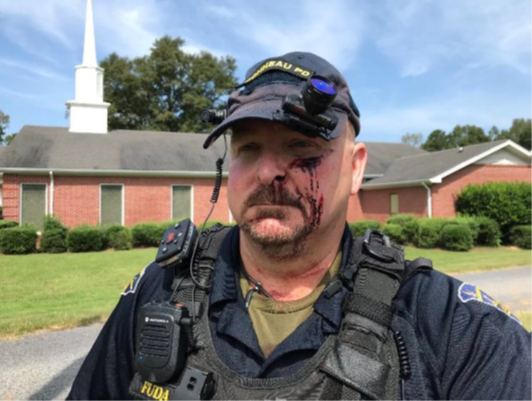
This Chief of Police opened his front door and was stabbed in the face by a suspect.
Berkeley County, South Carolina, September 7, 2020: A man accused of stabbing the Bonneau police chief in the face with an ice pick is in custody after a standoff with Berkeley County deputies. After stabbing Chief Franco Fuda under his left eye, investigators said Bowman ran to his mobile home and barricaded. Forrest Bowman was arrested shortly after 12:30 p.m. The SWAT team brought Bowman, who was naked and screaming, out of his trailer. According to Fuda, Bowman told him that he was “going to die today.”
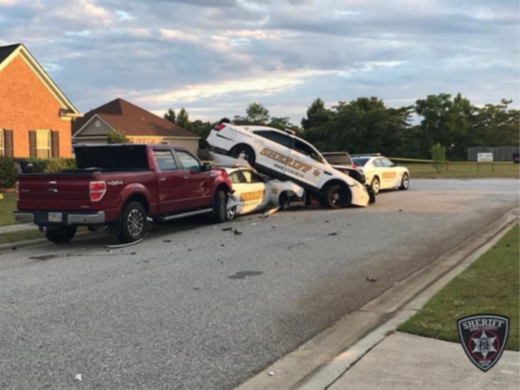
A domestic violence suspect crashed his red truck into one patrol car – a deputy who was in it at the time survived.
Also, remember it’s not only firearms that can be used in ambushes – always be mindful of scene security. The red truck was the suspect in a domestic violence call who had left earlier but returned to the scene while Deputies were interviewing the victim. A deputy seated in one of the patrol vehicles was injured but recovered.

A Mississippi man was arrested Friday during a traffic stop after he attempted to hide a gun in a quesadilla from Taco Bell. Devin P. Mitchell folded the gun into the quesadilla when police in Picayune stopped him and driver Olivia Neff for a traffic violation.
Officers reportedly saw Mitchell stuffing the handgun into a Taco Bell bag, prompting them to conduct a search of the vehicle, where they found the gun hidden in the Mexican meal.
Mitchell found himself slapped with other charges after police also recovered methamphetamine, liquid heroin, and drug paraphernalia during their search.

Mitchell was taken into custody and charged with possession of a controlled substance with intent to distribute while in possession of a firearm, possession of a controlled substance, tampering with physical evidence, possession of weapon by a felon, and possession of paraphernalia.