Month: March 2023

“Expeller of evil” (mušēṣu lemnūti) with white pigment and red spots “Catcher of the enemy” (kāšid ayyāb) with red pigment “Don’t think, bite!” (ē tamtallik epuš pāka) with white pigment “Biter of his foe!” (munaššiku gārîšu) with turquoise pigment “Loud is his bark!” (dan rigiššu) with black pigment
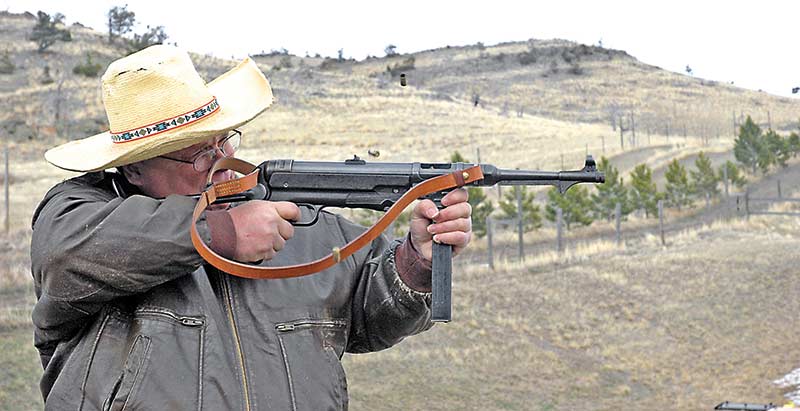
One of Duke’s most important quests was to have a home site where he could shoot right
in his front yard, which is exactly what he is doing with his MP40 submachine gun.
In my humble opinion a life should contain quests, or in more modern parlance, “bucket list” items. Mine have been rather humble. The two most far-fetched ones I entertained as a kid in the 1950s was flying in a B17 and visiting the island of Iwo Jima. As an older fellow, more prominent quests including finding a wonderful wife, seconded by a nice home with lots of land so I could shoot on it freely. I’m happy to say all those quests have been satisfied.
However, more minor quests have kept me busy unto this day. Those were quests for various firearms, and brothers I have been mostly successful. I’ll detail one right now.
Yahoos Miss Out
Back in my native West Virginia, it seemed older S&W .44s were fairly common in gun stores and pawn shops. I even got to borrow a target-sighted triple lock (S&W Hand Ejector, First Model) for some shooting. Another triple lock with target sights and a 5″ barrel had actually belonged to one of Mingo County’s Hatfield clan and was offered to me. Unfortunately, I didn’t have the coin to afford it at the time.
Much later at a Montana gun show, an older gent with whom I was acquainted approached holding a holstered revolver under his arm. I could tell at a glance it was an older Smith & Wesson N-Frame revolver. He said, “I’ve waved this under the noses of several of these yahoo dealers and they have offered me a pittance for it. Are you interested?” I looked the gun over, instantly recognizing it as a target-sighted triple lock with 6 1/2″ barrel. I made him what turned out to be a sufficient offer, he accepted and we both left the gun show happy.
A Day At The Museum
Quest guns can appear unexpectedly. A few years later, I was in a gun store/military museum in Los Angeles of all places. Therein on the used gun shelf was a Smith & Wesson Hand Ejector 2nd Model with fixed sights and a 6 1/2″ barrel. I paid for it and had it shipped to Montana. When lettering it, what did I find? It had been shipped to West Virginia in 1929. With this bit of good luck, my quest then became having Smith & Wesson .44s in all four basic models.
Later, after some diligent searching on the Gunbroker.com auction site, the quest for all four basic permutations of Smith & Wesson .44s was fulfilled. The next one was a Hand Ejector Third Model with fixed sights and 6 1/2″ barrel. It lettered to an army officer based in California in 1939. Finally, after more diligent online searching, a target-sighted Model 1950 Target with 6 1/2″ barrel appeared (the later model number was M24). I nabbed it. Those four big .44 Specials sure look good in a photo!
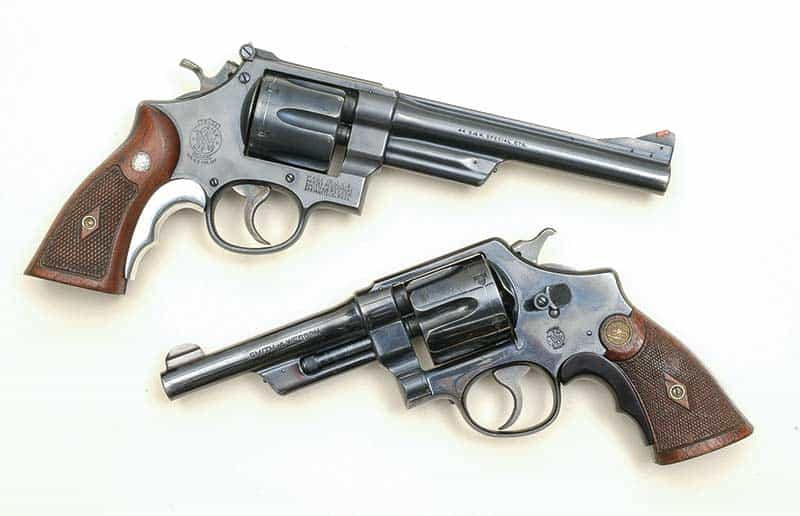
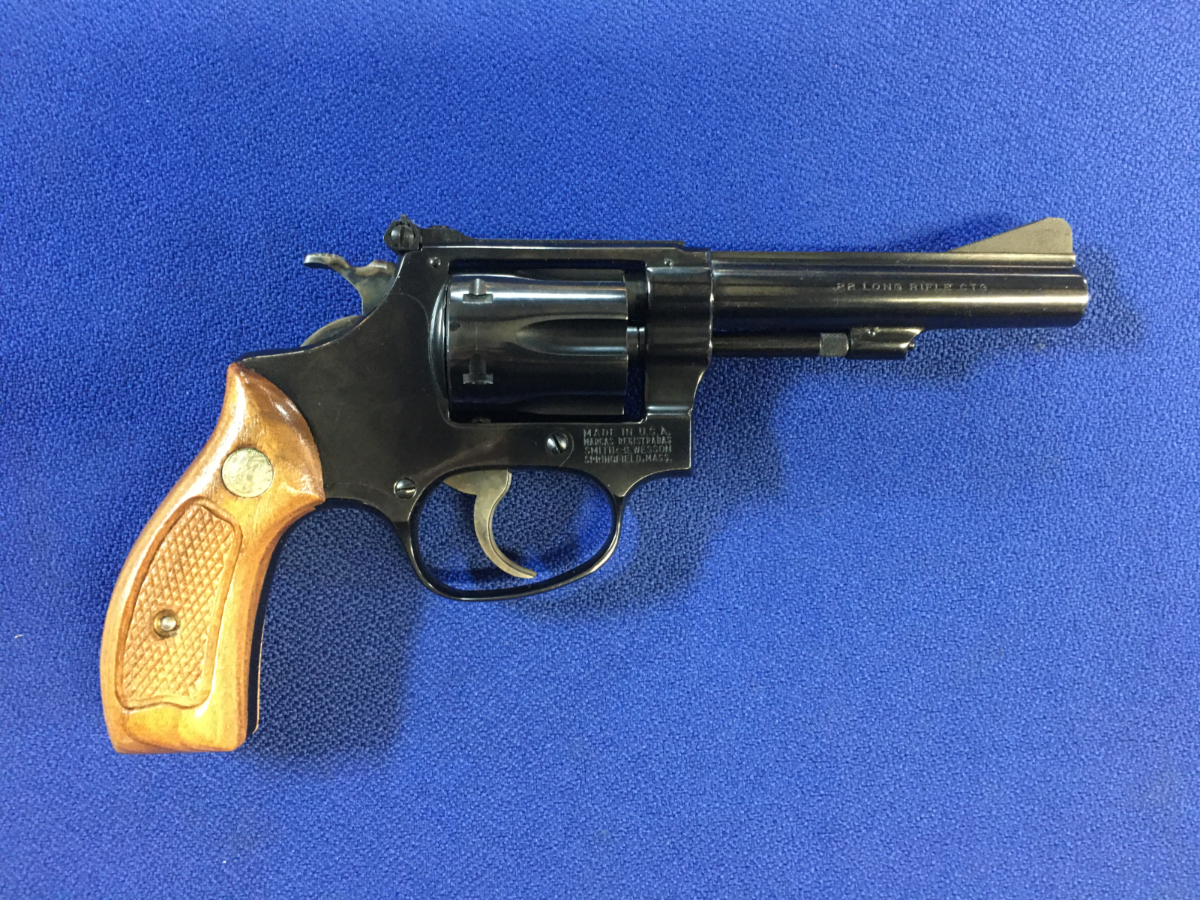
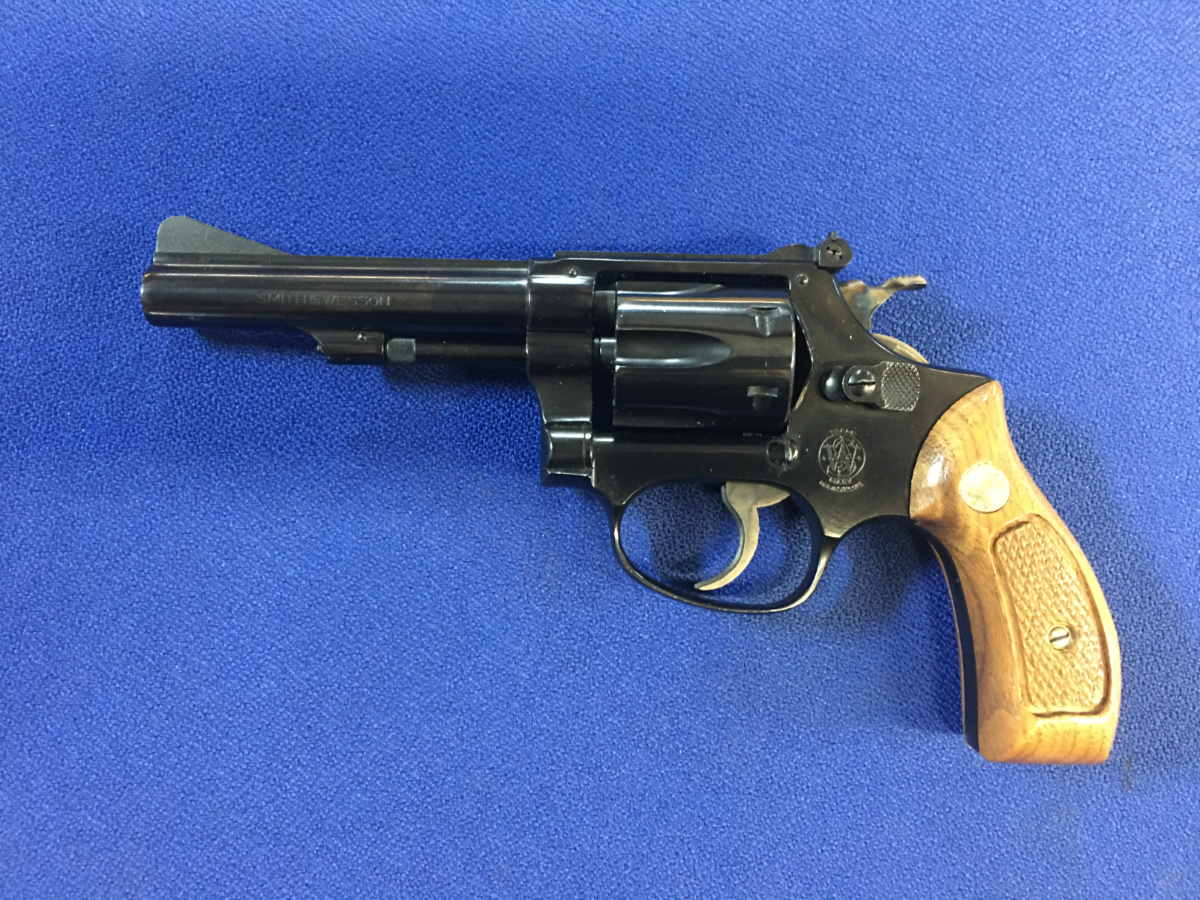
Both of these N-Frame S&W revolvers are Hand Ejector, Fourth Models. Top is target-sighted
Model 1950 Target aka Model 24. Bottom is Model 1950 Military aka Model 21.
Not Done
But — I wasn’t finished. As a teen poring over catalog sections in things like Gun Digest, I took note of another .44 Special Smith & Wesson revolver. It was their N-Frame fixed sight Model 21 which came with 4″, 5″ and 6-1/2″ barrel lengths. Sadly I learned Smith & Wesson discontinued Model 21s, along with several fine N-Frame revolvers, right about the time I discovered them. A further frustration was only 1,200 Model 21s had been made, including those pre-model numbered ones named Model 1950 Military. (S&W adopted model numbers in 1957.) Satisfying this quest seemed unlikely.
Decades passed without ever encountering even one of those Model 21s. Then, in my early 50s, I walked into a gun show in Bozeman, Montana. Upon the first table visited there sat a Model 21 with a 4″ barrel. Its price was steep but I didn’t hesitate. It’s odd how things happen, because within a year I came across two more with 5″ barrels. I bought them too.
So — do all these .44s I quested for sit safe in my gun vault? No, they don’t. Only two remain. They are the triple lock and the Hand Ejector Second Model. Why would I let go of such valued quest objects. Well, questing is an ongoing thing (ailment?). Over the half-century plus of my gun-buying quests arose for Colt SAAs, Winchester lever guns, Sharps single-shot rifles and even World War II full-autos. Sometimes satisfied quest objects must make room for new quest objects.

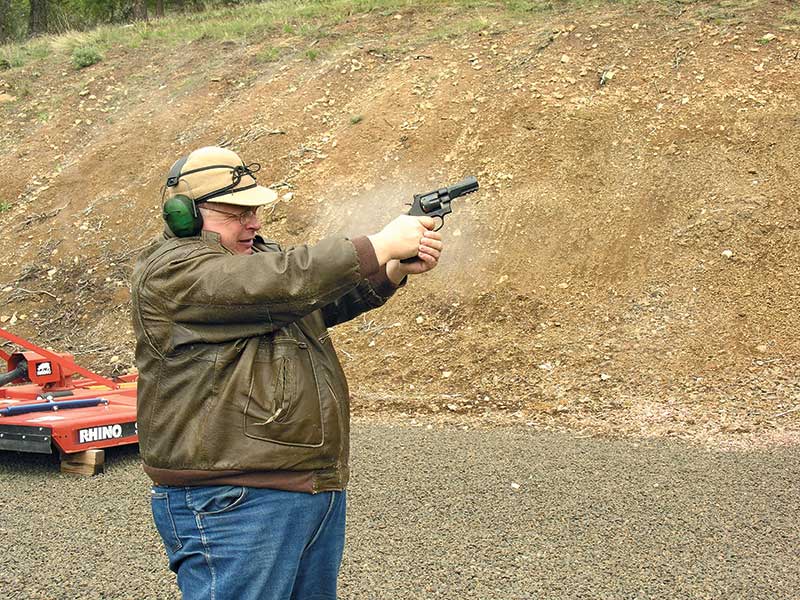
Duke shot the new S&W TRD .45 only in double action. He didn’t dare shoot it single action,
but such a method is possible. Just not when Clint Smith is around.
When Smith & Wesson’s Tony Miele and Thunder Ranch’s Director, Clint Smith, got together a few year’s ago, their fertile brains cooked up something special. It was the third revolver introduced in collaboration between Thunder Ranch and Smith & Wesson, but as you will see this one was a departure from those first two Thunder Ranch Revolvers. It is the Thunder Ranch Defense revolver or TRD.
Here’s some background. Back at SHOT Show 2004, Clint, Tony, Roy Huntington and myself had dinner together. It was the first time Clint and I had met Tony, who at that time was Smith & Wesson’s production manager. Naturally we all launched into our ideas about what revolvers Smith & Wesson should be making. Guess what it was? Right! We wanted all steel, fixed sight, wood gripped, big-bore sixguns. Such are traditional Smith & Wesson handguns to shooters of our age.
Thunder Ranch Revolver
We got them too. By April Tony, Clint, and I shot together at a Thunder Ranch Revolver class in Texas passing around the prototype first Thunder Ranch Revolver. It was a Model 21-4 .44 Special, with 4″ barrel. It went over so well Thunder Ranch and Smith & Wesson did another revolver together in late 2005. This time it was a Model 22-4, which externally was similar to the Model 21-4, but chambered for .45 ACP/.45 Auto-Rim. If anything, it was an even bigger success.
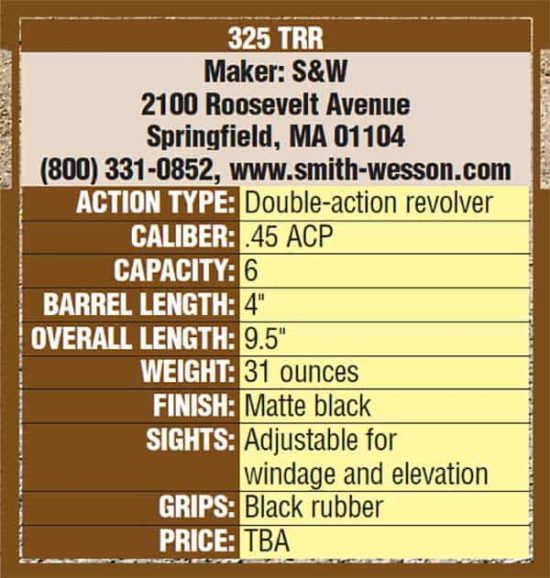
This set the stage for the TRD, which as I said is a departure from tradition. Clint referred to this new revolver as “new age.” Instead of steel, its N-frame is scandium, while its cylinder is blackened stainless steel. Instead of fixed sights, it has adjustable ones, and the grips are rubber. In fact about the only things “traditional” about it are the 4″ barrel and caliber.
Again, it is chambered for .45 ACP/.45 Auto-Rim. I asked Clint why did you pick the .45 ACP/.45 Auto-Rim again? He said, “Because the revolver is versatile ammo-wise and allows the 1911 people to also have a viable revolver in a matching caliber. Also, with .45 ACP/.45 Auto-Rim someone has the option of 1/2-moon clips or full-moon clips with .45 ACP or speed loaders with .45 Auto-Rim.” I’m also happy to note the .45 Auto-Rim isn’t just an option for hand-loaders. The South Dakota-based firm Black Hills Ammunition is again offering .45 Auto-Rim factory loads.

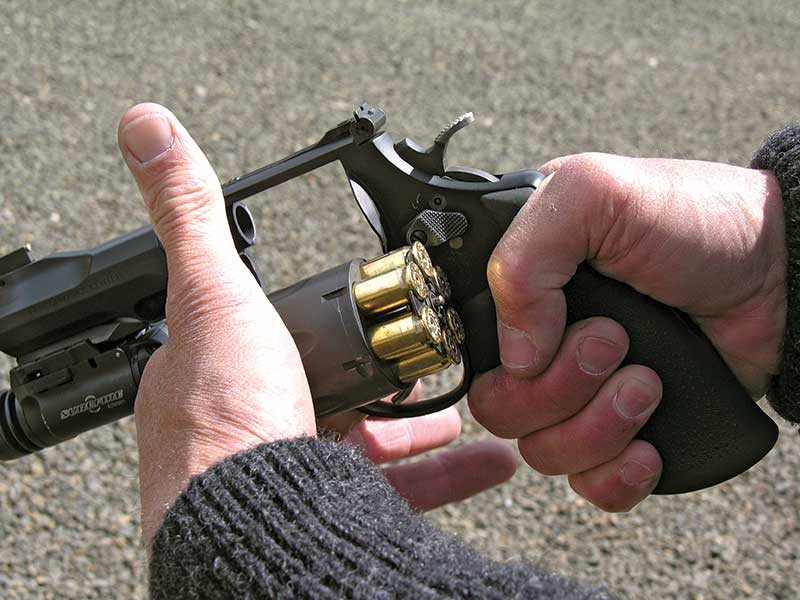
The new S&W TRD .45 can handle .45 ACP ammunition (above) in either full or 1/2-moon clips
and .45 Auto Rim in speed loaders. One benefit of a revolver chambered for .45 ACP (below)
is the car-tridges can be held in 1/2 or full-moon clips for a truly flexible reload.
Sight Thoughts
When I got to Oregon, the first thing Clint and Tony showed me was the sample TRD revolver. When I saw it carried adjustable sights, I had to ask why. After all Clint had wanted the earlier Model 21-4 and 22-4 precisely because they were fixed-sight revolvers, hence nearly impossible to knock askew once sighted in. And that’s a good thing for a defensive handgun. But, Clint said experience showed him adjustable sights were logical for a .45 ACP/.45 Auto-Rim revolver because of the wide range of bullet weights available.
For instance, .44 Special factory load bullet weights generally run from 200 to 250 grains. In comparison .45 ACP/.45 Auto-Rim now have factory load bullet weights from 155 grains to 255 grains. The lighter load is the TTI brand of “green” or lead-less factory ammo in .45 ACP. The heavier bullet is the lead 255-grain SWC carried in Black Hills new .45 Auto-Rim loading. Depending on exact barrel length, velocity, and/or range the points of impact between 155-and 255-grain bullets can be a foot or more. Hence adjustable sights are more practical.
The new TRD revolver’s rear sight was perfectly familiar to me, being the standard S&W micrometer style inlet into the topstrap and adjustable for both windage and elevation by means of a small screwdriver. I’ve used hundreds of S&W revolvers so equipped. However, the front sight got my attention. It had a gold bead, but the interesting thing is that its “quick detachable.” Pulling it back against spring pressure and then lifting it upwards brings it right out of its slot. As shipped from the factory these new TRD revolvers will have a gold bead with a sight height of .250″. However, the buyer can order other sight blades to suit his individual needs such as higher, shorter, or the Hi-Viz colored types S&W has been marketing for awhile. I thought it was a nifty option, all the while feeling perfectly happy with the original gold bead while shooting of several hundred rounds through the TRD during my visit.
A Little More Custom
In the above paragraph I mentioned “shipped from the factory.” Let’s be clear on one point — these Smith & Wesson TRD revolvers were actually coming from their Performance Center. Coming out of the PC, the revolver has a few options standard factory revolvers don’t have. One is the hammer and trigger are forged and machined parts and not the MIM (machine injected molding) parts as found on factory issue Smith & Wesson revolvers nowadays. They are color case hardened. Second, the hammer has a shape referred to as a “tear-drop” which is slightly different from the rectangular one on standard revolvers. Third, the trigger comes with an overtravel stop. And finally, the cylinder’s crane has an extra lock-up in the form of a ball detent, in addition to the standard lock-up of the ejector rod fore and aft. That third lock, while not exactly like those found on the old “Triplelocks” (Hand Ejector, 1st Model), serves the same purpose.
All us “old revolver guys” like wood grips on our handguns, or perhaps even grips made of some exotic material like ivory or bone. Therefore, I was a bit surprised the TRD has rubber, finger-groove grips. Again I asked Clint why. He said, “Many revolver people like custom grips of their choosing, so the rubber works well, yet is cost effective in case the owner wants to ditch them. In fairness, though, the rubber is also pretty tough stuff for everyday carry or field work.”
Personally speaking, I’ve had a deep aversion to rubber grips all my life. That is until encountering Smith & Wesson’s new breed of AirLite revolvers. These ultra light revolvers are great for carrying but firing them with wood stocks will tear up your hands in short order. Yet, the rubber grips make them perfectly usable. The TRD, with its scandium frame and shrouded barrel weighs a mere 31 ounces. We fired hundreds of rounds through it while I was at Thunder Ranch, and those grips made it perfectly pleasant to shoot. So once more, a departure from “tradition” was well thought out.
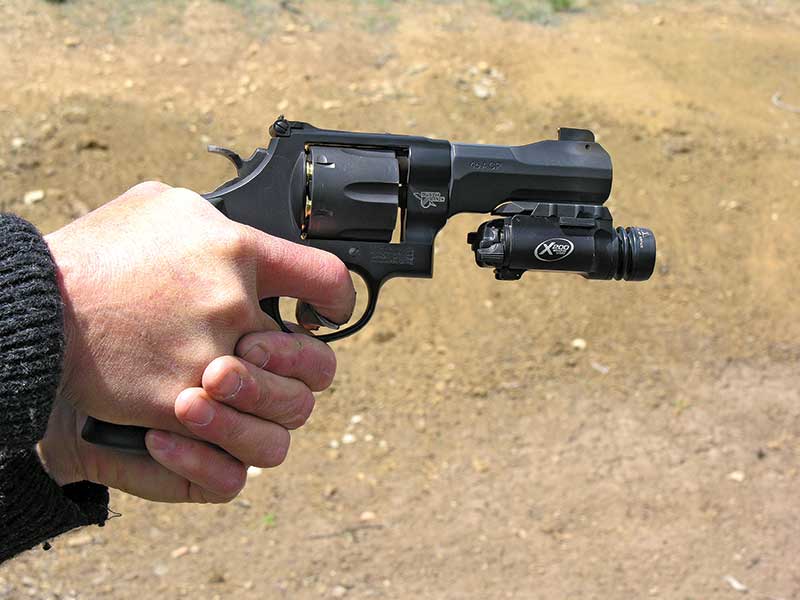
The new Smith & Wesson TRD .45 comes with a Picatinny rail beneath the
4″ barrel (above). It is removable if lights aren’t your thing.
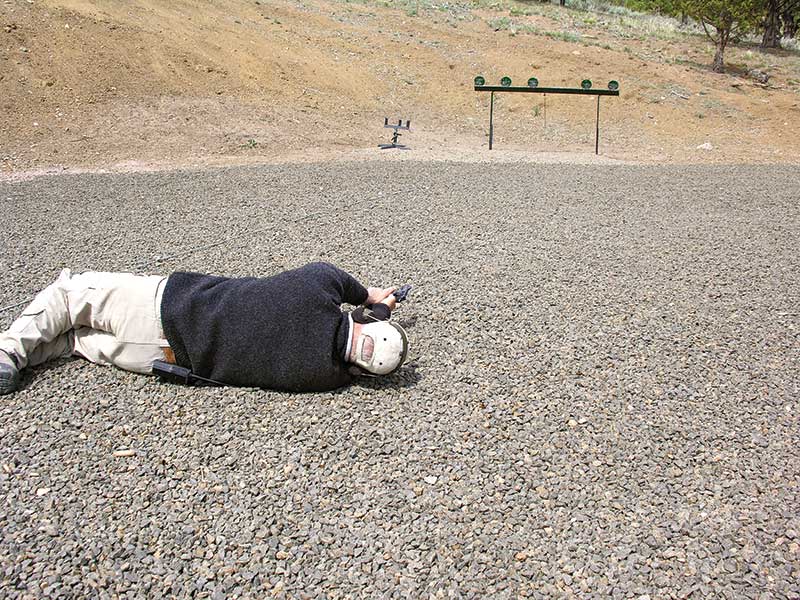
You never can predict how you might have to engage an enemy, so Clint practices being able
to shoot from many positions. Here, he puts the new TRD .45 through its paces from such
unorthodox positions as this. It functioned flawlessly for 2,000 rounds.
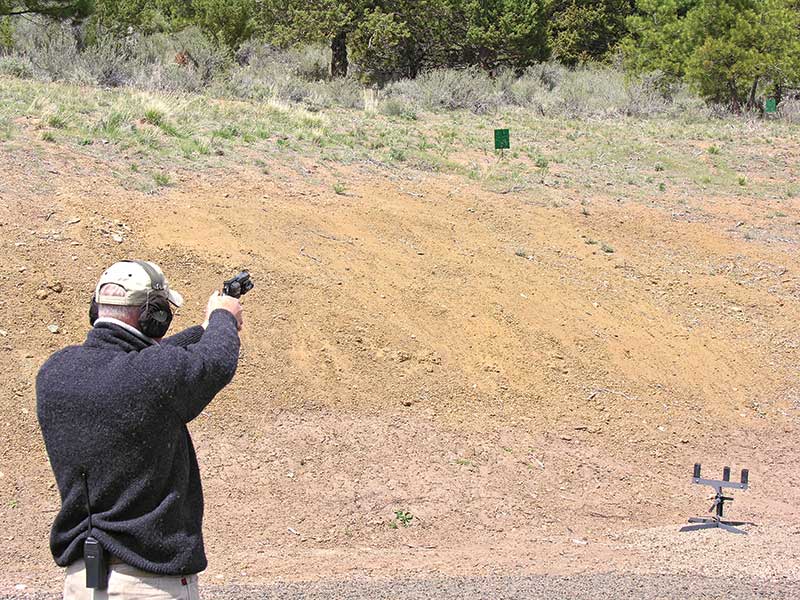
Clint shooting the new Smith & Wesson Thunder Ranch Defense (TRD) revolver .45 ACP
double-action at a steel plate 45-yards away. Hits were easy.
New Tradition
But this next item is perhaps the most non-traditional of all. It’s a Picatinny style light rail mounted beneath the barrel. I have no experience with handgun-mounted lights, so again Clint had to be referenced as to why he thought it a good idea. Here’s what he said, “The light rail is there because so much of what happens confrontation-wise is in an altered light environment. The idea is to carry the TRD for daily use without the light, and then when you get home mount the light. An option would be to have the light with you and then mount it when needed, such as a cop might have to do when entering a dark building.” Also, it should be mentioned the Picatinny-style light rail can be dismounted from the barrel, in case the owner feels no need for it at all.
Now at this point in the usual sort of gun test we would tell about the groups it fired on paper from sandbag or machine rest. That we didn’t do. What’s the point?
Every single one of these new S&W revolvers we have “test fired” the last few years have been extremely accurate. So instead we had a lot of fun shooting steel. In fact while I was there in Oregon the number of rounds put through that sample TRD passed 2,000 and none of them were fired at paper targets. Clint has a steel falling plate range set up for use at dis-tances from seven to 25 yards. Also on the hill above the plates are larger plates 12″ wide and 18″ tall set at 45 and 65 yards.
Right off the bat when it was my turn to shoot the TRD the first time, I reached up to cock the hammer and fire it single action. After all why did God give me thumbs if he didn’t want me to use them? A ton of bricks might as well have fallen on me. Clint said, “It’s a double-action revolver! Shoot it double action!” I know better than to argue with him, and besides he’s been trying to teach me proficiency in double action shooting for several years.
It didn’t surprise me I was able to hit those falling plates at ranges from seven to 10 yards. What did surprise me was we were all hitting them at 15 to 20 yards, and it astounded me that all three of us were regularly hitting those 45-and 65-yard distant plates shooting double action. The double-action trigger pull on the TRD revolver was just plain smooth, yet the hammer fall was strong enough it never failed to set off a primer.
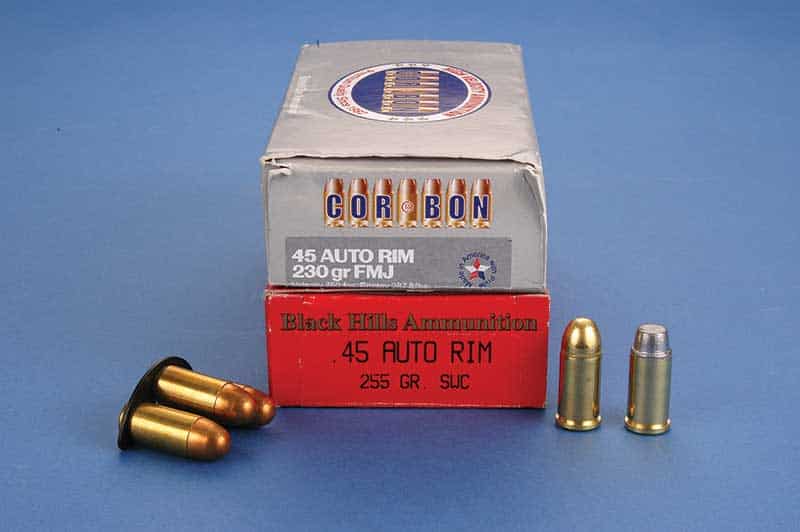
Besides the vast amount of .45 ACP loads available, both Cor-Bon and Black Hills
Ammunition are now making .45 Auto-Rim factory loads once more.
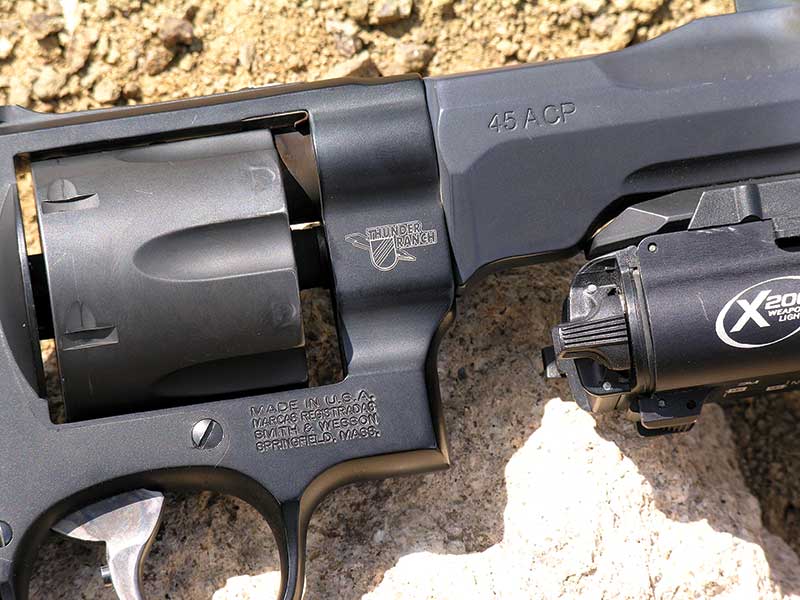
Each Thunder Ranch Defense revolver has the Thunder Ranch logo etched into its frame.
Ammo Choices
Not only did we fire .45 ACP Remington 230-grain FMJ factory loads and TTI 155-grain lead-less .45 ACP factory loads, but also tried Cor-Bon’s new 230-grain FMJ Auto Rim load and Black Hills new 255-grain SWC Auto Rim load. All shot just fine albeit with some sight changes to com-pensate for differing bullet weights. (I never did fire the thing single action, so I have no idea as to how its SA trigger felt. I wasn’t about to let Clint catch me thumb-cocking it again!)
At the end, I had to ask Clint again; “Why the great departure from the first two Smith & Wesson and Thunder Ranch collaborations?” He said, “This TRD is a sort of update or new age version of the defensive revolver. The Models 21/22 were an attempt on my part to bring back the old guns so they could be carried and shot, maybe by people who couldn’t find or afford original Model 21s and 22s.”
Milt Sparks, the famous Idaho holster maker, has both inside and out-side the pants holsters for the TRD and its light rail.
I just hope that this is fake but one never knows what will happen when the troops are left unsupervisied. Grumpy