Month: July 2022


Categories
CZ P10S 1000 Round Review

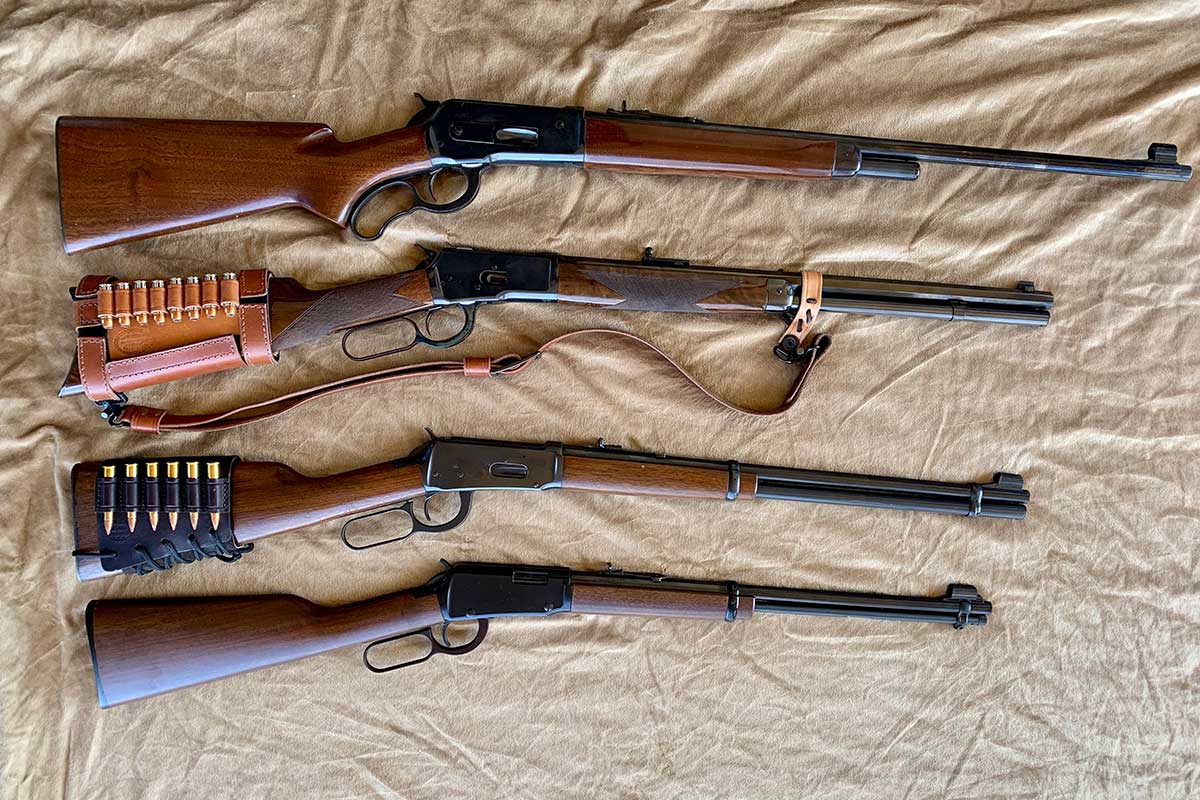
If I were to pick one class of long guns as my favorite, it would have to be lever-action rifles. They can be chambered in everything from .22 Long Rifle up to Big Horn Amory’s 500 S&W Magnum. There is a caliber that is right for your purposes.
To paraphrase an old country song, I liked lever-actions before lever-actions were cool. And, in the last few years there has been a resurgence in the popularity of lever-actions.
My favorite lever guns are a Winchester Model 71 in .348 Winchester, a Model 92 in .45 Colt, a Winchester Model 94 in .30-30 Winchester and a Henry Classic in .22 Long Rifle. I’ve hunted with all four for game, ranging from feral hogs to rabbits, and I have trained with the Model 92 and Model 94 at Gunsite.
The .22 also serves as a good sub-caliber trainer for its bigger bothers in addition to being good clean fun.
PRACTICAL USAGE
One reason the lever-gun remains popular for those on horseback is that it’s thinner than any other design. It also has less height and does not require the mounting of scopes, red dots, lasers and microwave ovens to get the job done.
When riding fence a Winchester Model 94 went with me, snuggled into my saddle scabbard. Unlike the movies, when I was actively working cattle the rifle came off as there was too much of a chance my rope may catch on the stock and cause a wreck in the corral—something to be avoided around sharp horn Brahma-cross cows.
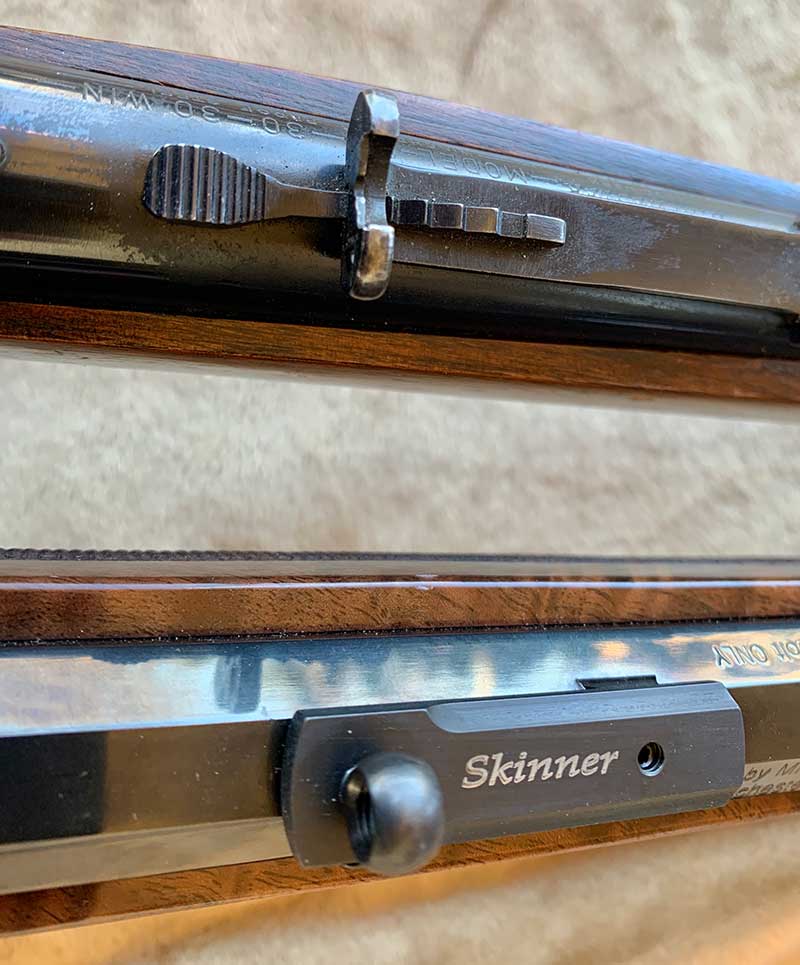
Typical Buckhorn sight (top) is adequate, but the Skinner Sights ghost ring is faster to pick up under speed and increases accuracy.
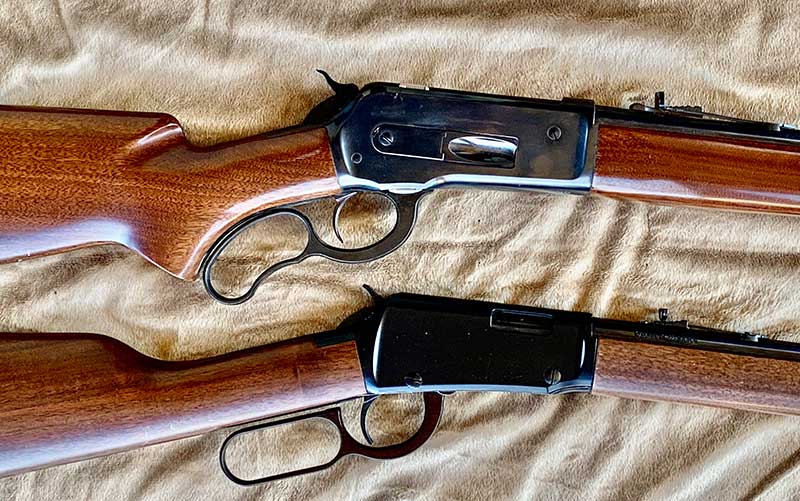
Although the Henry Classic (bottom) does not have a side loading gate, it still serves well as a sub-caliber trainer.
I believe lever actions are a good choice for private citizens for self-defense, and also fill the role of patrol rifle for law enforcement. I can almost hear some people screaming that the ammo capacity of lever guns is too low, and lever guns are not accurate enough unless they have optics. For the private citizen or patrol officer, I disagree.
Most law enforcement shootings with rifles are within 100 yards with only a few shots fired. That is well within the capacity and distance of a lever gun. If you are a private citizen, unless your assailant also has a rifle, you’ll be hard pressed to make a case for self-defense at less than a quarter of that distance.
TECHNIQUE
Unlike what is portrayed in movies, the lever-action (like bolt-action rifles) should remain on the shoulder while the action is worked. Lowering it and then bringing it back into the shoulder takes more time to reacquire the target.
That extra time may result in not getting a follow-up shot on game or, if used in a defensive role, allow a bad guy to put more holes in you than you were issued at birth. With little practice rounds can be placed on target quite quickly with a lever gun.
The addition of a ghost ring sight from Skinner Sights will decrease the time it takes to get on target while increasing accuracy over the buckhorn type sights usually found on lever-actions.
AMMUNITION
For economical practice, I handload hard-cast bullets for both the Model 1892 and 1894. For the .30-30, I use 168-grain round nose, and for the .45 Colt I load 230-grain flat nose, round point, and 255-grain semiwadcutters. Even though hard-cast, I load the .30-30 to very moderate velocities to reduce the chance of leading the bore.
For years the standard loading for the .30-30 was a 158-grain round-nose jacketed soft-point bullet. Ballistically, it is on a par with the 7.62x39mm cartridge.
Only round-nose or flat-nose bullets could safely be used in the tubular magazine because, under recoil, a cartridge-loaded with a spire point bullet could ignite the primer of the next round in the magazine with disastrous consequences.
That all changed several years ago, when Hornady introduced the LEVERevolution® for lever-action rifles. The patented elastomer Flex Tip® technology of the FTX® and MonoFlex® bullets makes spire points safe to use in tubular magazines. The bullets feature higher ballistic coefficients and dramatically flatter trajectory for increased downrange performance.
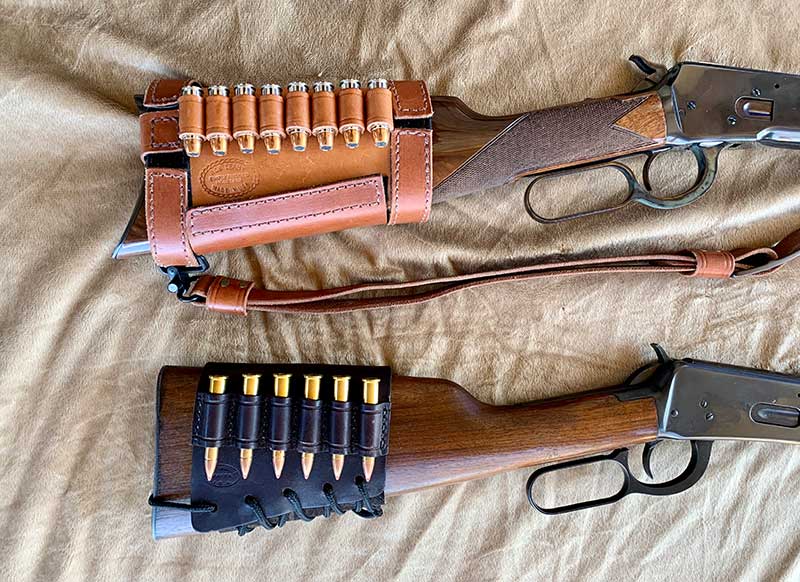
Two styles of buttcuffs. Simply Rugged Holsters’ (top) has an integral sling. More traditional cuff from Andy’s Leather. Both attach securely to the end of the stock.

Top to bottom: Winchester Model 71, 348 Winchester; Model 92, .45 Colt; Winchester Model 94, .30-30 Winchester; Henry Classic, .22 Long Rifle.
They are available in 140-grain (Mono-Flex) and 160-grain (FTX) weights and are suitable on big game up to and including elk, breathing new life into the over century old cartridge.
When hunting with the Model 71, I normally just place an extra half-dozen rounds in my pocket. The Model 92 and Model 94, however, often ride in my truck for defensive purposes as well as for critter control. With that in mind they both have butt cuffs for quick access to reload.
One word of caution on butt cuffs: make sure it is attached in such a way that it will not slide forward and interfere with the functioning of the rifle. A cuff sliding forward cost me winning a man-against-man shoot-off at Gunsite. In the real world it could have cost me much more…
It’s high time to bring “Grandpa’s rifle” out from the back of the safe and put it to use. Lever-actions rifles remains viable for most any task you choose to use it for.
SOURCES
ANDY’S LEATHER
(603) 630-4072
www.andysleather.com
SIMPLY RUGGED HOLSTERS
(928) 227-0432
www.simplyrugged.com
SKINNER SIGHTS
www.skinnersights.com
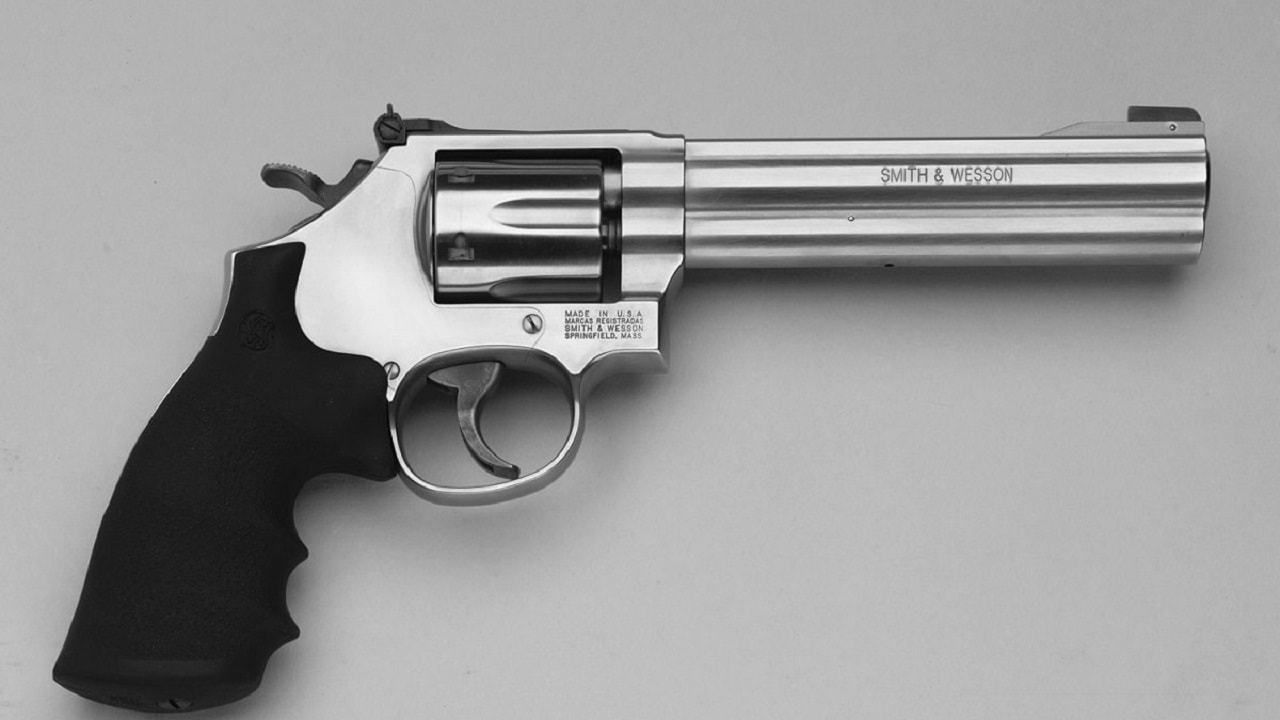
Smith and Wesson Revolvers. Image Credit: Creative Commons.
Smith & Wesson Revolvers: A Classic or Overrated? It’s difficult to beat a revolver for reliability. They usually don’t malfunction or jam because they have fewer moving parts compared to semi-automatics. They are effective in home defense situations. Many are chambered in many different calibers including beefy .44 or .357 Magnum for heavy-duty stopping power. They are easy to maintain – just use a bore brush for the barrel and cylinders and then wipe down the piece. But revolvers tend to be heavier and slower to load if you are not used to them.
Is Smith & Wesson Keeping Up With the Competition?
You can’t discuss revolvers without mentioning the Smith & Wesson brand. Since Horace Smith and Daniel Baird Wesson made their first repeating pistol in 1852, Smith & Wesson have been perfecting their firearms. But is S&W resting on its laurels and letting the competition eclipse them? Colt and Ruger make commendable revolvers too.
History of Smith & Wesson Revolvers
Sam Colt invented the revolver in 1836, so Colt has played the revolver game longer than Smith & Wesson. The Ruger Blackhawk gave the late 19th century legendary Colt Peacemaker a run for its money.
For Smith & Wesson, it was the Model 3 American that put them on the map in 1869. This gun, like the Peacemaker, proliferated around the Old West and was especially prized during the Civil War. The gun maker is also widely known for its Model 10 .38 caliber Military and Police revolver. By 1935, Smith & Wesson had a .357 Magnum version. In 1956, S&W pioneered the Model 29 .44 caliber made famous in popular culture by Clint Eastwood in the Dirty Harry movies. Then in 1966, S&W unveiled the first stainless steel revolver. In the 1980s profits went down because police departments in the United States were switching to lighter semi-automatics made by Glock and SIG Sauer.
Uh Oh, Quality May Be Taking a Hit
But lately, according to some reviewers, the Smith & Wesson brand has taken a dive. Gun blogger Chuck Hawks gives examples of why the S&W revolvers are having trouble accomplishing their basic mission.
First, two .22 Masterpiece target revolvers he inspected for a sporting goods store were so out of the ordinary that the cylinders could not be rotated fully. Upon another inspection for a gun shop, Hawks found the “cylinder ratchet notches were so poorly machined that no two were identical.” After a day at the range with a new Chief’s Special .38 Special revolver, he noticed that all the chambers on the cylinder had a small bulge.
These types of issues are likely the cause of poor quality control at the manufacturer. Hawks thinks the revolvers are not being tested correctly.
“Such examples are far too numerous and widespread. Design, quality, and quality control problems have been endemic to Smith & Wesson firearms for decades,” he wrote.
Some Reviewers Still Sing Praises for the S&W Revolver
S&W revolvers are still popular with other reviewers. Some like the heavy trigger pull that will keep the gun from firing unexpectedly. There are numerous types of holsters that offer ample concealment. You can usually find quality ammunition for the pistol.
The Model 500 Is One of the Most Powerful S&W Revolvers
The S&W Model 500 gets good reviews. You can mount optics on the Model 500. The front sight is interchangeable, and the rear sight is adjustable. 1945’s own Richard Douglas sings its praises.
“For one, Smith & Wesson recently developed the innovative ‘x-frame’ to give you a better grip and help to handle the recoil that comes along with the immense power of this handgun. This makes the 500 very comfortable to handle, and even features a recoil-absorbing rubberized grip complete with finger grooves to let you hold the gun at an angle that allows for optimal control and accuracy,” according to Douglas.
Smith & Wesson: Enviable Sales and Profits
Smith & Wesson has a legion of fans. You can tell from their record sales and profits. Sales went up 100 percent year over year in July 2021. The Springfield, Massachusetts company made over $250 million in profit during that period. S&W paid off its corporate debt and even gave full-time workers $1,200 bonuses.
All told Smith & Wesson revolvers get mixed reviews. It seems there are problems when models are produced in high numbers. Like all new guns, keep a close eye on your pistol when it comes out of the box and inspect it carefully after your first day on the range.
If there are problems with your Smith & Wesson revolver, the company has a limited one-year warranty. When you find a defect, put it in writing and the company promises that it will fix the problem free of charge.