Categories
All About Guns Being a Stranger in a very Strange Land Cops

A Judge Pulled a Gun in the Courtroom—and Then It Got Weird Jose Pagliery

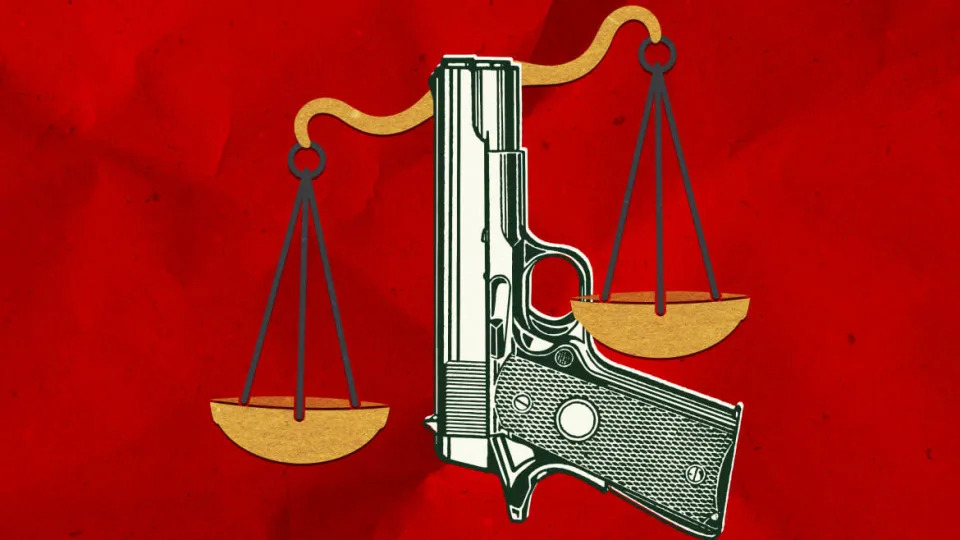
Photo Illustration by Thomas Levinson/The Daily Beast/Getty

During a trial in West Virginia earlier this year, witnesses tell The Daily Beast, a state court judge whipped out his handgun, waved it in the air, and left it on the bench with the barrel pointing directly at the corporate lawyers who had irritated him.

Circuit Judge David W. Hummel Jr., who oversees cases in the tiny city of New Martinsville, repeatedly told The Daily Beast it never happened. When reached by phone in March, he initially professed shock at the allegations. On subsequent phone calls, however, his story kept changing as he claimed to recall more details about the incident.

“I did not have my 1911 at any point during that trial,” he said then, referring to a common type of semi-automatic pistol. “It was secreted in a drawer on the bench. I never showed my 1911 at the trial whatsoever—at any point during that trial.”

That judge is now under investigation by the state’s judiciary for violating the profession’s code of conduct, according to three witnesses now sharing information with law enforcement and official communications about the investigation reviewed by The Daily Beast. The judge’s own staff has since told an investigator that the judge did, in fact, display his gun openly during an attorneys-only hearing and boasted about having it in his possession, according to two of those witnesses.

Hummel insisted to The Daily Beast that there was no recording of the incident that would back up these accusations, but two witnesses say the state investigator has acquired a videotape of the interaction.

“You don’t understand what a terrible victimization it is,” said Lauren Varnado, the attorney who was standing at the podium when the judge pulled out his gun. “It was pretty traumatic for multiple people. The whole trial was insane.”

“We have no power in this situation,” she said. “It was way scarier than even just a normal person on the sidewalk. You need more power over us than you already have right now? That’s frightening, because he could order us to do whatever. Why would you ever need to pull out a gun?”

The judge’s show of force was the culmination of months of building tension between him and Varnado’s team of corporate lawyers. The Daily Beast has reviewed hundreds of pages of court transcripts and spoken to several people involved.

As with many legal battles in West Virginia, it all started with fossil fuels.

Until the case settled recently, Hummel oversaw a dispute involving West Virginia landowners who sued over the royalty payments they get from the natural gas giant EQT for fossil fuels extracted from the earth hundreds of feet below their property.

But the gas company’s lawyers accused the judge of never disclosing that his parents get gas company royalties that may someday pass on to him—sparking questions about a glaring conflict of interest. When the gas company’s lawyers sought to disqualify him, court transcripts show he grew increasingly aggravated at Varnado and her team.

At an April 2021 court hearing in which he was asked about his family’s gas interests, the transcript shows how the judge patronized EQT’s lawyers as he detailed his family tree and dismissed their concerns, ranting about how his cousin “Christy” got mad at him for not recognizing her at a wedding. When the attempt to have higher state courts disqualify him failed, Hummel started the next court hearing in similar fashion.

“Okay. Excellent. And I’m Judge Hummel, and I have no conflicts, Supreme Court said, so here we are. And this time I don’t have to talk about my Aunt Rose’s numerals or which shoe I put on first or anything,” he said on July 19, 2021, according to another transcript.

<div class="inline-image__caption"><p>The dispute revolved around the energy company EQT.</p></div> <div class="inline-image__credit">Photo Illustration by Rafael Henrique/SOPA Images/LightRocket via Getty</div>

The dispute revolved around the energy company EQT.

Photo Illustration by Rafael Henrique/SOPA Images/LightRocket via Getty

The eventual trial was always going to be fiercely contentious. EQT cut its royalty payments nearly a decade ago, shortly before the energy value of the state’s natural gas production began to overtake coal. While the state has relied heavily on the exports of coal and oil since the 1800s, natural gas from the fracking of the massive Marcellus Shale underground has the promise to enrich the state.

By the time the two-week trial started in February in New Martinsville, the locals were so angry at how the gas company had cut their royalties in recent years that EQT lawyers felt the need to be escorted by ex-CIA private security contractors, according to three members of that team. But when lawyers on both sides were called into the century-old sandstone courthouse for a special hearing on Saturday, March 12, bailiffs at the entrance surprised the legal teams with a new rule for the day.

“Trial counsel only today,” they said, according to three witnesses who spoke to The Daily Beast on condition of anonymity, fearing potential reprisal.

Varnado’s private security guard and a paralegal were turned away. The lawyers made their way into the courtroom on the second floor. Once there, according to a transcript, the judge castigated the gas company’s lawyers for having private guards, noting that if there were any concerns about safety, “I promise you, I’ll take care of them.”

“We were never told these folks were security until most recently,” the judge said, according to a court transcript. “I got this man here carrying a man purse, which I make fun of him every damn day for wearing such a sissy-ass contraption. And I hear he has blood coagulant. I have blood coagulant up here too, and I’ve got lots of guns. Like, bigger ones too.”


Hummel then pulled out a black handgun from an over-the-belt leather holster beneath his robe, and started waving it around the room, according to Varnado and another person in the room.

Hummel then put it down on his wooden desk, known as a judge’s bench, and left the barrel pointing at Varnado, her New York law partner David R. Dehoney, and their local West Virginia attorney Jennifer Hicks.

The gun stayed there for the rest of the hearing. When the attorneys were directed to negotiate in a private room, they found the handgun still waiting for them when they returned. When lawyers had to approach the judge, the resting gun remained pointed at their faces.

“It’s just a violation of basic gun safety, having it out like that pointing at people,” Varnado said. “It was too stunning to even process it. My brain didn’t even process it until after the hearing concluded. I was on edge. I don’t know if it was loaded.”

Indeed, pointing a firearm at anything but a target violates the National Rifle Association’s primary rule on gun safety, which is to keep a barrel pointed away from people at all times. And the judge seems to have broken a second rule of safe gun handling, which is to check whether a firearm’s chamber is empty and clear of ammunition—then say so out loud.

In the days after the hearing, Varnado reached out to the FBI to report what happened. But she decided to seek help from the feds 100 miles away in Pittsburgh, concerned that local law enforcement might be untrustworthy given the judge’s position of power and influence.

Varnado still feels confident that was the right move. When The Daily Beast reached out to Wetzel County Sheriff Michael L. Koontz, whose deputies provide security outside the courthouse, the sheriff remembered that a special hearing happened that Saturday morning—but denied any knowledge about the judge pulling out the gun.

However, two sources with direct knowledge say a sheriff’s deputy who was in the courtroom that day has since confirmed to the state investigator that the judge brandished his pistol.

When reached by phone a few weeks after the episode, Hummel first denied anything remarkable ever occurred.

“There is no incident… I absolutely, categorically deny I had a gun that day in the courtroom,” he said. “It was just me and the attorneys. I had no reason to have a firearm that day… I’ve never shown a gun in my courtroom to anybody. I don’t want them to know that I have it. I do not display my firearm at any time during trial.”

“My job is not to protect anyone with firearms,” he said. “That’s what my bailiffs and deputy sheriffs are for.”

Minutes later, the judge called back and said he now recalled having a holstered gun on him beneath his robe during the trial the previous week. But it wasn’t the 1911 pistol, he said. It was a long, classic-looking revolver that hails from the days of the Wild West.

“I wore the Colt Peacemaker,” he said. “The Peacemaker never ever came out of the holster during that trial.”

When the judge called back a third time, he acknowledged showing something to the attorneys in the courtroom that day. But he said it wasn’t a gun.

“I did pull out a small, red first aid kit. But it was casual. I did show her a foiled packet, and said this is blood coagulant. We have preparations for active shooter situations,” he said.

In April, a spokeswoman with the Supreme Court of Appeals of West Virginia told The Daily Beast that she was not aware of the gun incident. And records showed that Hummel had not been the subject of an admonishment or formal statement of charges.

But in the weeks since, Judicial Investigation Commission of West Virginia investigator David Hudson has been gathering evidence about the incident, asking witnesses to describe the firearm and how they felt about it being displayed by the judge, according to communications reviewed by The Daily Beast.

In a signed affidavit submitted to the investigator, Varnado, who hails from Texas, described the judge’s gun as a “Colt 45,” a widely recognized pistol otherwise known as a 1911.

The judge, his court clerk, a secretary, and a court reporter have all submitted sworn affidavits describing the events that day to the investigator, court reporter Holly A. Kocher told The Daily Beast on Wednesday.

Since March, the FBI’s Pittsburgh field office has repeatedly declined to confirm that a special agent there has been assigned to look into the incident. The judge did not respond to requests for comment on Wednesday.

The state judiciary, citing policy, declined to provide details about the ongoing ethics investigation. But its staff pointed to its website, which indicates that judges who violate the rules face a one-year suspension.

Categories
All About Guns

Is Walnut Dead? Synthetic vs. Wood Stocks by PHILIP MASSARO

is-walnut-dead-synthetic-vs-wood-stocks_lead.jpg

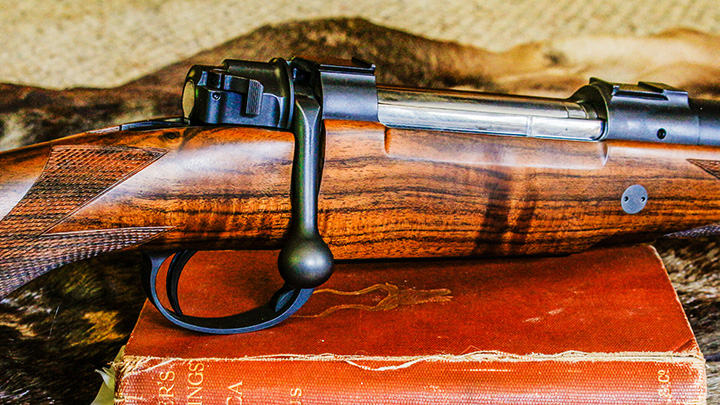
Blued-steel and walnut; for time immemorial this was the combination of materials used to make a firearm. Bluing—or blacking if you’re referring to English guns—can be achieved via several different methods, but for generations, walnut was the preferred material for a gun stock.

Walnut is tough, light, rigid, hard and doesn’t split easily, making it just about the perfect choice for a gunstock. Other woods have been used, but the most popular material has been walnut, though as with any wood species, it comes with its own unique issues. Walnut, in many different circumstances, can be one of the most highly figured woods imaginable; if you’ve ever seen a true high-end stock, you can spend hours staring into the depths of that figure.

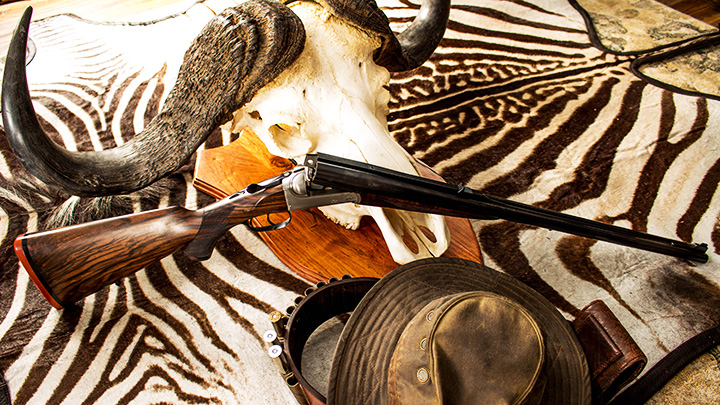
Heym Express Rifle .404 Jeffery Walnut Stock

However, wood will absorb water, it will swell, it will warp, it can (under heavy recoil, or if the grain is maligned) crack or split, and all of these characteristics can drastically affect the performance of the firearm. Looking back at historic firearms, their walnut stocks will show varying levels of wear—quite obviously, depending on finish and amount of use—but gunsmiths have always searched for the best materials for making a dependable firearm.

Synthetic Stock Rifles in Alaska

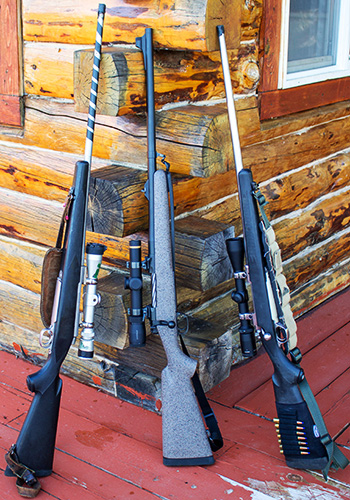
If you’ve spent any amount of time shopping for a new firearm, I’m sure you’ve noticed that there are as many—and quite often more—choices of polymer, fiberglass or synthetic stocks as there are wood.

These relatively modern developments (they became popular in the 1950s in firearms like the Remington Nylon 66) proved to be nearly impervious to weather, resisting the influence of heat and humidity on the firearm’s performance. When combined with stainless steel or some of the other more impervious metal finishes, these stocks were a big part of the weatherproof equation that hunters who spend their time in salty sea air or those areas with heavy rainfall would come appreciate.

Taking a look at some of the most popular firearms companies, I was honestly a bit shocked to see how the synthetic/polymer/laminate wood stocks have come to dominate the market. The vast majority of RugerRemington and Savage rifles and shotguns are stocked in something other than walnut. The Winchester Model 70 maintains a walnut stock advantage, as does the lineup of Winchester lever-action rifles, but synthetic-stocked lever-actions are popping up regularly these days; Marlin and Henry being two examples which come quickly to mind.

Heym Model 89B Double Rifle .45-70 Government

Like I said, the weatherproof characteristics of the laminates and synthetics make a lot of sense, but I personally feel that many of them lack the warmth and feel of the walnut stock. There are a few—Mark Bansner of Bansner & Co. makes a synthetic stock that I really enjoy—but when you compare them to the design of a proper Winchester Model 70, or some of the higher-end rifles like the Rigby Highland Stalker or the Heym Express by Martini, I feel the synthetic stock gets left behind. A worn, vintage Winchester or Marlin lever gun seems to have a story to tell, with every ding and scratch being a chapter in the tale.

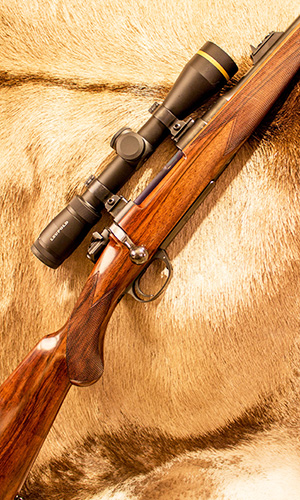
Rigby Highland Stalker Rifle

A well-sealed walnut stock will actually stand up well to most hunting situations, though they aren’t as rigid or easy to produce as a synthetic stock. While the mass-produced stocks are created by machinery, the higher-end walnut stocks are finished by hand. Custom stocks are a work of art, and to watch a classically trained stockmaker hand-carve a stock is like watching Michelangelo work.

Names like Ralf Martini, Todd Ramirez, D’Arcy Echols, Mark Renmant and JJ Perodeau, just to name a few, can make the stock of your dreams. And I firmly believe that, like a fine watch, everyone should own at least one gun with a stock they are truly proud of.

Those stocks—even the blanks from which they are made—are not cheap. The custom walnut stock is extremely labor-intensive, and the highly figured walnut, which was much more common a century ago, has become a rarity. Many of the hardwood stocks in use today are rather plain looking, and the figured stocks come at a premium, for certain. So where does that leave the walnut stock? Is it nearing the end of days for a stock with that honey and chocolate streaking, which seems to have an immeasurable depth to it? Has the synthetic stock won after all?

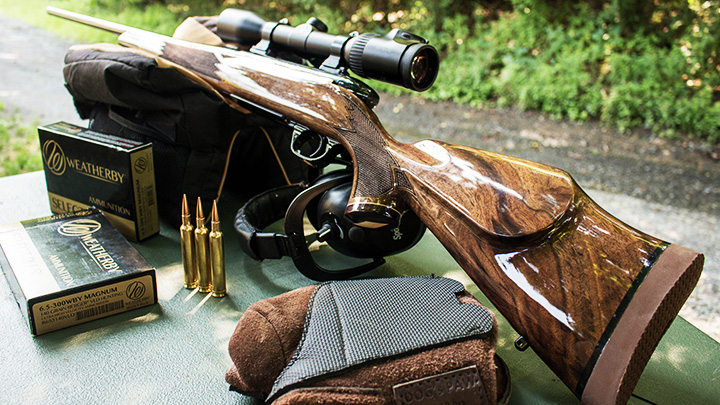
I think that the walnut stock still has its place, especially in the world of bespoke guns. I am proud to own a pair of Heym rifles—a .404 Jeffery Express rifle and a .470 NE Model 89B double rifle—which have some pretty fancy Turkish walnut. Rather than make them safe queens, I hunt them pretty hard in rather remote locations, adding one chapter at a time to their story. I also own synthetic-stocked rifles, which may not be as handsome, but with which I’ve made some wonderful memories. In spite of the new offerings, most lever guns will continue to be bedecked in walnut, as will any of the classic double rifles. And I’m also pretty certain we’ll always have a shiny, well-figured stock on a Weatherby Mark VBrowning Medallion and Dakota 76.

Weatherby Mark V Deluxe on Shooting Bench

If your budget only allows one rifle or shotgun—and my own did for quite a few years—a synthetic-stocked gun with a rugged finish makes all sorts of sense. I’ve always been the kind of hunter who would rather go hunting than own a bunch of fancy rifles which gobble up the hunting budget. But if you’re in the market for a rifle or shotgun on the fancier side, a fine walnut stock will certainly provide a lifetime of enjoyment. With modern finishing techniques, there aren’t many worries about the reliability of a walnut stock, just be prepared to pay a premium for a piece of walnut with some figure to it.

Categories
All About Guns

Shotguns: What’s New In 2022 While demand for defensive shotguns has cooled somewhat, a good selection of new models may heat things back up. by JEFF JOHNSTON

New Shotguns

Although I tend to believe being well trained with any shotgun is better than being untrained with the best one, why not be well trained with a great gun? To that end, here are a few defensive shotguns for all tastes, and all-new for 2022.

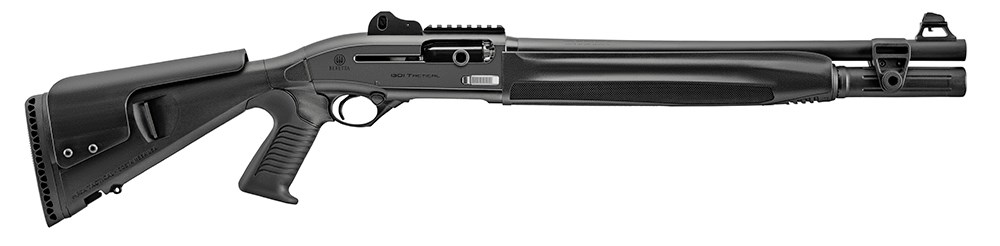
Beretta 1301 Tactical Enhanced
While Beretta is better known for its first-class over/unders and semi-automatics for the field and clay range, its 1301 Tactical is a cult-favorite among operators in the know. Over the years, Beretta’s BLINK gas-action system has proven to be as reliable as gas-action semis come, and it also lends the benefit of substantial recoil mitigation. Indeed, of all the guns listed here, the 1301 is likely the lightest recoiler. It’s more than that: The Tactical Enhanced version comes with everything to give home defenders an advantage when some lowlife kicks in the door. Key features include an 18.5-inch barrel, giant controls and a small accessory rail for mounting a flashlight. I don’t prefer the tall ghost ring sights that come on it, but they are not hard to replace. In sum, you can’t go wrong with this best-quality shotgun. MSRP: $1,499.

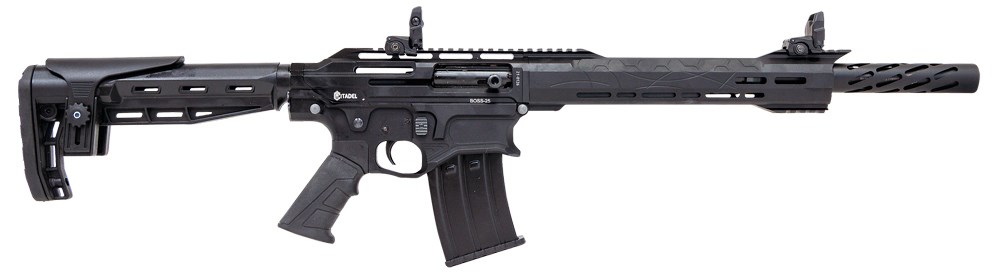
Citadel Boss 25
Citadel Boss 25
If you are used to shooting ARs and love them for their detachable magazines and modular, machined-aluminum feel, Citadel’s Boss 25 might be for you. This six-round, 8-pound semi-auto from Legacy International has all the features of an AR-15—including a collapsible stock, Picatinny rail with flip-up sights and AR-15-style controls—except that it shoots 12-gauge shells. Rounding out the Boss 25’s features are a chrome-lined barrel, textured fore-end and adjustable cheek rest. MSRP: $599.

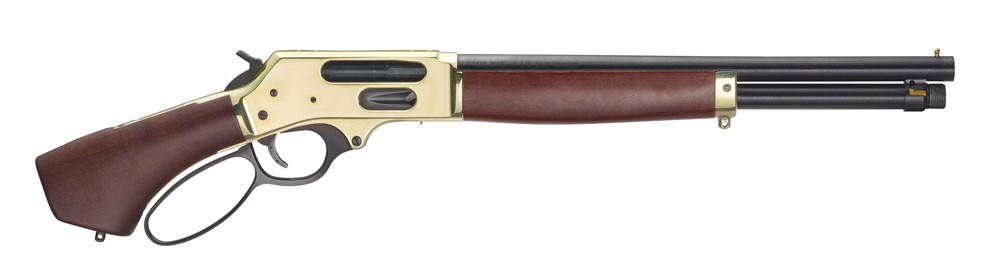
Henry Brass Axe .410
Perhaps the most unique item here is Henry’s new lever-action “firearm” that fires .410-bore shotshells, thereby qualifying it for this list. While some (this author included) question its viability as a home defender, I’d think this 26-inch, five-round novelty would be at home in a motorcycle saddlebag, strapped to a horse, mounted on an ATV or stashed away in a truck box for emergencies. What I know for sure is that it’s a hell of a lot of fun to shoot. MSRP: $1,132.

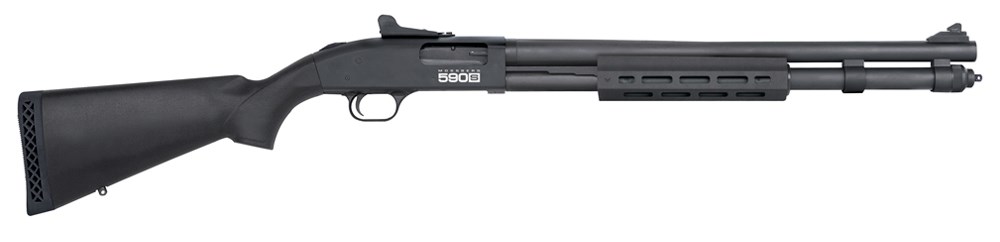
Mossberg 590S
Mossberg 590S
No doubt you’re aware of Mossberg’s workhorse 590 pump. It’s one of the best-selling shotguns of all time, because it’s inexpensive and because it goes bang every time. But lately, the trend in defensive shotguns is in recoil reduction, and the most effective way to do this without adding pounds to the gun is to lower the power of the shell. A few years back, Aguila introduced its 13/4-inch Minishell, but unfortunately, few if any repeating shotguns could reliably feed them. So, Mossberg responded with its 590S model that can. While we can debate the merits of the 1,200 fps, 5/8-ounce load all day long, what I know for certain is that if recoil is your biggest concern, the 590S so loaded with 14 mini-shells will address it. But, that doesn’t mean you must shoot these midget shells. Both the full-length-stocked 590S and the birdshead-grip Shockwave S will also handle regular 23/4- and 3-inch shells, in any order. MSRP: $731.

Mossberg 940 Pro Tactical
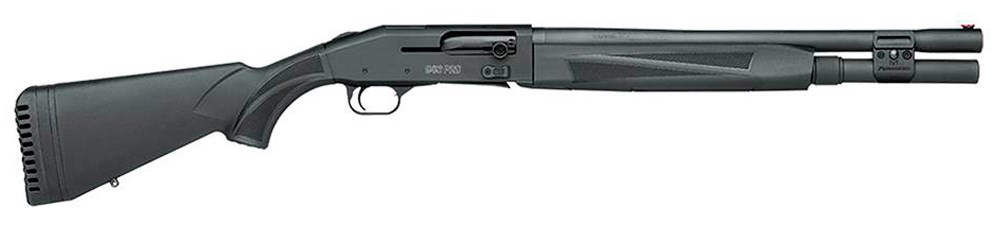
Mossberg’s welcome update to its semi-automatic 930 was first released in the form of its top-end competition shotgun promoted by Jerry Miculek, the 940 JM Pro. After testing this shotgun extensively, I really believe Mossberg hit a home run with it, what with its features that make it easy to shoot under pressure—like oversize controls and great recoil mitigation. But, the real advancement was more than cosmetic: Mossberg redesigned the gas system to handle many more shells (around 1,500) before cleaning, something the 930 certainly couldn’t boast. After releasing waterfowl and hunting models, for 2022 the privately owned American gun-making juggernaut released its 940 Tactical, and I’m really stoked about it. That’s because this thing holds eight rounds with its extended magazine, features a handy 18.5-inch barrel, Mossberg’s iconic tang safety, oversize controls, a flashlight mount and a front-bead sight along with an optics-ready top. MSRP: $1,120.

Standard Manufacturing SP12
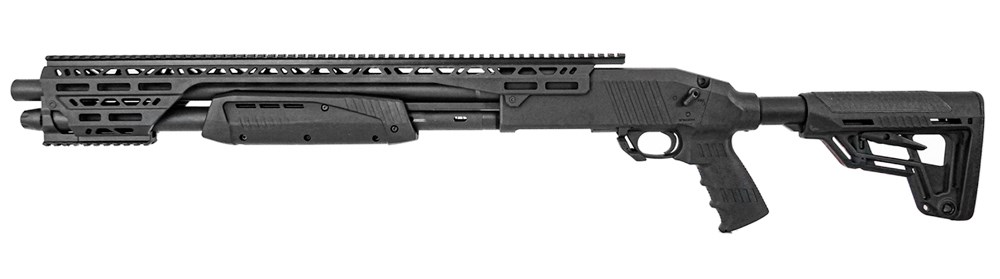
Standard’s SP12 looks like a shotgun from a bad zombie movie—and truth be told I haven’t tested it yet and so I can’t comment on its reliability—but no doubt its tactical look and myriad features will appeal to some, so it’s worth mentioning here. This 7-pound, seven-round shotgun’s claim to fame is that with its bottom loading/ejecting mechanism and dual-sided controls, it’s truly ambidextrous. Its huge top-mounted Picatinny rail requires the mounting of sights or optics, and I doubt that its collapsible AR-15-style stock does much in the way of recoil reduction. But hey, who am I to judge? MSRP: $799.

Winchester SXP Defender
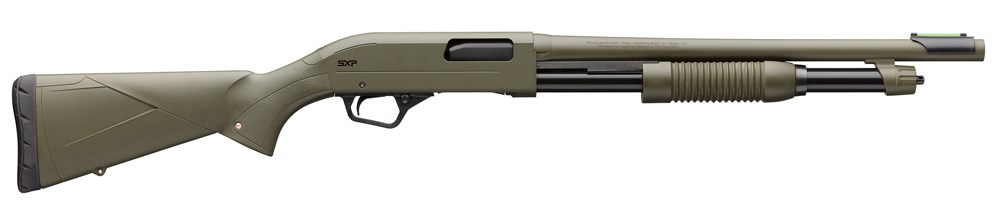
Like the 590, the SXP needs no introduction. Its spring-assisted, rotary-bolt design helped make this Winchester become known as the “speed pump,” because it actually self-initiates the pumping action. The gun holds six rounds total and is no frills, while also quite affordable. New models come with the company’s Perma-Coat Cerakote-like finish so you can leave the SXP in a closet and forget about it for long spells. If you’re a Winchester Model 12 guy, the SXP will feel very familiar, and familiarity is a huge asset when things go bump in the middle of the night. MSRP: $390.

Categories
All About Guns Useful Shit War

MACHINE GUNS HAVE THE MARINES TO THANK FOR THEIR ROLE IN WARFARE by Travis Pike

Ask any infantrymen in a line company about the value of a machine gun, and you might get a long, complicated answer based on years of training and practical experience. Or… you might get Private Snuffy telling you, “Machine gun good, machine-gun fire lots of bullets.” They’d both be right.

In the modern infantry, machine gunners utilize their weapons to lay down a wall of lead to pin down or destroy an enemy force. So, it may come as little surprise that the Marines appreciate these weapons so much that machine gunners get their own MOS (Military Occupational Specialty) separate from your average rifleman.

Remember the Maine. To Hell With Spain!

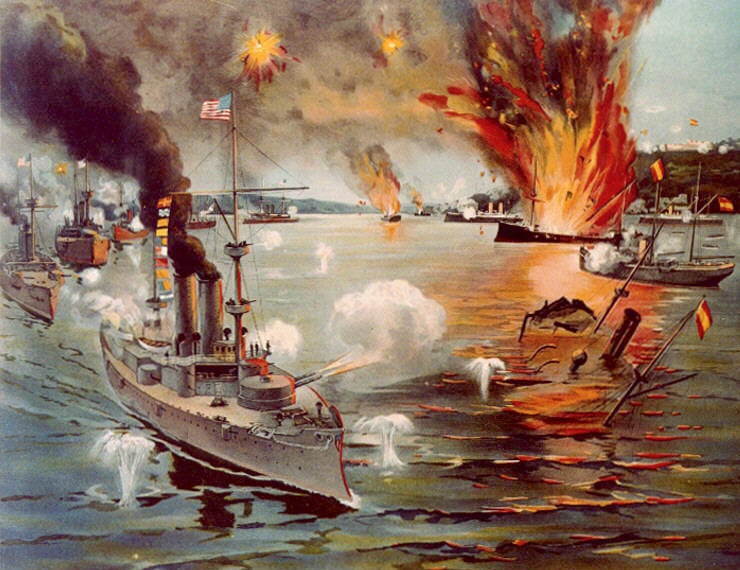
The Marines’ affinity for these lead-spreader makes sense, as the Corps helped shape the use of machine guns in modern conflict way back in 1898, during the Spanish-American War. After the U.S.S. Maine sank in Havana Harbor on February 15, 1898, calls of “Remember the Maine! To Hell With Spain” rang out across the country. And as luck would have it, the Marines were uniquely positioned to fight in this sort of war. Cuba, after all, is an island, and Marines excelled at ship to shore operations.

As such, the 1st Marine Battalion responded to the call and landed at Guantanamo Bay, Cuba, on June 10th, 1898. They landed unopposed and were the first American military unit to plant the flag of the United States on Cuban soil.

Hoisting the first American flag over Camp McCalla by Lieutenant Jenkins and men from the USS Abarenda (AC-13) at Palya de Este, Cuba on 12 June 1898.

Related: Suppressed machine guns: A worthwhile proposition

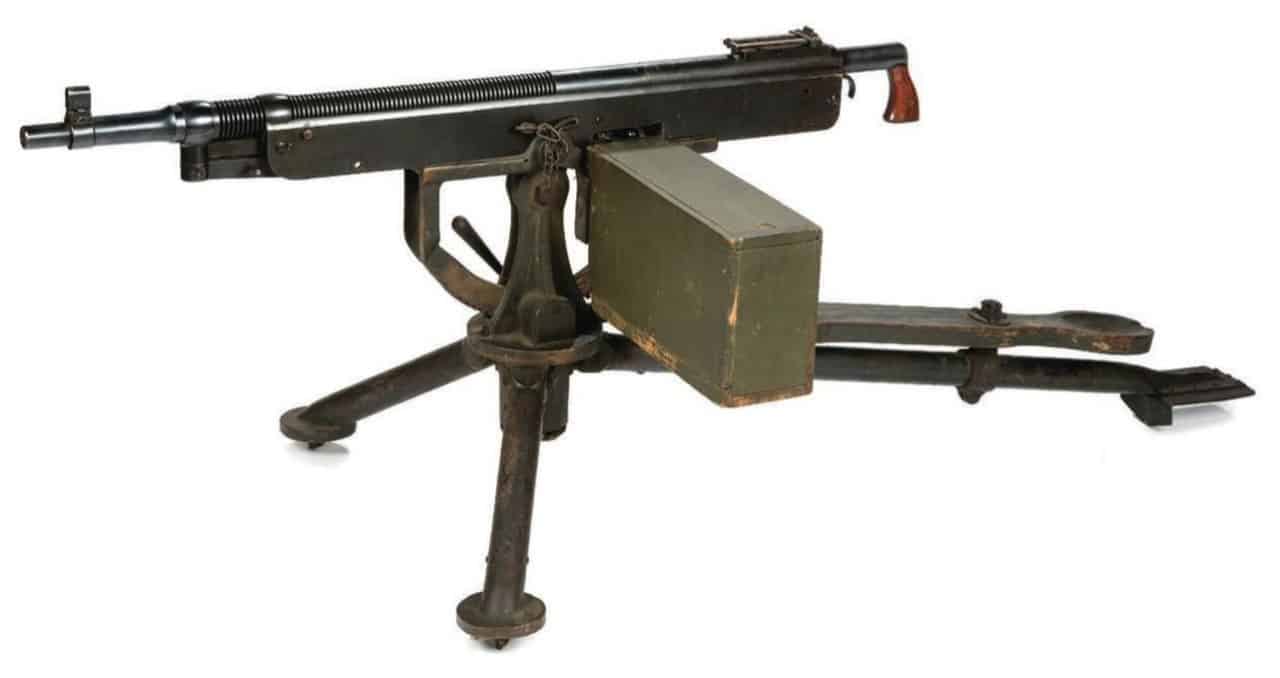
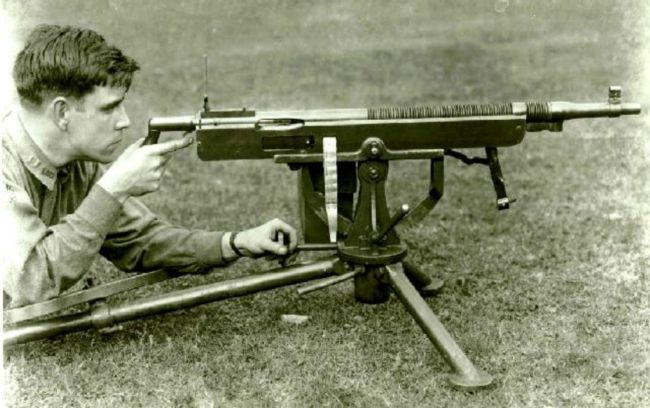
They did this before the Army had even left the United States. The relative peace they encountered upon their arrival didn’t last, and the Marines knew it wouldn’t. With them, they carried the new 6mm Lee Navy, a fantastic and modern rifle for the time. Alongside it, they carried the Colt-Browning Model 1895 machine gun, also in 6mm Lee Navy.

Both weapons were high-tech at the time. The rifle featured a straight-pull bolt and used a unique and rapid loading clip system. The M1895 was an early machine gun that gained the name potato digger due to the operating lever that cycled out of the bottom of the gun. The Colt-Browning was superbly modern and weighed 35 pounds, which was light compared to the 60 pound Maxim guns that were also available in this era.

At the time, the Army was still using mule pulled Gatling guns, and when compared, the M1895 might as well have been a space-age piece of technology. Its lighter and smaller nature allowed the Marines to actually carry the guns during various portions of the Battle For Guantanamo bay.

The Marine machine guns get some

The Marines carried four M1895 Colt-Browning machine guns to shore, and they became invaluable in the Battle for Camp McCalla. Camp McCalla was tactically unsound, and in hind sight it seems clear that Marine leadership fell prey to complacency. They didn’t expect a battle and didn’t bring their artillery company ashore. They didn’t dig trenches, and the camp was on open sand.

You can’t predict the Spanish inquisition, but Marine leaders should’ve predicted a Spanish attack. At daybreak, June 11th, the Spanish did just that, with guerillas attacking the camp in force.

Related: The Gatling Guns that led to Roosevelt’s Medal of Honor

The guerillas may have had the advantage, but the Marines had the machine guns. They fended them off and chased them until night fell. But the victory was to be short lived. The Spanish may have failed to take the beach in their first try, but they had a significant numerical advantage. By some accounts, Spanish forces outnumbered the Marines by more than five to one.

As wave after wave of Spanish guerillas attacked, the Marines dug in, got two additional machine guns set up, and unloaded their artillery.

They fought for 100 hours against the Spaniards and held their own despite their poor positioning and the overwhelming odds. On June 13th, a unit of 60 Cubans arrived to support the Marines, led by Lt. Col. Enrique Thomas. Soon thereafter, Thomas advised the Marine officers to attack the Cuzco Well, the only nearby source of freshwater, to force the Spanish into a retreat.

Machine Guns, Spaniards, and the Well

The Marines saddled up, and 160 of them, plus 50 Cubans, began their way to Cuzco Well on June 14th, 1898. They brought three of their four machine guns with them.

After fighting through the heat of the day, perilous terrain, and brutal undergrowth, the Marines arrived at the base of the steep hill around Cuzco Valley. Unfortunately, they arrived at almost the same time as a sizeable number of Spanish forces.

Their Cuban scouts were spotted by the enemy, and a race began to get to the top of the hill. In 2021, if the enemy has the high ground, you JDAM the high ground. In 1898, however, taking the high ground was the key to victory. The Spanish already outnumbered the Marines, so without securing the high ground, the American troops were as good as dead.

They assaulted up the hill, and the Marine’s M1895 Colt-Browning machine guns poured lead into the Spanish troops nearby. The light 6mm rounds made it easier for Marines to carry extra ammunition so they could afford to use their belt feds to their full advantage.

Related: Stinger: The DIY machine gun Marines yanked out of warplanes

Layin’ It Down

The machine guns laid down covering fire, supporting the Marine’s assault up the hill. Historically speaking, this was the first time Marines used machine guns to support an infantry assault. But in practical terms, the Marines grabbed M1895s and ran what we now consider to be a modern machine gun drill: Setting them up, shooting, then moving to continue support.

Since it weighed only 35 pounds, the Potato Digger moved easily. The machine guns acted as force multipliers for the Marines, and in fact, were a mobile assault force unto themselves.

In the end, the Marines defeated the Spanish, killing 60, wounding 150, and capturing 18 of them. On the winning side, two Cubans were killed in combat, with two Marines and two more Cubans wounded. The Marines destroyed the well and accomplished their objective.

The surviving Spanish fighters reported they had been attacked by 10,000 Americans, though the real figure was actually closer to 160. After that, Camp McCalla saw no further attacks by Spanish forces.

The Effect on Modern War

During the Battle of Guantanamo Bay, the machine gun established itself as a fight-changing weapon. Although the lessons learned in the Spanish-American war would be echoed on a massive scale in World War I a little more than a decade later, the Marines had proven that mobile machine guns were incredibly valuable, and when used properly, can inflict physical and moral damage upon an enemy.

To this day, Marine Machine gunners run gun drills where they rapidly set the machine gun in place with bipods, ammo, etc. They then take it down and do it again, over and over, much like the machine guns at Cuzco Well. To do this day, machine guns in the offensive are used to support infantry assaults and lay down suppressive fire. This allows riflemen to move quickly and swiftly to their objectives.

What occurred in 1898 still has a clear effect on the tactics of 2021.

Categories
All About Guns Hard Nosed Folks Both Good & Bad The Green Machine

Bert Waldron: Nature versus Nurture, A Sniper’s Story by WILL DABBS

On the surface, this just looks like some GI with a really nice Vietnam-era sniper rifle. To the VC in the Mekong Delta, however, SSG Bert Waldron was so much more.

“Many GIs in Vietnam thought the night belonged to the enemy, but in the Mekong Delta, darkness belonged to Bert Waldron.” –Major John Plaster

Fear in wartime is a profoundly powerful weapon. It invariably shapes the affairs of men.

Think back to the last time you felt truly frustrated and helpless. At some point in their lives, everybody finds themselves in circumstances utterly beyond their control. It’s a terrifying sensation.

These guys were some extraordinarily effective fighters until it got dark and SSG Bert Waldron went out hunting with his night vision-enabled M21 sniper rifle.

Perhaps you were the subject of bullying. Maybe you were a little kid and got lost. For the Vietcong in the Mekong Delta in 1969, the engine behind their nightmares was SSG Bert Waldron.

What began as a source of refuge and solitude from chaos eventually became a home of sorts for a young Bert Waldron.

SSG Waldron was a broken man imbued with a dark gift. Born in Syracuse, New York, in 1933, Waldron came of age amidst chaos and despair. The product of a dysfunctional home, young Bert despised his stepfather. This antipathy drove the kid into the nearby forest in search of peace and solitude. There Bert Waldron came to think of the wilderness as home.

The most successful sniper of the Vietnam War got his introduction to military service in a place like this.

Bert Waldron’s life could be a case study of the effects of nature versus nurture. By his 23rd birthday, the man had been married three times. His unique emotional milieu apparently made him all but impossible to live with. Waldron enlisted in the US Navy and served during the Korean War. He left the Navy in 1965 after twelve years to try his hand at civilian life.

Don’t let the youthful demeanor fool you. These guys were stone-cold killers.

With the country embroiled in an increasingly bitter land war in Southeast Asia and life out of uniform not to his liking, Waldron enlisted again, this time in the Army. He completed Basic Training at Fort Benning and five months later was in Vietnam.

The most successful US sniper in Vietnam had a mere eighteen days in a place like this to learn the rudiments of his craft.

Waldron’s prior service in the Navy earned him Staff Sergeant’s stripes, but he still had very little experience with practical soldiering. Once in country, SSG Waldron attended a brief eighteen-day sniper course taught by members of the Army Marksmanship Unit. I don’t know exactly what they taught during those two and one-half weeks, but it took. In short order, SSG Bert Waldron became a holy terror behind a sniper rifle.

These hulking Tango Boats also served as proper mobile sniping platforms.

SSG Waldron was assigned to the 3d Battalion, 60th Infantry, Regiment, 9th Infantry Division under LTG Julian Ewell. Operating in close conjunction with the Navy’s Mobile Riverine Force, SSG Waldron and his fellow snipers cruised the murky waterways of the Mekong looking for trouble. Waldron’s prior service as a sailor made him a perfect fit for this joint operation with the Brown Water Navy. More often than not Waldron staged onboard ATC’s or Armored Troop Carriers. These heavily armed and armored riverine vessels were called Tango Boats and offered US forces a prickly platform for operations throughout the myriad shallow waterways of the Mekong Delta.

Tourists pay money to visit the Mekong Delta today. Back in the 1960s, this idyllic piece of jungle was a killing ground.

The Mekong was heavily populated and teeming with VC. Charlie typically played to his own strengths, conducting many operations under cover of darkness when American air power and artillery support could not be readily brought to bear. Then Bert Waldrop and his snipers hit the battlefield with high-tech sniper rifles equipped with starlight scopes. The result was unfettered carnage.

War Stories

In addition to a few basic technical skills, a successful sniper needs courage, patience, and audacity. Bert Waldron had these gifts in spades.

It takes unimaginable courage to strike out alone into the jungle in the middle of a firefight, but that was exactly Bert Waldron’s forte. In January of 1969, Waldron and his unit came under intense night attack by a force of forty well-armed VC. When his unit found itself in danger of being overrun SSG Waldron pressed out into the jungle alone to hunt. Using his accurized M21 sniper rifle and AN-PVS-2 starlight scope he could spot the enemy maneuvering in the deep foliage and pick them off as opportunity allowed. During the course of the engagement, SSG Waldron savaged the attacking force and broke the back of the assault. This fight earned him a Bronze Star with “V” device.

The accurized M21 sniper rifle fitted with the AN/PVS-2 starlight scope represented the absolute state of the art in precision night sniper systems during the Vietnam War.

Three nights later SSG Waldron discovered a large VC force moving tactically. He tracked the enemy unit using his night vision system until he gained an advantageous position to attack. SSG Waldron then sniped and maneuvered, engaging from various angles to convince the VC they were facing a larger, more organized force. Three hours later he had killed eleven of the Cong and forced them to leave the field. This night’s work earned him the Silver Star.

Thanks to SSG Waldron and his fellow snipers the VC no longer owned the night.

Eight days later SSG Waldron and his spotter were set up near Ben Tre scanning the darkness around their rice paddy with their starlight equipment. They encountered a seventeen-man VC patrol and took out their lead scout as he emerged from the treeline. Calls for artillery support were denied because of a nearby friendly village. At a range of more than 500 meters and under cover of darkness SSG Waldron killed eight VC with eight rounds from his sniper rifle. The surviving members of the VC combat patrol melted back into the jungle to safety.

This skinny little guy was a holy terror on the VC.

Four days after that SSG Waldron was deployed in support of an ARVN unit in contact. He discovered a group of six VC attempting to outflank the ARVNs and gain a position of advantage. SSG Waldron then meticulously killed all six of the insurgents, picking them off one by one in the darkness with his sniper rifle and night vision gear.

The Distinguished Service Cross is the Army’s second highest award for gallantry. SSG Bert Waldron earned one twice.

In one nineteen-day period, SSG Bert Waldron conducted fourteen successful nocturnal sniper operations. For his dedication, valor, and ruthlessness he was awarded his first Distinguished Service Cross. By now the VC were beginning to appreciate that horrible feeling of helplessness. Where previously they could move and operate in the darkness with relative impunity, now SSG Waldron and his snipers brought death from unexpected quarters. Their efforts began to take a toll.

SSG Bert Waldron just had a gift for the dark art of military sniping.

SSG Waldron’s effectiveness as a sniper clearly spawned from some innate skill. He had only had eighteen days’ worth of formal sniper training. During one engagement a VC sniper was peppering a passing Tango Boat from the top of a coconut tree some 900 meters distant. While the boat’s crew struggled to find the hidden sniper with their heavy crew-served weapons, SSG Waldron killed the man with a single round from his M21 rifle…while the boat was in motion. The Physics behind making a one-round kill from a moving boat against a camouflaged adversary nearly a kilometer distant strains credulity. However, the details were verified.

SSG Waldron’s combat record stood until it was broken during the Global War on Terror by Navy SEAL sniper Chris Kyle.

For these and similar actions SSG Waldron was awarded his second Distinguished Service Cross. Waldron’s reputation exploded among both Allied forces and the Cong, earning him the respectful nickname Daniel Boone. After eight months in country, the 9th ID rotated home and SSG Waldron with them. By the time he left Vietnam Bert Waldron had 109 confirmed kills, fully 12% of all the kills logged by all of the division’s snipers. Until Navy SEAL sniper Chris Kyle broke his record in 2006, SSG Bert Waldron was the deadliest American sniper in history.

The Weapon

The M14 would have been earth-shattering in WW2. By Vietnam the design was already badly dated.

The Army adopted the M14 rifle as a replacement for the WW2-era M1 Garand in 1959. A gas-operated, magazine-fed design, the M14 really reflected the previous generation’s technology. At 44 inches long the M14 was found to be unduly bulky for the bitter close-range jungle fighting that characterized the war in Vietnam. By the mid-1960’s the M14 was being replaced in SE Asia by the lighter, more maneuverable M16.

The M21 began life as an accurized National Match version of the M14 service rifle.

The US Army is indeed a majestically cumbersome beast. In 1955 the US Army Marksmanship Training Unit (USAMTU) embarked on a quest to incorporate snipers into the Infantry squad. In the malaise of the early 1960s, this initiative was discontinued. However, the exigencies of combat in Vietnam renewed interest in the art. That exposed the need for a dedicated precision sniper rifle.

The approaches to sniper rifles by the Army and Marine Corps were fairly disparate. The Army’s M21 offered 20 rounds of on-demand semiautomatic firepower.

While the Marines were using modified bolt-action hunting rifles, the Army contracted with Rock Island Armory to build up 1,435 National Match M14 rifles with Redfield 3-9x Adjustable Ranging Telescope (ART) sights. The ART was the brainchild of 2LT James Leatherwood and included both range finding and bullet drop compensation in its mechanism. This new rifle was formally designated the XM21 and first issued in 1969. An improved version with a fiberglass stock was classified the M21 in 1975 and served until 1988 when it was replaced by the bolt-action M24.

The AN/PVS-2 starlight scope offered unprecedented capabilities to the sniper hunting at night.

The AN/PVS-2 starlight scope was the first truly successful man-portable passive night vision weapon sight fielded by the US Army. This device amplified ambient starlight to produce a usable image in the absence of an active IR emitter. While such stuff is commonplace today, it was radical indeed in 1967 when it was first deployed to Vietnam. When combined with the early SIONICS suppressors fielded in 1969 the AN/PVS-2 offered American snipers a literally unprecedented capacity to own the night in Vietnam.

The Rest of the Story

Bert Waldron struggled to find his niche in civilian life. Here he is seen on the left instructing at Mitch WerBell’s paramilitary training school in Georgia.

Like so many true professional warriors, Bert Waldron found himself ill-suited to peacetime life at home. He served as a senior instructor for the US Army Marksmanship Training Unit (USAMTU) until his discharge in 1970. Along the way he met Mitch WerBell III through the commander of the USAMTU, COL Robert Bayard. and accepted a position as a counter-sniper advisor with Cobray International, WerBell’s weird creepy paramilitary training school in Georgia.

Mitch WerBell was one serious piece of work. We have explored his story here at GunsAmerica before.

Mitch WerBell dabbled in overthrowing third world governments for a time and made quite a few enemies along the way. In 1975 COL Bayard was found murdered outside an Atlanta shopping mall. His killer was never apprehended. Throughout it all Bert Waldron’s name was a persistent fixture.

Bert Waldron was by all accounts a profoundly committed patriot and a truly exceptional soldier.

For the next two decades, Waldron worked in the shadows, plying the dark skills he mastered in Vietnam into a livelihood. Along the way his final marriage self-destructed and he was investigated by the FBI. In October of 1995, Bert Waldron died of a heart attack at age 62. His ex-wife Betty said this of him, “Bert was a wonderful soldier. He loved his country, he would have died for his country, but he had a lot of problems as a human being.”

Our great republic cannot prevail without such men as Bert Waldron.

Bert Waldron was a “Break Glass in Case of War” type of soldier. America desperately needs such men. It is simply figuring out what to do with them when the bullets aren’t flying that seems to be the perennial challenge.

Categories
Born again Cynic!

You have to be kidding right? (All you MIGHT see is the flash and then that’s it)

New York City’s emergency management office has come under scrutiny for a decision to air a public service announcement offering residents of the city advice on how to survive a nuclear weapons attack.
The office defended its decision on Wednesday, stating that the advertisement was meant to spread awareness of how to survive a nuclear attack in the event that a nuclear weapon was aimed at New York.
“There is no direct threat to the city but we felt it was important that we addressed this topic,” said Allison Pennisi, head of public information for NYC Emergency Management.
The 90-second advertisement, released online by the department on Monday, opens with a person saying: “So there’s been a nuclear attack. Don’t ask me how or why, just know that the big one has hit.”
It makes you wonder how fucked up the priorities of the people who are supposed to be in charge really are, doesn’t it? And you wonder why I have no faith at all in any of these so-called ‘civic leaders’
Categories
All About Guns

Greatest Pellet Gun ever made!! Sheridan Blue Streak

Categories
Fieldcraft Grumpy's hall of Shame

Some Shortcomings of Open Carry by Dan Reedy

Some Shortcomings of Open Carry

U.S.A. –-(AmmoLand.com)- Recently while I was at Petco, a man walked in, and he was quite a sight to see. This man was in his late 50’s to early 60’s, in decent shape. He wore green Condor BDU pants bloused on his black 511 Tactical boots, a black 2A moto tee was tucked into his BDU pants. On his hip was an openly carried Springfield XDS, with extended magazine, jammed into a Serpa holster. He was buying some dog food.

Immediately after paying, his head dives into his smartphone like his neck is a wet noodle. I watch him as he exits, and he remains like this all the way until he gets into his new Chevy Colorado. The man is almost is struck by two vehicles on his way through the parking lot, with him completely oblivious to the world around him. Bad gun, bad holster, bad outfit, bad mindset. Classic. I’ve seen guys like him dozens of times and it’s always something painfully similar to this.

Open Carry

Open carry is legal in my city. Open carry is your right in much of the country. For places where it isn’t, I think it should be. That being said, open carry is often a sign of incompetence, and I almost exclusively advise people against the practice. I’ve never seen anyone publicly open carry with good equipment, nor with any serious amount of awareness or training.

Time and time again it’s been proven that open carry does not deter threats, does not make you a good ambassador for our rights, and doesn’t give you an edge in a fight.

Open Carry As a Deterrent Against Crime

Open carry doesn’t deter people from attacking cops, and they actually have some level of training to defend against that on top of holsters designed to defeat a gun grab. In addition to training and quality retention holsters, police can call for backup in a jam. I doubt many of you, if any, can say the same thing.

Open Carry
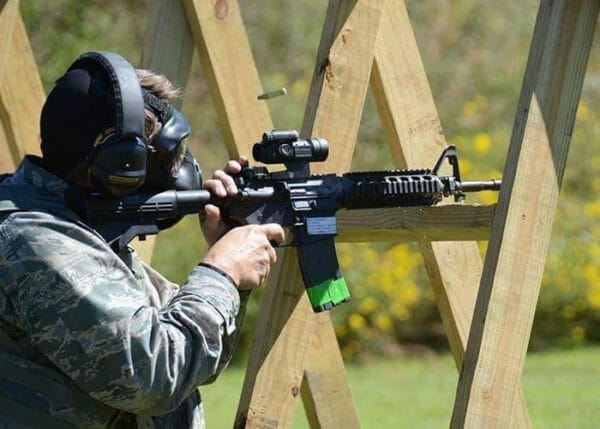
Even this former USMC grunt found himself confused on the rifle range. Imagine the non-existent pistol skills. Every Marine a Rifleman, or something.

Most people struggle to make effective hits on a stationary target or simply operate their gun under no stress. Trying to incorporate weapons retention, in-fight weapons access, and other skills without training doesn’t go well for the average shooter. Your conceal carry class, “been shooting all my life”, or an enlistment as an 11B/0311/3P0 doesn’t guarantee your effectiveness. Do you have the skills and equipment necessary to fight back against someone trying to take your openly carried firearm?

Fighting on Whose Terms?

Open carry also presents issues outside of the gunfight. Now you’re alerting everyone to the presence of your firearm, threat or not. This means it is automatically in play in any defensive encounter, not something you can choose to reveal or continue hiding based on the situation at hand. With the gun openly displayed, you are now someone who can be dealt with quickly, instead of you waiting for your moment to counterattack.

Open Carry
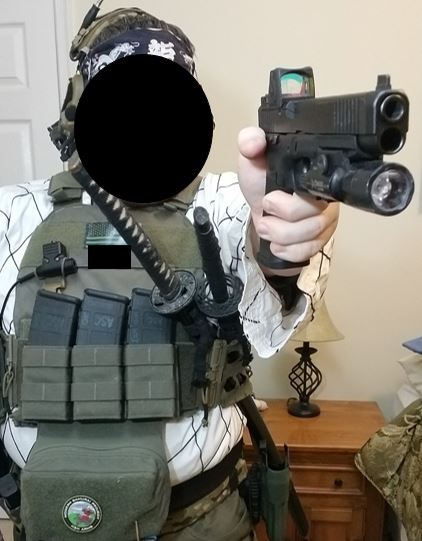
Most mall ninjas look more offensive than this Modern Samurai AND have a fraction of his training

Before someone says it, I know you’re talking out your ass when you say nobody would ever get the drop on you, or you never let anyone within XYZ distance of yourself. You and your Meal Team 6 ninja friends can go back to the land of Make-Believe to scare the children and soccer moms.

Man with a Gun

Don’t forget the potential for Karens or legitimately concerned citizens calling 911 with reports of “a man with a gun” at the sight of your openly carried pistol or long gun. That’s certainly not a situation I want to put myself in, and I live in a fairly gun-friendly area. Especially in light of recent mass casualty events, from movie theaters to grocery stores, schools, and more, concern for those armed in public continues to grow. Do you know what to do if someone were to call you in for a crime you didn’t commit?

Open Carry Exceptions

This piece is regarding open carry in public, occupied areas. Time spent hunting or on your private land is another matter, and not entirely relevant here. There are pros and cons to situations such as those, which is outside the scope of what we’re talking about today. I know someone would bring this up, which is why I’m addressing it here.

Parting Thoughts on Open Carry

Go get good training, read quality resources, and buy good equipment. If you don’t take my word for it, trust people like Greg Ellifritz, who has an awesome piece compiling over 60 recent examples of open carriers losing their guns or being killed due to carrying openly. He then goes on to link dozens of other articles where various experts like Massad Ayoob, Jeff Gonzales, and others give their opinions on the subject. You can read that >>HERE<<.

Alien Gear Rapid Force
Here we can see the GMR lever and the retention device of the Rapid Force

If you decide to open carry, do it in a Level 2 or 3 retention holster like those from Safariland, with a service grade pistol, and have significant training under your belt. Go take Jiu Jitsu, jump into an ECQC class, and find ways to enhance your situational awareness. Better yet, continue to study and train, but carry concealed in a quality holster like those from JM Custom Kydex, Tenicor, Raven Concealment, and others.


About Dan Reedy

Dan is an Air Force veteran, avid shooter, and dog dad. With a passion for teaching, he holds instructor certifications from Rangemaster, Agile Training & Consulting, and the NRA. He has trained with Darryl Bolke, Mike Pannone, Craig Douglas, among several other instructors, amassing over 400 hours of professional instruction thus far. In his spare time you’ll find him teaching handgun, shotgun, and less lethal classes.

Dan’s work has been published by Primer Peak, and The Kommando Blog, and he has been featured as a guest on Primary & Secondary.Dan Reedy headshot

Categories
N.S.F.W.

To my Great Readers have a Great Weekend! NSFW

Categories
All About Guns

A 2021 3″ Barrel Colt Python in caliber 357 Magnum

No photo description available.Now I do not know about you. But I am not a fan of the white grips on this model. Now if it was say Elk Horn that would be a different story. Any thoughts out there about this? Grumpy