Categories
Month: August 2018

Yep Teenage Boys! All they can think about is Sex and how they do not have any. Just remember that it is not their fault as they are suffering though a massive chemical overhaul at this stage of life.
Mom Nature can be mighty cruel at times!
Categories
Unannounced NSFW for my Loyal Readers!
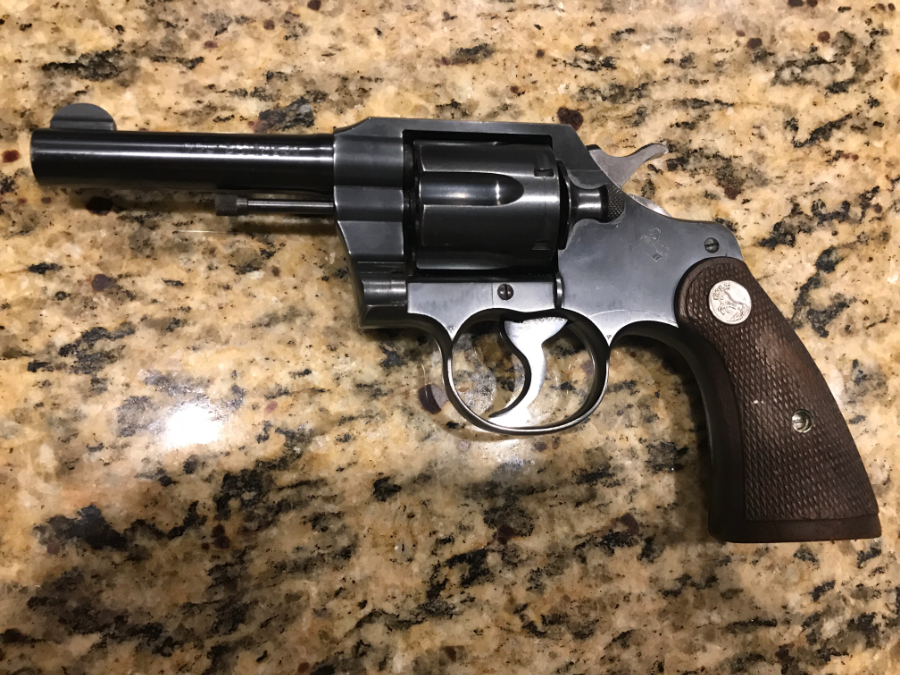
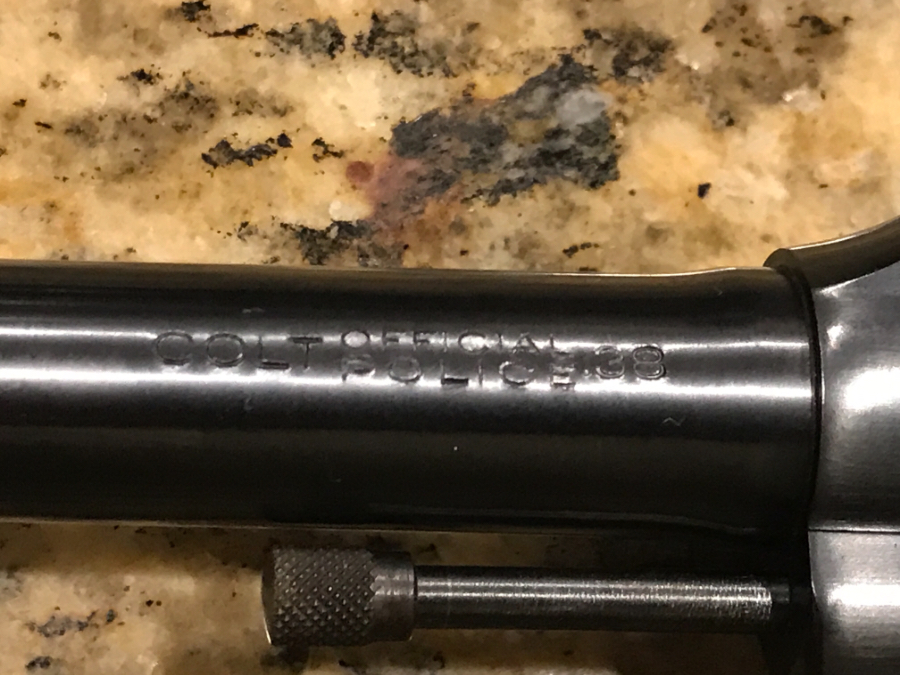
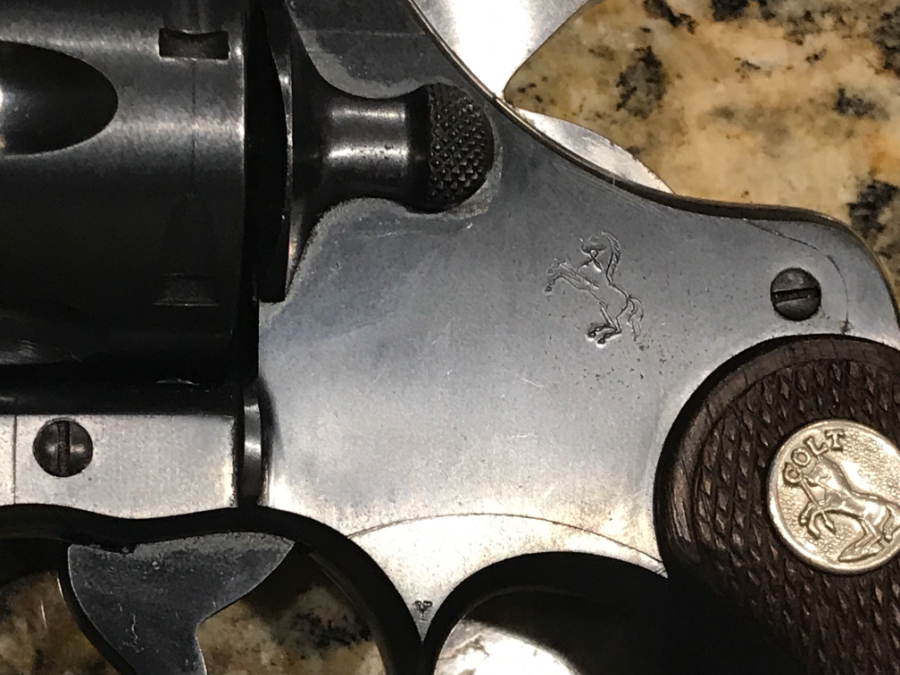
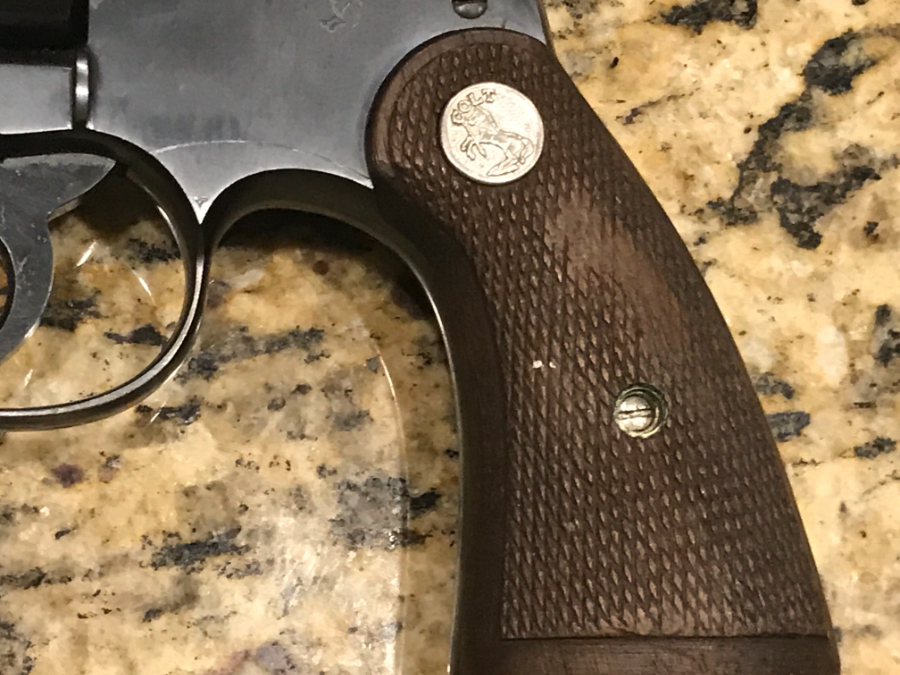
I like to think that the Zombie Fad just proved that Gun Folks also have a sense of humor too!
Grumpy
| July 11, 2011
Gun Skills & Safety, Manly Skills, Survival, Tactical Skills
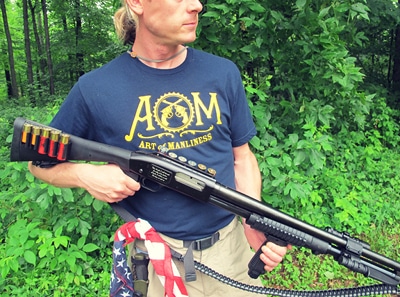
Editor’s note: This is a guest post from Creek Stewart of Willow Haven Outdoor.
As a Survival and Preparedness instructor, I take my line of work very seriously–sometimes too seriously. Occasionally, though, I like to take on survival projects that are just downright fun. This article highlights one of those projects.
I’m fortunate in that I’ve been able to turn my passion into my profession–this being the study of Survival and Preparedness. I’ve always enjoyed building survival kits of all shapes and sizes. I enjoy the challenge of fitting lifesaving survival necessities into small compact containers. I’ve built survival kits using film canisters, candy tins, key-rings, boxes, bottles, tubes, bags and everything in-between. For this project, I decided to build a survival kit using a shotgun platform–creating the Ultimate Survival Shotgun. My challenge was that everything had to be included in or on the gun itself–no extra pack items or containers. Below is what I did as well as the survival logic behind each decision.
Ultimately your survival needs fall into five main categories. Your situation dictates the order. They are:
- Water
- Fire
- Shelter
- Signaling
- Food
Every survival kit must include contents that directly or indirectly meet these five basic survival needs. The shotgun platform I decided to use is the Mossberg 500 – PUMP. I chose a pump action because it is easier for me to troubleshoot and work on in the field compared to other models. I chose the Mossberg brand because it is a very popular gun, and there are literally hundreds of aftermarket modification pieces and parts designed to fit this gun. I knew I would want to add on some of these extras to increase the gun’s survival value. Below is a photo of the shotgun “off the shelf”–before my survival modifications.
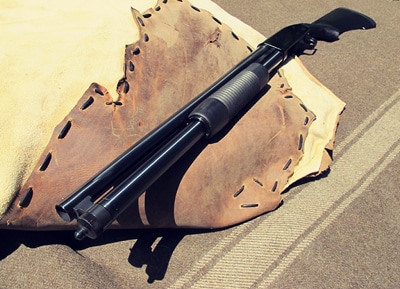
Mossberg 500 Pump Action Shotgun Before Survival/Zombie Modifications
I will now break down each survival modification and detail why it was included in the final build.
Ammunition
First things first: the gun itself. A shotgun’s primary purpose is hunting. Clearly, you can use this shotgun as a hunting weapon to “restock” on valuable calories. Humans can go for three weeks without food, but it’s not fun. Lack of food leads to light-headedness, weakness, and poor decisions. In a survival situation, meat is the fastest and most effective way to replenish lost calories. Meat comes in all shapes and sizes. Carrying different shot shells designed for different applications increases your chances of a successful hunt. For this reason, I chose to pack a variety of shotgun shells:
- Bird Shot: Designed for birds and other small game such as rabbit and squirrel.
- 00 Buck: Good for turkey and larger game such as deer.
- Slug: Designed for large game such as deer, hog, or elk.
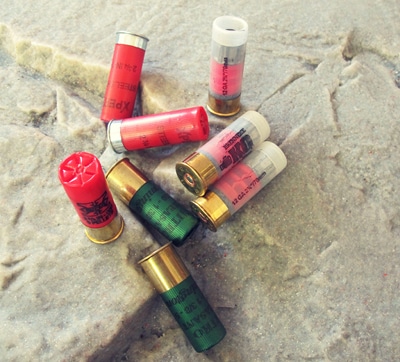
Your Arsenal: Bird Shot, Buck Shot, and Slugs
In addition to hunting, a shotgun is an excellent self-defense weapon. It’s easy to imagine the need for a self-defense weapon in an urban or wilderness survival scenario–defending you or your family from man or animal. Not only is a pump action shotgun a proven deterrent, but it also has some serious knockdown power. Because of these 2 considerations (hunting & self defense), I wanted to carry as much ammo on the gun as I could. I filled the magazine and the chamber which holds 7 + 1. I also added a side saddle shell holder and a screw on stock mount shell holder which together extends my total capacity to 19 rounds of ammunition. Not bad at all.
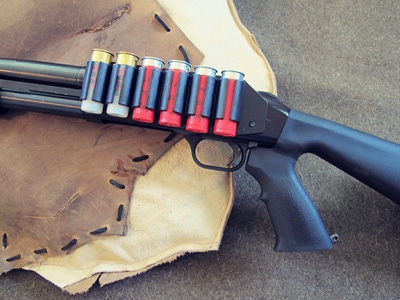
Side Saddle for Holding Shells

Side Saddle on the Stock
Signal Flares

Special shotgun shells allow you to fire signal flares.
You are probably wondering what the short orange rounds are on the stock side saddle. These are specialty signaling flare rounds designed for 12 gauge shotguns. These flares fire over 300 feet and can be seen for miles. They are the perfect signaling solution for a shotgun survival kit. Not only are these EXCELLENT rescue signals but they can also be fired into a prepared fire pit to start a fire. In survival, multi-use products are key.
Knife
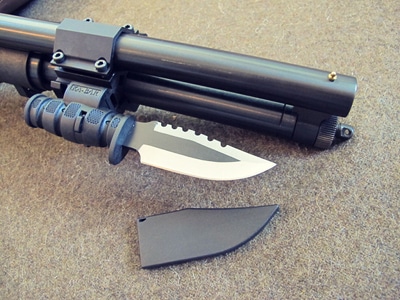
5” Ka-Bar Knife Mounted on a Picatinny Rail
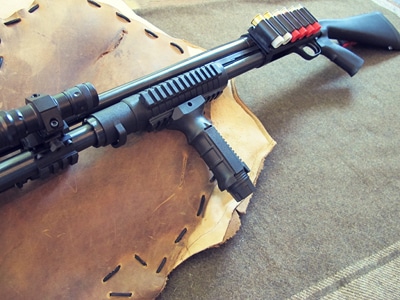
I know from experience that one of the most important survival resources is a good quality knife. It can assist in almost every survival related task. I found a great 5” Ka-Bar brand knife designed to mount directly to a picatinny rail. The stock Mossberg shotgun does not have picatinny mounts, so I purchased a barrel mount picatinny rail unit. This makes the knife easily accessible for quick deployment. A knife can perform thousands of survival tasks including dressing game, cutting wood and cordage, striking a fire steel, digging, scraping, prying, slicing, and the list goes on and on. I prefer a larger survival knife, but this one will work just fine. I sacrificed size for the seamless integrated mount option.
Flashlight
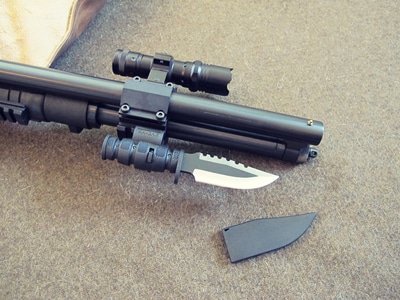
Another tool that assists in survival is a light source. Without a flashlight, low-light work or travel can be very difficult & dangerous–sometimes impossible. Not only can a flashlight allow you to be productive in low-light conditions, but it can also be used as a nighttime signaling device. A good flashlight can also help prevent injuries in dark conditions. I purchased a flashlight with a picatinny rail holder for the other side of my barrel. The push button switch on this flashlight is also a compass. Now, I have a means to confirm direction as well. This can certainly be useful in any survival scenario.
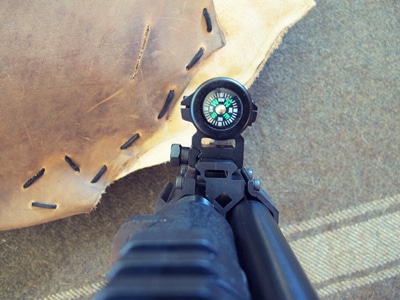
Flashlight/Compass combo will ensure you never get lost.
Storage
At this point I need to be thinking about storage space to house several other crucial survival items. After much consideration, I opted for 2 additional modifications which gave me 3 separate storage areas. I first replaced the standard stock with an integrated pistol grip/stock combo unit. The rubber butt plate unscrews and detaches, revealing a generously sized compartment inside of the stock.
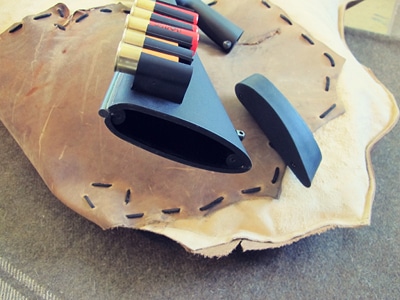
In addition, the pistol grip is hollow which allows for more storage.
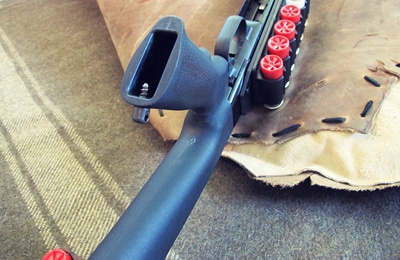
I went one step further and replaced the pump hand grip with a picatinny version mounted on a picatinny compatible vertical grip.
Fire
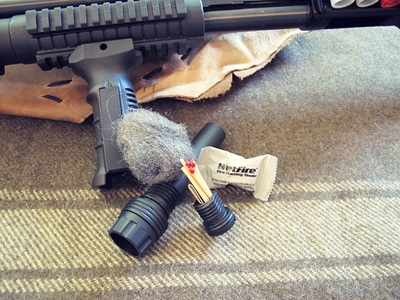
Fire kit that’s stored in the vertical grip.
This particular grip is already designed to store extra batteries and has a water tight seal. This makes an excellent area to store fire starting materials. In here, I stored 6 waterproof matches and a striker. I also stuffed in some steel wool and a package of WetFire brand fire starting material. Both of these are excellent fire starting aids even in damp conditions.

Quick Access Fire and Steel Setup
Before I started assembling items to be stored inside of the stock, I carved a groove along the top of the stock to fit a blank fire steel rod. I used epoxy to permanently secure this in place. I like the idea of having quick access to the fire steel without taking the time to open a storage area. Using the back side of the Ka-Bar, I can strike a shower of sparks into one of my fire starting materials to quickly ignite a fire.
Multi-Tool
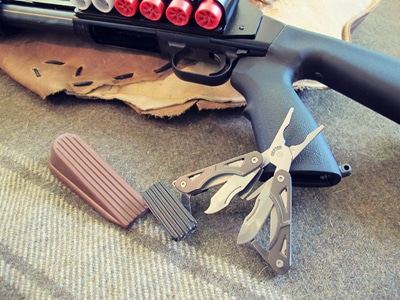
Store your multi-tool in the hollow pistol grip.
In the hollow pistol grip I stored a small Gerber Multi-Tool with pliers, large flathead screwdriver, small flat head screwdriver, cross point screwdriver, small knife, nail file, and tweezers. All of these tools can be useful in a survival situation. I carved a custom rubber plug for the bottom of the pistol grip from a cheap rubber door stop and spray painted it black. It is a perfect and secure fit.
Survival Kit
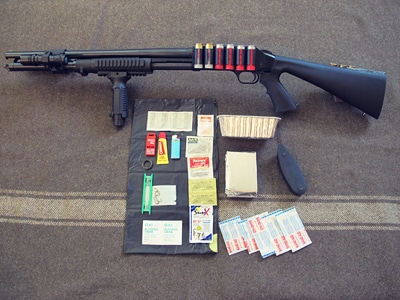
A survival kit that fits in the butt stock of your shotgun.
Next I assembled a variety of survival kit items to be stored in the butt stock compartment. To remove the rubber butt plate, I use the cross point driver on the multi-tool. Below are the items that I included in this kit and why.
- 4”x6” Aluminum Baking Pan: Available at any grocery store, this aluminum bread pan can be folded flat for compact storage. A metal container is invaluable in any survival scenario. It can be used to boil water which kills bacteria, virus, and cysts. Boiling water is a 100% effective method of water purification. This container can also be used for other cooking tasks as well as water collection. The reflective metal also makes an excellent signaling device.
- Trash Bag: A trash bag has a myriad of survival uses. Some of the most practical are poncho, water collection, ground tarp, make-shift shelter, solar still, and flotation device.
- Fishing Kit: This kit includes 20 feet of 30 lb test line, 5 assorted fish hooks and 3 sinkers. Not only can these items be used for fishing but the line can also be used as cordage for shelter building, gear repairs, or animal snares. Bank lines can be set at night to work while you rest.
- 2 Non-Lubricated Condoms: By design, condoms are watertight. They make amazing water containers–capable of holding about 1 liter of water each. They are very lightweight and compact and make great back-up water collection and storage containers. They can also be used to protect fire materials such as matches and dry tinder. You can also fill these with clear (but not purified) water and leave them in the sun for 48 hours for UV purification.
- Water Purification Tablets: Boiling water is not always possible or practical. Chemical water treatment tablets are an excellent back-up water purification solution. They weigh virtually nothing and take up very little space. You can fill up a condom with water and use a tablet to purify it. They also have a very long shelf life. Chemical tablets are not very effective on cloudy or dirty water. The water must be fairly clear. You can pre-filter using clothing or a bandana.
- Emergency Survival Blanket: These survival blankets are designed to reflect and trap your body heat in a cold weather survival scenario. They also make excellent make-shift shelters, ground tarps, ponchos, rescue signals, and fire heat reflectors.
- First Aid Supplies: (packed in zip lock bag): 3 adhesive bandages, 30 SPF sun block packet, 2 wound closure strips, 2 Ibuprofen pills, 2 Acetaminophen pills, 2 Calcium Carbonate pills.
- Carmex Lip Balm: Not only for obvious reasons, but this petroleum based product can be mixed with natural fire tinder such as cattail down. Doing so can extend burn-time up to 5 minutes which is very helpful in fire building. This is an excellent multi-use product.
- Whistle: Even though I have signal flares, a rescue whistle is always a good idea.
- Small Bic Lighter: This is the easiest way to start a fire.
- Snare Wire: Snares can work for you while you are working on other tasks–such as sleep. I’ve included 25 feet of snare wire for building traps. This can also be used as cordage or binding for a variety of projects.
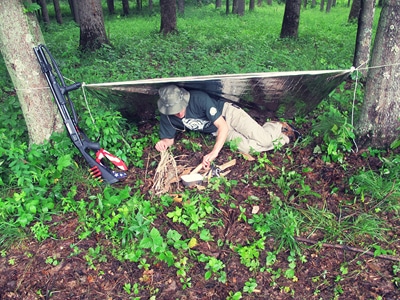
Emergency blanket in survival kit can be used for shelter.
I carefully wrapped most of the items inside of the trash bag for water proofing and then stored everything in the stock storage area. All of the kit items only weigh a few ounces.
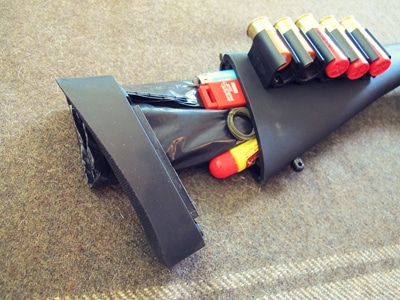
What the survival kit looks like in the butt stock.
Saw
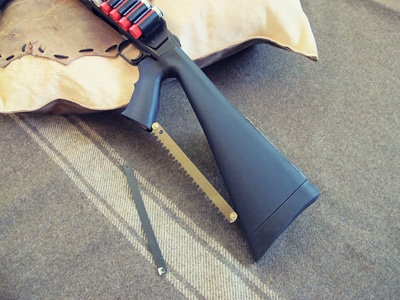
Makeshift Survival Saw
One tool that I use extensively while on survival trips is a handheld folding saw. It’s not practical to include one of these in this shotgun kit. However, I did incorporate a suitable work-around. A saw is an excellent tool for cutting larger fire wood or collecting limbs & trees for shelter building. I purchased 2 replacement bow saw blades and cut them down to fit the span between the back of the pistol grip and the butt stock sling stud. I added another sling stud to the bottom back of the pistol grip which allowed for 2 anchor points. Using 2 small bolts which I keep in the stock, I can secure 1 of the saw blades on these sling studs–creating a perfect make-shift bow saw. I chose to pack 1 blade designed for wood and 1 blade designed for metal to give me versatility in a variety of survival scenarios. The blades easily tuck into the butt stock compartment when not in use.
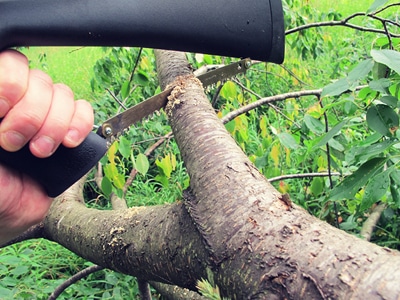
Saw in action.
Cordage
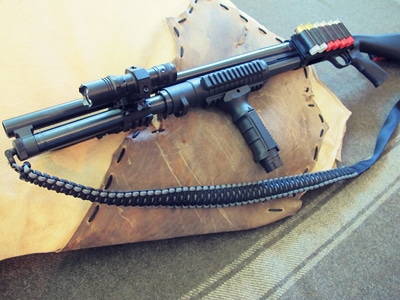
Make your gun sling from braided paracord.
At this point I am still lacking sufficient cordage. Never underestimate how important cordage can be in a survival scenario. My favorite cordage is 550 Parachute Cord. I always like to keep as mush 550 paracord with me as possible. It can be used for all kinds of survival functions from climbing ropes to shelter construction. 550 paracord is comprised of 7 inner strands which can be used independently as well. These lines make excellent snares and fishing line. For this reason, I also added a shotgun sling made from approximately 80 feet of braided paracord. If necessary I can unravel the sling and use it accordingly.

Another view of the paracord gun sling
Bandana
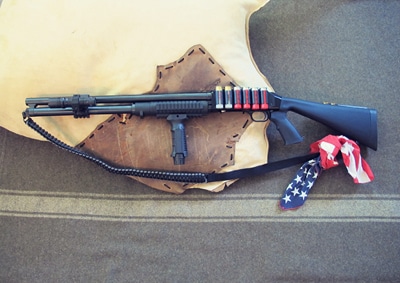
I finished off the sling by tying on a bandana. I have used a bandana in more ways than I can count while camping and backpacking. It is an incredible multi-use product that I know for a fact would be very useful in a survival situation. Below are just 15 great bandana survival uses:
- Filter/Sieve for dirty water
- First Aid Bandage
- Dust/Sand Mask
- Hat
- Signal Flag
- Dew Rag for collecting dew as drinking water
- Container for collecting berries, fruit, nuts, etc…
- Cut/striped into emergency cordage
- Cleaning Rag
- Neck Gator – Cool Weather
- Evaporative cooling neck band – Hot Weather
- Filter for Bush Tea (filtering out seeds, leaves, bark, etc…)
- Eskimo sunglass to prevent sun blindness. Cut eye slits in the bandana.
- Trail Markers – strip into pieces
- Last ditch toilet paper
Locked and Loaded

So there you have it, the Ultimate Survival Shotgun ready for even the worst scenario. It offers multiple solutions for securing food. It offers multiple solutions for collecting and purifying water. It offers incredible signaling devices. It includes shelter building materials and also several “fool-proof” fire building methods. It also includes a knife, a flashlight, 80 feet of paracord, 2 saws, and a complete first aid kit. If the zombies still eat your brains when you’re carrying this thing, it’s your own dang fault.
Inspiration
However, it is still missing one very critical piece. Survival is 90% mental. Keeping your morale and spirits high is absolutely critical. Finding your inspiration and motivation for staying alive can get you through even the worst of situations. The will to live is more powerful than any skill or tool you can buy or improvise. I always include something personal in every survival kit I build–an item that might keep my spirits lifted and remind me of what I’m fighting for. It can be anything–a photo of your girlfriend or your family, a song lyric or a motivational quote. It must be meaningful and inspirational to you.
So finally, for inspiration, I had one of my favorite passages engraved on a small metal plate which I affixed to the receiver of this survival shotgun:

Now…I’m all set.
Many of the lessons in this project apply to building any kind of preparedness kit for urban or wilderness survival. Basic survival principles apply to almost all survival scenarios. I hope you’ve enjoyed this article and have taken something away that you can use in your own preparedness efforts and projects.
Remember, it’s not IF but WHEN.
Creek
Addendum: Many have asked about the weight of the gun and where you can get the modifications mentioned. Before the modifications, the gun weighed 7.5 pounds, after the modifications it weighs 9.5 lbs. For a list of where you can get the supplies, click here.
____________________________________
Creek Stewart is a Senior Instructor at the Willow Haven Outdoor School for Survival, Preparedness & Bushcraft. Creek’s passion is teaching, sharing, and preserving outdoor living and survival skills. Creek is also the author of the book Build the Perfect Bug Out Bag: Your 72-Hour Disaster Survival Kit. For more information, visit Willowhaven Outdoor.
Attachments area


| Sten, Submachine gun | |
|---|---|

Sten Mk. II (trigger mechanism cover is missing)
|
|
| Type | Submachine gun |
| Place of origin | United Kingdom |
| Service history | |
| In service | 1941–1960s |
| Used by | See Users |
| Wars | World War II Warsaw Uprising Second Sino-Japanese War Chinese Civil War Indonesian National Revolution Malayan Emergency Korean War Mau Mau Uprising Suez Crisis 1948 Arab-Israeli War Sino-Indian War First Indochina War Vietnam War Laotian Civil War Lebanese Civil War Rhodesian Bush War Turkish invasion of Cyprus Indo-Pakistan Wars IRA Border Campaign The Troubles Punjab insurgency |
| Production history | |
| Designer | Major Reginald V. Shepherd Harold J. Turpin |
| Designed | 1940 |
| Manufacturer | Royal Small Arms Factory Enfield BSA ROF Fazakerley ROF Maltby ROF Theale Berkshire Lines Brothers Ltd Long Branch Canada (plus numerous sub-contractors making individual parts). Various Underground Resistance Group Factories. |
| Produced | 1941– (version dependent) |
| No. built | 3.7–4.6 million (all variants, depending on source) |
| Variants | Mk. I, II, IIS, III, IV, V, VI Unit Cost $10 or £2.3 in 1942 |
| Specifications | |
| Weight | 3.2 kg (7.1 lb) (Mk. II) |
| Length | 760 mm (30 in) |
| Barrel length | 196 mm (7.7 in) |
|
|
|
| Cartridge | 9×19mm Parabellum |
| Action | Blowback-operated, Open bolt |
| Rate of fire | version dependent; ~500-600 round/min |
| Muzzle velocity | 365 m/s (1,198 ft/s) 305 m/s (1,001 ft/s) (suppressed models) |
| Effective firing range | 100 m |
| Feed system | 32-round detachable box magazine |
| Sights | fixed peep rear, post front |
The STEN (or Sten gun) was a family of British submachine gunschambered in 9×19mm and used extensively by British and Commonwealth forces throughout World War II and the Korean War.
They were notable for having a simple design and very low production cost, and so also making them effective insurgency weapons for resistance groups.
STEN is an acronym, from the names of the weapon’s chief designers, Major Reginald V. Shepherd and Harold Turpin, and ENfor Enfield.[1][2] Over four million Stens in various versions were made in the 1940s.
Contents
- 1History
- 2Design
- 3Variants
- 3.1Mark I
- 3.2Mark I*
- 3.3Mark II
- 3.4Mark II (Canadian)
- 3.5Mark III
- 3.6Mark V
- 3.7Mark VI
- 3.8Suppressed models
- 3.9Experimental models
- 3.10Foreign-built variants and post 1945 derivatives
- 3.10.1Argentine Sten
- 3.10.2Palestininian Mandate Stens
- 3.10.3French Sten
- 3.10.4Norwegian Sten
- 3.10.5Danish Sten
- 3.10.6Polish Sten
- 3.10.7Belgian Sten MkII
- 3.10.8Gerät Potsdam
- 3.10.9German MP 3008
- 3.10.10Austen Mk I
- 3.10.11Imperia submachine gun
- 3.10.12Sputter Gun
- 3.10.13Halcon ML-57
- 3.10.14International Ordnance MP2
- 3.10.15Cellini Dunn SM-9
- 3.10.16Pleter 91
- 3.10.17SaskSten
- 4Service
- 5Users
- 6Gallery
- 7References
- 8External links
History[edit]
The Sten emerged while Britain was engaged in the Battle of Britain, facing invasion by Germany. The army was forced to replace weapons lost during the evacuation from Dunkirk while expanding at the same time. Prior to 1941 (and even later) the British were purchasing all the Thompson submachine guns they could from the United States, but these did not meet demand. American entry into the war at the end of 1941 placed an even bigger demand on the facilities making Thompsons. In order to rapidly equip a sufficient fighting force to counter the Axis threat, the Royal Small Arms Factory, Enfield, was commissioned to produce an alternative.
The credited designers were Major R. V. Shepherd, OBE, Inspector of Armaments in the Ministry of Supply Design Department at The Royal Arsenal, Woolwich, (later Assistant Chief Superintendent at the Armaments Design Department) and Mr. Harold John Turpin, Senior Draughtsman of the Design Department of the Royal Small Arms Factory (RSAF), Enfield. Shepherd had been recalled to service after having retired and spending some time at BSA.
The Sten shared design features, such as its side-mounted magazine configuration, with the Royal Navy‘s Lanchester submachine gun, which was a copy of the German MP28. In terms of manufacture, the Lanchester was entirely different, being made of high-quality materials with pre-war fit and finish, in stark contrast to the Sten’s austere execution. The Lanchester and Sten magazines were even interchangeable (though the Lanchester’s magazine was longer with a 50-round capacity, compared to the Sten’s 32-round capacity).
The Sten used simple stamped metal components and minor welding, which required minimal machining and manufacturing. Much of the production could be performed by small workshops, with the firearms assembled at the Enfield site. Over the period of manufacture the Sten design was further simplified: the most basic model, the Mark III, could be produced from five man-hours of work. Some of the cheapest versions were made from only 47 different parts. It was distinctive for its bare appearance (just a pipe with a metal loop for a stock), and its horizontal magazine. The Mark I was a more finely finished weapon with a wooden foregrip and handle; later versions were generally more spartan, although the final version, the Mark V, which was produced after the threat of invasion had died down, was produced to a higher standard.
The Sten has been described as: highly unreliable, prone to jamming, and inaccurate beyond 30 meters. It was unsuitable for guerrilla operations in open country because it encouraged waste of ammunition. But it was easy and cheap to produce – a gun was said to cost fifteen shillings (three quarters of a pound) – and was supplied to the (French) Resistance in huge quantities.[3]
The Sten underwent various design improvements over the course of the war. For example, the Mark 4 cocking handle and corresponding hole drilled in the receiver were created to lock the bolt in the closed position to reduce the likelihood of accidental discharges inherent in the design. Most changes to the production process were more subtle, designed to give greater ease of manufacture and increased reliability. Build quality ranged from quite good (Canadian production) to poor (early British production.) Sten guns of late 1942 and beyond were, in general, highly effective weapons, though complaints of accidental discharge continued throughout the war.
The Sten was replaced by the Sterling submachine gun from 1953 and was gradually withdrawn from British service in the 1960s. The other Commonwealth nations made or adopted their own replacements.
Design[edit]
The Sten was a blowback-operated submachine gun firing from an open bolt with a fixed firing pin on the face of the bolt. This means the bolt remains to the rear when the weapon is cocked, and on pulling the trigger the bolt moves forward under spring pressure, stripping the round from the magazine, chambering it and firing the weapon all in the same movement. There is no breech locking mechanism, the rearward movement of the bolt caused by the recoil impulse is arrested only by the mainspring and the bolt’s inertia. The basic operating principles were similar to those of the German MP40, Russian PPSh-41, US M3 submachine gun and numerous other designs. These shared similar attributes and faults; they were simple and cheap to manufacture, and put an automatic weapon into the hands of soldiers, greatly increasing the short-range firepower of the infantry, especially when the main infantry weapon was a bolt-action riflecapable of only around 15 rounds per minute and not suited for short-range combat. However, the open-bolt firing and use of pistol ammunition severely restricted accuracy, with an effective range of around 100m.
Stoppages could occur due to a variety of problems: some as a result of poor maintenance, while others were particular to the Sten. Carbon buildup on the face of the breech[4] or debris in the bolt raceway could cause a failure to fire, while a dirty chamber could cause a failure to feed.[5] Firing the Sten by grasping the magazine with the supporting hand tended to wear the magazine catch, altering the angle of feed and causing a failure to feed – the correct method of holding the weapon was as with a rifle, the left hand cradling the fore piece, as per the picture of Winston Churchill firing one below.
Additional problems stemmed from the Sten’s magazine, which was a direct copy of the one used in the German MP-38, originally in order to facilitate the use of German 9 mm magazines.[6] Unfortunately, this decision necessarily incorporated the Erma magazine’s faults in the process. The magazine had two columns of 9 mm cartridges in a staggered arrangement, merging at the top to form a single column. While other staggered magazines, such as the Thompson, fed from both the left and right side alternately (double-column, double feed), the Sten magazine, like the MP38, required the cartridges to gradually merge at the top of the magazine to form a single column (double column, single feed). As a consequence, any dirt or foreign matter in this taper area could cause feed malfunctions. Additionally, the walls of the magazine lip had to endure the full stresses of the rounds being pushed in by the spring. This, along with rough handling could result in deformation of the magazine lips (which required a precise 8° feed angle to operate), resulting in misfeeding and a failure to fire.
Modern 9 mm magazines, such as those used by the Sterling SMG, are curved and feed both sides to avoid this problem. If a Sten failed to feed due to jammed cartridges in the magazine, standard practice to clear it was as follows: remove magazine from Sten, tap the base of the magazine against the knee, re-insert magazine in Sten, then recocking the weapon and firing again as normal.[5] To facilitate easier loading when attempting to push the cartridges down to insert the next one, a magazine filler tool was developed and formed part of the weapon’s kit.
The slot on the side of the body where the cocking knob ran was also a target of criticism, as the long opening could allow foreign objects to enter. On the other hand, a beneficial side-effect of the Sten’s minimalist design was that it would fire without any lubrication.[5] This proved useful in desert environments such as the Western Desert Campaign, where oil attracted and retained dust and sand.
The open bolt design combined with cheap manufacture and rudimentary safety devices also meant the weapon was prone to accidental discharges, which proved hazardous. A simple safety could be engaged while the bolt was in the rearwards (cocked) position. However, if a Sten with a loaded magazine, with the bolt in the closed position, was dropped or the butt was knocked against the ground, the bolt could move far enough rearward to pick up a round (but not far enough to be engaged by the trigger mechanism) and the spring pressure could be enough to chamber and fire the round. The Mk 4 cocking handle was designed to prevent this by enabling the bolt to be locked in its forward position, thereby immobilising it. Wear and manufacturing tolerances could render these safety devices ineffective.
Variants[edit]
Sten guns were produced in several basic marks (though the Mk I saw limited service, and the Mk IV was never issued), and nearly half of the total produced were Mark II versions. Approximately 4.5 million Stens were produced during the second world war.
Mark I[edit]
The first ever Mk I Sten gun (number ‘T-40/1’ indicating its originator Harold Turpin, the year 1940 and the serial number “1”) was handmade by Turpin at the Philips Radio works at Perivale, Middlesex
The first model had a conical flash hider and fine finish. It had a wooden foregrip and forward handle (sometimes this was made of steel), as well for a section of the stock. The stock was a small tube outline, rather like the Mark II Canadian. One unique feature was that the front pistol grip could be rotated forward to make the firearm easier to stow. The barrel sleeve extended all the way to the end, where it met the flash hider. Along the top of the tube surrounding the barrel was a line of small holes and its sights were configured somewhat differently. About 100,000 were made before production switched to the Mark II. Sten Mk I’s in German possession were designated MP 748(e), the ‘e’ standing for englisch.
Mark I*[edit]
This was the first simplification of the Mk I. The foregrip, the wooden furniture and the flash hider were removed for production expediency.[8]
Mark II[edit]
The Mark II was the most common variant, with two million units produced. It was a much rougher weapon than the Mk I. The flash eliminator and the folding handle (the grip) of the Mk I were eliminated. A removable barrel was now provided which projected 3 inches (76 mm) beyond the barrel sleeve. Also, a special catch allowed the magazine to be slid partly out of the magazine housing and the housing rotated 90 degrees counter-clockwise (from the operator’s perspective), together covering the ejection opening and allowing the weapon and magazine both to lie flat on its side.

Winston Churchill with a Sten Mk II in Shoeburyness on 13 June 1941.
The barrel sleeve was shorter and rather than having small holes on the top, it had three sets of three holes equally spaced on the shroud. To allow a soldier to hold a Sten by the hot barrel sleeve with the supporting hand, an insulating lace-on leather sleeve guard was sometimes issued.[9] Sten Mk II’s in German possession were designated MP 749(e), the “e” signifying “englisch”. Some Mk IIs were fitted with a wooden stock as this part was desirable and interchangeable with the Mk V. Also, the Spz-kr assault rifle uses the receiver and components from the Sten Mk II.
Regular Mark II:
- Overall length: 762 mm (30.0 in)
- Barrel length: 197 mm (7.8 in)
- Weight: 3.2 kg (7.1 lb)
Mark II (Canadian)[edit]
During World War II a version of the Sten gun was produced at the Long Branch Arsenal in Long Branch, Ontario now part of Toronto, Ontario. This was very similar to the regular Mark II, with a different stock (‘skeleton’ type instead of strut type) and improved quality of manufacture. It was first used in combat in the Dieppe Raid in 1942.

Worker posing with a Sten Mk II in the factory on 26 May 1942.
Mark II:
- Overall length: 896 mm (35.3 in)
- Barrel length: 198 mm (7.8 in)
- Weight: 3.8 kg (8.4 lb)
Mark III[edit]
This simple design was the next most commonly produced after the Mark II. A result of the manufacturer Lines Bros Ltd stating it could build a modified design that was quicker and cheaper to build than the Mk II, it was a simplification of the Mk I made both in Canada and the UK. Lines Bros Ltd was the largest manufacturer. The biggest difference from the Mark II was the unification of the receiver, ejection port, and barrel shroud that now extended farther up the barrel. The barrel was fixed and the body was welded shut along the centre of the top. Captured Sten Mk IIIs in German possession were designated MP 750(e).
Mark V[edit]

British paratroopers in Oosterbeekduring Operation Market Gardenarmed with the Sten Mk V.
Introduced in 1944, the Mk V was essentially a better-quality, more elaborate version of the Mk 2. Changes included a wooden pistol grip, a vertical wooden fore grip, a wooden stock, and a bayonet mount. There was a No4 Lee–Enfield foresight and the weapon was of better quality manufacture and finish than the Mk2 and Mk3. The Sten bandolier issued to paratroopers held seven full magazines.
Another variant of the Mk V had a swivel stock and rear sight mirror intended for firing around corners in urban warfare, similar to the Krummlauf developed by the Germans for the StG 44.
Mark VI[edit]
See Suppressed Models.
- Overall length: 908 mm (35.7 in)
- Barrel length: 198 mm (7.8 in)
- Weight: 4.5 kg (9.9 lb)
Suppressed models[edit]

Sten Mk IIS (suppressed)

Sten Mk VIS (suppressed)
Mk IIS and Mk VI models incorporated an integral suppressor (“
Mk IIS[edit]
The Mk IIS was, as the name suggests, a suppressed version of the Mk II. Captured examples of the Sten Mk IIS in German service were designated MP 751(e).
Mk VI[edit]
The Mk VI (or ‘6’) was a suppressed version of the Mk V. The Mk VI was the heaviest version due to the added weight of the suppressor, as well as using a wooden pistol grip and wooden stock.
The suppressed models were produced at the request of the Special Operations Executive (SOE) for use on clandestine operations in occupied Europe, starting with the Mk IIS in 1943. Owing to their tendency to overheat, they were fired in short bursts or single shots.[11]
In addition to its use in the European Theatre, the Mk IIS saw service with clandestine units in the Southwest Pacific Area (SWPA) such as the Services Reconnaissance Department and SOE’s Force 136 on operations against Imperial Japanese forces. The Sten Mk IIS was used by the Operation Jaywick party during their raid into Japanese-occupied Singapore Harbour.
The Sten Mk IIS also saw service with the Australian Special Air Service (SAS) in Vietnam.
Experimental models[edit]
Mark II (wooden butt model)[edit]
This was a standard Sten Mk.II submachine gun with a wooden butt attached in place of the wireframe steel butt used with Mk.IIs. This wooden butt model was never put in service, likely due to the cost of producing it.
Mark II (Rosciszewski model)[edit]
This was a Sten Mk.II modified by Antoni Rosciszewski of Small Arms Ltd. The magazine was mechanically operated by the breech block movement. The trigger was split into two sections, with the upper part of the trigger offering full-auto fire and a lower part offering single shots. It was very complex in design and never fielded.
Mark II (pistol grip model)[edit]
This was a Sten Mk.II with a wireframe pistol grip, intended for use with paratroopers. It was compact but predictably uncomfortable to fire.
Model T42[edit]
This was a Sten Mk.II modified with a 5-inch barrel and folding stock, as well as a conventional pistol grip and redesigned trigger guard. It was dubbed the “T42” in prototype phases, but never entered service.
Mark III (wooden model)[edit]
This was a Sten Mk.III with a “Lanchester” type wooden body and butt, and bayonet fittings. Sling swivels were also added. It never entered service due to the costs associated with producing it.[citation needed]
Mark III (wooden model II)[edit]
This was a Sten Mk.III entirely encased in a wooden body, with the only external metal parts being the trigger, barrel, magazine and cocking handle. The trigger and pistol grip were in line with the magazine. The reasons for its creation are likely an experiment into increasing the comfort and handling of the weapon in freezing temperatures.
Mark IV[edit]
The Mark IV was a smaller version which did not progress beyond the prototype stage. It was near pistol-sized and it had a different configuration with a conical flash hider, a rear pistol grip, a very light stock and a much shorter barrel.
Rofsten[edit]
Developed at the Royal Ordnance Factory at Fazakerley (ROF), the Rofsten was an odd Sten prototype with a redesigned magazine feed, ergonomic pistol grip, selector switch and cocking system. The weapon was cocked by pulling the small ring above the stock. A large flash eliminator was fixed onto the barrel, and a No.5 bayonet could be fixed. It was made to a very high quality standard and had an increased rate of fire (around 900 rounds per minute). The Rofsten was made in 1944 as a single prototype and ROF wanted to submit it to trials the next year. Despite better quality there were numerous reliability problems due to the much higher rate of fire. The budget cuts prevented the modifications and this version never got beyond the prototype stage.
Foreign-built variants and post 1945 derivatives[edit]
Argentine Sten[edit]

…
[Message clipped] View entire message

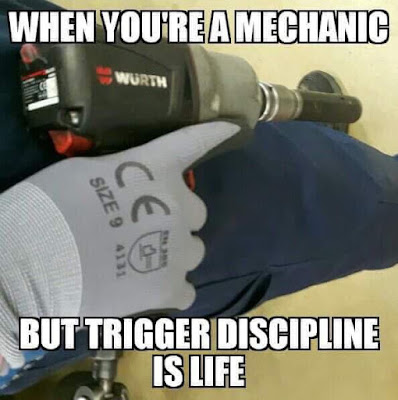

Yep and you will also have Teacher Dreams even after retiring like I did. Like the one when I am looking for my classroom and cannot find it.
Grumpy