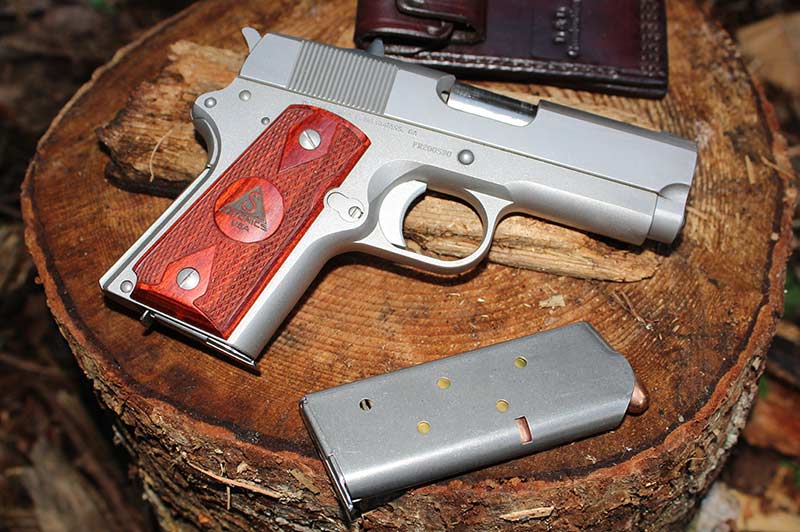
The Detonics Combat Master was a remarkable compact .45 ACP
pistol that unfortunately didn’t catch fire at the retail counter
When someone mentions Detonics, I get a slight tinge of nostalgia because the original company was based in Bellevue, Washington about 25 minutes from my front porch. The first time I set eyes on one was in the hands of a pal who — honest-to-all-the-ancient-gods-of Greece, Rome, Egypt and the Aztecs — showed up one Saturday at the gun range to use it in an action pistol match.
This was hardly a full-size pistol, but the groundbreaking Detonics Combat Master — a remarkably well-built (and well-thought-out) compact .45 ACP single-action semi-auto on what was essentially a chopped Model 1911 platform. Honestly, I thought my buddy was nuts to bring a squirt like that to a shooting match, until the shooting started.
Al Butler was the guy, and his pint-sized powerhouse proved to be a formidable little gatt, especially when loaded with 230-grain hardball ammunition. I was impressed, albeit skeptical, and so were most of the other guys. By the end of that match, my mind had changed.
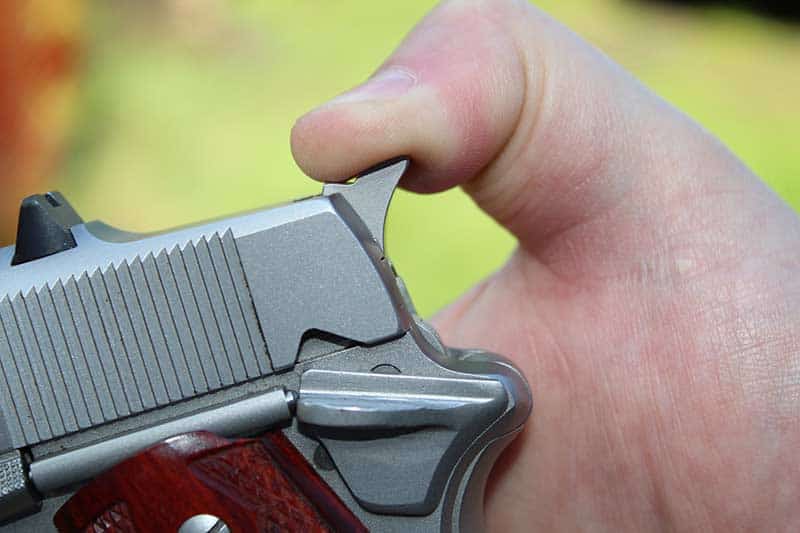
Designed for compact concealed carry, the Combat Master features an unusual slope at the rear of the slide, to allow for easier cocking when the pistol is carried with the hammer down and a live round in the chamber…
There is quite a story behind the Detonics brand, involving a couple of gunsmiths I eventually knew — Peter Dunn, the late Richard Niemer and another guy named Sid Woodcock, whom I met once briefly and later interviewed. I’ll skip over the details for fear of getting something wrong, but suffice to say some brilliant minds and skilled hands gave life to the Combat Master, beginning with the original development by an engineer named Pat Yates.
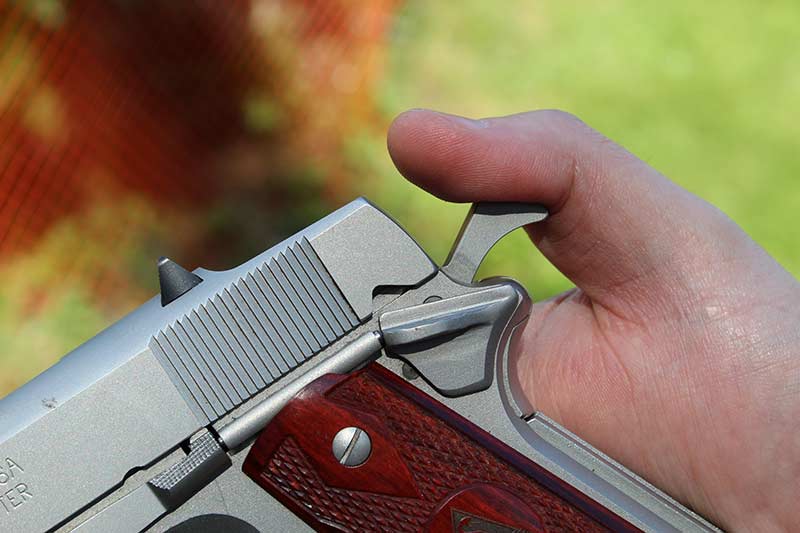
…The hammer can be quickly cocked, thanks to that sloping slide,
and then the traditional thumb safety may be engaged to carry cocked-and-locked.
As I wrote this, I checked online to clear away some mental cobwebs and make sure I wasn’t going out in the weeds. If I leave out anyone’s name, my apologies, since I’m writing this from my perspective.
Leap ahead several years. Detonics of Bellevue had been sold to a group of investors and moved to Phoenix, by Robbie Barrkman, who had become well known in gun circles for developing the ROBAR gun finish. The company was renamed New Detonics, but even with a new handle, it didn’t gain the necessary commercial traction and closed up shop in 1994.
In 2004, the company changed hands again, reborn as Detonics USA, based in Georgia under the command of the late author Jerry Ahern, a true Detonics devotee who had included the pistol in his novels. And that’s where I sort of came in, again.
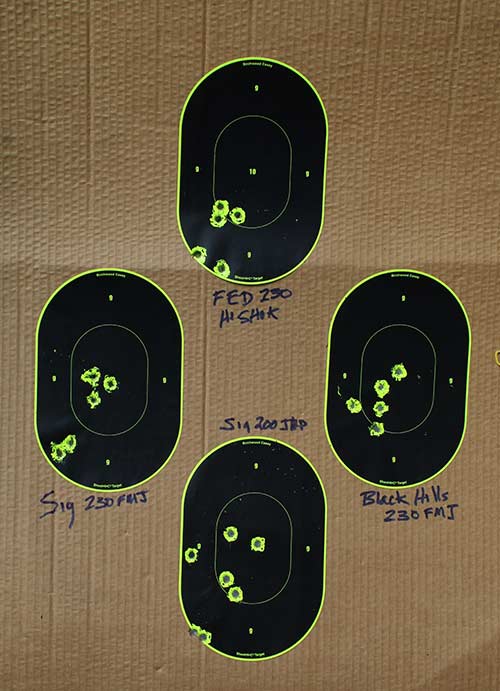
Targets tell the story of the little .45. Dave says his Combat Master likes 230-grain FMJ ammunition, though it shot a bit low, the groups were tighter.
‘Test This Gun’
Jerry, as the saying goes, hit the ground running. He provided one of the newly resurrected Combat Master models to a magazine for which I was writing at the time, for a test and evaluation. The editor called me and asked if I would put it through its paces.
After picking up the pistol, I drove immediately to my local gun range with a box of Remington 230-grain FMJ as I recall, and started shooting. The test pistol burned through the whole box without a hiccup and as I left the range, I called the editor, told him “There’s nothing wrong with this gun that I can see.” Bang, instant assignment!
What followed was a telephone chat with Woodcock for some background. Dunn, I was told, had relocated to Georgia to be part of the Ahern operation, and of course, I chatted with Ahern himself. By that time, Niemer was working at Olympic Arms about 60 miles down the road and one morning I took the pistol down for him to examine. The test gun was built from stainless steel, with no plastic or aluminum that I could see, and Niemer seemed impressed, especially after I told him about how well the little gun performed.
When I finished the test, back went the pistol to Ahern, who called me, said he would have Dunn go completely through the gun, and then send it back to me for further evaluation and future articles. At that point, this particular pistol had changed hands more times than a used car and eventually I took ownership for a remarkably good deal, since sending it back and forth seemed kind of silly.

Coned barrel is part of the Combat Master’s working formula, allowing the slide to cycle despite the short stroke.
Coned Barrel
As I recall, Woodcock explained how the coned barrel was a key to the Combat Master’s ability to reliably cycle. Since the little handgun performed quite well, I saw no reason to question that, and still don’t. The innards also feature a triple recoil spring setup that performed perfectly during a recent trip to the range just to see if it still had its reliable spunk.
The Combat Master is a very easy pistol to disassemble and reassemble, so it’s easy to keep clean and properly lubed.
Woodcock said the odd slope at the rear of the slide, beginning right behind the rear sight, was incorporated into the design to allow easier cocking of the pistol when carried with the hammer down. Prevalent thinking about the Model 1911 design is that hammer-down carry with a live round in the chamber is a bad idea, but I’ve never heard of a mishap involving a Combat Master carried in such a manner.
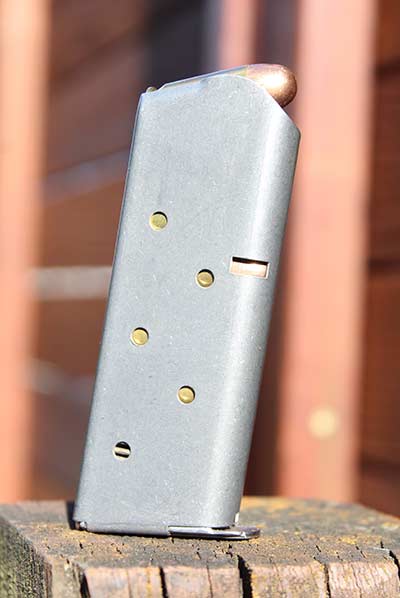
All of these components, plus a six-round Metalform magazine (three came with the test gun) to fit the shorter grip frame with its beveled mag well, make the Detonics Combat Master a terrific little hideout gun with the punch of a heavyweight boxer. Anyone who remembers “Miami Vice” will recall the Sonny Crockett character carried a Combat Master in an ankle holster in at least one episode.
When the fully loaded magazine is inserted into the pistol, a small metal projection comes out at the bottom rear of the floorplate. It appears to be part of the follower. After the first round goes into the chamber, this small projection retracts into the magazine.
Still, television exposure evidently wasn’t enough to keep the little gun moving across retail counters, and the company folded again. Ahern passed away almost exactly ten years ago. I like to recall our association as friendly, and he was certainly a fan of the Combat Master. Niemer died unexpectedly in December 2013, and in addition to losing a good pal who really knew his stuff, I lost a walking reference library to the workings of the Combat Master and all things 1911.
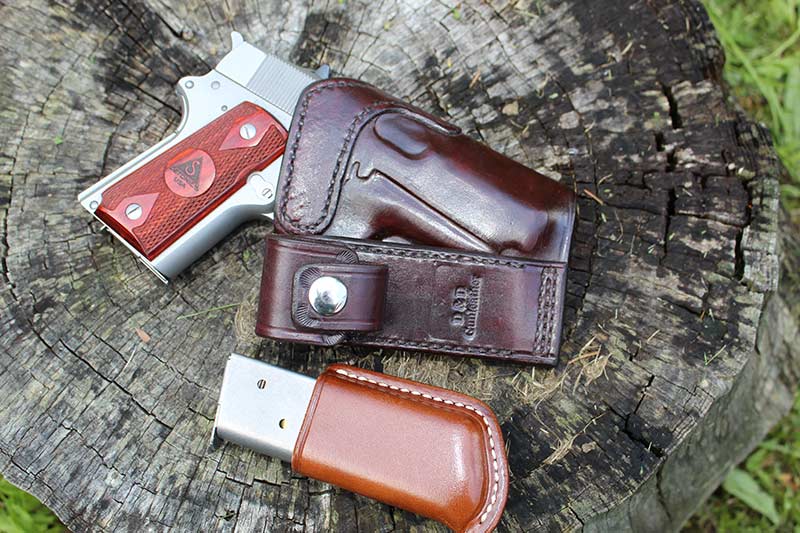
Dave’s son, Josh, built this holster from scratch based on Dave’s original “tuckable” design. The magazine pouch is from Milt Sparks.
It Loves FMJ
I’ve got to admit the compact pistol doesn’t get much range time these days. It’s more of a keepsake than a “working gun,” but it’s kind of fun to bring it out of the safe now and then to run a few rounds downrange.
Just as it did when I first fired the Detonics more than a dozen years ago (can it really be that long?), the Combat Master really likes 230-grain FMJ ammunition, and my handloads using 200-grain plated round-nose pills ahead of a healthy dose of HS-6.
Jacketed hollowpoints, not so much. At the range, I ran SIG 230-grain FMJs along with Black Hills 230-grainers on a target at 10 yards. Federal Hi Shok 230-grain pills shot low left, and the SIG 200-grain JHPs produced the loosest group, as shown in the accompanying photo. I like using Birchwood Casey Shoot-N-See targets because they absolutely do not fib.
But remember, the Detonics Combat Master is definitely not a target pistol. It was never designed for match grade accuracy. But it is a classic; it broke some barriers and made its mark in the shooting world.
Nowadays, this particular specimen comes out rarely, and when it does, it rides in a holster I designed and my son built when I was trying to teach him about working with leather. I’d take it down any dark alley.
I checked online and found there is still a Detonics company, based in Illinois. However, a look at its website shows no pistols even remotely resembling the Combat Master.