Categories
Oops!

Categories
ETHICS OR ELITISM? BY DAVE WORKMAN
DAVE MAKES THE MISTAKE OF SHOWING A GROUSE PHOTO
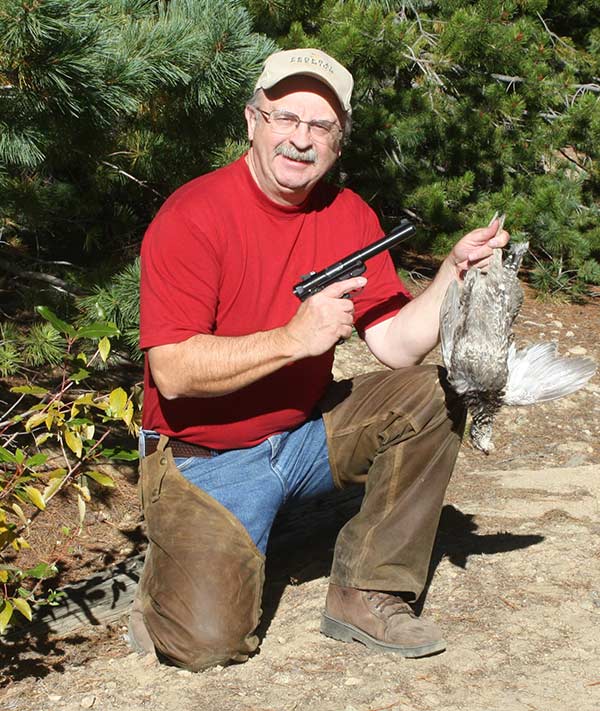
Dave posted this photo, which Insider readers have seen before,
to introduce himself to a group of grouse hunting devotees recently.
It ignited a lively debate because, well, he didn’t use a shotgun.
It was an innocent-enough mistake — well, not really a mistake; perhaps an error in polite judgment — but it provided an opportunity for some folks to examine their principles, and maybe their perspectives, on a question for which there may be no satisfactory answer.
This started with an invitation to join an online group devoted to grouse hunting. It’s one of my favorite early-fall activities. It was sheer coincidence the invitation somewhat coincided with my work on last week’s column about working on my classic Ruger Standard .22-caliber semi-auto pistol. I’ve killed grouse with this pistol, and with my much newer Ruger MKIV, and it was the posting of an image of me with the newer pistol and a dead grouse, to sort of introduce myself which ignited the fireworks.
Considering a handful of reactions, you’d have thought I punched the Pope. I sensed there might be a problem when one guy remarked, “Not how I would ever shoot a grouse short of being starving.” Ooookay!
Another fellow chimed in, “Shotgun & bird dog more sporting.” A third stated, “They would stand a chance if you let them fly.” A fourth gent sneered, “Try wing shooting them like a grown up.” If everyone agreed all of the time, I wouldn’t have anything to write about.
There were ample defenders of my plugging a fool hen with a handgun — dubbed “ground swatting” and it’s not a compliment — including the very diplomatic group administrator, who sagely observed, “It’s not my preferred method of harvesting them, nor do I believe I (or anyone else) am entitled to be condescending of your methods. We are all part of the hunting community. Congratulations on your successes with your preferred method of harvesting! Shoot straight & often in your upcoming season!”
In my defense, one guy wrote, “I’ve always enjoyed the holier-than-thou faction of the grouse hunting community.” Another observed, “Head shooting spooky grouse with a pistol is more of an accomplishment than with a rifle or shotgun on the wing.”
In all, more than 185 comments were generated, and it reminded me of my days as managing editor of a monthly publication about hunter education. Frequently, somebody would bring up “ethics,” and as one might guess, one person’s ethics sometimes turned out to be another guy’s definition of elitism.
In this case, I found myself up against some folks who religiously hunt over dogs, using shotguns, and anyone doing it differently is apparently … something less.
Elmer Did It, Too!
My guess is that the purist dog crowd never heard of Elmer Keith, whose name is hardly strange to American Handgunner and GUNS Magazine readers. Keith was the father of long-range handgunning, and his 600-yard shot on a wounded mule deer buck with a .44 Magnum is the stuff of legend. On page 126 of my revised 1961 edition of “Sixguns By Keith” is a photo of Elmer taken in 1932. He’s holding three dead blue grouse in his left hand and a Smith & Wesson .38/44 in his right.
During my online discussion with the grouse group, I and a couple of other people explained to the crowd how shooting grouse with handguns is completely legal and something of a tradition in western states, which seemed to surprise some of those folks. To prove it, I contacted wildlife agencies in Idaho, Montana, Colorado, Utah and Oregon. They all allow shooting grouse with rimfires, and it is safe to conclude birds taken in such a way are shot on the ground or sitting on a stump or tree limb.
Is it ethical? Here’s where the fun begins. Wingshooting purists don’t care for it, while everyone else seems to at least understand it or embrace it. Last year, I wrote an Insider column about using pistols for small game which seemed to have been read by many of my pals. It’s hardly a “lost art,” and it takes more than mediocre skill to maintain consistency.
Balance shooting a grouse off a tree limb with a pistol at 20-25 yards or farther against walking in on a bird holding tight to cover because of a good dog hovering close. When the unfortunate fowl finally explodes from cover, it will be facing a spreading payload of birdshot, as opposed to dodging a single projectile. Which is truly more “sporting?”
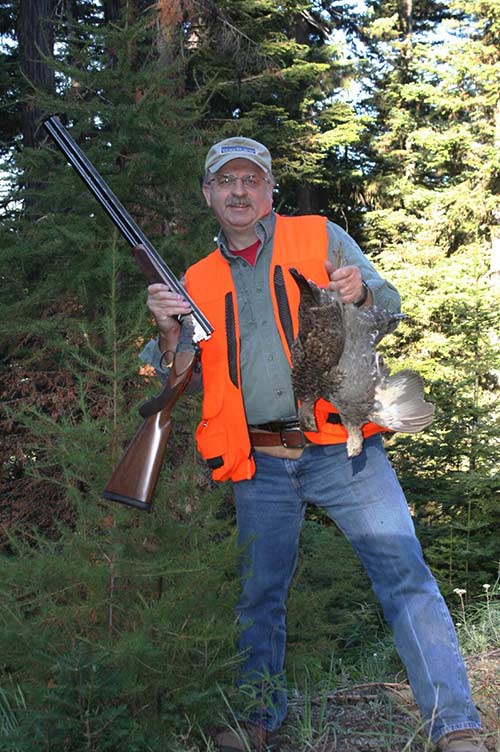
Yes, Dave does hunt fool hens with a shotgun.
Here’s proof he’s not a complete ogre.
What is ‘Fair Chase?’
People talk about “fair chase.” What is that, exactly? According to the Boone and Crockett Club, fair chase “is the ethical, sportsmanlike, and lawful pursuit and taking of any free-ranging wild game animal in a manner that does not give the hunter an improper or unfair advantage over the game animals.” Okay.
Straight from the B&C website come these tenets:
1. Obey all applicable laws and regulations.
2. Respect the customs of the locale where the hunting occurs.
3. Exercise a personal code of behavior that reflects favorably on your abilities and sensibilities as a hunter.
4. Attain and maintain the skills necessary to make the kill as certain and quick as possible.
5 .Behave in a way that will bring no dishonor to either the hunter, the hunted, or the environment.
6. Recognize that these tenets are intended to enhance the hunter’s experience of the relationship between predator and prey, which is one of the most fundamental relationships of humans and their environment.
Well, whaddaya know, items #1 and #2 apply directly to my situation, as well as #3 and #4. Evidently #5 is subject to some dispute (I’d suggest taking it up with Elmer!), and #6 seems open to personal judgment at the end of the day when the game bag may be full or not.
Here, again, sportsmen and women do not necessarily concur on the finer points. I know guys who have stalked game over considerable distances in order to get close enough for a clean, humane shot. Is that different than someone who may be on wide-open ground, and who takes an accurate shot at several hundred yards, using a rifle chambered for a long-range caliber?
Yet there are some in the outdoors with a “my way or the highway” approach. They tend to look down their noses at others who do things differently. This may be where “ethics” becomes “elitism.” Not everyone can afford a hunting dog, nor do they have the time or a home big enough, and neither can they afford a hunting lease.
Having hunted on public and private land, and a couple of times by invitation at a “hunting club” or “preserve,” I’m not sure there is a pat answer about fair chase, despite what B&C says. It’s not clear whether anyone at B&C ever hunted blue grouse, a bird of such remarkable stupidity at times that it will freeze in place or run along on the ground rather than take wing. Birds that dumb might deserve getting plugged by me, or Elmer.
Question: Is “fair chase” going without a professional guide? If you hire a guide, is that somehow less “fair” than hunting on your own? Maybe there is no correct answer, so we each do what, in our hearts, is the “right” thing; what you’d do if grandpa was watching. Maybe that’s ethics, and in some ways, it might be tinged with a bit of elitism.
And Then There’s This
My state’s wildlife agency encourages hunters to:
• Be considerate of non-hunters’ sensibilities and strive to leave them with positive images of hunting and hunters.
• Do not flaunt your harvested animals.
My reaction on social media was to be as considerate of non-hunters’ sensibilities as they are to mine (I’ve had people yell how they wished I’d get shot). I recall “big buck” contests held at local sporting goods stores in the days of my youth, when hunters were encouraged to show off their successes. There’s noting wrong with this. Yet nowadays hunters are encouraged to cover up their game, as if to hide what we do.
Back On Target
Last time I lamented one of my Ruger .22 pistols was shooting low and left. Practice pays off because a couple of hundred rounds has gone downrange since our last visit, and my pistol is back on track.
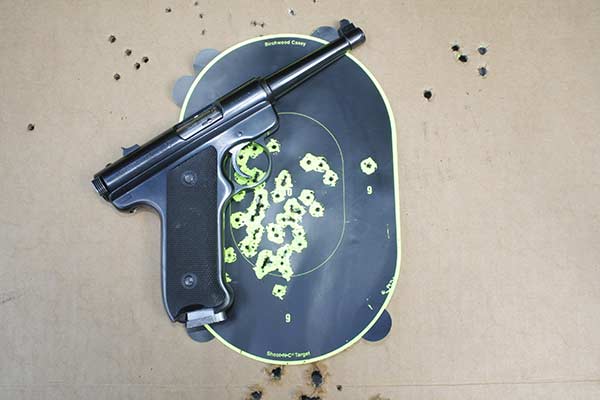
Dave’s classic Ruger appears ready to rock after return visits t
o the range. More than 40 shots went into this target from 15 yards.
Small game hunting ought to be fun this fall!
It still shoots a bit low, so all I’ve got to do is raise the front sight just a bit, or gently stone it down a bit. Windage seems to be fine — I didn’t do a thing to change it — so maybe I was just a bit rusty.
The great thing about practicing to shoot small game with a rimfire sidearm is being able to afford lots of ammunition and having the time to leisurely burn it up.
At some point, I may have to change my bullet weight from 40 to 36 grains, or simply switch brands of ammunition. I doubt there will be an effort to drift the rear sight slightly to the right (I’ve got a sight adjustment tool from Brownells for this purpose), but at least the equipment is at hand.
I was using different ammunition to punch the target in the accompanying image; 36-grain lead hollowpoints, where previously I was shooting 40-grain RNL ammunition.
Learn from my experience. Even with all the years I’ve had shooting handguns, my skills can suffer without regular range visits. You are no more or less prone to share the same experience at some point. Don’t throw in the towel, find out where the problem is and adjust accordingly.
Shoulda Known Better
You might think a fellow in his early 60s would know better than trying to break into a home, with a gun in his hand, especially in Missouri.
Recently, Fox News reported an incident in which an older guy — who probably should have been enjoying his senior years in a lounge chair or on a porch somewhere — entered a home in Missouri’s McDonald County. Only too late did this guy discover he had picked the wrong house. The residents were there, and both had guns of their own.
According to the narrative, the suspect in this caper fired at the homeowners. Probably to his surprise, they shot back. He missed, they didn’t. He wasn’t killed, just wounded in both legs. The homeowners held their unwelcome guest for the local sheriff’s department.
No News is Good News
Rasmussen is a seasoned polling firm, and their survey results are typically spot-on, so when they recently did a poll on media trustworthiness, it was worthy of attention.
Turns out 25% of likely voters don’t think the major news networks are reliable. Another 25% like Fox News, 13% favor CNN, while 12% trust MSNBC, Rasmussen noted. The “big three” are in single digits: NBC and ABC (7% apiece) and CBS (6%).
“Fifty-eight percent (58%) of voters believe the problem of bias in the news media is getting worse,” Rasmussen said, “compared to just 13% who think the problem is getting better. Twenty-six percent (26%) say the media bias problem is about the same as usual.”
Categories
The Guns of Elmer Keith
Categories
A real nightmare!

Also the outer skin was doped with nitro-cellulose lacquer which is highly flammable, nitro-cellulose is also used to make explosives such as gun-cotton. Grumpy
Categories
Some Winchester Model 1894s

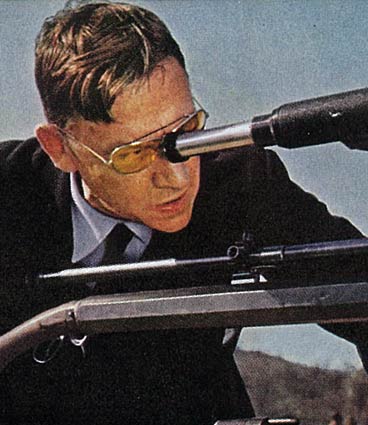
Lucian Cary looked through the spotting scope to discover his first shot was a bull’s-eye.
Writer Lucian Cary didn’t think he was a “gun crank.” He simply had an enthusiasm for rifle shooting, like other people had for golf, fly fishing, or antique collecting. The difference, Cary assured Post readers in 1935, was that his was “a reasonable enthusiasm. … I do not go in for collecting guns. I never buy a gun unless I really need it. As a matter of fact, I really need a dozen, or say 14, more guns than I have now.”
If he were writing today, Cary might be denying he was a “gun nut”—a term that has gathered some ugly connotations that crank never had. But if you step back from all the political and psychological analyses about gun collectors, you might see there’s little difference between gun nuts and enthusiasts in other fields: all the geeks, devotees, fanciers, wonks, and nerds of our population. There is small difference between the people who fuss over different grades of gunpowder and those who fuss over different database software.
American enthusiasts—whether car restorers, bird watchers, or quilters—are fascinated by details, technique, and different styles. They endlessly tinker with equipment and methods, always trying to make some improvement. They are the tinkerers who gave us radio and TV technology; the inexpensive family sedan and high-performance sports car; the Internet, microbrewed beers, and fantasy baseball.
And, in the 18th century, they were the people who developed the American longrifle, also known as the Kentucky rifle. It was an improvement on the musket and greatly improved the survival odds of the early country and its pioneers.
A traditional rifle of that time required its shooter to literally hammer his bullet into the breech before firing. The Yankee innovation was a greased patch of cloth or buckskin, which was pushed in front of the bullet and into the barrel. In a 1955 article, “All American Weapon,” Ashley Halsey Jr. explained that the greased patch filled the grooves, eased the bullet down, and partly cleaned the barrel when fired out of it.
This innovation made it possible to build rifles with long, slender barrels that didn’t have to endure hammering. “The longer barrel helped the bullet to pick up more speed before leaving the gun. Hence a smaller bullet delivered about the same wallop as the slower, bigger ones then in use. … The smaller bullet required only about a fourth as much lead to make, and half as much powder to shoot, both precious savings in the backwoods,” Halsey wrote.
During the Revolution, General Washington was delighted to find recruits with long rifles who could hit an 8-by-10-inch sheet of paper at 1,300 feet. But they were scarce. Most soldiers of the time used smooth-bore muskets, which were easier to load, though not nearly as accurate. Occasionally a long-barrel marksman might decide a battle by picking off a British general who thought he was safely out of range. The accuracy of the long rifle soon became legendary and proved to have a psychological power as great as its hitting power, as Halsey wrote.
“[A British general was outraged] that certain uncouth American frontiersmen, who wore their shirttails hanging out down to their knees, picked off his sentries and officers at outlandishly long ranges. Forthwith, the general ordered the capture of one specimen, each of the marksmen, and his gun. A raiding party dragged back Cpl. Walter Crouse, of York County, Pennsylvania, with his long rifle. At that point, the British … made a psychological blunder. They shipped their specimen rifleman to London. … Crouse, commanded to demonstrate his remarkable gun in public, daily hit targets at 200 yards—four times the practical range of the smoothbore military flintlock of the day. Enlistments faded away, so the story goes, and King George III hurriedly hired Hessian rifle companies to fight marksmanship with marksmanship.”
In the War of 1812, the Kentucky rifle had a chance to prove what it could do in battle when used in significant numbers. On January 8, 1915, outside New Orleans, Andrew Jackson threw together an army of soldiers, militiamen, pirates, and about 2,000 Kentucky and Tennessee woodsmen to meet men a British force twice its size. When the assault began, the American artillery opened fire but was unable to break the charge. Then, Halsey wrote, “the 2000 Kentuckians and Tennesseans, standing four deep, began taking turns with their long rifles. … At less than 200 yards, the advancing redcoat ranks melted away. … The British lost more than 2,000 killed and wounded; the Americans, eight killed and thirteen wounded. Scarcely ever have battle losses been more lopsided.”
Long after the war, the Kentucky rifle continued to prove its worth. Its incredible accuracy let pioneers and farmers hit predators and game at the very edge of visibility. As Lucian Cary explained, the long rifle meant survival in the wilderness to men like Daniel Boone and the settlers who followed him. “How could Boone have done what he did if he had carried an English Brown Bess, with its smoothbore, its heavy bullets, and its inability to hit what it was aimed at, instead of the instrument of precision he had? He lived by the rifle. He couldn’t have lived by a blunderbuss.”
In 1941, Cary’s fascination with rifles brought him to Friendship, Indiana, to the national shooting championship of the National Muzzle Loading Rifle Association. Here, he was surrounded by gun cranks even more fanatic than himself. And he marveled at the techniques of the champion marksmen.
“Rifle matches are as hotly fought as any other kind of contest. But rifle shooters make every effort to remain calm. They don’t want to talk when they are in a match. They don’t want to laugh or hear anybody else laugh. If they have any walking to do, they walk slowly. They don’t want to raise their heartbeats. They know that one mistake, one bad shot, will make all the difference between a good score and a poor one.
“Their sport requires its own special kind of nerve, the nerve to wait under pressure, to resist the natural human impulse to snatch at the trigger as the sights swing fast across the bull, to hold until the gun steadies, slows down, edges toward the center, and then, promptly but without haste, to put the last necessary quarter-ounce pressure on that trigger.”
Great marksmanship, as Cary described it, sounded like Zen mastery. “When everything is going well, the gun seems to fire itself. But it won’t do that for a man who is excited, or even for one who is trying too hard.”
This week, the National Muzzle Loading Rifle Association will again hold its annual championship in Friendship, Indiana, as it has since 1933. Perhaps the event hasn’t changed much in the 71 years since Cary described it “as American as a church sociable, or the Fourth of July, or a horseshoe-pitching contest, and reminded me of all three.”
But it will probably still give enthusiasts the opportunity to debate powder, shot, barrel riflings, and shooting technique; in other words, that American mixture of innovation built on tradition.