Categories
Have a Good Hump Day!! N.S.F.W.
















Categories
A lot of money sitting there!!

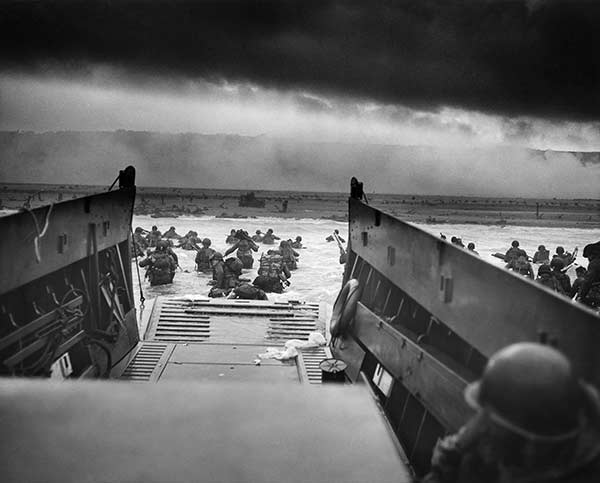
Operation Overlord was the official title for the D-Day assault. This was the largest amphibious invasion in human history. Public domain.
Operation Overlord, the 1944 Allied invasion of mainland Europe, was one of the most audacious military enterprises in human history. 160,000 Allied troops drawn mostly from the US, Great Britain, and Canada plowed inland against some 50,000 Axis defenders. The end result was a lodgment from which the Allies eventually pressed all the way to Germany.
The Germans knew we were coming. They just didn’t know exactly when or where. Calais was the obvious spot. It is less than twenty miles across the English Channel from Dover to France near Calais. As a result, the Germans staged a great deal of their defensive effort in this area. However, as we all know, that’s not what Ike had in mind.
The invasion forces moved between 80 and 100 miles by sea to reach the actual landing beaches in Normandy. While the landings were a gory mess, particularly at Omaha, they would have been far worse had the Allies not spoofed the Germans into believing that Calais was their primary landing zone. In addition to a great deal of good old-fashioned subterfuge, a decorated German General named Hans Cramer unwittingly did his part to help the Allies.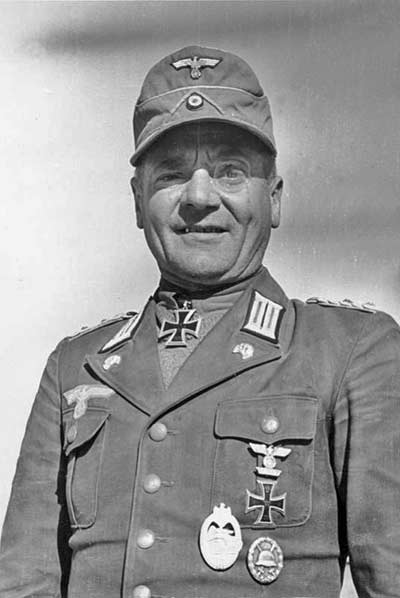
This is Hans Cramer, last commanding officer of the
German Afrika Korps. He unwittingly helped dupe Hitler
into believing that the D-Day force was landing in Calais.
Bundesarchiv.
The Guy
Hans Cramer was the last commander of the DAK, the famed German Afrika Korps. He was captured in North Africa in May of 1943 and held in a POW camp in Wales. In 1944, Cramer was 48 years old. That seems pretty spry by my current standards, but that’s actually fairly antiquated for a soldier. Once established in his POW camp, General Cramer got seriously sick.
On 23 May 1944, General Cramer was transported across England to be repatriated to Germany courtesy of the Swedish Red Cross. Despite the global hemoclysm that engulfed the world, there was still the occasional humanitarian release between the Allies and the Axis. Cramer’s Allied handlers carefully orchestrated his trek across the UK.
First, he processed through London. Then they motored across the English countryside so Cramer could see the massive buildup of troops, tanks, and military equipment being staged for the invasion. However, his driver led him to believe he was in southeastern England, the perfect place to stage an invasion of Calais.
Once he returned safely to Berlin, Cramer was aggressively debriefed. German intelligence officers mined him for information. Everything he reported was consistent with an objective in Calais.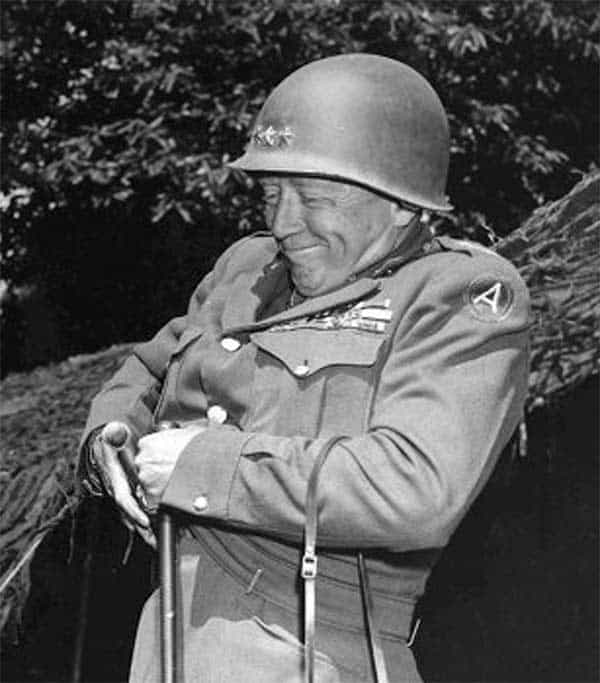
Everyone knew that George Patton was the Allies’ most effective combat general. In the lead-up to D-Day, his job was to command an enormous fake army. Public domain.
Operation Fortitude
This was but a tiny part of the overall deception plan. They called this overarching enterprise Operation Fortitude. The British officer tasked with putting it all together was named, no kidding, LTC David Strangeways.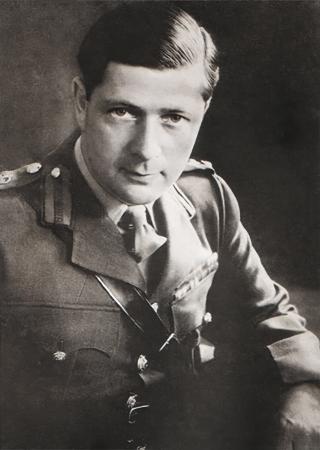
At the Tehran Conference in November of 1943, Stalin, Churchill, and Roosevelt met to hammer out the details of the coming invasion. It was there that Winston Churchill coined the phrase, “In wartime, truth is so precious that it should always be attended by a bodyguard of lies.” LTC Strangeways took that mandate to heart.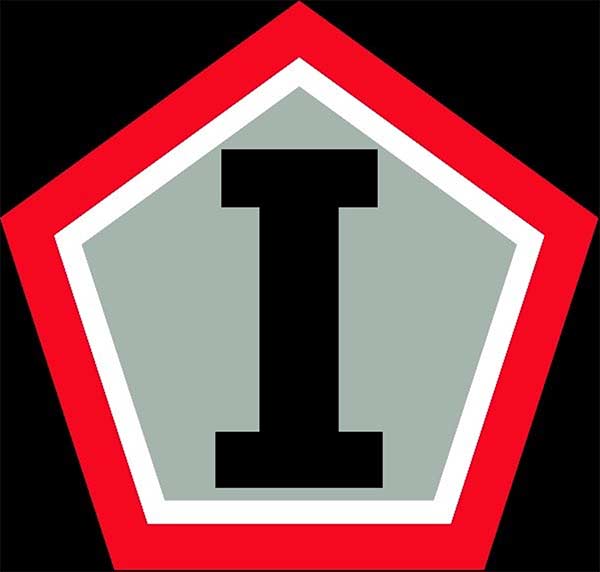
FUSAG, the giant fake army designed to mislead the
Germans about D-Day, even had its own unique unit insignia. Public domain.
Details
General Bernard Law Montgomery’s 21st Army Group was the invasion’s major effort. However, the Allies desperately needed to keep the German 15th Army occupied in the Calais region. To do so, they created a 300,000-man army that did not technically exist.
This giant fake army was technically deployed around Kent, Essex, and Suffolk. Great effort was invested in creating radio traffic that mimicked such a gargantuan military organization. Squadrons of imaginary aircraft and flotillas of nonexistent ships were folded into the tactical organization. Double agents captured and turned by British MI5 fed carefully-screened information back to their handlers in Germany.
This massive diaphanous unit was called the First US Army Group. They were known by the acronym FUSAG, which obviously sounds pretty cool. They even had their own unit patches and insignia.
A big part of Operation Fortitude was manning it with some proper talent. They chose America’s most flamboyant general to lead this theoretical mob. With the largest amphibious invasion in human history staging to the south, General George S. Patton was put in command of FUSAG. Patton clearly would have preferred commanding real troops. However, he absolutely owned the role.
Patton made speeches and inspected imaginary combat units. A bevy of photographers followed the flamboyant general everywhere he went, documenting his sundry inspections and presentations. The Germans rightfully thought Patton to be one of the best generals in the Allied stable. They fully expected him to command the pending invasion of Europe.
Success…
The ruse was fabulously successful. Even after the Normandy landings, Hitler and his generals still suspected it was a feint to draw attention away from Calais. This misperception of the tactical situation bought the assault troops precious time to create a foothold in Normandy.
The Germans eventually figured out that they had been duped and moved their reinforcements to Normandy right sharpish. However, by then, the Allies had established air supremacy. That made tactical troop movements in daylight tantamount to suicide.
We all know how it ultimately turned out. Less than a year after the D-Day invasion, Hitler debrained himself in his bunker in Berlin while victorious Russian troops slagged the countryside above. However, all of that might have been very different had it not been for LTC Strangeways’ Operation Fortitude and one unwitting German general.
Categories
Let there be light!
Categories