
“I sure wish we would have to mix with some of the [Warlord] armies over here as I would like to see if they are good in a scrap” – Pvt John Black, 3rd Brigade USMC, Tientsin, 15 Dec 1927
Until February of 1938 the Marines did not maintain a permanent presence in Tientsin. The city on the Pei ho River (Hai River) with both road and rail access served as a natural gateway to Peking. In 1900, during the Boxer troubles the Marines did fight here and earned the respect of a number of their allies for their courage under fire.
Furthermore, until shortly after WWI they routinely used the city as a logistics center for gathering supplies off loaded at the shallow water ports of Taku and Tangku. In the 1920’s they occasionally occupied the city when fighting between local warlords threatened to cut off Peking from the outside world. But apart from Smedley Butler’s 1927-28 expeditionary force, they rarely stayed beyond a few weeks. Bulter redeployed his force from Shanghai and brought them to Tientsin because he feared the fighting between the Nationalist forces and the warlord armies might cut off Peking from the outside world.
Pvt Black summed up Butler’s mission in much simpler and cruder terms: “I think I will have to go to Peking again soon as there is quite some fighting there and I am one of many that is here to see that when these Chinks fight that they don’t mix with anybody that is white.” Black never had to fight his way to Peking and by January 1929 Butler’s Marines returned stateside, leaving on rather good terms with the Chinese. Follow this link to pictures of Butler’s activities in Tientsin.
10 Novemebr 1928, Gen Butler and American Minister to China John Van Antwerten MacMurray along with Chinese officals at a dedication to a Sino-American cooperation and friendship project to honor of the opening of a highway between Tientsin and Peking.
10th Artillery park outside Tientsin
A company on paradeInstead, Tientsin was an Army town, as elements of the 15th US Infantry garrisoned Tientsin from January 1912 until they were withdrawn in March 1938. At that time the Marines took over the 15th old post,remaining until forced to surrender to the Japanese on 8 Dec 1941.
A common misnomer is the Tientsin compound was originally German barracks vacated during WWI. Although the buildings the 15th and the Marines used were inside the old German concession, the buildings were originally built as a residential apartment complex. Associated with Tientsin was the deep water port city of Chinwangtao. Since Tientsin was a shallow draft port, larger ocean vessels such as US Navy transports had to dock at Chinwangtao.
Chinwangato became after WWI, the primary entry point for Marines coming to north China. In addition, the 15th Infantry maintained a training camp with artillery range at Chinwangtao.
When the Marines took over Tientsin in 1938, they also assumed control of this camp which they renamed Camp Holcomb. Since Camp Holcomb was close to Chinwangtao, Marines were immediately dispatched to covertly record Japanese movements in and out of the port following the outbreak of hostilities between the Chinese and Japanese during the summer of 1937. Like the Peiping Marines, the Tientsin-Chinwangtao Marines were surrendered at the start of WWII.
Following WWII the 1st Marine Division was based at Tientsin from 30 September 1945 until their September 1947 withdrawal. The 1st along with the 6th Marine Division at Tsingtao were tasked with disarming and removing Japanese forces from North China as well as protecting the approaches to Peking. For some brief excerpts and images of post WWII duty around Tientsin and Tsingtao click here.
Gordon Hall during the Great Flood of 1938. Photo courtesy of the Tim Brig Collection
Training on the parade ground. Photo courtesy of the Tim Brig Collection
Marines with their Cole Carts. Photo courtesy of the Tim Brig Collection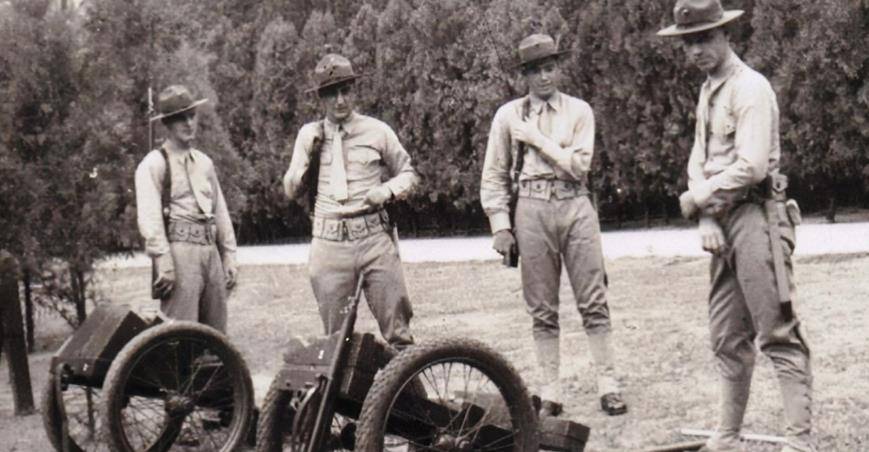
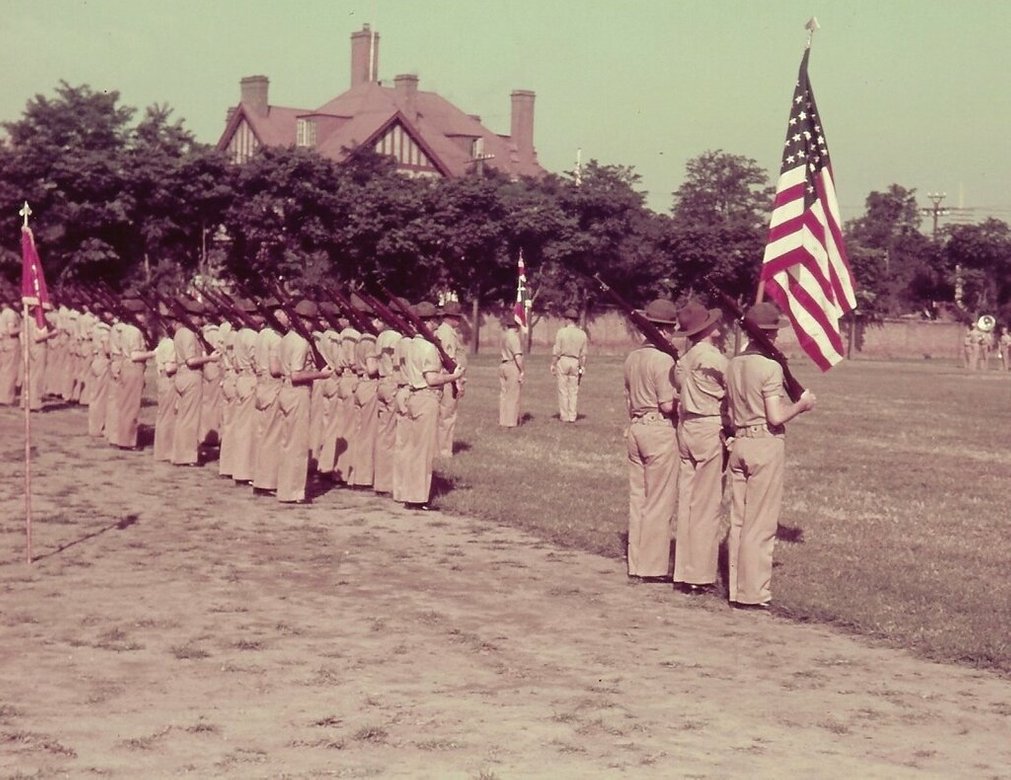 Rare pre-WWII color images of the Tientsin Marines drilling on their parade field
Parade practice, 1938
 Marine Guards, Camp Holcomb, 1938.
Categories
Winchester model 71 in 348 caliber
Categories
Job Search Humor

 NRA-ILA
Last week, the Kansas Supreme Court upheld a significant district court dismissal in Johnson v. Bass Pro Outdoor World, LLC, deciding that Bass Pro Outdoor World and Beretta USA/Beretta Italy cannot be sued by a man who was accidentally shot.
The court cited the Protection of Lawful Commerce in Arms Act (PLCAA), a federal law that protects firearm manufacturers and dealers when products are misused in a crime and concluded neither can be held responsible for the incident.
In an unfortunate set of events in 2018, a former college football player purchased a Beretta handgun from a Kansas Bass Pro Shops location.
According to court documents, while attempting to disassemble the firearm to show it to a teammate, he mistakenly believed the firearm was clear and would not fire if the magazine was removed.
In further error, he also believed that the trigger had to be pulled before disassembly. These detrimental and erroneous assumptions subsequently led to his teammate, seated next to him, being shot in the leg, resulting in an injury requiring amputation.
The injured teammate subsequently filed a product liability lawsuit claiming the handgun lacked essential safety features that would have prevented a discharge and that both Beretta and Bass Pro Shops ultimately bore responsibility.
The lawsuit also pointed to the man’s lack of knowledge on the firearm’s operation despite various directions and signed paperwork directing the purchaser to further training and education, as well as the Beretta’s frame being stamped with the message, “FIRES WITHOUT MAGAZINE.”
When the case reached the Kansas Supreme Court on appeal, the justices unanimously agreed with the district court that Bass Pro and Beretta are immune from the lawsuit because of the PLCAA’s protections. The analysis hinged on whether the lawsuit is considered a qualified civil liability action, per 15 U.S.C. § 7903(5)(A)(v). A qualified civil liability action is any civil action seeking damages resulting from criminal or unlawful use of a firearm. PLCAA bars product liability actions if the firearm discharge was caused by a volitional act and the shooting constituted a crime.
The court held that the PLCAA does, in fact, provide immunity for the firearm sellers and manufacturer in this case due to the commission of a volitional act, as well as this shooting constituting a crime. Even though there was no intention to fire the gun, the man deliberately pulled the trigger, a volitional act. Further, because he did so while stopped at a traffic light, it violated a Kansas strict liability law against discharging a gun on a public road, making it a criminal act, the ruling said.
The Protection of Lawful Commerce in Arms Act, signed into law by President Bush in 2005, continues to serve a critical role in reinforcing the well-established legal principle that companies lawfully conducting business cannot be held responsible for crimes they didn’t commit. Unfortunately, anti-gun activists continue to pursue lawsuits meant to sue the firearm industry into oblivion or to force “settlements” that include judicially imposed gun control.
NRA-ILA regularly reports on these abuses, for example, here, here, and here. We also remain committed to the important work of reinforcing the PLCAA at the federal and state levels, as well as advocating to ensure the law’s intent is upheld by the courts.
Beginning with the dubious decision in Soto v. Bushmaster, which provided the backdrop to Remington Arms’ bankruptcy, gun control activists have renewed their efforts to infringe all Americans’ Second Amendment rights by targeting the industries that serve them.
It is therefore especially encouraging to see the Kansas Supreme Court embrace the commonsense notion, embodied in the PLCAA, that responsibility for Johnson’s lamentable injuries lies not with the companies that lawfully imported and sold the gun but with the man who intentionally pulled the gun’s trigger while the muzzle was pointed at Johnson.