Categories
Other Stuff

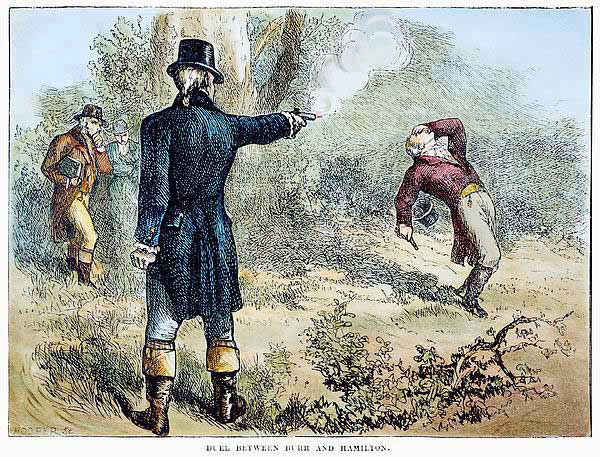
The Hamilton & Burr Duel

Image result for hamilton burr duel
So you think that US Politics are at the bottom Pit of Hell right now?Image result for 2016 election memes
Okay then try this one on for size. Imagine the Vice President of the USA blowing a hole in the Former Sec. Of the Treasury then. No? Well it actually happened!Image result for hamilton burr duel guns
Here is that story from Wiki:
The Burr–Hamilton duel was fought between prominent American politicians Aaron Burr, the sitting Vice President of the United States, and Alexander Hamilton, the former Secretary of the Treasury, at Weehawken, New Jersey on July 11, 1804.[1]
The duel was the culmination of a long and bitter rivalry between the two men. Burr shot and mortally wounded Hamilton, who was carried to the home of William Bayard, where he died the next day.
Background

Philip Schuyler, Hamilton’s father-in-law, lost his Senate seat to Burr.

The Burr–Hamilton duel is one of the most famous personal conflicts in American history. It was a draw duel which arose from long-standing personal bitterness that developed between the two men over the course of several years. Tensions reached a boiling point with Hamilton’s journalistic defamation of Burr’s character during the 1804 New York gubernatorial race, in which Burr was a candidate. The duel was fought at a time when the practice was being outlawed in the northern United States, and it had immense political ramifications. Burr survived the duel and was indicted for murder in both New York and New Jersey, though these charges were later either dismissed or resulted in acquittal. The harsh criticism and animosity directed toward him following the duel brought an end to his political career. The Federalist Party, already weakened by the defeat of John Adams in the presidential election of 1800, was further weakened by Hamilton’s death.
The duel was the final skirmish of a long conflict between Democratic-Republicans and Federalists. The conflict began in 1791 when Burr won a United States Senate seat from Philip Schuyler, Hamilton’s father-in-law, who would have supported Federalist policies. (Hamilton was the Secretary of the Treasury at the time.) The Electoral College then deadlocked in the election of 1800, during which Hamilton’s maneuvering in the House of Representatives caused Thomas Jefferson to be named president and Burr vice-president.[2]
Hamilton’s animosity toward Burr was severe and well-documented in personal letters to his friend and compatriot James McHenry. The following quotation from one of these letters on January 4, 1801 exemplifies his bitterness:

Nothing has given me so much chagrin as the Intelligence that the Federal party were thinking seriously of supporting Mr. Burr for president. I should consider the execution of the plan as devoting the country and signing their own death warrant. Mr. Burr will probably make stipulations, but he will laugh in his sleeve while he makes them and will break them the first moment it may serve his purpose.[3]

In a more extensive letter written shortly afterward, Hamilton details the many charges that he has against Burr, calling him a “profligate, a voluptuary in the extreme”, accusing him of corruptly serving the interests of the Holland Land Companywhile a member of the legislature, criticizing his military commission and accusing him of resigning under false pretenses, and many more serious accusations.[3]

Morgan Lewis, endorsed by Hamilton, defeated Burr in the 1804 New York gubernatorial election.

It became clear that Jefferson would drop Burr from his ticket in the 1804 election, so the Vice President ran for the governorship of New York instead.[citation needed]Hamilton campaigned vigorously against Burr, who was running as an independent, causing him to lose to Morgan Lewis, a Democratic-Republican endorsed by Hamilton.[citation needed]
Both men had been involved in duels in the past. Hamilton had been a principal in 10 shotless duels prior to his fatal encounter with Burr, including duels with William Gordon (1779), Aedanus Burke (1790), John Francis Mercer (1792–1793), James Nicholson (1795), James Monroe (1797), and Ebenezer Purdy/George Clinton (1804). He also served as a second to John Laurens in a 1779 duel with General Charles Lee, and to legal client John Auldjo in a 1787 duel with William Pierce.[4] Hamilton also claimed that he had one previous honor dispute with Burr;[5] Burr stated that there were two.[6][7]

Election of 1800[edit]

Burr and Hamilton first came into public opposition during the United States presidential election of 1800. Burr ran for Vice President on the Democratic-Republican ticket, along with presidential candidate Thomas Jefferson, against President John Adams (the Federalist incumbent) and his vice presidential running mate Charles C. Pinckney. Electoral College rules at the time gave each elector two votes for president; the candidate who received the second most votes became vice president. The Democratic-Republican Party, therefore, planned to have 72 of their 73 electors vote for both Jefferson and Burr, with the remaining elector voting only for Jefferson. However, the electors failed to execute this plan, so Burr and Jefferson tied with 73 votes each. The Constitution stipulates that, if no candidate wins a majority, the election is moved to the United States House of Representatives—which was controlled by the Federalists, at this point, many of whom were loathe to vote for Jefferson. Hamilton, however, regarded Burr as far more dangerous than Jefferson and used all his influence to ensure Jefferson’s election. On the 36th ballot, the House of Representatives gave Jefferson the presidency, with Burr becoming vice president.

Charles Cooper’s letter[edit]

On April 24, 1804, a letter was published in the Albany Register in the context of opposing Burr’s candidacy.[8] It was originally sent from Charles D. Cooper to Hamilton’s father-in-law, former U.S. Sen. Philip Schuyler,[9] and made reference to a previous statement by Cooper: “General Hamilton and Judge Kent have declared in substance that they looked upon Mr. Burr to be a dangerous man, and one who ought not be trusted with the reins of government.” Cooper went on to emphasize that he could describe in detail “a still more despicable opinion which General Hamilton has expressed of Mr. Burr” at a political dinner.[10]
Burr responded in a letter delivered by William P. Van Ness, pointing particularly to the “more despicable” phrase, and demanded “a prompt and unqualified acknowledgment or denial of the use of any expression which would warrant the assertion of Dr. Cooper.” Hamilton’s verbose reply on June 20, 1804 indicated that he could not be held responsible for Cooper’s interpretation of his words (yet did not fault that interpretation), concluding that Hamilton would “abide the consequences” should Burr remain unsatisfied.[11] A recurring theme in their correspondence is that Burr seeks avowal or disavowal of anything that could justify Cooper’s characterization, while Hamilton protests that there are no specifics.
Burr’s reply on June 21, 1804, also delivered by Van Ness, stated that “political opposition can never absolve gentlemen from the necessity of a rigid adherence to the laws of honor and the rules of decorum”.[12] Hamilton replied that he had “no other answer to give than that which has already been given”. This letter was delivered to Nathaniel Pendleton on June 22 but did not reach Burr until June 25.[13] The delay was due to negotiation between Pendleton and Van Ness in which Pendleton submitted the following paper:

General Hamilton says he cannot imagine what Dr. Cooper may have alluded, unless it were to a conversation at Mr. Taylor’s, in Albany, last winter (at which he and General Hamilton were present). General Hamilton cannot recollect distinctly the particulars of that conversation, so as to undertake to repeat them, without running the risk of varying or omitting what might be deemed important circumstances. The expressions are entirely forgotten, and the specific ideas imperfectly remembered; but to the best of his recollection it consisted of comments on the political principles and views of Colonel Burr, and the results that might be expected from them in the event of his election as Governor, without reference to any particular instance of past conduct or private character.[14]

Eventually, Burr issued a formal challenge, and Hamilton accepted.[15] Many historians have considered the causes of the duel to be flimsy and have thus either characterized Hamilton as “suicidal”, Burr as “malicious and murderous,” or both.[16]Thomas Fleming offers the theory that Burr may have been attempting to recover his honor by challenging Hamilton, whom he considered to be the only gentleman among his detractors, in response to the slanderous attacks against his character published during the 1804 gubernatorial campaign.[17]

The duel[edit]

In the early morning hours of July 11, 1804, Burr and Hamilton departed from Manhattan by separate boats and rowed across the Hudson River to a spot known as the Heights of Weehawken in New Jersey, a popular dueling ground below the towering cliffs of the Palisades.[18] Dueling had been prohibited in both New York and New Jersey; Hamilton and Burr agreed to take the duel to Weehawken, however, because New Jersey was not as aggressive in prosecuting dueling participants as New York. The same site was used for eighteen known duels between 1700 and 1845.[19] In an attempt to shield the participants from prosecution, procedures were implemented to give all witnesses plausible deniability. For example, the pistols were transported to the island in a portmanteau, enabling the rowers to say under oath that they had not seen any pistols. (They also stood with their backs to the duelists.)[20]
Burr, William P. Van Ness (his second), Matthew L. Davis, and another (often identified as John Swarthout) plus their rowers reached the site at 6:30 a.m. whereupon Swarthout and Van Ness started to clear the underbrush from the dueling ground. Hamilton, Judge Nathaniel Pendleton (his second), and David Hosack arrived a few minutes before seven. Lots were cast for the choice of position and which second should start the duel; both were won by Hamilton’s second, who chose the upper edge of the ledge (which faced the city) for Hamilton.[21] However, according to historian and author Joseph Ellis, Hamilton had been challenged and therefore had choice of both weapon and position. Under this account, it was Hamilton himself who chose the upstream or north side position. The duel took place near the area where Phillip Hamilton had dueled and lost three years before his father. [22]
All first-hand accounts of the duel agree that two shots were fired; however, Hamilton and Burr’s seconds disagreed on the intervening time between the shots. It was common for both principals in a duel to fire a shot at the ground to exemplify courage, and then the duel could come to an end. Hamilton apparently fired a shot above Burr’s head. Burr returned fire and hit Hamilton in the lower abdomen above the right hip. The large-caliber lead ball ricocheted off Hamilton’s third or second false rib, fracturing it, and caused considerable damage to his internal organs, particularly his liver and diaphragm, before becoming lodged in his first or second lumbar vertebra. According to Pendleton’s account, Hamilton collapsed almost immediately, dropping the pistol involuntarily, and Burr moved toward Hamilton in a speechless manner (which Pendleton deemed to be indicative of regret) before being hustled away behind an umbrella by Van Ness because Hosack and the rowers were already approaching.[23]
It is entirely uncertain which principal fired first, as both seconds’ backs were to the duel in accordance with the pre-arranged regulations of the duel and so that the men could later testify that they “saw no fire”. After much research to determine the actual events of the duel, historian Joseph Ellis gives his best guess:

Hamilton did fire his weapon intentionally, and he fired first. But he aimed to miss Burr, sending his ball into the tree above and behind Burr’s location. In so doing, he did not withhold his shot, but he did waste it, thereby honoring his pre-duel pledge. Meanwhile, Burr, who did not know about the pledge, did know that a projectile from Hamilton’s gun had whizzed past him and crashed into the tree to his rear. According to the principles of the code duello, Burr was perfectly justified in taking deadly aim at Hamilton and firing to kill.

David Hosack’s account[edit]

Hosack wrote his account on August 17, about one month after the duel had taken place. Hosack testified that he had only seen Hamilton and the two seconds disappear “into the wood”, heard two shots, and rushed to find a wounded Hamilton when his name was called. Hosack also testified that he had not seen Burr, who had been hidden behind an umbrella by Van Ness, his second.[24] In a letter to William Coleman, Hosack gives a very clear picture of the events:

When called to him upon his receiving the fatal wound, I found him half sitting on the ground, supported in the arms of Mr. Pendleton. His countenance of death I shall never forget. He had at that instant just strength to say, ‘This is a mortal wound, doctor;’ when he sunk away, and became to all appearance lifeless. I immediately stripped up his clothes, and soon, alas I ascertained that the direction of the ball must have been through some vital part. His pulses were not to be felt, his respiration was entirely suspended, and, upon laying my hand on his heart and perceiving no motion there, I considered him as irrecoverably gone. I, however, observed to Mr. Pendleton, that the only chance for his reviving was immediately to get him upon the water. We therefore lifted him up, and carried him out of the wood to the margin of the bank, where the bargemen aided us in conveying him into the boat, which immediately put off. During all this time I could not discover the least symptom of returning life. I now rubbed his face, lips, and temples with spirits of hartshorn, applied it to his neck and breast, and to the wrists and palms of his hands, and endeavoured to pour some into his mouth.[25]

Hosack goes on to say that in a few minutes Hamilton had revived, either from the hartshorn or fresh air. Hosack finishes his letter:

Soon after recovering his sight, he happened to cast his eye upon the case of pistols, and observing the one that he had had in his hand lying on the outside, he said, “Take care of that pistol; it is undischarged, and still cocked; it may go off and do harm. Pendleton knows” (attempting to turn his head towards him) ‘that I did not intend to fire at him.’ ‘Yes,’ said Mr. Pendleton, understanding his wish, ‘I have already made Dr. Hosack acquainted with your determination as to that’ He then closed his eyes and remained calm, without any disposition to speak; nor did he say much afterward, except in reply to my questions. He asked me once or twice how I found his pulse; and he informed me that his lower extremities had lost all feeling, manifesting to me that he entertained no hopes that he should long survive.[25]

Statement to the press[edit]

Pendleton and Van Ness issued a press statement about the events of the duel. The statement printed out the agreed upon dueling rules and events that transpired, that being given the order to present, both participants were free to open fire. After first fire had been given, the opposite’s second would count to three and the opponent would fire, or sacrifice his shot.[26] Pendleton and Van Ness disagree as to who fired the first shot, but concur that both men had fired “within a few seconds of each other” (as they must have: neither Pendleton nor Van Ness mention counting down).[26]
In Pendleton’s amended version of the statement, he and a friend went to the site of the duel the day after Hamilton’s death to discover where Hamilton’s shot went. The statement reads:

They [Mr. Pendleton and an accomplice] ascertained that the ball passed through the limb of a cedar tree, at an elevation of about twelve feet and a half, perpendicularly from the ground, between thirteen and fourteen feet from the mark on which General Hamilton stood, and about four feet wide of the direct line between him and Col. Burr, on the right side; he having fallen on the left.[27]

Hamilton’s intentions[edit]

Hamilton wrote a letter before the duel entitled Statement on Impending Duel with Aaron Burr[28] in which he stated that he was “strongly opposed to the practice of dueling” for both religious and practical reasons. “I have resolved,” it continued, “if our interview is conducted in the usual manner, and it pleases God to give me the opportunity, to reserve and throw away my first fire, and I have thoughts even of reserving my second fire.”[29][30]
Hamilton regained consciousness after being shot, and told Dr. Hosack that his gun was still loaded and that “Pendleton knows I did not mean to fire at him.” This is evidence for the theory that Hamilton intended not to fire, honoring his pre-duel pledge, and only fired accidentally upon being hit.[27] Such an intention would have violated the protocol of the code duello. When Burr later learned of this, he responded: “Contemptible, if true.”[31] Hamilton could have thrown his shot away by firing into the ground, thus possibly signaling Burr of his purpose.
Modern historians have debated to what extent Hamilton’s statements and letter represent his true beliefs, and how much of this was a deliberate attempt to permanently ruin Burr if Hamilton were to be killed. An example of this may be seen in what a historian has considered to be deliberate attempts to provoke Burr on the dueling ground, specifically Ogden’s perspective that

Hamilton performed a series of deliberately provocative actions to ensure a lethal outcome. As they were taking their places, he asked that the proceedings stop, adjusted his spectacles, and slowly, repeatedly, sighted along his pistol to test his aim.[32]

Burr’s intentions[edit]

There is good reason to think that Burr had every intention of killing Hamilton.[33] The afternoon after the duel, Burr was quoted as saying that had his vision not been impaired by the morning mist, he would have shot Hamilton in the heart.[34]According to the account of noted English philosopher Jeremy Bentham, who met with Burr in England in 1808 (four years after the fact), Burr claimed to have been certain of his ability to kill Hamilton, and Bentham concluded that Burr was “little better than a murderer.”[35]
There is, however, much evidence in Burr’s defense. Had Hamilton apologized for his “more despicable opinion of Mr. Burr”,[36] all would have been forgotten. However neither principal could avoid the confrontation honorably, and thus each was forced into the duel: Burr to regain his honor and Hamilton to sustain his.[37]
Furthermore, Burr was unsure of Hamilton’s intentions (as historians still are today). Seeing Hamilton fire into the brush above his head, Burr could not be sure if Hamilton had thrown away his shot or simply missed his target. According to the principles of the code duello, Burr was entirely justified in taking aim at Hamilton, under the hypothesis that Hamilton had shot first. Continuing this line of reasoning, it is not clear that Burr did more than react to hearing Hamilton fire before he had any time to realize where the shot had gone.
Burr certainly knew of Hamilton’s publicly opposing his ascension to the vice-presidency in 1800. Hamilton made confidential statements against him, such as those enumerated in Hamilton’s private letter to Supreme Court Justice Rutledge. In the attachment to that letter, Hamilton had argued against Burr’s character on repetitive scores, for example “suspected on strong grounds of having corruptly served the views of the Holland Company … his very friends do not insist on his integrity … he will court and employ able and daring scoundrels … his conduct indicates [he seeks] Supreme power in his own person … will in all likelihood attempt a usurpation.”[38]

Pistols[edit]

The Wogdon pistols used in the duel

Philip Hamilton, killed in a duel three years before the Burr–Hamilton duel

The pistols used in the duel belonged to Hamilton’s brother-in-law John Barker Church, who was a business partner of both Hamilton and Burr.[citation needed]
Later legend claimed that these pistols were the same ones used in a 1799 duel between Church and Burr, in which neither man was injured.[39][40] Burr, however, wrote in his memoirs that he supplied the duelling pistols for his duel with Church, and that they belonged to him.[41][40]
The Wogdon duelling pistols incorporated a hair-trigger feature that could be pre-set by the user.[39][42] Hamilton, familiar with the weapons, would have known about and been able to use the hair trigger. However, when asked by Pendleton before the duel if he would use the “hair-spring”, Hamilton reportedly replied, “Not this time.”[21] The “hair-spring” feature gives an advantage because it reduces the force required to engage the trigger, preventing unintentional hand movement while firing. It may also make people who are not familiar with the reduced force miss the target.
In 1801, three years before the Burr–Hamilton duel, Hamilton’s son Philip used the Church weapons in a duel in which he died.[citation needed]
The pistols reposed at Church’s estate Belvidere until the late 19th century.[43] In 1930, the pistols were sold to the Chase Manhattan Bank, now part of JPMorgan Chase & Co. and are on display in the investment bank’s headquarters at 270 Park Avenue in New York City.[44]

Aftermath[edit]

The mortally wounded Hamilton was taken to the home of William Bayard in New York, where he received communion from Bishop Benjamin Moore.[45][46] The next day, after having seen his wife, Elizabeth Schuyler Hamilton, and children, he died in the presence of more than 20 friends and family members and was buried in the Trinity Churchyard Cemetery in Manhattan (Hamilton was an Episcopalianat his death).[47] Gouverneur Morris, a political ally of Hamilton’s, gave the eulogy at his funeral and established a private fund to support his widow and children.
Burr was charged with murder in New York and New Jersey, but neither charge reached trial. In Bergen County, New Jersey, a grand jury indicted Burr for murder in November 1804,[18] but the New Jersey Supreme Court quashed the indictment on a motion from Colonel Ogden.[48] Burr fled to Saint Simons Island, Georgia. He stayed at the plantation of Pierce Butler at Hampton Point, but soon returned to Washington, D.C. to complete his term of service as Vice President. He presided over the Samuel Chase impeachment trial “with the dignity and impartiality of an angel, but with the rigor of a devil” according to a Washington newspaper. Burr’s heartfelt farewell speech in March 1805 moved some of his harshest critics in the Senate to tears.[49]

An 1841 map showing the location of a Hamilton monument

With his political career apparently over, Burr went west, where he became involved in “filibuster” plans, which some[who?] later claimed were intended to establish a new independent empire carved out of the Louisiana territory.[citation needed] General James Wilkinson, who had worked with Burr, later had a change of heart and betrayed their plans to President Jefferson. Another man Burr allegedly tried to recruit, William Eaton, accused Burr in letters to Jefferson, resulting in Burr’s arrest and trial for treason. Although he was acquitted of all charges, Burr’s reputation was further damaged and he spent the following years in Europe. He finally returned to New York City in 1812, where he resumed his law practice and spent the remainder of his life in relative obscurity.

Monuments[edit]

Boulder where Hamilton may have rested

Bust of Hamilton from 1935

The first memorial to the duel was constructed in 1806 by the Saint Andrew’s Society, of which Hamilton was formerly a member.[50] A 14-foot marble cenotaph, consisting of an obelisk topped by a flaming urn and a plaque with a quote from Horace surrounded by an iron fence, was constructed approximately where Hamilton was believed to have fallen.[51] Duels continued to be fought at the site and the marble was slowly vandalized and removed for souvenirs, leaving nothing remaining by 1820. The memorial’s plaque survived, turning up in a junk store and finding its way to the New-York Historical Society in Manhattan, where it still resides.[52]
From 1820 to 1857, the site was marked by two stones with the names Hamilton and Burr placed where they were thought to have stood during the duel. When a road from Hoboken to Fort Lee was built through the site in 1858, an inscription on a boulder where a mortally wounded Hamilton was thought to have rested—one of the many pieces of graffiti left by visitors—was all that remained. No primary accounts of the duel confirm the boulder anecdote. In 1870, railroad tracks were built directly through the site, and the boulder was hauled to the top of the Palisades, where it remains today.[53] In 1894, an iron fence was built around the boulder, supplemented by a bust of Hamilton and a plaque. The bust was thrown over the cliff on October 14, 1934 by vandals and the head was never recovered; a new bust was installed on July 12, 1935.[54]
The plaque was stolen by vandals in the 1980s and an abbreviated version of the text was inscribed on the indentation left in the boulder, which remained until the 1990s when a granite pedestal was added in front of the boulder and the bust was moved to the top of the pedestal. New markers were added on July 11, 2004, the 200th anniversary of the duel.[55]

Anti-dueling movement in New York state[edit]

In the months and years following the duel, a movement started to end the practice. Eliphalet Nott, the pastor at an Albany church attended by Hamilton’s father-in-law, Philip Schuyler, gave a sermon that was soon reprinted, “A Discourse, Delivered in the North Dutch Church, in the City of Albany, Occasioned by the Ever to be Lamented Death of General Alexander Hamilton, July 29, 1804”. In 1806, Lyman Beecher delivered an anti-dueling sermon, later reprinted in 1809 by the Anti-Dueling Association of New York.
 
 
Image result for hamilton burr duel site

Categories
N.S.F.W.

Some Eye Candy NSFW

Image result for and its gone memes
Related image
Half Cheek - Half Story
Premium Boobs
Milly Morris. I can’t believe I remembered her name! My ex used to work for a startup trying to break into video-on-demand for hotels. They didn’t have anyone who was knowledgeable about the porn industry. I told her I would be happy to advise them,...
바카라이용방법\\【 MW995.COM 】\\、온라인카지노

 
Related image
 

Categories
All About Guns

IWI Announces New Bullpup Shotgun with 26 Round Capacity: The Tavor TS12 by S.H. BLANNELBERRY on JANUARY 17, 2018

TS12 Shotgun

The TS12. The first bullpup shotgun from IWI. (Photo: IWI)


On the eve of SHOT Show 2018, IWI just dropped a bomb of an announcement!  It’s the company’s first ever bullpup shotgun!  The Tavor TS12.
This 12 gauge semi-automatic, gas-operated scattergun feeds from one of three rotating magazine tubes, each capable of holding four 3-inch shells or five 2-inch shells for a total capacity of 15+1.
Of course, if it feeds Aguila mini shells, that capacity bumps up to 26 rounds.  Talk about an ideal platform to have at the ready when something goes bump in the night.
“The TAVOR TS12 is our first entry into the home defense shotgun market and we held off until we had something unique and desirable that held the same characteristic quality and performance of the entire TAVOR line,” Casey Flack, CEO of IWI US commented.
“The TS12 is it; compact, easy to use and maintain, and with a large magazine capacity, it is ideal for home defense, as well as a sporting shotgun,”Flack added.

Loaded with minishells, the TS12 will have a capacity of 26 rounds. (Photo: IWI)

TS 12 Specs

  • Gauge: 12GA/ 3” chamber
  • Weight: 3.6 kg (mag empty) / 8 lbs.
  • Barrel Length: 47 cm / 18.5”
  • Overall Length: 720 cm (not including choke) / 28.34”
  • Height: 260 mm / 10.23” (from pistol grip to top)
  • Magazine: Tubular system, 15-rounds total capacity (five 2.75” or four 3”)
  • Choke: Internal muzzle threads / Benelli / Beretta Type (one choke included)
  • Picatinny Rail: one-piece, full-length 1913 standard top rail
  • Safety: cross bolt safety
  • MSRP $1,399

The TS12 can be loaded from either side and users can adjust for either right or left side ejection.  Other features include IWI’s patented “Bullhead” bolt locking system, internal muzzle threads compatible with  Benelli/Beretta choke tubes, a full-length Picatinny top rail, and M-LOK friendly forearm for the requisite bells and whistles.
The TS12 will be initially available in black, but IWI has plans to offer this bully in Olive Drab and Flat Dark Earth.  MSRP is $1,399.
We plan on getting to know the TS12 at Industry Day at the Range this coming Monday.  Stay tuned.  In the meantime, visit IWI US for more information.

Categories
Hard Nosed Folks Both Good & Bad This great Nation & Its People Well I thought it was funny!

R. Lee Ermey Geico Commercial – Gunny Therapy

I just think that this is one of the Best Commercials ever made! Grumpy

Categories
War

Don't Mess with Texas – The Alamo 182 years ago today!

Inline image 5
Inline image 2
Inline image 6

The Battle of the Alamo (February 23 – March 6, 1836) was a pivotal event in the Texas Revolution.
Following a 13-day siege, Mexican troops under President General Antonio López de Santa Annalaunched an assault on the Alamo Mission near San Antonio de Béxar (modern-day San AntonioTexas, United States), killing all of the Texian defenders.
Santa Anna’s cruelty during the battle inspired many Texians, both Texas settlers and adventurers from the United States—to join the Texian Army.
Buoyed by a desire for revenge, the Texians defeated the Mexican Army at the Battle of San Jacinto, on April 21, 1836, ending the revolution.
Several months previously, Texians had driven all Mexican troops out of Mexican Texas. About 100 Texians were then garrisoned at the Alamo.
The Texian force grew slightly with the arrival of reinforcements led by eventual Alamo co-commanders James Bowie and William B. Travis. On February 23, approximately 1,500 Mexicans marched into San Antonio de Béxar as the first step in a campaign to retake Texas.
For the next 10 days, the two armies engaged in several skirmishes with minimal casualties. Aware that his garrison could not withstand an attack by such a large force, Travis wrote multiple letters pleading for more men and supplies, but the Texians were reinforced by fewer than 100 men.
In the early morning hours of March 6, the Mexican Army advanced on the Alamo. After repelling two attacks, the Texians were unable to fend off a third attack.
As Mexican soldiers scaled the walls, most of the Texian soldiers withdrew into interior buildings. Defenders unable to reach these points were slain by the Mexican cavalry as they attempted to escape. Between five and seven Texians may have surrendered; if so, they were quickly executed.
Most eyewitness accounts reported between 182 and 257 Texians died, while most historians of the Alamo agree that around 600 Mexicans were killed or wounded.
Several noncombatants were sent to Gonzales to spread word of the Texian defeat. The news sparked both a strong rush to join the Texian army and a panic, known as “The Runaway Scrape“, in which the Texian army, most settlers, and the new Republic of Texas government fled from the advancing Mexican Army.
Within Mexico, the battle has often been overshadowed by events from the Mexican–American War of 1846–48. In 19th-century Texas, the Alamo complex gradually became known as a battle site rather than a former mission.
The Texas Legislature purchased the land and buildings in the early part of the 20th century and designated the Alamo chapel as an official Texas State Shrine.
The Alamo is now “the most popular tourist site in Texas”.[5]The Alamo has been the subject of numerous non-fiction works beginning in 1843. Most Americans, however, are more familiar with the myths and legends spread by many of the movie and television adaptations,[6] including the 1950s Disney mini-series Davy Crockett and John Wayne‘s 1960 film The Alamo.

Background

Further information: Mexican Texas and Texas Revolution

Under President Antonio López de Santa Anna, the Mexican government began to shift away from a federalist model. The increasingly dictatorial policies, including the revocation of the Constitution of 1824 in early 1835, incited many federalists to revolt.[7]
The border region of Mexican Texas was largely populated by immigrants from the United States. These people were accustomed to a federalist government and to extensive individual rights, and they were quite vocal in their displeasure at Mexico’s shift towards centralism.[8]
Already suspicious after previous American attempts to purchase Mexican Texas,[9]Mexican authorities blamed much of the Texian unrest on American immigrants, most of whom had made little effort to adapt to the Mexican culture.[10]
In October, Texians engaged Mexican troops in the first official battle of the Texas Revolution.[11] Determined to quell the rebellion, Santa Anna began assembling a large force, the Army of Operations in Texas, to restore order.[12] Most of his soldiers were raw recruits,[13] and a large number had been forcibly conscripted.[14]

A sprawling complex of buildings with low walls sits in a shallow valley overlooked by rolling hills.

The Fall of the Alamo, painted by Theodore Gentilz in 1844, depicts the Alamo complex from the south. The Low Barracks, the chapel, and the wooden palisade connecting them are in the foreground.

 
The Texians systematically defeated the Mexican troops already stationed in Texas. The last group of Mexican soldiers in the region—commanded by Santa Anna’s brother-in-law, General Martín Perfecto de Cos—surrendered on December 9 following the siege of Béxar.[11]
By this point, the Texian Army was dominated by very recent arrivals to the region, primarily adventurers from the United States. Many Texas settlers, unprepared for a long campaign, had returned home.[15]
Angered by what he perceived to be American interference in Mexican affairs, Santa Anna spearheaded a resolution classifying foreigners found fighting in Texas as pirates.
The resolution effectively banned the taking of prisoners of war: in this period of time, captured pirates were executed immediately.[15][16]
Santa Anna reiterated this message in a strongly worded letter to United States President Andrew Jackson. This letter was not widely distributed, and it is unlikely that most of the American recruits serving in the Texian Army were aware that there would be no prisoners of war.[17]
When Mexican troops departed San Antonio de Béxar (now San Antonio, Texas, USA) Texian soldiers established a garrison at the Alamo Mission, a former Spanish religious outpost which had been converted to a makeshift fort by the recently expelled Mexican Army.[18]
Described by Santa Anna as an “irregular fortification hardly worthy of the name”,[18] the Alamo had been designed to withstand an attack by native tribes, not an artillery-equipped army.[19]
The complex sprawled across 3 acres (1.2 ha), providing almost 1,320 feet (400 m) of perimeter to defend.[20] An interior plaza was bordered on the east by the chapel and to the south by a one-story building known as the Low Barracks.[21]
A wooden palisade stretched between these two buildings.[22] The two-story Long Barracks extended north from the chapel.[21] At the northern corner of the east wall stood a cattle pen and horse corral.[23]
The walls surrounding the complex were at least 2.75 feet (0.84 m) thick and ranged from 9–12 ft (2.7–3.7 m) high.[24][Note 1]
To compensate for the lack of firing ports, Texian engineer Green B. Jameson constructed catwalks to allow defenders to fire over the walls; this method, however, left the rifleman’s upper body exposed.[20]
Mexican forces had left behind 19 cannons, which Jameson installed along the walls. A large 18-pounder had arrived in Texas with the New Orleans Greys. Jameson positioned this cannon in the southwest corner of the compound.
He boasted to Texian Army commander Sam Houston that the Texians could “whip 10 to 1 with our artillery”.[25]
The Texian garrison was woefully undermanned and underprovisioned, with fewer than 100 soldiers remaining by January 6, 1836.[26]
Colonel James C. Neill, the acting Alamo commander, wrote to the provisional government: “If there has ever been a dollar here I have no knowledge of it”.[26]
Neill requested additional troops and supplies, stressing that the garrison was likely to be unable to withstand a siege lasting longer than four days.[26][27]
The Texian government was in turmoil and unable to provide much assistance.[28][Note 2]Four different men claimed to have been given command over the entire army:[Note 3] on January 14, Neill approached one of them, Sam Houston, for assistance in gathering supplies, clothing, and ammunition.[28]

Prelude to battle

Three-quarter portrait of a young clean-shaven man with long sideburns and a widow's peak hairline. His arms are crossed.

James Bowie arrived at the Alamo Mission on January 19 with orders to destroy the complex. He instead became the garrison’s co-commander.

Houston could not spare the number of men necessary to mount a successful defense.[29]
Instead, he sent Colonel James Bowie with 30 men to remove the artillery from the Alamo and destroy the complex.[28][Note 4] Bowie was unable to transport the artillery since the Alamo garrison lacked the necessary draft animals.
Neill soon persuaded Bowie that the location held strategic importance.[30] In a letter to Governor Henry Smith, Bowie argued that “the salvation of Texas depends in great measure on keeping Béxar out of the hands of the enemy.
It serves as the frontier picquet guard, and if it were in the possession of Santa Anna, there is no stronghold from which to repel him in his march towards the Sabine.”[31][Note 5] The letter to Smith ended, “Colonel Neill and myself have come to the solemn resolution that we will rather die in these ditches than give it up to the enemy.”[31]
Bowie also wrote to the provisional government, asking for “men, money, rifles, and cannon powder”.[31] Few reinforcements were authorized; cavalry officer William B. Travis arrived in Béxar with 30 men on February 3.
Five days later, a small group of volunteers arrived, including the famous frontiersman and former U.S. Congressman David Crockett of Tennessee.[32]

Lithograph depicting head and shoulders of a middle-aged, clean-shaven man wearing an ostentatious military uniform.

General Antonio Lopez de Santa Anna led Mexican troops into Texas in 1836.

 
On February 11, Neill left the Alamo, determined to recruit additional reinforcements and gather supplies.[33][34] He transferred command to Travis, the highest-ranking regular army officer in the garrison.[31]
Volunteers comprised much of the garrison, and they were unwilling to accept Travis as their leader.[Note 6] The men instead elected Bowie, who had a reputation as a fierce fighter, as their commander.
Bowie celebrated by getting very intoxicated and creating havoc in Béxar. To mitigate the resulting ill feelings, Bowie agreed to share command with Travis.[34][35][36]
As the Texians struggled to find men and supplies, Santa Anna continued to gather men at San Luis Potosi; by the end of 1835 his army numbered 6,019 soldiers.[37]
Rather than advance along the coast, where supplies and reinforcements could be easily delivered by sea, Santa Anna ordered his army inland to Béxar, the political center of Texas and the site of Cos’s defeat.[37]
The army began its march north in late December.[37] Officers used the long journey to train the men. Many of the new recruits did not know how to use the sights of their guns, and many refused to fire from the shoulder because of the large recoil.[38]
Progress was slow. There were not enough mules to transport all of the supplies, and many of the teamsters, all civilians, quit when their pay was delayed.
The large number of soldaderas – women and children who followed the army – consumed much of the already scarce supplies. The soldiers were soon reduced to partial rations.[39]
On February 12 they crossed the Rio Grande.[40][Note 7] Temperatures in Texas reached record lows, and by February 13 an estimated 15–16 inches (38–41 cm) of snow had fallen. Hypothermia, dysentery, and Comanche raiding parties took a heavy toll on the Mexican soldiers.[41]
On February 21, Santa Anna and his vanguard reached the banks of the Medina River, 25 miles (40 km) from Béxar.[42][43] Unaware of the Mexican Army’s proximity, the majority of the Alamo garrison joined Béxar residents at a fiesta.[44][Note 8]
After learning of the planned celebration, Santa Anna ordered General Joaquín Ramírez y Sesma to immediately seize the unprotected Alamo, but sudden rains halted that raid.[43]

Siege

Investment

In the early hours of February 23, residents began fleeing Béxar, fearing the Mexican army’s imminent arrival. Although unconvinced by the reports, Travis stationed a soldier in the San Fernando church bell tower, the highest location in town, to watch for signs of an approaching force.
Several hours later, Texian scouts reported seeing Mexican troops 1.5 miles (2.4 km) outside the town.[44] Few arrangements had been made for a potential siege.
One group of Texians scrambled to herd cattle into the Alamo, while others scrounged for food in the recently abandoned houses.[45] Several members of the garrison who had been living in town brought their families with them when they reported to the Alamo.
Among these were Almaron Dickinson, who brought his wife Susanna and their infant daughter Angelina; Bowie, who was accompanied by his deceased wife’s cousins, Gertrudis Navarro and Juana Navarro Alsbury, and Alsbury’s young son;[46] and Gregorio Esparza, whose family climbed through the window of the Alamo chapel after the Mexican army arrived.[47]
Other members of the garrison failed to report for duty; most of the men working outside Béxar did not try to sneak past Mexican lines.[48]

I reply to you, according to the order of His Excellency, that the Mexican army cannot come to terms under any conditions with rebellious foreigners to whom there is no recourse left, if they wish to save their lives, than to place themselves immediately at the disposal of the Supreme Government from whom alone they may expect clemency after some considerations.

response of José Bartres to Texian requests for an honorable surrender, as quoted in the journal of Juan Almonte[49]

By late afternoon Béxar was occupied by about 1,500 Mexican soldiers.[50]
When the Mexican troops raised a blood-red flag signifying no quarter, Travis responded with a blast from the Alamo’s largest cannon.[51] Believing that Travis had acted hastily, Bowie sent Jameson to meet with Santa Anna.[49]
Travis was angered that Bowie had acted unilaterally and sent his own representative, Captain Albert Martin.[52] Both emissaries met with Colonel Juan Almonte and José Bartres. According to Almonte, the Texians asked for an honorable surrender but were informed that any surrender must be unconditional.[49] On learning this, Bowie and Travis mutually agreed to fire the cannon again.[52][Note 9]

Skirmishes

The first night of the siege was relatively quiet.[53] Over the next few days, Mexican soldiers established artillery batteries, initially about 1,000 feet (300 m) from the south and east walls of the Alamo.[54]
A third battery was positioned southeast of the fort. Each night the batteries inched closer to the Alamo walls.[55] During the first week of the siege more than 200 cannonballs landed in the Alamo plaza.
At first, the Texians matched Mexican artillery fire, often reusing the Mexican cannonballs.[56][57] On February 26 Travis ordered the artillery to conserve powder and shot.[56]
Two notable events occurred on Wednesday, February 24. At some point that day, Bowie collapsed from illness,[58] leaving Travis in sole command of the garrison.[58] Late that afternoon, two Mexican scouts became the first fatalities of the siege.[59][Note 9] The following morning, 200–300 Mexican soldiers crossed the San Antonio River and took cover in abandoned shacks near the Alamo walls.[55][59][60]
Several Texians ventured out to burn the huts[60] while Texians within the Alamo provided cover fire.[61][62] After a two-hour skirmish, the Mexican troops retreated to Béxar.[55][62] Six Mexican soldiers were killed and four others were wounded.[55] No Texians were injured.[63]
blue norther blew in on February 25, dropping the temperature to 39 °F (4 °C).[56] Neither army was prepared for the cold temperatures.[64] Texian attempts to gather firewood were thwarted by Mexican troops.[56]
On the evening of February 26 Colonel Juan Bringas engaged several Texians who were burning more huts.[65] According to historian J.R. Edmondson, one Texian was killed.[66]
Four days later, Texians shot and killed Private First Class Secundino Alvarez, a soldier from one of two battalions that Santa Anna had stationed on two sides of the Alamo. By March 1, the number of Mexican casualties were nine dead and four wounded, while the Texian garrison had lost only one man.

Reinforcements

I am determined to sustain myself as long as possible & die like a soldier who never forgets what is due to his own honor & that of his country. VICTORY OR DEATH.

excerpt from William B. Travis‘s letter To the People of Texas & All Americans in the World.[67]

Santa Anna posted one company east of the Alamo, on the road to Gonzales.[55][68] Almonte and 800 dragoons were stationed along the road to Goliad.[69]
Throughout the siege these towns had received multiple couriers, dispatched by Travis to plead for reinforcements and supplies.[51][70]
The most famous of his missives, written February 24, was addressed To the People of Texas & All Americans in the World.
According to historian Mary Deborah Petite, the letter is “considered by many as one of the masterpieces of American patriotism.”[71]
Copies of the letter were distributed across Texas,[72] and eventually reprinted throughout the United States and much of Europe.[59] At the end of the first day of the siege, Santa Anna’s troops were reinforced by 600 men under General Joaquin Ramirez y Sesma, bringing the Mexican army up to more than 2,000 men.
As news of the siege spread throughout Texas, potential reinforcements gathered in Gonzales. They hoped to rendezvous with Colonel James Fannin, who was expected to arrive from Goliad with his garrison.[73]
On February 26, after days of indecision, Fannin ordered 320 men, four cannons, and several supply wagons to march towards the Alamo, 90 miles (140 km) away. This group traveled less than 1.0 mile (1.6 km) before turning back.[74][75] Fannin blamed the retreat on his officers; the officers and enlisted men accused Fannin of aborting the mission.[76]

Head and shoulders of a clean-shaven man with wavy hair. He wears a simple military jacket, unbuttoned, with a star on the collar.

William B. Travis became sole Texian commander at the Alamo on February 24.

 
Texians gathered in Gonzales were unaware of Fannin’s return to Goliad, and most continued to wait. Impatient with the delay, on February 27 Travis ordered Samuel G. Bastian to go to Gonzales “to hurry up reinforcements”.[77]
According to historian Thomas Ricks Lindley, Bastian encountered the Gonzales Ranging Company led by Lieutenant George C. Kimble and Travis’ courier to Gonzales, Albert Martin, who had tired of waiting for Fannin.
A Mexican patrol attacked, driving off four of the men including Bastian.[Note 10][78] In the darkness, the Texians fired on the remaining 32 men, whom they assumed were Mexican soldiers. One man was wounded, and his English curses convinced the defenders to open the gates.[Note 11][79]
On March 3, the Texians watched from the walls as approximately 1,000 Mexicans marched into Béxar.
The Mexican army celebrated loudly throughout the afternoon, both in honor of their reinforcements and at the news that troops under General José de Urrea had soundly defeated Texian Colonel Frank W. Johnson at the Battle of San Patricio on February 27.[80]
Most of the Texians in the Alamo believed that Sesma had been leading the Mexican forces during the siege, and they mistakenly attributed the celebration to the arrival of Santa Anna. The reinforcements brought the number of Mexican soldiers in Béxar to almost 3,100.[81]
The arrival of the Mexican reinforcements prompted Travis to send three men, including Davy Crockett, to find Fannin’s force, which he still believed to be en route.[82]
The scouts discovered a large group of Texians camped 20 miles (32 km) from the Alamo.[83] Lindley’s research indicates that up to 50 of these men had come from Goliad after Fannin’s aborted rescue mission.
The others had left Gonzales several days earlier.[84] Just before daylight on March 4, part of the Texian force broke through Mexican lines and entered the Alamo. Mexican soldiers drove a second group across the prairie.[83][Note 12]

Assault preparations

On March 4, the day after his reinforcements arrived, Santa Anna proposed an assault on the Alamo. Many of his senior officers recommended that they wait for two 12-pounder cannons anticipated to arrive on March 7.[85]
That evening, a local woman, likely Bowie’s cousin-in-law Juana Navarro Alsbury, approached Santa Anna to negotiate a surrender for the Alamo defenders.[86]
According to many historians, this visit probably increased Santa Anna’s impatience; as historian Timothy Todish noted, “there would have been little glory in a bloodless victory”.[87]
The following morning, Santa Anna announced to his staff that the assault would take place early on March 6. Santa Anna arranged for troops from Béxar to be excused from the front lines so that they would not be forced to fight their own families.[87]
Legend holds that at some point on March 5, Travis gathered his men and explained that an attack was imminent, and that they were greatly outnumbered by the Mexican Army.
He supposedly drew a line in the ground and asked those willing to die for the Texian cause to cross and stand alongside him; only one man (Moses Rose) was said to have declined.[88]
Most scholars disregard this tale as there is no primary source evidence to support it (the story only surfaced decades after the battle in a third-hand account).[89]
However, Travis apparently did, at some point prior to the final assault, assemble the men for a conference to inform them of the dire situation and giving them the chance to either escape or stay and die for the cause. Susannah Dickinson recalled Travis announcing that any men who wished to escape should let it be known and step out of ranks.[90]
The last Texian verified to have left the Alamo was James Allen, a courier who carried personal messages from Travis and several of the other men on March 5.[91]

Final assault

Exterior fighting

Initial Mexican troop deployment[92][93]
Commander Troops Equipment
Cos 350 10 ladders2 crowbars
2 axes
Duque/Castrillón 400 10 ladders
Romero 400 6 ladders
Morales 125 2 ladders
Sesma 500 cavalry
Santa Anna 400 reserves

At 10 p.m. on March 5, the Mexican artillery ceased their bombardment. As Santa Anna had anticipated, the exhausted Texians soon fell into the first uninterrupted sleep many of them had since the siege began.[94]
Just after midnight, more than 2,000 Mexican soldiers began preparing for the final assault.[95] Fewer than 1,800 were divided into four columns, commanded by Cos, Colonel Francisco Duque, Colonel José María Romero and Colonel Juan Morales.[92][93]
Veterans were positioned on the outside of the columns to better control the new recruits and conscripts in the middle.[96]
As a precaution, 500 Mexican cavalry were positioned around the Alamo to prevent escape of either Texian or Mexican soldiers. Santa Anna remained in camp with the 400 reserves.[93][97]
Despite the bitter cold, the soldiers were ordered not to wear overcoats which could impede their movements.[93] Clouds concealed the moon and thus the movements of the soldiers.[98]
At 5:30 a.m. troops silently advanced. Cos and his men approached the northwest corner of the Alamo,[96] while Duque led his men from the northwest towards a repaired breach in the Alamo’s north wall.[99]
The column commanded by Romero marched towards the east wall, and Morales’s column aimed for the low parapet by the chapel.[99]
The three Texian sentinels stationed outside the walls were killed in their sleep,[99][100]allowing Mexican soldiers to approach undetected within musket range of the walls.[99] At this point, the silence was broken by shouts of “¡Viva Santa Anna!” and music from the buglers.[95]
The noise woke the Texians.[100] Most of the noncombatants gathered in the church sacristy for safety.[101] Travis rushed to his post yelling, “Come on boys, the Mexicans are upon us and we’ll give them hell!”[99] and, as he passed a group of Tejanos, “¡No rendirse, muchachos!” (“Don’t surrender, boys”).[94]

A manuscript map with a diagram of the Alamo complex. Mexican artillery are shown positioned at the northwest, southwest, and south with their projected trajectory reaching all of the north, west, and south walls.

This plan of the Alamo was created by José Juan Sánchez-Navarro in 1836. Places marked R and V denote Mexican cannon; position S indicates Cos’s forces.

 
In the initial moments of the assault, Mexican troops were at a disadvantage. Their column formation allowed only the front rows of soldiers to fire safely.[102]
Unaware of the dangers, the untrained recruits in the ranks “blindly fir[ed] their guns”, injuring or killing the troops in front of them.[103] The tight concentration of troops also offered an excellent target for the Texian artillery.[102]
Lacking canister shot, Texians filled their cannon with any metal they could find, including door hinges, nails, and chopped-up horseshoes, essentially turning the cannon into giant shotguns.[99]
According to the diary of José Enrique de la Peña, “a single cannon volley did away with half the company of chasseurs from Toluca“.[104] Duque fell from his horse after suffering a wound in his thigh and was almost trampled by his own men. General Manuel Castrillón quickly assumed command of Duque’s column.[23]
Although some in the front of the Mexican ranks wavered, soldiers in the rear pushed them on.[102] As the troops massed against the walls, Texians were forced to lean over the walls to shoot, leaving them exposed to Mexican fire.
Travis became one of the first defenders to die, shot while firing his shotgun into the soldiers below him, though one source says that he drew his sword and stabbed a Mexican officer who had stormed the wall before succumbing to his injury.[102]
Few of the Mexican ladders reached the walls.[105] The few soldiers who were able to climb the ladders were quickly killed or beaten back. As the Texians discharged their previously loaded rifles, however, they found it increasingly difficult to reload while attempting to keep Mexican soldiers from scaling the walls.[23]
Mexican soldiers withdrew and regrouped, but their second attack was repulsed. Fifteen minutes into the battle, they attacked a third time.[23][102]
During the third strike, Romero’s column, aiming for the east wall, was exposed to cannon fire and shifted to the north, mingling with the second column.[23] Cos’ column, under fire from Texians on the west wall, also veered north.[106]
When Santa Anna saw that the bulk of his army was massed against the north wall, he feared a rout; “panicked”, he sent the reserves into the same area.[107]
The Mexican soldiers closest to the north wall realized that the makeshift wall contained many gaps and toeholds. One of the first to scale the 12-foot (3.7 m) wall was General Juan Amador; at his challenge, his men began swarming up the wall.
Amador opened the postern in the north wall, allowing Mexican soldiers to pour into the complex.[105] Others climbed through gun ports in the west wall, which had few defenders.[108] As the Texian defenders abandoned the north wall and the northern end of the west wall,[105][108]
Texian gunners at the south end of the mission turned their cannon towards the north and fired into the advancing Mexican soldiers. This left the south end of the mission unprotected; within minutes Mexican soldiers had climbed the walls and killed the gunners, gaining control of the Alamo’s 18-pounder cannon.[98]
By this time Romero’s men had taken the east wall of the compound and were pouring in through the cattle pen.[108]

Interior fighting

Great God, Sue, the Mexicans are inside our walls! If they spare you, save my child

Last words of Texian defender Almaron Dickinson to his wife Susanna as he prepared to defend the chapel.[106]

As previously planned, most of the Texians fell back to the barracks and the chapel.
Holes had been carved in the walls to allow the Texians to fire.[106] Unable to reach the barracks, Texians stationed along the west wall headed west for the San Antonio River.
When the cavalry charged, the Texians took cover and began firing from a ditch. Sesma was forced to send reinforcements, and the Texians were eventually killed. Sesma reported that this skirmish involved 50 Texians, but Edmondson believes that number was inflated.[109]
The defenders in the cattle pen retreated into the horse corral. After discharging their weapons, the small band of Texians scrambled over the low wall, circled behind the church and raced on foot for the east prairie, which appeared empty.[106][108][110]
As the Mexican cavalry advanced on the group, Almaron Dickinson and his artillery crew turned a cannon around and fired into the cavalry, probably inflicting casualties. Nevertheless, all of the escaping Texians were killed.[110]

A man in buckskin clothes holds a rifle over his head. He is surrounded by dead soldiers.

The Fall of the Alamo (1903) by [[Robert Jenkins Onderdonk]], depicts Davy Crockettwielding his rifle as a club against Mexican troops who have breached the walls of the mission.

 
The last Texian group to remain in the open were Crockett and his men, defending the low wall in front of the church. Unable to reload, they used their rifles as clubs and fought with knives.
After a volley of fire and a wave of Mexican bayonets, the few remaining Texians in this group fell back towards the church.[109]The Mexican army now controlled all of the outer walls and the interior of the Alamo compound except for the church and rooms along the east and west walls.[111]
Mexican soldiers turned their attention to a Texian flag waving from the roof of one building. Four Mexicans were killed before the flag of Mexico was raised in that location.[Note 13][112]
For the next hour, the Mexican army worked to secure complete control of the Alamo.[113]Many of the remaining defenders were ensconced in the fortified barracks rooms.[114]
In the confusion, the Texians had neglected to spike their cannon before retreating. Mexican soldiers turned the cannon towards the barracks.[105] As each door was blown off Mexican soldiers would fire a volley of muskets into the dark room, then charge in for hand-to-hand combat.[114]

A knife purportedly used by Davy Crockett during the Battle of the Alamo

 
Too sick to participate in the battle, Bowie likely died in bed. Eyewitnesses to the battle gave conflicting accounts of his death. Some witnesses maintained that they saw several Mexican soldiers enter Bowie’s room, bayonet him, and carry him alive from the room.[115]
Others claimed that Bowie shot himself or was killed by soldiers while too weak to lift his head.[116] According to historian Wallace Chariton, the “most popular, and probably the most accurate”[117] version is that Bowie died on his cot, “back braced against the wall, and using his pistols and his famous knife.”[116]
The last of the Texians to die were the 11 men manning the two 12-pounder cannon in the chapel.[112][118]
A shot from the 18-pounder cannon destroyed the barricades at the front of the church, and Mexican soldiers entered the building after firing an initial musket volley. Dickinson’s crew fired their cannon from the apse into the Mexican soldiers at the door.
With no time to reload, the Texians, including Dickinson, Gregorio Esparza and James Bonham, grabbed rifles and fired before being bayoneted to death.[119] Texian Robert Evans, the master of ordnance, had been tasked with keeping the gunpowder from falling into Mexican hands. Wounded, he crawled towards the powder magazine but was killed by a musket ball with his torch only inches from the powder.[119]
Had he succeeded, the blast would have destroyed the church and killed the women and children hiding in the sacristy.[120]
As soldiers approached the sacristy, one of the young sons of defender Anthony Wolf stood to pull a blanket over his shoulders.[119]
In the dark, Mexican soldiers mistook him for an adult and killed him.[Note 14][121] Possibly the last Texian to die in battle was Jacob Walker,[122] who attempted to hide behind Susannah Dickinson and was bayoneted in front of the women.[123]
Another Texian, Brigido Guerrero, also sought refuge in the sacristy.[119]Guerrero, who had deserted from the Mexican Army in December 1835, was spared after convincing the soldiers he was a Texian prisoner.[121][124]
By 6:30 a.m. the battle for the Alamo was over.[123] Mexican soldiers inspected each corpse, bayoneting any body that moved.[121]
Even with all of the Texians dead, Mexican soldiers continued to shoot, some killing each other in the confusion. Mexican generals were unable to stop the bloodlust and appealed to Santa Anna for help.
Although the general showed himself, the violence continued and the buglers were finally ordered to sound a retreat. For 15 minutes after that, soldiers continued to fire into dead bodies.[125]

Aftermath

Casualties

A white marble coffin sits on a ledge in front of stained glass windows. On the front of the coffin is a large 5-pointed star. Engraved within the star are the words "Texas Heroes" and small images of three men.

crypt in the San Fernando Cathedral purports to hold the ashes of the Alamo defenders. Historians believe it is more likely that the ashes were buried near the Alamo.

According to many accounts of the battle, between five and seven Texians surrendered.[Note 15][126][127]
Incensed that his orders had been ignored, Santa Anna demanded the immediate execution of the survivors.[128]Weeks after the battle, stories circulated that Crockett was among those who surrendered.[127]
However, Ben, a former American slave who cooked for one of Santa Anna’s officers, maintained that Crockett’s body was found surrounded by “no less than sixteen Mexican corpses”.[129] Historians disagree on which version of Crockett’s death is accurate.[Note 16][130]
Santa Anna reportedly told Captain Fernando Urizza that the battle “was but a small affair”.[131] Another officer then remarked that “with another such victory as this, we’ll go to the devil”.[Note 17][2]
In his initial report Santa Anna claimed that 600 Texians had been killed, with only 70 Mexican soldiers killed and 300 wounded.[132] His secretary, Ramón Martínez Caro, later repudiated the report.[133]
Other estimates of the number of Mexican soldiers killed ranged from 60–200, with an additional 250–300 wounded.[2] Most Alamo historians place the number of Mexican casualties at 400–600.[2][3][4]
This would represent about one-third of the Mexican soldiers involved in the final assault, which Todish remarks is “a tremendous casualty rate by any standards”.[2] Most eyewitnesses counted between 182–257 Texians killed.[134]
Some historians believe that at least one Texian, Henry Warnell, successfully escaped from the battle. Warnell died several months later of wounds incurred either during the final battle or during his escape as a courier.[135][136]
Mexican soldiers were buried in the local cemetery, Campo Santo.[Note 18][132] Shortly after the battle, Colonel José Juan Sanchez Navarro proposed that a monument should be erected to the fallen Mexican soldiers. Cos rejected the idea.[137]
The Texian bodies were stacked and burned.[Note 19][132] The only exception was the body of Gregorio Esparza. His brother Francisco, an officer in Santa Anna’s army, received permission to give Gregorio a proper burial.[132]
The ashes were left where they fell until February 1837, when Juan Seguín returned to Béxar to examine the remains. A simple coffin inscribed with the names Travis, Crockett, and Bowie was filled with ashes from the funeral pyres.[138]
According to a March 28, 1837, article in the Telegraph and Texas Register,[139] Seguín buried the coffin under a peach tree grove. The spot was not marked and cannot now be identified.[140] Seguín later claimed that he had placed the coffin in front of the altar at the San Fernando Cathedral.
In July 1936 a coffin was discovered buried in that location, but according to historian Wallace Chariton, it is unlikely to actually contain the remains of the Alamo defenders. Fragments of uniforms were found in the coffin, and it is known that the Alamo defenders did not wear uniforms.[139]

Texian survivors

Portrait of an unsmiling, middle-aged woman in a voluminous dress. Her hair is piled on the back of her head, with ringlets near her ears. She holds a fan in her hands.

Susanna Dickinsonsurvived the Battle of the Alamo. Santa Anna sent her to spread word of the Texian defeat to the Texas colonists.

 
In an attempt to convince other slaves in Texas to support the Mexican government over the Texian rebellion, Santa Anna spared Travis’ slave, Joe.[141]
The day after the battle, he interviewed each noncombatant individually. Impressed with Susanna Dickinson, Santa Anna offered to adopt her infant daughter Angelina and have the child educated in Mexico City. Dickinson refused the offer, which was not extended to Juana Navarro Alsbury although her son was of similar age.[2]
Each woman was given a blanket and two silver pesos.[142] Alsbury and the other Tejanowomen were allowed to return to their homes in Béxar; Dickinson, her daughter and Joe were sent to Gonzales, escorted by Ben.
They were encouraged to relate the events of the battle, and to inform the remainder of the Texian forces that Santa Anna’s army was unbeatable.[2]

Impact on revolution

During the siege, newly elected delegates from across Texas met at the Convention of 1836. On March 2, the delegates declared independence, forming the Republic of Texas.
Four days later, the delegates at the convention received a dispatch Travis had written March 3 warning of his dire situation.
Unaware that the Alamo had fallen, Robert Potter called for the convention to adjourn and march immediately to relieve the Alamo. Sam Houston convinced the delegates to remain in Washington-on-the-Brazos to develop a constitution. After being appointed sole commander of all Texian troops, Houston journeyed to Gonzales to take command of the 400 volunteers who were still waiting for Fannin to lead them to the Alamo.[143]
Within hours of Houston’s arrival on March 11, Andres Barcenas and Anselmo Bergaras arrived with news that the Alamo had fallen and all Texians were slain.[144]
Hoping to halt a panic, Houston arrested the men as enemy spies. They were released hours later when Susannah Dickinson and Joe reached Gonzales and confirmed the report.[145]
Realizing that the Mexican army would soon advance towards the Texian settlements, Houston advised all civilians in the area to evacuate and ordered his new army to retreat.[146] This sparked a mass exodus, known as the Runaway Scrape, and most Texians, including members of the new government, fled east.[147]
Despite their losses at the Alamo, the Mexican army in Texas still outnumbered the Texian army by almost six to one.[148]
Santa Anna assumed that knowledge of the disparity in troop numbers and the fate of the Texian soldiers at the Alamo would quell the resistance,[149] and that Texian soldiers would quickly leave the territory.[150]
News of the Alamo’s fall had the opposite effect, however, and men flocked to join Houston’s army.[149]The New York Post editorialized that “had [Santa Anna] treated the vanquished with moderation and generosity, it would have been difficult if not impossible to awaken that general sympathy for the people of Texas which now impels so many adventurous and ardent spirits to throng to the aid of their brethren”.[151]
On the afternoon of April 21 the Texian army attacked Santa Anna’s camp near Lynchburg Ferry. The Mexican army was taken by surprise, and the Battle of San Jacinto was essentially over after 18 minutes.
During the fighting, many of the Texian soldiers repeatedly cried “Remember the Alamo!” as they slaughtered fleeing Mexican troops.[152]Santa Anna was captured the following day, and reportedly told Houston: “That man may consider himself born to no common destiny who has conquered the Napoleon of the West. And now it remains for him to be generous to the vanquished.”[153]
Houston replied, “You should have remembered that at the Alamo”.[153] Santa Anna’s life was spared, and he was forced to order his troops out of Texas, ending Mexican control of the province and bestowing some legitimacy on the new republic.[153]

Legacy

The rectangular base of a cenotaph. An angel is carved on one end. On the side are carvings of several men, shown wearing bucksin or 19th-century suits. Many hold guns or knives; at the far end, one operates a cannon.

Cenotaph memorial of the Alamo defenders

Closeup of the Alamo defenders at the Cenotaph memorial

Following the battle, Santa Anna was alternately viewed as a national hero or a pariah. Mexican perceptions of the battle often mirrored the prevailing viewpoint.[154]
Santa Anna had been disgraced following his capture at the Battle of San Jacinto, and many Mexican accounts of the battle were written by men who had been, or had become, his outspoken critics.
Petite and many other historians believe that some of the stories, such as the execution of Crockett, may have been invented to further discredit Santa Anna.[130] In Mexican history, the Texas campaign, including the Battle of the Alamo, was soon overshadowed by the Mexican–American War of 1846–48.[154]
In San Antonio de Béxar, the largely Tejanopopulation viewed the Alamo complex as more than just a battle site; it represented decades of assistance—as a mission, a hospital, or a military post.[155]
As the English-speaking population increased, the complex became best known for the battle. Focus has centered primarily on the Texian defenders, with little emphasis given to the role of the Tejano soldiers who served in the Texian army or the actions of the Mexican army.[156]
In the early 20th century the Texas Legislature purchased the property and appointed the Daughters of the Republic of Texas as permanent caretakers[157] of what is now an official state shrine.[5]
In front of the church, in the center of Alamo Plaza, stands a cenotaph, designed by Pompeo Coppini, which commemorates the Texians and Tejanos who died during the battle.[158] According to Bill Groneman’s Battlefields of Texas, the Alamo has become “the most popular tourist site in Texas”.[5]
The first English-language histories of the battle were written and published by Texas Ranger and amateur historian John Henry Brown.[159]
The next major treatment of the battle was Reuben Potter’s The Fall of the Alamo, published in The Magazine of American History in 1878. Potter based his work on interviews with many of the Mexican survivors of the battle.[159][160]
The first full-length, non-fiction book covering the battle, John Myers Myers‘ The Alamo, was published in 1948.[161] In the decades since, the battle has featured prominently in many non-fiction works.
According to Todish et al., “there can be little doubt that most Americans have probably formed many of their opinions on what occurred at the Alamo not from books, but from the various movies made about the battle.”[162]
The first film version of the battle appeared in 1911, when Gaston Méliès directed The Immortal Alamo.[6] The battle became more widely known after it was featured in the 1950s Disney miniseries Davy Crockett, which was largely based on myth.[6]
Within several years, John Wayne directed and starred in one of the best-known, but questionably accurate, film versions, 1960’s The Alamo.[163][Note 20]
In 2004 another film, also called The Alamo, was released. CNN described it as possibly “the most character-driven of all the movies made on the subject”. It is also considered more faithful to the actual events than other movies.[164]
A number of songwriters have been inspired by the Battle of the Alamo. Tennessee Ernie Ford‘s “The Ballad of Davy Crockett” spent 16 weeks on the country music charts, peaking at No. 4 in 1955.[165] Marty Robbins recorded a version of the song “The Ballad of the Alamo” in 1960 which spent 13 weeks on the pop charts, peaking at No. 34.[166] Jane Bowers‘ song “Remember the Alamo” has been recorded by artists including Johnny Cash[167] and Donovan.[168]
Singer-songwriter Phil Collins collected hundreds of items related to the battle, narrated a light and sound show about the Alamo, and has spoken at related events.[169] In 2014 Collins donated his entire collection to the Alamo via the State of Texas.[170]
The U.S. Post Office issued two postage stamps in commemoration of the Battle of Alamo and Texas Statehood.[171][172]

First stamp to commemorate battle was issued in 1936, the 100th anniversary of the battle, depicting Sam Houston and Stephen Austin.

Second stamp, issued in 1956, depicts the facade of the Alamo mission

Categories
Uncategorized

Your online correspondence course on Anatomy is here NSFW

Image result for hot nude slim women hd
Related image
Related image
Related image
Image result for hot nude slim women hd
Image result for Clatto Verata  nude
Image result for Eva mendes nude
Related imageRelated image
Image result for Alice Eve  hd nude
Related image
Related image
Related image

Categories
Art

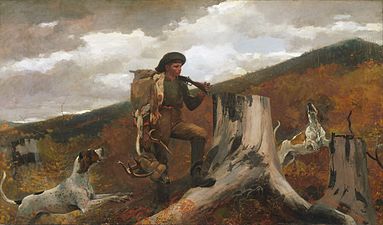
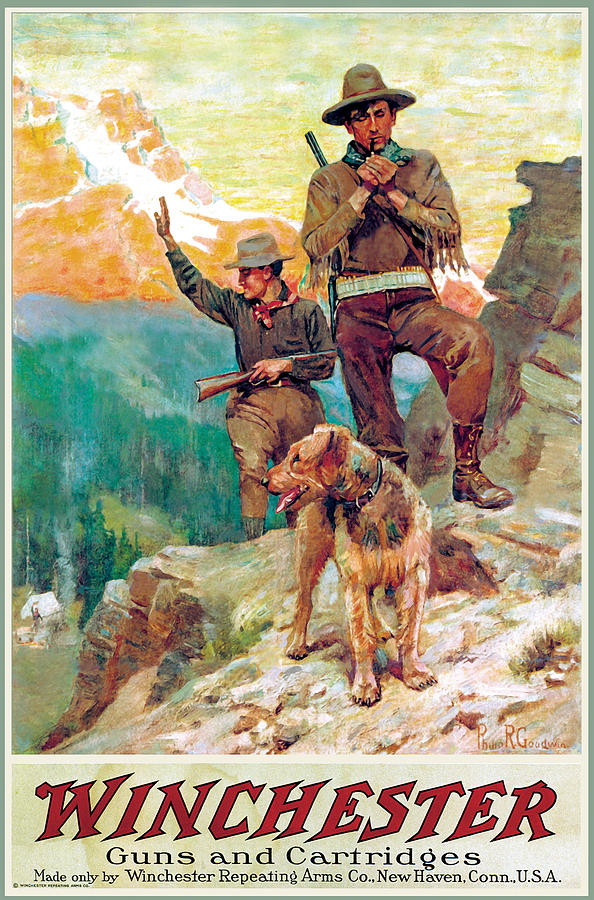
Some Old Hunting / Gun Advertising Porn

I hope that like these as much as I do!                          Grumpy
Image result for hunting paintings scenes
Image result for classic american hunting advertising scenes
Related image
Related image
Image result for classic american hunting advertising scenes
Related image
Image result for classic american hunting advertising scenes
Related image
Related image
Related image

Categories
All About Guns Other Stuff Related Topics

Hopefully this is Legally Correct but you might want to check it out on your own!

Having sore fingers from reloading your magazines?  RAE Speedloader is your hero! For AUTHENTIC AMERICAN MADE magazine loaders, visit http://www.amazon.com/shops/raeind

Categories
The Green Machine Well I thought it was funny!

Facial hair

Image result for combat moustache In the spirit of so called transparency. My Mustache does not think this is funny either!

Categories
All About Guns

Hitler's Bandsaw- A Video about the MG-34 and MG-42

Image result for MG-34
When you ran into one of these Machine Guns in WWII or beyond it to another war.
You then knew that you are well & truly f**ked. So you just hoped that your RTO is still alive. Otherwise your day just went to pot!
That & Arty is awake & ready for a Time on Target fire mission.
Image result for MG-34

Attachments area