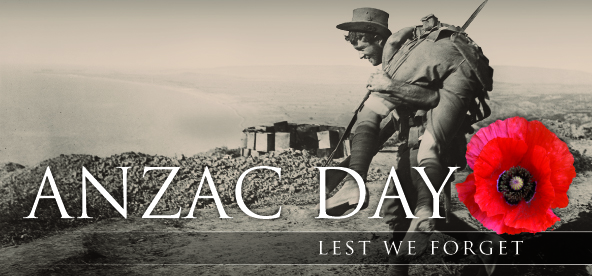
Anzac Day is a national day of remembrance in Australia and New Zealand that broadly commemorates all Australians and New Zealanders “who served and died in all wars, conflicts, and peacekeeping operations” and “the contribution and suffering of all those who have served”.[1][2] Observed on 25 April each year, Anzac Day was originally to honour the members of the Australian and New Zealand Army Corps(ANZAC) who fought at Gallipoli against the Ottoman Empire during World War I.
Anzac Day is also observed in the Cook Islands, Niue, Pitcairn Islands, and Tonga, and previously was a national holiday in Papua New Guinea and Samoa.[3][4]
History[edit]

An Australian veteran on Anzac Day.
Anzac Day marks the anniversary of the first campaign that led to major casualties for Australian and New Zealand forces during the First World War. The acronym ANZAC stands for Australian and New Zealand Army Corps, whose soldiers were known as Anzacs. Anzac Day remains one of the most important national occasions of both Australia and New Zealand,[5] a rare instance of two sovereign countries not only sharing the same remembrance day, but making reference to both countries in its name. When war broke out in 1914, Australia and New Zealand had been dominions of the British Empire for thirteen and seven years respectively.
Gallipoli campaign[edit]
In 1915, Australian and New Zealand soldiers formed part of an Allied expedition that set out to capture the Gallipoli Peninsula to open the way to the Black Sea for the Allied navies. The objective was to capture Constantinople, the capital of the Ottoman Empire, which was an ally of Germany during the war. The ANZAC force landed at Gallipoli on 25 April, meeting fierce resistance from the Ottoman Army commanded by Mustafa Kemal (later known as Atatürk). What had been planned as a bold strike to knock the Ottomans out of the war quickly became a stalemate, and the campaign dragged on for eight months. At the end of 1915, the Allied forces were evacuated after both sides had suffered heavy casualties and endured great hardships. The Allied casualties included 21,255 from the United Kingdom, of which were some 4000 Irish soldiers from the Royal Irish Fusiliers, an estimated 10,000 dead soldiers from France, 8,709 from Australia, 2,721 from New Zealand, and 1,358 from British India. News of the landing at Gallipoli made a profound impact on Australians and New Zealanders at home and 25 April quickly became the day on which they remembered the sacrifice of those who had died in the war.
Though the Gallipoli campaign failed to achieve its military objectives of capturing Constantinople and knocking the Ottoman Empire out of the war, the actions of the Australian and New Zealand troops during the campaign bequeathed an intangible but powerful legacy. The creation of what became known as an “Anzac legend” became an important part of the national identity in both countries. This has shaped the way their citizens have viewed both their past and their understanding of the present. The heroism of the soldiers in the failed Gallipoli campaign made their sacrifices iconic in New Zealand memory, and is often credited with securing the psychological independence of the nation.[6][7]
Foundations of Anzac Day[edit]
On 30 April 1915, when the first news of the landing reached New Zealand, a half-day holiday was declared and impromptu services were held.[8]
In South Australia, Australia’s first built memorial to the Gallipoli landing was unveiled by Governor-General Sir Ronald Munro Ferguson on “Wattle Day“, 7 September 1915, just over four months after the first landings. The monument was originally the centrepiece of the Wattle Day League’s Gallipoli Memorial Wattle Grove, later known as “Wattle Grove”, on Sir Lewis Cohen Avenue in the South Park Lands but in 1940 the Adelaide City Council moved the monument and its surrounding pergola to Lundie Garden, a lawned area off South Terrace near the junction with Anzac Highway. The original native pines and remnant seedlings of the original wattles still grow in “Wattle Grove”.[9] Also in South Australia, Eight Hour Day, 13 October 1915, was renamed “Anzac Day” and a carnival was organised to raise money for the Wounded Soldiers Fund.[10][11]
The date 25 April was officially named Anzac Day in 1916; in that year it was marked by a wide variety of ceremonies and services in Australia and New Zealand, including a commemorative march through London involving Australian and New Zealand troops. In New Zealand it was gazetted as a half-day holiday.[8] Australian Great War battalion and brigade war diaries show that on this first anniversary, units including those on the front line, made efforts to solemnise the memory of those who were killed this day twelve months previously. A common format found in the war diaries by Australian and New Zealand soldiers for the day commenced with a dawn requiem mass, followed mid-morning with a commemorative service, and after lunch organised sports activities with the proceeds of any gambling going to Battalion funds. This occurred in Egypt as well.
In Queensland on 10 January 1916 Canon David John Garland was appointed the honorary secretary of the Anzac Day Commemoration Committee of Queensland (ADCCQ) at a public meeting which endorsed 25 April as be the date promoted as “Anzac Day” in 1916 and ever after. Devoted to the cause of a non-denominational commemoration that could be attended by the whole of Australian society, Garland worked amicably across all denominational divides, creating the framework for Anzac Day commemorative services.[12] Garland is specifically credited with initiating the Anzac Day march, the wreath-laying ceremonies at memorials and the special church services, the two minutes silence, and the luncheon for returned soldiers.[13] Garland intended the silence was used in lieu of a prayer to allow the Anzac Day service to be universally attended, allowing attendees to make a silent prayer or remembrance in accordance with their own beliefs. He particularly feared that the universality of the ceremony would fall victim to religious sectarian disputes.[14]
In London, over 2,000 Australian and New Zealand troops marched through the streets of the city.[15] A London newspaper[which?] headline dubbed them “The Knights of Gallipoli”. Marches were held all over Australia in 1916; wounded soldiers from Gallipoli attended the Sydney march in convoys of cars, accompanied by nurses. Over 2,000 people attended the service in Rotorua.[8] For the remaining years of the war, Anzac Day was used as an occasion for patriotic rallies and recruiting campaigns, and marches of serving members of the AIF were held in most cities. From 1916 onwards, in both Australia and New Zealand, Anzac memorials were held on or about 25 April, mainly organised by returned servicemen and school children in cooperation with local authorities.

Flags on the cenotaph in Wellington for the 2007 Dawn March. From left to right, the flags of New Zealand, the United Kingdom and Australia
Anzac Day was gazetted as a public holiday in New Zealand in 1920, through the Anzac Day Act, after lobbying by the New Zealand Returned Soldiers’ Association,[16] the RSA.[17] In Australia at the 1921 State Premiers’ Conference, it was decided that Anzac Day would be observed on 25 April each year. However, it was not observed uniformly in all the states.
During the 1920s, Anzac Day became established as a National Day of Commemoration for the 60,000 Australians and 18,000 New Zealanders who died during the war. The first year in which all the Australian states observed some form of public holiday together on Anzac Day was 1927. By the mid-1930s, all the rituals now associated with the day—dawn vigils, marches, memorial services, reunions, sly two-up games—became part of Australian Anzac Day culture. New Zealand commemorations also adopted many of these rituals, with the dawn service being introduced from Australia in 1939.[17]
Anzac Day since World War II[edit]
With the coming of the Second World War, Anzac Day became a day on which to commemorate the lives of Australians and New Zealanders lost in that war as well and in subsequent years. The meaning of the day has been further broadened to include those killed in all the military operations in which the countries have been involved.
Anzac Day was first commemorated at the Australian War Memorial in 1942, but, due to government orders preventing large public gatherings in case of Japanese air attack, it was a small affair and was neither a march nor a memorial service. Anzac Day has been annually commemorated at the Australian War Memorial ever since.[5]
In New Zealand, Anzac Day saw a surge in popularity immediately after World War II. However this was short-lived, and by the 1950s many New Zealanders had become antagonistic or indifferent towards the day. Much of this was linked to the legal ban on commerce on Anzac Day, and the banning by many local authorities of sports events and other entertainment on the day. Annoyance was particularly pronounced in 1953 and 1959, when Anzac Day fell on a Saturday. There was widespread public debate on the issue, with some people calling for the public holiday to be moved to the nearest Sunday or abolished altogether. In 1966 a new Anzac Day Act was passed, allowing sport and entertainment in the afternoon.[18]
From the 1960s, but especially in the 1970s and 1980s, Anzac Day became increasingly controversial in both Australia and New Zealand. Protests against the Vietnam War were common Anzac Day occurrences during the 1960s and 1970s.[19][20] In 1967, two members of the left-wing Progressive Youth Movement in Christchurch staged a minor protest at the Anzac Day ceremony, laying a wreath protesting against the Vietnam War. They were subsequently convicted of disorderly conduct. In 1978, a women’s group laid a wreath dedicated to all the women raped and killed during war, and movements for feminism, gay rights, and peace used the occasion to draw attention to their respective causes at various times during the 1980s.[21] In the 1980s, Australian feminists used the annual Anzac Day march to protest against rape and violence in war and were banned from marching.[22][23]
From about the late 1980s, however, there was an international resurgence of interest in World War I and its commemorations. Anzac Day attendances rose in Australia and New Zealand, with young people taking a particular interest. Protests and controversy became much rarer.
Until 1981 Papua New Guinea commemorated its war dead on Anzac Day; however, since then Remembrance Day has been observed on 23 July, the date of the first action of the Papuan Infantry Battalion against the Japanese at Awala in 1942 during the Kokoda Track campaign.[24]
Revival[edit]

Anzac Day at Darwin, 25 April 2013
Following Australia’s involvement in the Vietnam War, interest in Anzac Day reached its lowest point. On 26 April 1975 The Australian newspaper covered the passing of Anzac Day in a single story.[25] However, in recent years Anzac Day has drawn record crowds,[26] with an increasing number of those attending being young Australians,[27][28] many of whom attend ceremonies swathed in Australian flags, wearing green and gold T-shirts and beanies and with Australian flag tattoos imprinted on their skin.[29][30][31][32] This phenomenon has been perceived by some as a reflection of the desire of younger generations of Australians to honour the sacrifices made by the previous generations.[33]
Australians and New Zealanders recognise 25 April as a ceremonial occasion to reflect on the cost of war and to remember those who fought and lost their lives for their country. Commemorative services and marches are held at dawn, the time of the original landing, mainly at war memorials in cities and towns across both nations and the sites of some of Australia and New Zealand’s more-recognised battles and greatest losses, such as Villers-Bretonneux in France[34]and Gallipoli in Turkey.[35]
One of the traditions of Anzac Day is the “gunfire breakfast” (coffee with rumadded) which occurs shortly after many dawn ceremonies, and recalls the “breakfast” taken by many soldiers before facing battle. Later in the day, ex-servicemen and ex-servicewomen meet and join in marches through the major cities and many smaller centres.
Dawn service[edit]
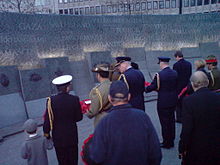
The wreath laying at the 2008 dawn service at the Australian War Memorial at Hyde Park Corner, London.
After the First World War, returned soldiers sought the comradeship they felt in those quiet, peaceful moments before dawn. With symbolic links to the dawn landing at Gallipoli, a dawn stand-to or dawn ceremony became a common form of Anzac Day remembrance during the 1920s.
The first official dawn service was held at the Sydney Cenotaph in 1927. Dawn services were originally very simple and followed the operational ritual; in many cases they were restricted to veterans only. The daytime ceremony was for families and other well-wishers and the dawn service was for returned soldiers to remember and reflect among the comrades with whom they shared a special bond.
Before dawn the gathered veterans would be ordered to “stand-to” and two minutes of silence would follow. At the start of this time a lone bugler would play the Last Post and then concluded the service with Reveille. In more recent times the families and young people have been encouraged to take part in dawn services, and services in Australian capital cities have seen some of the largest turnouts ever. Reflecting this change, the ceremonies have become more elaborate, incorporating hymns, readings, pipers and rifle volleys. Others, though, have retained the simple format of the dawn stand-to, familiar to so many soldiers.
Typical modern dawn services follow a pattern that is now familiar to generations of Australians, containing the following features: introduction, hymn, prayer, an address, laying of wreaths, recitation, the playing of the Last Post, a minute of silence, Reveille, and the playing of both the New Zealand and Australian national anthems. At the Australian War Memorial, following events such as the Anzac Day and Remembrance Day services, families often place artificial red poppiesbeside the names of relatives on the Memorial’s Roll of Honour. In Australia, sprigs of rosemary are often worn on lapels[36] and in New Zealand poppies have taken on this role.[37]
Commemoration[edit]

The Last Post is played at an Anzac Day ceremony in Port Melbourne, Victoria, 25 April 2005. Ceremonies like this are held in virtually every suburb and town in Australia and New Zealand on Anzac Day each year.
In Australia and New Zealand, Anzac Day commemoration features solemn “Dawn Services” or “Dawn Marches”, a tradition started in Albany, Western Australia on 25 April 1923 and now held at war memorials around both countries, accompanied by thoughts of those lost at war to the ceremonial sounds of the Last Post on the bugle. The fourth stanza of Laurence Binyon‘s poem For the Fallen (known as the “Ode of Remembrance“, or simply as “the Ode”) is often recited.
Australia[edit]
Anzac Day is a national public holiday and is considered by many Australians to be one of the most solemn days of the year. Marches by veterans from all past wars, as well as current serving members of the Australian Defence Force and Reserves, with allied veterans as well as the Australian Defence Force Cadetsand Australian Air League and supported by members of Scouts Australia, Guides Australia, and other service groups, are held in cities and towns nationwide. The Anzac Day March from each state capital is televised live with commentary. These events are generally followed by social gatherings of veterans, hosted either in a public house or in an RSL club, often including a traditional Australian gambling game called two-up, which was an extremely popular pastime with ANZAC soldiers. In most Australian states and territories, gambling is forbidden outside of licensed venues. However, due to the significance of this tradition, two-up is legal only on Anzac Day.
Despite federation being proclaimed in Australia in 1901, it is argued that the “national identity” of Australia was largely forged during the violent conflict of World War I,[29][38]and the most iconic event in the war for most Australians was the landing at Gallipoli. Dr. Paul Skrebels of the University of South Australia has noted that Anzac Day has continued to grow in popularity;[39] even the threat of a terrorist attack at the Gallipoli site in 2004[40] did not deter some 15,000 Australians from making the pilgrimage to Turkey to commemorate the fallen ANZAC troops.[41]
Although commemoration events are always held on 25 April, most states and territories currently observe a substitute public holiday on the following Monday when Anzac Day falls on a Sunday. When Anzac Day falls on Easter Monday, such as in 2011, the Easter Monday holiday is transferred to Tuesday.[42] This followed a 2008 meeting of the Council for the Australian Federation in which the states and territories made an in-principle agreement to work towards making this a universal practice.[43] However, in 2009, the Legislative Council of Tasmania rejected a bill amendment that would have enabled the substitute holiday in that state.[44]
Australian postage stamps[edit]
Australia Post has issued stamps over the years to commemorate Anzac Day, the first being in 1935 for the 20th anniversary of the Gallipoli landings.
The full list of issued stamps is as follows:
- 1935 – 20th Anniversary (2 values) 2d Red and 1/- Black featuring the London Cenotaph.
- 1955 – the then current 3½d Purple Nursing commemorative stamp was privately overprinted with the words “ANZAC 1915–1955 40 YEARS LEST WE FORGET” and a value ranging from 1d to £1 was also added which was the fundraising amount in addition to the legal cost of stamp of which the denomination was 3½d. Eight values were issued and were intended to raise funds for the Anzac commemorations. It is believed these stamps were authorised by the secretary of a leading Melbourne RSL club.
- 1965 – 50th Anniversary (3 values) 5d Khaki, 8d Blue and 2/3 Maroon featuring Simpson and his donkey.
- 1990 – 75th Anniversary (5 values) 41¢ x 2, 65¢, $1, and $1.10 all featuring various Anzac themes.
- 2000 – ANZAC legends (4 values) 45¢ x 4 featuring Walter Parker, Roy Longmore, Alec Campbell and the Anzac medal.
During many wars, Australian rules football matches have been played overseas in places like northern Africa, Vietnam, and Iraq as a celebration of Australian culture and as a bonding exercise between soldiers.[45][46][47]
The modern-day tradition began in 1995 and is played every year between traditional AFL rivals Collingwood and Essendon at the Melbourne Cricket Ground. This annual match is often considered the biggest of the AFL season outside of the finals, sometimes drawing bigger crowds than all but the Grand Final,[48] and often selling out in advance. A record crowd of 94,825 people attended the inaugural match in 1995.[49][50][51] The Anzac Medal is awarded to the player in the match who best exemplifies the Anzac spirit – skill, courage, self-sacrifice, teamwork and fair play. Collingwood hold the advantage 11 wins to 8 with one draw (in the inaugural year, 1995).
In 2013, St Kilda and the Sydney Swans played an Anzac Day game in Wellington, New Zealand, the first AFL game played for premiership points outside of Australia.[52] The winning team, Sydney, were presented with the inaugural Simpson-Henderson Trophy by the Prime Minister of New Zealand. The trophy was named after two notable Anzac soldiers: John Simpson Kirkpatrickand Richard Alexander Henderson.[53]
Beginning in 1997, the Anzac Test, a rugby league test match, has commemorated Anzac Day, though it is typically played a week prior to Anzac Day. The match is always played between the Australian and New Zealand national teams, and has drawn attendances of between 20,000 and 45,000 in the past.
Domestically, matches have been played on Anzac Day since 1927 (with occasional exceptions). Since 2002, the National Rugby League (NRL) has followed the lead of the Australian Football League, hosting a match between traditional rivals St George Illawarra Dragons and the Sydney Roosters each year to commemorate Anzac Day in the Club ANZAC Game, although these two sides had previously met on Anzac Day several times as early as the 1970s. Since 2009, an additional Anzac Day game has been played between the Melbourne Storm and New Zealand Warriors.
New Zealand[edit]

Each year on ANZAC Day in Te Awamutu, New Zealand the graves of War Veterans are decorated
New Zealand’s Commemoration of Anzac Day[54] is similar. The number of New Zealanders attending Anzac Day events in New Zealand, and at Gallipoli, is increasing. For some, the day adds weight to the idea that war is futile.[55]
Dawn Marches and other memorials nationwide are typically attended by the New Zealand Defence Force, the New Zealand Cadet Forces, members of the New Zealand Police, New Zealand Fire Service, Order of St John Ambulance Service (Youth and Adult Volunteers) as well as Scouting New Zealand, GirlGuiding New Zealand and other uniformed community service groups including in most places the local Pipe Bandto lead or accompany the March, and sometimes a Brass Band to accompany the hymns.
Anzac Day now promotes a sense of unity, perhaps more effectively than any other day on the national calendar. People whose politics, beliefs and aspirations are widely different can nevertheless share a genuine sorrow at the loss of so many lives in war.
Paper poppies are widely distributed by the Returned Services Association and worn as symbols of remembrance. This tradition follows that of the wearing of poppies on Remembrance Sunday in other Commonwealth countries.[56]
The day is a public holiday in New Zealand. Shops are prohibited from opening before 1 pm as per the Anzac Day Act1966. A prior Act passed in 1949 prevented the holiday from being “Mondayised” (moved to the 26th or 27th should the 25th fall on a weekend),[57] although this drew criticism from trade unionists and Labour Party politicians.[58] In 2013, a member’s bill introduced by Labour MP David Clark to Mondayise Anzac Day and Waitangi Day passed, despite opposition from the governing National Party.[59]
New Zealand’s reason for having Anzac Day as its national commemoration day is different to Australia. In 1921 the poppies were ordered by the RSA for Armistice Day but arrived too late on the ship Westmorland. The RSA was stuck with the cost of 350,000 of these French made poppies and to get its money returned quickly it chose the next commemoration date available to sell them – Dardanelles Day, 25 April 1922. This date then stuck in the psyche of New Zealanders ever since. So Anzac Day in New Zealand was used by accident and not as a direct association to Anzac, Australia or Gallipoli. New Zealand did copy Australia in having dawn services 16 years later, despite New Zealand not landing at dawn at Gallipoli. Attempts have been made to revert to Armistice Day, commencing with the “Tomb for the Unknown Warrior” parade in 2004. But New Zealanders have resisted, unaware of its history. The reason for some wanting to revert is that other bigger battles and losses have since been ignored. Gallipoli accounted for 8% of New Zealand’s war losses and 60% of those were not the result of direct combat.[60]
In Turkey the name “ANZAC Cove” was officially recognised by the Turkish government on Anzac Day in 1985. In 1934, Kemal Atatürk delivered the following words to the first Australians, New Zealanders and British to visit the Gallipoli battlefields. This was later inscribed on a monolith at Ari Burnu Cemetery (ANZAC Beach) which was unveiled in 1985. The words also appear on the Kemal Atatürk Memorial, Canberra, and the Atatürk Memorial in Wellington:[61]
- “Those heroes that shed their blood
And lost their lives.
You are now lying in the soil of a friendly country.
Therefore rest in peace.
There is no difference between the Johnnies
And the Mehmets to us where they lie side by side
Here in this country of ours.
You, the mothers,
Who sent their sons from far away countries
Wipe away your tears,
Your sons are now lying in our bosom
And are in peace
After having lost their lives on this land they have
Become our sons as well.”[62]
In 1990, to mark the 75th anniversary of the Gallipoli landing, Government officials from Australia and New Zealand (including Australian Prime Minister Bob Hawke[63][64] and New Zealand Governor-General Paul Reeves[65]) as well as most of the last surviving Gallipoli veterans, and many Australian and New Zealand tourists travelled to Turkey for a special Dawn Service at Gallipoli. The Gallipoli Dawn Service was held at the Ari Burnu War Cemetery at Anzac Cove, but the growing numbers of people attending resulted in the construction of a more spacious site on North Beach, known as the “Anzac Commemorative Site” in time for the year 2000 service.
A ballot was held to allocate passes for Australians and New Zealanders wishing to attend Anzac Day commemorations at Gallipoli in 2015. Of the 10,500 people that could be safely, securely and comfortably accommodated at the Anzac Commemorative Site, in 2015 this comprised places for 8,000 Australians, 2,000 New Zealanders and 500 official representatives of all nations involved in the Gallipoli campaign. Only those who received an offer of attendance passes attended the commemorations in 2015.[66]
Other overseas ceremonies[edit]
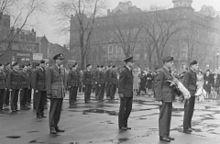
Anzac Day ceremony in Montreal, Quebec

Anzac Day dawn service at the New Zealand Memorial, Hyde Park Corner, London, 25 April 2008.
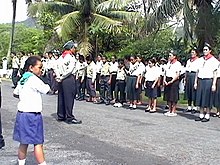
Boys Brigade review on 25 April 2005 (Rarotonga)
Antarctica[edit]
Belgium[edit]
- In Ypres – Belgium, the ANZAC-Day Ceremony is held at the Menin Gate at 11 A.M.
- In Newfoundland, Canada, the Gallipoli offensive is commemorated each year on 25 April by the Royal Newfoundland Regiment who hold a march from Government House through the streets of St. John’s ending at the National War Memorial. Members of both the Australian and New Zealand armed forces are invited each year to participate in the march and wreath laying ceremonies.
- Calgary has had a Cenotaph Service annually at Central Park with participation from the local military.[68]
- In Winnipeg, Manitoba Anzac service is held at the Royal Aviation Museum of Western Canada by the Down Under Club of Winnipeg.
- In Edmonton, Alberta, Anzac dawn service is held annually at Edmonton City Hall Cenotaph.
- In London, Ontario Anzac service is held at Wolseley Barracks, Royal Canadian Regiment (RCR) Memorial, 701 Oxford Street East, London.
- In Toronto, Ontario, Anzac service is held at the Armour Heights Officers’ Mess, Canadian Forces College.
- In Vancouver, British Columbia, Anzac service is held at Victory Square, Vancouver.[69]
- In Nicosia, the ANZAC Day dawn service is held at the Nicosia War Cemetery(Waynes Keep) at 05:00. The ceremony is usually attended by expatriates from both countries and by high-ranking officials of the UN peacekeeping mission deployed on the island.
- In Cairo, Egypt, Anzac Day is remembered by the expatriate New Zealand and Australian communities with a dawn ceremony held at the Old Cairo War Graves Cemetery, Abu Seifen Street, Old Cairo. New Zealand and Australian Embassies rotate hosting the service.
United Kingdom[edit]
- In London, England, a 5 am Dawn Service is held, alternating between the Australian War Memorial, and the more recently constructed New Zealand War Memorial, both of which are at Hyde Park Corner. The day is also marked by a 9 am Wreath Laying Ceremony and service at the Gallipoli Memorial in the crypt of St Paul’s Cathedral[70] and an 11 am Wreath Laying Ceremony and Parade at The Cenotaph, Whitehall, both of which are attended by official representatives and veterans associations of Australia, New Zealand, the United Kingdom and other countries. The Wreath Laying Ceremony at the Cenotaph is directly followed by a Service of Commemoration and Thanksgiving at Westminster Abbey.[71] The Dawn Service, ceremony at the Cenotaph and the Service of Commemoration and Thanksgiving are usually attended by a member of the Royal Family representing the Queen, and by the High Commissioners of Australia and New Zealand.[72] Anzac Day has been officially observed in London since 1916, when King George V and Queen Maryattended the first commemorative service at the Abbey.[73]
- In Tetbury, Gloucestershire, England, a March is held on the nearest Sunday to Anzac Day. The service is held in a graveyard with several war graves of service men from Australia and New Zealand. Veterans and cadets from the local ATC squadron attend.
- In Oxford, Oxfordshire, England, an Anzac Day service is organised by the Oxford University Australia New Zealand Society. In 2015 the service was held at the University Church on 25 April, followed by dinner in Somerville College Hall.[74] Representatives of the Australian and New Zealand High Commissions attend and Australian, New Zealand, and Turkish students are all involved in the service.
- A service of remembrance to commemorate Anzac Day and Gallipoli is held at the National Memorial Arboretum in Staffordshire, England, UK. This commences with a service in the chapel followed by wreath laying at the Gallipoli memorial.
- In France in the towns of Le Quesnoy and Longueval[75] and in the town of Villers-Bretonneux (on the next closest weekend) because on 25 April 1918, the village of Villers-Bretonneux was liberated by the Anzacs. The Australian Government holds an annual dawn service[34] at the Australian National Memorial just outside the small town of Villers-Bretonneux.
- In French Polynesia, Anzac Day has been commemorated with an official ceremony held in Papeete since 2006.[76]The 2009 ceremony was attended by French Polynesia President Oscar Temaru, who praised the “courage and liberty” of Australian and New Zealand soldiers in a statement.[76]
Germany[edit]
- In Germany, Anzac Day is commemorated in Berlin, at the Commonwealth Kriegsgräber, Charlottenburg. (Commonwealth War Graves).[77]
Hong Kong[edit]
Ireland[edit]
- In Ireland, Anzac Day is remembered by the expatriate New Zealand and Australian communities. In the absence of an official World War I remembrance, and in honour of Irish soldiers who fought and perished in the Dardanelles and elsewhere, Anzac Day commemorations are also attended by members of veterans groups and historical societies, including the Royal Dublin Fusiliers, O.N.E.T., the Royal British Legion, UN Veterans, and more. Since the mid-1980s, an evening service has been organised by the New Zealand-Ireland Association,[79] which currently takes place in St Ann’s Church, Dawson St, Dublin 2. For the 90th anniversary in 2005, a daylight service was held for the first time in the re-furbished Grangegorman Military Cemetery, Dublin 7. A Turkish Hazel tree, planted by the Ambassadors of Australia, New Zealand and Turkey, commemorates this occasion. It can be found to the south of the limestone Memorial Wall. Since this date, a dawn service has been held at this location. At the Ballance House in County Antrim, the official New Zealand centre in Northern Ireland, a midday Anzac reception and act of remembrance takes place.
Kiribati[edit]
- In Kiribati, Anzac Day is commemorated at the Coast Watchers Memorial on the islet of Betio, Tarawa, hosted by the New Zealand and Australian High Commissions.
Malaysia[edit]
The Australian Borneo Exhibition Group organises annual trips for ANZAC veterans and students to commemorate World War II in the states of Sabah and Sarawak.[80]
- In Kuala Lumpur and Sandakan,[81] Anzac Day is a memorial day to honour the Australian, British, New Zealand and local soldiers who perished during the Second World War. A commemorative service will be held like Dawn Service and Gunfire Breakfast.
- In Kota Kinabalu, a ceremony is held on 26 April at Jalan Tugu (Monument Street) to honour and remember the sacrifices of all freedom fighters including the contribution of Australia and New Zealand to the state of Sabah.[82]
- In Kuching, a commemorative service was held at the World War II Heroes Graves Memorial in Jalan Taman Budaya (Culture Park Street) on 25 April.[83]
- In Malta Anzac day is commemorated at dawn in Floriana at the Anzac Monument at the Argotti Gardens.
- In South Sudan, Anzac Day is commemorated in the capital Juba at a dawn service at DaVinci by the Nile River by expats and friends of Australia alike.
Thailand[edit]
- In Kanchanaburi, Thailand, a dawn service is held at Hellfire Pass, a rock cutting dug by allied Prisoners of War and Asian labourers for the Thai-Burma Railway. This cutting is where the greatest number of lives were lost during railway construction. The dawn service is followed by a “gunfire breakfast” (coffee with a shot (or two) of rum) recalling the ‘breakfast’ taken by many soldiers before facing battle. At 11 am a second ceremony is held at the main POW cemetery in the city of Kanchanaburi, where 6,982 POWs are buried, mostly British, Australian, Dutch and Canadians. Over the years, both services have been attended by some Anzac ex-POWs and their families travelling from Australia, as well as ambassadors from the Australian and New Zealand consulates, the Kanchanaburi Provincial Governor, and others. The closest Saturday to Anzac Day also sees the ex-POWs attend an Australian Rules football match between the Thailand Tigers AFL club and a team invited from neighbouring Asian countries.
United States[edit]
- In the United States, Anzac Day is commemorated at the Los Angeles National Cemetery in Westwood, California. The New Zealand and Australian Consulates-General rotate hosting the service. The largest expatriate community of New Zealanders and Australians are in Southern California, hence this location.
- In Santa Barbara, California, Anzac Day is remembered by the expatriate Australian and New Zealand communities. In the absence of an official World War I remembrance, several dignitaries from many countries including Australia, New Zealand and the U.S. attend an 11.11 am morning service held at the Elings Park Veteran’s Memorial Walk on 25 April of each year.
- In New York City, a small mid-morning tribute to Anzac Day is held in the roof garden at the Rockefeller Center British Empire Building in Rockefeller Plaza, 620 Fifth Avenue, overlooking St. Patrick’s Cathedral, on the Sunday nearest 25 April; it is an annual tradition that has been held at this locale since 1950.
- In Washington DC, Australian and New Zealand servicemen and women observe Anzac Day at a dawn service at the Korean War Veterans Memorial on 25 April each year.
- In Hawaii the Marine Corps hosts an Anzac Day ceremony at the National Memorial Cemetery of the Pacific, known as “The Punchbowl”, where several dignitaries from many countries including Australia, New Zealand, Canada, and the U.S. attend to commemorate the memory of all who have fallen for their country.
- In San Francisco, there is an 11am service at the Log Cabin in the Presidio on the Sunday nearest 25 April. Dignitaries from Australia, New Zealand, Turkey, USA and England attend. It is followed by a BBQ picnic.
Criticism[edit]
Anzac Day has been criticised by a number of Australians and New Zealanders.[85][86] At its inception, Anzac Day faced criticism from the Australian labor movement, and in the country at large, there was opposition to political exploitation of what was seen as a day of mourning.[87] One controversy occurred in 1960 with the publication of Alan Seymour‘s classic play, The One Day of the Year,[88] which dramatised the growing social divide in Australia and the questioning of old values. In the play, Anzac Day is critiqued by the central character, Hughie, as a day of drunken debauchery by returned soldiers and as a day when questions of what it means to be loyal to a nation or Empire must be raised. The play was scheduled to be performed at the inaugural Adelaide Festival of Arts, but after complaints from the Returned Services League, the governors of the Festival refused permission for this to occur.[89]
In October 2008, former Australian Prime Minister Paul Keating stated that he believes it is misguided for people to gather each year at Anzac Cove to commemorate the landing at Gallipoli, because it is “utter and complete nonsense” to suggest that the nation was “born again or even, redeemed there.”[90] The then Australian Prime Minister Kevin Rudd rejected Keating’s views, saying the Gallipoli campaign is “part of our national consciousness, it’s part of our national psyche, it’s part of our national identity, and I, for one, as Prime Minister of the country, am absolutely proud of it.”[91]
In April 2015, Australian men’s magazine ZOO Weekly created controversy by marking the centenary of Anzac Day with an image of a bikini-clad model holding a poppy. The magazine was regarded as “inappropriate” by the Australian Department of Veteran’s Affairs and by many ordinary Australians, and many stores, including Target, were forced to recall it from shelves.[92]
Criticisms of the revival of public participation[edit]
Some critics have suggested that the revival in public interest in Anzac Day amongst the young results from the fact that younger Australians have not themselves experienced war.[93][94][95] Critics see the revival as part of a rise of unreflective nationalism in Australia which was particularly fostered by the then Australian Prime Minister John Howard.[96][97][98][99][100][101][102]
For decades, there have been concerns that the participation of young people in Anzac Day events has injected a carnival element into what is traditionally a solemn occasion. The change was highlighted by a rock concert-style performance at the 2005 Anzac Cove commemoration during which attendees drank and slept between headstones. After the event the site was left strewn with rubbish.[103][104][105] In 2013, historian Jonathan King expressed concern about the rising popularity of Anzac Day, arguing that “escalating commercial pressures threaten to turn the centenary [of the landing at Gallipoli] into a Big Day Out.”[106]
Insufficient remembrance of the contribution of New Zealand[edit]
Other criticisms have revolved around a perceived overzealousness in Australian attachment to the event, either from participants unaware of the loss or when the focus is at the expense of remembrance of the contribution of New Zealand.[106] In 2005, then Prime Minister John Howard was criticised for shunning the New Zealand Anzac ceremony at Gallipoli,[107] preferring instead to spend his morning at a barbecue on the beach with Australian soldiers. In 2009, New Zealand historians noted that some Australian children were unaware that New Zealand was a part of ANZAC.[108] In 2012 a New Zealand journalist caused controversy following comments that Australian World War I soldiers were bludgers and thieves.[109]

 SPECS
SPECS