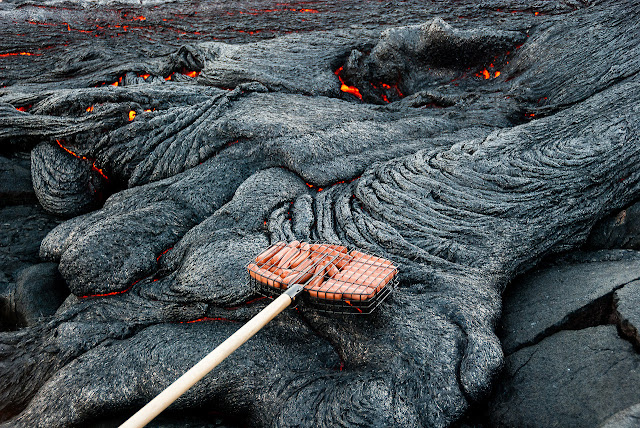
I am just surprised it wasn’t Spam instead of hot dogs!
by JORDAN MICHAELS
A new report from the FBI has found that of the 50 “active shooter incidents” in 2016 and 2017, individuals with valid firearm permits successfully stopped four of them.
While that may not sound like a large percentage, concealed carry holders actually outperformed their representative segment of the population. The three million Americans who carry a handgun every day represent only .9 percent of the people living in the U.S., but CCL holders stopped 8 percent of the active shooter situations in the past two years. If a greater percentage of the population carried a firearm for self-defense, more incidents like these might have been cut short.
SEE ALSO: Suppressed CDC Survey Indicates Over 2 Million Defensive Gun Uses Per Year… in 1998
The FBI defined “active shooter incidents” as when “one or more individuals actively engaged in killing or attempting to kill people in a populated area.” The feds didn’t include gang- or drug-related incidents, and analysts relied on official law enforcement investigative reports (when available), FBI holdings, and publicly available resources when gathering data.
Here’s a brief description of each incident in which a CCL holder stopped the suspect:
- On September 28, 2016, at 1:45 p.m., Jesse Dewitt Osborne, 14, armed with a handgun, allegedly began shooting at the Townville Elementary School playground in Townville, South Carolina. Prior to the shooting, the shooter, a former student, killed his father at their home. Two people were killed, including one student; three were wounded, one teacher and two students. A volunteer firefighter, who possessed a valid firearms permit, restrained the shooter until law enforcement officers arrived and apprehended him.
- On September 24, 2017, at 11:15 a.m., Emanuel Kidega Samson, 25, armed with two handguns, allegedly began shooting in the parking lot of the Burnette Chapel Church of Christ in Antioch, Tennessee. After killing one person, the shooter entered the church and shot six people. A citizen who attempted to subdue the shooter was pistol-whipped. During the altercation, the shooter accidently shot himself. While the shooter was preoccupied, the citizen, who possessed a valid firearms permit, retrieved a handgun from his car and held the shooter at gunpoint until law enforcement arrived. One person was killed; seven were wounded. The shooter was apprehended by law enforcement.
- On November 5, 2017, at 11:20 a.m., Devin Patrick Kelley, 26, armed with a rifle, exited his vehicle and began shooting outside the First Baptist Church in Sutherland Springs, Texas. He then entered the church and continued shooting at members of the congregation. The shooter exited the church and was confronted by a citizen who possessed a valid firearms permit. The citizen shot the shooter twice, causing the shooter to drop his rifle and flee the scene in his vehicle. The armed citizen, together with the owner of a pickup truck, pursued the shooter. The chase ended when the shooter’s vehicle struck a road sign and overturned. Twenty-six people were killed; 20 were wounded. The shooter committed suicide with a handgun he had in his vehicle before police arrived.
- On November 17, 2017, at 4:30 p.m., Robert Lorenzo Bailey, Jr., 28, armed with a handgun, allegedly began shooting in the parking lot of Schlenker Automotive in Rockledge, Florida. The manager of the auto repair shop and an employee, both possessing valid firearms permits, exchanged gunfire with the shooter. One person was killed; one was wounded. The shooter, shot twice during the exchange, was held at gunpoint by the manager until law enforcement arrived and took him into custody.
The FBI recorded another incident in which the CCL holder forced the suspect to flee, but the suspect began shooting at a different location soon after.
SEE ALSO: New Yorker’s Adam Gopnik, “Guns, however, have an almost entirely symbolic function. No lives are saved. No intruders are repelled. The dense and hysterical mythology of gun love has been refuted again and again.”
The study only reports one incident in which an armed citizen was wounded while attempting to intervene, which works to discredit the argument that CCL holders always end up getting shot when they try to stop a suspect.
These incidents represent only a small fraction of the millions of defensive gun uses each year, but they nonetheless suggest the good that armed law-abiding citizens can accomplish. If 20 percent of Americans carried a handgun every day rather than .9, perhaps all or most of these mass casualty events could have been averted.
Categories
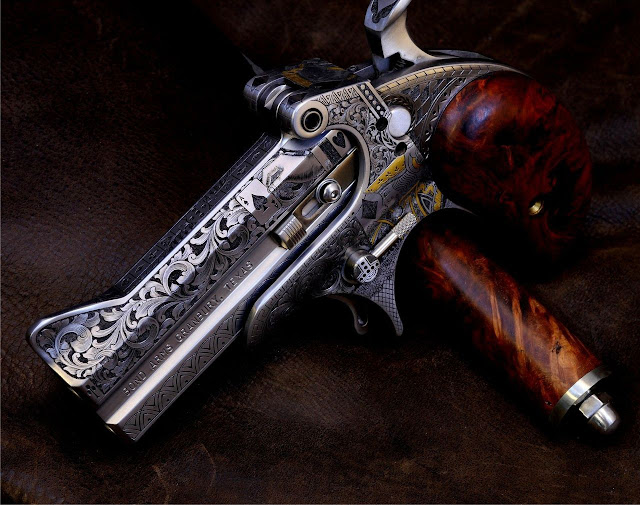
Walter PPK

So I like Sean Connery as James Bond, Guilty as charged okay?
But let us move on to the gun itself. Now I have only fired this twice in my life. So let us begin with the good news first. It is a very well made and designed gun that would make a good backup gun or belly gun*.
Also the 380 acp or 9mm Kurz is better than having no gun at all.
Now for the bad news
They are not cheap or easy to find. Also the recoil, small barrel & report will not allow most folks to hit anything beyond 20 feet realistically.
The other problem is that if you have a beefy hand. One runs a great risk of having the slide cut you pretty bad.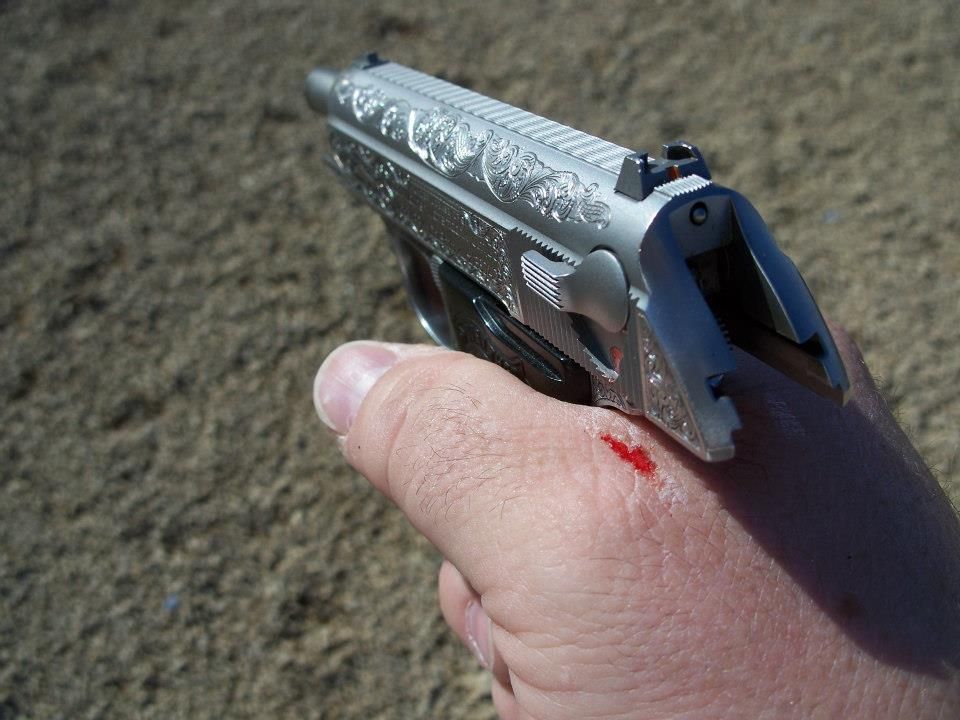 Also the ammo is not real cheap any more.
But it is a very sexy looking gun and it will be around for a very long time after I am gone and buried.
So if you want a well built and always going up in value gun. Then you could do a whole lot worse!
*a Belly Gun is a small easily concealable gun. That will really not makes somebody’s day. When it’s shoved into their guts and a round or two is then fired off in anger.
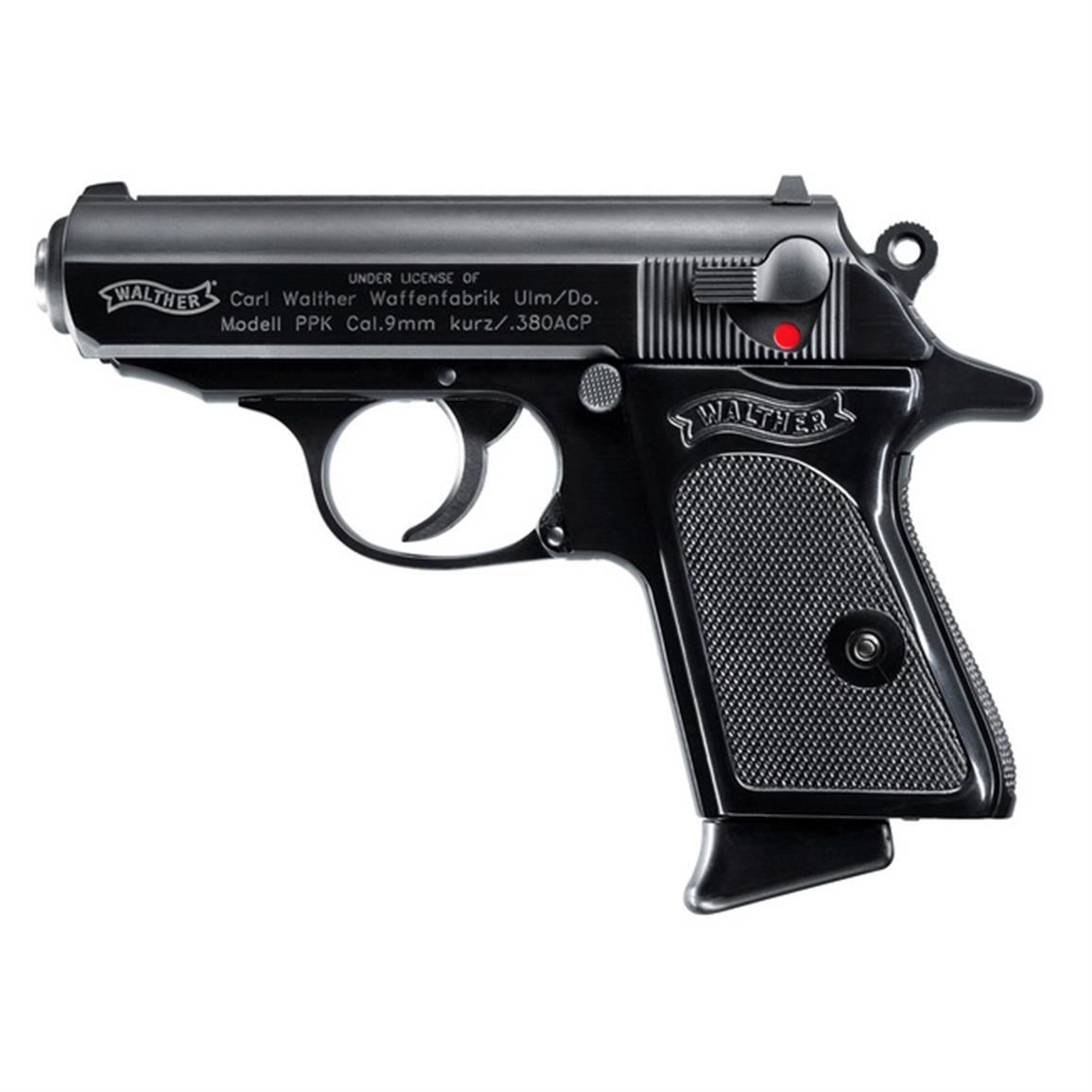
Here is some more information about this fine German Pistol

Attachments area


Walther PP
| Walther PP | |
|---|---|

Original Walther PP pistol.
|
|
| Type | Semi-automatic pistol |
| Place of origin | Germany[1] |
| Service history | |
| In service | 1935–1992 |
| Used by | See Users |
| Wars | World War II |
| Production history | |
| Designer | Carl Walther Waffenfabrik |
| Designed | 1929 |
| Manufacturer | Carl Walther GmbH Sportwaffen |
| Produced | 1929–present |
| Variants | PPK, PPK-L, PPKS, PP-Super, PPK/E, PP Sport and Walther TPH |
| Specifications | |
| Weight | 665 g (23.5 oz) (PP 9×17mm Short/.380 ACP) 660 g (23 oz) (PP 7.65×17mm Browning SR/.32 ACP) 675 g (23.8 oz) (PP .22 LR) 590 g (21 oz) (PPK 9×17mm Short/.380 ACP) 590 g (21 oz) (PPK 7.65×17mm Browning SR/.32 ACP) 560 g (20 oz) (PPK .22 LR) 635 g (22.4 oz) (PPK/S 9×17mm Short/.380 ACP) 630 g (22 oz) (PPK/S 7.65×17mm Browning SR/.32 ACP) 645 g (22.8 oz) (PPK/S .22 LR) 480 g (17 oz) (PPK-L 7.65×17mm Browning SR/.32 ACP) 450 g (16 oz) (PPK-L .22 LR) 780 g (28 oz) (PP-Super) |
| Length | 170 mm (6.7 in) (PP) 155 mm (6.1 in) (PPK) 156 mm (6.1 in) (PPK/S) 155 mm (6.1 in) (PPK-L) 176 mm (6.9 in) (PP-Super) |
| Barrel length | 98 mm (3.9 in) (PP) 83 mm (3.3 in) (PPK, PPK/S, PPK-L) 92 mm (3.6 in) (PP-Super) |
| Width | 30 mm (1.2 in) (PP, PPK/S, PPK-E) 25 mm (1.0 in) (PPK) 35 mm (1.4 in) (PP-Super) |
| Height | 109 mm (4.3 in) (PP) 100 mm (3.9 in) (PPK) 110 mm (4.3 in) (PPK/S) 113 mm (4.4 in) (PPK-E) 124 mm (4.9 in) (PP-Super) |
|
|
|
| Cartridge | 7.65×17mm Browning SR (.32 ACP) 9×17mm Short (.380 ACP) .22 Long Rifle 6.35×15mm Browning SR (.25 ACP) 9×18mm Ultra (PP-Super) |
| Action | Straight blowback |
| Muzzle velocity | 256 m/s (840 ft/s) (PP 9×17mm Short/.380 ACP) 320 m/s (1,049.9 ft/s) (PP 7.65×17mm Browning SR/.32 ACP) 305 m/s (1,000.7 ft/s) (PP .22 LR) 244 m/s (800.5 ft/s) (PPK/PPK/S 9×17mm Short/.380 ACP) 308 m/s (1,010.5 ft/s) (PPK/PPK/S/PPK-L 7.65×17mm Browning SR/.32 ACP) 280 m/s (918.6 ft/s) (PPK/PPK/S/PPK-L .22 LR) 325 m/s (1,066.3 ft/s) (PP-Super) |
| Feed system | Magazine capacity: PP: 10 (.22 LR), 8 (.32 ACP) 7 (.380) PPK: 9 (.22 LR), 7 (.32 ACP) 6 (.380). |
| Sights | Fixed iron sights, rear notch and front blade |
The Walther PP (Polizeipistole, or police pistol) series pistols are blowback-operated semi-automatic pistols, developed by the German arms manufacturer Walther.[2]
It features an exposed hammer, a traditional double-action trigger mechanism,[3] a single-column magazine, and a fixed barrel that also acts as the guide rod for the recoil spring. The series includes the Walther PP, PPK, PPK/S, and PPK/E. Since 1971, the Walther TPHpocket pistol is a miniaturised PPK identical in handling and operation.
Various PP series are manufactured in Germany, France, and the United States.[4] Since 2002, the PPK variant is solely manufactured by Smith & Wesson in Houlton, Maine, United States, under license from Carl Walther GmbH Sportwaffen. In the past, this particular model has been manufactured by Carl Walther in its own factory in Germany, as well as under licenses by Manurhin in Alsace, France, and by Interarms in Alexandria, Virginia.
The PP and the PPK were among the world’s first successful double action semi-automatic pistols and were widely copied, but are still made by Walther. The design inspired other pistols, among them the Soviet Makarov, the Hungarian FEG PA-63, the Polish P-64, the American Accu-Tek AT-380 II, and the Argentinian Bersa Thunder 380. The PP and PPK were both popular with European police and civilians for being reliable and concealable. During World War II, they were issued to the German military, including the Luftwaffe, as well as the police.[1]
Contents
[hide]
PP series[edit]

Walther PP .32 made in Germany in 1968
The original PP (Polizeipistole) was released in 1929.[1] It was designed for police use and was used by police forces in Europe in the 1930s and later.[1] The semi-automatic pistol operated using a simple blowback action.[1] The PP was designed with several safety features, some of them innovative, including an automatic hammer block, a combination safety/decocker and a loaded chamber indicator.[1]
PPK[edit]
The most common variant is the Walther PPK, a smaller version of the PP with a shorter grip, barrel and frame, and reduced magazine capacity. A new, two-piece wrap-around grip panel construction was used to conceal the exposed back strap. The smaller size made it more concealable than the original PP and hence better suited to plainclothes or undercover work. It was released in 1930.
“PPK” is an abbreviation for Polizeipistole Kurz (Police Pistol Short), “kurz” referring to the police Pistol with a shorter barrel and frame. Adolf Hitler shot and killed himself with his PPK (a 7.65mm/.32 ACP) in the Führerbunker in Berlin.[5] South Korean dictator Park Chung-hee was shot and killed by Kim Jae-gyu, using the Walther PPK. The Walther PPK pistol is famous as fictional secret agent James Bond‘s gun in many of the films and novels: Ian Fleming‘s choice of the Walther PPK directly influenced its popularity and its notoriety.[6][7]Fleming had given Bond a .25 Beretta 418 pistol in early novels, but switched to the PPK in Dr. No on the advice of firearms expert Geoffrey Boothroyd.[7][8][9]
Singer Elvis Presley owned a silver-finish PPK, inscribed “TCB” (“Taking Care of Business”).[10]
PPK/S[edit]
The PPK/S was developed following the enactment of the Gun Control Act of 1968 (GCA68) in the United States, the pistol’s largest market.[11] One of the provisions of GCA68 banned the importation of pistols and revolvers not meeting certain requirements of length, weight, and other “sporting” features into the United States. The PPK failed the “Import Points” test of the GCA68 by a single point. Walther addressed this situation by combining the PP’s frame with the PPK’s barrel and slide to create a pistol that weighed slightly more than the PPK.[3] The additional ounce or two of weight of the PPK/S compared to the PPK was sufficient to provide the extra needed import points.
Because United States law allowed domestic production (as opposed to importation) of the PPK, manufacture began under license in the U.S. in 1983; this version was distributed by Interarms. The version currently manufactured by Walther Arms in Fort Smith, Arkansas has been modified (by Smith & Wesson) by incorporating a longer grip tang (S&W calls it “extended beaver tail”),[12] better protecting the shooter from slide bite, i.e., the rearward-traveling slide’s pinching the web between the index finger and thumb of the firing hand, which could be a problem with the original design for people with larger hands or an improper grip, especially when using “hotter” cartridge loads. The PPK/S is made of stainless steel.[3]
The PPK/S differs from the PPK as follows:
- Overall height: 104 mm (4.1 in) vs. 100 mm (3.9 in)
- Weight: the PPK/S weighs 51 g (1.8 oz) more than the PPK
- The PPK/S magazine holds one additional round, in both calibers.[12]
The PPK/S and the PPK are offered in the following calibers: .32 ACP (with capacities of 8 for PPK/S and 7 for PPK); or .380 ACP (PPK/S: 7; PPK: 6). The PPK/S is also offered in .22 LR with capacity of 10 rounds.
PPK-L[edit]

A Walther PPK-L manufactured in 1966
In the 1960s, Walther produced the PPK-L, which was a light-weight variant of the PPK. The PPK-L differed from the standard, all steel PPK in that it had an aluminium alloy frame. These were only chambered in 7.65mm Browning (.32 ACP) and .22 LR because of the increase in felt recoil from the lighter weight of the gun. All other features of the postwar production PPK (brown plastic grips with Walther banner, high polished blue finish, lanyard loop, loaded chamber indicator, 7+1 magazine capacity and overall length) were the same on the PPK-L.
PP Super[edit]
First marketed in 1972, this was an all-steel variant of the PP chambered for the 9×18mm Ultra cartridge. Designed as a police service pistol, it was a blowback operated, double-action pistol with an external slide-stop lever and a firing-pin safety. A manual decocker lever was on the left side of the slide; when pushed down, it locked the firing pin and released the hammer. When the 9×19mm Parabellum was chosen as the standard service round by most of the German police forces, the experimental 9mm Ultra round fell into disuse. Only about 2,000 PP Super pistols were sold to German police forces in the 1970s, and lack of sales caused Walther to withdraw the PP Super from their catalogue in 1979.[13]
PPK/E[edit]

A Walther PPK/E

A Stainless PPK made under License by Ranger Arms
At the 2000 Internationale Waffen-Ausstellung (IWA—International Weapons Exhibition) in Nuremberg, Walther announced a new PPK variant designated as the PPK/E.[14][15] The PPK/E resembles the PPK/S and has a blue steel finish; it is manufactured under license by FEG in Hungary. Despite the resemblance between the two, certain PP-PPK-PPK/S parts, such as magazines, are not interchangeable with the PPK/E. Official factory photographs do not refer to the pistol’s Hungarian origins. Instead, the traditional Walther legend (“Carl Walther Waffenfabrik Ulm/Do.”) is stamped on the left side of the slide. The PPK/E is offered in .22 LR, .32 ACP, and .380 ACP calibers.
Manufacturing[edit]
Walther’s original factory was located in Zella-Mehlis in the “Land” (state) of Thuringia. As that part of Germany was occupied by the Soviet Union following World War II, Walther fled to West Germany, where they established a new factory in Ulm. For several years following the war, the Allied powers forbade any manufacture of weapons in Germany. As a result, in 1952, Walther licensed production of the PP series pistols to a French company, Manufacture de Machines du Haut-Rhin, also known as Manurhin. The French company continued to manufacture the PP series until 1986.
In 1978, Ranger Manufacturing of Gadsden, Alabama was licensed to manufacture the PPK and PPK/S; this version was distributed by Interarms of Alexandria, Virginia. This license was eventually canceled. Starting in 2002, Smith & Wesson (S&W) began manufacturing the PPK and PPK/S under license until 2017 when Walther began producing them again at their new US manufacturing plant in Fort Smith, Arkansas. In February 2009, S&W issued a recall for PPKs it manufactured for a defect in the hammer block safety.[16]
Users[edit]
 Bangladesh: Special Security Force.[17]
 Burkina Faso: PP variant.[18]
 Central African Republic: PP variant.[18]
 Chad: PP variant.[18]
 Republic of the Congo: PP variant.[18]
 Denmark: PPK variant. Danish Police used a 7.65mm version.[19]
 East Germany: A close copy was produced after World War II.[20]
 France: All Walther PP and variants were produced after World War II by Manurhin until 1986.[20]
 Guyana: PPK variant.[18]
 Hungary: A close copy was produced locally after World War II. A Hungarian version called the PA-63 (9×18mm Makarov) is still in service.[20]
 Indonesia: PPK variant is used by Komando Pasukan Katak (Kopaska) tactical diver group and Komando Pasukan Khusus (Kopassus) special forces group.[21]
 Madagascar: PP variant.[18]
 Mali: PP variant.[18]
 Mauritius: PP variant.[18]
 Nazi Germany[20] (origin)
 Niger: PP variant.[18]
 Romania: A close copy was produced locally after World War II.[20]
 Senegal: PP variant.[18]
 Seychelles: PP variant.[18]
 South Korea: PP variant.
 Sweden: Walther PP. Was in use by Swedish Police until early/mid 2000s.,[22][23]
 Togo: PP variant.[18]
 Turkey: A close copy Kirikkale 7.65 was produced locally after World War II.[20]
 United Kingdom: MI6 and the Royal Air Force – L66A1 .22 LR and L47A1 7.65mm Walther PP.[3]
 United States: Produced locally and used by various police forces. Kentucky State Police issued the stainless PPK/S as a backup gun and each pistol had the agency logo engraved on the slide

Categories
223 Subsonic Ammo
California Cities Are Free to Regulate Gun Stores Out of Existence
More Second Amendment setbacks in the Golden State when the Supreme Court declines to take a case about city zoning
The U.S. Supreme Court on Monday sent a clear message to millions of gun owners in California: You’re living in a Second Amendment-free zone.
In an order on Monday, without explanation or comment, the Court rejected a civil rights lawsuit brought by the Calguns Foundation and the Second Amendment Foundation. Those groups had hoped the justices would rule that the Second Amendment continues to apply even in the progressive enclaves of the left coast—and that law-abiding California residents possess the right to buy and sell firearms.
Instead, the Supreme Court declined to hear the case, a decision that underscores its willingness to let California legislators and judges evade the Second Amendment within the borders of the state.
In an order on Monday, without explanation or comment, the Court rejected a civil rights lawsuit brought by the Calguns Foundation and the Second Amendment Foundation. Those groups had hoped the justices would rule that the Second Amendment continues to apply even in the progressive enclaves of the left coast—and that law-abiding California residents possess the right to buy and sell firearms.
Instead, the Supreme Court declined to hear the case, a decision that underscores its willingness to let California legislators and judges evade the Second Amendment within the borders of the state.
“There are no significant Second Amendment obstacles to local and state gun control at this point,” said Don Kilmer, an attorney in San Jose, California, who is representing the gun rights groups. Also representing them is Alan Gura, who has taken two Second Amendment cases to the Supreme Court before.
Their lawsuit challenges a decision by Alameda, a California county that includes Oakland and other east bay cities, to enact a zoning law so onerous it effectively bans gun stores. The U.S. Court of Appeals for the 9th Circuit sided with Alameda in 2017, saying that “no historical authority suggests that the Second Amendment protects an individual’s right to sell a firearm.”
At least Monday’s decision serves one useful purpose: It exposes the federal judiciary’s willingness to elevate some constitutional rights over others.
If a city enacted zoning laws that effectively outlawed abortion clinics, and a federal appeals court had permitted it, the Supreme Court would have stepped in a heartbeat later. Under precedents going back to Maher v. Roe (1977), any law representing “direct state interference” with abortion is evaluated using strict scrutiny, the most exacting standard of legal review. Few such laws survive. (The 9th Circuit did not apply strict scrutiny to Alameda’s law.)
In today’s California, even adult movie theaters enjoy greater legal protections than gun stores. In a 1986 decision, the Supreme Court said the First Amendment allows municipalities to restrict such theaters (apparently they were a thing before the Internet) only if zoning laws provide a “reasonable opportunity to open and operate an adult theater within the city.”
The current lawsuit arose when three entrepreneurs, John Teixeira, Steve Nobriga, and Gary Gamaza, formed a partnership called Valley Guns and Ammo and started to look for potential locations in Alameda County. They planned to open a specialty shop that, in addition to selling firearms and ammunition, would have been the only store in the area to offer firearm safety training and certification, gunsmithing and repairs, and consignment and appraisal services.
Finding a location was difficult. An Alameda County zoning ordinance singles out gun stores by imposing extraordinarily strict rules. The location must be 500 feet away from any residentially zoned area, from any elementary, middle, or high school, from any preschool or day care center, from any other firearm retailer, and from any liquor stores, bars, or restaurants where liquor is served.
Alameda’s true motive, of course, was to outlaw gun stores. But the three men managed to find a location that complied—it was over 500 feet from the store to the front door of the nearest home—and Alameda’s zoning board approved the application. After complaints from anti-gun activists, however, the county changed its policy to require a distance of 500 feet from the store to the nearest area that was zoned for residential use. That made the distance from the store to the nearest home 446 feet, which the county said was not far enough.
The Calguns Foundation, the Second Amendment Foundation, and the California Association of Federal Firearms Licensees sued on behalf of the three entrepreneurs, but the outcome before the 9th Circuit was predetermined. This is one circuit that has never seen a Second Amendment violation and, unless President Donald Trump fills the current vacancies with reasonable picks, likely never will.
In theory, after the Supreme Court’s Heller decision in 2008, the Second Amendment right to self-defense joined the pantheon of constitutional rights including the right to worship, the right to be free from unreasonable searches, and the right to speak freely. After the court’s followup McDonalddecision in 2010, it was supposed to be another fundamental right for all Americans to enjoy.
Alas, the Bill of Rights is not self-enforcing; our judiciary is entrusted with upholding and defending it. But the unfortunate reality today is that many federal judges, including a majority of the 9th Circuit, have creatively defined away Americans’ right to self defense. And a majority of the justices on the Supreme Court have shown themselves, repeatedly, to be unwilling to do anything about it.
“If a lower court treated another right so cavalierly, I have little doubt that this Court would intervene,” Justice Clarence Thomas wrote in a dissent from his colleagues’ decision not to intervene after the 9th Circuit upheld another California anti-gun measure in February. “But as evidenced by our continued inaction in this area, the Second Amendment is a disfavored right in this Court… The right to keep and bear arms is apparently this Court’s constitutional orphan.” (Justice Neil Gorsuch joined Thomas in a separate dissent last year that made a similar point.)
Kilmer, the San Jose attorney representing the gun rights groups against Alameda, says: “The problem with the 9th Circuit’s activism, and the refusal of the Supreme Court to cabin in their abuses, is that the California legislature and local municipalities will feel free to do whatever they want.”
Exactly so: the Second Amendment has been effectively repealed inside California. I suspect that California’s millions of gun owners, who are subject to intrusive new registration requirements starting in July, are beginning to wonder: If federal judges routinely ignore the law, why can’t I?
Photo Credit: Benkrut/Dreamstime.com