
Categories
HUH!

By Ashley Brugnone, CMP Writer
CAMP PERRY, Ohio – The Camp Perry National Guard Training Base, home of the National Trophy Pistol and Rifle Matches since 1907, is currently undergoing significant upgrades to some of the most celebrated areas of the grounds.
“There will be a different feel when people come onto post,” said MAJ Michael Yates, base operations manager of the Camp Perry facility since 2014.
Since his time at Camp Perry, MAJ Yates has overseen a considerable amount of projects totaling multi-millions of dollars, which have included structural, functional, aesthetic and historical developments. He admitted the renovations being conducted in 2018 have been years in the making – featuring major additions to base facilities and a substantial restoration in the historical theatre.
“We’re doing so much to continually improve the post and make it better,” he said. “Our predecessors have made it better, and we want to take it from there and continue to make it that much better for everyone to use.”
He added, “It’s been a century-plus of things going on here – people training up for World War I, to a POW camp for Italian and German prisoners during World War II, to all the different schools and people, soldiers, shooters coming through here. We want to ensure that they understand that we always keep an eye to this and want to show our legacy. Not only holding to it, but improving on it. That’s what we strive for.”
Even with the significant construction going on this year at Camp Perry, there is still plenty of improvements in store as MAJ Yates and his crew continue to plan for the future.
“There will be more to come,” he said.
Below is a summary of the major projects going on at Camp Perry in 2018.
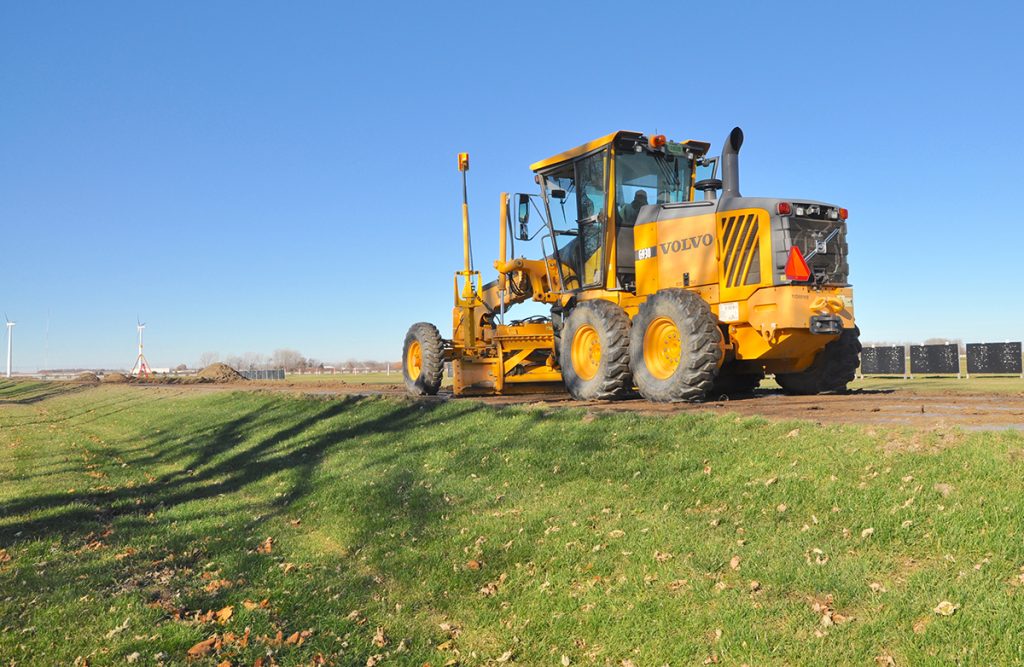
The berms at 300 and 600 yards were redone to allow more comfort for competitors.
300 and 600 Yard Shooting Berms on Rodriguez Range
Completed in November 2017, improvements were made on all of the berms by adding more room on top, to help those who train and hold competitions. MAJ Yates and his team partnered with the 200th Red Horse, Air National Guard Unit within the Ohio National Guard on the project – setting a solid 10-foot shooting platform to ensure everyone will be more comfortable.
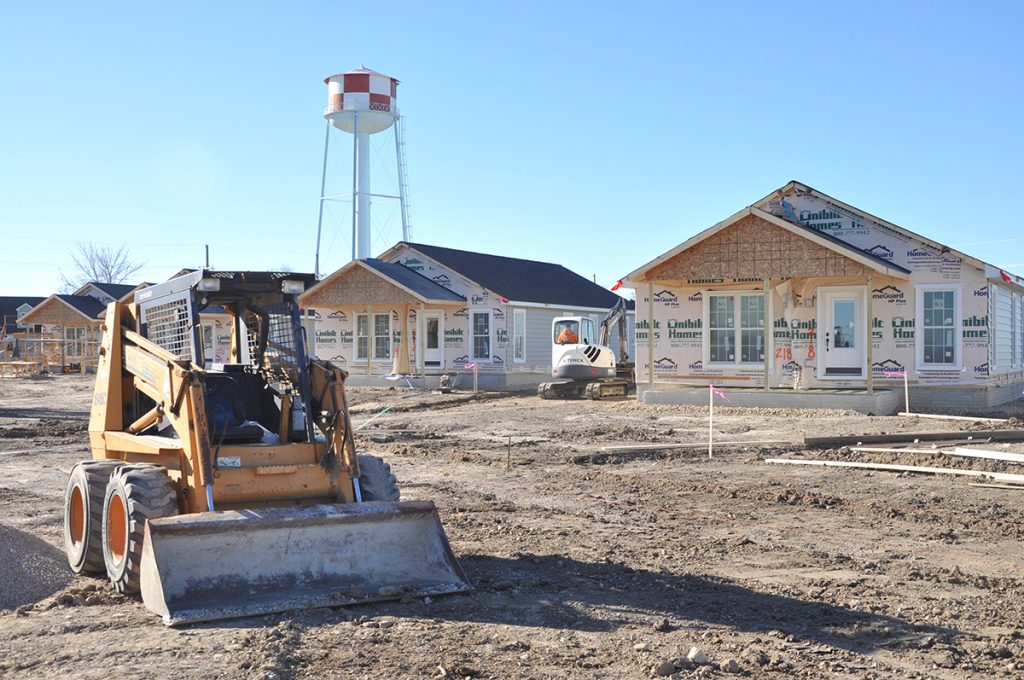
The old lakeside cottages are being replaced with new structures that all allow a view of the lake.
“The Point Project”
The old lakeside cottages, located behind the beach on base, are being phased out. The nearby tennis courts have been removed, and roads and walkways have also been repaved. Five new cottages are being built – totaling $2.25 million from the capital budgets.
All new infrastructure has been put into the area, including brand new sewer, water, electric and gas lines. The cottages will sleep eight, with three bedrooms, twoand angled positioning of the buildings to give every one a view of the lake from the porch to the kitchen.
“They are absolutely fantastic. Everyone gets a great view,” said MAJ Yates.
The modular style homes were built in a warehouse and brought in two parts, then set up and put together. The homes are designed with insulated style siding, plus insolation within to make them comfortable during the winter months.
Offering competitive pricing that is more affordable than the surrounding areas, the new cottages will be available to rent at Camp Perry 365 days out of the year.
“This is the best kept secret in all of Ohio,” said MAJ Yates. “People will get to see what a great stay Camp Perry is. It’s going to be a great upgrade to the facilities.”
MAJ Yates will be requesting for fiscal year 2019-2020 capital budgets to finish the rest of the cottages and replace existing buildings – demoing the rest and adding in 10 more houses.
The new cottages are planned to be finished some time in the spring.
The last cottages were built in the 1950s, based around tent pads that used to be on the grounds in the early days of Camp Perry. According to MAJ Yates, they were not energy-efficient and needed winterized – it was just time for an upgrade.
“We have done the best we possibly can with those facilities, and they have been great to us in the past, but it was time to make a step forward and to give everyone a great place to go to enjoy all of the local surrounding areas,” he said. “This is going to benefit everyone.”
The Club House next door can hold 350 people for parties and events. Located on the water, with a chapel on post and the cottages right next door, Camp Perry has become a sought-after destination for weddings.
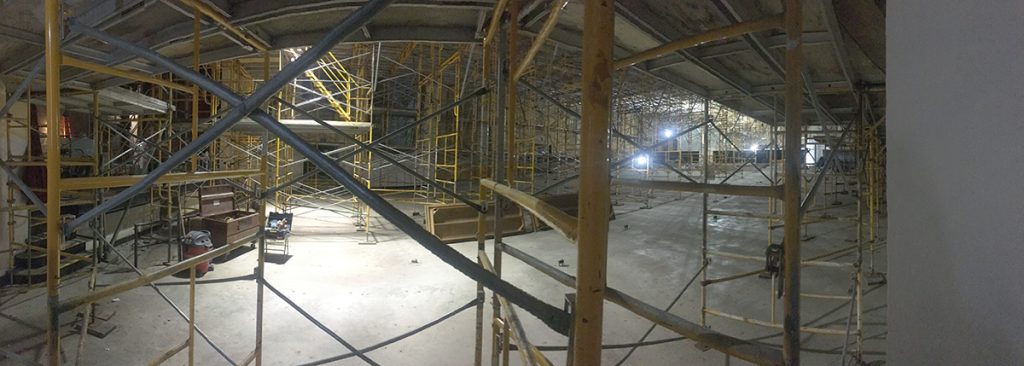
The mural of the auditorium and other historical aspects will remain in the theatre, along with the addition of past photos and other Camp Perry artifacts.
The Hough Theatre
Considered one of the most exciting projects on base, the Hough Theatre has received upgrades to entranceways, restrooms, seating, lighting and the interior as a whole – totaling $1.3 million. Some of the stage is being improved upon as well, including the orchestra pit, and existing offices and classrooms backstage will be updated, with the hopes of being utilized in the future.
“We have worked heavily with the state historical and preservation society to ensure that we have the historical feel to the auditorium itself, but with modern comforts,” said MAJ Yates.
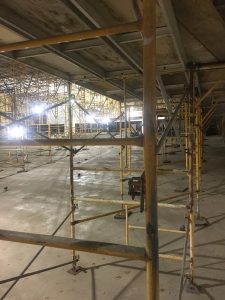
The old auditorium seats of Hough Theatre were torn out and will be replaced with more up-to-date seating. Construction on the Hough Theatre will not only improve the auditorium interior, but will also enhance classrooms and other areas of the building.
The original theatre seats were completely gutted from the building. The new seating will have the effect of the historical seating, but with more padding and comfort – designed for the modern world. The famous mural cascading across the walls around the theatre will remain intact, with much of the interior upgraded or kept as-is.
“It’s an amazing facility, and to bring it up to where it deserves to be is fantastic,” said MAJ Yates.
The Hough Theatre is an important landmark in the history of Camp Perry. Originally the second brick facility built on the post, the inside has seen many distinguished guests during its century-old reign, including countless military and civilian heroes like General John Pershing after World War I and Bob Hope.
The new entranceway of the theatre will throw homage to its incredible history, displaying true photos and artifacts for guests to enjoy. With a projected completion date slotted for the spring, the building will be ready in time for the National Matches ceremonies.
“This has been many years in the coming, and I’m really excited to see what this is going to look like,” said MAJ Yates.
Reconstruction to Bldg 2009
Camp Perry’s Bldg 2009, the long, large building before the historical park when entering base to the north, has undergone an exterior renovation for $640,000.
First constructed in 1903, a new roof, exterior doors and windows have all been installed on the building. MAJ Yates worked with a historical society to again ensure the facility was restored to the times, with modern upgrades, but still within the guidelines of historical restoration.
“Keeping with our history is a big part of what we do here at Camp Perry. We work with our environmental department and state historical society. Everything that we do here, we ensure that we hold to our historical section,” he said.
Demolition Across the Post
Demolition of the rest of the old POW huts by existing two-story barracks on the west side of post will continue until completion. Eight other facilities will also be coming down to clean up post, ridding those that are not used or are passed where they are able to be reutilized. The project should be completed in June 2018.


| February 3, 2017
Fitness, Health & Sports, Tactical Skills
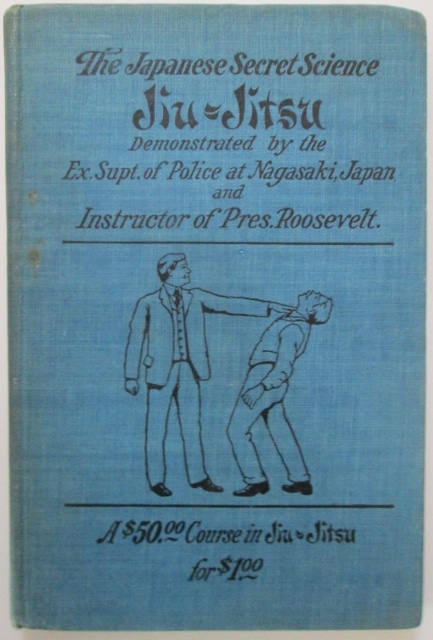
Editor’s note: Theodore Roosevelt had a keen interest in martial and combative arts, beginning with boxing as a young man, and later as president — after a blow blinded him in the eye — focusing on wrestling and grappling. While in the White House, he first took jiu-jitsu lessons from Professor John J. O’Brien, who had learned the art while working as a police inspector in Nagasaki, Japan. According to a 1902 article in the New York World, Roosevelt “hope[d] soon to be able to break the arms, legs or neck of any Anarchist or thug who may assail him.”
Later, TR was taught jiu-jitsu and judo (while now distinct, he used the terms interchangeably) three times a week, for three years, by Japanese master Yoshiaki (Yoshitsugu) Yamashita. Roosevelt loved practicing jiu-jitsu (his ardor would help popularize it with Americans) as well as good old fashioned wrestling, and he would ask any and all companions and visitors — from diplomats to cabinet members to his wife and sister-in-law — to grapple with him. TR’s unflagging enthusiasm and burly frame eventually wore out even Yamashita, who told a journalist that while Teddy “was his best pupil…he was very heavy and impetuous, and it had cost the poor professor many bruisings, much worry and infinite pains during Theodore’s rushes to avoid laming the President of the United States.”
If you want to learn some of the vintage jiu-jitsu moves TR once practiced, below you’ll find the book (condensed) his original instructor, J. J. O’Brien, published in 1905.
Bully!
“A noble soul dwells in a strong body.” —Japanese Proverb
We know that you will find interest in reading and demonstrating to your own satisfaction the effectiveness of Jiu-Jitsu, in its mildest form, as a means of self-defense.
This is the first time that all the secrets of the Japanese national system of training and self-defense have been given to Western people. Less than a generation ago you could not have obtained this knowledge at any price. So religiously have the principles of Jiu-Jitsu been guarded that no foreigner has ever before received official instruction from one who has taken the highest degree in the art.
Jiu-Jitsu is the most wonderful physical training the world has ever known. It is a science. It is muscle dominated and directed in every detail by brain. The Japanese are the hardiest race of people in the world to-day, and we attribute their wonderful strength and power of endurance solely to the persistent practice of their national system of physical development. Jiu-Jitsu develops every muscle and strengthens every organ in the human body. It does not produce knotted muscles, but develops the body harmoniously and uniformly. It affects those minute muscles which are not reached by any other system. It strengthens the heart action, scientifically renews and invigorates every tissue, and helps every organ to perform its functions. The man or woman who devotes ten minutes daily to the practice of Jiu-Jitsu will enjoy a degree of health and strength that will make him or her thoroughly alive and fully conscious of the possession of perfect manhood or womanhood.
As a means of self-defense, Jiu-Jitsu is as potent at short range as the most deadly weapon that human ingenuity has devised. A Japanese skilled in this art has no fear of any form of personal attack. He will even defend himself unarmed against a swordsman and emerge from the combat victorious. The science of Jiu-Jitsu takes into account the vulnerable points in the human body. It comprehends the laws of mechanics, thus enabling the weak to overthrow the strong. One unskilled in the art is entirely at the mercy of the expert Jiu-Jitsuian, no matter how unequally matched in point of size or strength the contestants may be. An opponent may be overcome and remain unharmed if it be the will of the operator, or he may be seriously disabled by a slight pressure exerted at a vulnerable point, or a sharp twist of the arm, as to be rendered utterly helpless and unable to renew the attack.
The full-page illustrations in this book show the holds and locks of Jiu-Jitsu and represent Professor J. J. O’Brien, who was for many years a resident of Japan and received his diploma as Professor of Jiu-Jitsu from the Japanese Government.
Prof. John J. O’Brien came to America well known and highly recommended by the Japanese Government, and it was he who introduced Jiu-jitsu into this country, first in Washington, D.C., by giving instruction in the art to President Roosevelt, members of his Cabinet, and heads of many of the departments in Washington, and, says the New York Sun, “Jiu-Jitsu, the Japanese system of physical training, has become a popular fad at the Capitol under the President’s example, who, through persistent practice, has become an expert in the art, and as told in the news dispatches, is anxious to have Jiu-Jitsu introduced in the course of training at the Naval Academy.”
We give in this book twenty-eight illustrated lessons in Jiu-Jitsu, by Prof. John J. O’Brien and James Clinton Gavigan, one of the world’s greatest Physical Culture instructors. No apparatus whatever is required, and an ordinary room will suffice in which to perform the exercises. It is necessary to have a friend who is equally interested, to practice with you, as it adds pleasure and zeal to the work, and you will be surprised to find how rapidly you become familiar with the subject.
The practice of the modern system of Physical Culture needs a good deal of self-denial because there is little to keep up the interest; but with Jiu-Jitsu it is entirely different. A tilt with a companion has a great deal of pleasurable anticipation, and in combat there is always that uncertainty of success in offensive moments which makes one keenly alive to the situation.
It does not matter who the companion may be, a man of unequal strength, or husband and wife, brother and sister, may join in the friendly contest and each derive equal pleasure and benefit therefrom.
Lesson #1
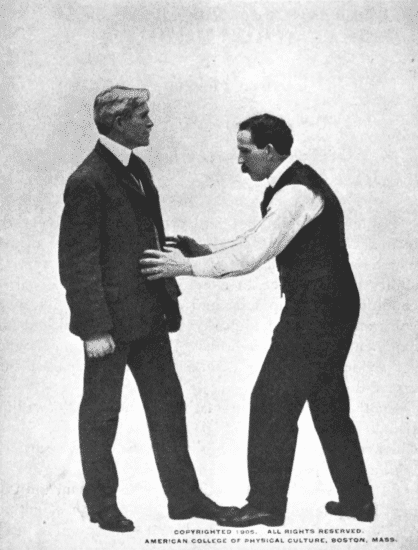
This lesson shows how a weak person could stop an opponent who is about to clinch…
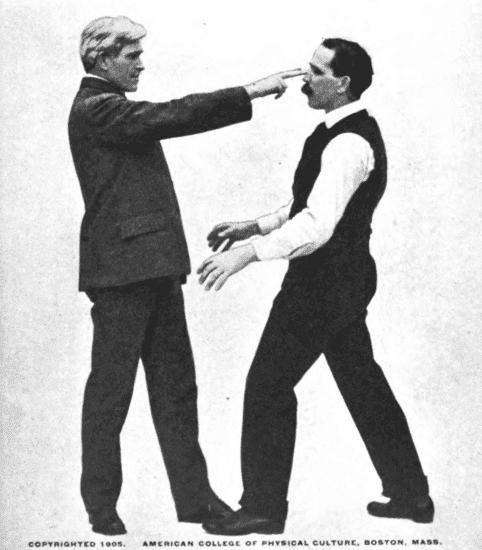
…by putting the first and index fingers to the eyes. This method was used by the Japanese at Port Arthur in the hand-to-hand battle with the Russians.
Lesson #2
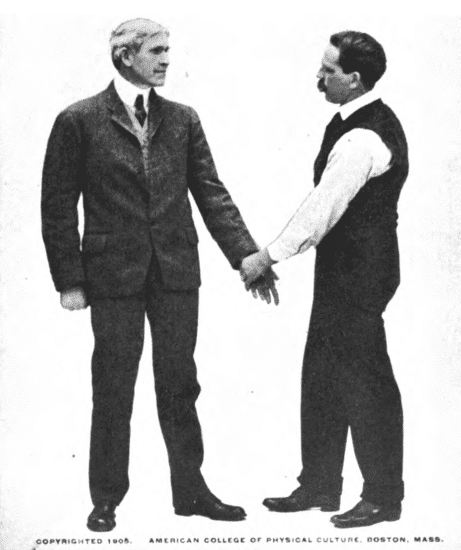
Take your opponent by the left hand firmly, as above illustrated.
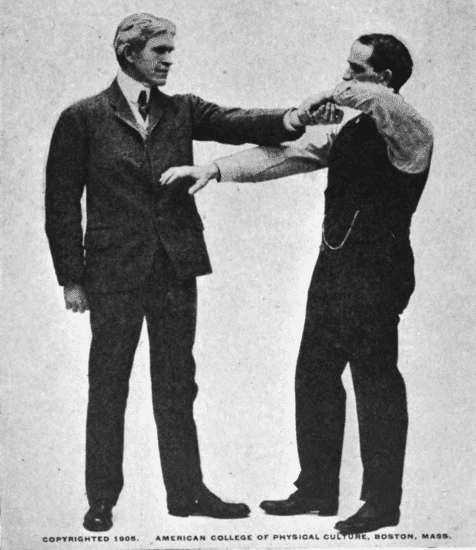
Raise the left arm, turning your opponent’s wrist inward with your left; slide your right under your opponent’s left.
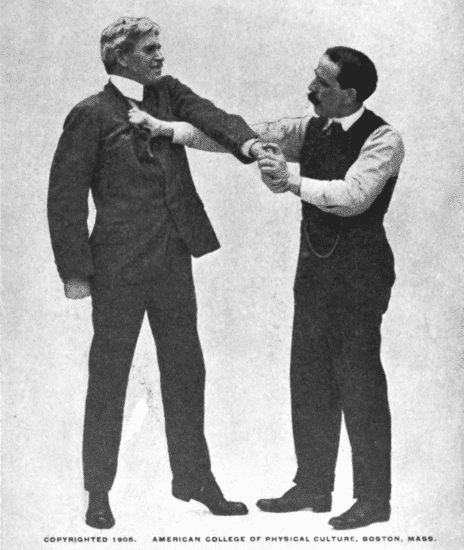
Grasp your opponent’s lapels firmly; stiffen your right arm, pushing your opponent’s left from you until it rests on your right forearm. At the same time twist your opponent’s left wrist inwardly and down.
Lesson #3
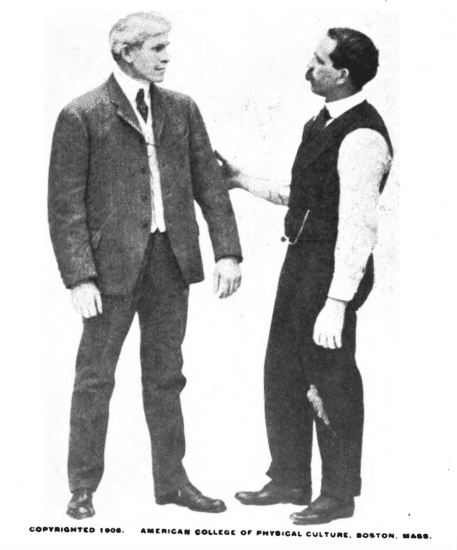
Place your right hand on your opponent’s left arm at the elbow.
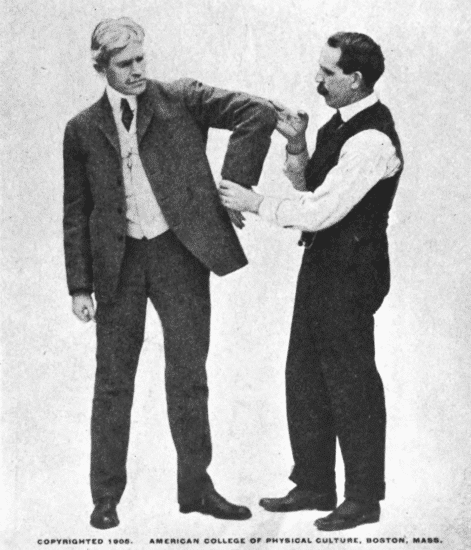
Take your opponent’s left hand at the wrist with your left, raising it inwardly, using your right to push his elbow forward.
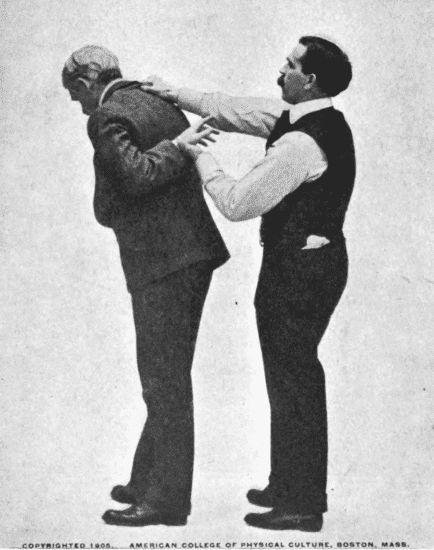
This will turn your opponent so his back will face you. Draw his left arm up, twisting the wrist with your left, taking a firm hold of your opponent’s coat collar with your right.
Lesson #4
Place your right hand on your opponent’s left arm at the elbow.
Take your opponent’s left hand at the wrist with your left, raising it inwardly, using your right to push his elbow forward.
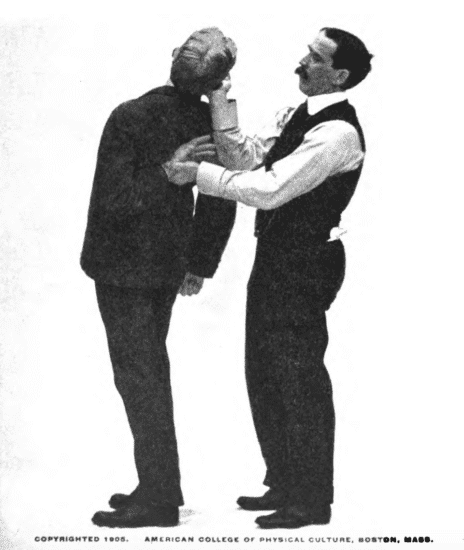
This will turn your opponent so his back will face you. Draw his left arm up, twisting the wrist with your left, taking a firm hold of your opponent’s chin with your right and twist his head backwards.
Lesson #5
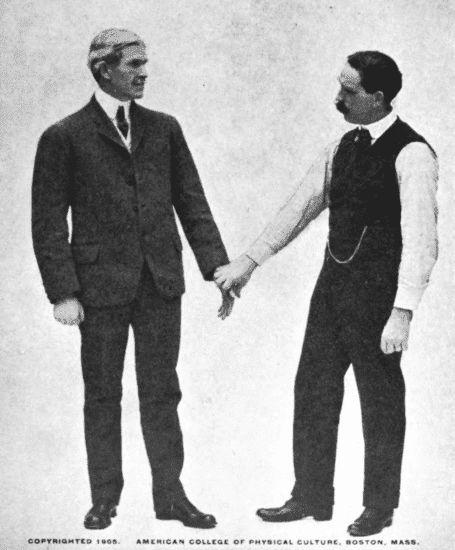
Take your opponent’s left hand with your right so your thumb will rest on the back of his knuckles and your four fingers on the ball of your opponent’s hand.
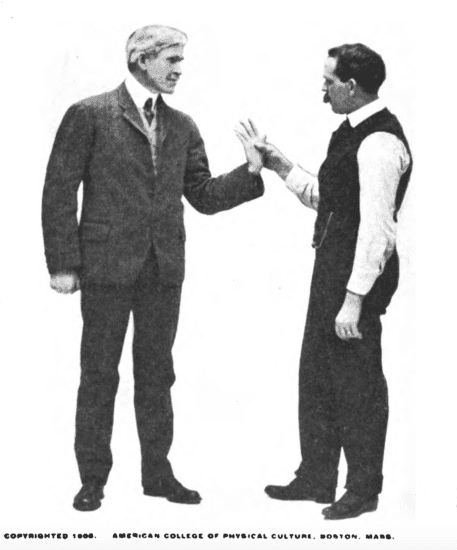
Raise his hand as shown in the above illustration, hold it firmly.
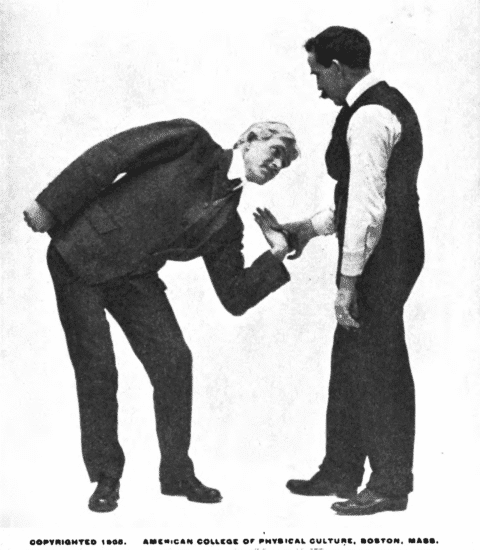
Press your opponent’s hand backwards with your thumb and at the same time twist his hand to the right with your fingers.
Lesson #6
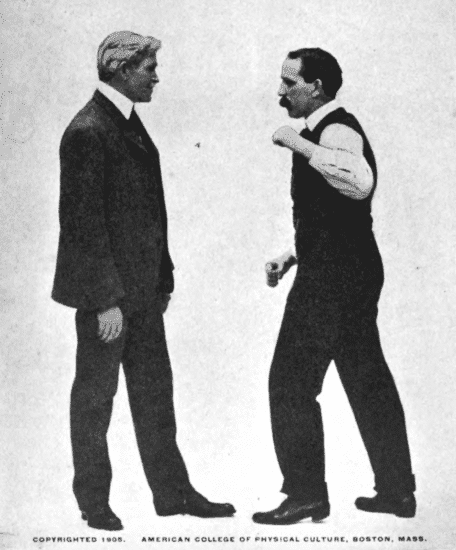
Should a person make an attempt to strike you with either hand…
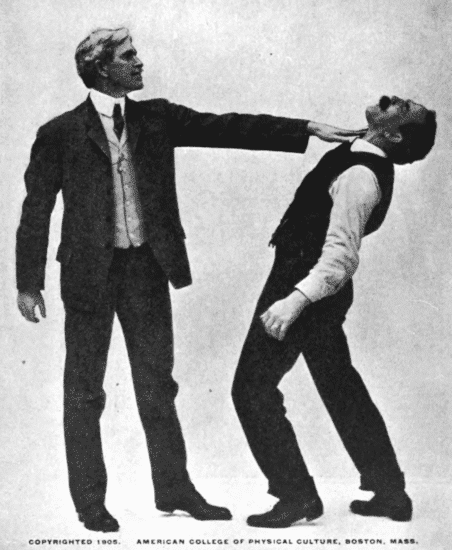
…stiffen the fingers of your left hand and strike your opponent in the neck.
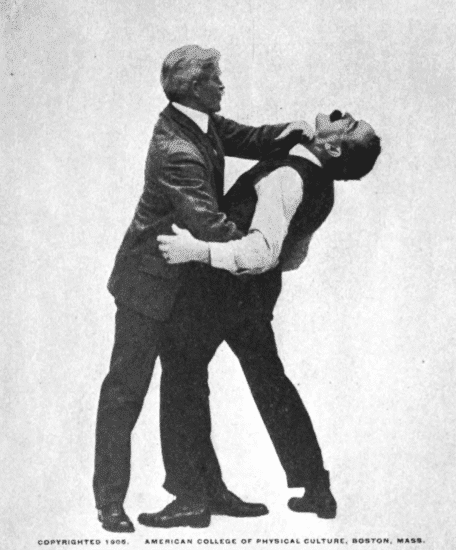
Follow this up by placing your right around his waist, drawing him closely to you and pressing firmly on his neck with your left.
Lesson #7
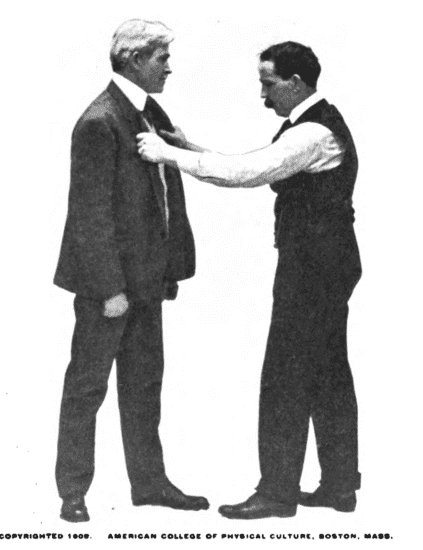
Take your opponent firmly by the lapels of the coat, drawing him to you.
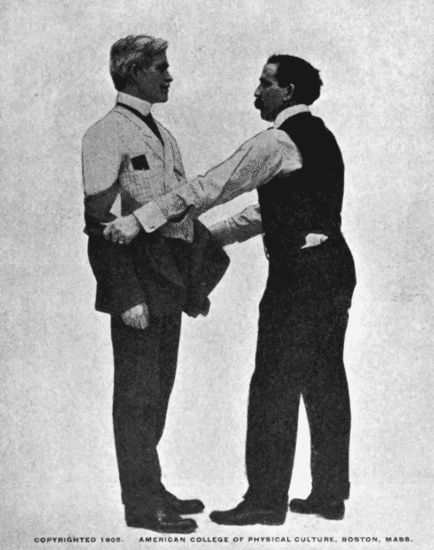
Throw the coat over his shoulders, drawing your opponent’s arms firmly together.
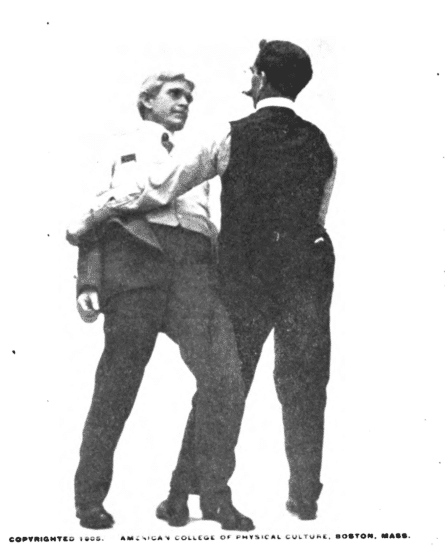
Step to right quickly, placing your left leg behind your opponent’s left, giving a sudden push backwards and to the right will result in a throw.
Lesson #8
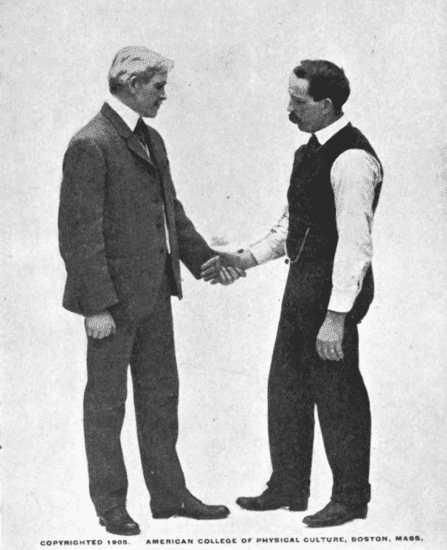
Grasp your opponent’s right with your left so as your fingers will rest in the centre of his hand and your thumb or the back of your opponent’s, close to the wrist.
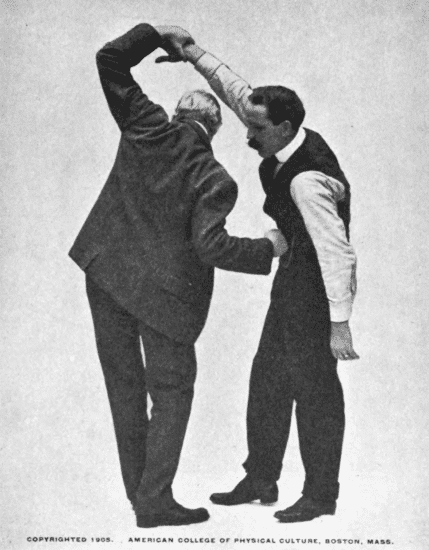
Raise your opponent’s arm over your head, striking him in the solar plexus with your right, holding firmly with left, going under as indicated by the above illustration.
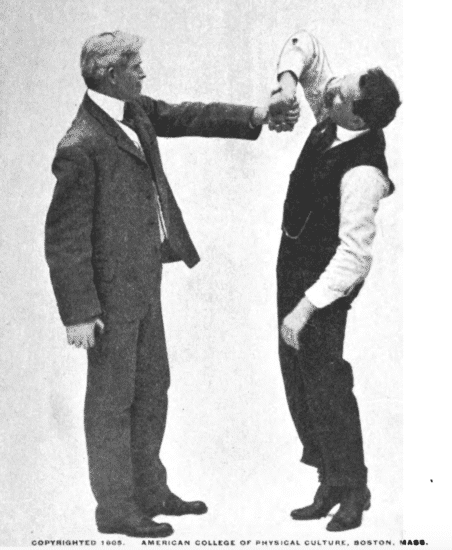
As shown by the above you have your opponent’s right arm twisted and in a position where he is at your mercy.
Lesson #9
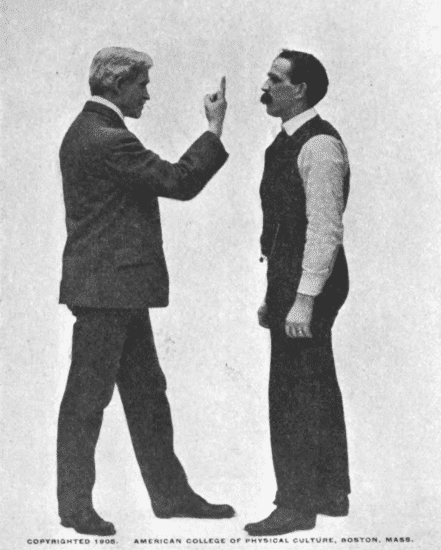
Should a person shake his finger in your face and about to strike…
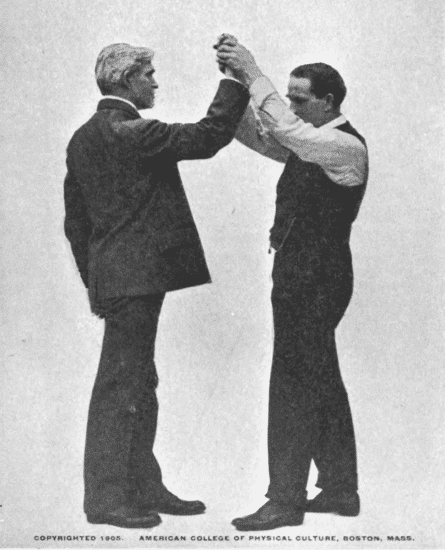
…take a firm hold with both your hands so your thumbs will rest on the back of your opponent’s hand.
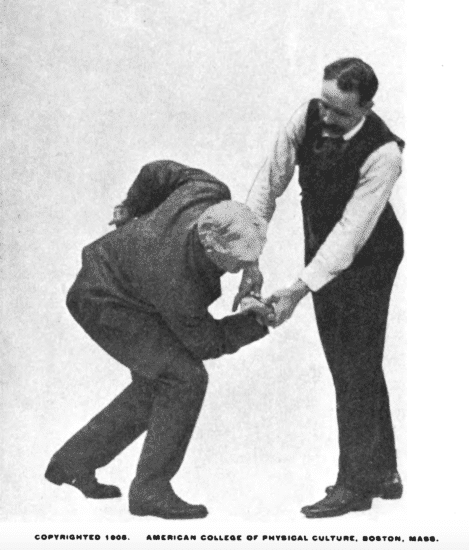
Press the hand back with your thumbs and at the same time twist your opponent’s hand to the left and downward.
Lesson #10
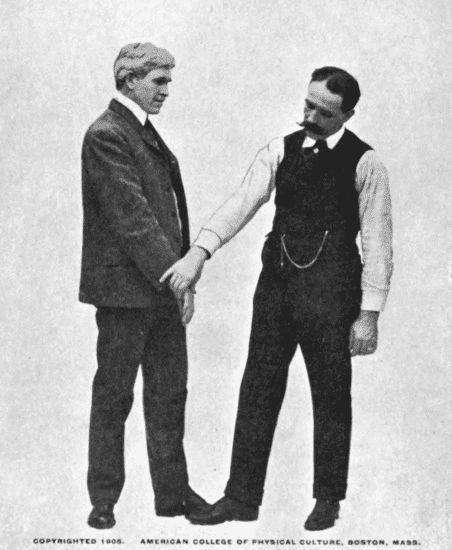
Take your opponent’s right, using your right so that thumb will rest on the back of his hand and your first three fingers in the palm of your opponent’s.
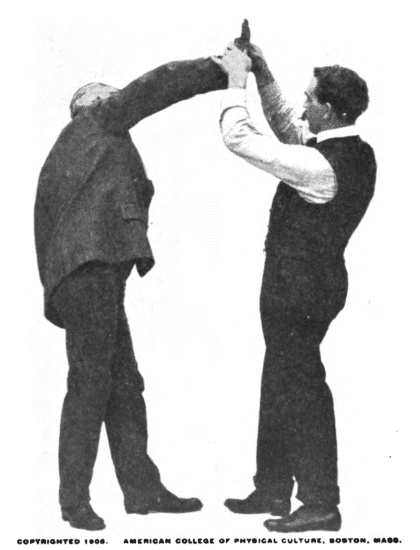
Step to the left; raise your opponent’s arm, taking hold with both hands…
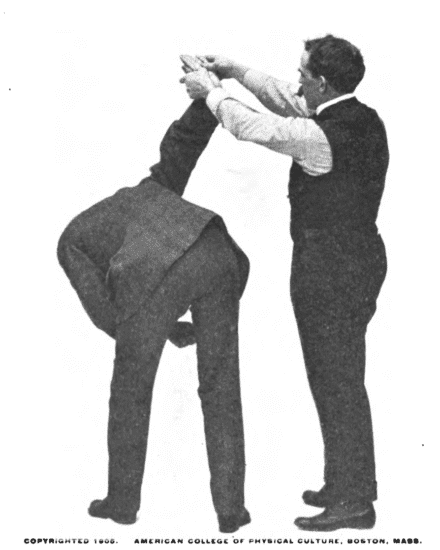
…pressing inward and twist to the right. You should always keep your opponent’s arm raised, which will cause him to bend forward.
Lesson #11
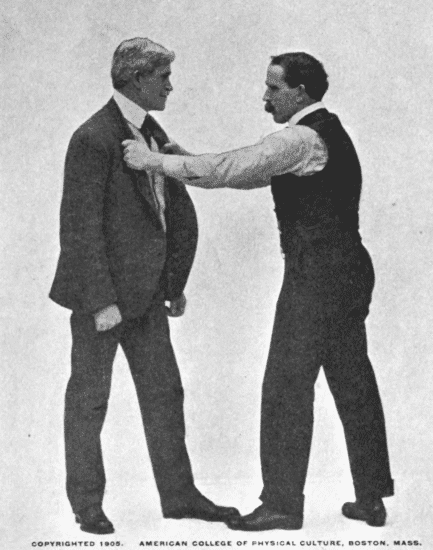
Should a person take hold of you by the lapel of your coat with intentions of causing you bodily harm…
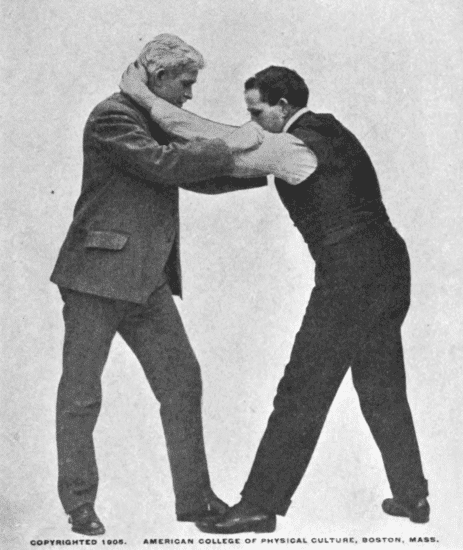
…and you should try to break the hold after your opponent had you by the back of the neck…
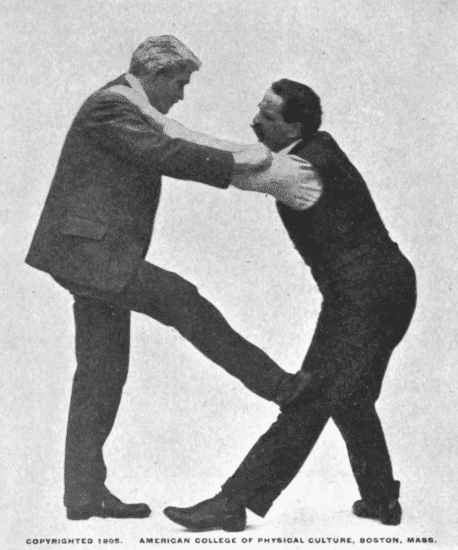
…hold him firmly by the arms with both hands, raise your right leg, pressing it firmly against his left, above the knee, as above illustrated. You will find it very effective.
Lesson #12
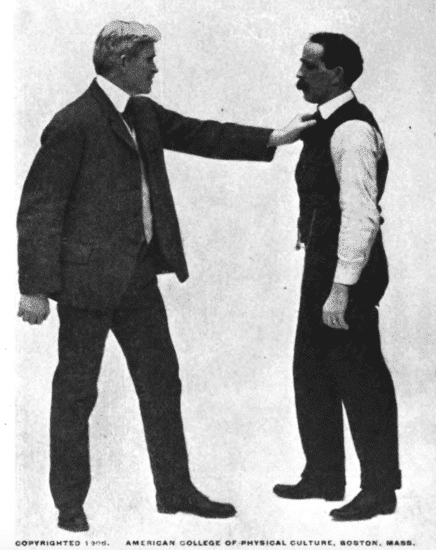
Should a thief reach to steal your pin or diamond stud on the street or in a public place…
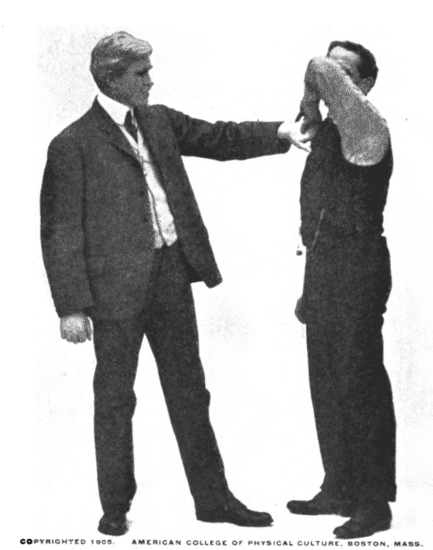
…use your left hand, placing your three first fingers firmly on his hand, forcing his arm to the left.
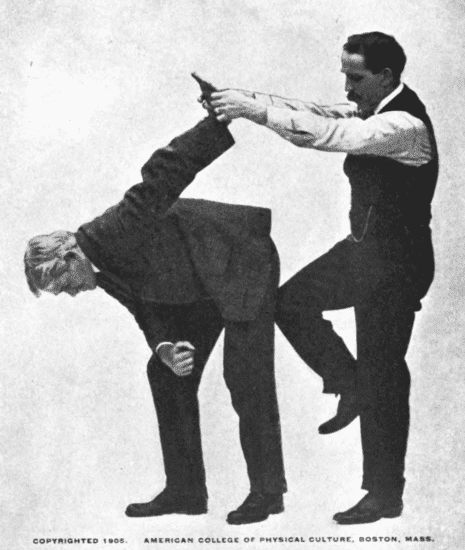
Take two steps to the right, holding your opponent’s arm upward, and you will have him at your mercy.
Lesson #13
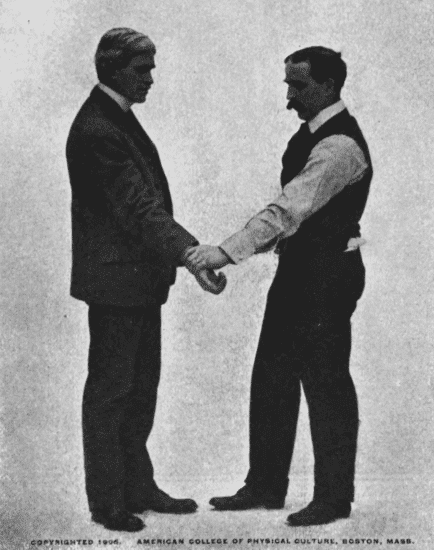
Take your opponent’s right with your left firmly by the wrist as above illustrated.
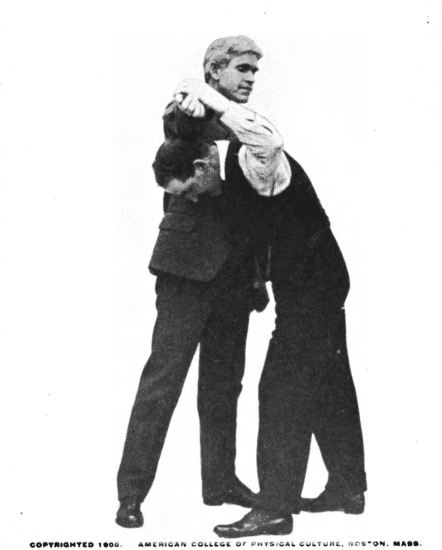
Twist your opponent’s arm to the left as you are about to raise it; at the same time go under, holding firmly with your left.
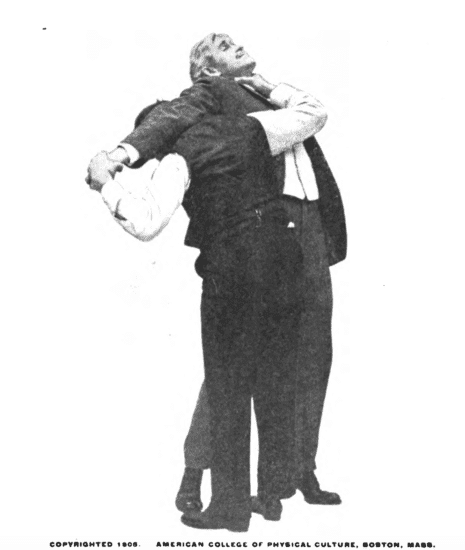
Place your right to your opponent’s throat, taking a firm hold, pressing downward with your left; you can either choke your victim or break his arm.
Lesson #14
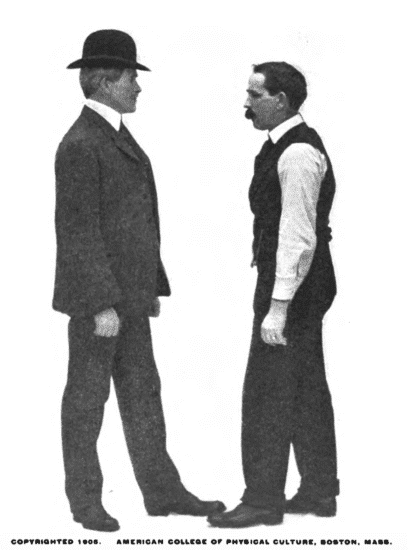
Should you get into an argument with a person and have your hat on, which is sometimes the case…
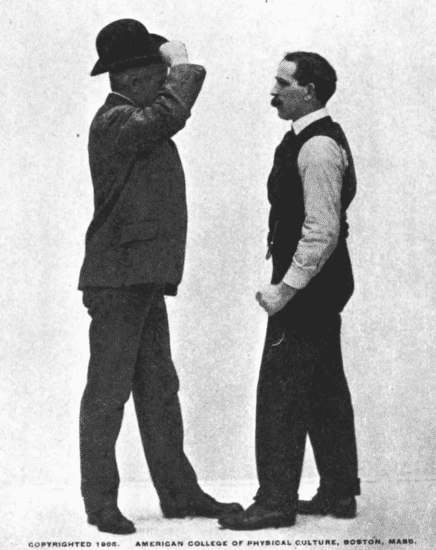
…and you are about to be attacked, pretend to raise your hat a casual way with your right hand.
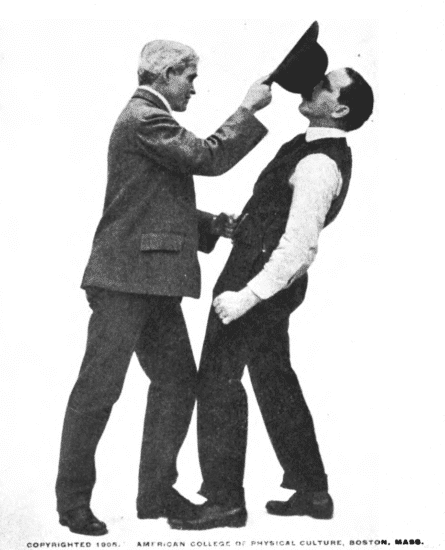
Lean forward, striking your opponent in the face with your hat and using your left, sending it to his solar plexus.
Lesson #15
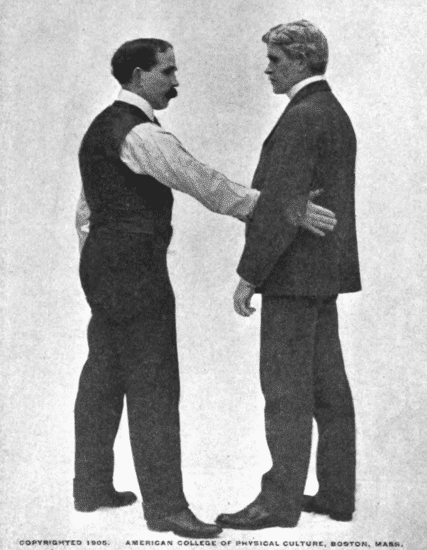
Place your right arm inside your opponent’s left as above illustrated, step to the right…
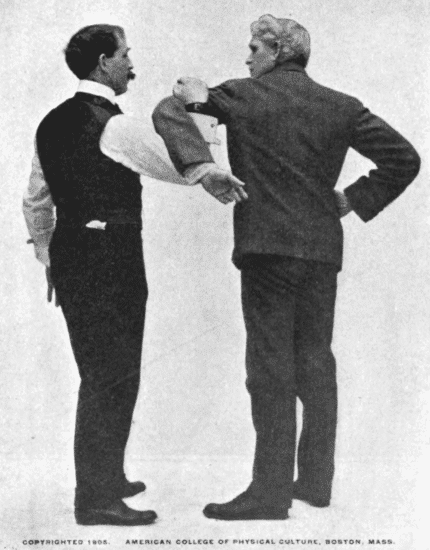
…and inward, raising your opponent’s arm as shown above…
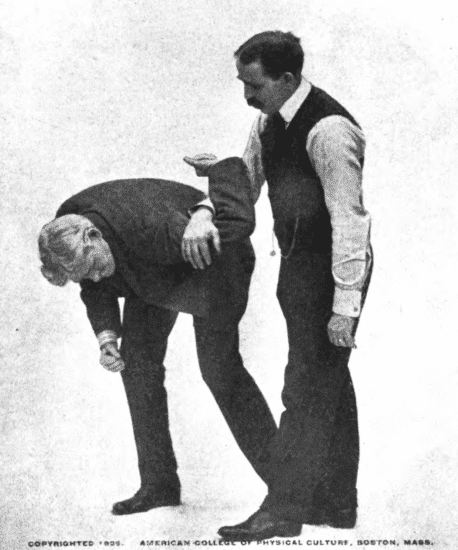
…forcing your opponent’s arm up, which will cause him to bend forward in great pain he cannot resist.
Lesson #16
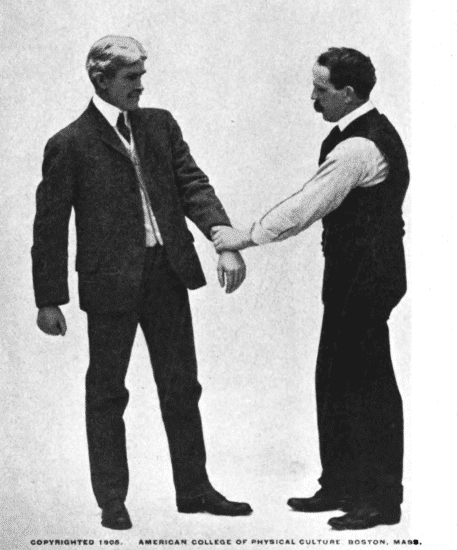
Take your opponent firmly by the left wrist with left hand as shown above…
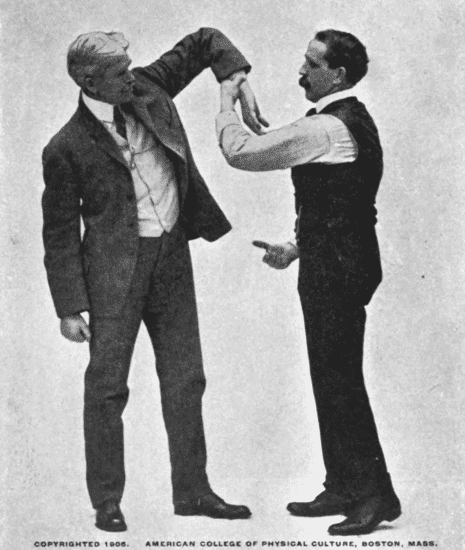
…force your opponent’s hand up and twist to the left, gripping firmly with your left, at the same time have your right ready to…
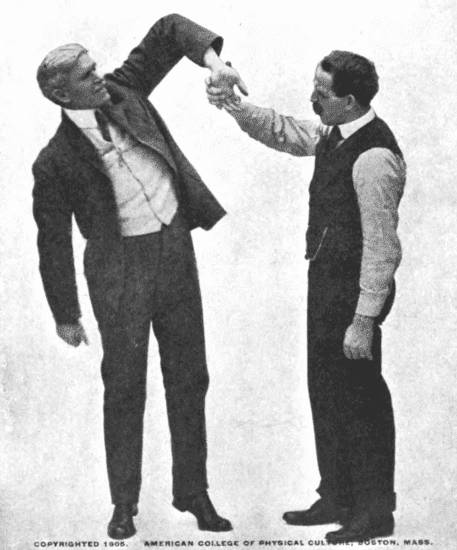
…take hold of your opponent’s left hand as above shown. You can then twist his arm at your will, which is very painful.
Lesson #17
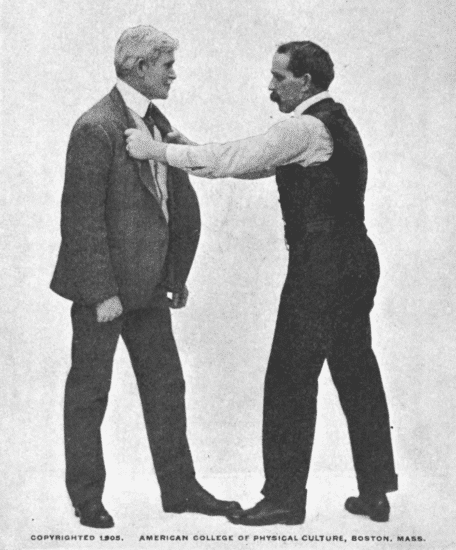
Should a person take hold of you by the lapel of your coat with the intention of doing you bodily harm…
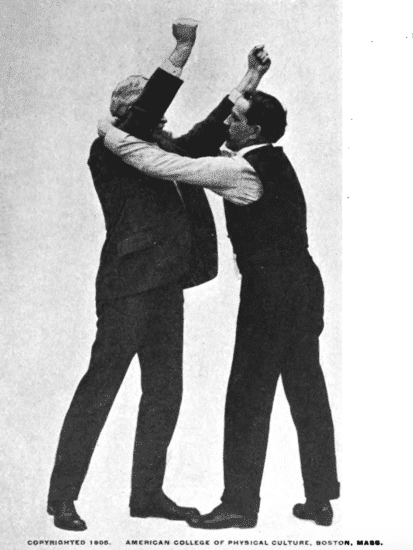
…force your arms up between your opponent’s. This must be done quickly, and step forward.
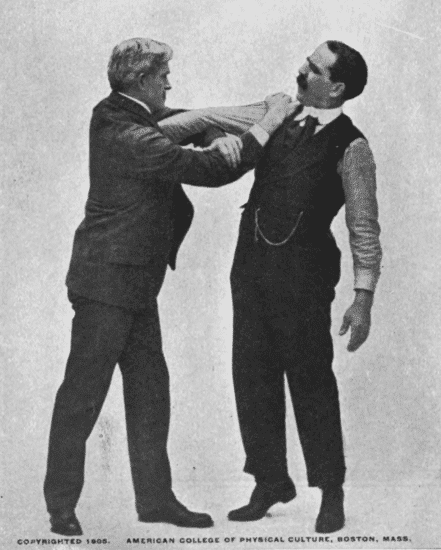
Bring your left arm outside and under your opponent’s right, placing your right to his shoulder and your left firmly on your right, which will cause your opponent much pain.
Lesson #18
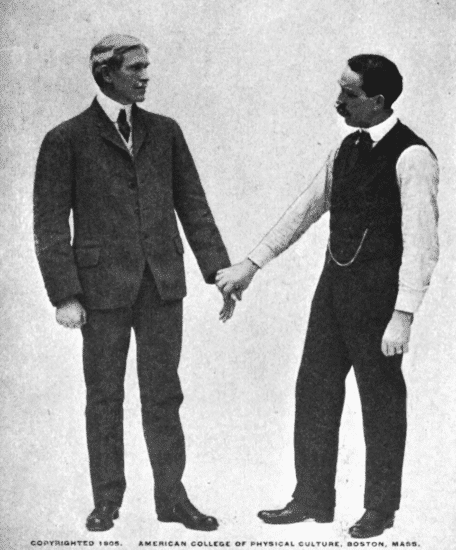
Take your opponent’s lefthand with your right. Have the thumb rest on the back and your four fingers on the ball of his hand.
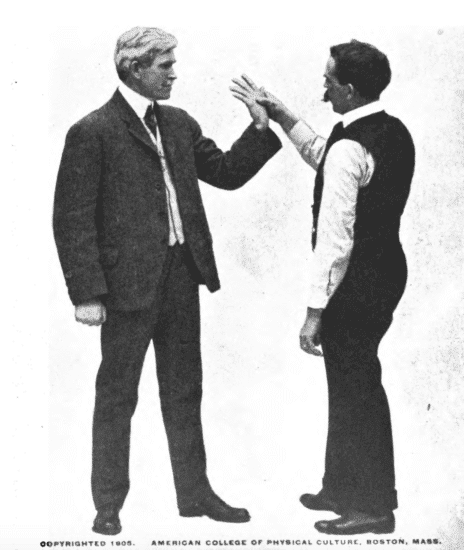
Raise the hand as indicated above, turning your opponent’s wrist to the right.
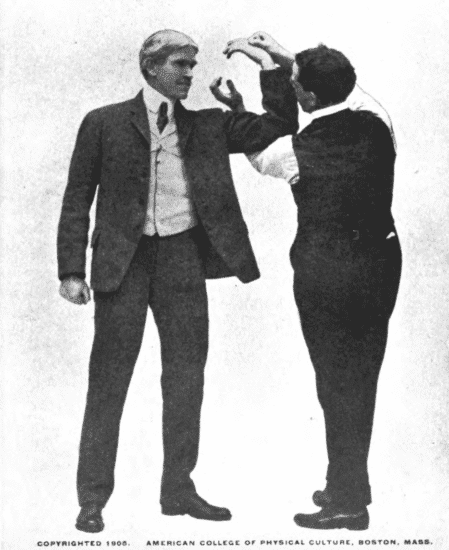
Hold firmly with your right and pass your left under the arm as above illustrated.
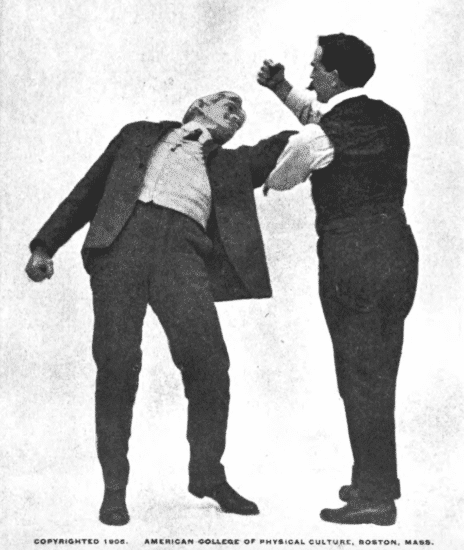
Grasp your opponent’s left at about the wrist with your left. Pressing downward you then have your right free and have opponent at your mercy.
Lesson #19
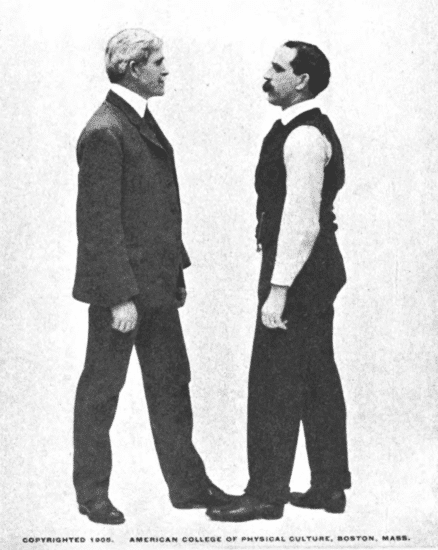
Should you get into an argument…
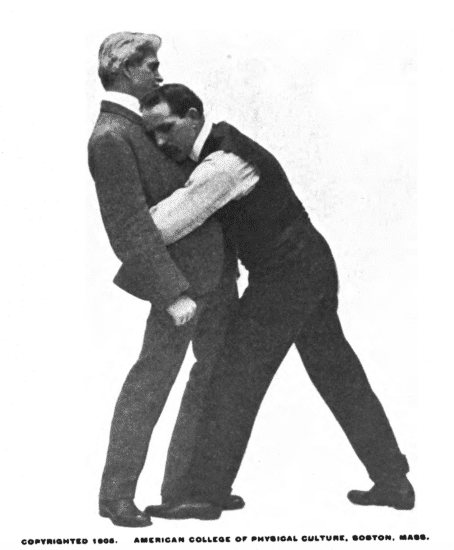
…and your opponent should clinch as above illustrated…
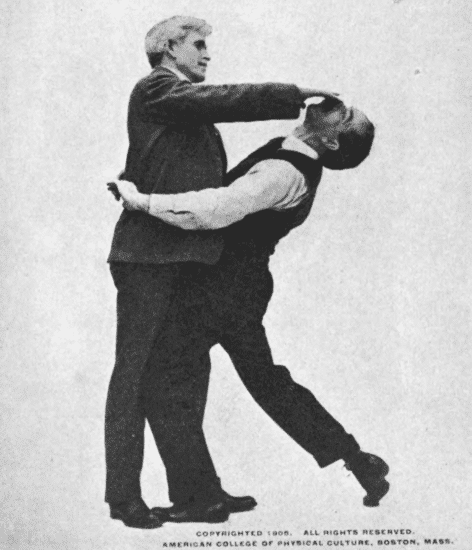
…place your right to opponent’s nose and push. He will be more than willing to release his hold.
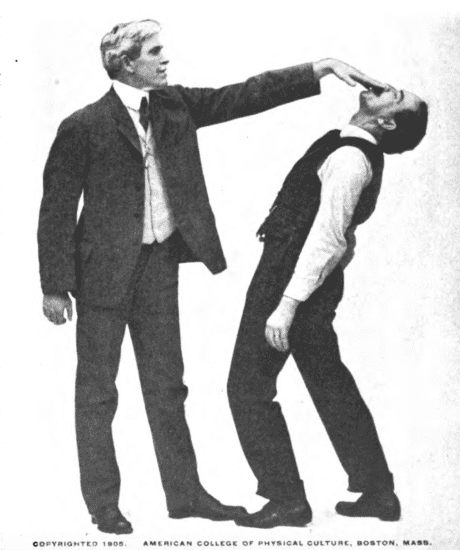
You can then follow up with your left, which leaves your right free to take hold, same as lesson W.
Lesson #20

Should a person point a revolver in your face to hold you up or otherwise, do not make a false move with either hand, keep cool.
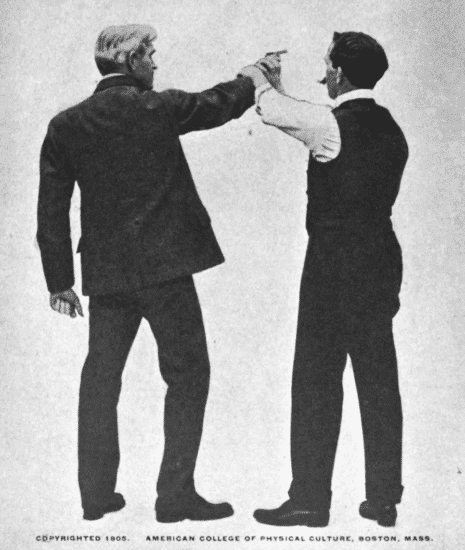
Direct your left to your opponent’s wrist, forcing his arm to the right, hold firmly, then grasp the back of the hand with your right.
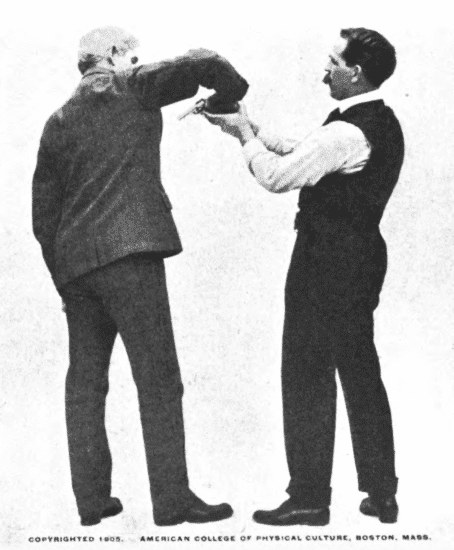
Hold firmly with your left, force inwardly with the right; this must be done quickly.
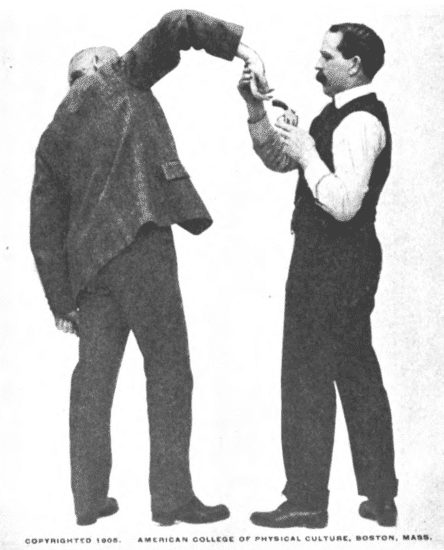
Turn your opponent’s wrist with your right, holding his arm up. You can then take the revolver from him with your left very easily. N. B. [observe carefully] This should be practiced by removing chamber from revolver.
Lesson #21
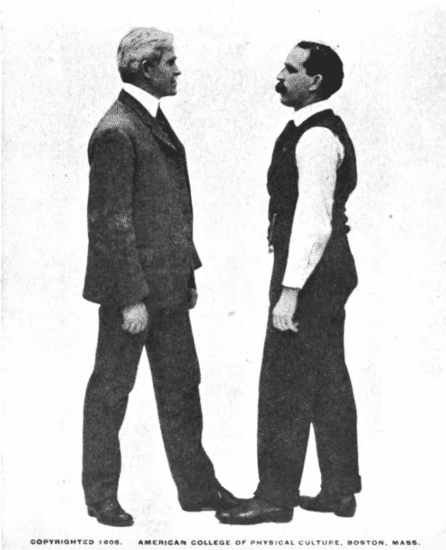
Should you become involved in an argument and your opponent…
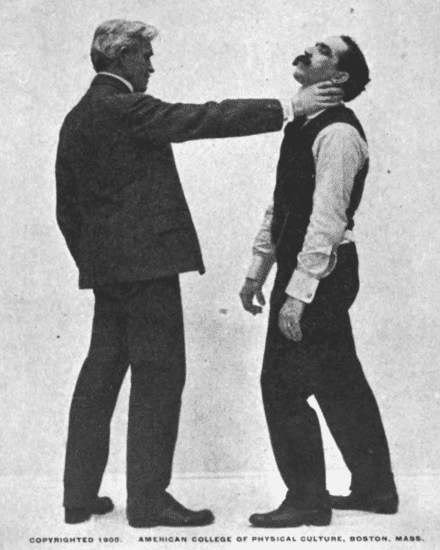
…grasps you by the throat, as above illustrated…
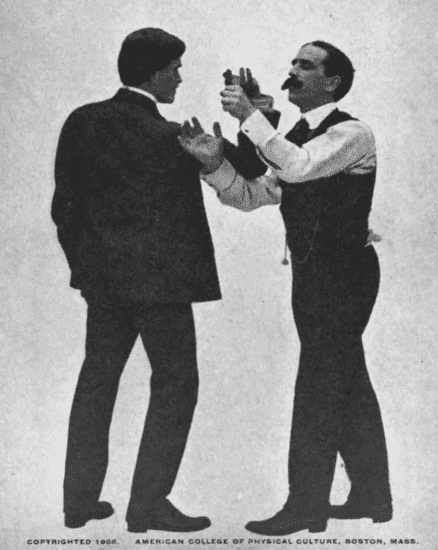
…take a firm hold of his index finger with your left, draw his hand up and to the left, run your right under his left arm.
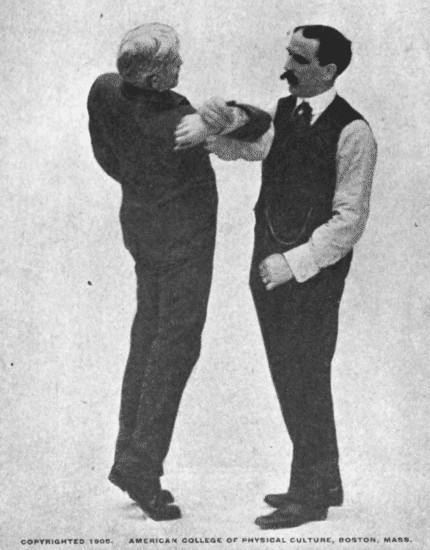
Place your wrist over your opponent’s, as above illustrated, pressing firmly down with your right. You have then reversed the positions and have your opponent at your mercy.
Categories
Remington XP-100

Amazingly enough, I am old enough to remember. When this gun came out and saw one at a Gun Shop in Pasadena back in the late 60’s.
I also remember that I thought that it was & still is. One of the strangest gun that I have ever seen.
Little did I know that this was the start of the Bullpup system and the rise of plastic in the world of guns.
I have also been told reliably that it’s a very accurate piece. Which in turn allowed the growth of large game hunting.

Here is some more information about this pistol.

I also found this very strange video at 46 min. you judge also
https://youtu.be/qr4vgHsmNEk?t=24
The Remington XP-100 (from experimental Pistol number 100) is a bolt-action pistol produced by Remington Arms from 1963 to 1998. The XP-100 was one of the first handguns designed for long-range shooting, and introduced the .221 Remington Fireball (often called .221 Fireball). The XP-100 was noted for its accuracy and is still competitive today in the sport of handgun varminting, which it helped create.[1]
Contents
[hide]
Overview[edit]
The XP-100 was based on Remington’s short action bolt action carbine, the Remington Model 40X, which influenced the later Remington Model 600 rifle.[2] The XP-100 was initially introduced with a 10¾” barrel set into a nylon stock with an unusual center-mounted grip. Chambered in .222 Remington in early prototypes, the short barrel produced significant noise and muzzle flash. Subsequently the case was shortened to reduce powder capacity to a volume more suited to the shorter barrel of a pistol. The resulting cartridge, the .221 Fireball, produced factory loaded velocities of over 825 m/s (2,700 ft/s) from the short barrel, and accuracy rivaling the parent .222 Remington, one of the most accurate cartridges made.[1]
All but the XP-100R model were single-shot designs, while the XP-100R had a small internal magazine (holding four rounds), similar to most bolt-action rifles. The R model – for “repeater” – was made 1991-1997 in .223 Rem., .250 Savage, 7mm-08 Rem., .308 Win., .35 Rem., and 350 Rem. Mag. It was reintroduced in 1998, this time without sights, in .223 Rem., .22-250 Rem., .260 Rem., and .35 Rem.[2]
Model history[edit]
The XP-100 went through a number of changes during its production run, and many variations were only available through the Remington Custom shop. The most significant changes in the later versions were to barrel length, which went to 14½”, and the grip location, which was moved to the rear of the stock. The calibers changed; with the elimination of the original 10¾” barrel, the reduced powder capacity was no longer such a requirement, and the chamberings switched to standard commercial rifle cartridges. By the time the XP-100 was discontinued, it faced stiff competition from other bolt-action pistols such as the Savage Striker as well as the versatile Thompson Center Arms break-action Contender.[2]
Model production by year[edit]
- XP-100 (1963–1985)
- XP-100 Varmint Special (1986–1992)
- XP-100 Silhouette (1980–1997)
- XP-100 Hunter (1993–1994)
- XP-100 Custom (1986–1997)[3]
- XP-100R (1998)[4]
- XR-100 (2005–Present)[5]
Caliber production by year[edit]
- .221 Remington Fireball (1963–1985)
- 7 mm BR Remington (1980–1985)
- .223 Remington (1986–1997), (2005–Present in XR-100)
- .35 Remington (1986–1997)
- 350 Rem. Mag (1991-1997)
- .250 Savage (1990–1992) Custom Shop only
- 6 mm BR Remington (1990–1992) Custom Shop only
- .22-250 Remington (1992–1994) Custom Shop only, (2005–Present in XR-100)
- .308 Winchester (1992–1994) Custom Shop only
- 7 mm-08 Remington (1993–1994)
- .204 Ruger (2005–Present in XR-100)[3][4][5]
Current production[edit]
The XP-100 action was used as the basis for a new single-shot rifle from Remington called the XR-100 Rangemaster.[5]
While the XP-100 has disappeared from Remington’s lineup (Remington is primarily a maker of rifles and shotguns), the .221 Fireball remains in production. The Model 700 rifle has been available since 2002 in a .221 Fireball chambering; while it lacks the velocity attainable with the vastly more popular .223 Remington, the short .221 Fireball delivers most of the performance with far less noise and flash.[6]
Factory recall[edit]
XP-100 pistols and Remington Model 600 rifles were recalled in 1979 because of a safety issue. The bolt was fully locked when the safety was on, making it impossible to unload the gun. Remington made a free modification available that allowed the bolt to open while the gun was on safe, allowing it to be unloaded.[1]

Categories
Colt Model 1903 Pocket Hammerless
| Colt Pocket Hammerless | |
|---|---|

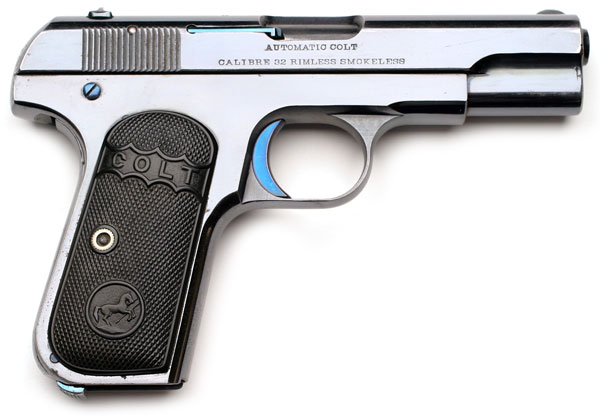
Pocket Hammerless in .32 ACP caliber. Its serial number dates manufacture to 1935.
|
|
| Type | Semi-automatic pistol |
| Place of origin | United States |
| Production history | |
| Designer | John Browning |
| Manufacturer | Colt Patent Firearms Manufacturing Company of Hartford, Connecticut |
| Produced | 1903–45 |
| No. built | ~570,000 |
| Variants | M1903, M1908 (Types 1-5) |
| Specifications | |
| Weight | 24 oz (680 g) |
| Length | 7 in (180 mm) (Type I) 6.75 in (171 mm) (Types 2 – 5) |
| Barrel length | 4 in (100 mm) (Type I) 3.75 in (95 mm) (Types 2 – 5) |
|
|
|
| Cartridge | .32 ACP (M1903) .380 ACP (M1908) |
| Action | single-action Blowback |
| Feed system | 8-round detachable box magazine(M1903) 7-round detachable box magazine (M1908) |
| Sights | fixed front, rear drift-adjustable for windage |
The Colt Model 1903 Pocket Hammerless (not to be confused with the Colt Model 1903 Pocket Hammer) is a .32 ACP caliber, self-loading, semi-automatic pistol designed by John Browning and built by ColtPatent Firearms Manufacturing Company of Hartford, Connecticut. The Colt Model 1908 Pocket Hammerless is a variant introduced five years later in .380 ACP caliber. Despite the title “hammerless”, the Model 1903 does have a hammer. It is covered and hidden from view under the rear of the slide. This allows the pistol to be carried in, and withdrawn from a pocket quickly and smoothly without snagging.
Contents
[hide]
History[edit]
Approximately 570,000 Colt Pocket Hammerless pistols were produced from 1903 to 1945, in five different types. Some were issued to US Army and US Air Force general officers from World War II through the 1970s; these were replaced in 1972 with the RIAColt M15 general officer’s model, a compact version of the M1911A1. The Shanghai Municipal Police issued the M1908 to its officers in the 1920s and 1930s and it was a popular model with police in the United States such as the New York City Police Department. In addition to lawful owners, many gangsters of the pre-World War II era favored the Model 1903 and Model 1908 because they were relatively small and easily concealed. It is said that Al Capone kept one in his coat pocket and Bonnie Parker used one to break Clyde Barrow out of jail after smuggling it into the jail by taping it to her thigh. Bank robber John Dillinger was carrying this model of pistol when he was shot by FBIagents outside the Biograph theater on July 22, 1934, and another famous bank robber, Willie Sutton, had one when he was captured by police in Brooklyn on February 18, 1952.[1]
Note: There was also a Colt Model 1903 Pocket Hammer pistol in .38 ACP, but this design is unrelated. The FN Model 1903 pistol design is related to the Colt Pocket Hammerless, but it is physically larger due to its chambering in the 9×20mm SR Browning Long cartridge.
General officer models[edit]
General officer models were often engraved with the officer’s name. Recipients include generals Eisenhower, Bradley, Marshall, and Patton. Patton’s Model 1908 was embellished with three (later four) stars on the grip panels to denote his rank. They were issued with a fine-grade leather holster, leather pistol belt with gold-metal clasp, rope pistol lanyard with gold-metal fittings, and leather two-pocket ammunition pouch with gold-metal fasteners. They came in russet or black leather (depending on service and regulations) and were made by Atchison Leather Products or Hickock. A cleaning rod and two spare magazines were also included.[2] Generals were issued the Model M in .380 ACP, until 1950, when supplies ran out. At that point, they were substituted with .32 models until their replacement in 1972. The Pocket Hammerless was replaced by the M15 pistol made by Rock Island Arsenal in .45 ACP. Today, the Pocket Hammerless is manufactured by U.S. Armament, and is licensed by Colt.[3]
Design[edit]

Colt Model 1908 Pocket Hammerless .380 ACP. Its serial number dates manufacture to 1919.
This pistol is actually fired by action of a hammer striking and driving a firing pin into a center-fire cartridge’s primer. The hammer is covered by the rear of the slide. The “hammerless” designation was merely an advertising designation pointing out the pistol’s particular suitability for concealed carry. Special features include a serrated slide to prevent slippage during manual cycling of the slide and two safety mechanisms (a grip safety and a manual safety). The grip safety is a spring-loaded piece making up the back strap of the pistol. The grip safety, though not solely restricted to them, was a typical feature of Colt automatic pistols. A magazine safety was added on later models; this feature prevents the pistol from being fired with a round in the chamber and the magazine removed.[2]
In 1908, a .380 ACP version of this gun was introduced. Called the Model 1908, it is nearly identical to the Model 1903 except for the bore diameter and the magazine, which hold seven rounds (one less than the Model 1903).[2]
Grip panels are black checked hard rubber, checked walnut, or special order materials (ivory, mother of pearl, inset medallion).[2]
Sights are fixed, although the rear sight is drift-adjustable for windage.[2]
Metal finish is blued or nickel, and some special-order finishes such as engraved, silver- or gold-plated.[2]
Variants[edit]
- Type I: Integral barrel bushing, four-inch barrel, no magazine safety, serial numbers 1 through 71,999[2]
- Type II: 32 cal separate barrel bushing, 33⁄4-inch barrel; 1908–1910, SN 72,000 through 105,050[2]
- Type II: 380 cal separate barrel bushing, 33⁄4-inch barrel; 1908–1910, SN 001 through 6250 [2]
- Type III: integrated barrel bushing, 33⁄4-inch barrel; 1910–1926, SN 105,051 through 468,789[2]
- Type IV: integrated barrel bushing, 33⁄4-inch barrel, magazine safety[2]
- Type V: integrated barrel bushing, 33⁄4-inch barrel, military sights, magazine safety on both commercial and “U.S. property” variations. SN 468,097 through 554,446.[2]
There was an M1903 version with a military Parkerized finish, which is otherwise the same as the Model IV, SN 554,447 through 572,214.
