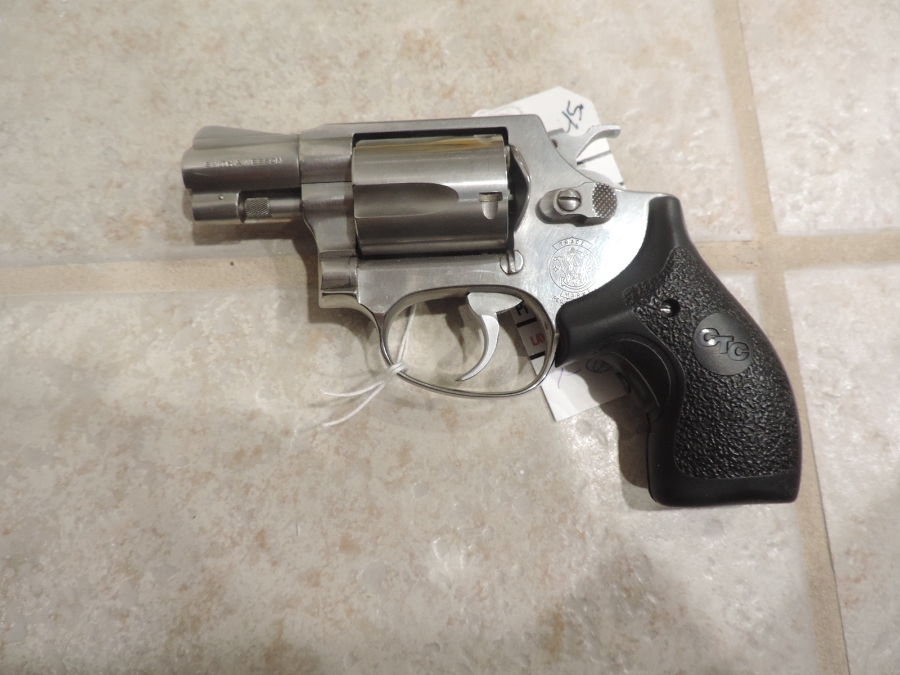
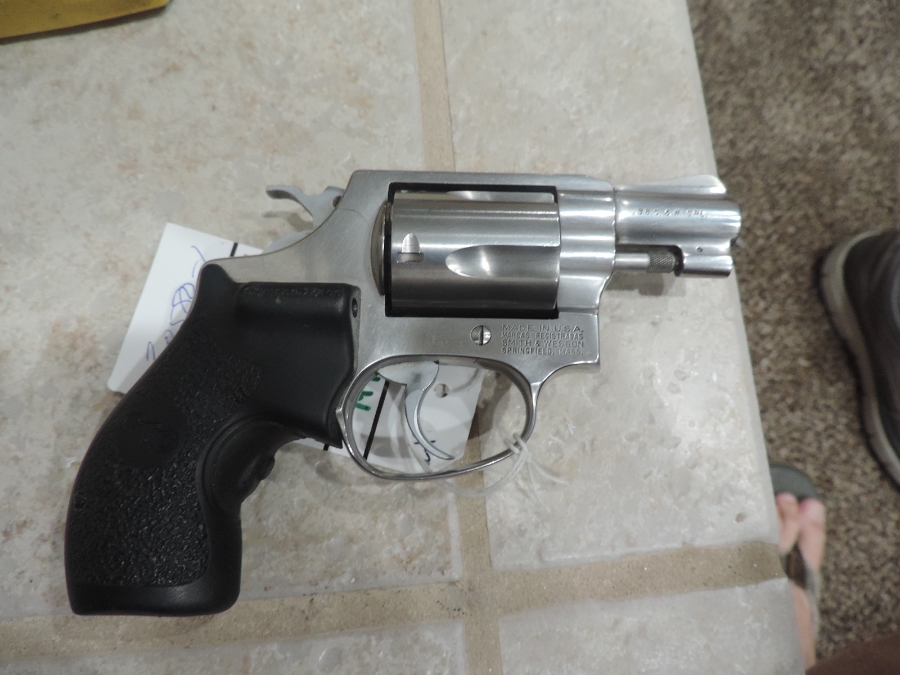
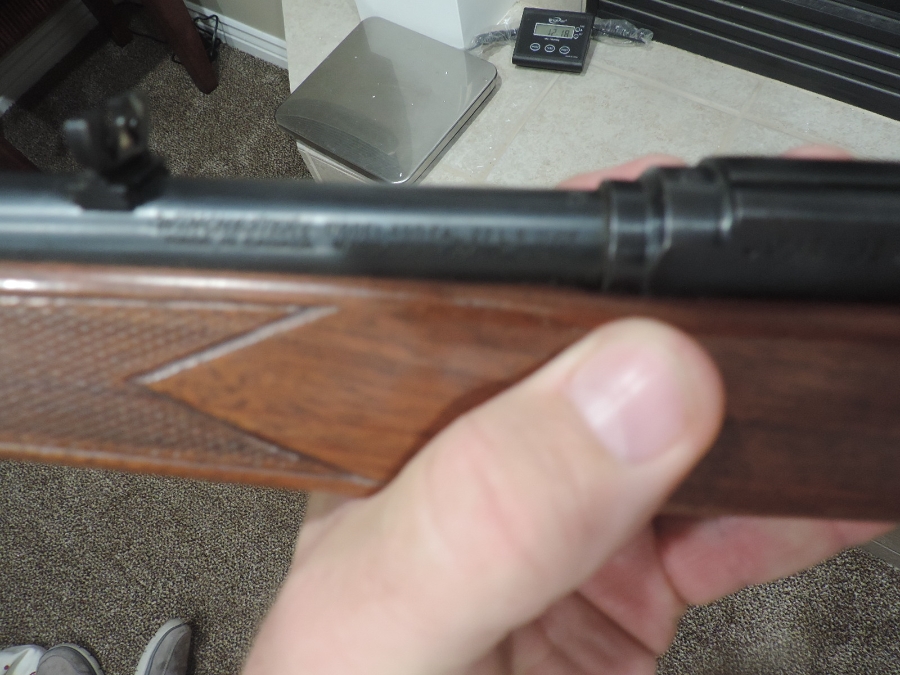
Based on my experience of owning 4 of these over the years. The Lugar is a pain in the backside. Plus I never owned or shot one that ever was a minute of angle pistol.
Now granted these puppies are ancient. But in my Humble opinion. The teutonic Crows never got their act together with making a decent pistol until after WWII.
Then God took pity on them and brought forth the Sigs! Need I say more?
A Missouri bill which seeks to nullify virtually every federal gun control measure on the books, “whether past, present or future,” passed the Senate Thursday. SB613 would ban the state from enforcing virtually all federal gun control measures, and includes criminal charges for federal agents attempting to violate the right to keep and bear arms in Missouri.
The measure passed 23-10.
SB613 counts as what could be the strongest defense against federal encroachments on the right to keep an bear arms ever considered at the state level. It reads, in part:
All federal acts, laws, executive orders, administrative orders, court orders, rules, and regulations, whether past, present, or future, which infringe on the people’s right to keep and bear arms as guaranteed by the Second Amendment to the United States I and Section 23 of the Missouri Constitution shall be invalid in this state, shall not be recognized by this state, shall be specifically rejected by this state, and shall be considered null and void and of no effect in this state.
Federal acts which would be considered “null and void and of no effect” include, but are not limited to:
(a) Any tax, levy, fee, or stamp imposed on firearms, firearm accessories, or ammunition not common to all other goods and services which might reasonably be expected to create a chilling effect on the purchase or ownership of those items by law-abiding citizens;
(b) Any registering or tracking of firearms, firearm accessories, or ammunition which might reasonably be expected to create a chilling effect on the purchase or ownership of those items by law-abiding citizens;
(c) Any registering or tracking of the owners of firearms, firearm accessories, or ammunition which might reasonably be expected to create a chilling effect on the purchase or ownership of those items by law-abiding citizens;
(d) Any act forbidding the possession, ownership, or use or transfer of a firearm, firearm accessory, or ammunition by law-abiding citizens; and
(e) Any act ordering the confiscation of firearms, firearm accessories, or ammunition from law-abiding citizens
The legislation specifically bans all state employees from enforcing or attempting to enforce any acts running counter to the proposed law. Such a tactic is an extremely effective way to stop a federal government busting at the seams. Even the National Governors Association admitted the same recently when they sent out a press release noting that “States are partners with the federal government in implementing most federal programs.”
That means states can create impediments to enforcing and implementing “most federal programs.” On federal gun control measures, Judge Andrew Napolitano suggested that a single state standing down would make federal gun laws “nearly impossible to enforce” within that state.
James Madison, the “Father of the Constitution,” advised this very tactic. Madison supplied the blueprint for resisting federal power inFederalist 46. He outlined several steps that states can take to effective stop “an unwarrantable measure,” or “even a warrantable measure” of the federal government. Madison called for “refusal to cooperate with officers of the Union” as a way to successfully thwart federal acts. FRIENDLY FIRE
The bill passed despite strong opposition from the law enforcement community. According to a Report from the Institute of Justice, Missouri law enforcement cashed in to the tune of $34,462,153 in forfeiture from 2001 to 2008. They only get this money if they do the bidding of the federal government.
The NRA also came out against the legislation due to a proposed amendment. Anti-gun Senator Jamilah Nasheed added language requiring gun owners to report a stolen firearm to police no more than 72 hrs after the discovery of the theft. The NRA claimed the amendment also included penalties.
“Those who are unable to report a lost or stolen firearm within this arbitrary amount of time, would be subject to penalties including: a $1,000 fine, Class A misdemeanor and the loss of their Right to Carry Permit.”
But the actual text of the amendment included no such language. (read it here)
Bill author Sen. Brian Nieves and Nasheed agreed to reconsider and the amendment was removed earlier this week, removing the source of NRA opposition. PENALTIES
In what many legal experts consider a controversial move, the Missouri bill also includes criminal charges for any federal agent who violates the state law. Under the law, state and local law enforcement would have “discretionary power” to determine determine if they will press charges. Inside sources say this was done to alleviate concerns from Missouri Law Enforcement organizations who actively lobbied against the effort in 2013, citing a requirement to arrest “federal law enforcement partners in the field” as a primarily concern.
While constitutionally valid within the original understanding of the Constitution, “legal experts” and federal courts won’t likely support this provision. Even so, every bill in Missouri is severable. That means if a court finds part of it unconstitutional, the rest remains. And the main provision calling on the entire state to stop enforcing federal gun control measures stands on solid legal ground under the anti-commandeering doctrine. Court precedent going from 1842 to 2012 holds the feds simply cannot require state to help them violate your rights. And the feds don’t have the manpower to do it themselves. STATE CONSTITUTION
Also today, a measure supporters say will work hand-in-hand with SB613 passed the Senate. Senate Joint Resolution 36 (SJR36) proposes an amendment the Missouri state constitution with text obligating the state government to uphold the right to keep and bear arms. It passed the Senate today by a vote of 29-4. If passed by the House, it will go to Missouri voters for approval this fall.
According to Missouri First, as a constitutional amendment to the Missouri Constitution’s existing Article I, Sec. 23, SJR 36 does these things:
Elevates the right to keep and bear arms to “unalienable rights” status. While you and I would and should maintain that a “right is a right”, the courts don’t look at it that way. The courts give more weight to some constitutional rights than others. Government actions infringing on what they consider lesser rights are not scrutinized as closely as the “weightier” rights. For example, when a citizen claims his rights are being violated by some law, the courts can “test” the law against two basic standards of review. The least strict standard is often referred to as the “Rational Basis Test”, and the tougher standard — the one that best protects your rights — is the “Compelling State Interest Test”.
The Second thing SJR36 does is “obligate” the state to protect the right to keep and bear arms from all infringements — including those from the federal government. Coupled with the “unalienable” provision, this clause will also help to defend any bills like SB613 to nullify unconstitutional federal gun control laws if those bills are challenged in state courts. This is an important provision that helps to empower state nullification of unconstitutional federal edicts.
It adds “ammunition and accessories” as explicitly constitutional protected. And adds the phrase “any restriction on these rights shall be subject to strict scrutiny” to the state Constitution. This phrase reinforces the concept in (1), above, which is a tremendous help in keeping the courts from redefining our gun rights.
SB613 and SJR36 now move on to the state House, where it will first need to pass out of committee before the full House can consider it.
An Urban Survival Course with Selco: Noise, Light, and Your Mind Playing Tricks
by Selco
NOTE: If you missed the first article in the Urban Survival Course series, go here to read it. Today, we’ll continue on with Selco as he teaches us the lessons students learned in his last course in Croatia.
Urban Survival: Keeping a Low Profile
Hollywood industry, fiction survival books and our imagination over the many years kinda taught us to expect big things and to think in big terms when SHTF.
As a result, a lot of preppers forgot to use common sense in preparing and thinking. Actually, they forgot to be aware and to notice little things around them. They were expecting big things so they forgot small things and techniques that are actually important. That can eventually get you in trouble or get you killed.
To understand better how things can be hard when SHTF you need to put into perspective how noise and light work in different situations, or in other words how light and noise can be your enemy or friend depending on what situation you find yourself during SHTF.
Noise
Often you have seen in the movies or read in a book how someone sneaks up on someone or through some building.
In reality, students are shown that there are no ninja warriors. Remember we are talking about average folks here. If they are forced to survive in some dangerous situations they simply need to know:
some basic technique of walking (sneaking)
a lot of time and patience
proper clothes (not noisy definitely)
proper preparations before taking action (checking for things in pockets that make noise, etc.)
a lot of practice
But the highlight is on time; you need time to do it the safe and secure way (even if you are highly trained). So, in reality (if it is dangerous) it may take you an hour to cover 20 meters sometimes.
Definitely, it is not like in the movies.
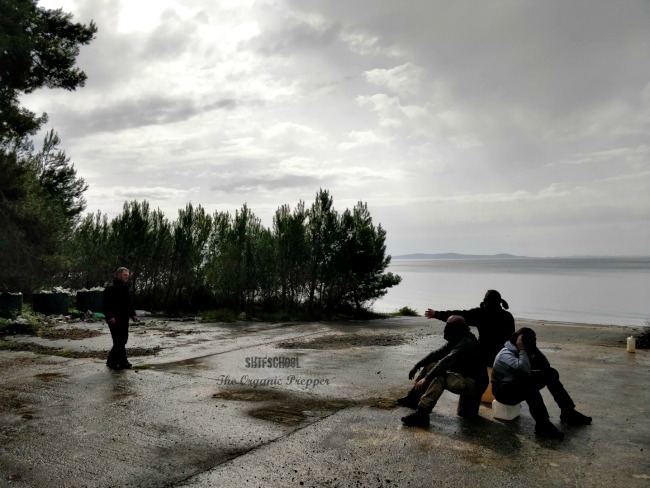
You can use sounds in surroundings (or background) to cover your movement (for example in this photo, it may be the sound of waves or wind through the trees) but again, you need a lot of time, and skill.
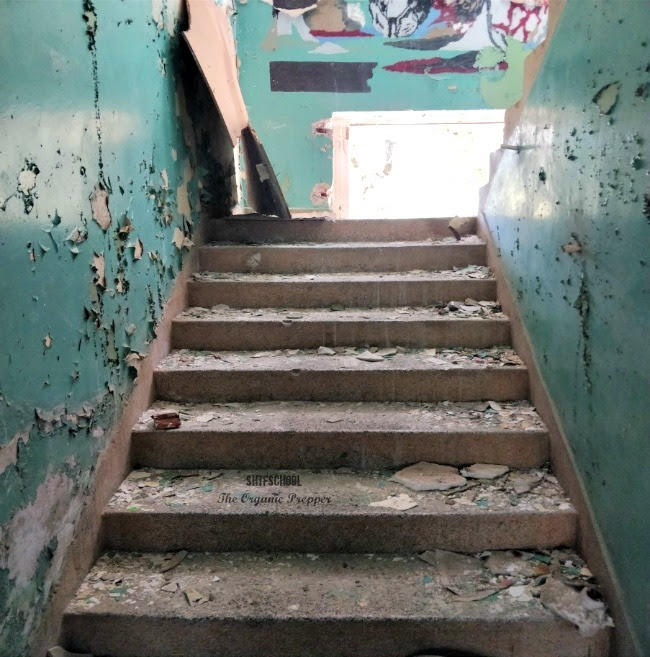
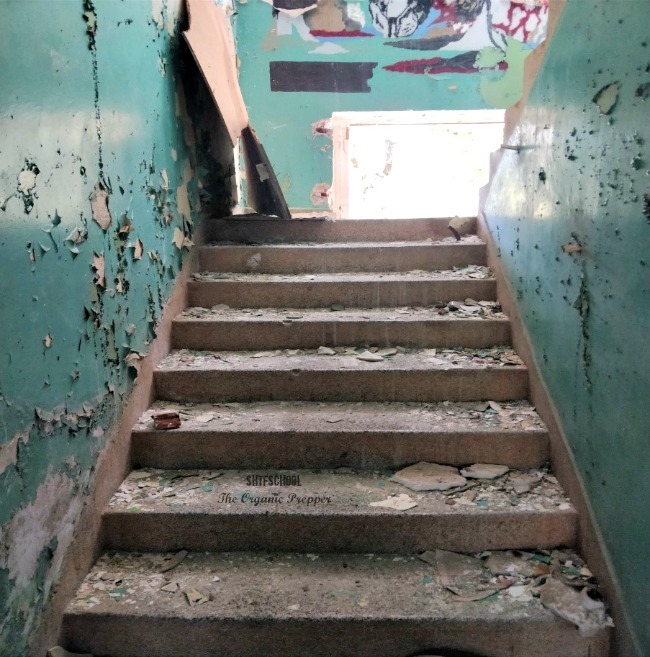
Now put that in perspective of real urban survival, and a situation where you need to check some building (for example to take shelter) that looks abandoned, with things on the ground that simply make too much sound. Sometimes it is impossible; sometimes it does not make sense to even try.
Moving in a group and staying quiet is a skill that is possible to learn, through the familiarization of group members, the use of hand signals, and proper preparing (again proper equipment, footwear, clothes). That technique makes sense to be put to the test in a hard situation like dark and bad weather (rain, wind) where you can try to use that weather and night in your favor. It’s also important to see how everything can easily go against you (conversation-signals in pitch dark, loss of orientation, losing group members.)
Light
If you tell average students group to start a fire so they can prepare a quick meal or make coffee, most of them will make a huge fire big enough to cook a boar on. If you tell them to turn on the flashlight to find something in their backpack, a lot of them will turn on a torch that will burn the eyes of all people around them, affecting their night vision badly.
Strong torches and big fires make sense sometimes, but in urban survival prepping staying undetected is a big priority, and you need to adopt that kind of philosophy first.
Planning your movement during the day, and taking that particular route during the night, even in an urban environment in SHTF settings, can be two completely different things, even if you saw (or went through) that area during the day.
It is very easy to get disoriented in pitch dark, and known buildings are not known anymore. Distance may look completely different, and the combination of everything may be very dangerous if you are not aware of that.
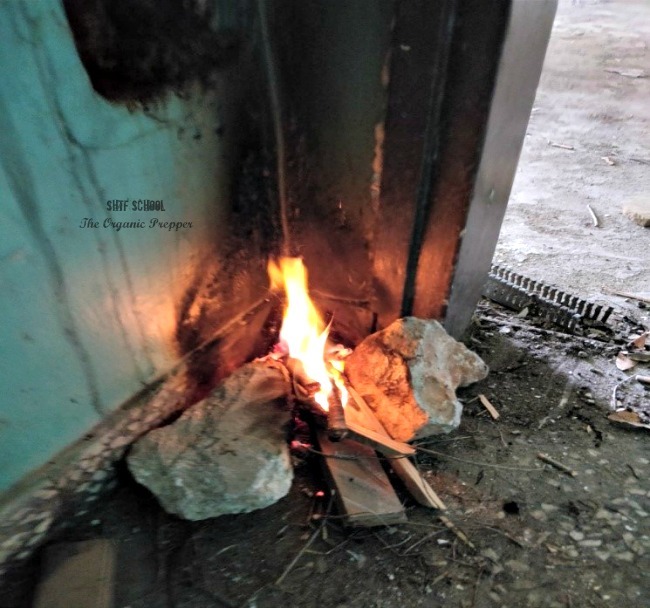
In the photo above there is a camping fire (not hidden) in an abandoned building in an area where there is no other light. It is clearly visible from 200-300 meters.
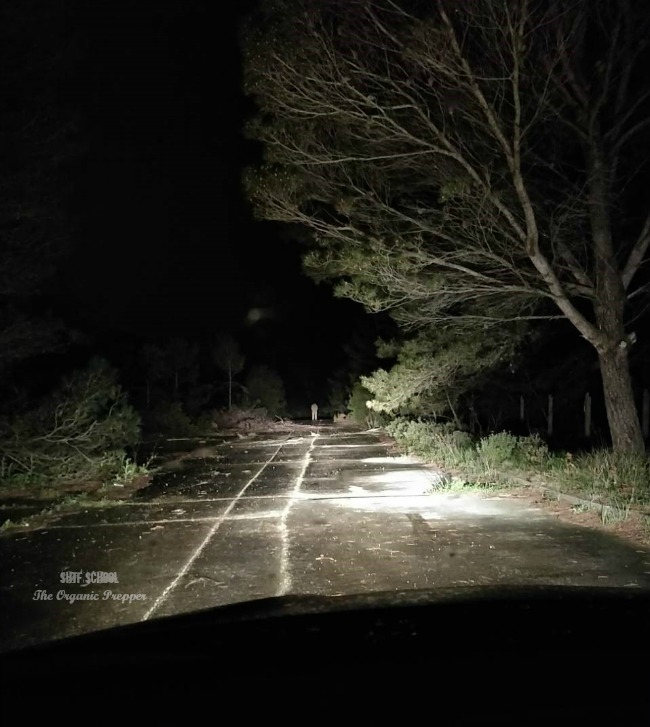
The photo above is taken after midnight in an area where students did not expect people to be. (The students were driving with us in a car during one of the exercises).
Students after the encounter described the man as a “very tall” (2 meters or 6’5″) person in a full white bodysuit, probably a man with no good intention (drug dealer? body disposal?).
The encounter lasted a few seconds.
Afer that they made camp in a close vicinity to where the “man in the white bodysuit” disappeared into the bush.
And of course, their minds continued to play dark scenarios in their heads for rest of the night.
They did not have nice night because of that.
In reality, it was one of our “ghost” instructors. He wore full camo and a clown mask – both were very visible (much better than in photo) but in the given circumstances (very late and a strange person walking slowly in area where there is not supposed to be anybody) the students mind offered a solution of what man is there and his intention.
Your mind WILL play tricks on you in survival situations. If you are in an uncommon situation or you are not very experienced when you are not sure what you see or hear your mind will offer you an answer. Often, that answer may be wrong, which may lead you to make some bad decisions.
It is the reality of SHTF.
Learn to use your skills under pressure
A big part of the course is using your skills and techniques under PRESSURE when you are not sure what is what, and that is a topic for other articles.
You can avoid that by training:
Rechecking how things work in the real world
What is visible from what distance
What can you hear from where
How many details can you spot and memorize
How good your orientation skills are
All that can be practiced in normal times, some in nature while hiking, some while drinking coffee in town by observing the people around you.
Again it is not about ninja warriors. It is about being aware of the world around you in different settings. Learn about Selco’s live courses here and his online courses here.
Selco survived the Balkan war of the 90s in a city under siege, without electricity, running water, or food distribution. In his online works, he gives an inside view of the reality of survival under the harshest conditions. He reviews what works and what doesn’t, tells you the hard lessons he learned, and shares how he prepares today. He never stopped learning about survival and preparedness since the war. Regardless what happens, chances are you will never experience extreme situations like Selco did. But you have the chance to learn from him and how he faced death for months. Real survival is not romantic or idealistic. It is brutal, hard and unfair. Let Selco take you into that world. Read more of Selco’s articles here: https://shtfschool.com/blog/ And take advantage of a deep and profound insight into his knowledge and advice by signing up for the outstanding and unrivaled online course. More details here: https://shtfschool.com/survival-boot-camp/
CA Democrats Author Bill To Protect Sex Offenders Who Lure Minors
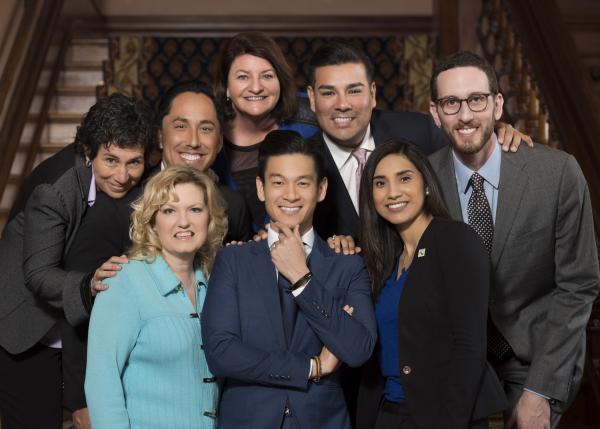
Senator Wiener with fellow LGBT Legislative Caucus members Susan Eggman, Todd Gloria, Toni Atkins, Ricardo Lara, Cathleen Galgiani, Evan Low, and Sabrina Cervantes. (Sen. Wiener photo gallery)
CA Democrats Author Bill to Protect Sex Offenders Who Lure Minors
No sex offender registry if perpetrator within 10 years of age of the minor
State Senator Scott Wiener (D-San Francisco) and Assemblywoman Susan Eggman (D-Stockton) introduced recent legislation “to end blatant discrimination against LGBT young people regarding California’s sex offender registry.”
However, under their bill, SB 145, the offenders would not have to automatically register as sex offenders if the offenders are within 10 years of age of the minor.
State Senator Scott Wiener. (Kevin Sanders For California Globe)
Wiener claims the current law “disproportionately targets LGBT young people for mandatory sex offender registration, since LGBT people usually cannot engage in vaginal intercourse.”
Existing law, the Sex Offender Registration Act, amended by Proposition 35by voters in 2012 (Ban on Human Trafficking and Sex Slavery), requires a person convicted of a certain sex crime to register with law enforcement as a sex offender while residing in California or while attending school or working in California.
Wiener says, “Currently, for consensual yet illegal sexual relations between a teenager age 15 and over and a partner within 10 years of age, ‘sexual intercourse’ (i.e., vaginal intercourse) does not require the offender to go onto the sex offender registry; rather, the judge decides based on the facts of the case whether sex offender registration is warranted or unwarranted. By contrast, for other forms of intercourse — specifically, oral and anal intercourse — sex offender registration is mandated under all situations, with no judicial discretion.”
“This bill would authorize a person convicted of certain offenses involving minors to seek discretionary relief from the duty to register if the person is not more than 10 years older than the minor,” SB 145 states.
Proposition 35 was created and passed to protect children from sexual exploitation and sex trafficking. Victims of sex trafficking are often vulnerable children, “afraid for their lives and abused—sexually, physically, and mentally,” the Proposition said. What Does SB 145 Also Do?
Legislators Wiener and Eggman say they are trying to shield LGBT young people from having to automatically register as sex offenders for specified sex crimes. But their bill does much more.
Assemblywoman Susan Eggman
SB 145 would allow a sex offender who lures a minor with the intent to commit a felony (i.e. a sex act) the ability to escape registering as a sex offender as long as the offender is within 10 years of age of the minor. No specification is made as to whether the sexual offender is straight or LGBT.
SB 145 would add a section to the state’s penal code (Section 290.55) stipulating that as long as the offender is “not more than 10 years older than the minor,” they are not automatically mandated to register as a sex offender. There is no age limit or range specified, except for existing law which already excludes lewd acts with children under 14.
SB 145 appears to allow adults to victimize minors by luring them with the intent to have sex, and then shields the predator from being automatically registered as a sex offender, as in the case of a 25 year old luring a 15 year old for sex, or a 22 year old luring a 12 year old.
SB 145, as currently written, appears to allow certain sexual predators to live among the population without anyone being aware.
Why is this bill needed?
Here is the text from SB 145:
This bill would authorize a person convicted of certain offenses involving minors to seek discretionary relief from the duty to register if the person is not more than 10 years older than the minor.
Digest Key – Vote: MAJORITY Appropriation: NO Fiscal Committee: YES Local Program: NO THE PEOPLE OF THE STATE OF CALIFORNIA DO ENACT AS FOLLOWS:
SECTION 1. Section 290.55 is added to the Penal Code, immediately following Section 290.5, to read:
290.55. (a) A person convicted of an offense specified in subdivision (b) may, by writ of mandate, seek discretionary relief from the duty, imposed as a result of that conviction, to register pursuant to the act if, at the time of the offense, the person is not more than 10 years older than the minor, as measured from the minor’s date of birth to the person’s date of birth.
Here is the current California Penal Code § 288.3 (2017)
(a) Every person who contacts or communicates with a minor, or attempts to contact or communicate with a minor, who knows or reasonably should know that the person is a minor, with intent to commit an offense specified in Section 207, 209, 261, 264.1, 273a, 286, 287, 288, 288.2, 289, 311.1, 311.2, 311.4 or 311.11, or former Section 288a, involving the minor shall be punished by imprisonment in the state prison for the term prescribed for an attempt to commit the intended offense.
(b) As used in this section, “contacts or communicates with” shall include direct and indirect contact or communication that may be achieved personally or by use of an agent or agency, any print medium, any postal service, a common carrier or communication common carrier, any electronic communications system, or any telecommunications, wire, computer, or radio communications device or system.
(c) A person convicted of a violation of subdivision (a) who has previously been convicted of a violation of subdivision (a) shall be punished by an additional and consecutive term of imprisonment in the state prison for five years.
Last week, California Globe reported on another sex crime bill introduced by California Democrats: “legislation to shield a person from the consequences of crimes they commit in California, even violent ones, as long as the person reports the crimes to authorities.The language of the proposed statute appears to immunize a person from ANY crime so long as they are reporting a violation of a sex crime law.” Sen. Scott Wiener is the author of California Senate Bill 233.
There is a new study of Millennials that explores their stress levels and it’s causes.
3 out of 5 claim that their lives are the most stressful ever. In the study the causes of those stresses were cataloged. Here’s the top 10:
1. Losing wallet/credit card
2. Arguing with partner
3. Commute/traffic delays
4. Losing phone
5. Arriving late to work
6. Slow WiFi
7. Phone battery dying
8. Forgetting passwords
9. Credit card fraud
10. Forgetting phone charger