


 |
 |

 |
 |
 |
| . |


|
|
|
|
|
|
| . |
Authored by Jack Phillips via The Epoch Times (emphasis ours),
Sen. Dianne Feinstein (D-Calif.) on Thursday introduced a ban on more than 200 “assault weapons” after the House passed two gun-control measures pertaining to background checks.

Her bill (pdf), called the “Assault Weapons Ban of 2021,” is co-sponsored by 34 Senate Democrats and would ban ammunition magazines that hold more than 10 rounds—similar to the bans on magazines in New York state and California.
According to the legislation, which was also introduced in the House by Rep. David Cicilline (D-R.I.), the ban would encompass more than 205 rifles. Feinstein’s bill would allow current owners of the guns to retain possession of them. If that gun is transferred, a person has to undergo an FBI background check before getting the firearm.
The bill also bans any weapon that has the capacity to use a magazine that isn’t a fixed ammunition magazine and has one or more characteristics such as a pistol grip, forward grip, a threaded barrel, a folding or telescoping stock, or a barrel shroud.
The bill “requires that grandfathered assault weapons are stored using a secure gun storage or safety device like a trigger lock” and prohibits the transfer of high-capacity ammunition magazines while banning “bump-fire stocks and other devices that allow semi-automatic weapons to fire at fully automatic rates,” according to a news release from Feinstein’s office. Bump-fire stocks were made illegal in March 2019.
“It’s been 17 years since the original Assault Weapons Ban expired, and the plague of gun violence continues to grow in this country. To be clear, this bill saves lives. When it was in place from 1994-2004, gun massacres declined by 37 percent compared with the decade before. After the ban expired, the number of massacres rose by 183 percent,” Feinstein said in a statement Thursday.
There are more than 20 million modern sporting rifles owned by private citizens, according to the National Shooting Sports Foundation, as reported by pro-Second Amendment website Bearingarms.com.
Republicans and gun-rights groups have said proposals from Feinstein, who has long advocated for gun control, are unconstitutional and won’t prevent firearms from getting in the hands of criminals.
“Law-abiding Americans use them for every type of lawful purpose, including personal and home defense, hunting, marksmanship competitions, and recreational target practice,” stated the National Rifle Association (NRA) when Feinstein attempted to introduce the bill in 2019. “Needless to say, however, the modern criminal element will not be playing by the antiquated rules that Feinstein hopes to apply to the rest of us,” the group asserted.
On Thursday, the House passed two Democratic-backed gun control measures, including one would that would expand background checks to those purchasing weapons over the internet, at gun shows, and through certain private transactions. Only eight Republicans joined the Democrats in backing the bill.
The second bill, passed 219-210 with only two Republicans supporting it, would give authorities 10 business days for federal background checks to be completed before a gun sale can be licensed.
Reuters contributed to this report.

The U.S. House Representatives, with the urging and support of Joe Biden, passed two bills on Thursday – H.R. 8 and H.R. 1446 – that would usher in a sweeping overhaul of how firearms are bought and sold in the U.S. Neither would impede criminals, who overwhelmingly obtain their firearms outside normal channels of lawful commerce. But together they would transform the constitutionally protected right to obtain firearms into a privilege administered at the whim of anti-gun bureaucrats.
To understand why these bills are so consequential, it’s important to understand how retail firearm sales work under existing federal law.
Currently, the primary means by which the federal government regulates firearms is through a network of licensed dealers (FFLs) making commercial sales. Anyone who repetitively engages in firearm sales for livelihood and profit is required to become an FFL. Failure to do so is already a federal felony. So when the media mentions “unlicensed dealers,” they’re actually talking about criminals, not people falling into a legal “loophole.”
Anyone buying a gun from an FFL must first go through a computerized, point-of-sale background check administered by the FBI. This check, which is supposed to be instant, searches several national databases to determine if a would-be buyer falls into any statutorily-defined category of “prohibited persons,” which include such things as felons, people who have been committed to a mental institution, and illegal aliens.
If the search does not turn up a disqualifying record, the system notifies the dealer to proceed. Sometimes, however, the records are unclear, and a response cannot be provided immediately. This results in a delay of up to three business days to allow the FBI to conduct additional research.
If the FBI still has not resolved the check within that three business day period, the FFL has the option (but not a requirement) to proceed with the sale, provided he or she has no reason to believe the buyer is prohibited. This is known as a default transfer.
The system is structured this way not because of some inadvertent loophole but as an intentional safeguard to protect Americans’ constitutional right to obtain firearms.
As with any constitutional right, the burden is on the government to justify a restriction, which in the case of a background check means the FBI must be able to locate a disqualifying record before it blocks a sale. The three day default transfer window ensures the government maintains the burden of proof, provides a specific timeframe to resolve incomplete checks, incentivizes the FBI to administer the system efficiently, and ensures legal transfers are not subject to extended delays.
Without the automatic default transfer option, the FBI could block even legal firearm sales, simply by refusing to complete the check.
Private individuals who are not selling firearms with the principle objective of livelihood and profit can make occasional transfers, sales, loans, or gifts of firearms without becoming an FFL. They cannot, however, transfer a firearm to anyone who they have reason to believe is legally prohibited from buying firearms. Private individuals also have the option (but not the requirement) to process a private transfer using the services of an FFL, with the attendant background check and record-keeping required of the dealer for a commercial sale.
The bills passed by the House last week would – in the case of H.R. 8 – presumptively ban any private transfer of a firearm, including loans and gifts, as well as – in the case of H.R. 1446 – eliminate the automatic three day default transfer period for dealer sales.
This means that every time a firearm changed hands, the transfer would have to be processed by an FFL, which would involve fees, background checks, and government-accessible paperwork documenting the sale. Friends and neighbors could no longer freely loan, sell, or trade firearms amongst the people they know and trust. Even some family members could no longer share firearms with each other.
Handing a firearm over to someone without hiring an FFL to facilitate the exchange would be a federal crime under H.R. 8, unless you could show the situation fell into certain narrow and confusing exceptions. For example, you could loan someone a gun for self-defense, but only if the person was actually under attack at the time. You could not loan someone a firearm as a safeguard against danger that had not yet materialized.
Making matters worse, H.R. 1446 would empower the FBI to indefinitely delay a firearm sale or transfer, simply by failing to complete the “instant” check that would now be mandatory for EVERY non-exempt transfer. There would be no automatic default transfer window. Instead, it would be up to the intended recipient of the gun to appeal a delayed background check and ask – for the second time – for an answer from the FBI.
If the FBI failed to answer this SECOND request for a resolution to the background check, the dealer would have to wait an additional 10 business days before deciding whether to transfer the gun. So, at a minimum, H.R. 1446 would allow the FBI to arbitrarily impose an extended delay, even in the case where a person stood on his or her rights by appealing the FBI’s non-answer to the check. If the person did not appeal, there would be NO option for the dealer to transfer the gun, even though the FBI had not shown the transfer was illegal.
Taken together, these bills transform the right to obtain firearms into a privilege administered at the say-so of the government. They also set the stage for a universal registry of gun owners and the transformation of the current “shall-issue” paradigm for FFL transfers to eligible buyers into a “may-issue” system where the FBI can block sales on a case-by-case basis as they see fit.
Arch anti-gun Senator Chuck Schumer has already promised that the legislation will get a vote in the Senate, where the margin for victory or defeat is razor thin.
That is why every freedom-loving American must contact their senators NOW and firmly but respectfully demand that they vote NO on H.R. 8 and H.R. 1446.
Giving the government total authority to document and oversee the movement of every legal gun in America is a recipe for a crackdown on law-abiding gun owners, while leaving criminals operating outside the bounds of the law untouched.
Do not delay. Make your voice heard TODAY or suffer the potential loss of your rights tomorrow! Contact your U.S. Senators Now!
Just as the FBI used a heavily armed tactical SWAT team to arrest Roger Stone, the FBI deployed the same tactics in Naples, Florida to arrest a man who attended the January 6th DC protest march. Military tactics, armored vehicles, automatic rifles and a no-knock raid.
Essentially the FBI continues to send a message to the larger electorate. They use these aggressive tactics against people based on their politics. There are no honorable “rank and file” in the modern FBI; the entire institution is compromised. This stuff is nuts.
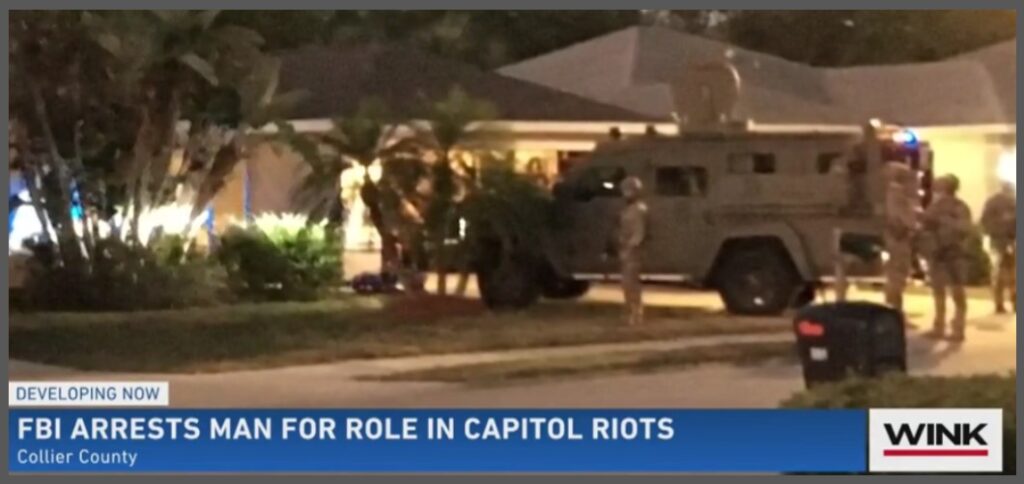
Collier County, Florida – The FBI said it executed a search and arrest warrant on Stanhope Circle in Collier County for a man investigators say was involved in the Jan. 6 Capitol riot. According to the FBI, Christopher Worrell faces charges related to the Capitol violence.
“Everyone is just shocked. Just shocked,” neighbor Lynn Elias said. “Because we never had anything like this in the neighborhood go on. This was a little too much when you see FBI and SWAT teams”
It was a startling morning for Elias and other neighbors when FBI investigators barricaded their street to raid a home. Law enforcement brought in armed men with helmets and a tanker truck.
“Whole outfits on like military and it was crazy,” Elias said. “There was like six or seven, the big black vehicles that follow like on [the Criminal Minds TV series] … They busted down the front door.” (link)
Every time I see stuff like this I am reminded of that very deliberate conversation with an official in Washington DC who warned me very deliberately and very forcefully: “under no circumstances should you ever engage the FBI in their main office; and all efforts should be made to avoid any/all lead agent FBI officers at all times.” The intensity of the warning was something I shall never forget, from a comfortably and purposefully invisible career official working inside the institutions of our national security apparatus.
Boy howdy, was that guy ever spot on!
NASHVILLE, Tenn. (WJHL) — A bill that would allow Tennesseans to carry a handgun without a carry permit has cleared another hurdle in the General Assembly.
House Bill 786 by Rep. William Lamberth (R-Portland) would change state law so that a person 21 years or older would be allowed to carry as long as they are lawfully in possession of a gun and are in a place where they have a right to be.
The House Criminal Justice Committee advanced the amended legislation on Wednesday. All four of the committee’s Democratic members voted against the bill.
The Tennessee Bureau of Investigation and Tennessee Sheriff’s Association oppose the bill.
Republican Gov. Bill Lee has pushed for allowing Tennesseans 21 and older to carry a handgun without a permit.
The Senate version of the bill is set to appear in the Senate Finance, Ways, and Means Committee next Tuesday. It cleared the Senate Judiciary Committee last week.


