Categories
"Tanker" Garands
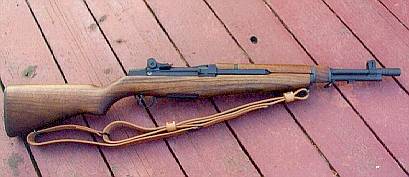
For several decades prior to the adoption of the Model 1903 Springfield rifle, the U.S. Army issued its U.S. Cavalry a carbine version of the standard U.S. Infantry rifle. The last official U.S. military carbine based on the standard infantry rifle was the Model 1899 .30-40 Krag, which had a 22″ barrel as compared to the Model 1898 Krag rifle’s 30″ barrel.
When the Model 1903 Springfield was in development, it was decided to equip the new rifle with a 24″ barrel that was intended to be a compromise between the shorter cavalry carbine and the longer infantry rifle. Both the infantry and cavalry were generally pleased with the new rifle, and the concept of separate arms for the two branches of the Army was over.
Nonetheless, there was still a fondness for the carbine in the minds of some of the former cavalrymen, who appreciated its light weight and handiness. There were two prototype carbine versions of the Model 1903 Springfield rifle fabricated in 1921 by Springfield Armory for testing and evaluation, but the concept never went beyond the prototype stage.

“Tanker” Garands had nothing to do with tanks, and the vast majority were fabricated as commercial guns by companies such as Golden State Arms. NRA Archives
When the M1 Garand rifle was adopted in 1936, it had approximately the same overall length as the M1903, which made it suitable for issue to both infantry and cavalry units. Such was the case until America’s entry into World War II, when the concept of a shorter M1 rifle was considered.
Although the .30-cal. M1 carbine had been adopted in 1941, it was an entirely different category of arm, and it was not designed, nor intended, to fulfill the same role as the M1 rifle. The light and compact semi-automatic M1 carbine lacked range, accuracy and “stopping power” compared to the M1 Garand. As World War II progressed, it was envisioned that a shorter version of the M1 rifle would combine the Garand’s power and accuracy with the compactness of the M1 carbine.
The Jan. 20, 1944, Springfield Armory “Monthly Report of Progress on R&D Projects” stated that a modified short-barrel Garand rifle, weighing about 1 lb., 3 ozs., less than a standard M1, was fabricated by the 93rd Infantry Division and tested by the Infantry Board.
It was recognized that such an arm might be particularly valuable for paratroopers, as it was more powerful than the carbines and submachine guns currently in use. Preliminary testing revealed it had excessive recoil and muzzle blast, but it was recommended that it be developed further. The Infantry Board directed Col. Rene Studler to proceed with the project.
The task was assigned to Springfield Armory, and John C. Garand began work in January 1944. The resultant experimental arm, designated as the “U.S. Carbine, Cal. 30, M1E5,” was fitted with a specially made 18″ barrel (not a shortened standard M1 rifle barrel) marked “1 SA 2-44” and a pantograph metal stock that folded neatly underneath the rifle. The receiver was marked “U.S. CARBINE/CAL. .30 M1E5/SPRINGFIELD/ARMORY/1.” It is interesting to note that it was designated as a carbine and not a rifle.

Other than the folding stock, the basic M1 rifle was essentially unchanged with the exception of the short barrel, a correspondingly shortened operating rod (and spring) and the lack of a front handguard. The overall length was 37½” and it weighed approximately 8 lbs., 6 ozs.
The M1E5 “Garand Carbine” was tested at Aberdeen Proving Ground in May 1944. It was determined that while accuracy at 300 yds. was on a par with the standard M1 rifle, recoil, muzzle blast and flash were excessive. It was recommended that a pistol grip be installed, which was done for subsequent testing.
Photos of the M1E5 in stocks with and without the pistol grip exist, which might suggest there were two different models, but this was not the case. The folding stock had been repaired several times and it proved to be rather uncomfortable when firing. Work began on a modified folding stock, designated as the “T6E3,” to improve the deficiencies found in the original pattern, but it was not fully developed.

This Springfield Armory archival photo depicts an M1E5 rifle without a pistol grip below a standard M1 rifle.
The M1E5 suffered from the “compromise syndrome,” as it required a trade-off between compactness and performance. It was indeed more compact than the standard Garand rifle, but the short barrel made it an unpleasant gun to fire—and the advantages were not judged to be sufficient to offset the disadvantages. Further development of the M1E5 was suspended as other projects at Springfield, such as the selective-fire T20 series, were deemed to have a higher priority. Only one example of the M1E5 was fabricated for testing, and the gun resides today in the Springfield Armory National Historic Site Museum.
Despite the concept being shelved at Springfield Armory, the idea of a shortened M1 rifle was still viewed as potentially valuable for airborne and jungle combat use. Particularly in the Pacific Theater, there was widespread dissatisfaction with the M1 carbine’s range, power and foliage-penetration (“brush-cutting”) capability. The Ordnance Dept. was not responsive to these complaints coming in from the Pacific and maintained that the M1 rifle and M1 carbine each filled a specific niche.
Nonetheless, by late 1944 the Pacific Warfare Board (PWB) decided to move forward with the development of a shortened M1 rifle. Colonel William Alexander, chief of the PWB, directed an Army ordnance unit of the 6th Army in the Philippines to fabricate 150 rifles in this configuration for testing. Since the previous M1E5 project was not widely disseminated, it is entirely possible that the PWB may not have been aware of Springfield Armory’s development of a similar rifle, and conceived the idea independently.
Some of the shortened M1 rifles were field-tested in October 1944 on Noemfoor Island, New Guinea, by an ad hoc “test committee,” which included three platoon leaders of the 503rd Parachute Infantry Regiment (PIR) Combat Team. While the members of the test committee liked the concept of the short M1 rifle, it was determined that the muzzle blast was excessive and was compared to a flash bulb going off in the darkened jungle. The conclusion of the test report stated that the shortened rifle was “totally unsuitable for a combat weapon.”
Even while the shortened M1 rifles were being evaluated by the 503rd PIR, two of them, Serial Nos. 2291873 and 2437139, were sent to the Ordnance Dept. in Washington, D.C., by special courier for evaluation. One of these rifles was then forwarded to Springfield Armory. The guys at Springfield must have felt a touch of déjà vu, as the rifle was very similar to the M1E5 built by the armory and tested at Aberdeen several months earlier.
The major difference was that the PWB rifle retained the standard M1 rifle wooden stock rather than the M1E5’s folding stock. The M1s shortened in the Philippines under the auspices of the PWB had been well-used prior to modification, and the conversion exhibited rather crude craftsmanship, including hand-cut splines on the barrel.
Upon receipt of the PWB rifle, Springfield Armory’s Model Shop fabricated a very similar shortened M1 that was designated as the “T26.” One of the more noticeable differences was that the shortened PWB rifle had a cut-down front handguard (secured by an M1903 rifle barrel band), while the T26 rifle was not fitted with a front handguard. It had been determined that the full-length stock was superior to the M1E5’s folding stock, so the T26 used a standard M1 rifle stock.

Shown above is a T26 prototype rifle manufactured in Springfield Armory’s Model Shop in early 1945 above an M1 rifle modified under the auspices of the Pacific Warfare Board in the Philippines during late 1944 and sent to the Ordnance Department for evaluation and testing. Note the near-pristine condition of the former compared to the well-used condition of the latter.
It is sometimes claimed that Springfield Armory simply put the existing M1E5 action into an M1 stock and dubbed it the T26. This was not the case, as the T26 did not use the M1E5’s purpose-made (and marked) receiver, but was made with a standard M1 rifle receiver and newly made, specially modified parts.
Regardless, it is a bit curious that the Ordnance Dept. decided to go to the trouble of having Springfield Armory make up another shortened Garand for additional testing when the M1E5, which differed primarily in the type of stock, had been thoroughly tested several months previously with less than spectacular results.
The PWB rifle, Serial No. 2437139, and Springfield Armory’s T26 were sent to Aberdeen Proving Ground (APG) on July 26, 1945, for testing. The APG report related that a standard M1 rifle, Serial No. 1,032,921, was the “control” rifle to which the shorter rifle was compared during the testing. The results mirrored those of the M1E5’s previous testing. As related in the test report:
“The rifle tested was a standard cal. .30 M1 with barrel shortened approximately six inches. This alteration was accomplished in the Philippine Islands by an Ordnance Maintenance Company and the rifle was delivered to the Chief of Ordnance by a USAFFE Board representative for the test.
“The object of the test was to compare, by observation, the muzzle flash, smoke and blast of the shortened M1 rifle, with and without the flash hider, to that of the standard rifle.
“Conclusions:
“The muzzle flash of the modified rifle, with and without flash hider, was approximately eighty (80) percent greater than the flash of the standard rifle.
“The muzzle smoke of the modified rifle, with and without the flash hider was equivalent to that of the standard rifle.
“The muzzle blast of the modified rifle, with and without flash hider, was approximately fifty (50) percent greater than that of the standard rifle.
“The recoil of the modified rifle was noticeably heavier than that of the standard rifle.”
In addition to the increased recoil and muzzle flash/blast, functioning problems related to the shortened operating rod and the location of the gas port in the shortened barrel were noted during the testing. The fact that the gas port was positioned closer to the chamber as compared to the standard M1 rifle resulted in increased port pressure, which was detrimental to proper functioning.
It should be noted that only the shortened PWB rifle, and not the T26, was discussed in the Aberdeen test report. It is reported that the T26 rifle was damaged during the testing, which is presumably why it was left out of the final report. The ultimate disposition or whereabouts of the T26 rifle are not known, although it has been speculated that it was salvaged for parts.
Somewhat inexplicably, despite the less-than-stellar results of the previous testing, including the 503rd PIR test committee’s conclusion that the modified rifle was “totally unsuitable as a combat weapon,” the concept was still of interest inasmuch as approval was forthcoming for procurement of 15,000 shortened M1 rifles. As related in the “Record of Army Ordnance Research and Development, Vol. 2”:
“In July of 1945, the Pacific Theater requested that they be supplied with 15,000 short M1 Rifles for Airborne use. A design of a short M1 Rifle was delivered by a courier from the Pacific Warfare Board. A comparative study of the sample short M1 Rifle and the M1E5 (a 1944 program to develop a short-barreled, folding stock M1, that was dropped as being of low priority) indicated a definite preference for the M1E5 action equipped with the standard stock; the rifle so equipped was designated as T26. A study by Springfield Armory resulted in a tentative completion schedule of five months for the limited procurement of 15,000 T26 Rifles; however, with the occurrence of V-J day on 14 August 1945 this requirement was dropped.”
As stated in the above documentation, the new rifles requested were to be designated “T26,” which would indicate that they were to be made to the same specifications as the T26 previously fabricated at Springfield Armory. As events transpired, however, the end of the war resulted in the cancellation of this order, and the concept of a “Garand Carbine” was dropped.
Since none of the 15,000 rifles was manufactured, there was only one T26 ever made. The M1 rifles shortened by the ordnance unit of the 6th Army in the Philippines apparently never had an officially assigned nomenclature. For lack of the better term, “Pacific Warfare Board Rifle” is undoubtedly the most appropriate designation for these rifles, albeit an unofficial one.
Since none of the 15,000 rifles was manufactured, there was only one T26 ever made. The M1 rifles shortened by the ordnance unit of the 6th Army in the Philippines apparently never had an officially assigned nomenclature. For lack of the better term, “Pacific Warfare Board Rifle” is undoubtedly the most appropriate designation for these rifles, albeit an unofficial one.
One of the PWB rifles, Serial No. 2291873, currently resides in the Springfield Armory Museum. The other PWB rifle, which was tested at Aberdeen in July 1945, Serial No. 2437139, has been in the West Point Museum (Catalog No. 19657) since it was transferred there by the Ordnance Dept. shortly after World War II.
According to West Point Museum officials, the only modification to the rifle since its testing by Ordnance was the substitution of the later T105E1 rear sight assembly in place of the original “locking bar” rear sight. The PWB rifle in the Springfield Armory collection appears to remain in its original configuration. It is interesting to note that at least one Springfield Armory archival photo (1964 vintage) exists that erroneously identifies the PWB Rifle in the museum’s collection as a “T26.”
There are still a number of unanswered questions regarding these rifles beyond the fate of the original T26. For example, it has not been confirmed beyond the shadow of a doubt how many of the rifles were actually fabricated in the Philippines as ordered by the PWB beyond the two known examples. While not stated one way or the other, it may be possible that the PWB waited to get word from Washington whether or not the concept met with Ordnance’s approval before proceeding with modification of the entire batch of 150 rifles.
The above-referenced report of the field testing of the short rifles by the 503rd PIR indicates that at least some additional rifles, beyond the two sent stateside, were produced. In any event, the number of shortened M1 rifles actually made during World War II as directed by the PWB almost certainly would have been no more than 150. The fact that no convincingly documented examples of the PWB-shortened M1 rifles are known to exist (other than the two mentioned above) seems to lend credence to the contention that few were actually fabricated.
It has been postulated, however, that the dearth of existing specimens can be explained because the shortened rifles were destroyed or re-converted to standard M1 rifle configuration after the “Garand Carbine” program was dropped. Unless further documentation is forthcoming, this will probably remain the subject of conjecture and debate.

Note the “Carbine” designation within the receiver markings on the M1E5.
Some claim to have run across, or own, one of these fascinating arms, but since converting a standard M1 to PWB/T26 configuration is not an overwhelmingly difficult gunsmithing task, and since there is no known roster of PWB rifle serial numbers, confirming the provenance of such a rifle is virtually impossible. There are a number of known fakes around including one with impressive, but totally bogus, “Pacific Warfare Board” markings on the receiver. The odds of one of the PWB rifles surviving and being smuggled home are all but nil.
Nevertheless, hope springs eternal and a number of individuals are certain they have a genuine example. Without some sort of convincing documentation, which almost certainly will not exist because any PWB rifle “on the loose” would be stolen government property, such a claim must be approached with much skepticism. A good rule of thumb to remember is: If it’s not in the Springfield Armory or West Point museums, it’s not a genuine Pacific Warfare Board rifle.
The shortened M1 rifle was one of those things that looked good in theory but didn’t work out so well in actual practice. With the conclusion of World War II, the U.S. military closed the chapter on the concept of a “Garand Carbine.”
The “Tanker Garand” Emerges
Despite its rejection by the American military, the idea of a Garand rifle shorter than the standard M1 was later resurrected in the civilian sector. The genesis of these rifles began in the early 1960s when some enterprising individuals acquired large quantities of surplus military firearm parts, including a significant number of M1 rifle receivers that had been “demilled” by torch-cutting.
Among the most notable of these was Robert E. Penney, Jr. Penney and his associates began to produce rifles, primarily standard-length M1 Garands, for the civilian market using these surplus parts, including some of the welded and re-machined torch-cut receivers. Examples were made in both .30-’06 Sprg. and .308 Win.
Penney was apparently aware of the World War II-era experimental shortened M1 rifles and decided a rifle in such a configuration would be a good addition to his company’s product line. The imaginative term “Tanker Garand” was coined for these rifles, presumably to give the impression (totally erroneous) they were military arms made for use in tanks. Despite being a fantasy appellation lacking any basis in reality, the name stuck.
Since genuine military M1 rifles were not readily available to civilians during this period, the ersatz Garand rifles, including the novel “Tankers,” sold relatively well. When the supply of the surplus components began to be depleted, Penney was faced with the prospect of manufacturing new parts. Such items as receivers, bolts and operating rods would have been prohibitively expensive to produce. Faced with this daunting prospect and declining health, Penney stopped manufacturing and sold the company.

While he was one of the pioneers in the field, it should not be inferred that Penney’s firm was the only one to make the so-called Tanker Garands. Several commercial firms, and even some individual gunsmiths, have continued to turn out similar arms to this day, either using existing G.I. M1 receivers, “demilled” receivers welded back together or newly made cast receivers. The workmanship can vary from extremely professional to downright shoddy.
Some people are enamored with the neat-looking little rifles, but this ardor often cools a bit when a few rounds are fired and the muzzle blast and recoil are experienced. Many owners of “Tanker Garands” found out what the Ordnance Dept. and the 503rd PIR test committee discovered in 1944-1945, and decided to become former owners when firing their pet guns proved to be less fun than originally imagined.
Nonetheless, some civilian shooters are not particularly bothered by the increased muzzle blast and recoil, and they continue to enjoy the neat little guns. In any event, these commercially shortened Tanker Garand rifles are not, and never were, military arms but are an interesting part of the fascinating story of the Garand.
While the concept of a “Garand Carbine” never went beyond the testing stage by the American military, it nevertheless illustrates how our armed forces continued to seek ways to improve the arms issued to our fighting men during the greatest conflict known to mankind
Categories
The Air Force having some fun


This week, I got a chance to do something we rarely do here on Guns America Digest. I got to take a second look at a rifle, with some upgrades from the aftermarket. This particular rifle really opened my eyes to new possibilities, and I really wondered what it could do with just a little bit of octane booster. I’m talking about of course the Bergara B14R in 22 Long Rifle.
In our last review, I called the B14R the best value in rimfire today. Which got me in a bit of hot water with some of you. Considering my test model has a street price of $1049, some offense was taken. I was in fact educated about how you could buy a 22 at Auto Zone for two wooden nickels and a book of Green Stamps back in the old days after you walked uphill in the snow to school. Both ways. And look, I get it. If the end goal is to plink cans in the backyard or shoot squirrels, the Bergara is no question overkill. Point taken. But for the intended customer, dudes either shooting precision rimfire matches or using it as a trainer for PRS competition, I stand by my words. Nothing even comes close in the price range. To put it in perspective, a barreled action from Vudoo Gun Works starts at $1770. Yes, for a 22 Long Rifle. And by barreled action, they mean no stock. Or trigger. Yes, that is the price in US Dollars, not Rupees or Pesos.

Given that is the market, the B14R is an absolute steal at $1049. Or $649 for just a barreled action, so you can put it in whatever stock you like. And our test gun performed absolutely magnificently, with one notable exception. The factory trigger, while both crisp and adjustable, just wasn’t in my opinion good enough. It did drop down to 2.5 pounds, which is great by some standards. But if we are talking real boy precision gun, I really like to go a bit lighter. I also genuinely wondered if we could squeeze more accuracy out of the Bergara if we eliminated that weak link. In our previous test, we achieved ½ MOA groups. But I had to fight for them. If there was the potential for even better accuracy, I felt obligated to go find the right tool to get it.

Fortunately, the B14R accepts Remington 700 Triggers (and stocks), which is the most prolific bolt action on earth when we count clones. And also helpful in this case, the most used custom actions such as Defiance and Surgeon are 700 actions in fancy dress. Instead of knocking around the local gun shop asking opinions, we went straight to the pros. The Precision Rifle Series is home to the best rifle shooters on earth today. Fortunately for us, they also happen to be data nerds, and there are statistics covering everything about the sport from caliber choice to what the top dogs had for breakfast readily available. Looking at the triggers page, the choice was obvious.

Of the top 100 shooters in PRS, 48% use a single brand of trigger. Seven out of the top ten competitors use it as well. TriggerTech, despite being a young company, absolutely dominates the sport. Not only are TriggerTech triggers fantastic in use, but they are notoriously durable. Thanks to the patented free-floating roller between the sear and the trigger, they are also all but dustproof. In environments where competitors’ products lock up, TriggerTech will keep working just like that annoying Bunny from the ’90s.

In a nod to the fact that we are building on a bargain gun, I opted for once to go with the bargain trigger. TriggerTech makes several grades of Rem 700 trigger, with the Diamond being the flagship. The Diamond adjusts to below 4 ounces and will set you back $275 to $294 depending on the lever shape desired. For our project, I opted to go one step down. The TriggerTech Rem 700 Special will only adjust down to 1 pound, but shaves off nearly $100. I picked this one for two reasons really. First, 1 pound is about as low as I like to go anyway. I have had some triggers in the ounces of pull weight, and a man has to know his limitations. 1 pound-ish is my sweet spot for personal use. Second, I picked the Special specifically to defeat the Geiselle Super 700 Trigger. I have owned and loved the Geiselle, and it served us well. You may remember the review we did on it, where it replaced an allegedly adjustable factory Remington 700 trigger. And in the process, dropped that rifle’s accuracy from 1 MOA to 1/2MOA in the time it took to install two pins. Well, the world has moved on. Not only is the TriggerTech a full half a pound lighter on the bottom end of adjustment, but it is also $50 cheaper.

True to reputation, TriggerTech is worth every penny. It is so crisp and clean as to defy the description. I don’t pull this card out often, but it bears a little ego stroke creds dropping in this context. I was a military sniper in two services for most of two decades. There is nothing else like the TriggerTech for a bolt action. Buy this one if you want to upgrade. Don’t bother with anything else. And if you can swing it, get the Diamond. If you don’t love the 4 ounces, you can always adjust it back up to a max of 32 ounces if it makes you nervous. The felt difference in our Bergara rifle was night and day after the trigger swap. No dollar you are going to spend on your gun is going to matter more than this one.

Since we had some wait time as the trigger was created for us, I went looking around for other aftermarket modifications. And I stumbled onto an incredible find. The TriggerTech trigger was supposed to be the star of this show, but it was very nearly upstaged by a company called Mack Brothers. A smaller shop out of South Dakota, Macbros.com blew my socks off with their contribution.

Mack Brothers make a wide variety of gun stuff, from suppressors to their own actions (from Titanium no less). And now that I have discovered them, we will be reviewing some other products. But for the Bergara, they have a magazine that is absolutely brilliant.

In our last review, I mentioned that the B14R magazines are the same size and feel like a short action AICS magazine, by design. Not only is that necessary to fit all Rem 700 stocks, but it makes the reload drill the same as with your centerfire rifle. But, as you can imagine, it leaves a lot of space cramming 10 rounds of 22LR in a magazine sized for 308. Mack Brothers, I like to think while having a Mount Rushmore brew and staring at a cornfield, said “hey, what if we just used both sides of the magazine?” So they did. For the same size as a regular 10 round Bergara magazine, you effectively get 20 rounds. Like a jungle mag, you just rotate 180 degrees, and you have 10 more on tap. While the magazine is $95, it does take the place of two $37 Bergara mags for the same space. And the Mack Brothers is CNC machined out of aluminum, unlike the plastic Bergara mag. In a word, magnificent.

With all that done, we headed to the range to find out if the B14R was hiding some more accuracy in that carbon fiber barrel. And the answer was yes, kind of. In our first test, we had ½ MOA groups from both Lapua Center X and SK Match. With our new trigger, we did get to just below ½ MOA this time with the Lapua, but not by much. .46 MOA, which is still very impressive for a 22LR. And I’m not too proud to say, that could very well be all I was capable of that day. But I will tell you this, those groups were MUCH easier to achieve with the TriggerTech on board. Even if we reached the mechanical limit of the B14R, which I doubt, it was still a solid investment.

This combination of the Bergara B14R, the TriggerTech Special, and the Mack Brother’s magazines is amazing. It is the most fun I have had with a 22 in quite some time. Especially given current ammunition circumstances, it may be time to think about a precision 22. If it was my money, this is the setup I would be looking for.
For more information on Bergara Click HERE
For more information on TriggerTech Click HERE


Categories
Rifles – WW1 Uncut: Dan Snow
 I am an inveterate gun store browser. A good portion of the wear and tear on my aging knees must have come from kneeling in front of glass front showcases in order to better see the Colt New Service in the back corner. The only real problem with this happy habit is the amount of time and gas it takes to travel from one gun shop to the next.

However, I have found a way to scan multiple gun stores in search of something I need (or want) and do it from my office in a quick session. Of course, I am referring to the phenomenon of online auction or purchase of firearms. It is a perfectly legal practice by which the registered transfer of ownership occurs between two FFL dealers, sometimes thousands of miles apart.
Easily run programs allow you to see what is available in the way of, say, .44 Special Colt Shooting Masters. It is an interesting way to look for guns of specific types. This blog is not about online gun buying as much as it’s about a recent purchase I made and the unique set of features I had to unravel.

First of all, I buy shooters. The so-called “safe queens” usually hold little interest for me. I am more likely to be looking for solid working condition Smith & Wesson, Colt and Ruger revolvers for use in various custom gun projects. Some solid bargains have come my way and a scratch, dent or spot of rust, easily repaired in the refinishing process, often drops the bottom line in my favor.
I get a lot of fun out of bringing a classic of yesteryear back to work or using it as the basis for a one-of-a-kind custom gem. Here, I’ll offer a bit of necessary background information and then dig into a very interesting new resident of my collection. It came from a gentleman in Texas, who accurately described every feature and flaw in his online listing.

The gun is a S&W, an old-line gunmaker who used a unique process for almost every gun made in its first 100 years of production. As a control measure in the fitting part of the manufacturing process, the company stamped the gun’s serial number on five major assemblies (sometimes six or seven) that make up a gun.
The number is on the frame (butt flat), barrel (forward of the threading), cylinder (rear face), extractor (inside face) and yoke (rear flat). Sometimes, they also marked one or both grips. To a latter day buyer, this tells him that all of these assemblies are complete and original. This also suggests that the gun has had a clear service life.

It must have been a tedious system to keep going, so it is understandable to see it stopped in the late ’50s. This was at about the time the company started assigning model numbers to their various models. Revolvers from then to now have the model number on the frame cutout for the yoke.
Still in what can be described as very good condition, the arm is a Model 27-2 and so marked. It is built on a so-called “three-screw” frame with a 6.5″ barrel, standard hammer and target trigger. The Model 27 was always an elite revolver, right from its 1935 origins as the legendary Registered Magnum.

Every Model 27 got a special touch in the checkering applied to the entire top surface of the gun. From the rear sight down the top of the frame, across to the slim barrel rib and all the way down to the front sight ramp, there is crisply applied metal checkering. The price was right and Model 27s of better than just shooter grade are hard to find, particularly when they have the puzzling enigmas like good ol’ #N92819.
The right side of the barrel is marked “.38 S&W Special Ctg.” The company never made Model 27s in that caliber. Also, there is no checkering on the barrel rib or on the long leaf of the rear sight.

More puzzling yet, there is a serial number on the barrel and… it doesn’t match the gun!
I think we can conclude that the original barrel was removed and replaced with a barrel from another revolver. In the immediate post-war era, Smith & Wesson returned to producing an N-frame revolver in .38 Special called the Outdoorsman.
It dated to the early 1930s and was the basic framework for the Registered Magnum. When it made its post-war re-appearance, the Outdoorsman got the ’50 Target features of several highly-sought-after N frames in .38 Special, .357 Magnum, .44 Special and .45 ACP.

That’s why we have the curious situation of a barrel, manufactured in 1953, serialized (#S97081) and installed on a frame. It was shipped as a finished gun to Rex Firearms in New York in late May of that year. At some completely unknown point in time, it was removed and re-installed on a different model and caliber revolver.
Actually, the only real difference between an N-frame target barrel in .38 Special and one in .357 Magnum is the caliber marking and checkering on the magnum tube. Records tell us that the original gun (#N92819) was part of a shipment of 27 miscellaneous Smiths that went to Watkins-Cottrell in Richmond, Virginia. All of the forgoing is factual. My observation is that of a sound and sturdy N frame S&W with some apparent contradictions and no great wear. It shoots good.

Why did all of this happen? I have to speculate on this one. My first speculation was that the gun was owned by a peace officer who worked for an agency that would not permit those nasty Magnums, either ammo or gun. The original .357 Magnum cylinder is in the gun, but the barrel marking would be “legal.”
If that one is true, he did not fire it much. Another possibility is that something happened to the original—bent, bulged, cracked—and this was the only possible replacement at that time and place. It’s also possible that the owner wanted to make it a .38, because that cartridge is associated with match accuracy to a greater degree than the .357.

However, the history of the gun, as well as the history of the cannibalized barrel, offer a more credible possibility. The original 1973 gun had the unique and desirable 3.5″ tube, and our anonymous owner wanted a longer barrel. Yeah, you’d best believe I’d love to find that snubby tube in somebody’s parts drawer, but I’d never be able to identify it, because they quit serializing major parts well before this barrel was made.
Stay tuned for more in the story of how a plain model 27 ‘Smith came to national attention.

For several years the FBI has been operating a shadow gun ban regime whereby Americans who are not prohibited from possessing firearms under federal law are being denied their Second Amendment rights without due process. This extralegal practice was brought to light again in recent weeks in the U.S. Court of Appeals for the Sixth Circuit case Turaani v. Wray. The case revealed that the FBI’s current administration of the National Instant Criminal Background Check System amounts to a may-issue gun purchasing scheme that is incompatible with the proper adjudication of a Constitutional right.
For more than a decade, gun control advocates and their allies in Congress have pushed legislation that would prohibit those on one of the federal government’s watch lists from purchasing firearms through the NICS system. As the federal government’s watch lists are oftenerroneous and the procedures for placing an individual on them are nebulous, opaque, and do not comport to any reasonable standard of due process, such legislation would empower the government to extinguish Americans’ Second Amendment rights with nearly unfettered discretion.
Given that such measures are a threat not only to Americans’ Second Amendment rights, but also their First and Fifth Amendment rights, NRA has been joined by the American Civil Liberties Union in opposing this dangerous legislation. NRA is not opposed to prohibiting dangerous individuals from possessing firearms, but the government must be forced to prove that an individual is dangerous by securing a conviction against them in a court of law.
Despite Congress having repeatedly rejected this may-issue scheme for gun ownership, the FBI has pressed forward with their shadow gun ban.
In 2013, the Congressional Research Service published a report titled, “Terrorist Watch List Screening and Background Checks for Firearms.” The document made clear that the FBI was checking the government’s watch lists during NICS background checks. Moreover, if a person came up on a list the transfer would be flagged and delayed. The report explained,
As part of the background check process, NICS typically responds to a federally licensed gun dealer, otherwise known as a federal firearms licensee (FFL), with a NICS Transaction Number (NTN) and one of three outcomes: (1) “proceed” with transfer or permit/license issuance because no prohibiting record was found; (2) “denied,” indicating that a prohibiting record was found; or (3) “delayed,” indicating that the system produced information suggesting that there could be a prohibiting record.60 In the case of a possible watchlist match, NICS sends a delayed transfer (for up to three business days) response to the querying federally licensed gun dealer or state POC. During a delay, NICS staff contacts immediately the FBI Headquarters’ Counterterrorism Division and FBI Special Agents in the field, and a coordinated effort is made to research possibly unknown prohibiting factors. If no prohibiting factors are uncovered within this three-day period, firearms dealers may proceed with the transaction at their discretion.
Therefore, the FBI delays, as a matter of practice, firearms transactions involving individual for whom they have no information suggesting they are prohibited from possessing firearms. This would be bad enough if it involved a temporary delay, however, the FBI does not clear the delay. Rather, the non-prohibited individual must rely on the Federal Firearms Licensee (FFL or gun dealer) to proceed with firearm transfer once three business days have elapsed since the NICS check was initiated, as they are permitted to do by law. Such “default proceed” transfers are at the FFL’s discretion and some FFLs are reluctant to transfer a firearm under these circumstances. If a person delayed in this manner is unable to acquire the firearm from a reluctant FFL after a default proceed, the FBI has denied a non-prohibited individual their right to purchase a firearm.
In Turaani v. Wray, the FBI went a step further.
According to the facts presented in Judge Jeffrey Sutton’s opinion, in 2018 the plaintiff (Turaani) attempted to buy a firearm from an FFL. The requisite NICS check resulted in a delay. Then, as Sutton described,
The next day, FBI agent Jason Chambers went to the dealer’s house, which doubled as his place of business, to speak to him about Turaani. Chambers wanted to see what information Turaani had provided about himself and explained that “we have a problem with the company” Turaani “keeps.” He showed photographs of Turaani with another person of apparent Middle Eastern descent, whom the dealer did not recognize. And Chambers left his contact information with the dealer.
Turaani followed up with the dealer a few days later to purchase the gun. The dealer explained that he had received a visit from the FBI. While he “technically could sell the gun” because the three-day delay had passed without further prohibitions on the sale, the dealer told Turaani that he was “no longer comfortable doing so.
To recap, the FBI delayed the firearm transfer of a non-prohibited individual merely due to “the company” he “keeps.” Then the FBI paid a visit to the FFL that all but assured the firearm transfer would not go forward. Of course, freedom of association is an essential component of the First Amendment right.
Following the FBI’s actions, Turaani then filed suit, claiming that the federal government had impermissibly restricted his rights. However, the Sixth Circuit ruled for the government, claiming that while the FBI did share information with the FFL that made the dealer reluctant to transfer the firearm, they did not force the FFL to halt the transfer.
What the court failed to fully appreciate is that FFLs are licensed by the federal government and subject to its oversight. There is an obvious measure of coercion attendant a visit from the FBI to an individual whose livelihood is directly regulated by another branch of the Department of Justice.
The FBI’s shadow ban regime could be used to target any number of politically disfavored groups and individuals.
Consider the 2009 U.S. Department of Homeland Security report “Rightwing Extremism: Current Economic and Political Climate Fueling Resurgence in Radicalization and Recruitment.” The report explicitly targeted Second Amendment supporters and returned military as potential terrorists, stating,
The possible passage of new restrictions on firearms and the return of military veterans facing significant challenges reintegrating into their communities could lead to the potential emergence of terrorist groups or lone wolf extremists capable of carrying out violent attacks.
Further targeting gun rights supporters for heightened scrutiny, the report went on to explain,
Weapons rights and gun-control legislation are likely to be hotly contested subjects of political debate in light of the 2008 Supreme Court’s decision in District of Columbia v. Heller in which the Court reaffirmed an individual’s right to keep and bear arms under the Second Amendment to the U.S. Constitution, but left open to debate the precise contours of that right. Because debates over constitutional rights are intense, and parties on all sides have deeply held, sincere, but vastly divergent beliefs, violent extremists may attempt to co-opt the debate and use the controversy as a radicalization tool.
In recent months, rhetoric about using the federal government to target those with divergent political views as “terrorists” has reached a fever pitch. The ACLU and other civil libertarians have warned about attempts to empower the federal government to pursue a new and misguided domestic war on terror. Former CIA Director John Brennan even suggested that the national security apparatus be turned on libertarians.
As bad as the current shadow gun ban regime is, there is legislation moving through Congress to make it even worse. H.R. 1446, would eliminate the three-day default proceed on NICS checks and would empower the FBI to indefinitely block FFLs from transferring firearms.
Under the bill, there would no longer be a set timeframe under which the FFL could proceed with a transfer if the FBI failed to give a definitive answer to a NICS check. An unresolved delay would become a presumptive prohibition on the transfer, even if the FBI never identified a disqualifying record.
Instead, the intended transferee – who already filed the Form 4473 with the FFL – would have to file a second petition with the government making the exact same declarations of eligibility and, once again, asking the FBI to rule on the matter.
But what would happen if the FBI didn’t resolve the follow-up petition?
In that case, the bill would require the FFL to wait at least 10 additional business days from the date the intended recipient filed the petition to consider making a default transfer. How the intended recipient is supposed to prove to the FFL the petition was even filed in the first place is not specified. This onerous and nebulous appeal procedure would only serve to exacerbate the threat posed by FBI’s current abuses.
The prejudices and unproven hunches of federal bureaucrats should never determine the exercise of a Constitutional right. That is why NRA members and other gun rights supporters must continue to work to oppose legislation that would give the federal government further discretion over the exercise of Second Amendment rights or compound the government’s current abuses.

Colt is bringing back its famous big-bore revolver, the Anaconda in .44 Magnum, for 2021. Now in production and starting to ship, the Anaconda is returning in both 6-inch and 8-inch models.
The .44 is based on Colt’s updated .357 Magnum design, scaled up and reinforced for the hard-hitting cartridge. Of course, shooters can always shoot friendlier .44 Special ammunition at the range.
These guns are returning with all the same looks as the originals, with full-length underlugs, ventilated rib topstraps, and Colt’s semi-bright polished finish. They ship with target sights including adjustable rear sights and a red ramp up-front.
The double-action revolvers chamber six rounds in the cylinder and are built on forged stainless steel parts. They are shipping with Hogue over-molded rubber grips to help with the recoil, which are replaceable with standard Python grips.

In addition to the grips, the sheer mass of these guns will help with hot-loaded magnum ammo. The 6-inch model weighs in at 53 ounces, while the 8-inch weighs a hefty 59 ounces, unloaded.
The trigger pull on these is about 12 pounds in double action, and 5 pounds in single action, and is characteristically smooth in both. The .44 Anaconda is about 7.5 inches tall and 13 or 15 inches long, depending on the model.
It’s possible that Colt also has plans for other chamberings, like .45 Colt, but for now, they’ll have no trouble finding buyers for their new-production .44 Magnum Anacondas. Even at the suggested retail pricing, which, in all fairness, is the same as the .357 Magnum Pythons.
See Also: CZ Buys Colt! Colt’s Manufacturing and the CZ Group Agree To Terms
As of now the MSRP on these snake guns is $1,499, which is a premium over the re-launched Colt Cobras, ranging from $699 all the way up to $1,299, depending on the model. Still, real-world and online pricing can be less, although it might take time for prices to come down.
For many shooters, this may be their first chance to shoot one of these classic revolvers, since original examples from the ’90s are getting harder and harder to find. And because these are new production guns, they’re going to be a lot more shootable, with originals becoming collector’s items and safe queens.
Between these being the new hotness and today’s market for firearms, if you want one and see one in stock, you had better move fast. These will not stay on shelves for long.
For more information about Colt, visit them online.