Categories
Dear Grumpy Advice on Teaching in Today's Classroom Interesting stuff Useful Shit Well I thought it was neat!

The First Aerial Bombing of the Continetial US

Bombing of Naco

From Wikipedia, the free encyclopedia
Bombing of Naco
Bombing Of Naco Arizona 1929.jpeg

A Dodge touring car destroyed by Patrick Murphy in the bombing of Naco.
Date April 2, 1929–April 6, 1929
Location NacoCochise County, Arizona, United States
Also known as The Naco incident
Type Aerial bombardment
Participants Patrick Murphy

The Bombing of Naco[1][2] was an international incident which occurred in the border town of Naco, Arizona, during the 1929 Escobar Rebellion. While rebel forces were battling Mexican ‘Federales‘ for control of the neighboring town of Naco, Sonora, the Irish mercenary and pilot Patrick Murphy was hired to bombard the government forces with improvised explosives dropped from his biplane. During the ensuing fighting, Murphy mistakenly dropped bombs on the American side of the international border on three occasions, causing significant damage to both private and government-owned property, as well as slight injuries to several American spectators watching the battle from across the border. The bombing, although unintentional, is noted for being the first aerial bombardment of the continental United States by a foreign power in history.[3]

Background[edit]

Late in 1928, as the Cristero War was raging in western Mexico, a new revolutionary faction led by General José Gonzalo Escobar drafted the “Plan of Hermosillo” and occupied the copper mining town of Cananea, Sonora, not far from the international border with the United States. Encouraged by their successes early on, they next decided to take control of Agua Prieta and Naco, both situated on the border with Arizona, knowing many of the locals were sympathetic to their cause and thinking the revenue generated by these two towns would be a good source of income for the revolution. From there, General Escobar intended to carry the war south and ultimately oust Emilio Portes Gil and take his place as president.[3]
The battle for Naco began early the next year, on the night of March 31, 1929. The rebels later claimed that they waited until 8:00 PM to attack, so as not to harm any American citizens shopping on the Mexican side of the border. To start the attack, the rebels loaded a train car full of explosives and sent it down the tracks toward the center of town. Unfortunately for the rebels, their plan failed when the train car derailed and exploded before reaching its intended target. After their failure with the train car, the rebels sought outside help from the United States and found it in an Irish cropduster named Patrick Murphy. Other pilots were hired as well, and the Federales found a pilot of their own named Jon Gorre. According to a witness, Murphy and Gorre were friends and although hired by opposing sides, would take turns making bombing runs on the opposing forces in Naco, Sonora, and would spend the night drinking together and enjoying themselves.[1][3][4]
An Arizona citizen named Charlie Elledge saw much of the fighting in Naco, Sonora, while working to repair the roof of the immigration building along the border. Elledge says that Murphy and Gorre bought their homemade “suitcase bombs” from the same man and that about 200 people gathered on the American side of the border each day to watch the fighting, like they had during the Mexican Revolution a decade before. Some brought their children and picnic baskets with lunch and others climbed on top of train cars sitting idle along the border for a better view of the action. The men gambled with each other on where the bombs would fall.[3]

Suitcase bomb[edit]

Diagram of the type of “suitcase bomb” dropped by Patrick Murphy and other pilots during the battle.

The so-called “suitcase bombs” used by Murphy and the other pilots in Naco were improvised aerial bombs made by packing dynamite, scrap iron, nails, nuts and bolts and other small pieces of material to use as fragmentation into a steel cylinder with fins and an improvised warhead made of dynamite caps and a nail for a firing pin. The bombs were then stuffed in suitcases that could be attached to the side of the plane and opened during flight to deliver the payload. Other improvised bombs were made the same way using five-gallon gasoline cans.[2][3]

Bombing[edit]

Murphy dropped one suitcase bomb each on his first two bombing runs, both of which turned out to be duds, and it was his third pass before managed to hit anything: the Mexican custom house near where the crowd of American spectators had formed. The resulting explosion sent small bits of shrapnel and other fragments into the crowd of spectators and caused the American patrons of the bars and clubs on the Mexican side of the border to rush back to their side of the line. Among the casualties were a reporter and a photographer, along with many others, but nobody was killed and all of the injuries were considered minor. After realizing the danger of watching the battle from such a short distance away, the crowd dispersed and went home, some to Fry and Buena.[3]
Neither Murphy or any of the other pilots were very successful in hitting their targets, but the high winds which regularly blow in the region in late spring and early summer most likely contributed to their inaccuracy. The first bomb to actually hit Arizona soil landed at 7:45 AM on April 2[4] and it was followed by others over the next few days. Murphy’s bombing runs smashed windows and otherwise damaged several buildings on the American side of the border, including a garage, the Phelps-Dodge Mercantile and the Haas Pharmacy. One bomb also struck the post office building, making it a federal offense, and another landed next to one of the idle train cars used by the crowd of spectators. Other bombs left large craters in the dirt streets and other unpaved surfaces. Yet another bomb landed on and devastated a regal Dodge touring car owned by a Mexican Army officer, which had been left on the American side of the border for safekeeping during the expected hostilities.[2][3]
Murphy’s bombs were responsible for at least a few deaths on the Mexican side of the border, but nobody was killed on the American side. The Americans suffered more casualties over the following days as bombs landed on their side, but none of the injuries were life-threatening. The final bombardment took place on April 6, when the rebels launched their final attack to take control of the city. Murphy was shot down by Mexican soldiers the following day, but he managed to escape and get across the border, where he was quickly arrested by American authorities. He was released for unspecified reasons after only a couple nights in jail. After being repulsed in their final attack, the rebels retreated to Cananea by way of Agua Prieta, marking the beginning of the end of the revolution in the north.[1][3]

Aftermath[edit]

The United States Army was slow in responding to the situation, having closed all military posts in Arizona the same year, with the exception of Fort Huachuca. Fort Huachuca, which is relatively close to Naco, sent two companies of Buffalo Soldiers to occupy Naco, Arizona, and prevent the fighting from spreading into American territory. The commander of the detachment positioned his men along the border and had them prepare to attack at a moment’s notice while he crossed the border and demanded that the rebel commanders stop dropping bombs on the Arizona side. By this time, however, the rebels were already defeated, and so the Buffalo Soldiers never had to engage. A squadron of eighteen warplanes was also dispatched from somewhere in Texas to shoot down any plane violating American airspace, but it never went into action either, and was withdrawn sometime later without incident.[1][3][4]
Murphy never faced charges for his bombing of Naco, Arizona, which became the first aerial bombardment of the continental United States by a foreign power in American history. According to local rumor, the rebel commander, General Escobar, kept a plane loaded with gold near the border so he could escape if the revolution collapsed. When it did, Escobar abandoned his troops and flew into Arizona, where he asked for and received asylum from the local authorities. The rebellion officially came to an end not long after the incident in Naco.[1][3]
Popular culture[edit]

The Bombing of Naco

Categories
All About Guns

IMI “Galatz” – Galil DMR/Sniper in 7.62 NATO

Categories
All About Guns

Colt's First Double Actions: The 1877 Lightning & Thunderer

Categories
Anti Civil Rights ideas & "Friends" Dear Grumpy Advice on Teaching in Today's Classroom Grumpy's hall of Shame Some Sick Puppies!

May he rot in Hell – Vasily Blokhin, history’s most prolific executioner

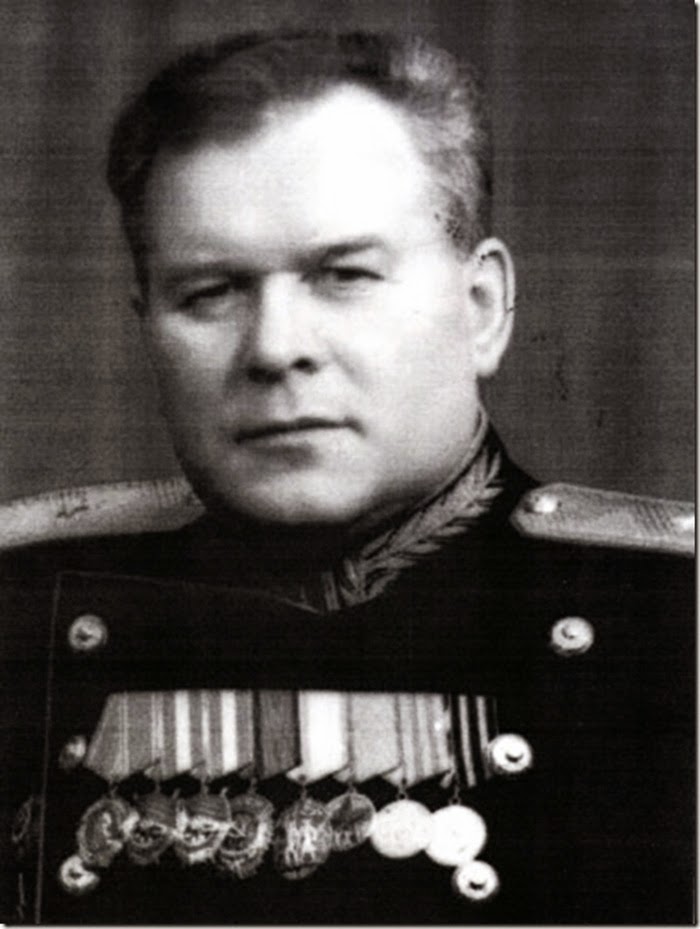
Vasili Mikhailovich Blokhin

Vasily Mikhailovich Blokhin.

Vasily Blokhin is recorded as having executed tens of thousands of prisoners by his own hand, including his killing of about 7,000 Polish prisoners of war during the Katyn massacre in spring 1940, making him the most prolific official executioner in recorded world history. He was the NKVD major in charge of executing the Polish officers from the Ostashkov camp, and he believed in personally doing the killing that his superiors had ordered him to supervise.

Born in 1885, he was known as the NKVD’s chief executioner, having been hand-picked for this position by Joseph Stalin himself. Blokhin personally killed tens of thousand of men and women during Stalin’s Great Purges of the 1930s, so it was only natural that the NKVD would turn to him when it came time to dispatch the officers held in the Soviet prison camps. Along with a team of about thirty NKVD men from Moscow, mainly drivers and prison guards, Blokhin arrived at the NKVD prison in Kalinin (Tver) and set himself up in a sound-proofed cellar room that had a sloping floor for drainage. He then put on his special uniform, consisting of a leather cap, long leather apron, and elbow-length gloves. On a table next to him was a briefcase filled with his own personal Walther PPK pistols, for Blokhin, a true artist at his trade, would use no one else’s tools but his own.

Vasili Blokhin's official photo

Vasily Blokhin’s official photo.

After the prisoner’s identity was verified, he was brought handcuffed into the cellar room where Blokhin awaited in his long apron, like some horrible butcher. One guard later testified: “The men held [the prisoner’s] arms and [Blokhin] shot him in the base of the skull…that’s all”. Blokhin worked fast and efficiently, killing an average of one men every three minutes during the course of ten-hour nights – the killings were always done at night, so that the bodies could be disposed of in darkness.

Although this has never been completely proven, historians suspect that Blokhin shot 7,000 men over a period of twenty-eight days, which would make him one of the most prolific murderers of all time. However many people he killed, Blokhin was consistently promoted by his superiors for performing “special tasks”. He lost his job after Stalin died. The cause of Blokhin’s death, in 1955, was listed as suicide.
Katyn massacre
The Katyn massacre, also known as the Katyn Forest massacre was a mass execution of Polish nationals carried out by the People’s Commissariat for Internal Affairs (NKVD), the Soviet secret police, in April and May 1940. The massacre was prompted by NKVD chief Lavrentiy Beria’s proposal to execute all captive members of the Polish Officer Corps, dated 5 March 1940. This official document was approved and signed by the Soviet Politburo, including its leader, Joseph Stalin. The number of victims is estimated at about 22,000.

Interesting facts:

  • Blokhin initially decided on an ambitious quota of 300 executions per night; and engineered an efficient system in which the prisoners were individually led to a small antechamber—which had been painted red and was known as the “Leninist room”—for a brief and cursory positive identification, before being handcuffed and led into the execution room next door. The room was specially designed with padded walls for soundproofing, a sloping concrete floor with a drain and hose, and a log wall for the prisoners to stand against.
  • He had brought a briefcase full of his own Walther pistols, since he did not trust the reliability of the standard-issue Soviet TT-30 for the frequent, heavy use he intended. The use of a German pocket pistol, which was commonly carried by German police and intelligence agents, also provided plausible deniability of the executions if the bodies were discovered later. Another reason he used the Walther rather than his standard issue Tokarev was the blow back. The Walther’s lower recoil made it easier for him (as well as other executioners for the NKVD) to kill large numbers of people in one night. Walthers were readily available due to the cooperation between the Soviets and Nazi’s in which the Germans ended up giving a fair amount of arms to their Soviet Allies.
  • Each night, 24–25 trenches, measuring eight to ten meters (24.3 to 32.8 feet) total, were dug by a bulldozer to hold the night’s corpses, and each trench was covered up before dawn.
  • Blokhin and his team worked without pause for ten hours each night, with Blokhin executing an average of one prisoner every three minutes. At the end of the night, Blokhin provided vodka to all his men.
  • On April 27, 1940, Blokhin secretly received the Order of the Red Banner and a modest monthly pay premium as a reward from Joseph Stalin for his “skill and organization in the effective carrying out of special tasks”.
  • His count of 7,000 shot in 28 days remains the most organized and protracted mass murder by a single individual on record; and saw him being named the Guinness World Record holder for ‘Most Prolific Executioner’ in 2010.
  • Blokhin’s rank was stripped from him in the de-Stalinization campaigns of Nikita Khrushchev. He reportedly sank into alcoholism, went insane, and died February 3, 1955, with the official cause of death listed as “suicide”.
  • The Soviet government admitted that the Soviet Secret Police were responsible for the Katyn massacre in 1990. Before that they claimed that the Germans did it. The Germans actually invited an international delegation to investigate the mass grave in 1943, which also concluded that the Soviets had done it. In order to try to ‘get away’ with it, the Soviets staged show trials against German POWs to blame them for Katyn, and tried to hold German defendants accountable for Katyn at Nuremberg (which the Allies refused).

Vasily Blokhin was buried in 1955 at the Novodevichy Cemetery. In the late 1960’s, after Khrushchev era ended, the titles and medals were returned to him, and he himself was rehabilitated by the state. The history’s most prolific executioner found a tomb to rest, unlike ten thousands of people killed by him.
Vasili Blokhin tomb

Vasily Blokhin tomb.

Categories
All About Guns Allies Well I thought it was funny!

Some “Fudd*” Humor

Know your fudd : Firearms

Fudd Memes

You Laugh, You Lose VOL. 3 - Page 1230

Tells awkward war stories was in the National Guard - Billy Badass - quickmeme

Ok ok. After demand...a true fudd : Firearms

Know Your Fudds Part 2 | LooseRounds.com

Know Your Fudds Part 2 | LooseRounds.com

Know your Fudd : Firearms

2849 best r/worldoftanksconsole images on Pholder | The Campers during True Vision play test


*Fudd

Slang term for a “casual” gun owner; eg; a person who typically only owns guns for hunting or shotgun sports and does not truly believe in the true premise of the second amendment.
These people also generally treat owners/users of so called “non sporting” firearms like handguns or semiautomatic rifles with unwarranted scorn or contempt.
“See sonny, all those pistols in that cabinet… all thems is good for is killin people.” -Example of ignorant comment from a fudd at a local gun shop. See also: Zumbo.
Categories
All About Guns

Old school dangerous game rifles, Now I would not mind having one. But it would be a VERY long time before I would shoot it!

After watching this I think you would understand my reluctance to shoot these beautiful but hard hitting rifles!

Categories
All About Guns

Small Arms of WWI Primer 131: Dutch 1895 KNIL

Categories
All About Guns Allies Anti Civil Rights ideas & "Friends" California

Sadly there is way too much true in there to be funny!

No photo description available.

Categories
All About Guns

The Australian Owen SMG

Categories
All About Guns Tips about Gunsmithing

How to Clean Years of Dirt and Grime from a Remington Rolling Block | MidwayUSA Gunsmithing