On Friday, February 28th, 1997 the Los Angeles Police Department would face one of the most dangerous criminal acts in its history – The North Hollywood Bank Shootout. On that Friday morning, after months of planning two armed bank robbers entered and robbed the North Hollywood Bank of America branch in California. The ensuing shootout between the heavily armed bank robbers and LAPD would go down in history as one of the largest gun battles in United States history. Today we’ll breakdown the facts leading up to and throughout the infamous North Hollywood Bank Shootout.
A Breakdown of the Infamous 1997 North Hollywood Bank Shootout
Disclaimer: This article is not intended to sit in judgment of any party that was involved in this incident. The purpose of this article is to take the facts which have been presented to the public to show readers a clinical, unbiased and truthful look at an unfortunate chain of events.
A Breakdown of the Infamous 1997 North Hollywood Bank Shootout
BEST-LAID PLANS
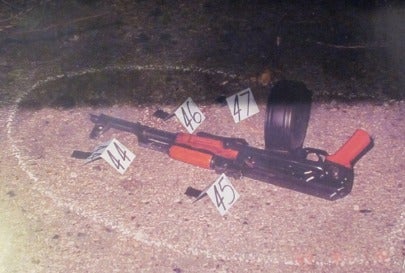
The robbers – Larry Eugene Phillips Jr. and Decebal Ștefan Emilian Mătăsăreanu – were familiar with firearms and prepared for the bank robbery by heavily arming and armoring themselves. Included in their arsenal were illegally modified rifles including two Norinco Type 56 S rifles, one Norinco Type 56 S-1 rifle and a Bushmaster XM15-ES2 Dissipator all of which were modified to be able to fire fully automatic. The robbers were also armed with an H&K Model 91 .308 rifle.
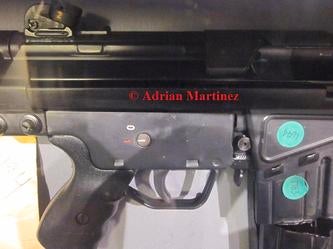
The HK-91 Rifle used by Phillips during the robbery (note the destroyed lower receiver and magazine)
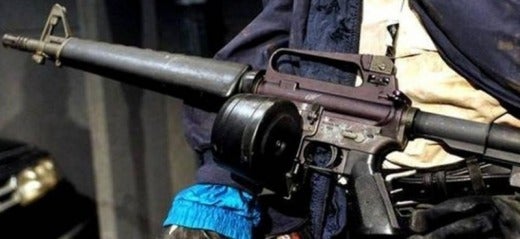
An illegally modified XM15 used by the robbers to fire fully-automatic – Beta mag attached
Norinco Type-56 Sporter modified to fire full-auto by the robbers – an attached Romanian 75 round drum magazine.
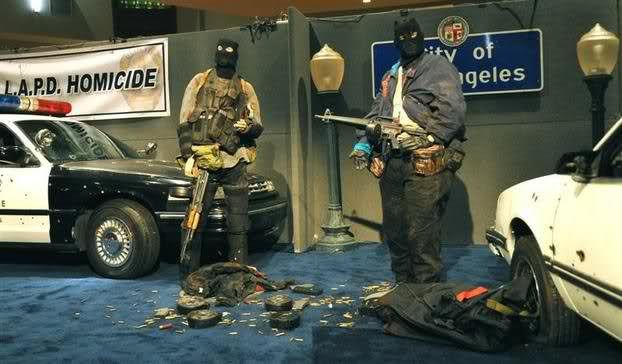
Phillips and Mătăsăreanu also armored themselves with varying degrees of body armor. Mătăsăreanu wore a Type IIIA bulletproof vest with a trauma plate to protect vital organs while Phillips was found to have worn more than 40 lbs of equipment including his armor. Phillips wore a Type IIIA vest which included a groin guard and he supplemented this with several pieces of homebrewed body armor salvaged from pieces of other vests. All together Phillips was nearly covered from head to toe in body armor.
A Breakdown of the Infamous 1997 North Hollywood Bank Shootout: Recreation of Phillips (left) and Mătăsăreanu on the day of the robbery
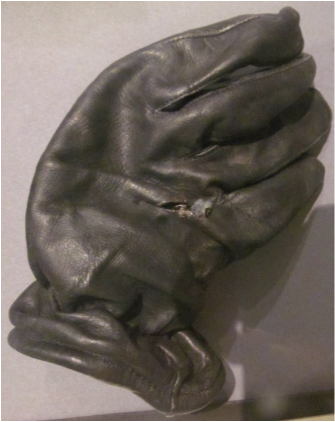
In addition to their armament, both robbers made an extensive reconnaissance of the Bank located at 6600 Laurel Canyon Boulevard – this reconnaissance included finding the exact person they needed to gain access to the bank’s vault which was their main target. The robbers also made use of police scanners to determine the estimated response time and included watches sewn onto the back of their gloves to monitor their timing.
THE ROBBERY
At 9:17am the two robbers arrived at the bank and set their watch alarms for 8 minutes. As the two made their way into the bank they were spotted by two patrolling officers. Loren Farrel and Martin Perello were on patrol and driving down Laurel Canyon when they spotted the robbers. Perello immediately called in the possible 211 – the code for robbery.
A Breakdown of the Infamous 1997 North Hollywood Bank Shootout
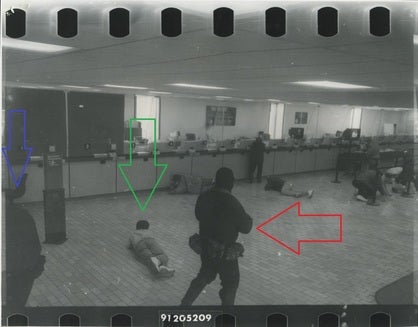
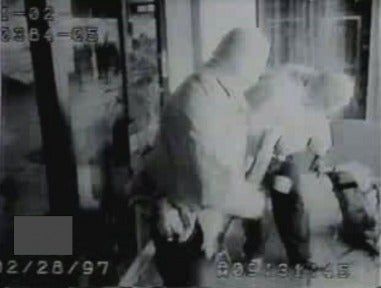
After entering the bank the robbers proceeded to harass both customers and bank employees. Mătăsăreanu opened fire into the bank’s ceiling declaring “This is a F*cking holdup!” As Phillips secured the main bank lobby Mătăsăreanu proceeded to track down the bank’s assistant manager John Viligrana.
The metal door jam was shot along with the bullet-resistant glass leading to the tellers and bank vault.
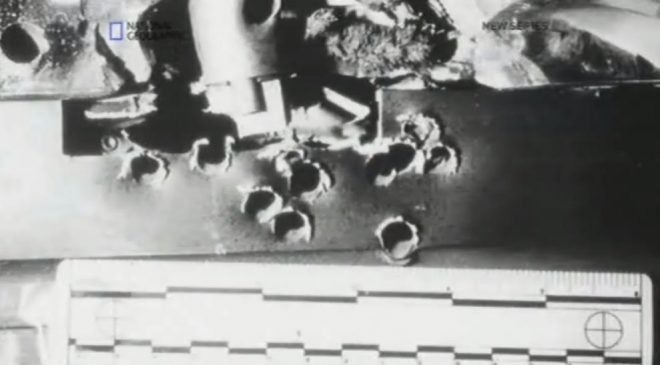
Viligrana was located inside the tellers where the vault door was. To gain access to this area, Mătăsăreanu shot through the 1/4″ thick bullet-resistant polycarbonate and acrylic composite panels with his converted Norinco Type 56 Sporter rifle. The short burst destroyed the panels and riddled the striker plate with bullet holes.
John Villigrana encountered Phillips after he blasted the door open and was immediately met with demands to “Get the money or we kill you.” Even though Villigrana immediately complied with the demands he was still struck in the back of the head with the wire-frame stock of Phillip’s rifle.
A Breakdown of the Infamous 1997 North Hollywood Bank Shootout
Upon entering the vault Villigrana began filling Mătăsăreanu’s bags with cash. However, due to a recent change in delivery times and practices, the bank had not yet received its bulk delivery and the amount of cash inside was not what the robbers had expected (roughly $750,000). Assistant Manager Villigrana recalls that Mătăsăreanu became visibly and audibly upset with this revelation. In a display of rage, Mătăsăreanu unloaded a full 75-round drum into one of the vault’s cash lockers (Burgher Box).
A Breakdown of the Infamous 1997 North Hollywood Bank Shootout
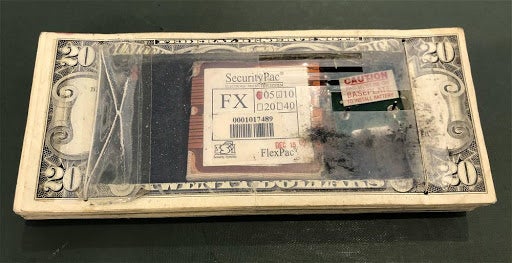
After this incident, Villigrana had finished loading up the robber’s bag with a total of $303,305 which included 3 dye packs that would all detonate as the robbers were leaving the building. With their 8 minutes up the robbers marshaled the terrified customers into the bank vault and at that point, Phillips exited the Northwest door of the building while Mătăsăreanu remained inside for another 4 minutes – it is still unknown what he did inside the bank during this time.
A Breakdown of the Infamous 1997 North Hollywood Bank Shootout
THE SHOOTOUT
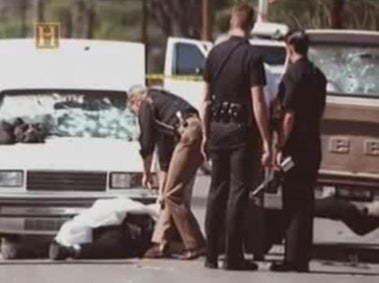
During the bank robbery, LAPD officers had managed to surround the building setting up patrol cars along Laurel Canyon Boulevard as well as the intersecting streets surrounding the bank. Officers began to arrive only minutes after the initial two-eleven call was made by Officer Perello.
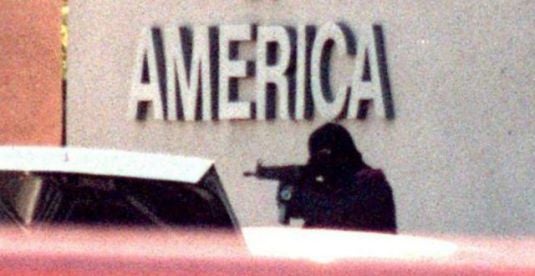
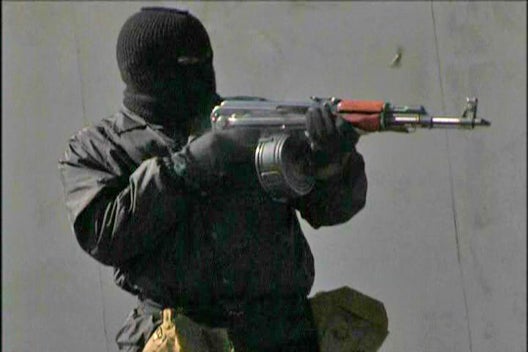
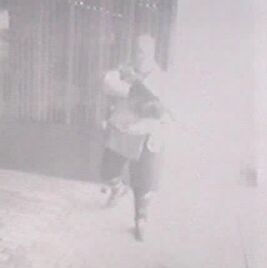
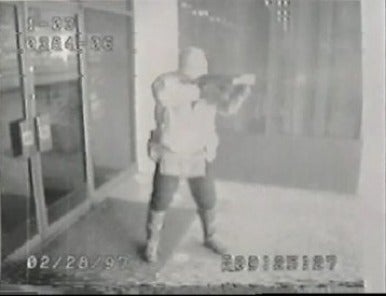
Phillips as he opened up with his initial barrage of fire at the LAPD
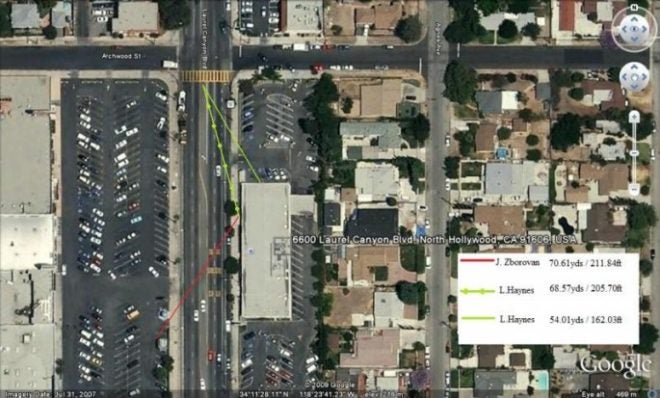
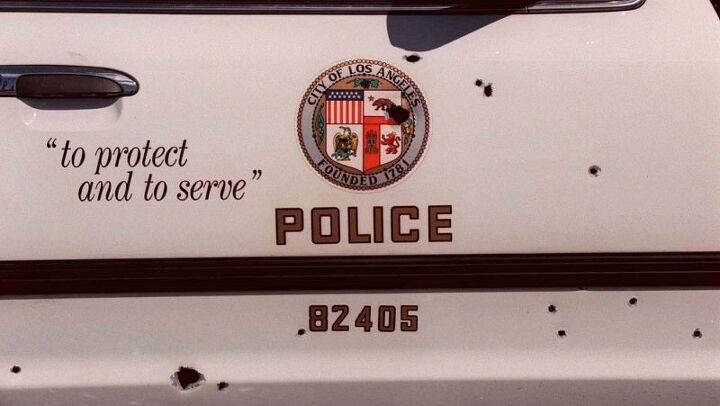
As Phillips exited the building he immediately encountered LAPD officers. Phillips opened fire with the first of what would eventually be 1,100 rounds reportedly fired by the robbers during the ongoing battle. LAPD Sgt. Haynes along with 3 other officers were the first targets of Phillips and the first barrage of full-auto fire riddled the police cruiser with bullet holes as the officers took cover. Phillips continued to pursue the officers and present civilians and even fired on the police helicopter AIR-8 which had arrived just seconds before Phillips exited the bank.
Although it may not seem like it the distances that the gunmen were engaging the officers at put officers armed with pistols at a significant disadvantage.
Phillips continued to fire till he emptied his 75-round drum and then proceeded to retreat to where he had exited the bank. Officers used this opportunity to return fire with their Beretta 92F 9mm pistols. Some other officers had S&W Model 15 revolvers and others brought Ithaca Model 37 shotguns to combat the robbers. Shortly after reloading, Phillips stepped out again and in a single 128-degree arc of fire, he wounded three police officers and one civilian.
A Breakdown of the Infamous 1997 North Hollywood Bank Shootout
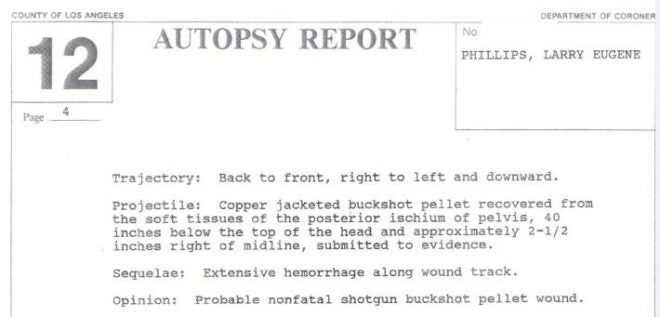
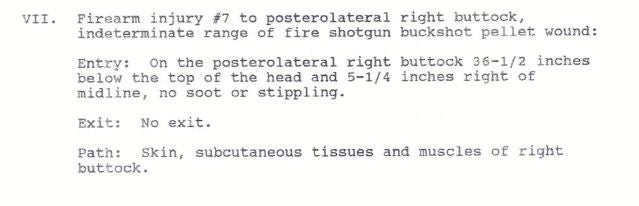
Phillips was initially shot by officer James Zboravan. Zboravan used his Ithica Model 37 and two blasts of buckshot to hit Phillips from the rear with 9 total projectiles but only one managed to injure Phillips by striking his right buttock which was unprotected by armor. Phillips turned to engage the officer and those around him and eventually wounded officer Zboravan with one round striking his lower back and other striking his hip and exiting through his thigh.
ATTEMPTED ESCAPE – PHILLIPS
This portion of the battle would go on between officers and Phillips until he decided to return to the bank Phillips may have been struck several times by both LAPD officers and detectives with 9mm rounds as several officers engaged him from multiple angles. After discarding several empty ammunition drums Phillips and Mătăsăreanu exited the bank both carrying the large money bag.
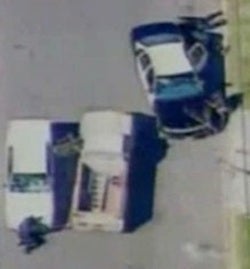
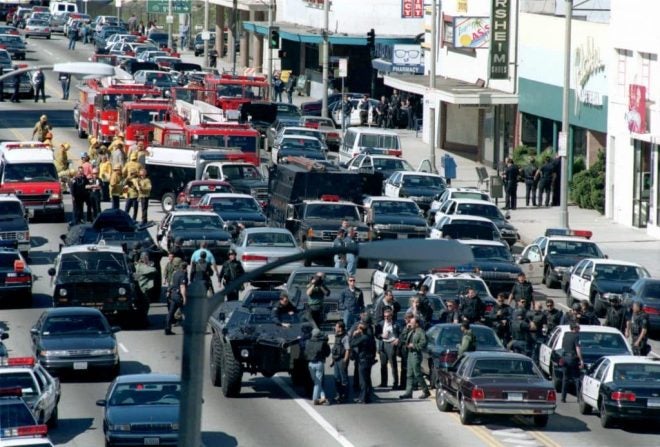
LAPD SWAT arrived 18 minutes after the shooting had begun and were much better armed than the patrol officers. LAPD SWAT brought AR-15 rifles to bear and commandeered a nearby armored truck to extract the wounded civilians and officers from the area.
LAPD officers and SWAT team members use a commandeered armored transport to rescue a wounded man, under fire from a robber at the Bank of America across the street. (Gene Blevins/Los Angeles Daily News)
As Mătăsăreanu and Phillips exited the bank and began to flee, Mătăsăreanu was shot twice in the right buttock and once in the left forearm which forced him to drop the bag of money which had been ruined by the detonation of the dye packs.
The glove from the right hand of Phillips
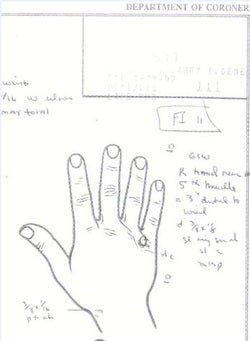
Autopsy report showing Phillips right hand which was shot
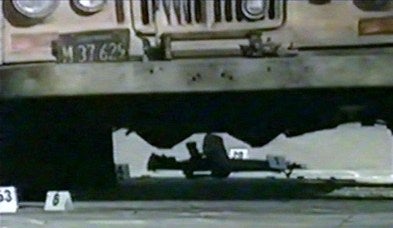
Mătăsăreanu then proceeded to enter their getaway vehicle and start the engine while Phillips retrieved the HK-91 from the trunk and continued firing at officers by walking along with the car as it moved. The HK-91 was struck on the receiver and magazine forcing Phillips to abandon the rifle. Phillips was simultaneously struck in the shoulder by officers.
A Breakdown of the Infamous 1997 North Hollywood Bank Shootout
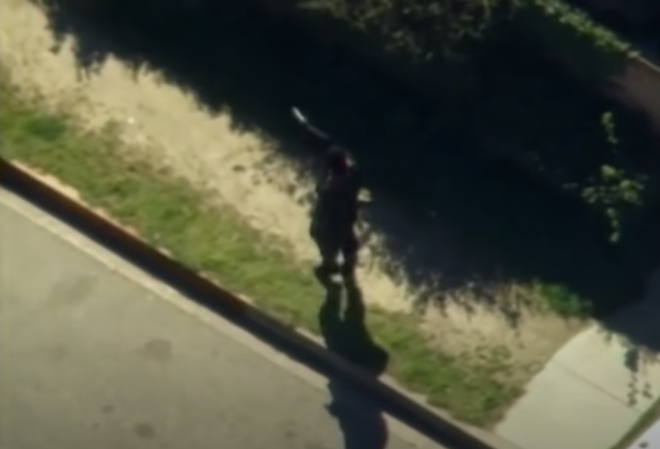
Phillips quickly picked up a second Type 56 rifle and exited the parking lot and onto the street where Mătăsăreanu had driven the getaway vehicle. It is at this point that he continued to fire at police until his rifle jammed at which point he drew his Beretta 92FS and continued firing at police. Phillips was shot in the right hand which caused him to drop his pistol. After retrieving the pistol, Phillips chose to end his life with it while officers simultaneously shot him several times while the pistol was under his chin.
Phillips firing his Beretta 92FS at police shortly before his death.
ATTEMPTED ESCAPE – MĂTĂSĂREANU
Mătăsăreanu continued down the street until the original getaway car was disabled by having two of its tires shot out. He attempted to steal a Jeep Gladiator by shooting at its driver. The driver ran away but not before activating the electrical kill switch which disabled the vehicle. As this was happening SWAT arrived and engaged Mătăsăreanu who had taken cover behind the original getaway car.
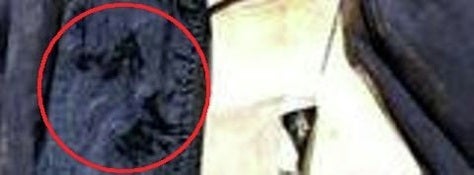
For almost the next two and a half minutes, there was a stream of near uninterrupted gunfire between the officers and Mătăsăreanu. The bank robber survived a direct “double-tap” to his vest and continued to fire at officers after catching his breath. Eventually, a swat officer chose to fire underneath the vehicles at Mătăsăreanu’s unprotected lower body which eventually wounded the bank robber and caused him to surrender, Mătăsăreanu put his hands up to indicate this.
A Breakdown of the Infamous 1997 North Hollywood Bank Shootout
Just seconds after his surrender, police officers rushed to pin the man down and cuff him. Officers questioned him about his own name and if there were any other suspects and Mătăsăreanu reportedly retorted with a vulgar “F*ck you! Shoot me in the head!”
A photo of the “double-tap” shot sustained to Mătăsăreanu’s vest during the final exchange of gunfire.
Ambulance personnel, following standard procedure, refused to enter “the hot zone” where Mătăsăreanu was as he was still considered dangerous and there were reports that a third gunman might be on the loose. EMTs were not allowed to reach the scene until almost 70 minutes later after police radioed for an ambulance and Mătăsăreanu died at the scene from excessive blood loss. In total, he was shot over 20 times in the legs although the two fatal shots were from his left thigh.
A Breakdown of the Infamous 1997 North Hollywood Bank Shootout
AFTERMATH – CONCLUSION
In just under 45 minutes, over 300 law enforcement officers had responded to the city-wide TAC alert. At that same time, over 1,100 rounds of various ammunition had been fired by just the robbers with an additional estimated 650 rounds fired by police. Miraculously the only two deaths were those of the two perpetrators. In total 11 police officers were wounded and 6 civilians were wounded during the 44-minute robbery.
A Breakdown of the Infamous 1997 North Hollywood Bank Shootout
This single incident in which two heavily armed and highly motivated men chose to rob a bank at high risk proved to be one of the motivating factors to standard patrol officers being armed with more lethal weapons. If anything this incident proves just how ineffective standard patrol weapons (pistols and shotguns) can be against those with heavier firepower.
This thought process led to the Department of Defense giving 600 surplus M-16 rifles to the LAPD which were then issued to each patrol sergeant. Today weapons like these can be considered “standard issue” by many police departments.
I hope that this brief breakdown of the facts has been informative and enjoyable to read. The story of the North Hollywood Bank shootout has many complex and intricate details, many of which I was not able to include for brevity’s sake. If you have questions many of the links in the article have a bounty of information that I was unable to include in the article. As always, thanks for reading and please feel free to leave a comment down below.
Photo Credits: CNN, National Geographic, Adrian Martinez, L. Mindham, LAPD Crime Scene Photos
Back in 1941, the Army did something extreme: it tested its doctrine. Not on tabletop wargames, not in a computer simulation, not with an invasion of a small Latin American country. No, the Army mobilized over 400,000 Regular and National Guard troops, spent a year training them up, and then let them fight each other across 30,000 square miles of Louisiana and Texas in an exercise that would make Jade Helm conspiracy theorists slaver with delight.
Why? Well, it was no secret that World War II would not remain a European affair much longer. The Germans had demonstrated that they had a pretty decent war machine, the likes of which the threadbare U.S. Army could only stare at longingly. The Army had been cut pretty badly after World War I. Pretty badly is an understatement. The Army had been gutted. From a wartime strength of several million men, it was reduced down below 80,000 by 1921. However, Army leaders had been smart; they knew that the next time war came, they would need adaptive and educated leaders. So the officers and non-commissioned officers that they could not retain were shifted over into the National Guard where they helped train up the nation’s reserve. The Army began service schools and professional development courses, open to both Regular and National Guard leaders. Although the Army would not be right-sized for the next conflict, or properly equipped with modern equipment at the outset, it would have a ready cadre of trained and adaptive leaders.
In 1940, the Army began preparing for possible entrance into World War II. Chief of Staff George C. Marshall – arguably one of the smartest men to ever wear pinks and greens – wanted to try something new: to take the latest doctrine and technology and actually try it out in force-on-force maneuvers between field armies of U.S. troops. He wanted to try it all, from armored tactics to air strikes to mechanized infantry. In essence, he wanted the largest NTC rotation the world had ever seen. And since this was back in the day when the Army still owned air power, it didn’t even need to be a joint operation.
General McNair dares you to call him Lesley (U.S.Army photo)
General Lesley – yes, Lesley – McNair was chosen to be the Chief of Staff for General Headquarters (GHQ), U.S. Army. McNair formulated the training plan that is basically still used to this day: individual soldier tasks are trained first, then small unit training, and lastly a combined arms exercise to validate a unit’s proficiency. Soldiers first learned their basic tasks: land navigation, first aid, physical conditioning, and rifle marksmanship. Officers attended branch service schools. Then the soldiers went to work honing their small unit tasks, before graduating to combined arms field exercises with infantry, field artillery, and engineers. Once this was complete, regiments and brigades took part in four weeks of division training. The grand culmination was the GHQ Maneuvers in Louisiana, with divisions forming corps, and corps, field armies. Which then slugged it out in the woods and swamps with freedom of maneuver.
So what was this new doctrine and technology? Well, there was the tank, for one thing. Sure, it had been around since World War I, but Army doctrine maintained that tanks were there to support the infantry. Tanks would advance behind a rolling artillery barrage and allow the infantry to break through linear enemy defensive positions; shades of Verdun here. The Nazis had demonstrated that tanks could pretty much out-fight any infantry or artillery unit out there, and that, combined with close air support and mechanized infantry, they pretty much dominated the battlefield. There was no independent tank corps in the U.S. Army in 1940. Well, there wasn’t until Colonel George Patton, General Adna Chaffee, and General Bruce Magruder met together in a basement – I kid you not – and decided that America really needed its own armor corps. So they sent their proposal to Marshall, who liked the idea, and ordered the infantry and cavalry to turn over all their tanks to the Armored Force on July 10, 1940. Just like that, the armor branch was born, and with it came a new doctrine that needed to be tested.
And what of the cavalry, those Stetson-wearing sons of a whatnot? Well, one would like to think that they embraced mechanization gracefully. They did not. The cavalry arm was still a primarily horse-fighting organization in 1940, with limited jeeps and motorcycles for reconnaissance. Marshall urged full mechanization, which was strongly resisted by die-hard cavalrymen.
The cavalry’s compromise: armored cars integrated with horse patrols (U.S. Army Photo)
Another group that was proving irascible to doctrinal change was the Army Air Force. Rather than conforming to Marshall’s view that fighter-bombers should support combined arms operations, the Air Force had embraced strategic bombing with a myopia that was alarming, especially given that there was daily evidence from the Luftwaffe that air-to-ground close air support was a stunning success. The Army Air Force was also being recalcitrant to provide aircraft for the Army’s new 501st Parachute Battalion. Still, the airmen had modernized readily and were at least developing new doctrine, albeit focused on high-altitude bombing. It remained to be seen how this could mesh with ground operations.
Combined arms in action, Louisiana Maneuvers (U.S. Army Photo)
All of this new training, new doctrine, and new technology would be tested in 1941. GHQ devised whole booklets of complicated rules on how the maneuvers would be run and how casualties would be assessed. Thousands of umpires traveled with units to assess their performance. All units were armed with blanks. Bombs were simulated with bags of flour. There were obvious flaws in the system. For example, any infantry within the vicinity of an enemy tank were ruled to have been wiped out. Conversely, light tanks could be destroyed by a .50 caliber machine gun at a range of 1,000 yards. Still, the maneuvers offered more benefits than drawbacks. Army, corps, division, brigade, and regimental commanders would be moving their forces in real time, experiencing the stress of command and control. Units would get used to the daily routines of combat: supply, movement, patrolling, offense, and defense.
Perhaps the greatest coup that the Army pulled off was to get state and local governments to buy into their plan. The Army leased and obtained trespass rights to 30,000 square miles of land from Shreveport to Lake Charles, and from Jasper, Texas to the Mississippi River. Bolstered by a Congress that finally placed defense spending as a priority, the Army had the land and the money to pull off the largest maneuvers – still the largest to this day – ever conducted in North America. Eighteen Army divisions and ten Air groups – combined Army and Navy – would face off against each other.
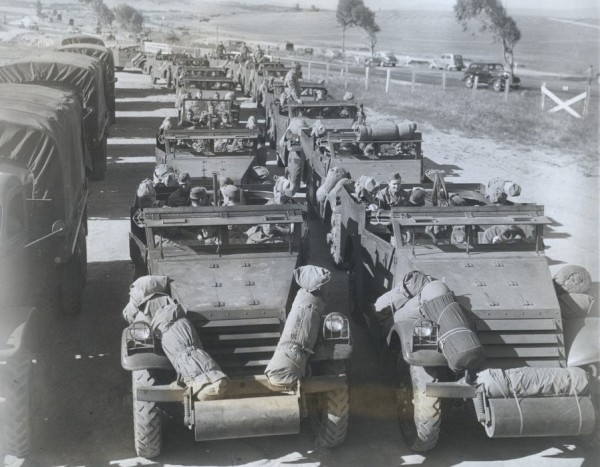
Motor convoy on the way to Louisiana, 1941 (U.S. Army Photo)
In the late summer of 1941, the long motor columns of troops and equipment swarmed into Louisiana. It was no small feat to organize supply networks for 400,000 men, but Army engineers built roads, railheads, depots, and barracks to accommodate the armies. Massive amounts of military brass and Army civilian leadership arrived as well, all wanting a look at how the modern U.S. Army was going to fight and win. Interestingly, the Harvard Business School even sent observers to see how the Army did logistics.
So what happened? Well, answers to that question varied by who you might ask. To the average grunt, the Louisiana Maneuvers meant more weeks of slogging through swamps and thickets with little to no sleep. To officers, it meant a chance to show their worth. And to senior leadership, it meant confirming or denying doctrinal assumptions. To advocates of armor or anti-tank units, it meant a time to show the worth of their new combat arm. Marshall was succinct: “I want the mistake [made] down in Louisiana, not over in Europe, and the only way to do this thing is to try it out, and if it doesn’t work, find out what we need to make it work.”
Everything kicked off on September 15. The Red Army received orders to invade the Blue Army’s territory. The orders were concise and basic: invade, seize key territory, and destroy the enemy. It was left up to army and corps commanders to devise the plan, and to division and brigade commanders to execute the plan. The Red Army had a secret weapon: George Patton and his tanks. But the Blue Army had a secret weapon of their own: their chief of staff was Colonel Dwight D. Eisenhower.
Baby-faced Ike, third from left, 1941 (U.S. Army Photo)
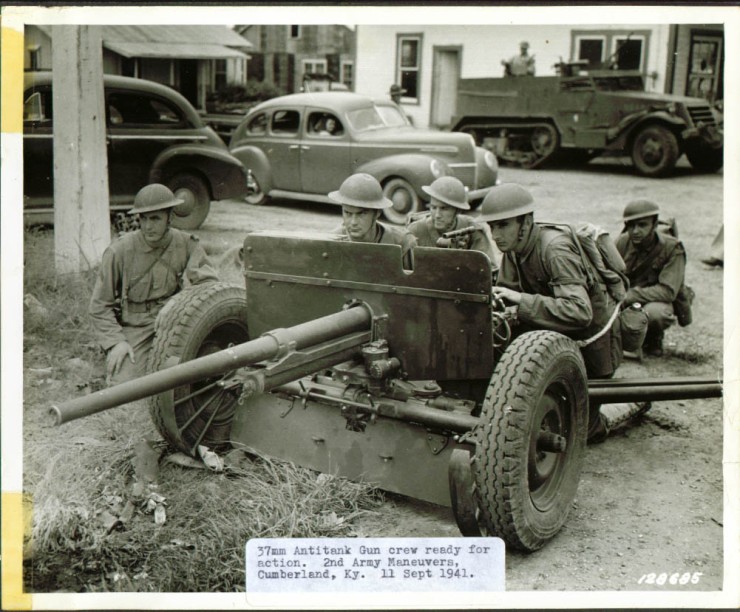
Things kicked off with predictable uncertainty. Commanders struggled with fording rivers and gaining air superiority. Rates of march by supposedly “slow” infantry units were accelerated when they were loaded into the trucks from the artillery and quartermaster corps. Eisenhower’s planning abilities showed as he fought a fluid and developing battle, while his opposite number tried to stick with the original plan for the Red Army. Adding to the chaos was a live airdrop of Company A, 502nd Parachute Battalion, which went on a daylong rampage, even raiding the Red Army’s headquarters before they were all “killed.” Red tanks fell victim to Blue anti-tank units at every turn, as they failed to support their armor with infantry. The “battle” ended on September 18, with a Blue Army victory. Both sides learned valuable lessons: battle was fluid and plans had to change as the situation did; air superiority was more valuable than anyone could have ever expected; armor had to have infantry support; and mobile anti-tank units were a must in every division. With these lessons in hand, Phase 2 of the Louisiana Maneuvers began.
The whole battle opened with one of the most ridiculous and fantastic episodes of combat engineering ever. With the Blue Army attacking, the Red Army’s engineers “blew up” every single bridge on their front. They even sent suicide squads to float down rivers inside the Blue Army’s lines and blow up bridges behind Blue forces. They placed over 900 obstacles in the Blue Army’s path, slowing their advance. When Blue engineers went out to repair bridges, special strike groups from the Red Army would hit them, force Blue troops to deploy for battle, and then retreat. Still, Blue Army, which greatly outnumbered the Reds, slowly advanced. Red Army pulled back again, creating a distance of forty-five miles – forty-five miles of blown bridges, cratered roads, and hundreds of more obstacles. The Red Army eventually halted to fight a defense. This was a mistake; when the maneuver had reset, Blue Army had gained Patton and his armor. Eisenhower planned a daring combined arms assault, sending Patton on an end run through Texas. Patton’s relatively small force drove twenty-four hours straight – Patton purchased fuel from local sources when he outran his supply lines – and appeared unexpectedly on the Red flank. For the duration of the battle, Patton’s force ran roughshod over Blue forces. However, the maneuvers ended before history would ever find out if Patton’s small force could have succeeded or if he would have been wiped out. One thing is sure: the partnership of Eisenhower and Patton made for a deadly combination.
Armor crossing a river in Louisiana, over an engineer pontoon bridge (U.S. Army Photo)
The GHQ Maneuvers of 1941 would continue into the fall, now in the Carolinas. In the interim, the Army began removing or replacing commanders who were either too old or too ineffectual for wartime service. The maneuvers gave concrete evidence for the need for innovative, adaptive, and thinking leaders. Younger officers who showed promise were given more responsibility. The Army was setting the cast of characters who would run the show in World War II.
There were many takeaways. The Maneuvers warmed the Army Air Force to the idea of air-to-ground integration. And ground commanders became acutely aware of what could happen if they persisted in moving in thick columns along the roads in the daytime. The Army learned that infantry and armor units needed to work together, but also that “end runs” of fast moving armor could pay off in huge dividends. The horse arm of the cavalry was deemed to be inferior to mechanized troops, something that had been true since 1918, but that the cavalry refused to acknowledge. Division force structure was rearranged to create more combined arms units. Deficiencies in small-unit training and execution were discovered, and remedial programs for retraining developed. The Army implemented infantry and artillery platoon, company/battery, and battalion tests, to ensure proficiency. The focus became a “back to basic” approach, and at not a moment too soon: four days after McNair and Marshall delivered the Army’s assessment of the GHQ Maneuvers to Congress, the Japanese attacked Pearl Harbor and the U.S. entered World War II. It is no exaggeration to say that the GHQ Maneuvers of 1941 built the Army’s doctrine and force structure for World War II.
Cities and towns in the south became battlegrounds in 1941. Surprisingly few residents issued claims for damaged property after the Maneuvers (U.S. Army Photo)
Fast forward to today. The Army is emerging from two low-intensity wars fought against unconventional forces and is refocusing to be able to counter a conventional threat. New technology, from unmanned vehicles to weapons to targeting systems, is rife across the Army. A new “battlefield” has emerged in the cyber realm. Doctrine has just been updated and new training doctrine is on the way. New relationships between Active, National Guard, and Reserve units are in the works, with a return to the “Roundout Brigade” concept. Combat units are now open to women. In short, the Army is undergoing dramatic changes as it shifts to meet conventional aggressors.
It is time for another GHQ Maneuvers.
As Marshall pointed out, it is better to see deficiencies in training than it is to see dead soldiers in combat. Have current corps and division commanders have ever led their forces as part of a conventional force-on-force engagement? Have brigade combat team commanders maneuvered their elements alongside like-sized brigades? Can the Army show that it is prepared to fight on land, air, and in cyberspace against a near-peer force? The answer to all of this is, “no.” Sure, combined arms exercises at NTC and JRTC serve to validate units’ readiness at lower levels, but moving beyond more than one or two brigades brings a complexity the type of which we have not seen in decades. Our leaders and soldiers are proficient at low-intensity warfare, from experience, but we lack the depth that comes from a massive exercise or actual conflict.
The time to do this is now.
A really interesting historical site in Saint Malo (Saint Servan), France dating from the Roman period, although the most obvious relics of its past are the extensive WW2 German fortifications making it one of the most significant elements in Festung St Malo.
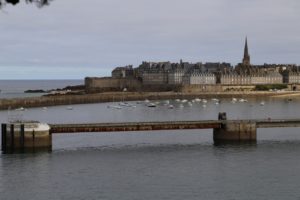
Having a couple of hours to spare in St Malo before catching the ferry or the train, the Fort de la Cité d’Alet, St Malo is well worth a visit. For those who have an interest in the international boundary and front line which existed in the area around the Channel Islands between warring England / Britain and France over the seven and a half centuries, it’s a reminder of the defences the French put up to repel frequent English raids.
For those with an interest in twentieth century history, it’s a massive German fortified position to defend St Malo, the Germans’ main gateway from occupied France to the occupied Channel Islands, from Allied attack.
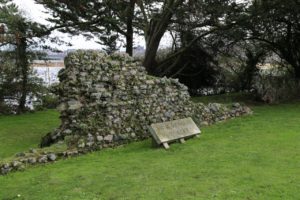
The area of la Cité d’Alet dates back to the Roman period when the promontory was topped by a fortified town, of which little remains except a few small sections of “Roman” walls. By the end of the seventeenth century, it was known as “la Cité d’Alet” and was fortified by a gun battery to protect the entrance to the Rance river.
Cité d’Alet, Roman walls
Vaubin, the well-known French Inspecteur Général of Fortifications from 1678, was, however, not satisfied by the defences of la Cité d’Alet, and he advised that additional mortars to be mounted. Apparently, this advice was not followed.
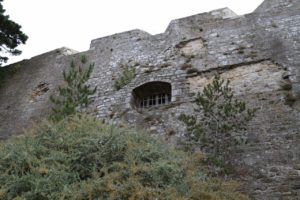
It was not until the next century when in 1759, during the Seven Years War, after numerous English incursions into the bay of St Malo, the decision was taken to build a very large artillery fort at the Cité d’Alet, capable of defending not only the bay, but also the town, the port, the Rance estuary as well as the area to the rear. That fort built by Mazin, the Chief Engineer of St Malo is still very much in evidence today, albeit that it now has some significant twentieth century additions.
Cité d’Alet, 18th century fort
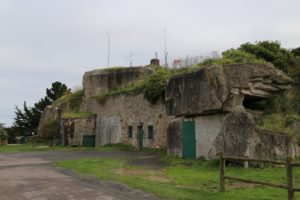
Those additions, built by the Germans after June 1940 and the fall of France, dwarf the original fort in scale. St Malo, quickly appropriated by the Kriegsmarine as the primary port for the supply of the occupied British Channel Islands, saw extensive fortification from 1941 onwards as part of Hitler’s Atlantic Wall to become “Forteresse St Malo” or “Festung St Malo”.
Cité d’Alet with WW2 German additions
By that time, the German occupied Channel Islands had become an obsession of Hitler, with him vowing that they were never to be returned to Britain when final German victory came, and destined to become part of the German Thousand Year Reich forever. As a result of that obsession, a staggering one twelfth of all the cost and materials expended in building the whole of the Atlantic Wall (i.e. from the Artic in Norway all the way down to the French/Spanish border) was ploughed in the Islands! It is therefore hardly surprising that the French port which served those islands was also destined to have more than its fair share of fortifications.
Around St Malo, La Varde, Saint-Ideuc, la Montagne Saint-Joseph, la Garde Guérin were all fortified, as were the islands of Grand-Bé and Cézembre (more of the latter later). But probably the most important element of the fortress was the Cité d’Alet.
From 1942 to 1944, the promontory became a huge building site into which tonnes of reinforced concrete were poured. Incorporated into la Cité was an artillery battery with a range-finding position, a fortress PC, extensive defensive positions, 1350 metres of underground tunnels and shelters for about 200 men.
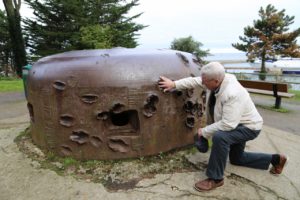
All in all, there were a total of 32 bunkers built and 8 heavy machine gun turrets (Sechsschartentürms) installed. The latter 50-ton 6 port armoured steel cupolas, mounted with MG 34s, were reserved for those places deemed by the Germans to be at most risk from Allied group attack.
The Cité d’Alet saw severe bombardment in August 1944 at the hands of the American forces who had entered Brittany from Normandy on 31 July. By the 4th August, the Americans headed by the 83rd Infantry Division had reached St Malo and by the 9th August, the city and the Germans in it, were encircled. It took two murderous infantry assaults by the Americans, as well as blanket bombing which left the fabulous old walled city of St Malo in ruins, before the German defenders surrendered on 17th August. The last remaining Germans of the Fortresse St Malo, held out on the island of Cézembre until early September, partially supplied from Jersey, until ground and aerial bombardment, including the first use of Napalm, forced their surrender.
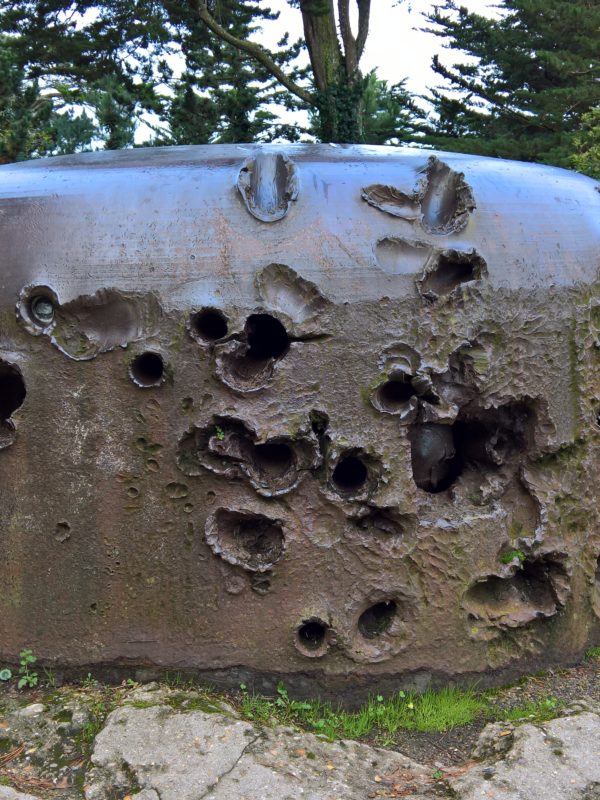
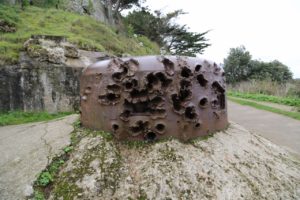
Cité d’Alet, St Malo. The heavy machine gun turrets are peppered with shell hits.
The most striking things that you will see at the Cité d’Alet are the armoured steel turrets along what is a very picturesque walk around the promontory. They are literally peppered by shell fire. But the vast majority of the shell fire is not as a result of the battle which raged around St Malo for nearly two weeks.
Cité d’Alet- German heavy machine gun turret after US attempt (post battle) to destroy them
No it’s a demonstration of the strength of these turrets, as after the battle, the Americans brought up various tanks and other anti-tank weapons into range and fired at them to see how much punishment they would take. It is incredible to see that virtually all the hits show shells bouncing off or merely embedding themselves into the armoured steel without penetrating it. I found only one shell hole which had penetrated the cupola straight through, whilst one other shell appears to have found a way in at the point where the moveable gun port shield slots into the turret.
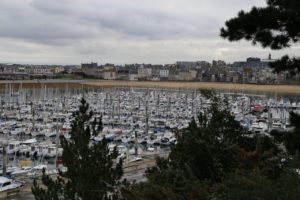
An interesting thing also seems apparent when you compare the direction from which the US shots have been fired at the first two turrets as you come to along the path at la Cité d’Alet . Whoever was firing at each of these two turrets was doing so from different positions – my guess is one was below the old city walls and the other, several hundred metres away, was on the beach at St Servan, the adjacent area next to St Malo. Were the two different sets of gunners having a competition perhaps? I don’t know but perhaps somebody else does know?
One of the likely firing positions of US forces below old city walls of St Malo
Second of the likely firing positions of US forces on the beach at St Servan
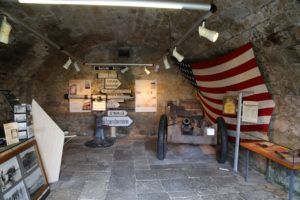
Memorial 39-45 Museum, la Cité d’Alet, St Malo
Finally, in the interior of the old fort of la Cité d’Alet, you can clamber around different battle-scarred bunkers and gun positions, as well as visiting the “Memorial 39-45” housed in the bunkers which have been built into the ancient walls. Unfortunately, on the day of my “spare time” visit, the museum was only open in the afternoon. Open regularly everyday only in July and August, it’s generally afternoons only in the shoulder months of April, May and October (closed Mondays) and the same afternoons and Sunday mornings in June and September. November to March, it is closed.
For further information, contact Jersey Military Tours
www.jerseymilitarytours.je