They didn’t contend that the current murder spree had anything what-so-ever to do with letting criminals go free without bail, defunding police and criminally prosecuting law enforcement for doing their job. Nah as that would mean taking responsibility for these actions! Grumpy
I just hope that the California State Commission for Teachers Creditialing does not see this one! Grumpy
John Moses Browning was the most famous and competent gunmaker the world has ever known. He was the son of Jonathan Browning, himself a highly competent gunsmith, and Elizabeth Clark.
John Moses was born January 23, 1855 in Ogden, Utah, U.S.A., where his father settled after the Mormon Exodus of 1847. It was in his father’s shop that John Moses first learned the art and secrets of gunsmithing.
John Moses, however, was much more than a gunsmith in the sense that he was much more interested in designing and building new, innovative, firearms than repairing broken ones. His first creation was a single shot rifle he built at the age of 14 for his brother, Matt.
 1879 was an eventful year for the Browings. Jonathan Browning died on June 21 and, soon thereafter, John Moses and his brothers started their own shop. There they first used steam powered tools, tools that were originally foot-powered but were converted by John Moses to get power from a steam engine. That year also saw John Moses marry Rachel Teresa Child, and his receipt of his first gun patent (No. 220.271) for the Breech-Loading Single Shot Rifle.
John and his brothers began producing this rifle in their Ogden shop but customer demand soon exceeded their shop’s production capacity. They were unable to expand the “Browning Gun Factory,” as their shop was called, because they lacked the capital required for expansion and didn’t have a well established distribution channel to market their products. One has to note here that although John Moses Browning was very satisfied with the sales of his guns he was also very unhappy that the production chores and the daily work prohibited him from working on his new ideas.
A salesman for the Winchester Repeating Arms Company named Andrew McAusland happened to see one of John’s Single Shot rifles in 1883. McAusland immediately bought one and sent it to Winchester’s headquarters. The gun drew Winchester’s interest and T. G. Bennet, Winchester’s vice president and general manager, went to Ogden to buy the rights to Browning’s gun. When Bennet arrived in Ogden, it didn’t take long for the men to agree on the sale and Winchester paid John Moses $8,000 for the rights to produce the gun. The agreement was beneficial to both parties. Winchester was happy because they turned competitor into a benefactor, plus they added an excellent rifle to their product line. John Moses was equally happy because the money from the sale and the ensuing relationship with Winchester allowed him to concentrate on inventing things instead of manufacturing them.
From 1883 until 1902, John Moses Browning designed several firearms for Winchester. Some of them reached production status while others were never produced. They all, however, were ingenious and innovative designs. In addition to that first Single Shot Rifle, other guns that John Moses designed and which became best sellers were: Winchester Model 1886 Lever Action Repeating Rifle, Model 1887 Lever Action Repeating Shotgun, Model 1897 Pump Action Shotgun, Model 1894 Lever Action Repeating Rifle, Model 1895 Lever Action Repeating Rifle, etc.
 At the same time, John Moses was also working on another of his ingenious ideas. He wanted to invent an automatic shotgun that would use the expanding gases of a fired shell to recock the gun and make it ready for the next shot. John got this idea while watching a friend of his, Will Wright, shoot his Browning-made rifle. A clump of weeds just in front of the firing line bent with the muzzle blast. This gave John the idea of using the gases for something productive like cocking the gun. He designed a testing gun with which he tested his ideas.
When the testing validated his theory, John applied the principle on three different guns: two machine-guns and a repeating shotgun. His machine-guns, the first fully automatic guns which used expanding gases for cycling, were later sold to Colt and the U.S. Government and served the U.S. Armed Forces through three wars. One was Colt Model 1895 Peacemaker machine-gun, while the other was the famous Browning Automatic Rifle, affectionately called BAR by GI’s. Browning’s machine-guns are still used by US and other armies around the world.
The repeating shotgun that John invented was the primary reason for the break between Browning and Winchester. When Winchester denied production of this gun, John Moses, packed a sample of his shotgun into his luggage, crossed the Atlantic, and negotiated an agreement for Fabrique National de Belgique (FN) to produce his gun. FN was then a young company in dire need of products to produce. Browning’s automatic shotgun revolutionized the hunting market. This same shotgun was later produced in U.S.A. by Remington, as their Model 11. Still later, variants of this shotgun were produced by almost all of the large shotgun manufacturers, including Savage, Franchi, and Breda.
 John M. Browning was usually working on more than one project at one time. He started working on automatic pistols before 1900. He was the first to invent the slide which encloses the barrel and the firing mechanism of a pistol. Pistols of his invention were produced by both FN and Colt and they range from baby .25 caliber pistols to the .45 Government Model. The first automatic pistol designed by Browning was produced by FN as FN’s .32 caliber Model 1900. The most famous pistols of John’s design, however, were Colt’s .45 ACP M1911 Government Model and FN’s Browning High-Power Model P-35 in 9mm Parabellum. A highly decorated sample of P-35, is shown at left, while a contemporary version customized by Wayne Novak can be found here.
John Moses Browning passed away in Liege, Belgium, the day after Thanksgiving, 1926. He died of heart failure while in his son Val’s office at the FN factory. It was the last day on earth for this ingenious person who invented more firearms than any other gunmaker in the history of the world.
Categories
A Friday Reward – N.S.F.W.


When a gun has been in production for more than 100 years like the SA-22, labeling its design as a ‘success’ is a massive understatement.
Why this semi-auto rimfire is one slick shooter:
-
- The svelte little .22 rifle has been in production for more than a century.
- It was designed by John Browning.
- It was also the first semi-auto chambered for the .22 rimfire cartridge.
- Spent casing are ejected downward.
- The cocking button is on the underside of the receiver.
- The Browning .22 Auto Rifle is a takedown.
- Top examples of certain Belgium-made versions of the rifle can fetch $3,250.
The svelte little .22 rifle, known by Browning variously as the SA-22, .22 Semi-Auto or just Auto Rifle, has been in production for more than a century. The John M. Browning design was the first semi-auto rifle made for the .22 rimfire cartridge. It has been called a rifle that was appropriately designed for its cartridge — slim, light and easy handling. It was manufactured by Fabrique Nationale in Belgium beginning from 1914, but it wasn’t imported to the United States until 1956. Production continued at FN until 1974, when it was moved to Miroku in Japan, where most Browning rifles and shotguns have been made ever since.
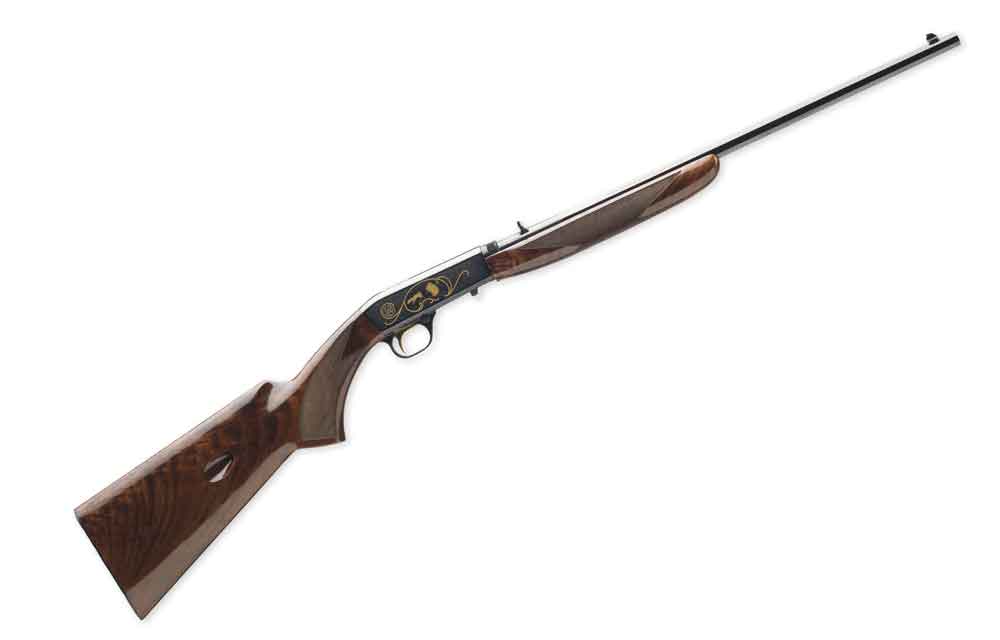
This Limited Edition SA-22 commemorates the 100th anniversary of the rifle. A similar rifle was made by Remington from 1919 to 1949 as the Model 24 and 241, under license from Browning. The main difference in the Browning and Remington versions had to do with a slight variation in the take-down system for removing the barrel. The Brownings were also cosmetically a bit nicer, with attractive checkering, wood, fit and finish.
I recall as a youngster seeing my first Browning .22 Semi-Auto at a gun store in downtown Austin, Texas, and being quite impressed. This was in the late ‘50s, and I recall the price being about $85. I was especially impressed with the .22 Short model. - My experiences with Texas fox squirrels taught me that .22 Short hollow-points were a fine choice for bushy-tails at reasonable ranges. Over the years I kept telling myself that I really needed one of the Short models, but somehow I never got around to buying it. They have been discontinued for several years, and these days the used ones are going for $1,000 or more. Lesson here for younger shooters — don’t wait too long for something you really “need.”
The Unique Browning .22 Auto Rifle
The .22 Auto Rifle design has several unique features that many shooters find appealing. The most noticeable is the downward ejection of empties. I’ve heard that this was to avoid ejecting the shells into the face of a person standing next to the shooter — the downside is that a hot shell can drop down into the sleeve of the shooter’s shirt.
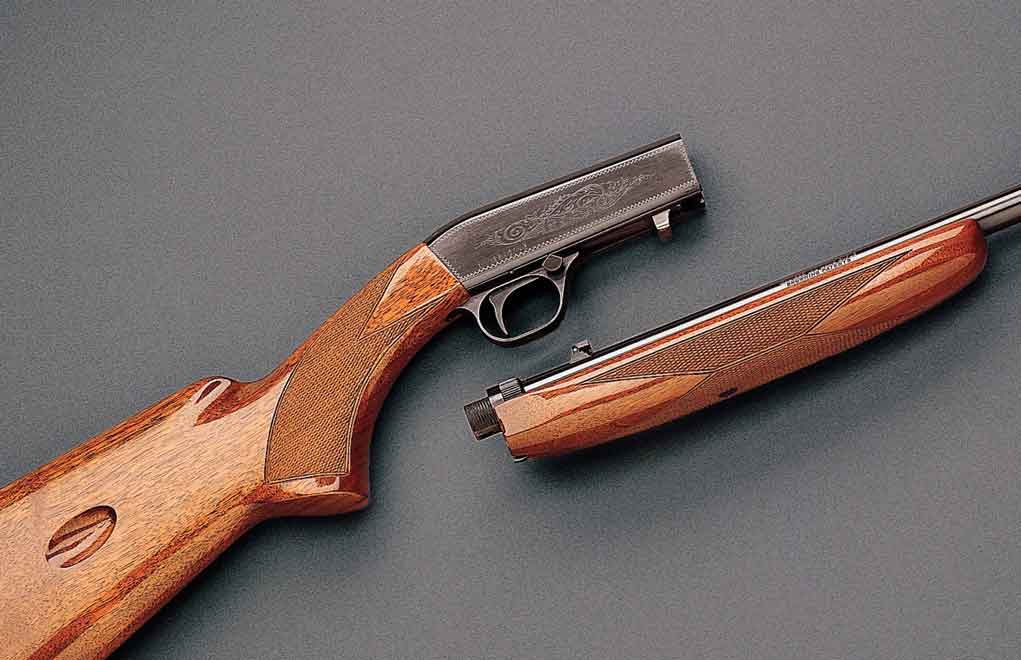
- Another distinctive feature is the cocking button on the underside of the receiver. This design, coupled with the ejection port on the bottom, gives the SA-22 a nice, flat surface on both the right and left sides of the receiver. Previously mentioned is the take-down feature, allowing the barrel to be easily removed without tools by way of the knurled ring at the rear of the barrel that can be turned with the fingers.
- Operation of the Browning .22 Auto is simple: Turn the loading tube in the buttplate to the left and pull it out far enough to expose the port on the right side of the buttstock, insert up to 10 .22 LR cartridges or 16 shorts (if you have a shorts-only model), reach under the receiver in front of the trigger guard, and pull back and release the cocking lever.
Make sure to use the button-operated safety in the front part of the trigger guard. Some of the early models have the loading port on top of the buttstock, directly behind where the stock meets the receiver. I believe these models are made in Belgium and marked “Fabrique Nationale” and not “Browning.”What To Look For In A Browning .22 Auto Rifle
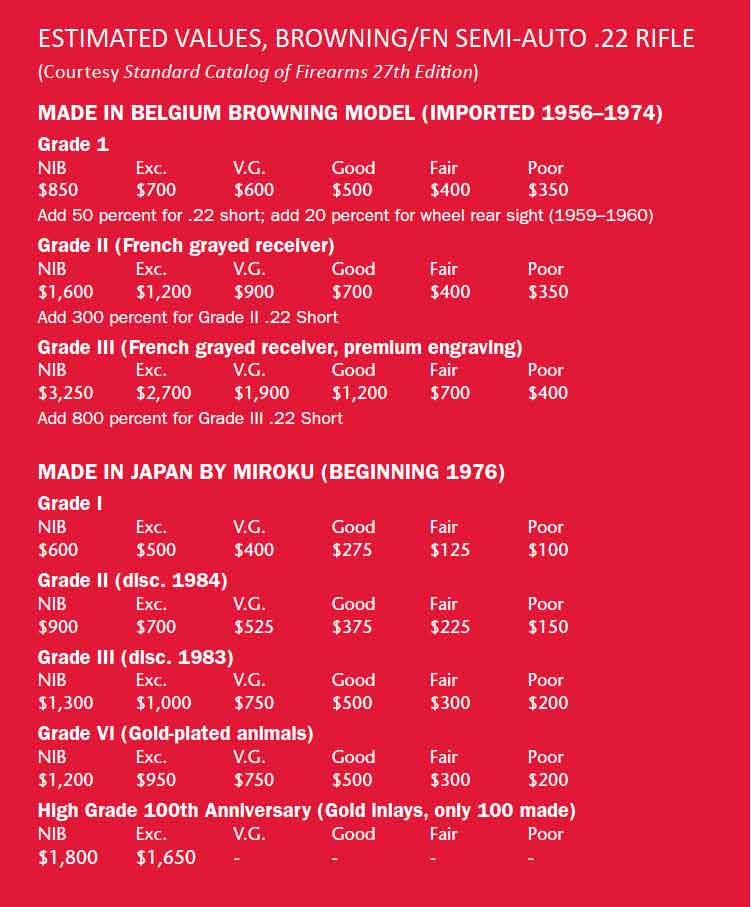
There have been several high-grade models with varying levels of engraving and wood. Some SA-22s I’ve seen had very nicely figured walnut stocks. The chart shows some current values, courtesy of the 2017 edition of Standard Catalog of Firearms.
Many collectors, as is often the case, are mainly interested in older models, especially those made in Belgium. The Miroku rifles, however, are very high quality and will likely show increases in value in the future. For small-game hunting or casual plinking, there isn’t a nicer .22 to take on a stroll in the woods than the Browning SA-22.
Editor’s Note: This article originally appeared in the May 2018 issue of Gun Digest the Magazine.