
Categories
Have a Legendary fun 4th! Grumpy
.gif)
.gif)
.gif)
.gif)
.gif)
It was a time when everyone was enamored with the .44 Magnum S&W Model 29, the Dirty Harry gun for which so many would add their names to waiting lists, patiently waiting their turn.
But I’m different, and not terribly patient. I’d done some homework and didn’t care for the .44 Magnum’s recoil, not to mention waiting lists. But there was another magnum available, and it intrigued me.

A good sixgun in a major caliber only needs spare ammunition. Dave prefers a
fully-loaded cartridge belt for backcountry trips.
A Cult Favorite Magnum
Introduced in 1964, the .41 Magnum was originally aimed at the law enforcement market, according to the writings of the late Elmer Keith. He’d been approached by Bill Jordan in the early 1960s and the two were able to talk S&W into building the gun while Remington developed the ammunition, according to Keith’s narrative.
When the gun and caliber didn’t catch fire with lawmen, hunters and silhouette shooters found it to be a superb cartridge for their purposes. The .41 Magnum shoots flatter than the .44 Magnum and also produces slightly less recoil, yet it can do anything the .44 does with comparable loads. It has become something of a cult favorite.
Keith was a well-known big game hunter and long-range handgunner, and my research included reading about the .41 Magnum’s development. He’d shot a couple of caribou in Alaska with a .41 Magnum, and wrote about it in his first autobiography, Keith. At the time I was among folks in Washington State advocating for handgun hunting. When the state finally approved, I went shopping.
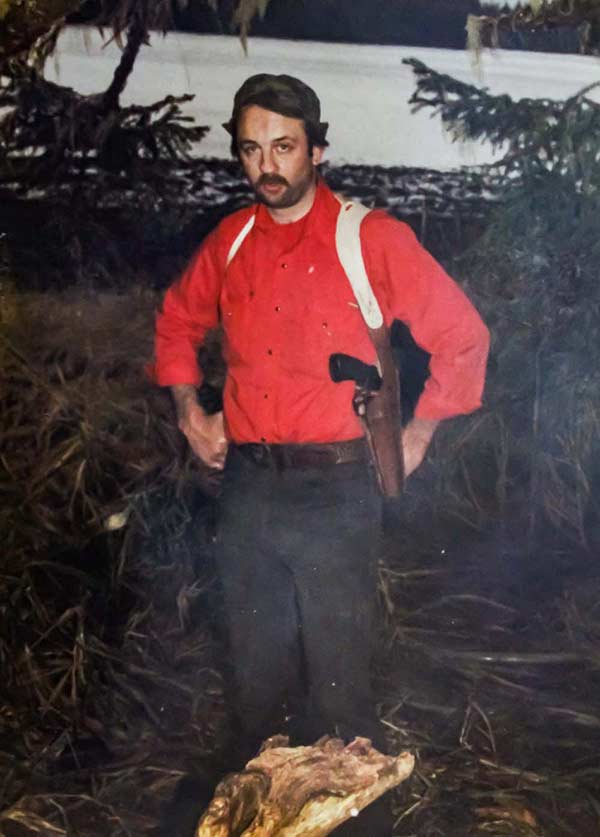
Vintage Dave drying off between rain showers on day 3 of an Alaskan deer hunt
circa mid-1980s. Cool Safariland shoulder holster!
My First
My first .41 Magnum was a Ruger Blackhawk with a 6.5″ barrel. I swapped out the factory wood grips for a Pachmayr one-piece. Using handloads topped with the old Speer half-jacket 200-gr. bullet or the Hornady 210-gr. XTP, both propelled by a stout charge of the then-Hercules 2400, the gun accounted for a blacktail buck and a 2-point mule deer, the latter as my young family looked on.
We were on a Sunday morning drive on a 4X4 road high in the mountains, coming downhill. We rounded a corner and there he stood, just as surprised as we were. He leaped into the brush; my rifle got stuck between the console and bucket seats so out the door I went with sixgun in hand. He’d gone into an old clearcut and was trying to sneak into some thick alders, but I was just a hair faster. Two rounds high behind the shoulder put him down.
Going Double-Action
Then along came a 6″ Model 57 S&W in handsome deep blue with walnut grips. It was on sale from John Jovino, the famous New York City gun store, and I couldn’t resist. It may not have been “the most powerful handgun in the world,” but my name didn’t gather any dust on a waiting list, either.
It arrived in the factory blue cardboard box, which I still have; a masterpiece of machinery with the elegant profile of a movie star. And it shot very well.
The following year, both the Ruger and S&W traveled along to Southeast Alaska’s Prince of Wales Island on a deer hunt. The day before we left, I’d shot a buck with the Ruger, which seemed to impress my eastern companions. Alas, we flew into lousy weather, the local Sitka Blacktail population went to deep cover and nobody scored. I carried the Model 57 in a Safariland shoulder holster, slogging through muskeg, across a couple of rivers and rain for four days.
I’ve found the shoulder holster more practical for such a large size handgun and it’s still my “go-to” favorite for long-range shooting.
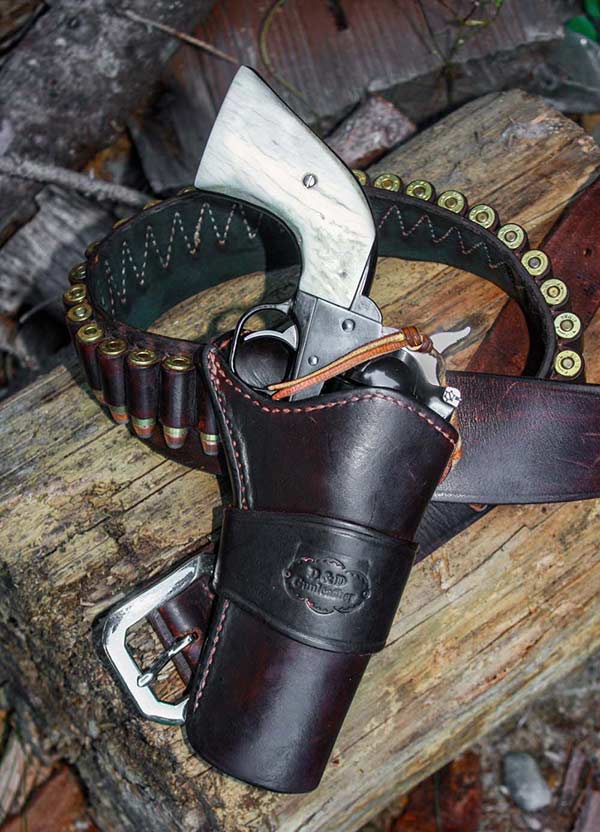
Dave spent a year carving and shaping a set of elk antler grips for his Ruger Blackhawk with a 4-5/8″ barrel.
Finding “The” Load
Factory .41 Magnum ammunition wasn’t always easy to find, and it was pricey. So, I got heavily into reloading, learning that maximum loads aren’t always the best, and in some cases, should be avoided. Suffice to say I flattened some primers and even some head stamps along the way.
Eventually, I found some bullet-powder combinations that work consistently and stuck with them.
There are lots of good propellants for magnum handgun loads, and my two favorites are H110 and 2400. I use 20.0 grains of H110 or 15.7 grains of 2400 behind a Nosler 210-gr. JHP, the latter listed as “the most accurate load” for that powder/bullet combination.
The Nosler bullet works well in cartridges carried in an HKS speed loader, and the same is true for the XTP and Sierra’s 210-gr. JHP.
During Pacific Northwest winters, I’ve carried the Model 57 under a parka and nobody was any the wiser. Confident that a .41 Magnum will stop just about any unpleasantness one might encounter, a handgun in this caliber is never far away when I leave the pavement.
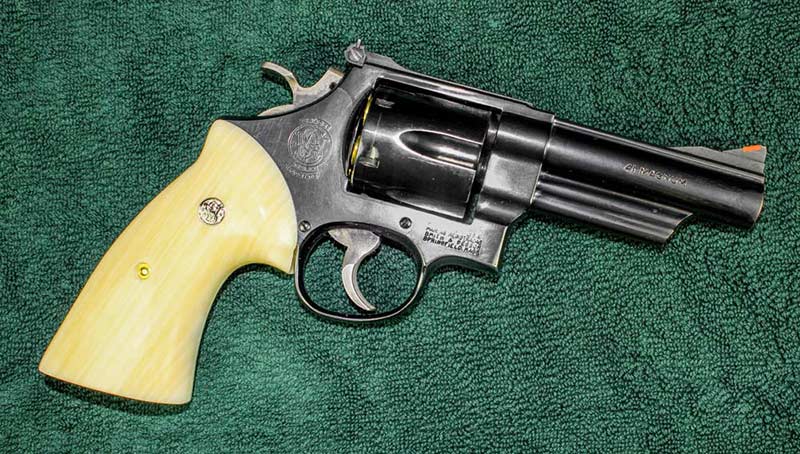
Raj Singh at Eagle Grips built a set of Kirinite target-style grips for Dave’s 4-incher.
He prefers this style of grip for his double-action magnums.
Memorial Shoot
Some years back, I was invited to an event called the “Elmer Keith Memorial Long Range Handgun Shoot,” held in farmland southwest of Spokane. It’s an invitational affair to raise money for the NRA Foundation, and the 6″ Model 57 always goes along.
This gathering typically attracts 40 to 60 shooters. I’ve happily taken 2nd, 4th and 7th place, and once during a practice session a few years ago I actually managed to walk one round (out of five) into a 600-yard deer-size target, set up to simulate the 600-yard shot Keith made on an Idaho buck with a .44 Magnum many years ago.
My 6-incher now wears a set of Heritage walnut grips from Eagle Grips, and my hand wraps around them perfectly.
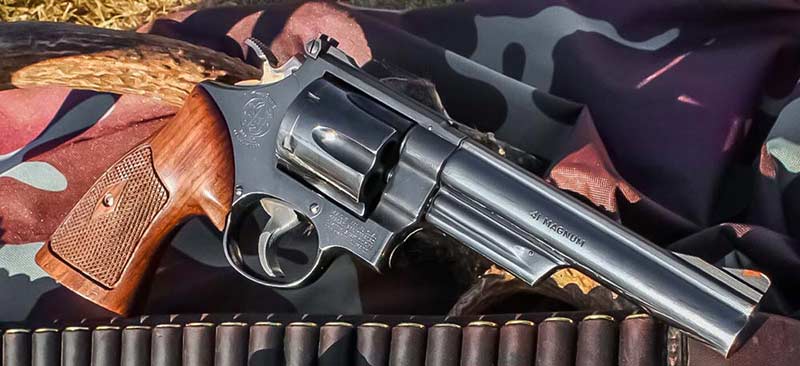
Sleek styling and rugged good looks combine to make the Model 57 S&W a superb
combination of handgun and cartridge. They’re classics in every sense.
“Oh, Deer!”
I waited many years go get my hands on a 4″ Model 57. A guy needed some money, and the gun came with 250 rounds of ammunition, two speedloaders and a set of brand-new dies. “Sold!”
I slapped on an old set of “bonded ivory” grips I’d purchased years ago and started shooting. The sights needed only a bit of adjustment, and nowadays it’s one of my favorite handguns, riding in a belt holster under a vest or jacket.
A couple of years ago, while hunting on a farm owned by a pal’s daughter and son-in-law, I used a rifle to drop a 2×3-point buck. As we drove across an alfalfa field to dress the animal, to everyone’s shock it got up and started zombie-walking toward a nearby hillside. My rifle was unloaded and cased, so out came the 4″ ’Smith — a handgun I never expected to use on game — and a head shot put him down.
Incidents like this reinforce my conviction the .41 Magnum is a grand, albeit often overlooked, cartridge. It seems the perfect match. It’s not special, nor is it exotic. It’s just different, and it works. I like that.
Categories
5 Guns to Buy Before a Ban in 2022

Seventy-five years have passed since George Orwell observed that, when challenged by uncomfortable facts, political advocates often descend into “euphemism, question-begging and sheer cloudy vagueness.” This is still the best description of the rhetorical approach being taken by the American gun-control movement.
Over the last four decades, as support for increasing restrictions has steadily eroded, America’s gun-control activists have attempted to redefine or obfuscate almost every element within the debate. Disfavored guns have been rebranded “assault weapons”—not because such a designation means anything useful or concrete, but because, as the anti-gun activist Josh Sugarmann put it, the term takes advantage of “the public’s confusion over fully automatic machine guns versus semi-automatic assault weapons” and helps to “increase the chance of public support for restrictions on these weapons.”
Over the same period, gun control has been relabeled “gun safety”; standard-issue magazines have been deemed “high-capacity” magazines; firearms owned by prohibited persons have become “illegal guns”; mass-murderers have been deemed “active shooters”; deliberately crafted laws have been transmuted into “loopholes”; weapons that happen to be black have been classified as “military style”; confiscation drives have been termed “mandatory buybacks”; and everything—yes, everything—that the opponents of the Second Amendment seek to do has been cast as mere “common sense.”
One can get a good idea of the game that is being played by comparing the changes in public-opinion polling to the evolving names of America’s largest gun-control groups. Back in 1974, when Gallup was finding that 41% of Americans favored a ban on handguns, the organization that is now called the Brady Campaign was called the National Council to Control Handguns. Also, the organization that is now called The Coalition to Stop Gun Violence was called the National Coalition to Ban Handguns. Over time, as polling changed, so did the names of the groups that were calling for it. In 1980, the National Council to Control Handguns was renamed Handgun Control Inc. By 2001, it had become the Brady Campaign to Prevent Gun Violence. Today, with support for a ban on handguns at 25%—about the same number as believe that we should “defund the police”—it is simply known as Brady: United Against Gun Violence.
Thanks to a relentless pressure campaign, these euphemisms have become standard in the media—and beyond. Back in 2013, as the Obama administration geared up for its big gun-control push, the Center for American Progress sent a memo to politicians and journalists alike explaining how they should talk about guns if they wanted to “help.” The big piece of advice in the memo: To describe everything Obama sought to do as mere “gun-violence prevention.” Since then, the Center for American Progress and similar anti-gun groups have so rigorously policed the language in this area that the vast majority of reporters have come to follow their advice without thinking about it.
The results of this shift have not only been farcical, but have also greatly diminished our understanding of reality. It is now common for media outlets, such as CNN, to describe any criminal event as a “mass shooting,” irrespective of the circumstances or the setting. There’s been a gang fight in Chicago? “Mass shooting.” We have news of a family tragedy inside an apartment building? “Mass shooting.” So imprecise has the media become, in fact, that by the end of 2019 almost every American outlet was repeating the claim made by the activist Gun Violence Archive that there had been 418 mass shootings in the United States that year. The real number, per the definition used by the FBI, was six.
Off by a factor of 70. Orwellian mission accomplished, I suppose.