Various manufacturers are selling “Let’s Go, Brandon” gun parts for AR-15 rifles.
“Let’s Go, Brandon” is synonymous with “F*ck Joe Biden” and emerged as a go-to phrase after NBC Sports reported that NASCAR fans chanting “F*ck Joe Biden” were actually voicing support for Talladega Speedway winner Brandon Brown.
The chant, “Let’s Go, Brandon” is by no means limited to sporting events. Texas Attorney General Ken Paxton has ended a speech with “Let’s Go, Brandon” and various U.S. Members, including Rep. Jeff Duncan (R-SC), have either chanted “Let’s Go Brandon” or wore facemasks bearing the phrase.
Breitbart News reported that a retired U.S. Marine attended an award ceremony and received a valor commendation while wearing a “Let’s Go Brandon” t-shirt.
Now, gun makers are producing AR-15 parts revolving around the “Let’s Go, Brandon” chant.
NBC News reports that Culper Precision and My Southern Tactical are both making “Let’s Go Brandon” ammunition magazines, and Palmetto State Armory has made a “LETSGO15 Stripped Lower Receiver.”
AWR Hawkins is an award-winning Second Amendment columnist for Breitbart News and the writer/curator of Down Range with AWR Hawkins, a weekly newsletter focused on all things Second Amendment, also for Breitbart News. He is the political analyst for Armed American Radio and a Turning Point USA Ambassador. Follow him on Instagram: @awr_hawkins. Reach him at awrhawkins@breitbart.com. You can sign up to get Down Range at breitbart.com/downrange.
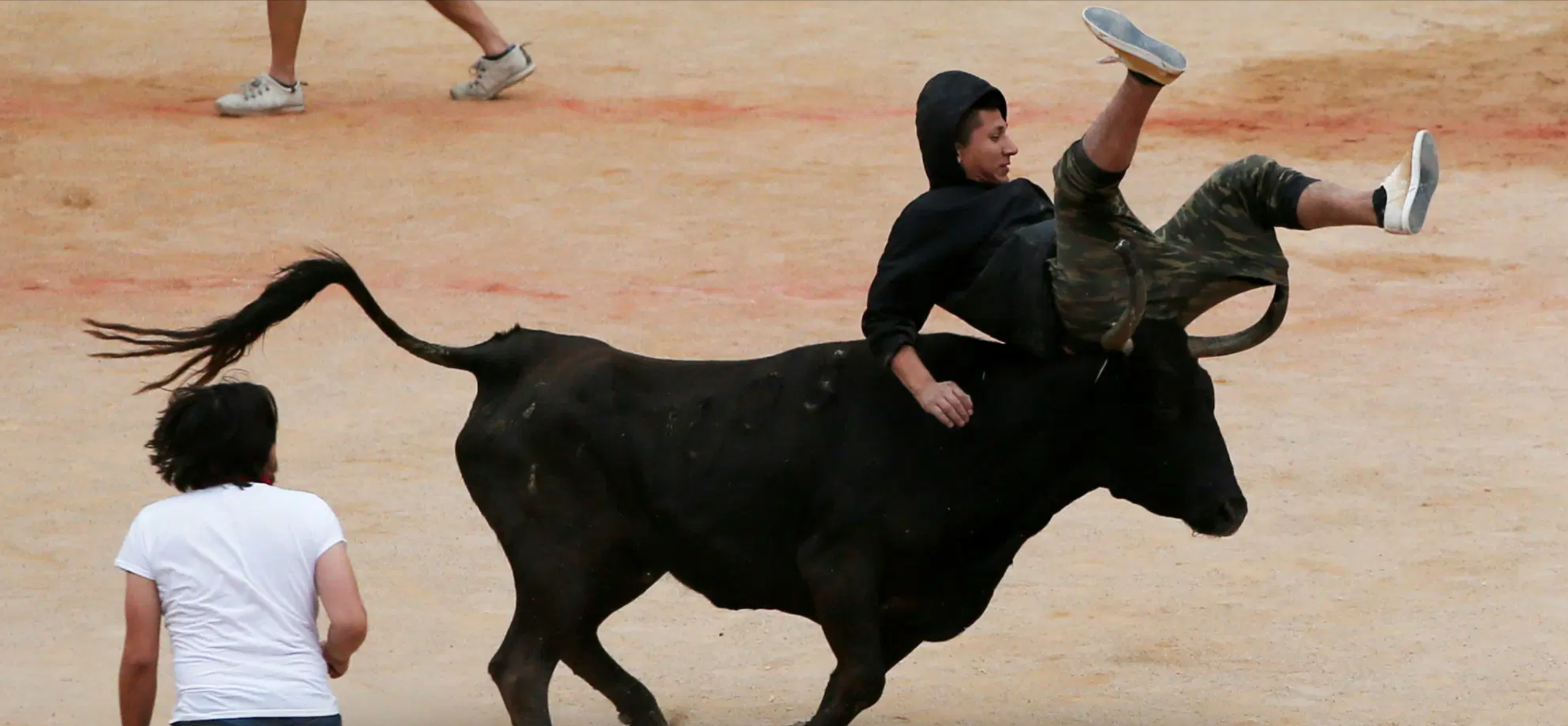
Not just a danger to themselves. Photo by Reuters/Susana Vera
In 1976, a professor of economic history at the University of California, Berkeley published an essay outlining the fundamental laws of a force he perceived as humanity’s greatest existential threat: Stupidity.
Stupid people, Carlo M. Cipolla explained, share several identifying traits: they are abundant, they are irrational, and they cause problems for others without apparent benefit to themselves, thereby lowering society’s total well-being. There are no defenses against stupidity, argued the Italian-born professor, who died in 2000. The only way a society can avoid being crushed by the burden of its idiots is if the non-stupid work even harder to offset the losses of their stupid brethren.
Let’s take a look at Cipolla’s five basic laws of human stupidity:
Law 1: Always and inevitably everyone underestimates the number of stupid individuals in circulation.
No matter how many idiots you suspect yourself surrounded by, Cipolla wrote, you are invariably lowballing the total. This problem is compounded by biased assumptions that certain people are intelligent based on superficial factors like their job, education level, or other traits we believe to be exclusive of stupidity. They aren’t. Which takes us to:
Law 2: The probability that a certain person be stupid is independent of any other characteristic of that person.
Cipolla posits stupidity is a variable that remains constant across all populations. Every category one can imagine—gender, race, nationality, education level, income—possesses a fixed percentage of stupid people. There are stupid college professors. There are stupid people at Davos and at the UN General Assembly. There are stupid people in every nation on earth. How numerous are the stupid amongst us? It’s impossible to say. And any guess would almost certainly violate the first law, anyway.
Law 3. A stupid person is a person who causes losses to another person or to a group of persons while himself deriving no gain and even possibly incurring losses.
Cipolla called this one the Golden Law of stupidity. A stupid person, according to the economist, is one who causes problems for others without any clear benefit to himself.
The uncle unable to stop himself from posting fake news articles to Facebook? Stupid. The customer service representative who keeps you on the phone for an hour, hangs up on you twice, and somehow still manages to screw up your account? Stupid.
This law also introduces three other phenotypes that Cipolla says co-exist alongside stupidity. First there is the intelligent person, whose actions benefit both himself and others. Then there is the bandit, who benefits himself at others’ expense. And lastly there is the helpless person, whose actions enrich others at his own expense. Cipolla imagined the four types along a graph, like this:
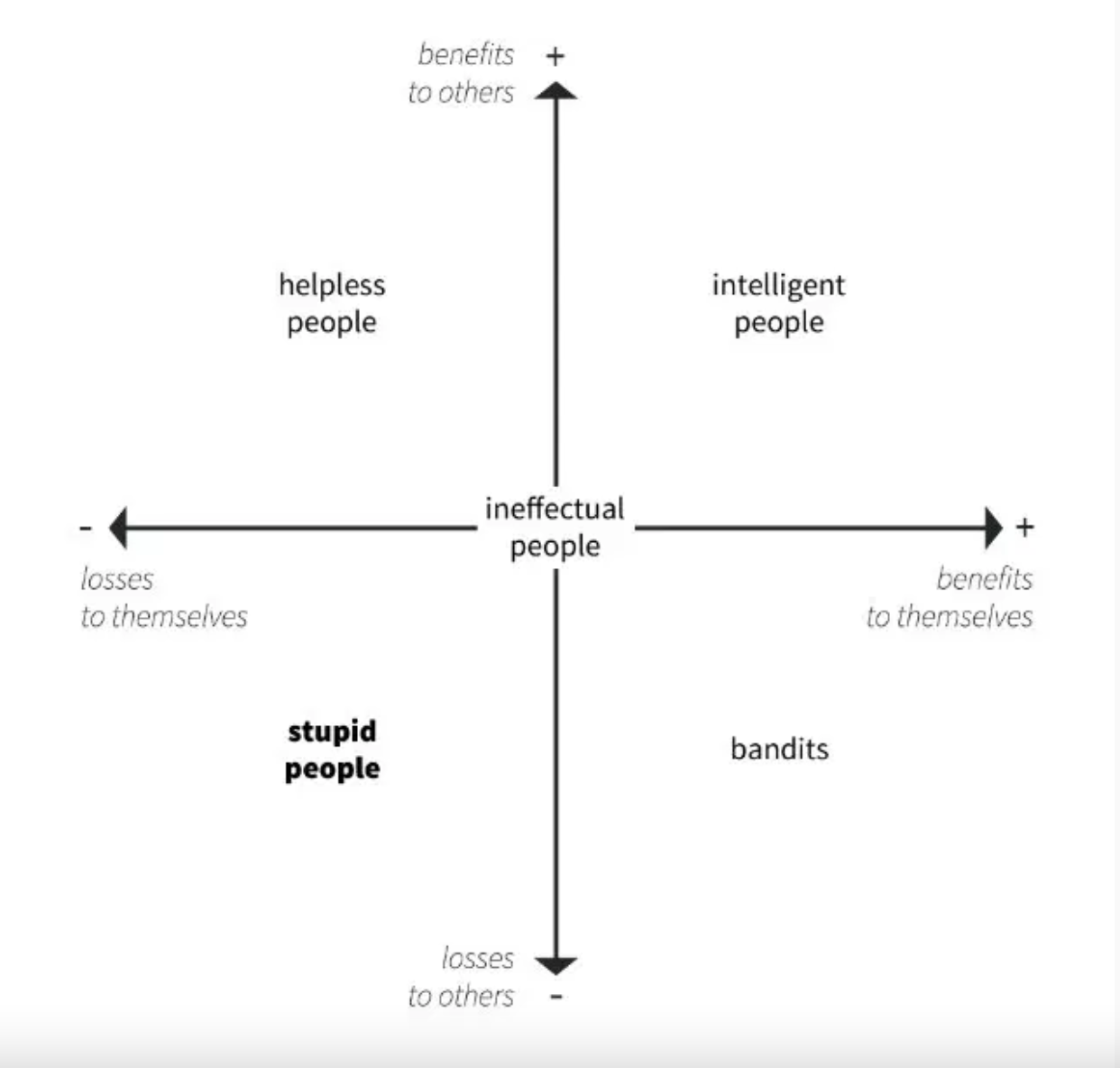
Stupidity, graphed. Photo by Vincedevries on Wikimedia, licensed under CC-BY-SA 4.0
The non-stupid are a flawed and inconsistent bunch. Sometimes we act intelligently, sometimes we are selfish bandits, sometimes we act helplessly and are taken advantage of by others, and sometimes we’re a bit of both. The stupid, in comparison, are paragons of consistency, acting at all times with unyielding idiocy.
However, consistent stupidity is the only consistent thing about the stupid. This is what makes stupid people so dangerous. Cipolla explains:
Essentially stupid people are dangerous and damaging because reasonable people find it difficult to imagine and understand unreasonable behavior. An intelligent person may understand the logic of a bandit. The bandit’s actions follow a pattern of rationality: nasty rationality, if you like, but still rationality. The bandit wants a plus on his account. Since he is not intelligent enough to devise ways of obtaining the plus as well as providing you with a plus, he will produce his plus by causing a minus to appear on your account. All this is bad, but it is rational and if you are rational you can predict it. You can foresee a bandit’s actions, his nasty maneuvres and ugly aspirations and often can build up your defenses.
With a stupid person all this is absolutely impossible as explained by the Third Basic Law. A stupid creature will harass you for no reason, for no advantage, without any plan or scheme and at the most improbable times and places. You have no rational way of telling if and when and how and why the stupid creature attacks. When confronted with a stupid individual you are completely at his mercy.
All of which leads us to:
Law 4: Non-stupid people always underestimate the damaging power of stupid individuals. In particular non-stupid people constantly forget that at all times and places and under any circumstances to deal and/or associate with stupid people always turns out to be a costly mistake.
We underestimate the stupid, and we do so at our own peril. This brings us to the fifth and final law:
Law 5: A stupid person is the most dangerous type of person.
And its corollary:
A stupid person is more dangerous than a bandit.
We can do nothing about the stupid. The difference between societies that collapse under the weight of their stupid citizens and those who transcend them are the makeup of the non-stupid. Those progressing in spite of their stupid possess a high proportion of people acting intelligently, those who counterbalance the stupid’s losses by bringing about gains for themselves and their fellows.
Declining societies have the same percentage of stupid people as successful ones. But they also have high percentages of helpless people and, Cipolla writes, “an alarming proliferation of the bandits with overtones of stupidity.”
“Such change in the composition of the non-stupid population inevitably strengthens the destructive power of the [stupid] fraction and makes decline a certainty,” Cipolla concludes. “And the country goes to Hell.”
Corinne Purtill writes about culture, behavioral science, and management. Based at various times in Washington, D.C., Phnom Penh, New York, and London, she has written about everything from terrorism to the search for the Loch Ness Monster. She has a BA in English from Stanford University and reports now from southern California.
(You have to be a real asshole not to have a allergy attack with your eyes on this story! Grumpy)

A historic Colt .45-caliber, semi-automatic pistol stolen more than 30 years ago from a Medal of Honor
winnerrecipient in South Carolina has been returned to its rightful owner.
The gun and owner were reunited after a history buff in Medford, who bought the old handgun in an online auction last month, tracked down the retired Marine whose name is engraved on it.
Pretty cool, huh? I’d guess there’d be some people who would see a weapon like that, engraved with the name of a Medal of Honor recipient and see dollar signs. This guy just saw the right thing to do.
“I knew if I found him and it was his gun, I couldn’t keep it,” said George Berry, 71, who knew little about the history of the gun when he purchased it from an auction house in Pennsylvania.
The story begins when Berry, a retired Navy warrant officer who also served in the Marine Corps, decided this summer to fulfill a lifelong dream of owning one of the historic handguns.
“I’ve always wanted to own a Colt Model 1911 .45 automatic — always wanted one,” he says. “John Wayne had one in every World War II movie I’ve ever seen him in.”
Early in July, he began searching the Internet and discovered that Alderfer Auction, a well-known auction firm in Hatfield, Pa., would be offering three of the Colt .45s in a July 12 auction.
In particular, lot No. 78 caught his eye: “Colt 1911 A1 semi-automatic pistol. Cal. 45. 5″ bbl. SN 0103889. Reblued finish on all metal, plain walnut Colt grips, after-market rear sight, no magazine,” the description read.
“Faint ‘USMC’ stamped on right side of slide, partial ‘United States Property’ wording is visible,” it continued. “The name ‘John J. McGinty USMC’ stamped on left side of slide. Very good.”
You can read John McGinty’s MoH citation here.
The pistol had been reblued, was missing its original sights or grips. It sold for a lot less at the auction than two other .45s. The new owner started searching the Internet to see what he could find out about this fellow whose name was on the pistol. Turns out, John McGinty had been awarded the Medal of Honor, and that very pistol was mentioned in his citation for the Medal.
As he read more about McGinty and his story, he knew he had to locate him to see if he was the same man who once owned the gun. He also wanted to find out how he parted with the pistol, and whether the former Marine wanted it back.
“His medal citation actually mentions the pistol,” Berry observed, referring to the fact the wounded McGinty used it to kill five enemy soldiers attacking his position.
However, Berry did not yet know whether it was the same McGinty associated with his newly acquired pistol. He used the Internet to track down McGinty, 71, in Beaufort, S.C. McGinty had retired from the corps as a captain in October 1976.
The retired Navy warrant officer called the retired Marine Corps officer and asked him if it was his pistol.
“He said, ‘Do you mean 0103889?’ ” Berry recalled, noting McGinty had just recited the gun’s serial number.
That’s when McGinty informed him the pistol had been stolen in 1978 when it was on display along with his uniform and sword. It was the very same pistol McGinty had used in Vietnam to repulse that final assault.
So, John McGinty was reunited with the pistol that saved his life and George Berry, the man who returned it to him refused to take any money for it. It was just the right thing to do.
Read the rest here.
What a Stud is all that I can say about this Great American! Grumpy

Johan Anderberg is a journalist and author of Flocken, a bestselling history of the Swedish experience during Covid-19.
A hundred years ago, in New York City, 20,000 people marched down Fifth Avenue in protest against one of the greatest public health policy experiments in history. One of them was wearing a sign featuring an image of Leonardo da Vinci’s “The Last Supper,” beside the slogan, “Wine was served.” There were posters of George Washington, Thomas Jefferson and Abraham Lincoln. Another read: “Tyranny in the name of righteousness is the worst of all tyrannies.”
For a year, beer, wine and spirits had been illegal throughout the United States. From a public health perspective, it seemed a reasonable enough measure. That alcohol was a dangerous substance was clear: disease, violence, poverty and crime were intimately bound up with it. Even now, despite its failure, it is known as the “noble experiment”. But was it right to prevent people from making drinks they not only enjoyed, but that also served important cultural and religious purposes? Not for the first time, Americans found themselves torn in a balance between freedom and security — nor for the last.
Until recently, prohibition remained the largest experiment in social engineering a democracy had ever undertaken. And then, in early 2020, a new virus began to spread from China. Faced with this threat, the world’s governments responded by closing schools, banning people from meeting, forcing entrepreneurs to shut their businesses and making ordinary people wear face masks. Like prohibition, this experiment provoked a debate. In all the democracies of the world, freedom was weighed against what was perceived as security; individual rights versus what was considered best for public health.
Few now remember that for most of 2020, the word “experiment” had negative connotations. That was what Swedes were accused of conducting when we — unlike the rest of the world — maintained some semblance of normality. The citizens of this country generally didn’t have to wear face masks; young children continued going to school; leisure activities were largely allowed to continue unhindered.
This experiment was judged early on as “a disaster” (Time magazine), a “the world’s cautionary tale” (New York Times), “deadly folly” (the Guardian). In Germany, Focus magazine described the policy as “sloppiness”; Italy’s La Repubblica concluded that the “Nordic model country” had made a dangerous mistake. But these countries — all countries — were also conducting an experiment, in that they were testing unprecedented measures to prevent the spread of a virus. Sweden simply chose one path, the rest of Europe another.
The hypothesis of the outside world was that Sweden’s freedom would be costly. The absence of restrictions, open schools, reliance on recommendations instead of mandates and police enforcement would result in higher deaths than other countries. Meanwhile, the lack of freedom endured by the citizens of other countries would “save lives.”
Many Swedes were persuaded by this hypothesis. “Shut down Sweden to protect the country,” wrote Peter Wolodarski, perhaps the country’s most powerful journalist. Renowned infectious diseases experts, microbiologists and epidemiologists from all over the country warned of the consequences of the government’s policy. Researchers from Uppsala University, the Karolinska Institute and the Royal Institute of Technology in Stockholm produced a model powered by supercomputers that predicted 96,000 Swedes would die before the summer of 2020.
At this stage, it was not unreasonable to conclude that Sweden would pay a high price for its freedom. Throughout the spring of 2020, Sweden’s death toll per capita was higher than most other countries.
But the experiment didn’t end there. During the year that followed, the virus continued to ravage the world and, one by one, the death tolls in countries that had locked down began to surpass Sweden’s. Britain, the US, France, Poland, Portugal, the Czech Republic, Hungary, Spain, Argentina, Belgium — countries that had variously shut down playgrounds, forced their children to wear facemasks, closed schools, fined citizens for hanging out on the beach and guarded parks with drones — have all been hit worse than Sweden. At the time of writing, more than 50 countries have a higher death rate. If you measure excess mortality for the whole of 2020, Sweden (according to Eurostat) will end up in 21st place out of 31 European countries. If Sweden was a part of the US, its death rate would rank number 43 of the 50 states.
This fact is shockingly underreported. Consider the sheer number of articles and TV segments devoted to Sweden’s foolishly liberal attitude to the pandemic last year — and the daily reference to figures that are forgotten today. Suddenly, it is as if Sweden doesn’t exist. When the Wall Street Journal recently published a report from Portugal, it described how the country “offered a glimpse” of what it would be like to live with the virus. This new normal involved, among other things, vaccine passports and face masks at large events like football matches. Nowhere in the report was it mentioned that in Sweden you can go to football matches without wearing a facemask, or that Sweden — with a smaller proportion of Covid deaths over the course of the pandemic — had ended virtually all restrictions. Sweden has been living with the virus for some time.
The WSJ is far from alone in its selective reporting. The New York Times, Guardian, BBC, The Times, all cheerleaders for lockdowns, can’t fathom casting doubt on their efficacy.
And those who’ve followed Sweden’s example have also come in for a lot of criticism. When the state of Florida — more than a year ago and strongly inspired by Sweden — removed most of its restrictions and allowed schools, restaurant and leisure parks to reopen, the judgement from the American media was swift. The state’s Republican governor was predicted to “lead his state to the morgue” (The New Republic). The media was outraged by images of Floridians swimming and sunbathing at the beach.
DeSantis’s counterpart in New York, the embattled Democrat Andrew Cuomo, on the other hand, was offered a book deal for his “Leadership lessons from the Covid-19 pandemic”. A few months ago, he was forced to resign after harassing a dozen women. But the result of his “leadership lesson” lives on: 0.29% of his state’s residents died of Covid-19. The equivalent figure for Florida — the state that not only allowed the most freedom, but also has the second highest proportion of pensioners in the country — is 0.27%.
Once again, an underreported fact.
From a human perspective, it is easy to understand the reluctance to face these numbers. It is hard to avoid the conclusion that millions of people have been deprived of their freedom, and millions of children have had their education gravely damaged, for little demonstrable gain. Who wants to admit that they were complicit in this? But what one American judge called the “laboratories of democracy” have conducted their experiment — and the result is increasingly clear.
Exactly why it turned out this way is harder to explain, but perhaps the “noble experiment” of the 1920s in the US can offer some clues. Prohibition didn’t win because the freedom argument prevailed. Nor was it because the substance itself had become any less harmful to people’s health. The reason for the eventual demise of the alcohol ban was that it simply didn’t work. No matter what the law said, Americans didn’t stop drinking alcohol. It simply moved from bars to “speakeasies”. People learned to brew their own spirits or smuggle it in from Canada. And the American mafia had a field day.
The mistake the American authorities made was to underestimate the complexity of society. Just because they banned alcohol did not mean that alcohol disappeared. People’s drives, desires and behaviours were impossible to predict or fit into a plan. A hundred years later, a new set of authorities made the same mistake. Closing schools didn’t stop children meeting in other settings; when life was extinguished in cities, many fled them, spreading the infection to new places; the authorities urged their citizens to buy food online, without thinking about who would transport the goods from home to home.
If the politicians had been honest with themselves, they might have foreseen what would happen. For just as American politicians were constantly caught drinking alcohol during the prohibition, their successors were caught 100 years later breaking precisely the restrictions they had imposed on everyone else. The mayors of New York and Chicago, the British government’s top advisor, the Dutch Minister of Justice, the EU Trade Commissioner, the Governor of California all broke their own rules.
It isn’t easy to control other people’s lives. It isn’t easy to dictate desirable behaviours in a population via centralised command. These are lessons that many dictators have learned. During the Covid pandemic, many democracies have learned it too. The lesson has perhaps not yet sunk in, but hopefully it will eventually. Then perhaps it will be another 100 years before we make the same mistake again.
This is an edited translation of an article that first appeared in Sydsvenskan.

The sudden fall of Afghanistan marks the very first time that the U.S. military has clearly lost a war fought solely by volunteers. This defeat will have many strategic consequences, but it also may have a deeply corrosive effect on the nation’s all-volunteer military. Losing a war can be debilitating for any military organization and can deeply erode morale and confidence. For a force that is widely viewed as the most capable and professional military in the world, the potential for such harmful consequences should not be underestimated. Left unaddressed, they could imperil the long-term health and effectiveness of the all-volunteer force.
Arguments will rage for a long time about whether the United States could have won the war in Afghanistan with another approach — or even won at all. But after the nation invested two decades, more than $2 trillion, and the lives of almost 2,500 military personnel, the outcome remains the same. Afghanistan is now occupied and controlled by essentially the same Taliban movement that governed the country in 2001 and which is gleefully celebrating its victory over the United States, NATO, and the internationally backed government in Kabul. The U.S. military now faces the challenge of processing this defeat on two different levels: as individuals, among those who deployed and fought, and as an institution, in which the military’s leaders should now help the all-volunteer force process this painful outcome while simultaneously ensuring that it remains strong and capable of winning the nation’s future wars.
Individually, those who served in Afghanistan are reeling from the speed and shock of the final collapse that capped a frustrating war many of them committed years of their lives to fighting. Watching scenes of the chaotic evacuation of Americans and some of their Afghan allies from Kabul, those who served in the Hindu Kush — one of us included — are inevitably experiencing painful and clashing emotions of anger, loss, grief, and resentment. They face an existential question about their service: Why did I sacrifice years of my life and lose friends in a war that essentially ended up where it began, with Afghanistan in the hands of the Taliban?
That angst will be compounded by a deep sense that the humiliating departure from Afghanistan — nearly the worst imaginable way to leave — represented a violation, an abandonment even, of the deepest ethos instilled among those who serve in uniform. All of the U.S. military services subscribe to a version of what the Army calls its warrior ethos: “I will always place the mission first. I will never accept defeat. I will never quit. I will never leave a fallen comrade.” The Marine Corps reflects this commitment in its recruiting pitch, “Battles Won,” and in its famed motto, Semper Fidelis (always faithful). And in the special operations community, “no one left behind” is a sacrosanct bond. An untold number of military servicemembers have been killed and wounded fulfilling that specific commitment to their brothers and sisters in arms during the past 20 years.
Yet the chaotic bumbling of the last days of the Afghanistan War undercut every aspect of this ethos. Committing to leave no one behind is especially important when creating bonds between the men and women who choose to place themselves in harm’s way for the nation. Many servicemembers now believe that the nation violated that bedrock principle by leaving behind 100 to 200 Americans and tens or even hundreds of thousands of Afghans who supported the United States at great personal risk over the last 20 years. Ad hoc veteran and military efforts to help get those people out in the last weeks of the U.S. withdrawal, which have been brilliantly described as a “digital Dunkirk,” powerfully reflects this deep-seated military creed.
Military leaders at all levels are going to have to confront these issues — for themselves and for their troops. And though that will be a complex and difficult process, this conversation should begin with the following message: “You served honorably and did what the nation asked you to do.” For the nation to keep its promise to those it asked to fight, this affirmation is a vital expression of gratitude and respect for all those who deployed to Afghanistan simply because the nation sent them. But it is not sufficient to sustain a strong all-volunteer force into the future. Unlike the U.S. defeat in Vietnam, the costs of this war — especially its human costs — were borne not by the nation as a whole, but by a small cohort of volunteer warriors while the vast majority of Americans remained uninvolved and largely uninterested. The failures of the war, and the policies that led to them, do not in any way diminish the fact that every single person who served in the war volunteered to fight when there was no obligation to do so. That choice, and the profound consequences it would have for those who stepped forward, shielded the rest of us from the painful experiences of war. The nation’s leaders and its people have an obligation to convey their gratitude for those who volunteered to serve so that those who follow in their footsteps know that their sacrifices are both honored and appreciated.
Institutionally, the U.S. military faces three critical tasks. First, it has both a moral and a practical obligation to dissect what went wrong during the 20 years of war and to demonstrate that it has processed and learned from those hard lessons. Current and future generations of servicemembers ought to have confidence that the hard lessons from Afghanistan were not buried and that harsh critiques of wartime decisions and performance in this war’s aftermath were welcomed in order to better prepare for any future irregular wars. The U.S. military utterly failed to do this after the Vietnam War, as it sought to erase counter-insurgency from its institutional memory instead of insisting on a brutal degree of self-assessment examining how military actions contributed to the defeat. As a result, a new generation of soldiers, sailors, airmen, and marines entered their own unconventional wars a quarter century later with no current doctrine or training on fighting insurgents. This should never happen again.
Second, U.S. military leaders ought to clearly identify what went wrong with the disastrous evacuation and take full responsibility for their part in the debacle. The decision to end the war was rightly made by civilian leaders. Their decision may or may not have been strategically wise. But the execution of the withdrawal was clearly a military responsibility, and it was indisputably done poorly. Congress is already scheduling hearings in an effort to establish some accountability for the war’s ghastly final days and for leaving behind so many Afghans who took tremendous personal risks to help the American effort. In recent weeks, we’ve both seen many social media posts about the withdrawal referencing Paul Yingling’s famous observation about recent conflicts — that a private who loses a rifle suffers greater consequences than a general who loses a war. Restoring confidence in the key principles of the warrior ethos requires senior leaders to launch a swift and candid assessment of the bungled conclusion to the war — perhaps by an independent and respected outside body, to ensure its credibility — and to hold themselves accountable for any military failures.
Third, senior leaders of the Department of Defense and the services should guide the force to somehow absorb the loss of the war in Afghanistan constructively. After the rancorous end of the Vietnam War in 1975, many servicemembers and veterans concluded that the war was lost primarily because civilian leaders imposed too many restrictions on military operations, forcing the military to fight with one hand tied behind its back. For some, this led to an insidious belief that the military had been “stabbed in the back” by political leaders, the media, and anti-war protesters who ostensibly undermined the U.S. military on the battlefield and caused the U.S. capitulation. But senior U.S. military leaders, including Gens. Creighton Abrams and Frederick Weyand, sought to stamp out this dangerous interpretation by reinforcing the idea that militaries in the United States and other democratic societies always fight within constraints imposed by elected leaders. The generals ensured that the psychology of blame and defeat never took root within the force, which enabled it to refocus on preparing for the wars of the future.
The parallels with today are clear. We’ve both heard veterans of the war in Afghanistan argue that the past four administrations forced the U.S. military to fight with one hand tied behind its back in Afghanistan with overly restrictive rules of engagement and feckless decision-making. There is a clear risk that some leaders and troops may begin to blame the war’s stinging outcome on poor civilian leadership and support. Senior military and defense leaders should once again stop this narrative from spreading throughout the force. In fact, doing so today is even more important than it was after Vietnam, since a force that consists entirely of self-selected volunteers faces a greater risk than a conscript force of developing a belief that it is morally superior to the society it serves. It’s a short leap from that outlook to conclude that the military was failed in Afghanistan by the poor decisions of civilian policymakers who have never been in uniform. This third task of helping the force come to grips with the loss of Afghanistan could be strongly reinforced by the first task, since an open and candid assessment of the military’s performance during the 20 years of the war would clearly demonstrate that civilian leaders were not the only ones to make major mistakes.
The humiliating end to America’s longest war came suddenly, and its shocks will ripple throughout the U.S. military for years to come. But in the immediate aftermath of this painful defeat, the nation’s civilian and military leadership should recognize that they have some new obligations to the all-volunteer force that they lead. These leaders should address the individual pain and anger that many servicemembers may be feeling by affirming the fundamental value of their military service. They should reaffirm the warrior ethos that animates each of the military services and the special operations community and commit to upholding those virtues. They should both ensure that the hard lessons of the past 20 years are identified and truly learned and hold themselves accountable for the disastrously executed withdrawal that left thousands of America’s partners behind. These tasks stem partly from a moral obligation to those who sacrificed so much over the past 20 years, but they are also necessary to ensure that the all-volunteer force remains strong, capable, and motivated to fight America’s future wars. If the men and women who fought in the Afghanistan conflict are to remain fully committed to their service tomorrow, and to continue encouraging young people to consider military service, they need to hear about the end to this long war from those at the top.
Lt. Gen. David W. Barno, U.S. Army (ret.) and Dr. Nora Bensahel are visiting professors of strategic studies at the Johns Hopkins School of Advanced International Studies and senior fellows at the Philip Merrill Center for Strategic Studies. They are also contributing editors at War on the Rocks, where their column appears monthly. Sign up for Barno and Bensahel’s Strategic Outpost newsletter to track their articles as well as their public events.