Categories
Uncategorized

Bully for Springfield Armory & those who want a Browning Hi Power! From Soldier System

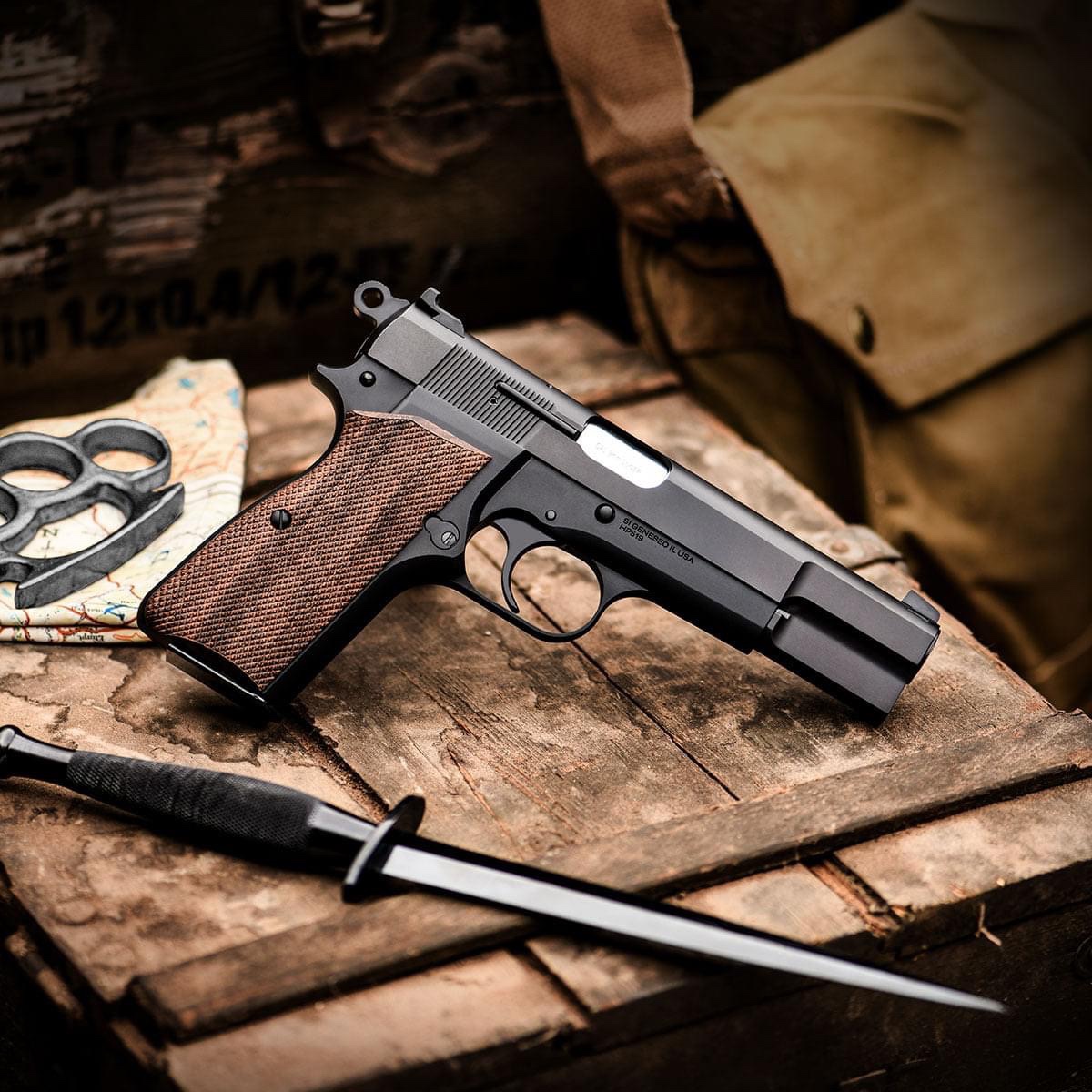
Springfield Armory Launches Hi-Power Clone, The SA-35

Earlier today, Springfield Armory announced their new SA-35, their version of the Browning P-35, popularly known as the Hi-Power.

But it’s not an exact clone. SA has reconfigured the hammer to help mitigate hammer bite, included an extended safety, modernized the sights, beveled the magwell and slipped in a factory tuned trigger.

Here are the stats:

At $699 MSRP, I’ll definitely be on the look for one, for nostalgia’s sake if nothing else. There’s something comforting about a pistol made of steel and wood.

I expect additional models in the future.

www.springfield-armory.com/sa-35-series-handguns/sa-35-handguns

Categories
All About Guns

Tisas 1911 (400 Dollar Bargain Pistol)

Categories
Fieldcraft Well I thought it was neat!

12 Tips for Shed Hunting the West by Aram von Benedikt

12 Tips for Shed Hunting the West

Shed antler hunting has become a popular sport across the winter ranges of the West, affording people a chance to spend time outdoors when days are short and cabin fever long. If you want to get in on the action yourself, you’ll need to be quick on your feet and strategic in your approach. If you’re not, all the brown gold will be gone before you even get your pan in the creek. Here are some tips that’ll help you find pay dirt.

1. Hunt Early
Timing is everything in today’s high-speed public land shed hunting scene—antlers get picked up within a few days of hitting the ground. Valentine’s Day usually heralds the first early muley sheds hitting the ground, and March seems to be the magic time for elk antlers to detach en-mass. Of course, both can and do drop from December through April, but the majority will begin mid-February and be bareheaded before the end of March.

2. Follow the Snowline for Elk Sheds
Most bull elk follow the snow line as it recedes into the high country, grazing on fresh grassy shoots that emerge in the snowline’s wake. They hang in bachelor groups, utilizing their spare time to beat up unsuspecting trees. They rub frequently until their antlers drop, leaving telltale beaten and broken trees as beacons. Find the freshest rubs, tracks and sign, and then search the area systematically.

3. Check Fences, Ditches and Obstacles
Antlers detach rapidly once the process starts, and the first jarring they get means a quick trip to the dirt. That might occur the first time the buck or bull rubs on a tree after the bone gets loose, but it also might be the first time the animal jumps a ditch, ducks under a fence or tries to rip hay from a stack with his antler. Spend extra time hunting fence lines, ditch crossing, and similar spots where an animal might knock or jar an antler free.

4. Search Bedding Areas
A high percentage of antlers are shed in bedding areas. Look for fresh and historical bedding sign, and spend time dissecting the area. In my neck of the woods, muleys typically bed on pinion- and juniper-covered benches and plateaus. Elk prefer to bed in brushy areas mixed with ponderosa, scrub oak and PJ (pinion/juniper), where they can find shelter from the afternoon sun.

5. Search Travel Corridors
I found the first half of my best-ever set of elk sheds during an early low-country October elk hunt. I had just harvested a bull on a tiny hillside bench, and as I walked up on my meat, I found four elk sheds. One was half of a 350-class set. I later returned to search for the match. Sitting my horse on a vantage point, I studied the area, trying to determine the elk’s movements and patterns during shedding time. A small saddle looked like a perfect cross-ridge travel corridor, so I rode my horse along the route I figured the elk would have traveled. Sure enough, there lay the match to my big shed, propped haphazardly against an oak bush. Figure out likely travel routes in your shed-hunting area, and work them—they’ll pay off.

6. Hunt Food Sources
The last element of a buck or bull’s springtime pattern is food. Grid any agricultural fields that deer have been hanging in (be sure you obtain permission from the landowner first). Hunt brushy draws and browse filled creek bottoms thoroughly. If you have access to haystacks on private land, a trip around the stack and short excursions down the spider-web trails leading in and out can pay dividends. South-facing grassy slopes and tiny brush-surrounded meadows and draws are good places to look for big bone—bulls love to bed in a shady north-facing patch of timber, and then pop over the ridge to feed on a south-facing meadow or draw.

7. Take a Kid Shed Hunting
Shed hunting is a high-energy endeavor. What better way to find sheds than taking a handful of high-energy kids to help you grid an area? Kids love a good treasure hunt, so load up with water and snacks, spend the day in good shed country, and come out light on food and heavy on antlers.

8. Train a Dog
Just about the only thing better at finding sheds than an energetic kid is an energetic dog. Shed antlers do have an odor, and dogs are usually good at sniffing out things that smell. There are even breeders that raise dogs specifically bred for shed hunting. Use treats, a couple sheds and weekend afternoons to teach your dog to love antlers. Come shed season, it’ll pay off.

9. Hunt Horseback
If you have access to horses, use them to hunt sheds. They offer two advantages over hunting on foot: first, they save you a lot of effort, rendering you capable of hunting longer and harder. Second, they offer a higher—and better—point of vantage. You can further, and you don’t have to watch where you’re putting your feet, leaving your eyes free to search for bone.

10. Find a Matched Set
The icing on a shed-hunter’s cake is finding a matched set. There are no hard and fast rules to how an animal drops his antlers, but there are some tendencies. Big, old animals are more likely to drop their antlers in close proximity, sometimes even atop each other. If you find a big shed, spend the time it takes to cover every inch in about a 400-yard radius. Hunt the close stuff first, then further out. Chances are, if someone hasn’t beaten you to the match, you’ll find it.

11. Know Your State’s Regulations
Some states have regulations or restrictions to shed hunting. Do your homework and comply with requirements before and during your trip. There are good reasons for regulation, and you should demonstrate integrity in abiding by the rules.

12. Be Respectful
I saved this subject for last intentionally. Deer and elk deserve space and respect while they drop their antlers, and here’s why: Bucks and bulls are more vulnerable while shedding their antlers than at any other time in their lives. The chemical process that occurs in their body while the antlers detach leaves them weak for several days, and can be lethal if they experience undue stress. If you slip into their home turf to pick up early drops, be clandestine. Try not to be seen, and if you bump into an animal, back off immediately. Give deer and elk the space and respect they need to shed their antlers in peace.

Categories
All About Guns Allies

7 Best Law Enforcement Revolvers of All Time by Sheriff Jim Wilson

7 Best Law Enforcement Revolvers of All Time

An interesting question was raised just the other day as to what have been the greatest law enforcement revolvers. I suppose you could look at it from several different perspectives. You might consider those guns that were the trend setters or you might tally up the guns that have had the highest production numbers. Or, you might just go with your favorites. And I suppose that there is nothing wrong with any of that.

When I first put on the badge of a Texas peace officer, the revolver was king. So I have a bit more than just academic interest in the subject. For my list, I have combined durability, longevity, and trend setting to come up with what I consider the seven greats.

Colt Single Action Army


Having been introduced in 1873, the Colt SAA enjoys 148 years of popularity although it is no longer considered a premier fighting gun.  But, for about 75 years, it was the gun that most savvy lawmen chose and with good reason.  Chambered in over 30 calibers (can you name them all?), the Colt was accurate enough to get the job done.  And, just as important, it was a robust handgun that could often, in the old days, be a substitute for a billy-club.  After all this time, it is still considered one of the iconic American handguns.

Smith & Wesson Model 10

The revolver that we call the Model 10 started life as the .38 Hand Ejector Model of 1899. Then, along came some military contracts and Smith & Wesson decided to call it the Military & Police model before finally settling on the Model 10. In its lifetime, some 6 million of the guns have been produced.

I would also venture to guess that more law enforcement officers have carried some version of the Model 10 (or its stainless versions…or its magnum versions) than any other handgun. There are several reasons for this popularity. The Model 10 is a medium-frame gun that is comfortable to carry during long hours of shift duty.

Its most popular caliber, .38 Spl., was relatively easy for most shooters to control. And the action was surprisingly smooth, and could be made even smoother by a good pistolsmith. Not as flamboyant as the magnums and other big-bore guns, the Model 10 was just a quality workhorse that could get the job done when an officer paid attention to the business at hand.

Smith & Wesson Triple Lock

The .44 Hand Ejector New Century was only manufactured from 1908 to 1915, with only about 15,000 guns made during that time. However, it showed the shooting world what Smith & Wesson was capable of building in a large-frame sixgun. And it created a line of descendants that are still with us today.

The Triple Lock became the foundation for the development of the .357 Magnum, .41 Magnum, and the .44 Magnum. If an officer had hands big enough to manage the large frame, he was well armed with just about any of the big frame Smith & Wessons. As an aside, though, I wonder just how many lawmen would have ever chosen the gun in .44 Magnum if Dirty Harry had not led the way.

Smith & Wesson Model 19

Border Patrol fast-draw expert Bill Jordan was one of the main ones to prevail upon Smith & Wesson to build a medium-frame revolver chambered for the .357 Magnum cartridge. Jordan suggested the adjustable sights, heavy barrel, and shrouded ejector rod as well and the results became known at the Combat Magnum. I carried one for many years…heck, I’ve still go four of them and use them often. Comfortable to carry, smooth action, extremely accurate, it was truly a lawman’s dream.

Back in those days, we practiced with .38 target loads and reserved our magnum ammo for serious use.  However, when departments began to mandate an officer practicing with the same ammo that he used on the street, we found that a steady diet of magnum loads could cause some serious trouble for these revolvers.  Thus, the Model 19 & 66 (the stainless version) revolvers gave way to the fine L-frame series and the tradition continued.

Colt Detective Special


Since its introduction in 1927, the Colt Detective Special has been a popular choice for plain-clothes detectives and off-duty carry. It is also the oldest of the modern snubnosed revolvers, predating the good S&W Model 36 by almost 25 years.

Colt employee J.H. FitzGerald started the trend when he would cut down the 4-inch Colt Police Positive to make custom belly guns for savvy lawmen and special friends. The popularity of the Detective Special paved the way for all of the snubnose guns that we’ve seen, and continue to see, today. It was definitely a trend setter.

Colt Python

Introduced in 1955, I suspect that the Python was designed by Colt for use in bullseye pistol matches which, in those days, the revolver ruled. However, most of us considered it the true Cadillac of cop guns, with its smooth action and great accuracy.

The Python also used a slightly larger frame than the S&W Model 19 which allowed us to handle the .357 Magnum cartridge a bit more efficiently. While you could buy a Model 19 for about $80, the Python sold for $125, but when you saw a lawman packing one, you could pretty well bet that he knew a thing or two about shooting handguns and was probably not a rookie.

Ruger Security-Six

Not to be outdone, Ruger introduced the Security-Six in 1972. It utilized investment casting and other manufacturing innovations to build a good revolver and keep the cost to a minimum at the same time—a fact that working cops really appreciated.

From 1972 to 1988, the Ruger DA family expanded to include stainless guns, as well as the original blue, and spin-off models of the Service-Six and Speed-Six. Typical of Ruger, the Security-Six was a lot of gun for the money. But it was just a bit too lightweight for steady use of magnum ammo, so the company beefed it up here and there and called it the GP100.

So there you have my picks for the seven great law enforcement revolvers. What’s that? I left out your favorite? Well, let us hear from you and tell us why your favorite is…well…your favorite.

Categories
All About Guns Well I thought it was neat!

MDGA

image.png

Categories
War

Spooks and Cowboys, Gooks and Grunts Part 2 (1975)

https://youtu.be/CKF6oXad_ow?list=RDCMUCsoahoJ3yhDQnsi4W2WImRA

Categories
War

Spooks and Cowboys, Gooks and Grunts Part 1 (1975)

https://youtu.be/yOmQoADOQWs

Categories
All About Guns

The First S&W .38: The "Baby Russian"

Categories
All About Guns Fieldcraft Gear & Stuff

Cheap Shotguns For Home Defense

Categories
All About Guns

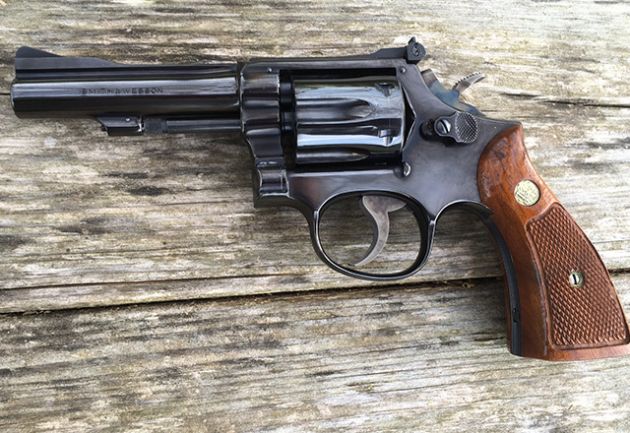
A S&W Model 18 no dash in caliber 22 LR

Smith Wesson Model 18