Categories
All About Guns

Merwin Hulbert & Co. Guns: Forgotten Western Revolvers by DAVE CAMPBEL

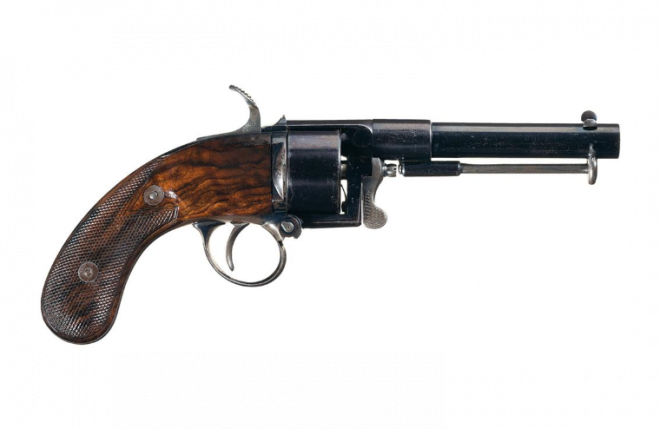
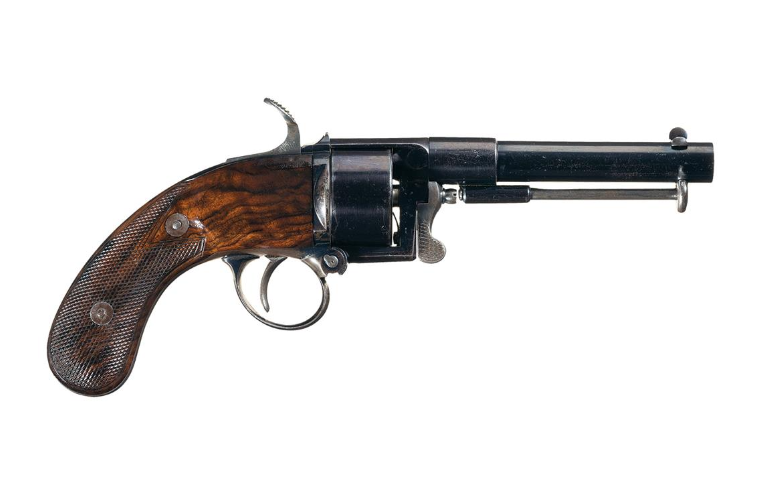
merwin-hulbert-revolver-f.jpg

During the mid-19th century, a man named Joseph Merwin was involved in manufacturing and marketing a single-action revolver. He teamed up with a man named Bray in 1856 and called the company Merwin & Bray. Like most newly formed gun companies, Merwin & Bray struggled for some 18 years before closing its doors.

An early Merwin & Bray revolver currently displated at the NRA National Firearms Museum in Fairfax, Va.

A couple of years later, Merwin got together with William and Milan Hulbert, who also owned 50-percent interest in the Hopkins & Allen Arms Company. The new company, Merwin, Hulbert & Co., expanded its business profile to include all manner of sporting goods at the time, as well as designing and importing firearms.

During its 12-year life Merwin, Hulbert & Co. produced no fewer than 14 different revolvers. The Frontier Model was a large-frame single action—and later double-action—meant to compete with the Colt Single Action Army, 1875 Remington and Smith & Wesson Model 3 revolvers.

It was made in four variations. The First Model was chambered in the proprietary .44 Merwin & Hulbert, similar to Smith & Wesson’s .44 American cartridge. It was an open-top, single-action revolver that was mostly seen with a nickel finish. One distinctive feature was the “scoop”-type cylinder flutes that did not extend all the way to the front of the cylinder.

The revolver’s design—considered one of the strongest of its time—also featured a novel case extraction system whereby the barrel and cylinder were twisted and pulled forward. Empty cases were extracted by the vacuum produced during the twisting motion, and loaded cartridges remained in the cylinder due to their mass and inertia.

Merwin & Hulbert wanted a piece of the Russian military business and also chambered the First Model in .44 Russian. This eventually proved to be one of the company’s many less-than-stellar business decisions, as the Russians never paid for three shipments. The Frontier First Model was made for just two years.

A Second Model had a shortened cylinder locking bolt and no sideplate. The trigger guard is longer and deeper, and it was chambered in .44-40 WCF. This model ran for four years.

The Third Model had several significant changes, chief of which was the introduction of a top strap to give the revolver more strength and reliability. Other changes included were the elimination of the barrel wedge, extending the scoop flutes to the more popular 3/4 flutes seen on competing revolvers and the incorporation of a folding hammer spur to make the revolver easier to draw from concealment.

The Third Model was also available as a single- or double-action revolver and was made from 1883 to 1887. A Fourth Model included a barrel rib and, for the first time, two additional barrel lengths—3 1/2″ and 5 1/2″—in addition to the standard 7″ barrel length. The front sight became a separate component to the barrel as well. Customers could buy the additional barrels and change them without tools.

The Fourth Model enjoyed some popularity as an alternative to the Colt, Smith & Wesson and Remington revolvers. They exhibited a degree of craftsmanship coveted by many today.

Concurrent with the Frontier models was the Pocket Army models—2, 3 and 4; there was no first—basically short-barreled versions of the Frontier Model. The Pocket Army models introduced a bird’s head-style of grip with an extension of steel past the wooden grip panels. Deemed the “skill crusher,” this feature has become iconic among Merwin & Hulbert revolvers.

A smaller-frame Pocket Model was designed for a more urban clientele. It, too, went through four model variations similar to the other models, but the Pocket series was chambered in another proprietary cartridge, the .38 Merwin & Hulbert. These featured a five-shot cylinder and 3 1/2″ and 5 1/2″ barrels, though a few were made with a 2 3/4″ barrel. An even smaller framed Pocket Model was produced with a five-shot cylinder chambered in .32 M&H.

Joseph Merwin died in 1888, and the Hulbert family changed the name of the company to Hulbert Brothers & Co. They continued to struggle as a company beleaguered by bad business decisions and eventually declared bankruptcy in 1894.

A small-frame Merwin & Hulbert Pocket model in the NRA National Firearms Museum collection.

Two years later, the company was purchased by Hopkins & Allen. Production of Merwin & Hulbert revolvers sputtered along until 1916 when Hopkins & Allen went bankrupt. The remaining assets were purchased by Marlin Firearms in 1917, but the revolvers were no longer manufactured.

That wasn’t the end of the road for the company, though. Interestingly, the Merwin & Hulbert company name and its patents were purchased in 2012 by a gun maker named Michael Blank, who attempted to revive the somewhat widely recognized revolver design.

Blank, who is something of a perfectionist when it comes to making replicas, was unable to produce the complicated design of the Merwin & Hulbert revolvers in a profitable manner, and the idea was abandoned by 2014.

Categories
All About Guns The Green Machine

The New American Rifle that Came Under Assault by Jerry Morelock

The New American Rifle that Came Under Assault

Misfire: The Tragic Failure of the M16 in Vietnam, by Bob Orkand and Lyman. (Duryea Stackpole Books, 2019)


This extensively researched, well-written book was a pleasant surprise. Instead of a dry, boring, statistics-filled diatribe against the “black rifle,” as the M16 has been called because of its color, I discovered a thoroughly documented, fascinating case study of the tragically flawed process of introducing the assault rifle into combat in 1965.

Faced with the task of providing U.S. Marines and soldiers with a weapon comparable to the enemy’s Soviet-made AK-47 assault rifle, the Defense Department rushed the still-experimental XM16E1—a small-caliber, high-velocity weapon capable of full-automatic fire—into production and field use in Vietnam when it “wasn’t yet fit for service,” the authors note. Later versions, notably the M16A1 introduced in 1967, corrected many of the flaws, which could have been done earlier because they had been clearly identified by extensive, pre-issue testing.

'Twilight of the Gods': An Interview with Historian Ian Toll

The Defense Department’s egregious failures with the M16 reveal an astonishing, unforgivable story of bureaucratic incompetence and malfeasance. Indeed, the authors use the M16’s “misfire” fiasco to present an overall critique of America’s involvement in the Vietnam War: “To a large extent, the flawed decision-making that accompanied the introduction of the M16 rifle into combat operations by U.S. Army and Marine units in South Vietnam, beginning in 1965, was symptomatic of similar questionable decision-making that became the tragedy of the war in Vietnam in terms of its ultimately disappointing outcome.”

They add that the flawed introduction of the M16 is “the tale of a well-intentioned but nevertheless misguided campaign by a global superpower, resulting in the loss of more than 58,300 American lives.”

Tragically, as the authors exhaustively document, some of those deaths were undeniably due to XM16E1 malfunctions. Unconscionably, senior commanders (from battalion leaders to the highest levels of the Army and Marines) blamed their troops for their own deaths, falsely insisting that failure to properly clean and maintain their weapons caused the malfunctions.

However, the “malfunction problem was the result of decisions made by people far from the shooting,” the authors point out. “Adding to the basic problems of design deficiencies and unsuitable ammunition was a basic lack of planning for the deployment of a new weapon.”

For example, the first M16 cleaning instructions were not provided until mid-1967, and the troops received no weapon-specific cleaning kits or lubricants. There were also no bore brushes and no chamber brushes. There was a lack of cleaning rods, and the initial-issue aluminum cleaning rods were easily broken. “Sometimes even magazines were in short supply,” according to the authors.

Serious problems afflicted the XM16E1, including: unchromed chambers and bores, which rapidly corroded in Vietnam’s hot, humid climate, regardless of frequent cleaning, and unsuitable powder ammunition, dangerously increasing the rate of fire, causing buffer/bolt malfunctions, firing pin breakages and excessive chamber/bore fouling.

Yet, the weapon’s most serious—often fatal—deficiency was its tendency to not fully eject its expended shells, which testing revealed was responsible for 90 percent of the rifle jams. In the event of such a malfunction, which would often occur when firing the weapon in combat, the rifleman had to push out the unextracted shell with a cleaning rod—if he had one.

This deadly deficiency led Marine Maj. Dick Culver to describe the XM16E1 as a “magazine-fed, air cooled, single shot [emphasis added], muzzle ejecting shoulder weapon.”

The authors are not “weapons buffs” with axes to grind. Duryea, who died before the book’s publication, was a retired Army colonel and test officer (1964-66) for M16 prototypes. Orkand is a retired lieutenant colonel. Both served in Vietnam, leading troops of the 1st Cavalry Division (Airmobile) in combat. Tellingly, Duryea (Silver Star and Bronze Star with a “V” device for valor) relates that “my first casualty in Vietnam was one of my men being killed by return fire at night when his [XM16E1] jammed after firing one round at a group of approaching NVA [North Vietnamese Army] soldiers.”

The “villains” in the XM16E1’s “misfire” are legion: Defense Secretary Robert McNamara and his systems analysis-obsessed, but military-ignorant, “whiz kids” riding roughshod over any resistance; entrenched “gravel bellies” wedded to long-range, large-caliber, semi-automatic-only rifles; ordnance department officials resisting small-caliber, high-velocity, automatic weapons for all infantry soldiers; Defense Department and corporate executives obsessed with lowering production costs; all levels of civilian/military leaders who, through ignorance or malfeasance, neglected to provide troops with the necessary training, instructions, maintenance materials and equipment; and senior commanders who ignored their duty to their troops and blamed their own men for the weapon’s gross deficiencies.

This excellent book’s only minor deficiency is not the authors’ fault: Misfire suffers from too-frequent, inexcusable redundancy due to sloppy, inattentive editing by the publisher.

Categories
All About Guns

August Coenders' 9x19mm Belt-Fed MG

Categories
Grumpy's hall of Shame

A Sneak Preview Of The Gun Cranks Show Discussing The On-Set Baldwin Shooting!

Categories
All About Guns

A Sako A2 Bolt Action Rifle in caliber 22-250 with a great looking stock

Sako A2 22-250 Bolt Rifle by Nic Kusmit , 24 Bull BBL Bolt Rifle .22-250 Rem. - Picture 1

Sako A2 22-250 Bolt Rifle by Nic Kusmit , 24 Bull BBL Bolt Rifle .22-250 Rem. - Picture 2
Sako A2 22-250 Bolt Rifle by Nic Kusmit , 24 Bull BBL Bolt Rifle .22-250 Rem. - Picture 3
Sako A2 22-250 Bolt Rifle by Nic Kusmit , 24 Bull BBL Bolt Rifle .22-250 Rem. - Picture 4
Sako A2 22-250 Bolt Rifle by Nic Kusmit , 24 Bull BBL Bolt Rifle .22-250 Rem. - Picture 5
Sako A2 22-250 Bolt Rifle by Nic Kusmit , 24 Bull BBL Bolt Rifle .22-250 Rem. - Picture 6
Sako A2 22-250 Bolt Rifle by Nic Kusmit , 24 Bull BBL Bolt Rifle .22-250 Rem. - Picture 7
Sako A2 22-250 Bolt Rifle by Nic Kusmit , 24 Bull BBL Bolt Rifle .22-250 Rem. - Picture 8
Sako A2 22-250 Bolt Rifle by Nic Kusmit , 24 Bull BBL Bolt Rifle .22-250 Rem. - Picture 9
Sako A2 22-250 Bolt Rifle by Nic Kusmit , 24 Bull BBL Bolt Rifle .22-250 Rem. - Picture 10


Categories
All About Guns

DON’T DO THIS to Your Guns – Gun Guys

Categories
A Victory! The Horror! War

The Sound of Silence: The End of WWI

Categories
All About Guns

Colt 357 Magnum Model 6 in. Bbl.

Colt 357 Magnum Model 6 in. Bbl., rev.,poorman`s Python .357 Magnum - Picture 2
Colt 357 Magnum Model 6 in. Bbl., rev.,poorman`s Python .357 Magnum - Picture 3
Colt 357 Magnum Model 6 in. Bbl., rev.,poorman`s Python .357 Magnum - Picture 4
Colt 357 Magnum Model 6 in. Bbl., rev.,poorman`s Python .357 Magnum - Picture 5
Colt 357 Magnum Model 6 in. Bbl., rev.,poorman`s Python .357 Magnum - Picture 6
Colt 357 Magnum Model 6 in. Bbl., rev.,poorman`s Python .357 Magnum - Picture 7
Colt 357 Magnum Model 6 in. Bbl., rev.,poorman`s Python .357 Magnum - Picture 8
Colt 357 Magnum Model 6 in. Bbl., rev.,poorman`s Python .357 Magnum - Picture 9
Colt 357 Magnum Model 6 in. Bbl., rev.,poorman`s Python .357 Magnum - Picture 10


Categories
All About Guns

My next Project Gun – A BRNO Peruvian Model VZ32 Sporterized in caliber 7×57 Mauser


Categories
I am so grateful!!

The old men in baseball caps – Thanks Grumpy

Some years back I was honored to call an older English gentleman my friend. He served in the British Army in WW2 in North Africa and on the island of Crete. He was captured when the Germans invaded that island and spent almost three years as a prisoner of war. He remained in the army after the war to retire as a senior NCO with over 25 years of service. My English friend sent me pictures of their yearly veteran’s ceremonies.

Every vet put on a blazer, wore his regimental tie and beret, and pinned his decorations to his jacket. They made their way to the local veterans’ memorial and laid a wreath in memory of their absent comrades. Then they retired to the local pub and lifted a glass to honor those who had gone on to report to a higher power. The men who chased Rommel across the desert and went ashore in Normandy are still be a bit thirsty.

We Americans don’t wear our ribbons. Mine are on the wall in a shadow box, faded by time. Most of us don’t wear ties except for weddings and funerals and berets are only worn by Frenchmen.

So what do we wear? Baseball caps – that great American invention. We mark our caps with our heritage – the Big Red One, the First Marines, the Strategic Air Command. The navy men wear blue caps with the names of proud ships – USS Enterprise, USS New Jersey, Lexington, Newport News. Unless you’ve been there you don’t know a CVA from a CA or a BB from an FFG, but we know.

The old men see fire and rain and Thuds and Phantoms in the hazy sky. They still hear that distinctive rotor beat of the Hueys. They see long gray ships silhouetted against the horizon and remember the days when they were dirty and tired and hungry. They remember playing rock and roll out to the tree line in 7.62 NATO time They remember the catapults throwing Skyhawks into the air. plane after plane, and doing it all again the next day and the day after that.

They were bored and tired and sometimes frightened, those old men who wear the hats. They came home to a country that didn’t understand and really didn’t care what they had done. Today they fight the diseases and the ghosts of those far off days. They will tell you where they’re going, but don’t ask them where they’ve been.

The old men in hats shake hands when they meet. They ask “Where were you?  What did you do?” and they sometimes say “Yeah I was there too”. Mostly they understand. For that minute in the middle of WalMart they’re nineteen years old again and tired and scared. Then they thank God that they made it home and they remember those who didn’t.

And the old men get into their cars and go about their business. If you look closely you might see the smoke and the tracers and the dead men behind their eyes. Sometimes they won’t hear you because their ears have rung since those days of steam turbines and jet engines and heavy artillery.

They stand and salute when the flag passes by because they learned of respect and honor in a hard school and that education has never left them. Sometimes the old men wake in the middle of the night and hear the band playing The Stars and Stripes Forever and they smile just a little and whisper to themselves “I’d do it all again.”

God bless the old men who wear the hats.