Since starting wwiiafterwwii, numerous people have contacted me requesting I write something on this topic. This is understandable as the M1 Garand remains one of the most popular rifles of all time, and there is a high degree of interest with American readers (and to my surprise, some readers in Vietnam as well) in the Vietnam War.
Other discussions on this topic usually end up in a fairly simplistic debate of “yes there were Garands used in Vietnam” or “no they were all gone by then” so hopefully this is of some value.

(South Vietnamese soldiers with M1 Garands on patrol during 1963.)
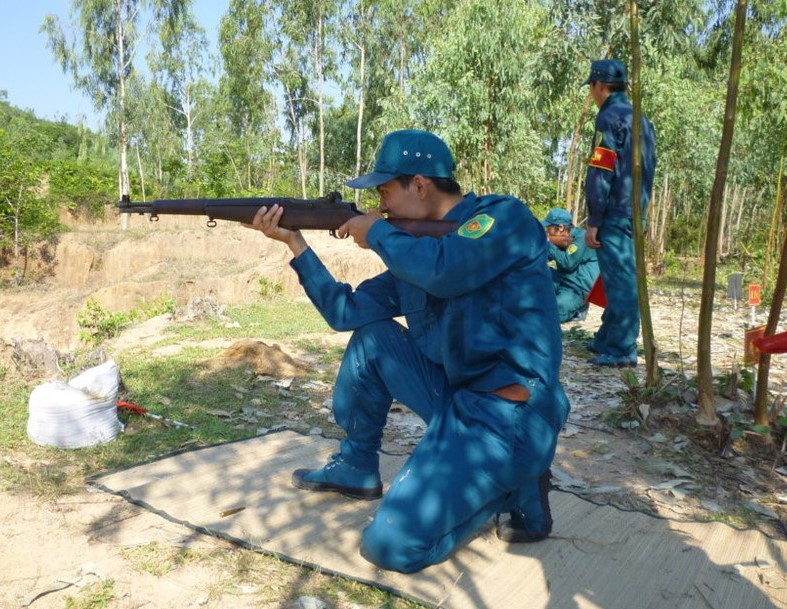
(A member of Vietnam’s DQTV militia takes aim with a M1 Garand in December 2018.)

(The legendary M1 Garand of WWII was a semi-automatic rifle which fired the .30-06 Springfield cartridge (2,800fps muzzle velocity) from a 8-round internal en bloc. It’s effective range was 500 yards. It was tremendously successful during WWII.)
the beginning
The first “local” army after WWII was the Cochin & Annamite Militia, a force recruited by France. It was equipped with whatever was available; typically Stens and Enfields donated by the British, guns of the former Vichy garrison, ex-Wehrmacht firearms shipped by France from Europe, and increasingly, American WWII guns.
On 8 March 1949, the Vietnam National Army (or by it’s French acronym, ANV) was created to replace various militias. Nominally led by an ethnic Vietnamese general, it served as the “local” contingent alongside the French Foreign Legion and other French units fighting the Indochina War.

(ANV soldiers parade in Hanoi – the future North Vietnamese capital – during 1951. They are armed with MAS-36 rifles and Modèle 24/29 machine guns, both of WWII French vintage.)

(1950s ANV soldiers examine an old Vickers machine gun, presumably left behind by the British in 1946 after their short post-WWII stay in Indochina.)
The ANV at first had a goal of standardizing on WWII-era French weapons, however as it turned out these were joined by postwar French guns, continued shipments of 98ks and MP-40s from Europe, and increasingly American-made WWII guns. Of these, the most common were the Thompson submachine gun family. The first Vietnamese M1 Garands arrived during this timeframe, coming from the USA’s transfers to France, which received 198,000 during and after WWII.
For it’s part, both the opposing Viet Minh were also heavily invested in WWII guns, basically everything under the sun: Mosin-Nagants from the USSR, ex-Wehrmacht 98ks and MP-40s via both the French and the Soviets, Mausers from China, MAS-36s captured from the French, British Enfields from sources unknown, Arisakas abandoned by the Imperial Japanese Army in 1945, and an ever-increasing number of captured American-made WWII guns: M3 Grease Guns, M1 Thompsons, M1 carbines, and even a few Garands.

(Viet Cong members with a Gongxian on a bamboo AA mount. Manufactured in China during WWII, this 7.92mm machine gun was a copy of the Czechoslovak vz.26. After Mao’s communists won the Chinese Civil War in 1949, odd WWII-era arms of the nationalists were dumped off into North Vietnam. By the 1960s, a gun like this was obsolete but could still shoot down a Huey.)
In July 1954, France began it’s exit from Indochina and ANV units were pulled south of the 17th Parallel, the line which was supposed to have been a temporary division of the country but became the DMZ. In October 1955, with what would become South Vietnam coalescing, the ANV was renamed the Army of the Republic of Vietnam (ARVN), effective 30 December 1955.
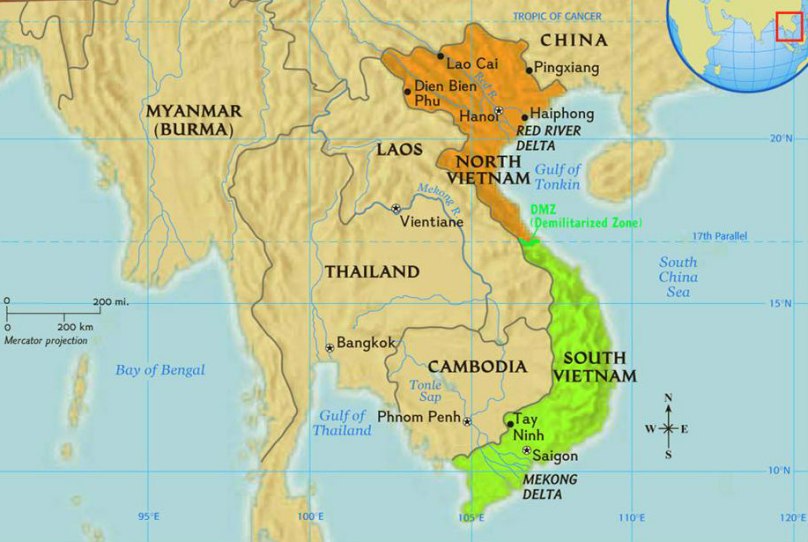
(map via National Geographic magazine)
M1 Garands in the ARVN
Less Garands already in-country from the ANV era, major shipments of M1 Garands to the ARVN started in 1963 and ran off and on for the remainder of the USA’s involvement in the conflict. Below is a year-by-year table of M1 Garand deliveries.

The reason for some of the small lot sizes in uncertain. These may have been paperwork maneuvers to square up previous shipments, or, may have been honest accounting of very tiny transfers. The 1967 shipments went to the USA’s Military Assistance Advisory Group for redistribution; one might assume this was to prevent corruption and incompetence by ARVN generals.
As shown in the table, warehoused M1 Garands were drawn from both the US Army and the Department of the Navy, which also included US Marine Corps Garands, but excluded US Coast Guard examples, as that branch was part of the Department of the Treasury at the time. No US Air Force Garands went to the ARVN.
Legal authority for M1 Garand transfers to South Vietnam was through Section 501 of the Military Assistance Program (MAP), a law passed in 1961. This facilitated the rifles as no-cost loans of indefinite duration, with the United States retaining first option on reclaiming the guns when South Vietnam no longer wanted them (this of course became moot when the country collapsed in 1975). Section 505 of MAP prohibited South Vietnam from reselling the Garands; of which they were seemingly in no position to do anyways.

Garands were only a small part of MAP aid given to South Vietnam, which ranged from bayonets to warplanes. Between the time the ARVN was formed in 1955 and it’s extinction 20 years later, the USA loaned $14.78 billion worth of weapons to the country ($61 billion in 2019 dollars) via MAP. Naturally this is dwarfed by the USA’s own spending on the Vietnam War, which was roughly the equivalent of $1.1 trillion in 2019 dollars. The bulk of the MAP gear came during operation “Enhance”, part of President Nixon’s “Vietnamization” policy in 1972 – 1973, which accelerated arms deliveries. The above report was presented to President Carter in 1978.
MAP Garand transfers were organized by the multi-services Pacific Command (PACOM) at USMC Camp Smith, HI. Rifles taken from various points in the United States were consolidated at ports in California, and usually sent via merchant ship to Saigon or Cam Ranh Bay by way of Japan or the Philippines.
The Garands supplied to South Vietnam were not segregated by their original manufacturer or production year; all were mixed together. As the M1s transferred out of American custody, each entire lot was reassigned one new NATO stock number (NSN). For example the large first lot in 1963 was assigned the NSN 1005-00-674-1425. This number, which still exists in the NSN database in 2019, has a description of “Rifle, Caliber .30” and a listed weight of 9,999 lbs. The manufacturer is listed as “United States Army” with a mailing address of Rock Island Arsenal.

(With M1 Garand deliveries flowing, the ARVN could flush out obsolete holdings. In October 1969, an auction of 200,000 old weapons was held, with scrappers and arms dealers both eligible to bid. Shown here are a Mle. 1892/M.16 cavalry carbine and a Berthier rifle; both holdovers from the French era.)
in ARVN service
M1 Garands naturally replaced any legacy MAS-36s or other WWII bolt-actions left over from the Indochina War, in addition to some M1/M2 carbines being inappropriately (in American eyes) used as standard infantry rifles. However by large, they replaced nothing as most were assigned to completely new ARVN units which were being rapidly recruited as South Vietnam’s army expanded in size.
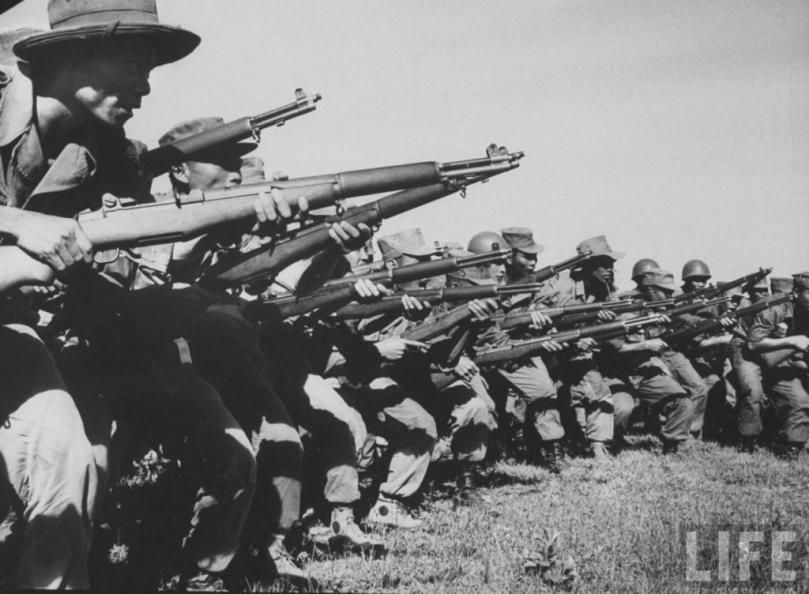
(South Vietnamese troops pose with M1 Garands in July 1961.) (photo via Life magazine)
By no means was the Garand the only WWII firearm in daily ARVN use during the 1960s and early 1970s. The M1/M2 carbine, the M1911 pistol, the Thompson family (M1928, M1, and M1A1), the M1918 BAR, and the M1919 and M2 Browning machine guns were all in service.

(A South Vietnamese unit poses with a UH-1 Iroquois helicopter. All firearms are of WWII vintage: the soldier taking aim has a M1 Garand rifle, the others Tommyguns or M1 carbines.)
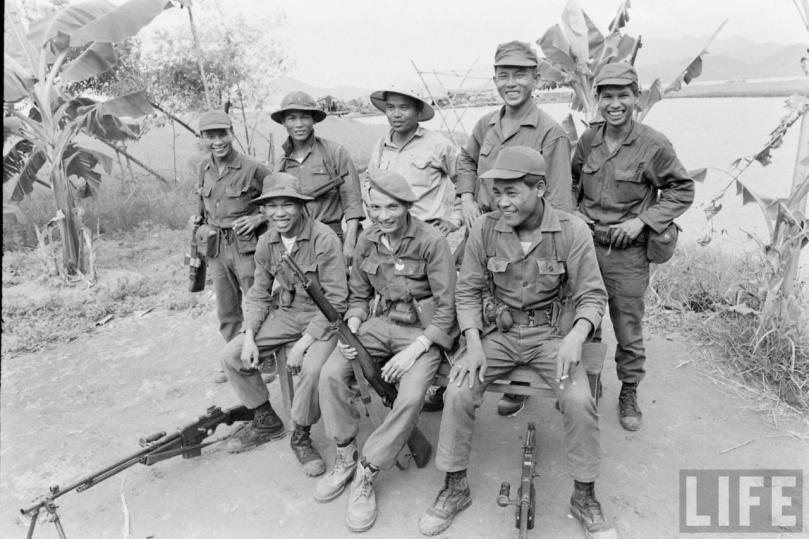
(This 1965 photo shows ARVN troops armed with M1 Garands, M1918 BARs, and M1 Thompsons – all WWII guns.) (photo via Life magazine)

(With the M1 Garand, the ARVN used both WWII-surplus M1905 and M1 bayonets, and the M5A1 shown above. The M5A1 entered American service during the Korean War. This plastic-handled design was basically a M3 combat knife modified for bayonet use.) (photo via warrelics.eu website)

(A South Vietnamese soldier in 1968 equipped with a M1 Thompson, Mk2 pineapple grenade, and M1 pot helmet; WWII items.) (photo via Life magazine)

(The M1 pot was standard headgear in the ARVN it’s entire existence. This one is marked in the late-1960s style of military police.)
The M1/M2 carbine was most popular as the ARVN viewed it’s lesser recoil and lighter weight as being superior to anything else (including the M1 Garand) in their perception, prior to M16s being available. Some South Vietnamese troops were loathe to exchange their carbines for Garands, even though on paper the M1 Garand was clearly a superior battlefield asset. Before large-scale transfers of M16s started, this perception was occasionally a point of contention with American advisors.
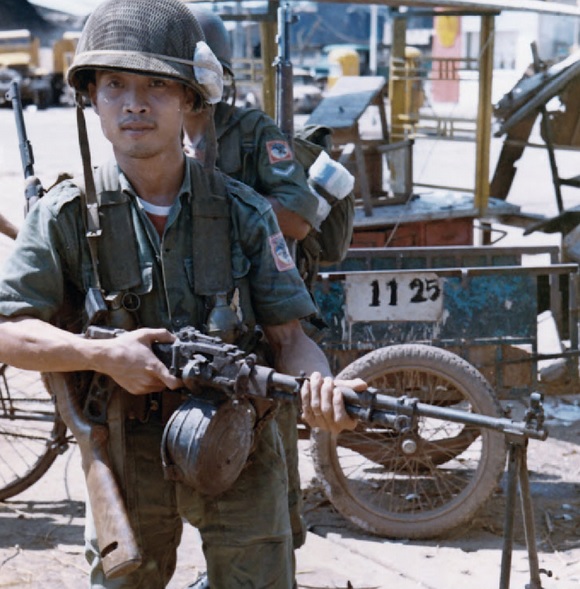
(A paratrooper of the ARVN with slung M1 carbine and a captured RPD, a Soviet-made light machine gun of Cold War vintage.)

(The “other side” appreciated the M1 carbine as much as the ARVN. This 1971 photo shows a female Viet Cong on the Ho Chi Minh Trail armed with one.)
The virtues of the M1 Garand in Vietnam were much as they had been during WWII: it was rugged, reliable, accurate, and the .30-06 Springfield had respectable stopping power and penetration through jungle foliage. By the mid-1960s, it’s perceived vices were lack of full-auto as the AK-47 became more common on the battlefield, and the rifle’s physical size, as discussed further below.
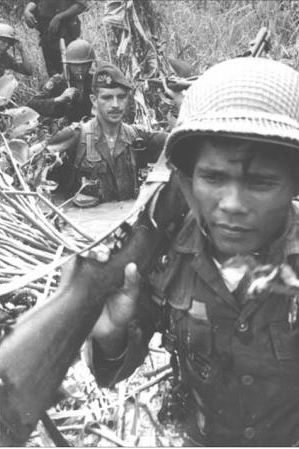
(A South Vietnamese soldier with WWII M1 Garand and Mk2 pineapple grenade during the 1960s.)

(Cadets of South Vietnam’s Military Academy pass in review with M1 Garands. Whatever it’s other hardships, the ARVN was never short of pageantry.)

(This photo shows an American advisor with a very early model of the AR-15 (note no forward assist and original-pattern mag) while his South Vietnamese partners carry M1 Garands.)

(Rangers of the ARVN armed with M1 Garands in 1961.) (photo via Life magazine)

(ARVN officer candidates train with M1 Garands.)

(ARVN paratroopers with M1 Garands pose with MPs with M1 carbines near Phan Thiet in 1968.) (photo via ARVN Veterans Association)
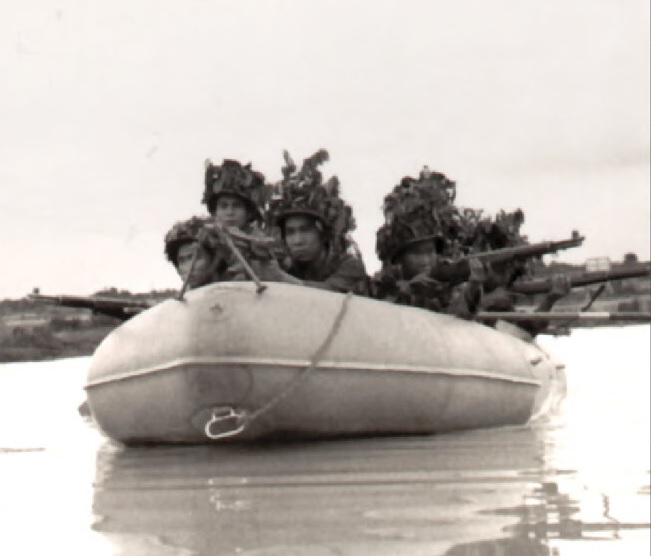
(ARVN Rangers train with a M1918 BAR and M1 Garands during the 1960s.)

(A Ranger of the ARVN strikes a pose with sandals, sunglasses, civilian transistor radio, and nón lá hat. Rangers were tremendously respected in the ARVN and generally allowed to do or dress as they pleased. The M42 “duck hunter” camouflage originated in the US Marine Corps during WWII. It was popular with US Army SpecOps personnel during the Vietnam War, and the same in the ARVN. This Ranger is armed with a M1911A1, the infantry behind him M1 Garands.)
the “physical stature” issue
One of the concerns regarding the use of the M1 Garand in Vietnam was that, on average, South Vietnamese recruits were shorter and smaller than their American counterparts had been during WWII. It did not help that although the legal draft age in South Vietnam was 18, rural teenagers two or even three years below were sometimes conscripted.

(Young ARVN soldier with M1 Garand and four en blocs in 1966.)
Like many things, this supposition was probably a mixture of fact and imagination. The M1 Garand was of average length & weight by WWII rifle standards, and maybe a bit long for soldiers with short arms. Likewise the .30-06’s recoil was not punishing but not mild either. On the other hand, when Japan rearmed after WWII it selected the M1 Garand as it’s first service standard rifle without problems, despite the fact that the same concerns had been voiced in relation to the average build of JGSDF recruits.
The Pentagon’s long-running (1961 – 1974) “Agile” project, which originally sought to refine skills, technology, and tactics for third-world allies to fight in extremely rural areas, was interested in this issue.

One recommendation of “Agile” was to consider converting the ARVN from the M1 Garand to Armalite’s then-new AR-15 rifle, which was eventually done in the form of the M16.
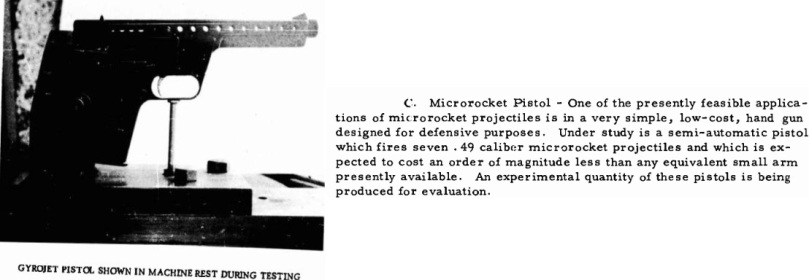
“Agile”s other ideas descended in levels of seriousness after that, starting with a suggestion to convert from the Garand to Eugene Stoner’s modular “63” weapon system (25 of which were made by Cadillac Gage for the ARVN) all the way down to a suggestion to adopt the Gyrojet system; an idea thankfully not taken beyond basic concept phase.
“Kalishnikov vs Garand” in Vietnam
In popular culture, the Vietnam War is portrayed as the classic match between the M16 and AK-47, however the reality was more complicated than that. In the early phases of the war, probably all the way up to the Tet Offensive in 1968, the Viet Cong used any imaginable firearm; largely SKSs and Mosin-Nagants but with a liberal dose of 98ks, MAS-36s, M1 carbines, MAT-49s, PPSh-41s, MP-40s, and AK-47/AKMs; while the de jure North Vietnamese army used a mixture of SKSs and AK-47s/AKMs – continuously shifting to the latter pair. After Tet, AKs became predominate.
Likewise, before 1968 the ARVN was equipped almost exclusively with WWII-era firearms, thereafter rapidly going on par with the US Army’s current types.

(ARVN soldiers with M1s in the 1960s.)

(Viet Cong guns captured during 1967’s operation “Cedar Falls”; represented are the M1 carbine, PPSh-41, M1 Thompson, M3 Grease Gun, MAT-49, RPG-7, and come civilian guns. Of the military arms, all but the MAT and rocket launchers are WWII-vintage. Some look as if they hadn’t been serviced since 1945.)
The M1 Garand was superior to any WWII-vintage bolt-action weapon in Vietnam, and to the post-WWII SKS as well. Compared to the AK-47, the Garand was of equal weight and ruggedness. While the most cited difference was the AK’s full-auto capability; to the ARVN other factors were more important. A loaded AKM had equal mass to a loaded M1, but, held 30 rounds to the Garand’s 8. While of equal loaded weight, the AK was 10″ shorter; making it not only easier for troops of modest stature to hold, but also less cumbersome in the jungle.
The weights of cartridge mattered as well. In what are called “fire units” (a military logistics term); an 80-round M1 Garand fire unit weighed 119½ lbs in ten articles (nine .30-06 en blocs + a loaded rifle), while a 90-round AK-47 fire unit weighed just 77 lbs in three articles (two preloaded 7.62mm mags + a loaded rifle). Thus the AK was superior in that regard; especially when considering the nature of most North vs South encounters; which were usually brief affairs decided by which side laid the most lead on the other in the most rapid timeframe; not classical infantry tactics.
One clear advantage the Garand held over the AK-47 was accuracy, but for the ARVN this was degraded by the abysmal marksmanship of it’s average soldier; being rushed through boot camp as cheaply as possible and then sent straight into combat.
Any M1 Garand could be fitted with the M7 rifle-grenade launching kit, which was an advantage compared to the communists, who typically assigned a dedicated RPG-7 troop plus dedicated ammo-bearer for this task.

(1964 selectees at the ARVN’s NCO course, training with the Garand’s M7 kit.)
As the ARVN received increased numbers of M79 40mm grenade guns during the 1960s, this advantage faded as well, as squads followed the American example and patrolled with a dedicated “thumper”.
replacement of the M1 Garand in the ARVN
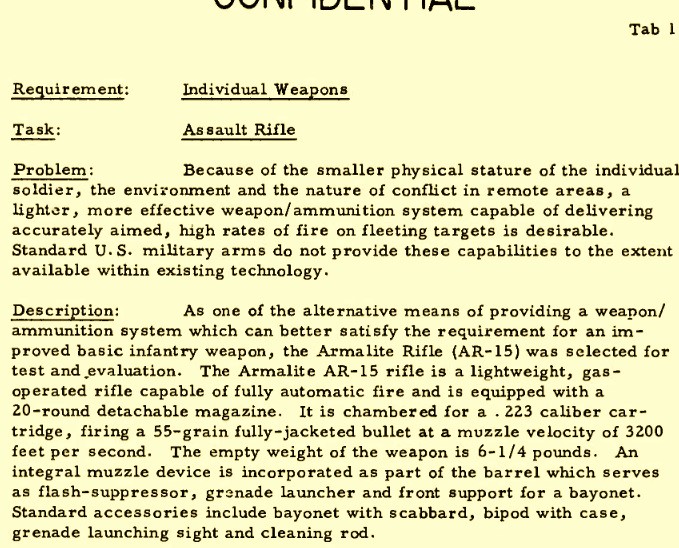
(1963 document advocating the AR-15 as a new standard rifle for the ARVN.)
In 1962, South Vietnam took delivery of 1,000 AR-15s (the original Armalite design). This was part of a DARPA (the Pentagon’s research arm) study as to the weapon’s feasibility for eventual American use. The results of real-world use of the rifle was monitored by American defense advisors in South Vietnam and reported as “highly favorable”.
Besides the battlefield advantages, there was a strong desire to standardize the American and South Vietnamese armies as far as ammunition. With the American changeover to M16 / 5.56 NATO starting in 1964, there was strong momentum for ARVN units to follow suit.

(American soldiers with M16s meet up with a South Vietnamese armored cavalry unit still equipped with M1 Garands.)
While the need to replace the M1 Garand was more or less decided, actually doing so was another matter and deliveries of the M16 (initially, the notoriously unchromed pre-A1 versions) were slow and sporadic. Only in May 1968, after the Tet Offensive had started, President Johnson released 100,000 M16s for South Vietnam.

(Depending on who is to be believed, American Gen. William Westmoreland either sped up or stalled South Vietnam’s adoption of the M16. Here he reviews a ARVN pathfinder unit armed with M1 Garands.)
Oddly enough by late 1968, a few months after final M1 Garand deliveries of any note were made, the ARVN’s first-tier combat divisions had already converted to M16s. Thus the ARVN’s rifle progression (and associated teething troubles) was rapid: MAS-36 to M1 to M16, in only about a decade and a half.
Just as in the US Army, the ARVN’s changeover from WWII M1 Garand to modern M16 was not “flipping a switch” but rather gradual. Ranger and airborne units were the first to get it, followed by infantry, then finally comms, MP, and other units. During the late 1960s it was common to see ARVN units of mixed M1 Garand / M16 composition.

(ARVN radioman with M1 Garand.)

(Naturally the South Vietnamese navy was slower to transition than the army. Here, US Navy Adm. Thomas Moorer reviews a South Vietnamese honor guard with M1 Garands.)
By 1973, the changeover was complete and most frontline combat units of the ARVN had standardized on the M16.
use by ROK forces
Often forgotten is that South Korea participated in the war. A total of 300,000 South Korean (ROK) soldiers rotated through Vietnam; usually at 40,000 – 45,000 strength at any given time. The ROK Army 9th “White Horse” division and ROK Marine Corps 2nd “Dragons” brigade were the main elements.

(A ROK marine in South Vietnam armed with M1 Garand during 1966.)
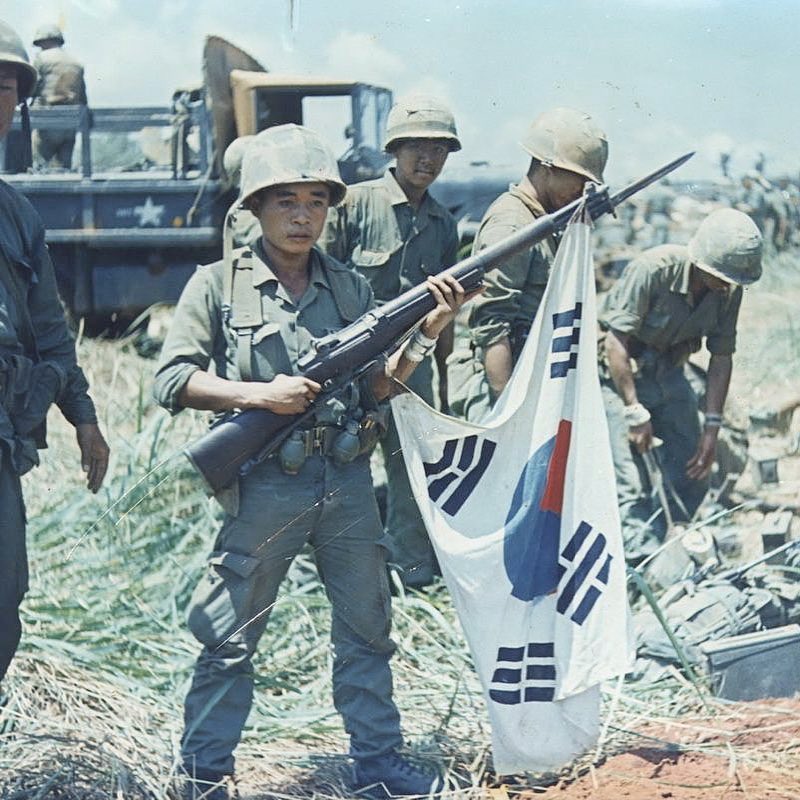
(South Korean soldier with M1 Garand in South Vietnam.) (photo via Asia Economy Daily newspaper)
For South Korea, there was a desire to standardize with the US Army and ARVN as they changed rifles, however the situation was more complex as it’s own homeland had a “hot” northern border to defend. During the late 1960s, there was a brief interlude where the M1 Garand, M14, and M16 were simultaneously being used.
use (or, non-use) by American forces
There was no official unit-level use of standard (non-sniper) M1 Garands by American forces in South Vietnam after 1963, which is quite certainly not the same as guaranteeing that none whatsoever happened.

(The US Army expected it’s next war to be a short high-intensity conflict with the Warsaw Pact in Europe. As involvement in Vietnam deepened, new tactics had to quickly be developed. This early-1960s photo shows a COIN (counter-insurgency) exercise inside the USA. Soldiers armed with M1 Garands examine fallen rebels, played by fellow soldiers.)
The M14 officially replaced the M1 Garand as the US Army’s service-standard infantry rifle in 1957. In a behemoth the size of the Cold War-era American army, this was not just “flipping a switch”, and the changeover was protracted. It was not until the start of 1965 that the ADCC (active-duty combat component) was fully converted; here with ADCC meaning active-duty (not Reserve or National Guard) divisions intended for actual combat; those typically being infantry, air cavalry, armored, MP, and airborne. Even within these divisions, subunits such as HQ companies, logistics, and the such, retained M1 Garands until sufficient M14s were available.
In 1964 (actually, even before the M1-to-M14 change itself being completed), the M16 began to enter US Army service, following the same general path. Throughout the late 1960s, into the 1970s and end of the Vietnam War, M14s then fell down the food chain and equipped National Guard, reserve, and non-ADCC units; often (but not always) replacing M1 Garands.
Thus the US Army’s progression from the WWII-era M1 Garand through M14 to the modern M16 was not linear; with subunits in some US Army divisions retaining M14s well past the end of the Vietnam War, and some subunits converting directly from M1 Garands to M16s during the conflict.
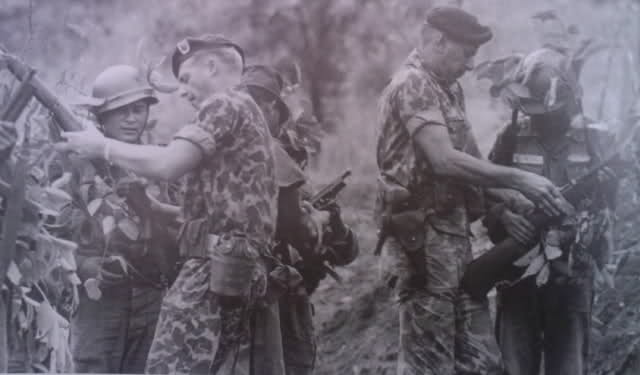
(American instructors train South Vietnamese troops on the Garand in 1964.)
In Vietnam, this meant that the Garand was absent. The US Army accelerated the use of the M16 as much as possible, so that by 1967 it was quite clearly the predominate type in-country.
An irony of the war was that in the US Army, other WWII firearms – the M3 Grease Gun, M1 Thompson, M1 carbine, M1897 shotgun, and even M1918 BAR – were decently represented in-country….just not the M1 Garand.
In the American defense establishment, the US Marine Corps is part of the Navy department and it’s rifle program was separate from the US Army’s. Some USMC units very early in the war may have still had Garands, but not to any appreciable extent. For example the USMC 9th Expeditionary Brigade was already equipped fully with M14s when it landed at Da Nang in 1965.
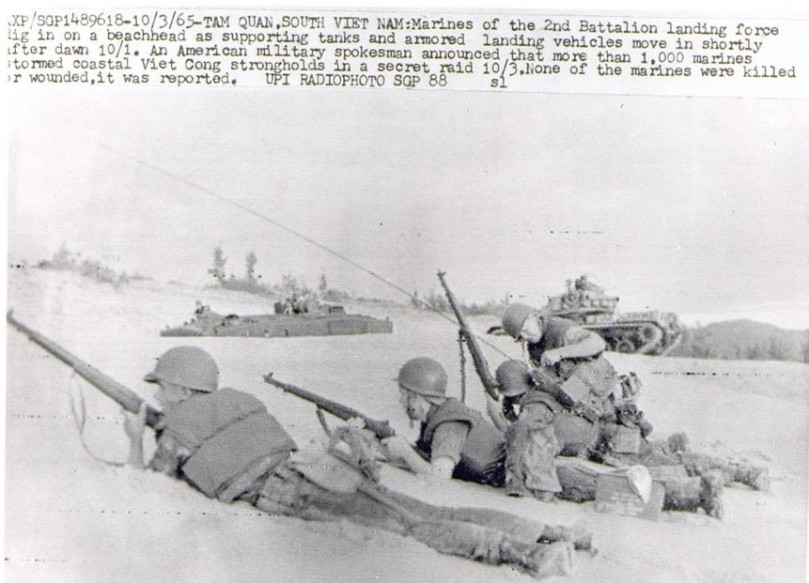
(The caption on this March 1965 photo is probably wrong and the men with Garands are likely US Navy sailors of a beachmaster team. All USMC amphibious units in Vietnam had already fully converted to the M14 by then.) (UPI photo)

(The USMC’s final changeover from M14 to M16 was more protracted than the US Army’s. Taken during the 1968 Hue battle, this photo shows Marines using the M14 and M16 side-by-side.)
Generally speaking, the standard (non-sniper) version of the M1 Garand simply did not see American use in the conflict.
sniper versions of the Garand
While the American military did not use the basic version, it certainly did employ the sniper versions of the M1 during the war, as did the ARVN.

(Sniper versions of the Garand along with a standard model.) (photo via National Rifle Association)
Both the M1C and M1D versions saw use in Vietnam. There were two runs of sniper Garands, the main one during the final two years of WWII and then a supplementary build during the Korean War. American forces in Vietnam used the sniper Garands until sufficient M40A1s were available. For the ARVN, this was it’s only sniper rifle it’s entire existence.
use by “the other side”
The communists (regular North Vietnamese army and the Viet Cong) were not about to turn their noses up at any captured M1 Garand, especially in the earlier and middle (basically before 1968) parts of the war. Similar to the ARVN, the communists also considered the M1 Garand less-preferable than the lighter M1/M2 carbine, or full-auto American WWII guns like the M3 or Thompson.

(North Vietnam published a series of pamphlets for distribution to the Viet Cong on use of captured American-made weapons. This one describes maintenance of the M1 Garand.) (photo via enemymilitaria website)
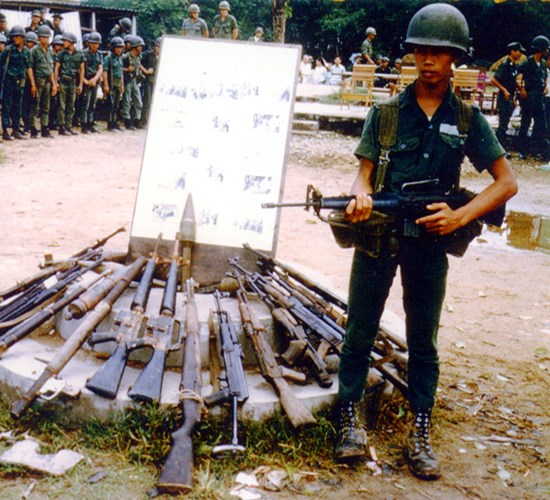
(A soldier of the ARVN with M16 guards captured Viet Cong weapons after the Tet Offensive. Most are combloc gear but there are two M16s and in the center, a M1 Garand.)
the end
With the “Vietnamization” policy at the end of the 1960s and curtailment of American involvement in the early 1970s, South Vietnam was in a precarious position, now without the American air and ground support it had leaned on throughout the war; and with the North still largely on a war footing. The year 1973 marked the final deliveries of any M1 Garands to South Vietnam; by which time the M1 had already largely been supplanted in first-tier use by the M16.
Despite it’s predicament, the speed with which South Vietnam collapsed in 1975 surprised military observers worldwide. In early March 1975, the North decided to undertake a limited offensive in the central highlands region, both to gain territory and more importantly, to see how far they could push their luck before the United States intervened again. But there was to be no more American involvement and by mid-March, the communists held the northern inland quarter of the country and decided to just keep going. Having already overstretched the ARVN, which was weaker than it had been five years previous, South Vietnam’s government made a fateful choice to retreat completely from the upper half of the country, basically anything beyond Cam Ranh Bay.
This “temporary consolidation” turned into a rout. By month’s end, Da Nang and Hue had fallen. By mid-April North Vietnamese troops were approaching Saigon, and on 29 April the USA evacuated it’s embassy.
Contrary to the sometimes-portrayal today, the ARVN did not just buckle and give up at the end. Many ARVN units fought with great courage. One battle stands out; at Xuan Loc during the second and third weeks of April, remnants of the ARVN 18th Division along with what remained of the South’s air force, held off and briefly even pushed back an entire North Vietnamese corps. But it was all too little, too late. The ARVN’s rank-and-file was let down by squabbling generals, a clueless government in Saigon, and years of neglect beforehand.
On 30 April 1975 Saigon was overrun and that was the end of South Vietnam and the end of the Vietnam War.
the Thuong Tiec statue
One of the more visible artistic renderings of the M1 Garand in South Vietnam was at the Binh An National Cemetery; the country’s rough equivalent of what Arlington is to the American military. At the time the country collapsed, the cemetery contained graves of about 16,000 fallen ARVN troops, a tall concrete obelisk monument, South Vietnam’s Tomb Of The Unknown Soldier, and the Thuong Tiec statue.
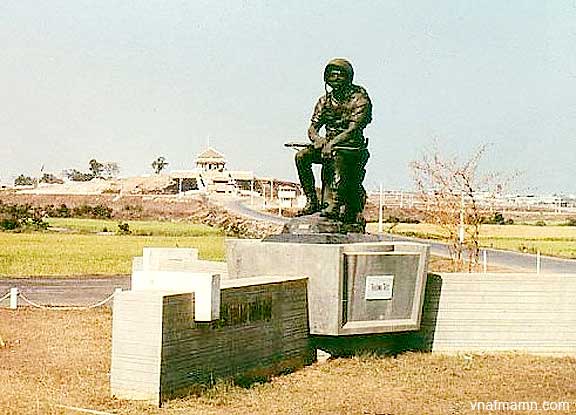
(The Thuong Tiec (mourning) statue. The pagoda on the hill behind covered the ARVN’s unknown soldier.) (photo via vnafmamn.com website)
The bronze statue showed a seated ARVN soldier in M1 pot helmet with a M1 Garand rifle. It was sculpted by Nguyen Thanh Thu, who said he was inspired by seeing a battle-weary ARVN soldier having an imaginary conversation with fallen buddies. It was installed at the cemetery in 1971.
When South Vietnam fell in 1975, the statue was toppled over by North Vietnamese troops.

During the late 1970s, the unified government closed the cemetery, encircling it with a cinderblock wall with signs insulting the buried ARVN troops. The statue’s base was bulldozed and a guardpost erected on the spot to prevent any commemoration.
During the 1980s, an American veteran of the war managed to get inside and filmed the cemetery’s condition; it was guarded with restricted access, completely overgrown and being used to graze cattle, with a factory built over some of the graves. Many tombstones had been vandalized. The ARVN’s Tomb Of The Unknown was pried open, empty, and desecrated. By contrast the nearby official Vietnamese military cemetery, which opened two years after the war ended, was immaculate and well-maintained.
During the 1990s, the Vietnamese government started to allow widows and families to visit individual graves again. In 2006, the Vietnamese police stopped guarding the cemetery and allowed general access, however any ceremonies are still prohibited, and no funds are allocated to maintaining the graves, which must be done by families.
Discussion of the ARVN is both a cultural and legal taboo in modern Vietnam – quite different than the way modern Americans openly discuss the Confederate army; or modern Nigerians, Biafra’s.
FATE OF THE ARVN’s M1 GARANDS
The victorious North, now governing a reunified country, inherited intact an unimaginable haul of American-made weapons in 1975. In all post-WWII military history there was nothing even remotely close to this event. The only vague parallel was in 1990 when reunified Germany inherited the East German military, but that was under much different circumstances.
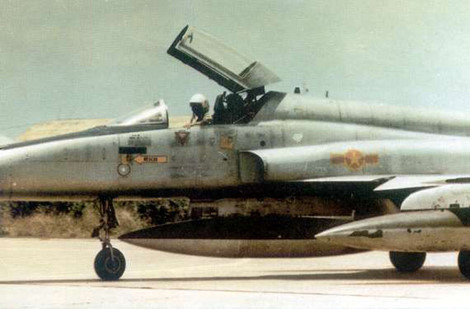
(A Northrop F-5 fighter inherited from the defunct South’s air force in 1975, ready for a mission in 1979.)
The grand prize was 114 fighter jets; followed by about 800 other aircraft, 550 tanks, 1,300 artillery pieces, the bulk of the South’s navy, thousands of APCs, trucks, MUTTs, and hundreds of thousands of firearms with millions of rounds of ammunition.

(Taken on 1 May 1975, this photo shows a pile of M16s, M60s, and M1919s of the defeated ARVN.) (Associated Press photo)
This bonanza of free weaponry would not all be usable. In late 1975 / early 1976 the Vietnamese had to consider several factors: ♦What they actually needed ♦Which American-made gear compared favorably to Soviet-made systems already in use ♦What could keep going long-term.
The last factor was most important. There would never be further American spare parts or ammunition support; so going forward these would need to either be replicated locally, or, obtained on the worldwide arms black market.
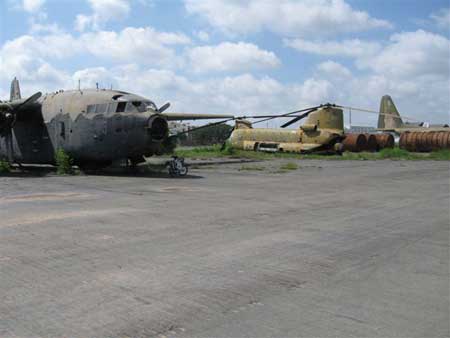
(One source of spare parts was to strip one item to keep another two or three going a while longer. Here is a graveyard of stripped ex-South Vietnamese aircraft.)
For the Vietnamese, choices had to be made as to what would be kept and what wouldn’t. For example, money spent to reverse-engineer parts for a WWII-era warship could not then be spent on black market 5.56 NATO ammo; while black market buys of Huey helicopter parts might preclude training technicians on American-made radars, and so on.

(Taken during the summer of 1979, this photo shows Soviet-made APCs disgorging from one of the defunct South Vietnamese navy’s amphibious ships. This is probably the South’s former HQVN Tien Giang, which had been the US Navy’s LSM-313 during WWII. Easy to maintain, Vietnam finally decommissioned this useful ship in 1990.)
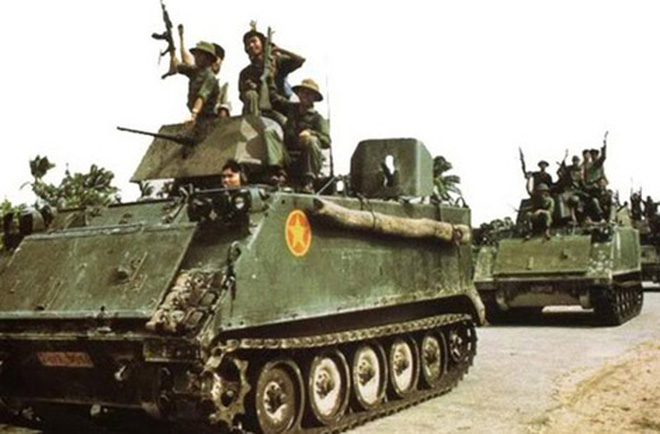
(Ex-ARVN American-made M113s in use during Vietnam’s war against the Khmer Rouge in Cambodia.)
There were other factors external to the weapons. Vietnam’s hoped-for peace dividend never really happened as Vietnam’s main aid benefactor, the USSR, was embroiled in “…it’s own Vietnam War” in Afghanistan during the Andropov and Gorbachev years, on top of a crippling arms race with the USA.
Cam Ranh Bay’s fate was typical. In January 1945, the US Navy’s operation “Gratitude” attacked the Imperial Japanese Navy base here. Carrier-based planes inflicted heavy damage, with 20 aircraft destroyed on the ground and most of the base’s fuel lost. The IJN abandoned Cam Ranh Bay thereafter. Starting in 1965, the US Navy rebuilt and extensively expanded the WWII facility, with a large deepwater port, Marine Corps barracks, and adjacent naval airfield. It was used until the American departure in 1972.
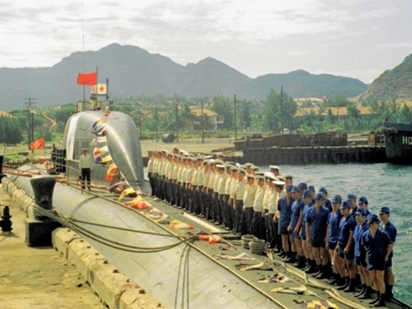
(A Soviet nuclear submarine moored to an ex-US Navy pier at Cam Ranh Bay in 1979.)
Captured intact in 1975, Vietnam leased the massive naval base to the USSR. However the rent was normally re-routed right back to the USSR via the COMECON aid system, to offset Vietnam’s running trade deficit. None of it was available to support continued use of American-made arms, certainly not WWII-vintage ones like the Garand.
The end result of all this was that ex-ARVN systems retained were either “too good to pass up” regardless of the cost, or, lesser gear which was easy to maintain but still somehow superior to combloc equipment. The M1 Garand did not fit either category. Thus, there was no large-scale adoption of the Garand after 1975.
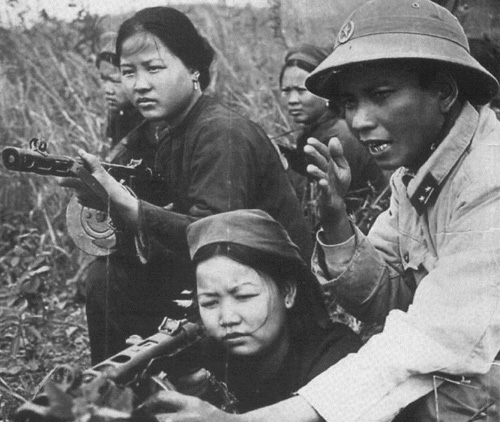
(Even as the M1 Garand vanished, Soviet-made gear of WWII continued in use. This 1979 photo shows a village militia being trained on the PPSh-41.)
ghost rifles
What then happened to the fifth of a million M1 Garands is then something of a mystery. During the early 1980s, unexpected appearances of Garands on the world’s battlefields were almost without fail, instantly attributed to Vietnam, only to be found to have come from elsewhere later on.
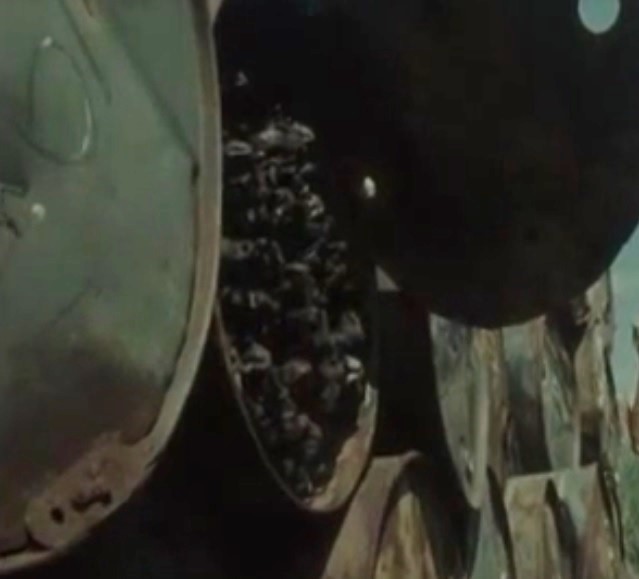
(One method South Vietnam had used to store excess / second-tier rifles was empty 55 gallon drums outdoors. Some non-service weapons inherited in 1975 were probably not pristine by then.)
For certain there were exports of ex-ARVN equipment. In 1976, an organization called Cuc Quan Lý Vu Khí, Khí Tài, & Ðan Duoc (approximately “Department Handling Weapons, Gear, & Ammunition”) was created to dispense with ex-ARVN equipment. It’s existence was revealed in the most comical of ways; in 2008 an archivist in Hanoi accidentally uploaded some files onto a website serving retired Vietnamese army veterans. It was taken offline but by then widely seen.
Curiously, a file from this department dated 1982 described the weapons as leaving “cáng Sai Gòn” (Saigon port), 5½ years after the official name change to Ho Chi Minh City.
There were several exports of ex-ARVN gear between November 1976 and July 1982. Designated by an alphabetical code, they were “C” (a failed plot to overthrow Pinochet in Chile, apparently known in Vietnam as operation “Lemus”), “N” (Nicaragua), “S” (communist rebels in El Salvador), and “X” which is still uncertain but thought to be Cuba. In none of these cases were M1 Garands mentioned. The “C” shipment is the best-known; in 1986 Chilean police captured a cache of 3,000 M16s. By cross-referencing Colt serial numbers, which were foolishly not sanded off, they were positively proved as ex-ARVN rifles. Again, no M1 Garands were found in this cache.
It is known that during the 1980s Vietnam helped Iran, another American ex-ally cut off from military aid. Main items were rotors and turbines for Iran’s Huey fleet, and spare F-5 fighter parts. Iran was also a M1 Garand user and did use the rifle in combat against Iraq between 1980 – 1988, however by then the Iranians considered it a bottom-tier asset and it seems doubtful they would buy more abroad.
Part of the difficulty in tracking the post-1975 history of American-made weapons is the way the modern Vietnamese military refers to them. “Thê hê dâu tiên” (first-generation) and “Thê hê thú hai” (second-generation) are normally used in a proper military way, as in differentiating the Mosin-Nagant from the AK-47 for example. But because of the taboo mentioned earlier regarding the ARVN, “Thê hê thú hai” is also a euphemism for ex-South Vietnamese gear inherited in 1975, regardless of it’s nature – a M1 Garand from WWII and modern A-37 Dragonfly attack jet are both “second-generation” arms when referred to this way. Without knowing the context the document is using, this can be confusing.
In 1978 the legendary international arms dealer Sam Cummings approached Vietnam’s diplomat in Europe, Le Duc Tho, with a $500 million offer to buy the defunct ARVN literally in it’s entirety; everything from howitzers to handguns. Cummings told the Washington Post newspaper in 1981 that he proposed to set up shop in the USA’s abandoned Saigon embassy, which he presumed was still full of telex machines and long-distance telephone switchboards, perfect for marketing the haul. (The embassy was in fact taken over by Petro, Vietnam’s state oil concern, and later torn down.) Vietnam did not accept his offer. Several years later, they tried to hire Cummings as an arms marketing consultant to help them sell American-made gear. Cummings saw little value in starting a new competitor to his Interarms company and declined.

(Now 43 years after the end of the Vietnam War, ex-ARVN guns remain a police concern in Vietnam. Here are two M1/M2 carbines and a M16 seized in 2017.) (pnoto by Minh Anh)
In March 1997, federal agents seized two truckloads of guns at a warehouse in Otay Mesa, CA. They were labelled as “hangers”, and had originated in Ho Chi Minh City, then traveling through Singapore, Germany, and finally Long Beach, CA; with a final destination of Mexico. They were only discovered by accident due to a paperwork error. The assumed intended recipient was narco gangs inside Mexico. The main portion was M1/M2 carbines of WWII vintage, along with some M16s. According to the L.A. Times newspaper, they were traced back to old ARVN lots, and in poor condition. This would not seem like an operation endorsed by the Hanoi government, and may have been corruption inside the Vietnamese military. It’s also possible that the guns had been black marketed by the South Vietnamese themselves and had already been circulating for 20+ years. Once again, M1 Garands were absent.
For the M1 Garands, their ultimate fate is, in all likelihood, simply the least exciting story: they were scrapped after 1975. As outlined earlier Vietnam had to make hard choices as to which American-made gear it would and wouldn’t keep, and despite the M1’s legendary WWII history, by the late 1970s there was nothing remarkable about it from a military perspective compared to a M16.

(A pile to be scrapped in 1980s Vietnam; American M60 machine guns of 1960s vintage along with British-made Brens from WWII, and a Hotchkiss Mle. 1914 of the Vichy forces during WWII.)
The above photo is from a series that appears on military & firearms message boards every few years, often with differing background stories. It was actually taken at a dump in Vietnam by a British metals merchant during the 1980s. The original photo series has several piles of old guns roughly sorted by type; a stack of bolt-action rifles (including ex-Wehrmacht types), a mountain of Tommyguns, a sea of rusting WWII-era box magazines, and this pile of machine guns. This was probably the fate of most of the ARVN’s M1 Garand stockpile. During the 1980s, scrap metal was one of the few commodities Vietnam had to export in a bid to offset it’s trade deficit.
During the 1980s, while the M16 was somewhat present in the regular active-duty Vietnamese army, some M1 Garands were held in reserve along with whatever .30-06 Springfield stockpiles remained in 1975. As 5.56 NATO ammo leftover from the war was depleted, the M16s themselves were put into reserve, displacing M1 Garands which were then presumably scrapped.
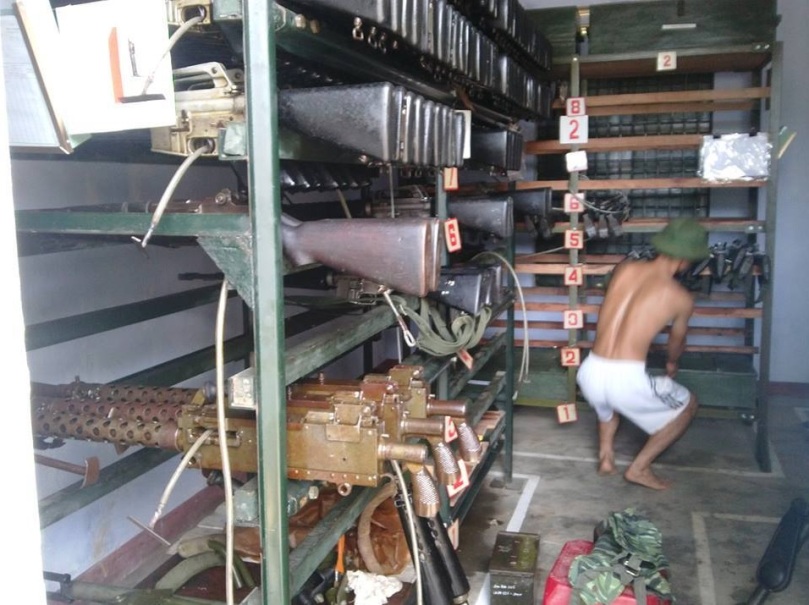
(Taken around 2015, this photo shows a reserve armory in Vietnam filled with ex-ARVN equipment. Most of the guns are M16s but there are five WWII weapons; a trio of M1919A1 machine guns and a pair of M1 Garands.)
During the 1990s, Vietnam’s military “turned the corner” and became a high-tech, world-class fighting force. As part of this, manpower was streamlined and there was thus even less need for nonstandard firearms.
By 2019, the last official holder of M1 Garands in any quantity in Vietnam is the DQTV, also known as the Worker’s Militia in English. Vietnamese citizens not in the military are required to be a member for 4 years and can volunteer for more after that. Similar in some (but certainly not all) ways to the USA’s National Guard, DQTV members drill on weekends. The DQTV is armed with a variety of cast-offs; mainly SKSs and M16s but with some M1 Garands.

(DQTV members drill in 2018 with M1 Garands. A M16 is also visible.)
postscript
By 2016, the last regular-duty Vietnamese army units still using ex-ARVN guns were a few light infantry elements specifically trained on just American-made weapons, by then limited to the M16 and M1911A1.
As one of his last acts of office, President Obama eliminated the arms & ammunition embargo against Vietnam which had been in place since the fall of Saigon. In 2017 President Trump reaffirmed this policy and encouraged arms exports to Vietnam.
Categories
Credit Card Gun

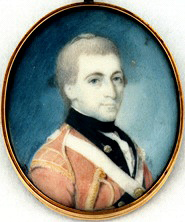
Born in Aberdeenshire in 1744, at fifteen Ferguson was commissioned as an officer in the Royal North British Dragoons, known as the Scots Greys. Cornet Ferguson then spent two years at the Royal Military Academy at Woolwich, an institution that specialised in training artillery and engineer officers, an indication of the young man’s intelligence.[1]He first saw action during the Seven Years War in Europe. In 1768, seeking advancement, Ferguson sold his cornetcy and transferred to the 70th Regiment of Foot, buying a commission as a captain and serving in the Caribbean for several years.
In 1771, the British Army introduced dedicated light infantry companies to each infantry battalion; Captain Ferguson was given command of the 70th Foot’s light company. Initially, the British Army’s light infantry arm was merely “light” in name with little specialist training given.[2] In 1774, Ferguson and his company spent the summer at Maj. Gen. William Howe’s light infantry training camp, learning how to deploy and fight as skirmishers.[3]

Ferguson was part of a generation of active, intelligent, professional and ambitious British light infantry officers. The light infantry arm of the British Army in the 1770s and 1780s was arguably one the most able elements of its day. Ferguson was reputedly one of the army’s finest marksmen and by the time he arrived in North America he was well versed in the light infantry tactics of the day, including skirmishing, scouting and irregular warfare.
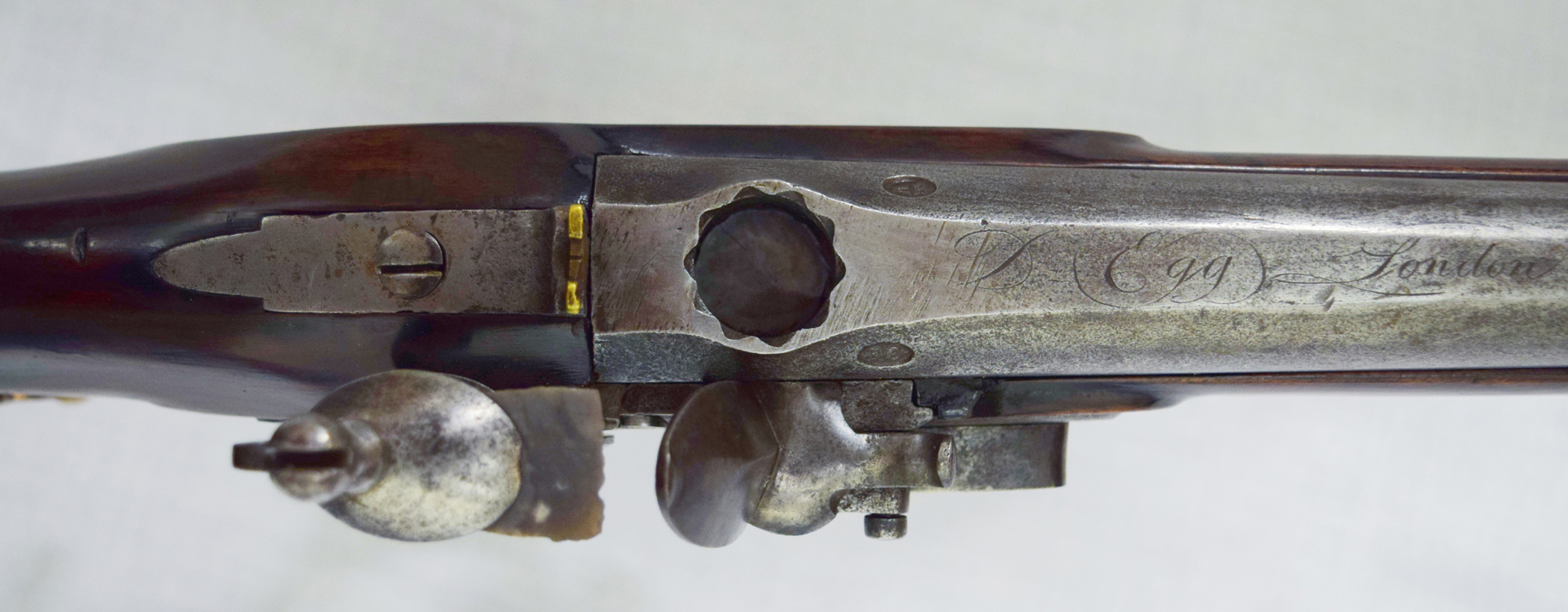
It is believed that Ferguson began developing his rifle shortly after his time at the light infantry training camp. His rifle, however, was not the British Army’s first experimentation with a screw plug breech-loader. In 1762, John Hirst had provided the Board of Ordnance with five breech loaders; twenty more were reportedly ordered but they never saw service.[4] Twelve years later, in 1774, Ferguson started working on his rifle, commissioning Durs Egg, a renowned Anglo-Swiss gunmaker, to produce a slightly improved version of Isaac de la Chaumette’s screw plug breech loading action. La Chaumette had originally developed his screw breech rifle in the early 1700s, with his “Fusil qui se charge par la culasse” or roughly translated “rifle which is loaded by the breech” first appearing in 1704.[5] La Chaumette came to Britain as a Protestant refugee and patented some of his firearms designs in 1721. Several years later Michael Bidet built a sporting gun for King George II using La Chaumette’s screw breech system.[6]

In principle Ferguson’s rifle was similar to a number of earlier screw breech rifle designs which preceded it. In addition to La Chaumette’s system, numerous British gunmakers produced screw breech guns including John Warsop, Joseph Griffin, John Hirst, Joseph Clarkson and George Payne.[7]
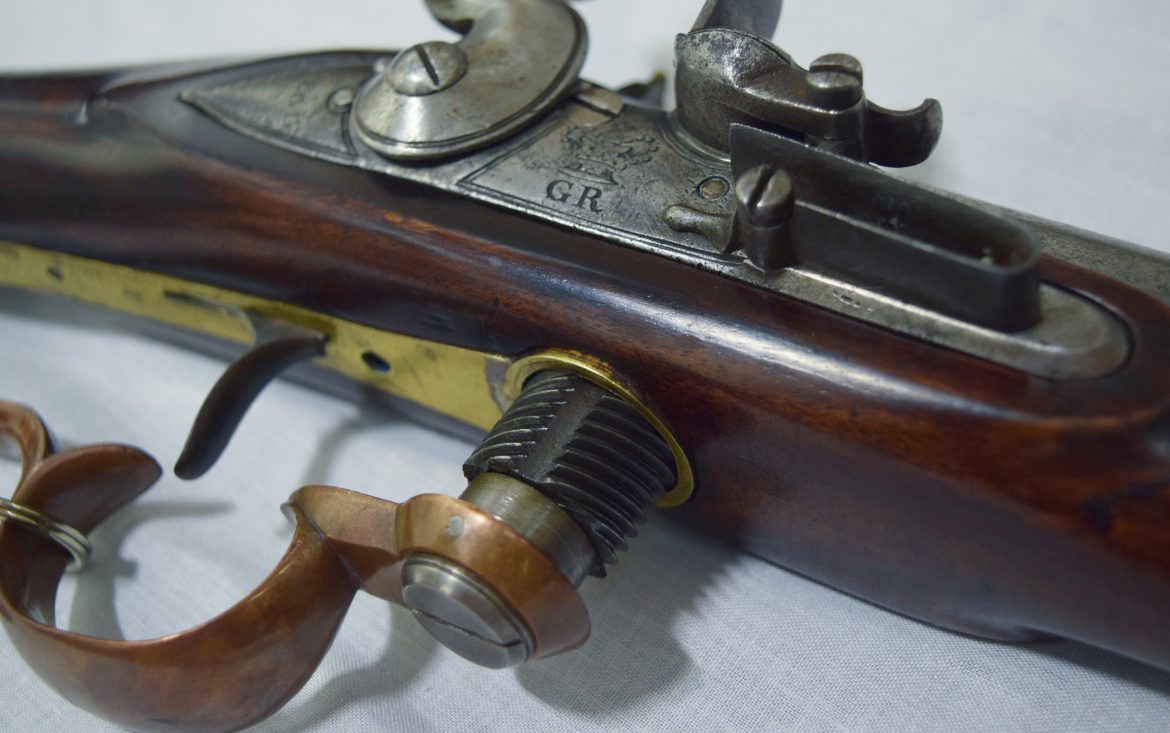
While clearly not unique, Ferguson made a number of improvements to La Chaumette’s earlier work, principally by introducing a multi-start perpendicular screw breech plug with ten or eleven threads at one pitch. This meant the breech could be opened by completing just one full revolution of the trigger guard which was attached to the base of the plug, and acted as a lever. While it might be expected that fouling from powder residue or from dust and dirt might quickly seize up the screw breech, Ferguson designed the screw to have a number of recesses and channels to provide a place for fouling to go during use, and while not noted in contemporary sources the plug itself could be lubricated.
Ferguson’s breech plug was also tapered at a ten or eleven degree angle, making it less prone to fouling but still able to create an adequate breech seal. Unlike most contemporary rifles pressed into service Ferguson’ rifle could mount a bayonet and also had an adjustable rear sight—the first of its kind to see service. In 1775, Ferguson began lobbying senior officers including Lord Townsend, the Master General of Ordnance. He told Townsend in a letter that his rifle “fires with twice the expedition, & five times the certainty, is five pounds lighter and only a fourth part of the powder of a common firelock.”[8]

British encounters with rebel militia and especially with riflemen in America during 1775 fuelled interest in the adoption of suitable rifles for British service. In the summer of 1776, American Gen. Charles Lee wrote that “the enemy entertain a most fortunate apprehension of American riflemen.”[9] As a result, 1,000 German Jaeger-pattern rifles (described as the Pattern 1776 Infantry Rifle by firearms historian De Witt Bailey) were ordered in late 1775.[10] In April 1776, Ferguson’s attempts to interest to British Army’s senior officers in his breechloading rifle began to bear fruit. Ferguson was allowed to demonstrate his gun before senior officers on the April 27, 1776.[11] He fired at targets at 80, 100 and 120 yards away and “put five good shots into a target in the space of a minute.”[12] Durs Egg was directed to make improvements and two more rifles were built; Egg appears to have had a close working relationship with Ferguson with several of the surviving rifle’s being Egg-made guns.[13]
Ferguson never claimed to have invented the breech system himself, writing that “altho the invention is not entirely my own, yet its application to the only Arm where it can be of use is mine, and moreover there are several original improvements . . . which are entirely mine.”[14] As such Ferguson’s subsequent patent, filed in December 1776 and granted the following March, is titled “Improvements in Breech-loading Fire-arms.”[15]
In the early hours of Saturday, June 1, 1776, Ferguson was advised that Lord Townsend along with Gen. Lord Jeffery Amherst (the Lieutenant-General of the Ordnance), Lt.Gen. Edward Harvey (the Adjutant-General) and Lt. Gen. Thomas Desaguliers (of the Royal Artillery) wished him to demonstrate his rifle at Woolwich later that morning. The morning was wet and windy but Ferguson put on a display of shooting which is still widely regarded as an impressive feat.
An account of the demonstration was published in the Annual Register, a yearly almanac of notable events;
under the disadvantages of heavy rain and a high wind, performed the following four things, none of which had ever been accomplished with any other small arms. 1st, He fired during four or five minute at a target, at 200 yards distance, at the rate of four shots each minute. 2dly, He fired six shots in one minute. 3dly, He fired four times per minute advancing at the same time at the rate of four miles in the hour. 4thly, He poured a bottle of water into the pan and barrel of the piece when loaded, so as to wet every grain of the powder, and in less than half a minute fired her as well as ever, without extracting the ball. He also hit the bull’s eye at 100 yards, lying with his back on the ground; and, notwithstanding the unequalness of the wind and wetness of the weather, he only missed the target three times during the whole course of the experiments.[16]
The demonstration had a dramatic effect. Lord Townsend, the Master General of Ordnance, directed that one hundred rifles should be produced and that Ferguson was to oversee their production. Four Birmingham gunmakers were contracted by the Board of Ordnance to produce twenty-five rifles each; these companies were William Grice, Benjamin Willetts, Mathias Barker (in partnership with John Whateley), and Samuel Galton & Son. Birmingham was then the hub of British gun manufacture; in 1788 it was estimated that some 4,000 gunmakers were at work in the area.[17] Each contractor was paid £100 for twenty-five guns, each rifle costing £4. Little is known about the production of the guns and the manufacturing techniques used but the screw plugs would have taken many hours of work using a treadle lathe and lapping techniques to fit them for each rifle.[18]
The rifles were handmade and as a result none of their parts were interchangeable. To ensure the unique breech plugs were matched to the right rifle, engraver William Sharp was paid three pence per rifle to engrave serial numbers in three places on the rifles: the butt plate, trigger guard and the tang.
Keen to experiment, Ferguson was given a small detachment of six men from the 25th Regiment of Foot to train in the use of his rifle and on October 1, he gave a demonstration for King George III at Windsor.[19] With his small detachment Ferguson repeated some of his earlier feats of marksmanship, firing from his back and putting five rounds into the bullseye.

During his meeting with the King, Ferguson also confidently proposed a new practical uniform for light troops. Sources do not confirm the color of these proposed uniforms, but Ferguson’s experimental corps did later have green jackets made up when they arrived in America.[20] This was not unusual; during the previous French & Indian War some British light infantry units including Rogers’ Rangers and Gage’s 80th Regiment of Light-Armed Foot had worn proto-camouflage uniforms just as did some of Ferguson’s contemporaries like the Queen’s Rangers and Tarleton’s British Legion.
As a result of his demonstrations and petitioning of senior officers Ferguson was authorized to raise an experimental corps of riflemen to test the rifle in the field, composed of 200 men formed into two companies.[21] This plan was temporarily cancelled in late 1776, but early the next year Ferguson was directed to begin forming and training a company of men at Chatham. The men who formed the new corps were drawn from the 6th and 14th Regiments of Foot, Ferguson and 100 riflemen were given orders to sail to sail for America on the March 11, 1777.[22] There they would join Gen. William Howe’s imminent campaign to take Philadelphia.With time short, Ferguson scrambled to gather supplies and begin training his men in the use of his rifle.
Captain Ferguson was formally seconded from the 70th Foot and officially given his command on March 6, 1777, his corps authorized for one campaign season after which Ferguson and his men would have to return to their units unless the experimental corps was seen as worthy of maintaining. Ferguson and his men arrived in New York in late May. Interestingly, according to Roberts and Brown’s book Every Insult & Indignity, Ferguson’s report to the Ordnance Store Keeper in New York noted that his corps arrived with only sixty-seven “rifle guns.”[23] Correspondence dating from June 1777 from the Master General of Ordnance’s secretary shows that a further thirty-three rifles were sent to America along with forty bayonets. It is unclear if these reached Ferguson and his men by the time they embarked for the Philadelphia campaign.[24]
Ferguson’s company took part in the fighting in New Jersey in June 1777 before General Howe withdrew his army from that region and regrouped to take a different approach to Philadelphia. In July, Ferguson confirmed that his “small command,” which had lost six men in early skirmishing, “never exceeded 90 under arms,” a far cry from the 160 to 200 he had hoped to field.[25] Ferguson realized that to grow his corps he would have to take men from other battalions, who were naturally averse to this. If Ferguson did not have enough rifles to equip his entire corps it seems likely that his men were armed with a mixture of rifles and standard issue muskets.
Throughout the Philadelphia campaign Ferguson’s experimental force acted as scouts and fought in a number skirmishes and engagements, the largest of these being the Battle of Brandywine. Ferguson and his company were attached to Gen. Wilhelm von Knyphausen’s column which was tasked with fixing George Washington’s Continental Army in place while General Howe’s main force flanked the American position. Ferguson and his men found themselves in some hot fighting at the head of Knyphausen’s column with the light infantry vanguard which screened the advance. Alongside the Loyalist light infantry battalion, the Queen’s Rangers led by Maj. James Wemyss, Ferguson’s riflemen pushed back American light infantry under Brig. Gen. William Maxwell.[26]
During the battle Ferguson and a party of his riflemen supposedly encountered George Washington, chivalrously deciding not to open fire. However, despite Ferguson’s own account of the encounter he could not confirm it was Washington and much myth surrounds the story. While the story cannot be proven with any degree of certainty it is definitely a colourful anecdote. Shortly after the alleged encounter Ferguson was badly wounded and his men were forced to fall back. He was shot in the right arm, his elbow shattered by a musket ball.[27] It took a year for Ferguson to recuperate, requiring numerous painful surgeries removing bone fragments to save his arm from amputation.
In the meantime, with well-trained light infantry in short supply, Ferguson’s experimental corps was disbanded. His men were returned to their original parent units and while one contemporary source suggest their rifles were placed in store, other evidence suggests the men took their kit back to their parent battalions.[28] Heavy casualties are often described as one of the key reasons for the rifle corps’ disbandment.[29] In reality Ferguson’s losses were comparatively minor. Wemyss’ Rangers suffered heavily, losing fourteen killed along with ten officers and forty-four other ranks wounded, while Ferguson’s corps suffered just two killed and six wounded—including Ferguson himself.[30] In a letter home to his brother George, Ferguson attributed this relatively low casualty rate to “the great advantage of the Arm [his rifle] that will admit of being loaded and fired on the ground without exposing the men.”[31]
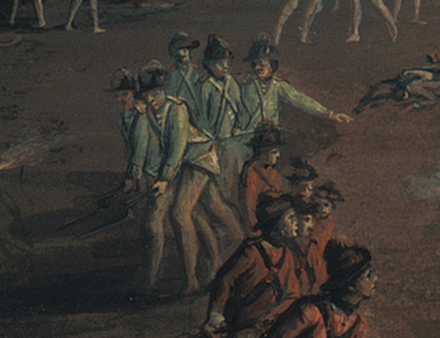
Xavier della Gatta’s 1784 painting of the Battle of Paoli shows what is believed to be some of Ferguson’s men, in their green jackets with their long sword bayonets fixed, over a week after Brandywine.[32] De Witt Bailey also notes that a February 1778 entry in the orderly book of the Guards brigade calls for an inventory of the rifles still in use with various battalions.[33] If this was the case then attrition of the remaining guns from use in the field partially explains why so few survive today. In July 1778, an order was issued to the army for the return of all Ferguson rifles still in use to the Ordnance Office for repair and probably storage.[34]
Recovered but with a largely lame right arm, Ferguson returned to duty in late 1778, leading a number of scouting expeditions and raids on American bases at Chestnut Neck and Little Egg Harbour, in New Jersey.[35] He was subsequently made a brevet lieutenant colonel and appointed commanding officer of a Loyalist militia force, the Loyal American Volunteers, and later was made Inspector of Militia in the Carolinas.[36] During 1779 and 1780, Ferguson led his Loyalist volunteer forces in the Carolinas.[37] Interestingly, a Commissary of Artillery ordnance stores return from November 1779 to May 1781, found in the Sir Henry Clinton Papers, notes that 200 “serviceable” rifles were issued to a “Capt. Pat. Ferguson” on December 16, 1779.[38] It does not state whether any of these rifles were of his pattern or if they were all muzzleloaders. While commanding the Loyalist militia force Ferguson was killed during the Battle of Kings Mountain in South Carolina, in October 1780.[39]
Opinions of Ferguson from historians is somewhat divided. Andrew O’Shaughnessy describes him as an example of “ambition, motivation, professional dedication and courage.”[40] Ian Saberton describes Ferguson as “a humane, benevolent officer who, despite trying circumstances, applied his best endeavours.”[41] Wayne Lynch is more critical of his strategic skill, suggesting that despite being “an active and enthusiastic soldier, I do not see military genius . . . he was a probably a good officer at times but not really the stuff of independent command.”[42] Despite his debated ability as a soldier and tactician, Ferguson’s true legacy lies with his innovative rifle, his belief in his design and the limited but intriguing service it saw.
Ferguson’s Rifle
For the purposes of this article we will confine our discussion to the military-pattern Ferguson rifles, excluding later hunting pieces. There is a great deal of variation among the few surviving Ferguson Rifles, in terms of minor differences such as wood or steel ramrods or the type of rear sight, but also more fundamental differences such as the use of brass or bronze plugs or the number of breech screw threads and the presence and positioning of fouling grooves. This is the result not just of eighteenth-century manufacturing processes but also due to choices made by individual gunmakers and evolution of the design itself.
Typically, the surviving rifles have a number of common features including the multi-start breech plug, trigger guard lever, the presence of one of two unusual patterns of rear sight and a bayonet lug beneath the barrel. While there is some slight variation in barrel length and bore diameter, the style of stock seen on the rifles is fairly uniform. The Board of Ordnance rifles had .65 calibre bores and used the same eight-groove rifling as the Jaeger-pattern 1776 muzzle-loading rifles, not the four-groove rifling that Ferguson patented, presumably for ease of manufacture.
Markings on the rifles vary with the manufacturer. The guns made for the Board of Ordnance have marker’s stamps on the barrel, various proof markings and a serial number at the tang while the locks were marked with “Tower” and “GR.” The non-Board of Ordnance guns have commercial gunmaker’s marks on both lock and barrel. Most of the surviving military pattern rifles have wooden rather than steel ramrods. There is some slight variation in the brass pipes which hold the ramrod as well as some differences in the position and width of the bass nose cap. The ramrod could be used to muzzle-load the rifle if the screw plug became jammed or so fouled it could not be opened. Provided the plug was in place the rifle could still be loaded from the muzzle, but without the plug the rifle was useless.
Two patterns of rear sight are seen, the Board of Ordnance guns having a rear notch post sighted at 200 yards, a folding leaf sight with an aperture sighted at 300 yards, and a further notch cut above the aperture likely sighted for 350 yards. The other pattern of sight, not seen on the Ordnance contract guns, is a brass rear sight located behind the breech, just in front of the tang, which slides up and down. This sight is on two Durs Egg-made rifles as well as an example produced by Hunt dating from 1780 held by the National Army Museum.[43]
The two surviving rifles believed to be original Board of Ordnance guns, held at the Morristown National Historical Parkand the Milwaukee Public Museum, have eleven-thread breech plugs; other surviving rifles have ten.[44] Not all of the surviving Ferguson rifles appear to have the anti-fouling cuts described in the 1776 patent. The style of trigger guard varies with most being made from iron, but all appear to be held in the closed position by a similar detent projecting from the rifle’s wrist. Damage to the guns is common as the stocks proved to be somewhat fragile. The two of the surviving rifles believed to have been used by Ferguson’s experimental corps have a number of cracks and breaks in their stocks; whether these occurred during service or in the years afterwards is unknown but the wrists and wood surrounding the breech and lock are fragile.
Some of the improvements that Ferguson made to La Chaumette’s earlier system are discussed above. According to Ferguson’s patent the breech plug was designed to be cleaned without having to be fully removed from the rifle; the lower section of the plug on some guns was smooth and allowed fouling to be pushed out of the threads as the action was worked. The plug was not retained in the gun by any mechanical means, however, and if unscrewed too far could come free. Additionally, according to Ferguson’s patent, the threads cut into the plug directed fouling away from the breech and were intended to spread powder gases evenly.[45] A “hollow or reservoir” behind the plug also helped direct fouling out of the action; not all surviving examples have this. The chamber and ball had a larger diameter than the barrel to ensure the ball remained seated until fired and to make sure it engaged the barrel’s rifling.
Firing the Ferguson
The loading procedure prescribed by Ferguson for his rifle is uncertain as no instructions have survived. The rifle used the British Army’s standard .615 calibre carbine ball, rather than a full sized .71 musket ball. Like the British 1776 Jaeger-pattern rifles, Ferguson’s rifle used special double-strength or “double glazed” rifle powder. De Witt Bailey notes that five 100-pound barrels of this powder were ordered for Ferguson’s corps before they embarked for America, each barrel costing £7 and 10 shillings, roughly six times more expensive than regular issue powder.[46]
Riflemen likely carried both paper cartridges and a powder flask and ball bag. To load, the rifleman would first place the rifle on half cock (a safety position where the trigger cannot be pulled) and then unscrew the breech. He would then place a ball into the breech, where it was held in place by the narrower bore. Then he would pour in powder behind the ball either from his flask or from a cartridge, before screwing the breech plug back into place. He then primed his pan from either his flask, the remains of the cartridge, or by pushing excess powder from the top of the breech across into the pan. He was then ready to fire.
The Ferguson had the advantage of much quicker and easier loading than contemporary muzzle-loading rifles. A muzzle-loading rifle takes longer to load as the ball has to be forced down the rifled bore, mating it with the grooves, which becomes more difficult as the barrel fouls with black powder residue. The Ferguson also had the distinct advantage of allowing the rifleman to rapidly load and fire in almost any position, or even while on the move, enabling him to make best use of cover—a tactic favored by the light infantry.
The all-important question is, how good of a weapon was the Ferguson? The two greatest advantages of Ferguson’s design were the ease and speed with which it could be loaded, and its accuracy. While speed was not Ferguson’s primary focus his impressive demonstrations showed that it could be fired far more rapidly than a muzzle-loading musket. During the 1777 campaign, and specifically during the Battle of Brandywine Creek, Ferguson found that the weapon’s ability to be loaded from cover was a significant advantage. At just over thirty-two inches long the barrels of Ferguson’s 1776 rifles were ten inches shorter than the Short Land Pattern musket (today commonly called the Brown Bess) then in service. It was substantially lighter, weighing around 7.5 pounds to the musket’s 10.5 pounds.[47] This made the rifle a handier weapon, one ideal for use by light infantry. The Ferguson was also far more accurate than the Short Land Pattern muskets.[48] But while the rifle was light, accurate and reliable it did have several weaknesses.
The first weakness stemmed from its construction. The rifle’s slender, lightweight stock was prone to cracking at the lock mortice where the wood was thinnest. As a result an iron horseshoe-shaped repair beneath the lock surrounding the breech screw was added to the rifle held at the Morristown National Historic Park, but it is unclear when this reinforcement was added. While not as robust as a standard issue musket, it is important to remember that the first batch of Ferguson rifles were still prototypes and the design could have been improved.
The cost of the rifles was also a disadvantage, as they were markedly more expensive than a smoothbore musket or even the Jaeger-pattern muzzle-loading rifles, which were around seventeen shillings cheaper. The cost of producing one Ferguson Rifle during the first production run of one hundred was in £4, double the cost of the Short Land Pattern musket, although economies of scale may have made the rifle cheaper had it gone into large-scale production. This and the slower rate at which the rifle was able to be produced meant that it could not be produced in the numbers necessary to challenge the dominance of the musket as the primary light infantry weapon.
Only one hundred rifles were officially made for the army, and the fate of most of them is unknown. A handful of original Ferguson rifles survive in private and public collections. After his death some of London and Birmingham’s finest gunsmiths, including Egg, Henry Nock, and Joseph Hunt, made Ferguson-pattern rifles in relatively small numbers for both military and hunting purposes.
Ernie Cowan and Richard Keller, who have built replicas of the rifle, describe it as “one of the finest rifles built during the eighteenth century.”[49] But Bailey describes it as “virtually useless as a military weapon” because the weakness of the rifle’s stock and the potential for fouling of the breech and bore.[50] In these criticisms I believe Bailey is too harsh. It must be remembered that these were prototype rifles being used by an experimental corps; the strength of the rifle’s wooden furniture could have been improved relatively easily and the impact of fouling is debated by those who have experience with modern black powder replicas.
While some erroneously believe the rifle was destined to replace the Short Land Pattern musket in general service, this is not the case. The Master General of Ordnance had initially directed the future focus of rifle production should be on the Ferguson breech-loader rather than the Jaeger-pattern; however, if larger scale production had begun, the rifles would only have been destined for light troops, the elite, disciplined well-trained, skirmishers who were best suited to their use. Ferguson himself was a proponent of light infantry, even suggesting that half the army in America should be light infantry, but I do not believe he intended his rifle to be issued to every soldier.
Ferguson’s riflemen never really had the chance to make the impact their commander desired. Sir William Howe made no mention of him or his men during his official report on the Battle of Brandywine.[51] The experimental corps was simply too small to do anything more than prove their concept. By the late 1770s the conventional British light infantry were more than a match for their American counterparts. Ferguson himself wrote Gen. Clinton in August 1778, noting that British light troops had gained “that superiority in the woods over the rebels which they once claimed.”[52]
The Ferguson Rifle has the distinction of being the first breech-loading rifle adopted for service by the British Army. Its service life, however, was short, especially compared to the 1,000 Board of Ordnance 1776 Jaeger-pattern rifles used throughout the war. Sadly, with so few made and with the wounding and later death of its inventor, the rifle did not have the opportunity to fully prove itself. It would be another twenty-two years, during the Napoleonic Wars, before the British Army experimented with a green-coated, rifle-armed unit again—what would become the 95th Rifles.
[1]Marianne M. Gilchrist, Patrick Ferguson ‘A Man of Some Genius’ (Edinburgh: NMS Enterprises Limited, 2003), 5.
[2]Matthew H. Spring, With Zeal and With Bayonets Only: The British Army on Campaign in North America, 1775-1783 (Norman, OK: University of Oklahoma Press, 2010 ), 246-8.
[4]“Flintlock breech-loading rifle – By John Hirst (about 1760),” Royal Armouries, collections.royalarmouries.org/object/rac-object-361.html, accessed November 3, 2018.
[5]Howard L. Blackmore, British Military Firearms 1650-1850 (Huntingtdon: Ken Trotman Publishing, 2010), 72.
[6]“Flintlock breech-loading gun (1727),”Royal Armouries, collections.royalarmouries.org/object/rac-object-15502.html, accessed November 3, 2018.
[7]Discussed in William Keith Neal, “The Ferguson Rifle and its Origins”, American Society of Arms Collectors, Bulletin #24 (Fall, 1971), and De Witt Bailey, British Military Flintlock Rifles 1740-1840 (Lincoln: Andrew Mowbray, 2002), 35.
[8]Gilchrist, Patrick Ferguson, 25.
[9]Jared Sparks, ed., Correspondence of the American Revolution Vol. II (Ithaca: Cornell University Library, 2009), 501-502.
[10]Bailey, British Military Flintlock Rifles, 26-29.
[11]The Scots Magazine, Vol. 38, 1776, 217, books.google.co.uk/books?id=ft4RAAAAYAAJ&dq=%27Captain+Patrick+Ferguson%27+the+king&q=ferguson#v=snippet&q=rifle&f=false, accessed October28, 2018.
[13]Bailey, British Military Flintlock Rifles, 37.
[14]Quoted in Bryan Brown and Ricky Roberts, Every Insult and Indignity: The Life Genius and Legacy of Major Patrick Ferguson, (CreateSpace Independent Publishing Platform 2011), Chap. 3 Kindle.
[15]The Gentleman’s Magazine and Historical Chronicle,Vol.41, 1776, 575, books.google.co.uk/books?id=cL9NAAAAcAAJ&dq=he+fired+during+four+or+five+minute+at+a+target%2C+at+200+yards+distance%2C+at+the+rate+of+four+shots+each+minute.&q=ferguson#v=snippet&q=ferguson&f=false, accessed October 30, 2018
[16]The Annual Register, or a View of the History, Politics and Literature for the Year 1776, 148, books.google.co.uk/books?id=JJI-AAAAYAAJ&pg=RA1-PA148&lpg=RA1-PA148&dq=he+fired+during+four+or+five+minute+at+a+target,+at+200+yards+distance&source=bl&ots=KKUtd0ASaK&sig=Ea0az8UUxbhYUzPTzuXg25LPzWo&hl=en&sa=X&ved=2ahUKEwio_NvlvObdAhVKDMAKHQl7CM4Q6AEwCnoECAoQAQ#v=onepage&q=he%20fired%20during%20four%20or%20five%20minute%20at%20a%20target%2C%20at%20200%20yards%20distance&f=false, accessed September 28, 2018.
[17]David Williams, The Birmingham Gun Trade (Stroud: The History Press, 2009), 37.
[18]Richard Keller and Ernest Cowan, “Shooting the Military Ferguson Rifle,” British Military Flintlock Rifles, edited by Bailey, 219-221
[19]The London Magazine, Or, Gentleman’s Monthly Intelligencer, Vol.45, 1776, 557,
books.google.co.uk/books?id=DfgRAAAAYAAJ&dq=american+riflemen&q=riflemen#v=snippet&q=riflemen&f=false, accessed October 18, 2018,
[20]Gilchrist, Patrick Ferguson, 29.
[22]The Gentleman’s Magazine, Vol.47, 1777, 144, books.google.co.uk/books?id=bHfPAAAAMAAJ&dq=he+fired+during+four+or+five+minute+at+a+target%2C+at+200+yards+distance%2C+at+the+rate+of+four+shots+each+minute.&q=ferguson#v=snippet&q=riflemen&f=false, accessed October 24, 2018.
[23]Roberts & Brown, Every Insult and Indignity, Chap. 11, Kindle.
[24]Bailey, British Military Flintlock Rifles, 44.
[25]Gilchrist, Patrick Ferguson, 37.
[26]Michael C. Harris, Brandywine: A Military History of the Battle that Lost Philadelphia but Saved America, September 11, 1777 (El Dorado Hills: Savas Beatie, 2014), 223-238.
[27]The Scots Magazine, Vol.39, January 1777, 603, books.google.co.uk/books?id=F14AAAAAYAAJ&dq=%27Captain+Patrick+Ferguson%27+the+king&q=ferguson#v=snippet&q=ferguson&f=false, accessed October 29, 2018
[28]Bailey, British Military Flintlock Rifles, 54.
[29]Blackmoore, British Military Firearms, 85.
[30]The Westminster Magazineor the Pantheon of Taste for June, 1777, Vol.5, Issue 2, 645, books.google.co.uk/books?id=NAQwAAAAYAAJ&pg=PA645&dq=Ferguson%27s+corps+of+riflemen&hl=en&sa=X&ved=0ahUKEwj4vrSXv4zeAhUKLMAKHf6bA58Q6AEIPDAE#v=onepage&q=Ferguson’s%20corps%20of%20riflemen&f=false, accessed October 27, 2018.
[31]Gilchrist, Patrick Ferguson, 39-40.
[32]S.R. Gilbert, “An Analysis of the Xavier della Gatta Paintings of the Battles of Paoli and Germantown, 1777: Part 1,” The Military Collector & Historian, 46, (1994), 98-108.
[33]“Orderly Book of Composite Guards Brigade, 21 Feb. 1778,” William L. Clements Library, Ann Arbor, Michigan, quoted in Bailey, British Military Flintlock Rifles, 54.
[34]Bailey, British Military Flintlock Rifles, 54.
[35]The London Gazette, November 28, 1778, Issue: 11931, 2,www.thegazette.co.uk/London/issue/11931/page/2, accessed November 2, 2018.
[36]The Scots Magazine, Vol.42, 1780, 425, books.google.co.uk/books?id=uV4AAAAAYAAJ&pg=PA425&dq=Ferguson+71+major&hl=en&sa=X&ved=0ahUKEwjjrfbbwozeAhVNasAKHUS1BIUQ6AEIKTAA#v=onepage&q=Ferguson%2071%20major&f=false, accessed November 6, 2018.
[37]“Col. Ferguson’s defeat,” The Scots Magazine, Vol.42, 1780, 688, books.google.co.uk/books?id=wEc2AAAAMAAJ&dq=%27Captain+Patrick+Ferguson%27+the+king&q=ferguson#v=snippet&q=ferguson&f=false, accessed November 3.
[38]“Return of Small Arms in Ordnance Stores, New York, Nov. 30, 1779—May 8, 1781,” Sir Henry Clinton Papers 155: 7, W. L. Clements Library, University of Michigan.
[39]The Scots Magazine, Vol.32, 1780, 29, books.google.co.uk/books?id=lOERAAAAYAAJ&pg=PA29&dq=scots+magazine+captain+patrick+ferguson++king&hl=en&sa=X&ved=0ahUKEwiuutvo1ubdAhVkK8AKHZd_DUsQ6AEIKTAA#v=onepage&q=scots%20magazine%20captain%20patrick%20ferguson%20%20king&f=false, accessed November 6, 2018.
[40]Andrew O’Shaughnessy, The Men Who Lost America (London: Oneworld Publications 2013), 263.
[41]Ian Saberton “The Revolutionary War in the South: Re-Evaluations of Certain British & British American Actors,” Journal of The American Revolution, allthingsliberty.com/2016/11/revolutionary-war-south-re-evaluations-certain-british-british-american-actors/,accessed October20, 2018,
[42]Wayne Lynch, “A Fresh Look at Major Patrick Ferguson,” Journal of The American Revolution, allthingsliberty.com/2017/09/fresh-look-major-patrick-ferguson/,accessed October 17, 2018.
[43]“Ferguson flintlock breech-loading rifle, 1780,” National Army Museum, collection.nam.ac.uk/detail.php?acc=1976-11-74-1, accessed November 2, 2018.
[44]“Ferguson Rifle,” American Revolutionary War Morristown National Historical Park, www.nps.gov/museum/exhibits/revwar/image_gal/morrimg/fergusonmusket.html, accessed October 12, 2018; and “Ferguson Breech Loading Rifle,” Milwaukee Public Museum,www.mpm.edu/node/27076, accessed October 12, 2018.
[45]Patrick Ferguson, Patent No. 1139 December 2, 1776, UK National Archives.
[46]Bailey, British Military Flintlock Rifles, 43.
[48]De Witt Bailey, “British Military Small Arms In North America 1755-1783,” American Society of Arms Collectors, Bulletin #71 (Fall, 1994),
americansocietyofarmscollectors.org/wp-content/uploads/2015/05/British-military-small-arms-in-North-America-1755-to-1783-B071_Bailey.pdf, accessed October 20, 2018
[49]Bailey, British Military Flintlock Rifles, 219.
[51]The Gentleman’s Magazine, Vol.47, 1777, books.google.co.uk/books?id=bHfPAAAAMAAJ&dq=he+fired+during+four+or+five+minute+at+a+target%2C+at+200+yards+distance%2C+at+the+rate+of+four+shots+each+minute.&q=brandy#v=snippet&q=brandywine&f=false, accessed October 21, 2018.
[52]Howard Peckham, ed., Sources of American Independence (Chicago: Chicago University Press, 1978), 2307.
Categories
Unloading A 1911 Pistol
Categories
