Categories

Top image: Smith & Wesson 22/32 Kit Gun courtesy collectorsfirearms.com
When somebody comes up with a great gun idea, one of the first things demanded after its initial success is either a scaled-down or scaled-up version. Smith & Wesson’s Hand Ejector series of double-action revolvers has become the icon of the company and was the benchmark of revolvers for more than a century. The first Hand Ejectors were brought to market in 1895 in two frame sizes: the .32-caliber I-frame and .38-caliber K-frame. It should be noted that there were some .32-caliber revolvers made on the K-frame as well. These revolvers found immediate favor among target shooters, as well as police officers and the general shooting public, and the company immediately began putting together a plan for producing revolvers from .22 caliber to .44 caliber in various frame sizes.
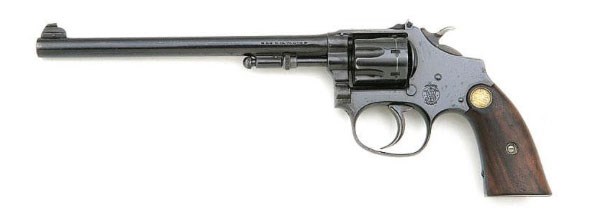
.22-cal. LadySmith revolver image courtesy invaluable.com
Smith & Wesson introduced the first Ladysmith built on its smallest M-frame in 1902. The Ladysmith was the only revolver made on this frame and featured a 7-shot cylinder chambered in .22 Long. Barrel lengths ranged from 2 to 6 inches. The Ladysmith was discontinued in 1921 with some 26,154 revolvers made in three variations. A major factor in consideration for halting production was the size of the revolver. It is said that the M-frame and its components were so small that the men assembling them had a fair amount of difficulty doing their job, thus increasing the cost of production substantially and lessening the profit on such pieces compared to their larger counterparts. These miniature Smith & Wessons are highly sought after by collectors today.
In 1910 a San Francisco-based gun dealer named Phil Bekeart began calling for Smith & Wesson to chamber its .32-caliber I-frame in .22 caliber. Bekeart felt that a heavy framed .22 would be a big seller among target shooters of the time. He was so committed to the idea that he pre-ordered 1,000 revolvers. This 22/32 Heavy-Frame Target model had a 6″ barrel, a six-shot cylinder, adjustable sights, checkered walnut stocks that extended beyond the square butt, a la the single-shot Smith & Wesson target revolvers. Bekeart’s faith in the popularity of the 22/32 Heavy-Frame Target model was a bit ambitious. Just 292 of the original order of 1,000 revolvers were shipped. Though this revolver remained in the Smith & Wesson catalog into the 1930s, it did not set the world on fire. Target shooting, while still popular, had pretty much reached its peak, and then—much like today—other forms of recreation began to make inroads into it, vying for its time and tools.
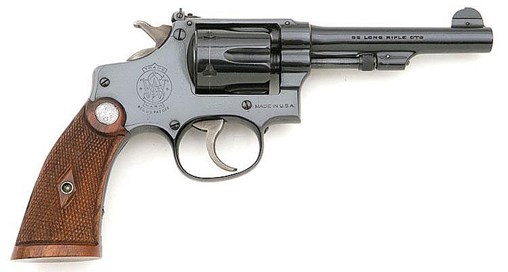
Smith & Wesson Transition 22/32 image courtesy invaluable.com
During the depths of The Depression—1936—Smith & Wesson introduced a 22/32 revolver with a 4″ barrel. Christened the Kit Gun, it was marketed to hikers and fishermen who wanted a handy, lightweight revolver to deal with pests and snakes. The term Kit Gun meant that its intent was to be carried within one’s kit as they traveled around the backcountry and streams. World War II curtailed virtually all civilian guns, including the 22/32 Kit Gun, but it returned to the S&W lineup in 1950. The post-war guns featured a change to the then-new hammer block, as well as a new micrometer-click rear sight.
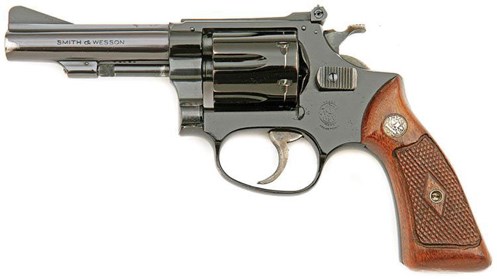
Smith & Wesson Flat Latch image courtesy invaluable.com
Three years later a new series was introduced, the 22/32 Kit Gun Model of 1953. The most notable change was an improvement to the I-frame by the replacement of a leaf-type mainspring with a coil spring. A 2″-barreled version was also first offered. In 1955 the fourth screw at the top of the sideplate was eliminated. Model numbers were assigned to all Smith & Wesson handguns in 1957, and the 22/32 Kit Gun became known as the Model 34. The I-frame was replaced by the J-frame in 1960; the primary difference being a larger cylinder window to make room for a longer cylinder that could accept .38 Special cartridges. Though this didn’t directly impact the Model 34, it followed with the J-frame to simplify the line. The M prefix to the serial number was added in October 1968 in order to distinguish these from others in the line. Fifteen examples of the Model 34 were started without the micrometer-click rear sight; instead a groove in the topstrap served. Of these, just four were shipped. As can be imagined, collector interest is quite high in these four revolvers.
In 1954 a prototype variation featuring an aluminum frame and weighing 14 1/2 oz. was built. Christened the Model 43, it was cataloged in 1955 but not in full distribution until 1958. A Model 51 chambered in .22 WMR was brought out in 1961 and discontinued in 1974. The Model 51 was produced in both round- and square-butt configuration with just 500 in the round-butt, making it quite rare and generation considerable collector interest.
A stainless-steel Kit Gun, dubbed the Model 63 was introduced in 1977 and made until 1998. It was available with either a 2″ or 4″ barrel, round or square butt.
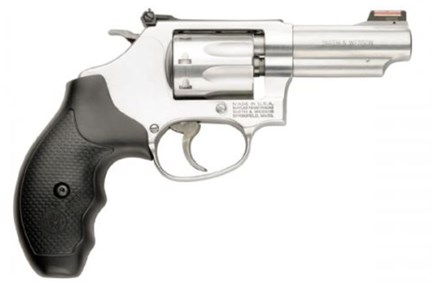
Smith & Wesson Model 63
The Model 34 was discontinued in 1991 though there were a few reissues. Today it exists in two more modern configurations, the Model 317 with an aluminum frame, 3″ barrel and an eight-shot cylinder or the Model 63, with a stainless steel frame, 3″ barrel and an eight-shot cylinder. The newer versions carry an MSRP just north of $750. Vintage Model 34s range from the mid-$500s to more than a grand, depending on condition and whether the original box and accessories are included. Add 75 percent to 150 percent for the 1953 version, and 200 percent to 300 percent for a pre-War Model 22/32 Kit Gun. Like Smith’s big .44s and .45s, there is considerable interest in these “micro” Smith & Wessons.


“We support the Second Amendment. If you own a gun, keep that gun. Nobody wants to take it away from you – at least I don’t want to do that.” That’s what Robert Francis “Beto” O’Rourke told voters in an April 2018 radio interview, when he was running against Republican Ted Cruz in the Senate election in Texas. Asked specifically about AR-15s (“I own an AR-15. A lot of our listeners out there own AR-15s. Why should they not have one?”) Beto responded (at the 0:24 mark), “To be clear, they should have them. If you purchased that AR-15, if you own it, keep it. Continue to use it responsibly.”
As a 2020 Democrat Presidential candidate, though, Beto became best known for his total repudiation of those sentiments. During the primary debate in Houston on September 12, 2019, he famously proclaimed, “Hell yes, we’re going to take your AR-15, your AK47…!” His campaign capitalized on this by selling t-shirts with the catchphrase, and Beto reiterated his call for mandatory confiscation in a CNN interview. Asked “Are you, in fact, in favor of gun confiscation?,” he replied, enthusiastically, “Yes, when it comes to AR-15s and AK-47s…”
This melodramatic rhetoric did nothing to improve his chances and he dropped out of the race a few weeks later. However, his call for mandatory gun confiscation was echoed by Kamala Harris and Joe Biden, who went so far as to promise that Beto was “going to take care of the gun problem with me. [He’s] going to be the one who leads this effort. I’m counting on ya.”
Beto is now running as the Democratic gubernatorial candidate in “Come and Take It” Texas. News reports indicated that he initially stood by his toxic stance on guns and confiscation, but – true to form – did another complete about-face ahead of the March primary amid speculation that it was just too much uncomfortable baggage in the intensely pro-gun state. At a campaign stop on February 8, Beto responded to a question with, “I’m not interested in taking anything from anyone. What I want to make sure that we do is defend the Second Amendment.” Deafened, perhaps, by the collective sound of jaws dropping across America, a spokesperson for O’Rourke’s campaign “declined to comment” on this stunning reversal.
The latest, but doubtless far from final, shift from Beto occurred at the SXSW 2022 festival in Austin, Texas, in a March interview by Evan Smith, CEO and co-founder of The Texas Tribune. “After some prodding, O’Rourke gave a direct answer” on his position that month on mandatory firearm confiscation:
I don’t think anyone should have [assault-style weapons]. And if I can find the consensus within the Legislature to have a law in the state of Texas that allows us to buy those AK-47s and AR-15s back, we will. As you said earlier, I cannot mandate or dictate anything as the next governor of the state of Texas. I’m going to have to do this by listening moving forward.
As positions go, this new one registers on the confiscation dial somewhere between “Hell yes!” and “Not interested in taking anything from anyone,” being “I hope I can get the Legislature to fall in with my gun confiscation plan.” We’re not seeing this slogan on Beto’s campaign t-shirts just yet, so a fresh take (or two, or more) is certainly possible between now and the election in November.
Perhaps Beto genuinely believes that defending the Second Amendment is completely compatible with his gun bans and mandatory gun grabs of ordinary semiautomatic firearms. Or maybe he’s still holding out hope that Joe Biden will make good on his promise, and is keeping his anti-gun credentials in working order.
Certainly his most recent swivel demonstrates an obvious lack of situational awareness, given that gun buys by law-abiding Americans have surged to unprecedented highs since (and possibly because of) his “Hell yes!” threat in 2019. Texas alone logged over 2.3 million NICS background checks in 2020 (compared to less than 1.5 million in 2019), many of which involved first-time gun owners. These Texas voters are unlikely to find Beto’s lip-service to the Second Amendment convincing, especially as, in the larger context, his shameless vacillating calls to mind the worst stereotype of the pandering, habitually opportunistic shill of a politician who will say anything he thinks will help elect him.
For those who are confused, uncertain or mystified about where Beto stands on firearm rights, please know our position is simple, straightforward and unchanged. Hell no, Beto.

https://youtu.be/-rSu6EdLV_c
This is just example of how good the British are at presenting History! Bottom line – They are a class act and one that is mighty tough to follow! Grumpy